
Our readers keep the lights on and my morning glass full of iced black tea. As an Amazon Associate, I earn from qualifying purchases.
Specs are compiled from manufacturer listings and verified buyer reviews and can change over time — please confirm the key details on the product page before buying.
An air operated cylinder turns compressed air into a straight-line push or pull — and picking the wrong one usually means buying a stroke length that is too short or a port size that does not fit your air line. Before you spend anything, you want to match bore size, stroke distance, and pressure rating to the actual job, not to the biggest number on the spec sheet.
I’m Min — the founder and writer behind Gadgets Feed. This guide is built by comparing the manufacturers’ published specifications and the patterns across verified customer reviews, so you get each pick’s real strengths and trade-offs instead of marketing spin.
Whether you are building a crusher, a clamp, or a shop automation project, the air operated cylinder you choose lives or dies on stroke length, bore size, and port size matching your air supply.
Our Picks at a Glance
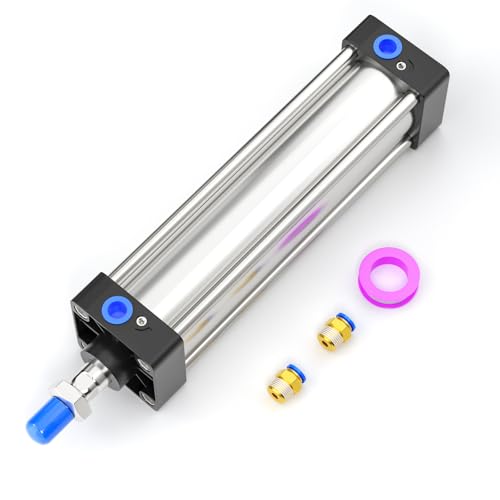

How To Choose The Best Air Operated Cylinder
Match bore size, stroke length, and port size to your air supply and project needs.
Match the bore to the force you need
Bore is the internal diameter of the cylinder tube, and it sets how much force you get at a given air pressure. A wider bore gives more pushing power for the same pressure. The 63mm bores on most of these picks deliver serious force; the 40mm bore unit is noticeably lighter and suited to smaller jobs.
Get the stroke length right
Stroke is how far the rod travels, and it must match the distance your application needs to move. A 50mm stroke moves a short distance, while a 200mm or 300mm stroke reaches much further. Measure the travel you need before buying, because swapping later means buying a whole new unit.
Check the port size before you plumb
Your air line connects to the cylinder through its port. A PT 3/8 port needs a larger air supply line than a PT1/4 port. The bigger port lets air flow faster, which cycles the cylinder quicker, but only if your compressor and tubing already match it.
Quick Comparison
| Model | Best For | Bore | Stroke | Port Size | Amazon |
|---|---|---|---|---|---|
| TAILONZ SC 63×200★ Best Overall | Industrial replacement | 63mm | 200mm | PT3/8 | Amazon |
| Heschen SC 63-125Best Value | Value with reach | 63mm | 125mm | PT 3/8 | Amazon |
| TAILONZ MAL40x50 | Compact projects | 40mm | 50mm | PT1/4 | Amazon |
| BAOMAIN SC63x200 | Can crusher builds | 2-1/2″ | 8″ | PT 3/8″ | Amazon |
| HNJPC SC63X300 | Longest reach | 63mm | 300mm | — | Amazon |
In‑Depth Reviews
1. TAILONZ SC 63×200 Cylinder
Our pick — over 4.5★ from 250+ verified ratings; the strongest balance of quality and price.
The long-stroke workhorse that replaces factory cylinders without a single modification.
This is the pick when you need reach and force together. The 63mm bore paired with a 200mm stroke gives you a long throw for pushing workpieces or driving a mechanism across a wide gap, and the PT3/8 port keeps air flowing fast enough to cycle it briskly.
It handles up to 1.0 MPa (145Psi) of max pressure, and the adjustable buffer cushions the rod at the end of travel so it does not slam into the caps. The aluminum body keeps the weight at 4.44 pounds while the threaded piston rod gives you a clean mounting point.
Buyers in industrial roles call it out as an exact replacement for a Norgren cylinder on a wide belt sander with no modifications needed — a 35-year tech’s verdict. The recurring note is that it runs two shifts flawlessly and holds a workpiece better than the original clamp. The one gripe is the clevis thread being oversized, so check your mounting hardware before you commit.
Why it wins
- Long 200mm stroke for wide travel
- Rated to 145Psi for strong push
- Adjustable buffer prevents harsh impact
What to check
- Clevis thread is unusually large
- Heavier than compact models
- Blue paint can peel at corners
Reach for it: if your job needs a long throw and factory-grade durability — this is the one buyers replace worn-out originals with.
Look elsewhere: if your mounting hardware uses small threads, since the clevis thread here is huge.
2. Heschen SC 63-125 Tie-Rod Cylinder
A self-lubricating 63mm bore that needs no manual oiling, ever.
What wins people over here is the design that removes maintenance from your to-do list. The specialized oil-bearing made from oily powder smelting copper means you never lubricate the piston rod by hand, and the hard-chromium plated steel rod with NBR seals keeps it leak-proof.
The 63mm bore with a 125mm stroke is a middle-distance throw, and the PT 3/8 port delivers fast cycling. It runs on a standard pressure range of 1.0-9.0 Bar (14.5-130 Psi) at 50-800 mm/s, and the adjustable buffer makes the rod settle smoothly instead of crashing at travel limits.
Buyers report this as excellent value against rivals costing well over twice as much, hitting a full 125mm stroke at 60 psig with zero leakage and stiff buffers. The straight trade-off is that at 60 psi with small tubing it slows near the travel limits — feed it enough air and it moves with authority.
Maintenance-free perks
- Self-lubricating bearing saves upkeep
- Hard-chromium rod resists wear
- Adjustable cushion for smooth stops
Keep in mind
- Slow near travel limits on small tubing
- Needs a mounting plate for install
Grab it if: you want a low-maintenance 63mm bore that outperforms far pricier options on the same air pressure.
skip it if: you need a longer reach than 125mm for your project.
3. BAOMAIN SC63x200 Pneumatic Cylinder
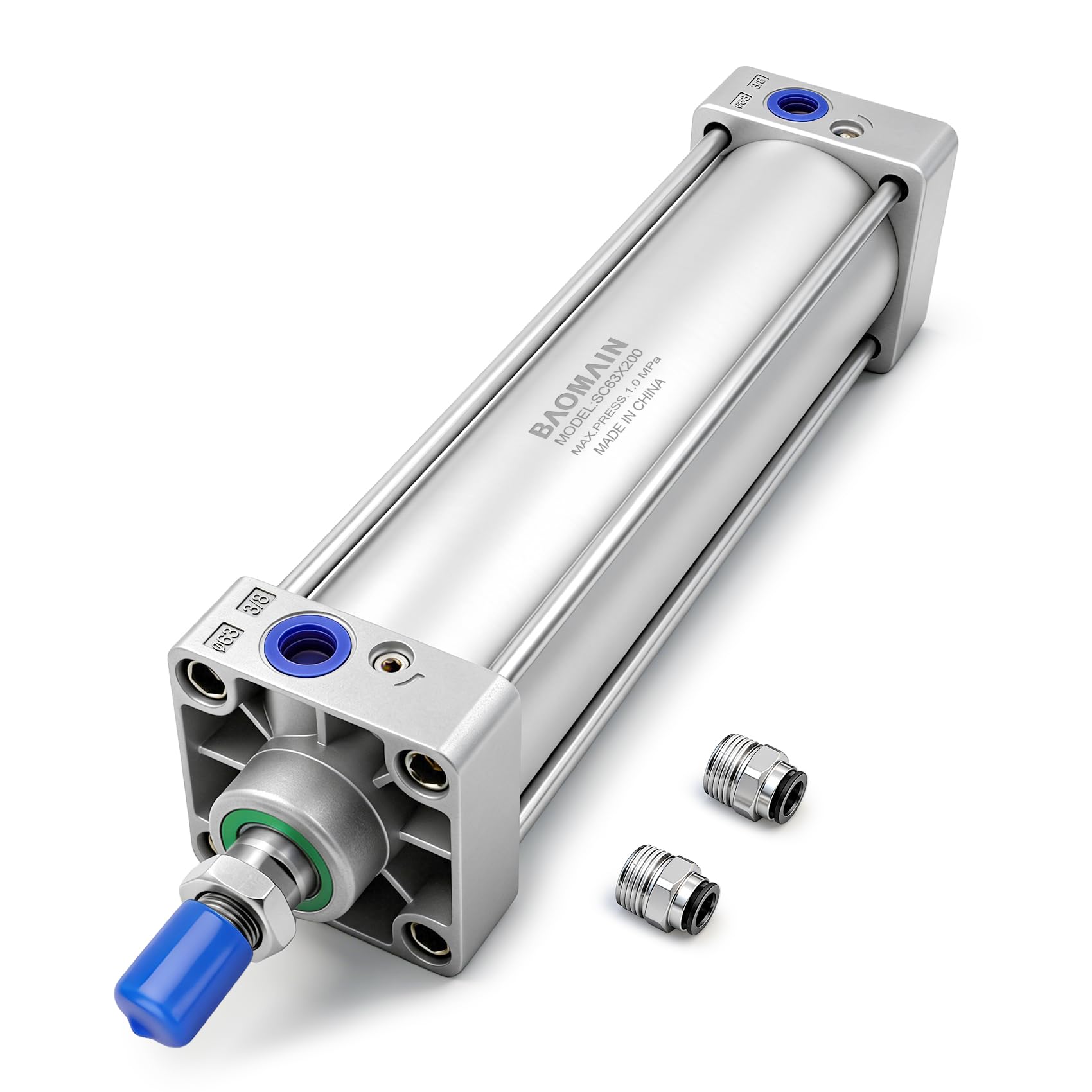
The factory-proven unit that crushes cans and satisfies seasoned pneumatic techs.
This is the favorite for DIY can crusher builds, and the owners doing that work know their pneumatics. The 2-1/2″ bore with an 8″ stroke delivers a serious slam, and the PT 3/8″ port gives it the air supply it needs to hit hard. It comes with 2 x push-in fittings for 8mm tubing, so hookup is fast.
The M16x1.5 threaded piston rod gives you a secure, standardized connection, and the integrated self-lubricating bearing means no maintenance once it is installed. The high-strength aluminum alloy body keeps it corrosion-resistant while staying at 4.6 pounds.
Owners mention this as outstanding quality straight from a factory-floor perspective, with one noting it ran several hours without issues and another crushing two five-gallon buckets of aluminum cans in about 10 minutes. Those same builders note you need 3/8″ quick-connect inserts and M8-1.25 x 30 screws unless you already have them — plan the hardware before it arrives.
Built to perform
- 8-inch stroke for big travel
- Self-lubricating bearing saves upkeep
- Includes push-in fittings for 8mm line
What you add
- Needs 3/8″ quick-connect inserts
- Mounting screws not included
Choose it for: a proven crusher or press project where you want factory-grade quality and a long 8-inch throw.
Think twice if: you want fittings and mounting hardware from the start — you will source those separately.
4. TAILONZ MAL40x50 Air Cylinder

The featherweight 1.74-pound cylinder for props, hobby rigs, and short travels.
At 1.74 pounds, this is the lightest unit in the lineup by a wide margin — the 63mm 200mm-stroke units run over 4.4 pounds, so this one is a 2.6x gap in carry weight. The 40mm bore with a 50mm stroke is built for short, quick movements rather than heavy pushing.
Quality is what owners praise most, and performance follows close behind. It runs smooth with a nice-size rod and good hardware, and is airtight from the start. Several customers note they ditched the included fittings and put their own speed control on for precise motion, which is the smart move if you need fine control.
The known catch is the fitting quality — reviewers point out the included fittings do not always match the cylinder, and an occasional shipment has missing parts. The port threads are non-standard rather than 1/8 NPT, though they seal fine with thread sealant and tape on the aluminum body. Durability is honestly mixed: some say it holds up, others report it breaking easily, so it suits light-duty use rather than constant industrial cycling.
Easy to live with
- Light 1.74-pound build
- Smooth, leak-free operation
- Nice-size rod and good hardware
Know before you buy
- Included fittings may not match
- Some units arrive with missing parts
Pick this if: you are building a prop, a small clamp, or a short-travel hobby rig and want something light and smooth.
Look past it if: you need heavy force or continuous shifts, since durability feedback is mixed.
5. HNJPC SC63X300 Pneumatic Cylinder

A 300mm stroke in a 63mm bore for pushes that need to travel far.
When your mechanism has to move a long distance, this is the one that reaches. The 63mm bore with a 300mm stroke gives a full 12 inches of travel, and it is rated to handle the full 0~145Psi (0~1MPa) pressure range, so you get the force of a wide bore plus the reach of the longest throw here.
Owners describe it as a well-made unit with a nicely finished exterior, cleanly cut air connection threads, and a nicely finished output shaft. It installed easily with no air leaks and delivers an impressive amount of force for its size — enough that one buyer replaced another old cylinder with a second of the same unit.
The aluminum alloy body keeps it solid at 5.6 pounds, and it runs in the 23-158℉ (-5-70℃) range, matching the other picks. It is a newer, less-reviewed option, so the value comes from the long stroke plus proven build quality rather than a huge owner base.
Long-throw strengths
- 300mm stroke reaches the farthest
- Handles full 145Psi pressure
- Clean threads with no air leaks
The caveat
- Newer model with fewer owner reports
- Heaviest pick at 5.6 pounds
Take it when: travel distance is the whole game — nothing else here reaches as far at the same pressure.
Leave it if: you prefer a model with a long track record and thousands of owner experiences behind it.
Understanding the Specs
Bore Size and Force
Bore is the diameter of the internal tube, and it is the main force controller. A larger bore gives more surface area for the air to push against, so you get more force at the same pressure. The 63mm bore units here deliver far more push than the 40mm model.
Stroke Length and Travel
Stroke is how far the piston rod extends, measured in millimeters. A 50mm stroke nudges a short distance; a 300mm stroke reaches a full foot. Measure the distance your project must move before buying, because you cannot lengthen a stroke after the fact.
FAQ
Will a 63mm bore cylinder fit my existing air compressor?
What is the difference between double acting and single acting cylinders?
How much force can a 63mm bore cylinder produce?
Can I use one of these cylinders for a can crusher?
What does the adjustable buffer do?
How do I know which stroke length I need?
Are the included fittings usable on every model?
Do these cylinders need any oil or maintenance?
Final Thoughts: The Verdict
For most people, the air operated cylinder winner is the TAILONZ SC 63×200 because it pairs a 200mm stroke with a 63mm bore and a proven industrial record as a drop-in replacement. If you want a maintenance-free 63mm bore with a mid-range 125mm throw, grab the Heschen SC 63-125. And for a long 300mm reach at full pressure, the HNJPC SC63X300 is the one to reach for.
How We Picked
We do not accept paid placement. Every pick is matched to a real buyer and a real use-case; we do not hands-on test units.
Sources & Methodology
Specifications: manufacturer listings and product documentation. Review insights: verified customer reviews, as of August 2026. Pricing: not shown on this page (it changes often); check the current price via the retailer link.
As an Amazon Associate, Gadgets Feed earns from qualifying purchases. This does not affect which products we feature.