
Our readers keep the lights on and my morning glass full of iced black tea. As an Amazon Associate, I earn from qualifying purchases.
Specs are compiled from manufacturer listings and verified buyer reviews and can change over time — please confirm the key details on the product page before buying.
You cannot see the 0.3-micron dust that slips past a window seal, but a particle counter can. It turns invisible air into a live number you can actually act on — before you buy a purifier, before you run a filter, and especially when wildfire season makes the sky look hazy. This guide sorts through the monitors that measure PM2.5, PM10, CO2, and formaldehyde, so you know exactly which readings you can trust.
I’m Min — the founder and writer behind Gadgets Feed. This guide is built by comparing the manufacturers’ published specifications and the patterns across verified customer reviews, so you get each pick’s real strengths and trade-offs instead of marketing spin.
Whether you are chasing cleaner sleep, tracking wildfire smoke, or checking a new build’s off-gassing, the air particle counter that fits your life depends on the sensors inside and the data they can export.
Our Picks at a Glance

How To Choose The Best Air Particle Counter
An air particle counter is only as useful as the numbers it reports. Before you buy, you need to know what each sensor measures, how the device samples air, and whether it can store trends over time — otherwise you are just watching a screen change colors.
Laser particle sensors versus gas sensors
Look for a laser or light-scattering sensor for dust and soot (PM1.0, PM2.5, PM10). These count physical particles as air passes through a beam. For gases like CO2 and formaldehyde, you need a different sensor type — often NDIR (a sensor that measures how much infrared light CO2 absorbs) or an electrochemical cell. One device can carry both, but a cheap counter that only does one will miss half the story.
The micron number that matters most
Check the smallest particle size the device can see. A spec like “0.3 μm” (micrometers — a millionth of a meter) tells you it can catch the ultrafine particles that travel deepest into your lungs. Counters that only measure PM2.5 and above miss those tiny particles entirely, which matters most after a wildfire or near heavy traffic.
Battery and data export shape daily use
Decide if you want a portable spot-checker or a wall-powered sentinel. A handheld unit with a multi-hour battery lets you walk from the bedroom to the basement and compare. A unit that logs data to a memory card or CSV file helps you see patterns over days or weeks — useful for proving a purifier works or for timing filter changes.
Quick Comparison
| Model | Best For | Particle Sizes | Display | Data Export | Amazon |
|---|---|---|---|---|---|
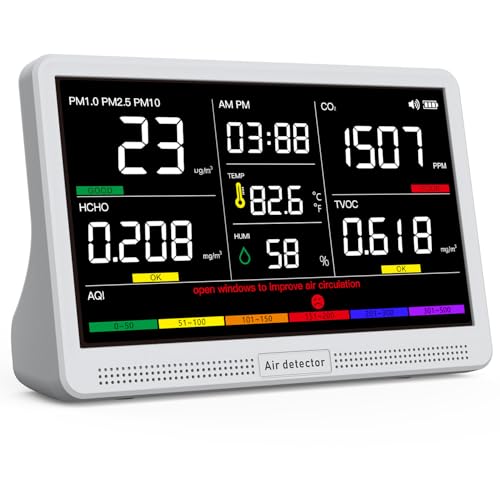
| YNAK 16-in-1★ Best Overall | Whole-family visibility | PM1.0 / PM2.5 / PM10 | 7-inch | App streaming | Amazon |
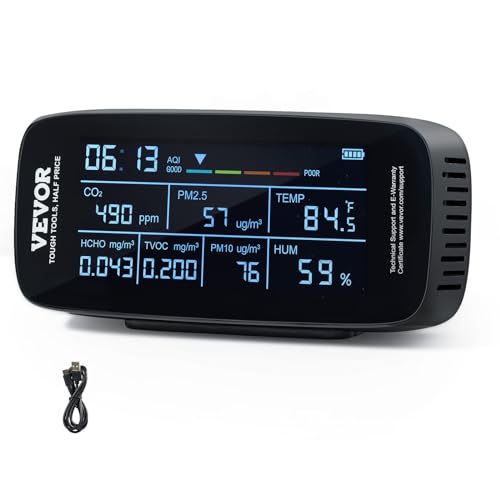
| VEVOR 9-in-1Best Portable | Indoor & outdoor portable checks | PM1.0 / PM2.5 / PM10 | 5.7-inch | — | Amazon |
| EG EGVOCBest Value | Formaldehyde & VOC detection | PM2.5 | 2.8-inch | — | Amazon |
| BREATHE Airmonitor Plus | App-driven home monitoring | PM1 / PM2.5 / PM10 | Compact LCD | App with 30-day history | Amazon |
| Temtop LKC-1000S+ | Desktop accuracy with history | PM2.5 / PM10 | 6.97-inch body | CSV / Excel export | Amazon |
| WapoRich T7-TC8100 | Industrial spot checks | PM0.3 / PM2.5 / PM10 | 3.2-inch TFT | 999-set records | Amazon |
| PerfectPrime AQ9600 | Clean-room & flow-hood checks | PM0.3 / PM2.5 / PM10 | Digital readout | — | Amazon |
| BLATN Smart 128s | Deep 6-channel particle logging | PM0.3 to PM10 (6 channels) | Handheld LCD | TF card up to 8G | Amazon |
| Dylos DC1100 Pro | Real-time particulate trending | PM2.5 (two bins) | Simple LED | Memory for Excel | Amazon |
In‑Depth Reviews
1. YNAK 16-in-1 Air Quality Monitor
Our pick — over 4★ from 350+ verified ratings; the strongest balance of quality and price.
The whole-house sentinel with a giant 7-inch screen that makes air quality instantly legible.
The 7-inch LED display shows all nine parameters at once, so you never dig through menus. Three brightness settings mean it works in a dim bedroom or a bright kitchen. The external high-precision sensors claim 0.001-unit accuracy, and a multi-sensor array with enhanced airflow is meant to catch even tiny shifts in your air.
Owners say the display reads clearly enough for everyone in the house to check at a glance, and it doubles as a clock. The device reacts fast to cooking, candles, and open windows — one owner saw the reading drop when a window was opened and spike when the stove was on. Multiple buyers report using it for months in wildfire season, and it caught the dog-dander load that a guest might not have noticed.
The monitor has also gotten praise for being light and compact, so it doesn’t dominate a shelf despite that big screen. It runs on wall power with a D battery backup, so it keeps logging even in a power blip. The 16-in-1 count combines 9 measured parameters with 7 AQI alert buzzers, all muteable with one press.
Why it wins
- 9 parameters read simultaneously on a crisp 7-inch display
- 0.001 accuracy from external high-precision sensors
- 7 AQI alerts with a mute button for peace and quiet
- Compact size that fits a shelf without dominating it
Watch outs
- Sensors need protection from perfumes and strong odors for accuracy
- Some owners note a slight reliability mixed impression over long use
Reach for this if: you want one big, obvious screen that the whole family can read without an app.
Look elsewhere if: you need a pocket-sized unit for walking around multiple rooms.
2. VEVOR Air Quality Monitor 9-in-1
A 9-in-1 portable that pairs a 9-hour battery with a multi-color health index.
The VEVOR is built for movement. A 3000mAh rechargeable battery gives it up to 9 hours of continuous use, so you can carry it from a wood-stove living room to a bedroom and keep measuring. The 5.7-inch HD display shows every value, the time, and the battery level at once — you never have to switch screens to see the full picture.
It resamples every 1.5 seconds and sounds an audible alarm when CO2 crosses 1000 PPM. The sensor setup is serious: semiconductor sensors for gases, laser scattering for particles, and an infrared NDIR sensor for CO2. One owner used it with a soapstone wood stove and saw particulate readings that behaved exactly as expected — around 3 PPM with the door closed, climbing to 5-7 PPM while loading wood. Another owner tracks daily formaldehyde changes and opens a window when HCHO crosses 0.050.
At 12.6 ounces it is roughly 19% heavier than the 10.56-ounce YNAK above, so it feels a bit more solid in hand. The single-button temperature toggle and backlight make it easy to use in low light. It covers CO2, AQI, PM1.0, PM2.5, PM10, TVOC, HCHO, humidity, and temperature — a complete toolkit in a portable shell.
What stands out
- 9-hour battery life on a 3000mAh cell for all-day portability
- 1.5-second resample rate for fast, live feedback
- NDIR infrared sensor for trustworthy CO2 readings
- Single-button temperature unit toggle
The honest catch
- Some units arrived with a loose battery rolling inside the case
- A few owners mention an alarm that triggers constantly even after calibration
Pick this when: you need a battery-powered counter that roams between indoor and outdoor spots.
Think again if: you want a plug-in unit that never needs charging.
3. EG Air Quality Monitor
The budget pick that hones in on formaldehyde and the VOCs that cause most odors.
This is a focused tool for one narrow job: finding the chemical off-gassing that a plain dust counter ignores. It measures formaldehyde (HCHO), total volatile organic compounds (TVOC), and PM2.5 dust — the particles smaller than 2.5 microns that reach deep into your lungs. A built-in fan pulls air across a laser sensor for particles and an electrochemical semiconductor sensor for the gases.
The 2200mAh battery lasts up to 2 days away from a DC 5V micro USB charger, and the 2.8-inch color LCD stays readable anywhere. One owner took it into a cabinet store and got a red alarm from the finish’s off-gassing, then was relieved to find the smell of mahogany furniture measured fine. Another used it for years in a truck and confirmed clean, low-dust readings in a child’s room.
The trade-offs are real. Several customers note heavy battery drain — some say roughly two uses per charge — and the unit needs 5 to 10 minutes to stabilize when you first turn it on. The screen shuts off during that stabilization, so you wait a few minutes before trusting the numbers. The recurring note is to calibrate it by running it in fresh outdoor air for 20 to 30 minutes first, and not to overreact to alarms that are not expressed in PPM.
Smart budget pick: this is the entry point for homeowners worried about new furniture and flooring off-gassing, not for fanatical dust tracking.
Known limit: the battery is soldered in and a couple of owners found it stops holding a charge after a few years — it still works plugged in.
4. BREATHE Airmonitor Plus
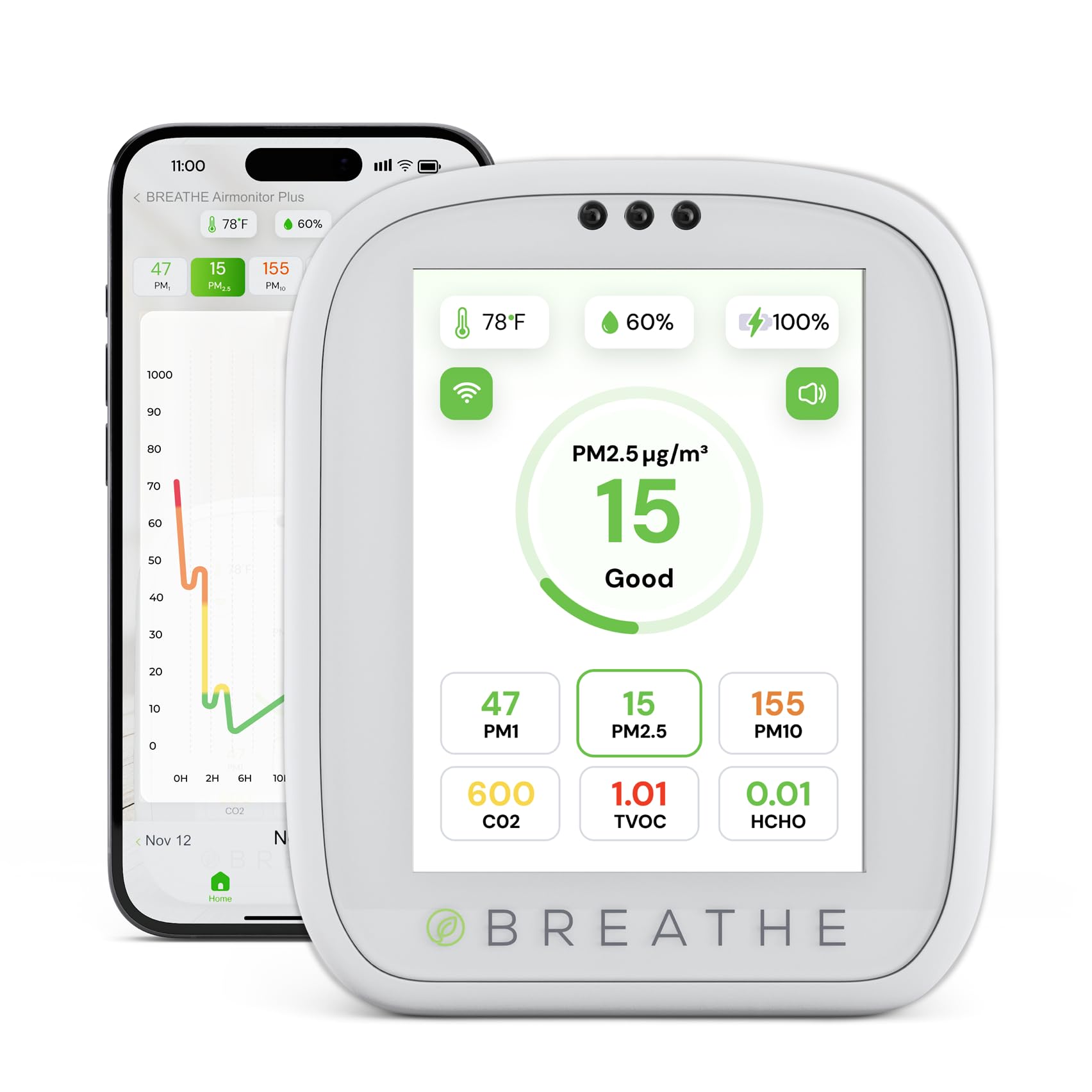
The compact app-connected monitor that catches CO2 spikes your nose cannot smell.
If you want trends, not just a live number, this is the one. The free Breathe Tech app gives you remote monitoring, instant alerts, and a 30-day data history so you can see how your air changes through the week. It connects in under 30 seconds and pairs with a compact 4-ounce body that measures PM1, PM2.5, PM10, TVOC, formaldehyde, temperature, and humidity — plus CO2 via a professional-grade NDIR sensor.
Reviewers point out it caught a bedroom sitting at high nighttime CO2 — opening the door improved sleep — and flagged dry air that was causing sore throats. An office user watched CO2 climb to 4,500 ppm in a poorly ventilated room, drop to 405 ppm with windows open, then rise again when they closed. It also detects conditions that promote mold by tracking humidity and particulates together.
The honest criticisms: battery life is short — measured in hours, not days — so treat this as a corded device. Some shoppers say Wi-Fi pairing that fights back; the common fix is draining the battery, then holding the power button for 10 seconds while plugging it in. A few report the automatic CO2 recalibration can drift readings downward over a day or two, so a manual outdoor recalibration every so often keeps it honest.
Why owners like it
- 30-day data history in the app for spotting trends
- Detects CO2, PM, TVOC, and formaldehyde in one compact unit
- 2-year manufacturer warranty for confidence
- Responds quickly to cooking, ventilation, and occupancy changes
The rough edges
- Battery life is the main complaint — keep it plugged in
- Wi-Fi setup can be finicky on the first try
This one fits: the tech-comfortable owner who wants graphs and remote alerts, not just a glowing screen.
Not for you if: you refuse to deal with app pairing — this wants the phone connection to shine.
5. Temtop LKC-1000S+
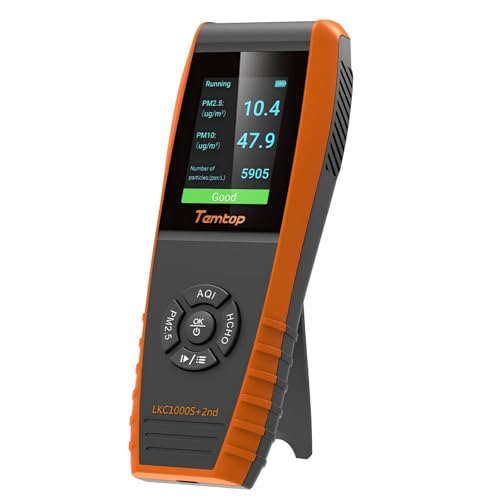
The long-haul logger built to survive 20,000 hours of laser particle counting.
This mid-range unit is for the person who keeps records. Its laser particle sensor is rated for up to 20,000 hours of use, and the device records up to 3 months of continuous data that exports to a basic Excel spreadsheet. The histogram function shows the last 12 hours of PM2.5 changes on screen, so you see a spike from cooking or a drop from a purifier without opening a laptop.
It measures PM2.5, PM10, formaldehyde, VOCs, humidity, temperature, and AQI. The pre-calibrated Dart electrochemical sensors are chosen for solid civilian-grade performance — and the maker is honest that alcohol, air fresheners, and cleaning products can influence the formaldehyde reading, so you should avoid those during a measurement. Owners use it to detect formaldehyde coming off new furniture and flooring, and one recommends it specifically for people with chemical sensitivities.
The 14.4-ounce body is a bit heavy for a pocket, so it reads as a desktop unit. Battery life gets “long enough” reviews but the recurring note is that it could be longer. One owner hit the 22-month mark and saw PM readings drift 1.5 to 2 times too high versus a PurpleAir reference — a reminder that a consumer-grade sensor’s accuracy drifts over time. The 12-month Temtop warranty and 24/7 support are genuinely useful if that happens to you.
Built for record-keepers: the 3-month logging and Excel export make it the best value for anyone tracking trends, not just glancing at a number.
The drift reality: after roughly two years of light use, a sensor can skew high — budget for that as a maintenance cost, not a flaw.
6. WapoRich T7-TC8100
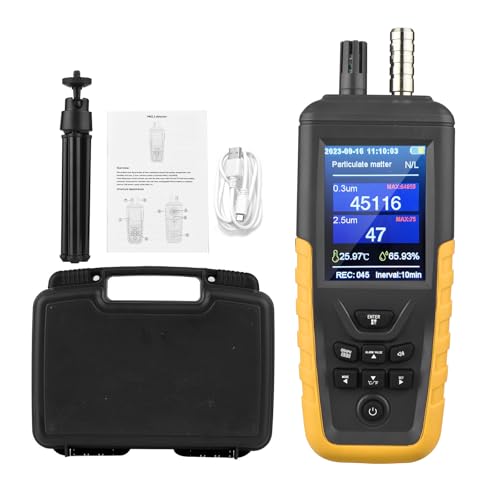
A 3-channel industrial counter that counts, stores, and mounts — built for the workshop floor.
This one drops the home-friendly screen for industrial precision. It counts three particle channels — PM0.3, PM2.5, and PM10 micrometers — with a PM2.5 range of 0 to 1000 μg/m³ and an accuracy of ±12 μg/m³. It also tracks temperature from -10 to 60°C and humidity from 0 to 100% RH, making it a full environmental monitor for a lab bench.
The 2000mAh battery delivers 9 hours per charge, with on-board storage for up to 999 data records. A 3.2-inch TFT full-color display shows curves in real time. The tripod mounting holes on the back are a big deal for industrial use — you can bolt it to a stand and let it run continuously while you work, freeing both hands for the actual task.
Owners using it in a demo setting say it helped keep venting and particle levels down as work happened in real time. The temperature spec stretches down to -10°C, so it can go into a cold workshop or utility space without complaint. It clearly targets electronics, optics, chemical industry, food and medicine, and filter-seal testing rather than the living room.
Meant for the shop: tripod mounts, 999-record storage, and a wide temperature range put it ahead of home units in a production or testing setting.
Fair warning: a few buyers report the temperature readout and PDF export are not as polished as the particle counting itself.
7. PerfectPrime AQ9600

The bare-bones lab tool for verifying a flow hood or clean bench is truly clean.
This is a specialist tool. It counts particles at 0.3 μm, 2.5 μm, and 10.0 μm — all in Piece/L units — using semiconductor lasers. Accuracy is tight at ±3% of reading plus ±5 digits, a spec serious users demand for certification. Alarm levels follow FED209E (1 to 100,000) and ISO14464-1 (2 to 9) standards.
The killer feature for lab work is the custom sampling timer: you can set it from 1 second up to 59 minutes 59 seconds, and run it 1 to 99 times or continuously. Owners use it to verify sterile air in flow hoods — one saw a baseline room reading of 30,000 particles per liter at 0.3 μm drop to 0 inside the hood. Another found it more accurate than a pricier rival for their purposes.
The honest limits: it runs on a 9V DC battery that is not included, and it has no gas sensors — this is pure dust counting, no CO2 or formaldehyde. A few owners mention the fan stopping mid-sample if the unit is disturbed, and one saw all-zero readings after a couple of uses. The lack of a built-in rechargeable battery means you should budget for the power source from day one.
The right call for: anyone validating clean benches, flow hoods, or filter performance where ±3% accuracy matters more than convenience.
skip it if: you want a home gadget that also checks CO2 and formaldehyde — this is a one-job instrument.
8. BLATN Smart 128s

A 6-channel particle logger with an 8G memory card for the data hoarder.
This handheld pushes particle detail further than almost anything else here. Its laser sensor detects six size channels — PM0.3, PM0.5, PM1.0, PM2.5, PM5.0, and PM10 — in particle count per liter, plus three mass channels in micrograms per cubic meter for PM1.0, PM2.5, and PM10. That granularity shows you not just how much dust is in the air, but exactly which size range is spiking.
The data logging is the headline. It logs all 12 testing items with date/time stamps every minute, expanding up to 8G via TF card for 400 days of records. An NDIR CO2 sensor with self-calibration and an electrochemical HCHO sensor round out the package, plus a semiconductor TVOC meter that catches benzene, toluene, and xylene. The 2200mAh battery runs the show, and a silent fan keeps the sampling from being annoying.
A long-term asthma user ran this 24/7 via USB and found the particle count tracked accurately against a HEPA filter’s effectiveness. The VOC sensor caught smells reliably, and the unit needed about an hour to stabilize after power-on. The honest notes: the battery is short-lived and — in a couple of units — the internal battery died entirely with no way to recharge or replace it, leaving the device dead unless kept plugged in. One owner tested it against three calibrated meters and found CO2 reading more than 300 ppm high, so take the numbers as directional, not clinical.
The deep-data advantage
- 6-channel particle size detection shows which dust is spiking
- 400 days of records on an 8G TF card
- NDIR CO2 plus electrochemical HCHO sensors for gas coverage
- Silent fan for unobtrusive 24/7 monitoring
The real trade-offs
- Battery life is genuinely short — plan to keep it plugged in
- A mixed record on accuracy; some units read CO2 significantly high
- Internal battery can die permanently in some units
Choose it for: the deepest particle-size breakdown and long-term logging in a portable shell.
Think twice if: you expect lab-grade CO2 accuracy or plan to run it mostly on battery.
9. Dylos DC1100 Pro
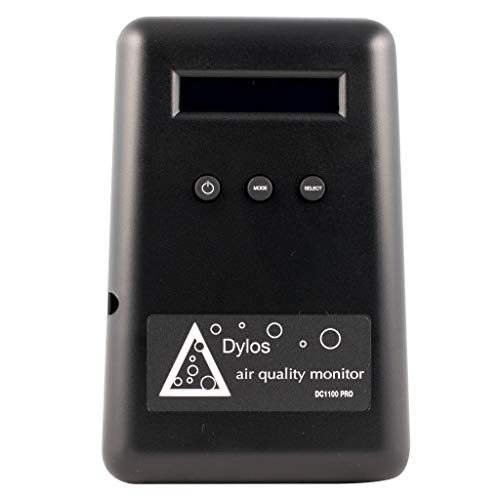
The plug-in veteran that has validated HEPA purifiers for allergy sufferers since 2003.
The Dylos does one job—counting particles—with no app or Wi-Fi chip. It is a real particle counter that reads PM2.5 in two size bins, and the memory feature lets you generate an Excel trend graph over time. The whole thing is built around reliability — the maker states it is only for use with 120V, so it is a stationary sentinel, not a roaming gadget.
Asthma sufferers have leaned on this for years. One owner confirmed their IQAir purifier’s effectiveness with hard numbers: a home baseline of 160,000 particles per cubic foot, 260,000 outside, and a bedroom that dropped to 30,000. That data even matched a professional scanner. Another uses it to time filter replacement based on actual readings instead of the indicator light on a purifier, and validates a MERV 12 AC filter the same way.
The honest limits are real. It cannot tell cooking smoke from road dust, it has no VOC or CO2 sensors, and it requires a cable — no battery, no portability. One owner’s internal fan failed after 18 months of use, and a repair cost around plus shipping. The reading is raw particle count, not an AQI number, so you have to make sense of the units yourself. But for someone who wants one tough, accurate, and simple particulate counter for the home, the track record is hard to argue with.
The reliability pick: decades of owner reports confirm this is the affordable real-particle counter that allergy and asthma households trust.
Know before you buy: 120V-only, cabled, no gas sensors — bring your own interpretation.
Understanding the Specs
Particle Size Channels (PM0.3, PM2.5, PM10)
These numbers tell you the smallest particle the counter can see, in micrometers (a millionth of a meter). A device that reads PM0.3 catches the ultrafine particles that slip deepest into your lungs. A counter that only sees PM2.5 and up still helps, but it misses the smallest and most dangerous fraction — something to weigh when wildfire smoke or heavy traffic is your concern.
Sensor Types: Laser, NDIR, and Electrochemical
Laser sensors count physical dust by scattering light off particles as air passes through. NDIR sensors measure CO2 by seeing how much infrared light the gas absorbs. Electrochemical sensors detect gases like formaldehyde by chemical reaction. A full air particle counter often carries two or three of these at once — so check the spec list rather than assuming one sensor covers everything.
Data Logging and Export
A live number is useful, but a trend is powerful. Devices that record to a memory card, app, or CSV file let you see whether a purifier actually works, when CO2 spikes at night, or when pollen surges at dawn. Look for how long the device can store history — from a 12-hour on-screen histogram up to 400 days on an expandable card — and how hard it is to pull that data off.
Battery Life and Power Source
Decide whether this is a portable spot-checker or a wall-powered sentinel. Portable units with a 2000 to 3000 mAh battery give you 9 hours of roaming checks. Corded units never run out but tie you to an outlet, and a few 120V-only models (like the Dylos) will not work abroad. Match the power source to where you actually plan to measure.
FAQ
What is the difference between an air particle counter and a CO2 monitor?
Can an air particle counter detect wildfire smoke?
What does the PM2.5 number actually mean?
How do I calibrate an air particle counter?
Why does my counter give different readings from another brand?
Is a higher micron channel count better?
Do I need a unit that measures formaldehyde and TVOC?
How long does an air particle counter last?
Can I use a particle counter to test if my air purifier works?
Final Thoughts: The Verdict
You want to know which air particle counter is worth buying, and the answer depends on how you like to see your air. For most families, the YNAK 16-in-1 wins because its 7-inch display shows nine live readings at once, no app needed, and its sensor reads down to 0.001 units (a tiny fraction of a micron, so you catch fine dust early) — buyers rate it 4.3 stars across 300+ reviews. If you prefer tracking trends on your phone and getting remote alerts, choose the BREATHE Airmonitor Plus. And if you want a rugged, no-app counter that allergy households have relied on for years, the Dylos DC1100 Pro is your pick.
How We Picked
We do not accept paid placement. Every pick is matched to a real buyer and a real use-case; we do not hands-on test units.
Sources & Methodology
Specifications: manufacturer listings and product documentation. Review insights: verified customer reviews, as of August 2026. Pricing: not shown on this page (it changes often); check the current price via the retailer link.
As an Amazon Associate, Gadgets Feed earns from qualifying purchases. This does not affect which products we feature.