
Our readers keep the lights on and my morning glass full of iced black tea. As an Amazon Associate, I earn from qualifying purchases.
Specs are compiled from manufacturer listings and verified buyer reviews and can change over time — please confirm the key details on the product page before buying.
Most air-powered tools fail because of a mismatch: a high-speed die grinder used like a lug-nut breaker, or a torque monster spinning too slow for a cut-off wheel. The real question isn’t which unit is biggest — it’s which rotating speed and power profile fits the job you repeat daily.
I’m Min — the founder and writer behind Gadgets Feed. This guide is built by comparing the manufacturers’ published specifications and the patterns across verified customer reviews, so you get each pick’s real strengths and trade-offs instead of marketing spin.
From die grinders to drum mixers, here is the shortlist that balances speed, torque, and durability. The air pneumatic motor you choose should match the fastener size and material you actually cut, drill, or stir every shift.
Our Picks at a Glance


How To Choose The Best Air Pneumatic Motor
Before you pick, know this: every tool here is a complete air motor in a housing, but each is tuned for a different job. The first decision is speed versus torque — a 24,000 RPM grinder and a 400 RPM drill share almost nothing in real use, even though both are pneumatic motors (air-powered motors that run on compressed air).
Speed First, Then Watch the Power
Free speed, measured in RPM, tells you how fast the business end spins with no load. High RPM suits grinding, polishing, and cutting thin metal. Low RPM with high horsepower suits drilling steel and driving big fasteners. Pick your material first, then find the matching speed range.
Read the Air Demand, Not Just the Price
An air tool is only as strong as the compressor behind it — airflow is measured in CFM (cubic feet per minute) and pressure in PSI. Most units here need about 90 PSI, but a hungry impact wrench can drain a small tank in seconds, so check your compressor’s output before you commit.
Quick Comparison
| Model | Best For | Max Speed | Power | Weight | Amazon |
|---|---|---|---|---|---|
| Chicago Pneumatic CP860★ Best Overall | High-speed grinding | 24,000 RPM | 0.54 HP | 1.26 lb | Amazon |
| Rockwood Air DrillBest Value | Tight-space drilling | 1,500 RPM | 750 W | 2.5 lb | Amazon |
| AIRCAT 6350 Air Saw | Low-vibration cutting | 9,500 SPM | — | 1.13 lb | Amazon |
| AIRCAT 4450 Drill | Quiet high-torque drilling | 400 RPM | 0.60 HP | 3 lb | Amazon |
| Ingersoll Rand 7803RA | Industrial daily drilling | 500 RPM | 0.50 HP | 3.2 lb | Amazon |
| Airboss AW-172P Wrench | Heavy truck lug nuts | 6,600 RPM | — | 7.1 lb | Amazon |
| COSMOSTAR Agitator | Mixing drums & paint | 2,500 RPM | 1/8 HP | 8.8 lb | Amazon |
In-Depth Reviews
1. Chicago Pneumatic CP860 Air Die Grinder
Our pick — over 4.5★ from 150+ verified ratings; the strongest balance of quality and price.
A 24,000 RPM straight grinder that turns porting and polishing into smooth, reliable work.
This die grinder leads the list because it pairs a 0.54 HP motor with a 24,000 RPM ceiling — a combination built for heavy grinding and polishing without bogging down. The 1/4-inch collet chuck holds burrs and stones firmly, so the tool keeps cutting instead of slipping mid-task. Its 5.8-inch length and 1.26-pound weight let you work one-handed in tight engine bays and moldings for extended periods.
The square handle gives a positive grip, and the rear exhaust blows air away from your face and the work surface. A lock-off throttle stops accidental startups, which matters when you are reaching into awkward spaces. You will need 90 PSI of air pressure to run it at full power, so a standard shop compressor handles it without strain.
Reviewers report a genuine split: one owner’s unit has stayed strong for six years while cheaper tools were discarded. The build quality is the thing everyone raves about — owners describe a solid feel that cheaper grinders lack, and several note it outlasts more expensive rivals.
Built for Real Shifts
- Verified 24,000 RPM top speed keeps grinding fast
- Aluminum alloy body handles daily abuse
- Rear exhaust keeps the work area clear
What to Know
- Smaller 1/4-inch collet limits bits to 6 mm
- Needs a steady 90 PSI supply to shine
The crowd’s pick: For a shop tool that survives years of regular use, this is the one owners trust.
Think twice if: You only need a one-time grinding job — a cheaper unit may suffice.
2. Rockwood 3/8 Inch High Torque Air Drill
A right-angle air drill built to squeeze into tight spots and still deliver real torque.
This Rockwood drill earns its spot as a budget-friendly workhorse with a high-torque, 5-vane ball bearing air motor. It spins at 1,500 RPM free speed, which is slower than a grinder but perfectly matched for drilling through wood and lighter metal. The 750-watt maximum power rating gives it enough grunt to push a 3/8-inch bit through tough spots without stalling.
The right-angle head is the standout feature — it is designed explicitly for tight places where a straight drill simply cannot fit. A positive-locking forward/reverse control lets you switch direction confidently mid-task. The hardened bevel and planetary gears are built for years of service, which explains why owners describe it as “handy for use in tight places” and report it works great right from the start.
At 2.5 pounds, it is noticeably heavier than the AIRCAT saw above but that mass translates into stability under load. One owner noted delivery arrived faster than scheduled and the tool “worked great for the job I needed it for” — a recurring theme of satisfaction for the price.
Torque you can feel: The 5-vane motor and planetary gears deliver punchy drilling in a compact right-angle body.
The trade-off: Variable speed is controlled by your trigger finger, so smooth starts take a little practice.
Reach for this if: You need a tight-space drill for occasional to regular work at a friendly price.
Look elsewhere if: You demand the highest RPM for heavy production drilling — this prioritizes torque over speed.
3. AIRCAT 6350 Low Vibration Air Saw

An air saw that cuts sheet metal smoothly with hand-friendly vibration control.
Your hands will thank you with this reciprocating saw: its internal damping system cuts vibration to 2.5 m/sec² (a measure of how much shaking you feel), so long cuts tire you less. The 9,500 strokes per minute motor slices through sheet metal fast, and buyers report it “never jammed cutting 1/8 inch aluminum.” At just 1.13 pounds, it is the lightest here, making it easy to guide along complex curves.
The 360-degree rotational exhaust muffler is a thoughtful touch — you can direct spent air away from your face and the work zone. It ships with 18, 24, and 32-tooth power saw blades, so you can match the blade to the material immediately. The short overall length gives you good access in tight body panels and cramped engine compartments.
Reviewers consistently praise the noise level as reasonable, the vibration as low, and the cutting performance as smooth. One owner compared it to budget saws and noted it “cuts like a hot knife through butter” without requiring a ton of air — a strong hint that your standard compressor will handle it.
Hand-saver: At 2.5 m/sec² vibration and 1.13 lb, this saw keeps your hands fresh through a full panel.
The catch: It is a cutting tool, not a drilling one — match the blade to your material for best results.
Best suited to: Auto body repair and sheet metal work where control and comfort matter most.
Who should pass: Anyone needing a grinder’s rotary action — this reciprocates, it does not spin.
4. AIRCAT 4450 1/2″ Reversible Drill

A reversible drill that stays whisper-quiet while delivering serious low-end torque.
This drill takes a different path than the Rockwood — it trades speed for sheer twisting force. Its 0.60 HP motor spins at just 400 RPM, which is 1,100 RPM slower than the Rockwood but delivers noticeably more torque for power tapping and chamfering. The superior-grade steel planetary gear is built for a longer life under that strain. It handles 3/4-inch steel and hole saws with ease, according to owners.
This drill stands out for its patented quiet-tuned exhaust, which lowers noise to 85 dBA (a decibel scale that measures sound pressure) — buyers consistently call it “quiet” and “super quiet” in everyday use. The patented drill grip keeps your hand comfortable during long jobs. It is reversible with a keyed chuck (a chuck that tightens with a key), so you get added torque and can back out stuck bits. One owner even uses it on commercial aircraft, proof of its torque and low weight.
The honest trade-off shows up in the feedback: several owners note it is really slow, which is the inevitable flip side of high torque at 400 RPM — and durability gets mixed reviews, with some reporting the keyway (the slot that holds the chuck in place) breaking under load. For heavy drilling where speed is secondary, this is a strong mid-range choice.
Quiet and strong: 85 dBA noise and 0.60 HP make it a favorite for torque-heavy jobs.
Where it struggles: Speed is genuinely limited — treat it as a torque tool, not a fast one.
Reach for this if: You value quiet operation and raw torque for tapping, chamfering, and steel work.
Look elsewhere if: You need quick drilling speed — consider the Rockwood or Ingersoll Rand instead.
5. Ingersoll Rand 7803RA 1/2″ Reversible Drill

A legendary pistol-grip drill that thrives on daily industrial abuse and high torque.
This Ingersoll Rand drill is the premium pick for professionals who need a tool that survives a hard life. Its 0.50 HP motor delivers 500 RPM — slower than some competitors but packed with torque, earning it the nickname “the wrist sprainer” from a daily user. The aluminum housing and ball and needle bearings are built for long-lasting reliability in harsh conditions. Planetary gear reduction balances the load to protect the motor internals.
The feather trigger gives you variable speed control, letting you ease into a hole or power through it. The quick reverse lever adds efficiency when you are backing out a stuck bit. It is a traditional pistol shape, which feels natural for extended use, and it is versatile enough for drilling, sawing, valve guide reaming, cylinder honing, and wire brushing.
Where the AIRCAT 4450 falls short on durability, this unit shines — reviews from full-time truck mechanics describe it as a “proven performer” that handles daily use on Class 8 trucks and trailers without problems. The prevailing wisdom is that Ingersoll Rand tools last, and this drill’s quality backs that up. At 3.2 pounds, it is the heaviest drill here, but that weight signals the rugged construction inside.
Built to Outlast
- Aluminum housing survives weather and drops
- Variable speed feather trigger for control
- Proven in daily fleet maintenance work
Know the Limits
- 500 RPM is slow for high-speed drilling
- Torque can twist the tool from your hands
The professional’s choice: For daily industrial use where durability trumps speed, this is the tool to reach for.
Who should pass: Hobbyists who only drill occasionally may find the premium price hard to justify.
6. Airboss AW-172P 3/4″ Air Impact Wrench
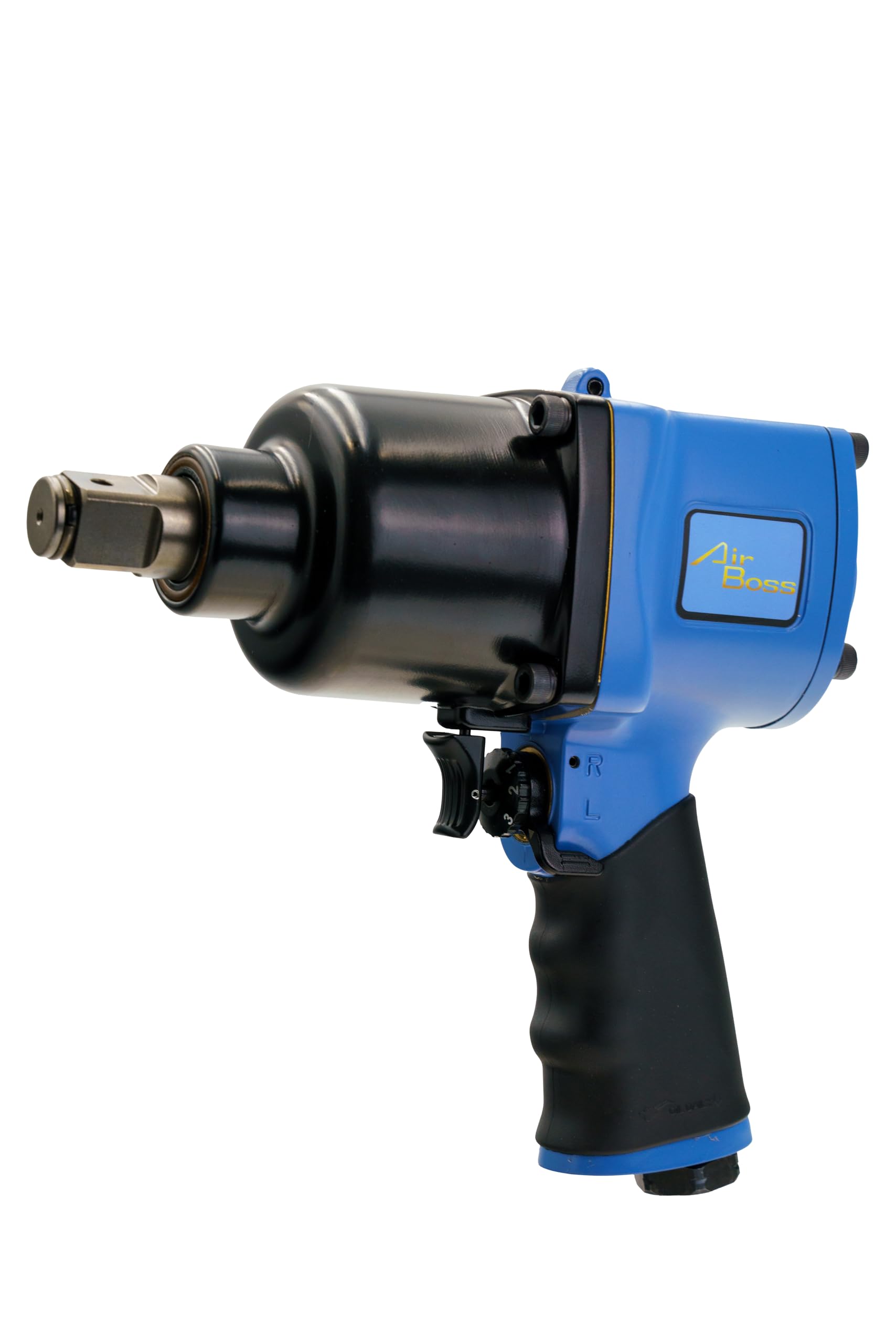
A 2,000 ft-lb impact wrench that snaps off rusted truck lugs without snapping your back.
This is the torque king of the list, delivering a massive 2,000 ft-lbs of max torque at a 6,600 RPM free speed. It is the tool you grab when a 1/2-inch impact simply cannot move a seized suspension bolt or trailer hardware. The magnesium alloy housing keeps the weight at a manageable 7.1 pounds, which owners describe as “lightweight” for a tool this powerful. One owner notes it removes rusted tractor lug bolts (5/8-inch fine thread) that 1/2-inch impacts can’t touch, working reliably at 80 PSI through a 100-foot hose.
This impact wrench is built for daily shop and truck work: the AIRBOSS steel motor and Twin Hammer mechanism (a dual-hammer impact system) deliver stable torque over long duty cycles. A rubber over-molded grip cushions vibration and gives you a secure, non-slip hold during repeated lug nut and brake jobs. The 3/4-inch drive format is the balance between shop and truck tools — more power than a 1/2-inch, without the bulk of a 1-inch unit.
Owners are near-unanimous in praise, calling it “professional-grade” and noting it removes rusted nuts easily. The recurring practical note is that it needs a high-flow compressor and does not include air fittings, so budget for those separately. Daily oiling is also recommended to keep the motor happy.
Serious Muscle
- 2,000 ft-lbs removes the most stubborn fasteners
- Magnesium body keeps weight manageable at 7.1 lb
- Steel motor built for daily duty cycles
Plan Ahead
- Air fittings not included — buy separately
- Demands a high-flow compressor to perform
- Requires regular oiling for longevity
Reach for this if: You work on trucks, fleets, or farm equipment with heavy seized fasteners.
Look elsewhere if: Your compressor is small or you only do light automotive work — this needs serious air.
7. COSMOSTAR 55 Gallon Pneumatic Agitator

A bung-mount air motor that stirs drums of paint and chemicals without a single spark.
This agitator is a different breed of air motor — it does not spin a cutting tool but instead turns a 200L stainless steel shaft with a 6-inch expandable propeller to mix liquids. Its three-piston air motor delivers a maximum torque of 1.3 N/m at up to 2,500 RPM, which is plenty for stirring ink, paint, and various liquid mixes. The 1/8 HP rating is modest, but the application is mixing, not cutting, so the torque profile fits its job perfectly.
The bung-mount design clamps directly onto a drum opening, making it compact and portable. A key advantage of pneumatic power here is safety — it runs cool, is non-electrical, and can operate in atmospheres up to 120°C, which is why it suits the paint, printing, chemical, and food industries. The speed is easy to control, giving you adjustable mixing intensity to reach a desired consistency.
Owners praise the quality and performance, with one noting the pneumatic operation is reliable and another highlighting it handles heavy-duty paint and thick liquids with an easy setup. The one critical voice warns it lacks reach on full 55-gallon barrels — it may only agitate the surface with certain setups, so check your barrel depth against the shaft length.
Safe by design: Non-electrical operation means no spark risk in volatile atmospheres — a real advantage.
The honest limit: A single critical review notes it struggles to mix the full depth of 55-gallon barrels thoroughly.
Best for: Professional paint, chemical, and food mixing where safety and adjustability matter.
Who should reconsider: Anyone mixing very thick materials in full 55-gallon drums — verify shaft reach first.
Understanding the Specs
RPM vs. Horsepower
These two numbers tell opposite sides of the same story. RPM (revolutions per minute) measures how fast the output spins; horsepower measures how much work it can do while spinning. A die grinder at 24,000 RPM and a drill at 400 RPM both have similar horsepower — the grinder uses it for speed, the drill for torque. Match the speed to your material, not the biggest number.
Air Demand and Vibration
Every air motor needs a compressor to feed it. CFM (cubic feet per minute) tells you how much air it drinks, and PSI (pounds per square inch) tells you the pressure required — most tools here need about 90 PSI. Vibration, measured in m/sec², tells you how much shake reaches your hands; lower numbers mean less fatigue on long jobs, like the AIRCAT saw’s 2.5 m/sec² rating.
FAQ
What size air compressor do I need for these pneumatic tools?
What is the difference between RPM and SPM on air tools?
Why would I choose a pneumatic tool over an electric one?
How much torque do I need for an air drill?
What does a 1/4-inch collet chuck mean on a die grinder?
Is higher RPM always better on an air motor?
How often should I oil a pneumatic tool?
Can I use a 1/2-inch impact wrench for truck lug nuts?
Final Thoughts: The Verdict
For the majority of shoppers, the air pneumatic motor winner is the Chicago Pneumatic CP860 because it pairs a crowd-favorite 4.6-star rating with the speed and durability that make it a genuine everyday shop tool. If you want raw torque for heavy drilling and power tapping, grab the AIRCAT 4450 for its quiet 0.60 HP motor. And for breaking loose stubborn truck lugs, the Airboss AW-172P with its 2,000 ft-lbs of torque is the one to reach for.
How We Picked
We do not accept paid placement. Every pick is matched to a real buyer and a real use-case; we do not hands-on test units.
Sources & Methodology
Specifications: manufacturer listings and product documentation. Review insights: verified customer reviews, as of August 2026. Pricing: not shown on this page (it changes often); check the current price via the retailer link.
As an Amazon Associate, Gadgets Feed earns from qualifying purchases. This does not affect which products we feature.