
An air powered circular saw isn’t a single tool — it’s a family of pneumatic cutters that includes reciprocating air saws, body saws, and gear-driven cut-off tools. The right one for your shop depends on whether you’re cutting exhaust pipe, trimming fiberglass, or slicing through 3/8-inch steel plate. The wrong choice means stalling blades, wasted air, and hand fatigue before lunch.
I’m Min — the co-founder and writer behind Gadgets Feed. I’ve spent hundreds of hours comparing pneumatic tool specs, reading real-world user reports, and analyzing build quality across dozens of air-powered cutters to separate the tools that deliver consistent torque from those that just make noise.
This guide covers seven air-powered saws for auto body repair, metal fabrication, and demolition work, from budget-friendly reciprocating models to premium gear-driven cutters. Whether you need a compact body saw for tight exhaust work or a heavy-duty unit capable of cutting 10.9 bolts, you’ll find the right best air powered circular saw for your specific application.
How To Choose The Best Air Powered Circular Saw
Selecting an air-powered saw isn’t about picking the flashiest brand. The decision comes down to three factors: the material you cut most often, the access you have to the workpiece, and the air volume your compressor can deliver. A premium gear-driven model is wasted on thin sheet metal, while a basic reciprocating saw stalls immediately on hardened steel bolts.
Cutting Mechanism: Reciprocating vs. Gear-Driven
Reciprocating air saws use a piston to drive the blade back and forth at high speeds — typically 9,000 to 10,000 strokes per minute. These excel at cutting curves, intricate shapes, and thin to medium-gauge materials like aluminum, fiberglass, and exhaust tubing. Gear-driven air saws use a reduction gear to multiply torque, delivering 250% more cutting capacity. These heavy-duty tools handle thick steel, hardened bolts, and dense materials that stall standard reciprocating saws. Choose gear-driven for demolition and structural cutting; choose reciprocating for bodywork and precision trimming.
Vibration and Ergonomics
Vibration directly impacts how long you can work without hand fatigue. The best low-vibration air saws feature internal damping systems that reduce vibration to around 2.5 m/s² — half the level of budget models. Look for rubberized overmolded grips, front exhaust that blows debris away from your hand, and 360-degree swivel inlets that keep the air hose out of your way during complex cuts. Weight matters too: a 1.1-pound body saw is ideal for overhead work, while a 3-pound gear-driven unit provides stability for heavy cuts.
Blade Compatibility and Stroke Length
Standard reciprocating air saw blades use a rectangular tang that fits most models, but some premium saws accept longer 4-inch blades for deeper cuts. Stroke length — typically 3/8 inch — determines how aggressively the saw removes material. A longer stroke cuts faster but produces rougher edges. Pay attention to blade retention: set screw systems are secure but slower to change, while slip-collar designs swap blades in seconds. Most quality air saws ship with 2-6 blades in varying tooth counts (18T, 24T, 32T) for different materials.
Quick Comparison
On smaller screens, swipe sideways to see the full table.
| Model | Category | Best For | Key Spec | Amazon |
|---|---|---|---|---|
| Astro Pneumatic 936 Onyx | Gear-Driven | Heavy steel cutting | 250% more capacity | Amazon |
| Ingersoll Rand 529 | Reciprocating | Fiberglass & composites | Lock-out lever, 6 blades | Amazon |
| AIRCAT 6350 | Reciprocating | Low-vibration precision cuts | 2.5 m/s² vibration | Amazon |
| Chicago Pneumatic CP7900 | Reciprocating | Tight-space cutting | 6.8″ compact body | Amazon |
| Ingersoll Rand 429G | Reciprocating | Affordable straight cuts | 10,000 SPM, 1.4 lbs | Amazon |
| Astro Pneumatic 930 | Reciprocating | Body shop & exhaust | 1.6 lbs, adjustable guide | Amazon |
| AIRCAT 6275-A | Cut-Off Tool | Sheet metal & bolts | 1.0 HP, 14,000 RPM | Amazon |
In‑Depth Reviews
1. Astro Pneumatic Tool 936 Onyx Gear Driven Heavy Duty Air Saw

The Astro Pneumatic 936 Onyx is a gear-driven air saw that delivers 250% more cutting capacity than standard direct-drive designs. Its gear reduction system multiplies torque so effectively that it chews through 10.9-grade bolts and 3/8-inch steel plate without stalling — tasks that would stop a reciprocating saw cold. The alloy steel handle and 3-pound heft provide the stability needed for aggressive cuts without excessive vibration transfer to your hand.
This saw accepts standard 4-inch reciprocating blades via a set screw retention system, giving you access to aftermarket options like Diablo bi-metal blades for serious metal cutting. The 12.2-inch overall length is longer than compact body saws, but the trade-off is justified by the raw cutting force. Multiple users report it’s significantly more stout than comparable Snap-on models at a fraction of the investment.
The Onyx is not for light trimming or intricate curves — its strength lies in demolition, bolt cutting, and structural metal work where standard air saws fail. The blade clamp can loosen under extreme side loads, so periodically check tightness during extended use. For shops that regularly cut hardened steel and thick plate, the 936 Onyx is the most capable air-powered cutter in its class.
Why it’s great
- Gear-driven design delivers unstoppable torque on thick steel
- Accepts 4-inch aftermarket blades for versatility
- Alloy steel construction outlasts plastic-bodied saws
Good to know
- Blade clamp requires periodic tightening under heavy use
- Heavier than compact air saws at 3 pounds
2. Ingersoll Rand 529 Reciprocating Air Saw
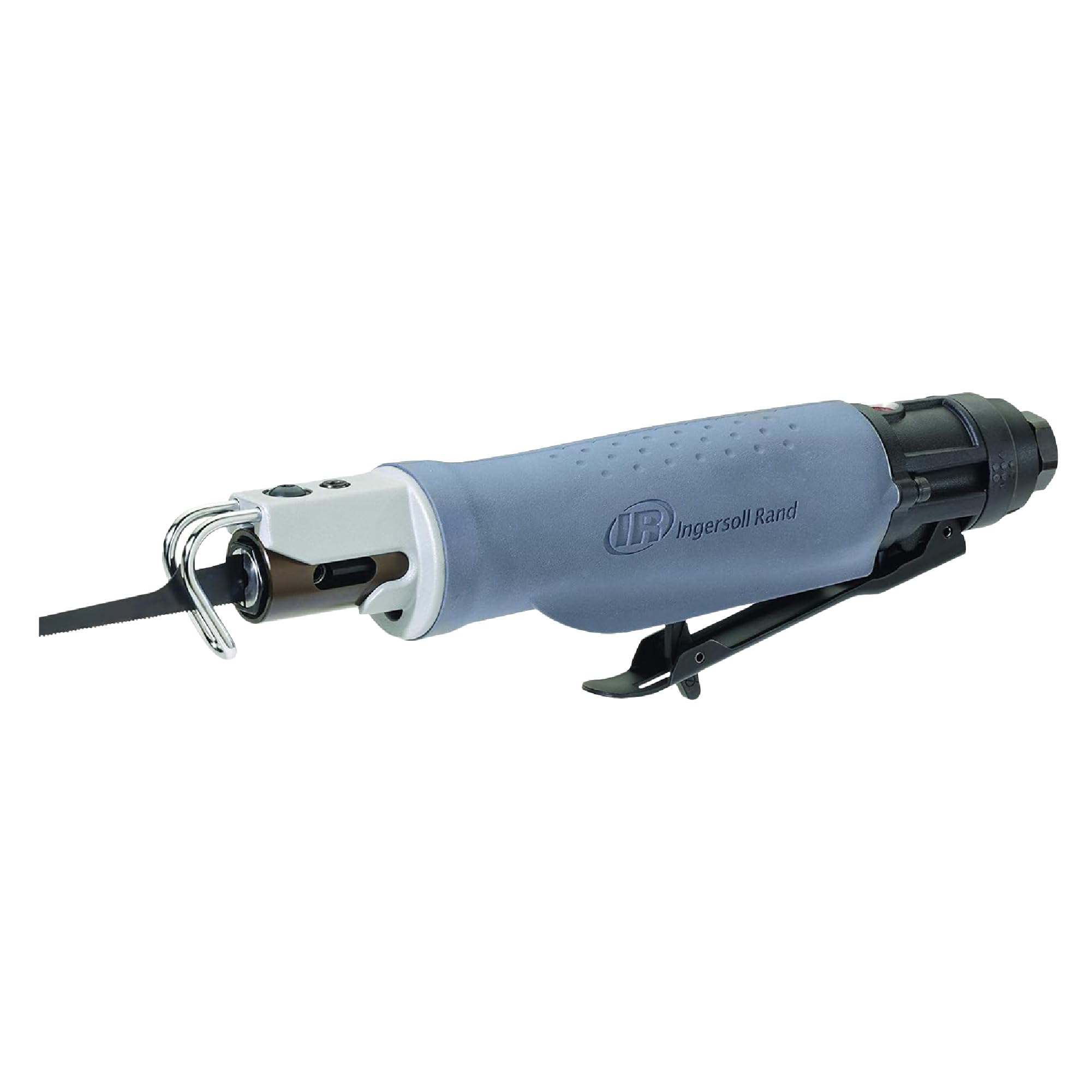
The Ingersoll Rand 529 sets the benchmark for low-vibration pneumatic cutting. Its internal damping and balanced reciprocating mechanism produce almost zero vibration at the handle — users report no hand tingling even after cutting fiberglass and sheet metal for extended periods. At 1.5 pounds with a compact 12-inch length, it provides excellent access to tight spaces while maintaining control during intricate cuts.
The lock-out lever is a standout safety feature: a spring-loaded latch prevents accidental throttle engagement, resetting each time you release the trigger. The 360-degree swivel inlet keeps the air hose oriented away from your cutting path, and the directional front exhaust blows debris downward rather than into your face. It ships with six blades covering fiberglass, plastic, sheet metal, and aluminum applications right out of the box.
This saw demands regular air tool oiling — blowback can cause the mechanism to stick if neglected. It’s also noticeably loud, requiring hearing protection during use. The blade guide extends blade life significantly, and users with 20-plus years of fiberglass cutting experience rate this as the best air saw they’ve ever used. For professional body shops and composite fabricators, the 529 is the gold standard.
Why it’s great
- Near-zero vibration eliminates hand fatigue
- Lock-out lever prevents accidental starts
- Six blades included for immediate use
Good to know
- Requires daily oiling to prevent mechanism sticking
- Very loud — hearing protection is mandatory
3. AIRCAT Pneumatic Tools 6350 Low Vibration Reciprocating Air Saw

The AIRCAT 6350 combines an internal damping system with a compact 1.13-pound frame to deliver a certified vibration level of just 2.5 m/s² — half the vibration of most reciprocating air saws. Its 9,500 strokes per minute motor provides ample cutting speed for aluminum, fiberglass, and sheet metal while remaining controllable for plunge cuts and tight-radius curves. The 360-degree rotational exhaust muffler lets you direct air away from your workspace and ears.
This saw ships with three blades (18, 24, and 32 teeth) covering coarse to fine cutting tasks. Users consistently report that it cuts smoothly without jamming, even on 1/8-inch aluminum. The short overall length provides excellent access to confined areas like vehicle body panels and exhaust systems. Build quality is notably high for its price segment — multiple users compare it favorably to saws costing twice as much.
The blade retention uses a grub screw system that some users modify by drilling the blade tang for a more positive lock. The included blades are adequate for initial use but replacing them with premium bi-metal blades improves durability significantly. For users moving up from harbor freight-level air saws, the 6350 represents a massive leap in performance and comfort without jumping to premium pricing.
Why it’s great
- Industry-leading 2.5 m/s² low vibration rating
- Lightweight 1.13 pounds reduces fatigue
- Rotational exhaust muffler directs air away
Good to know
- Blade retention may require tang modification for best grip
- Included blades dull faster than premium replacements
4. Chicago Pneumatic CP7900 Reciprocating Air Saw

The Chicago Pneumatic CP7900 is the shortest reciprocating air saw in this lineup at just 6.8 inches long, making it the tool of choice for cutting baseboard molding in place, trimming exhaust pipes in tight engine bays, and slicing sheet metal in confined spaces. Despite its compact size, it delivers 10,000 strokes per minute with a 3/8-inch stroke that cuts through materials quickly without the bulk of full-size saws.
The nylon handle and 1.3-pound weight make this saw exceptionally maneuverable for one-handed operation in awkward positions. It comes with three blades (18T, 28T, 32T) covering wood, metal, and general-purpose cutting. The set screw blade retention is secure but requires an Allen wrench for changes — less convenient than slip-collar systems but unlikely to loosen during use. Users report it runs effectively on a 3-gallon portable compressor.
The CP7900’s short stroke produces cleaner cuts than longer-stroke saws, though material removal is slower on thick stock. Replacement blades can be harder to find locally — ordering online is recommended. For trim carpenters, auto body techs, and anyone who regularly cuts in spaces where a full-length saw won’t fit, the CP7900 is the most compact and capable option available.
- Ultra-compact 6.8-inch body fits tight spaces
- Lightweight 1.3 pounds for one-handed use
- Short stroke produces clean, controlled cuts
- Blade changes require Allen wrench
- Replacement blades not commonly stocked locally
5. Ingersoll Rand 429G Reciprocating Air Saw

The Ingersoll Rand 429G delivers the brand’s renowned reliability at a price that undercuts tool truck brands by roughly 75%. Its 10,000 SPM motor and 3/8-inch stroke provide fast, straight-line cuts through sheet metal, aluminum, fiberglass, and plastic. The ergonomic thermoplastic elastomer grip reduces vibration transmission, and the front exhaust keeps debris clear of the workpiece. At 9.1 inches long and 1.4 pounds, it’s balanced enough for extended use without tiring your arm.
The 429G features an enhanced blade guard design that improves durability around the cutting zone. Users transitioning from 20-year-old Blue Point saws report this IR model is quieter and vibrates less while costing significantly less. The 20-gauge cutting capacity means it handles typical auto body panel thickness without strain. The 1-year limited warranty provides peace of mind for a tool that sees daily shop use.
This saw is less refined than premium models — the vibration level is higher than the AIRCAT 6350 or IR 529, and the included accessories are minimal (just the bare tool). Some users report that the blade clamp could be more robust. For a shop on a budget that needs a workhorse air saw capable of clean straight cuts in thin to medium materials, the 429G is the best value proposition in this category.
- Proven Ingersoll Rand quality at a budget-friendly price
- Quieter and lower vibration than older tool truck models
- Ergonomic grip reduces hand fatigue
- Higher vibration than premium low-vibration models
- Bare tool — no blades or case included
6. Astro Pneumatic Tool 930 Air Body Saber Saw

The Astro Pneumatic 930 is a dedicated body saber saw designed for auto restoration, muffler work, and exhaust repair. Its adjustable blade guide increases blade life by preventing the blade from wandering during aggressive cuts. The saw accepts 235mm rectangular blades (approximately 9.25 inches) — longer than typical air saw blades — allowing it to cut through wider panels and tubing in a single pass. The 1.6-pound weight keeps it manageable for overhead exhaust work.
Users report that this saw cuts through 3/8-inch steel with surprising ease, making it suitable for cutting brackets, body panels, and frame sections during restoration projects. The blade flexes during operation, which helps when cutting contoured surfaces but means precision cuts require careful control. Several users add an aftermarket blade guide to further improve cut accuracy. The Taiwan-made build quality is solid for the price tier.
This is not a high-speed production saw — the vibration level is about 35-40% higher than the Ingersoll Rand 429G, and the included blades dull relatively quickly. Upgrading to premium bi-metal blades and applying tool grease to the blade path extends usable life. For weekend restorers and body shops that need an affordable saw for occasional metal cutting, the Astro 930 delivers impressive capability at a minimal investment.
- Long 235mm blades cut wide panels in one pass
- Adjustable blade guide extends blade life
- Cuts 3/8-inch steel despite compact size
- Higher vibration than mid-range and premium competitors
- Included blades dull quickly in heavy use
7. AIRCAT Pneumatic Tools 6275-A 1.0 HP Cut-Off Tool

The AIRCAT 6275-A is not a reciprocating air saw — it’s a 1.0 HP pneumatic cut-off tool with a 4-inch grinding wheel, operating at 14,000 RPM. This distinction matters because the 6275-A serves a different purpose: cutting sheet metal, stripping bolts, slicing conduit, and cutting drain pipe with a rotating abrasive wheel rather than a reciprocating blade. Its 1.0 HP motor prevents stalling even under heavy load, and the tool runs effectively at lower air pressures without losing torque.
The spindle lock allows quick wheel changes, and the 11-position rotational guard lets you orient the spark stream away from your body and flammable materials. The compact tapered gear housing provides close-coupled access to tight cutting areas. The ergonomic handle and paddle throttle give excellent speed control for precise cuts. Users report that the tool hasn’t stalled even when cutting 1/4-inch steel, and one unit has been in service for three years without issues.
The 6275-A is heavier than reciprocating air saws at 4.8 pounds, but the weight improves stability during aggressive cuts. The tool binds occasionally if side-loaded, but using the spark guard as a brace helps maintain control. It’s a niche tool — you won’t use it for intricate curves or body panel trimming. But for metal fabricators, electricians, and demolition crews, the 6275-A is a tank-like cut-off tool that outlasts cheaper alternatives many times over.
- 1.0 HP motor won’t stall on 1/4-inch steel
- Spindle lock for fast wheel changes
- 11-position guard directs sparks away
- Heavy at 4.8 pounds — not for extended one-handed use
- Rotating wheel, not a reciprocating blade — different cutting action
FAQ
Can an air powered circular saw cut through 3/8-inch steel plate?
What CFM does an air saw need to run properly?
Are air saw blades universal between different brands?
Final Thoughts: The Verdict
For most users, the best air powered circular saw winner is the Astro Pneumatic 936 Onyx because its gear-driven design cuts through thick steel and hardened bolts that stall every reciprocating saw in this lineup. If you need the smoothest, lowest-vibration cutting experience for fiberglass and composites, grab the Ingersoll Rand 529. And for tight-space cutting where a full-length saw won’t fit, nothing beats the Chicago Pneumatic CP7900.