
An air compressor without a reliable gauge is just a heavy box that makes noise. Whether you’re topping off passenger tires between seasons or airing down for an off-road trail, the tool that connects your compressor to the valve stem determines whether you finish in thirty seconds or fight a leaky, inaccurate struggle for ten minutes. A proper air pressure gauge for an air compressor does three things simultaneously—inflates, bleeds, and reads—which is why grabbing a cheap stick gauge or relying on the compressor’s built-in dial costs you time and accuracy every single time.
I’m Min — the co-founder and writer behind Gadgets Feed. I’ve spent hundreds of hours cross-referencing ANSI accuracy standards, comparing analog vs. digital response times, and tracking down real user measurements against lab claims for this specific accessory category so you don’t waste money on a gauge that lies to you.
Whether you work in a home garage, maintain a fleet of work trucks, or simply want to squeeze more miles out of your daily driver, the right best air pressure gauge for air compressor saves fuel, extends tread life, and eliminates the back-and-forth dance between inflator and separate pressure checker.
How To Choose The Best Air Pressure Gauge For Air Compressor
Not every gauge that threads onto a 1/4” NPT fitting deserves a spot on your compressor hose. The deciding factors come down to accuracy certification, measurement range relative to your typical tire pressures, the type of chuck that locks onto the valve stem, and whether a built-in bleed valve gives you fine control over deflation. Each of these specs either speeds up your workflow or introduces frustrating friction every time you touch a tire.
Accuracy Certification — The Only Number That Matters
Marketing copy throws around phrases like “within 1%” or “high precision,” but the real benchmark is ANSI B40.7 Grade 2A, which certifies ±1 PSI across the entire range. A gauge that meets this standard delivers repeatable readings you can trust for inflation and deflation. Gauges without any certification reference often drift after a few months of use, especially when left attached to a compressor in a hot garage. Always verify whether the manufacturer explicitly states ANSI calibration, and look for manual calibration in the product description.
Range vs. Resolution — Match the Scale to Your Tires
A gauge rated for 0–250 PSI covers everything from bicycle tires to heavy truck duals, but the tradeoff is that the display resolution (typically 0.1 PSI on digital units) becomes the limiting factor. Analog dials with a 100 PSI max range deliver the best readability for passenger cars (32–40 PSI) because the needle sweeps a larger angle per PSI. If you work on mixed fleets, a 250 PSI digital gauge with 0.1 PSI increments offers the versatility you need. Choose the range that matches the majority of your work — buying a gauge that maxes out far above your typical pressure doesn’t improve accuracy.
Chuck Design — Lock-On vs. Push-On
The chuck is the single point of physical contact with the valve stem. A lock-on (clip-on) chuck grips the stem so you can walk away while the gauge reads; a push-on chuck requires constant hand pressure. For any real garage or shop use, a lock-on brass or stainless steel chuck is mandatory. It eliminates air loss during the reading and frees both hands to operate the bleed valve or adjust the compressor regulator. Look for a 360° swivel at the chuck base — this prevents hose kinking when reaching awkward valve positions on dual rear wheels or deep-set rims.
Bleed Valve — Precision Deflation Without Disconnecting
A built-in bleed valve lets you release small bursts of air while the chuck remains locked onto the stem. This is the defining feature that separates a useful inflator gauge from a basic air chuck. Without it, you either overshoot your target pressure and have to disconnect, recheck with a separate gauge, and reconnect — wasting minutes per wheel. Gauges with a dedicated deflate button or trigger give you real-time feedback on the display so you can land exactly on 35.0 PSI on the first attempt.
Quick Comparison
On smaller screens, swipe sideways to see the full table.
| Model | Category | Best For | Key Spec | Amazon |
|---|---|---|---|---|
| DigitPro P421 | Digital | All-around shop gauge | ±1% / 0.1 PSI resolution | Amazon |
| AstroAI T1 | Digital | ANSI-certified accuracy | ANSI B40.7 Grade 2A | Amazon |
| ETENWOLF T600 | Digital | Precision with rotating chuck | ±0.5% / 360° nozzle | Amazon |
| AstroAI 250PSI-M | Digital | Battery-saver auto operation | Auto on/off at 20 sec | Amazon |
| GERCHWAY 86500B | Analog | No-battery reliability | 100 PSI max / ±2 PSI | Amazon |
| AZUNO TIG200B03C | Digital | Portable kit with case | 0.1 resolution / 200 PSI | Amazon |
| Milton MIL507KIT | Digital | Heavy brass lock-on chuck | ANSI B40.1 / 250 PSI | Amazon |
In‑Depth Reviews
1. DigitPro P421
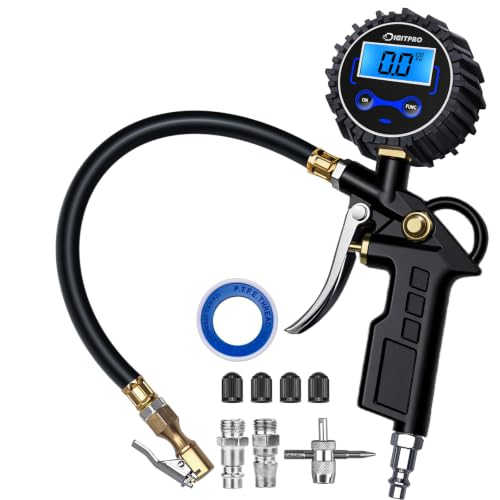
The DigitPro P421 wraps a stainless steel body and brass internals around a digital sensor that delivers readings within 0.5 PSI of true pressure — verified by multiple owners against both factory TPMS and analog reference gauges. The 3–250 PSI range covers everything from a bicycle tire to a heavy-duty truck dual, and the 0.1 PSI display resolution gives you fine enough granularity to set pressures precisely. The built-in backlight makes it usable under a hood at night or inside a dim garage bay.
The all-in-one design integrates inflation, deflation through the bleed valve, and pressure checking into a single pistol-grip body. Users report that the quick-connect coupler mates cleanly with both 1/4” and 1/2” NPT compressor fittings, and the included thread seal tape ensures no leaks at the connection point. The auto shut-off feature preserves battery life after 20 seconds of inactivity, which matters when you leave the gauge hanging on the hose between uses.
Multiple owners noted a measurable 4% improvement in fuel efficiency after switching from a stick gauge to this unit, simply because they started maintaining pressures more consistently. The 3-year warranty adds confidence for a tool that lives on a shop compressor. For the combination of build quality, accuracy, and multifunction capability at a mid-range price point, this is the most balanced choice for most garage owners.
Why it’s great
- Verified accuracy within 0.5 PSI across multiple user tests
- Heavy-duty stainless steel body resists drops and corrosion
- 3-year warranty backs the build quality
Good to know
- Requires two AAA batteries (not included in some packages)
- Pistol grip is bulkier than a pen-style gauge for glovebox storage
2. AstroAI T1
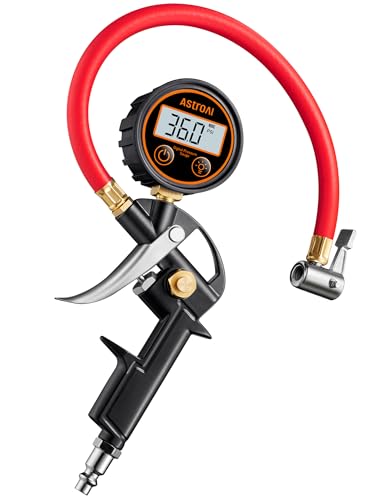
The AstroAI T1 stands out because it is manually calibrated to ANSI B40.7 Grade 2A — a certification that guarantees ±1 PSI accuracy across the entire 3–250 PSI sweep. That matters when you are setting cold pressures to the exact manufacturer recommendation and don’t want a gauge that reads 34 PSI when the true value is 35. The four-unit display (PSI, BAR, KPA, KG/CM²) eliminates mental math when switching between vehicle types or international spec sheets.
Weighing just 0.65 pounds, this gauge is noticeably lighter than the all-metal DigitPro while still using brass for the internal sensor path and the air chuck. The extended temperature tolerance of -14°F to 122°F means the electronics maintain ±0.1 PSI stability even if you leave it in a freezing garage or a hot service truck. The bleed valve is integrated into the top of the handle, so you can deflate without shifting your grip.
Customer reviews consistently call out the ease of use — the trigger-operated inflation and the deflate button require no two-handed coordination. Several owners compared it directly against professional shop gauges and found the T1 matched readings within 0.5 PSI. It is a strong choice if ANSI certification is non-negotiable for your workflow.
Why it’s great
- Manually calibrated to ANSI B40.7 Grade 2A (±1 PSI)
- Wide temperature tolerance for year-round outdoor use
- Ultra-lightweight at 0.65 lbs for carrying between vehicles
Good to know
- Plastic housing on the handle may not survive being run over
- No included carrying case or storage box
3. ETENWOLF T600
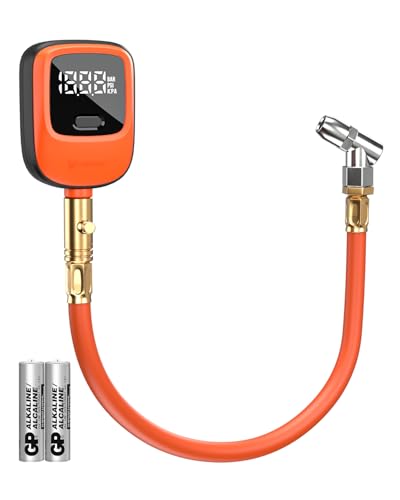
The ETENWOLF T600 claims ±0.5% accuracy, which works out to roughly ±0.2 PSI at 40 PSI — tighter than the typical ±1 PSI Grade 2A standard. Real-world user tests confirm this: one owner reported that the gauge matched his Toyota TPMS on all four tires within 0 PSI, and another cross-checked against three different sources (compressor gauge, track pump, dedicated inflator) and found all readings clustered within 0.2 PSI. That kind of repeatability inspires trust when setting pressures for performance driving or towing.
The 360° rotating nozzle is the standout mechanical feature. It lets you approach the valve stem from any angle without twisting the hose, which is critical when working on deep-dish rims or dual rear wheels where clearance is tight. The single-button operation for power, zero reset, and unit switching keeps the interface simple — no menu diving. The bleed valve releases air in controlled amounts while the locked-on chuck stays sealed, and the display updates in 0.1 PSI increments in real time.
Powered by two AA batteries that are easily replaceable, the T600 avoids the proprietary battery packs that strand you when the charge dies. The included batteries are standard alkaline cells, and the gauge draws minimal current thanks to auto shut-off. The 2-year warranty covers the sensor and electronics. For those who demand the tightest possible accuracy without stepping to a lab-grade instrument, this is the gauge.
Why it’s great
- ±0.5% accuracy exceeds standard Grade 2A spec
- 360° rotating chuck eliminates hose kinking
- Replaceable AA batteries instead of proprietary packs
Good to know
- Plastic body feels less durable than all-metal alternatives
- Max 250 PSI range may be overkill for cars but excellent for mixed fleets
4. AstroAI 250PSI-M
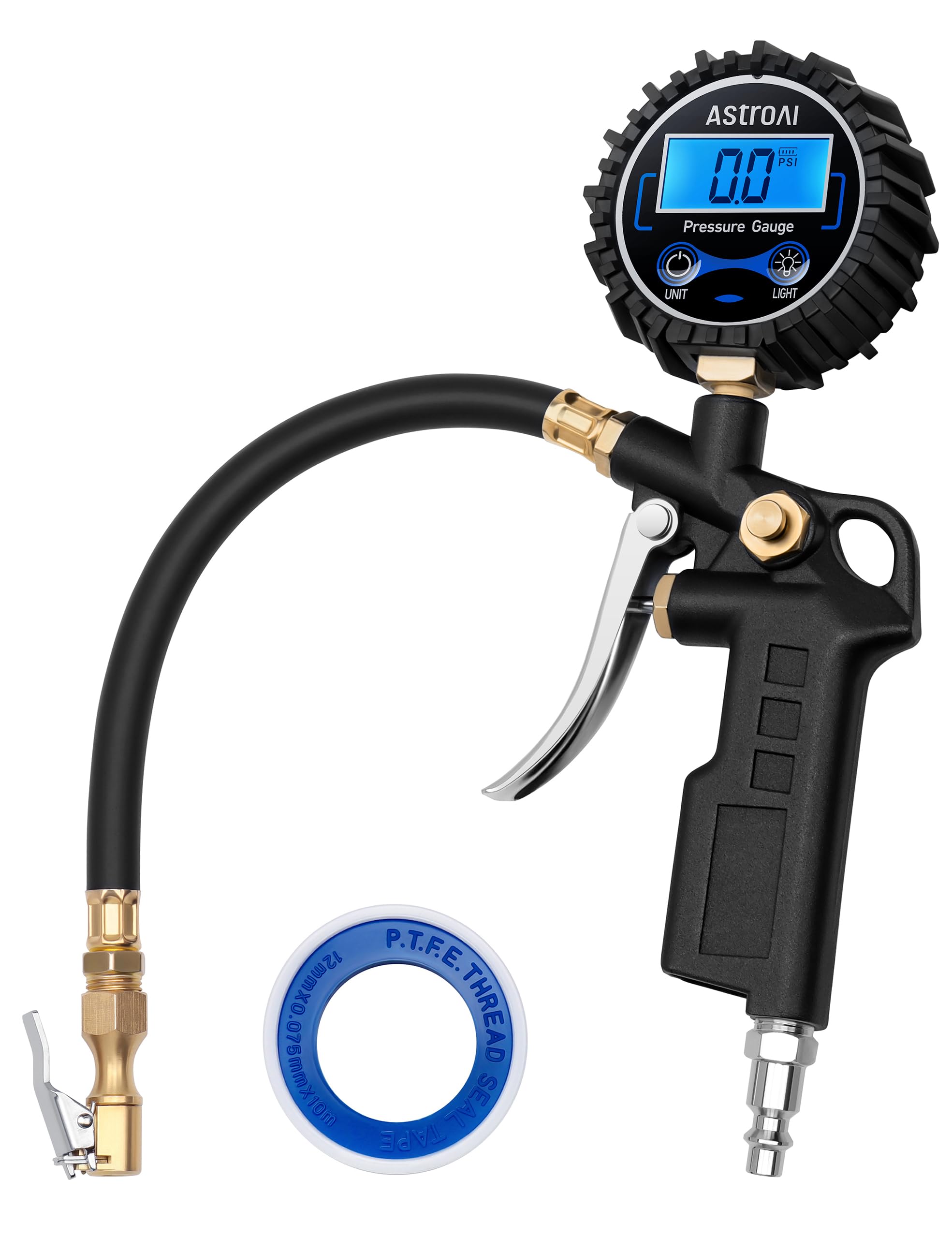
The AstroAI 250PSI-M has been a consistent top seller for years, and the reason is simple: it delivers reliable digital readings at a price point that undercuts most competitors while maintaining a stainless steel and brass build. The auto-on feature activates the display the moment pressurized air is detected — you don’t need to fumble for a power button when your hands are greasy. Auto shut-off kicks in after 20 seconds of inactivity, preventing dead batteries between garage sessions.
The measurement range spans 3–250 PSI with four selectable units, and the internal sensor is professionally calibrated to return readings within 1% of true pressure. Users consistently report that the gauge agrees with their vehicle’s TPMS within 0.5 PSI, and several owners mention using it seasonally to adjust pressures for temperature swings between summer and winter. The lock-on chuck is leak-proof and compatible with both 1/4” and 1/2” NPT compressor outputs.
The integrated bleed valve works as a push-button deflator, and the pistol-grip handle gives you enough leverage to hold the chuck firmly on tight stems without straining. The 3-year warranty is identical to the DigitPro P421, and AstroAI’s customer service is frequently praised for quick replacements. For the price, you get near-premium accuracy and construction without paying a premium.
Why it’s great
- Auto-on detection eliminates button pressing
- Leak-proof lock-on chuck works with dual NPT sizes
- 3-year warranty at a budget-friendly price point
Good to know
- Body uses some ABS plastic alongside metal components
- Non-swiveling chuck can be awkward on angled valve stems
5. GERCHWAY 86500B
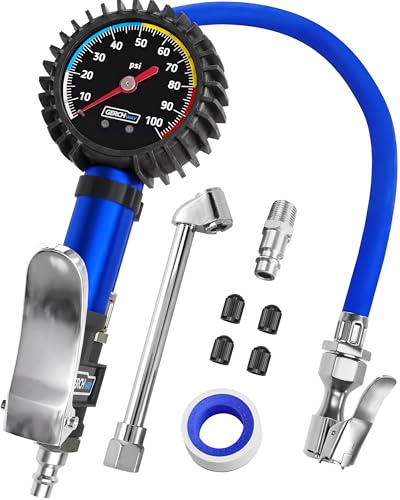
The GERCHWAY 86500B takes a deliberately different approach: an analog dial with a 100 PSI maximum range and zero reliance on batteries. This design philosophy makes sense because tire pressure gauges are most accurate in the middle third of their range. For passenger cars running 32–40 PSI, the 100 PSI dial positions the needle in the sweet spot, giving better visual resolution per PSI than a 250 PSI gauge would offer. The ±2 PSI (2% FS) accuracy is wider than digital options, but for quick checks on standard vehicles, this level is perfectly acceptable.
The build uses an aluminum and brass chuck with a 360° swivel, paired with a long rubber hose that reaches inner dual wheels on trailers and trucks — a specific pain point that several owners highlighted. The glow-in-the-dark dial numbers are legible in low light without needing a backlight, and the rubber casing around the gauge body provides drop protection. The included 1/4” NPT quick-connector and Teflon tape make installation straightforward.
The tradeoff is the lack of a bleed valve — you have to disconnect to release air. The lock-on chuck requires manual pressure to maintain a seal, as some owners noted the clip doesn’t hold hands-free. Still, for users who want a simple, always-ready gauge that never suffers from dead batteries or LCD failure in extreme cold, this analog unit delivers dependable service. It’s a specialty tool for a specific workflow: quick inflation checks on vehicles with common tire pressures.
Why it’s great
- No batteries means zero power-related failures
- 100 PSI dial offers better needle resolution for car tires
- Long flexible hose reaches inner dual rear wheels
Good to know
- ±2 PSI accuracy is wider than digital competitors
- Chuck does not lock on hands-free for all valve stems
6. AZUNO TIG200B03C
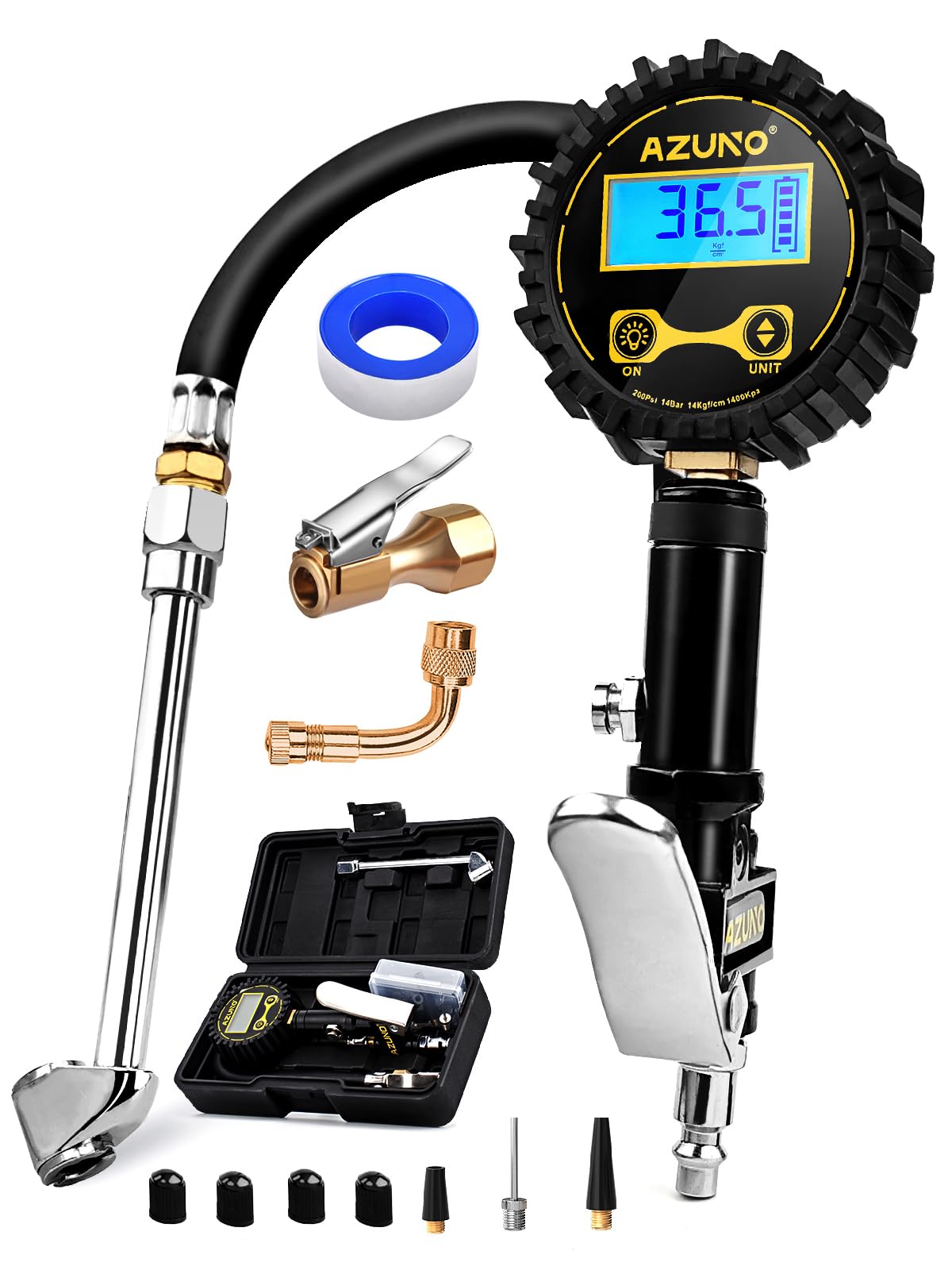
The AZUNO TIG200B03C differentiates itself with a hard-shell carrying case that keeps the gauge, hose, and accessories organized inside a truck cab or tool box. The digital display reads up to 200 PSI with 0.1 resolution and offers four unit selections. The bright LCD backlight activates automatically when pressure is detected, making it easy to read in direct sunlight or pitch darkness. The trigger-operated inflation and separate air bleeder allow single-handed operation — press to fill, press the bleeder to fine-tune.
Construction uses a mix of ABS plastic and metal components, keeping the weight reasonable for a tool you might toss in a glovebox. The lock-on chuck fits standard Schrader valves, and the 1/4” NPT quick-connect mates with most home and shop compressors. Several owners pointed out that the carrying case is sturdy enough to survive being thrown in a service truck bed, and the organized layout means you never lose the valve stem adapter or the spare O-rings.
Accuracy is rated within 1% of true pressure, and user reports confirm that readings match their vehicle TPMS closely. The auto on/off feature preserves battery life. The biggest advantage here is portability — if your compressor is stationary and you need to move the gauge between multiple vehicles or job sites, the case prevents damage. For a mobile mechanic or a weekend warrior who works on cars at different locations, this is the most practical package.
Why it’s great
- Hard carrying case protects the gauge during transport
- Bright backlit display readable in direct light
- Single-handed trigger and bleeder operation
Good to know
- 200 PSI max is slightly lower than 250 PSI alternatives
- Plastic housing may not withstand heavy shop abuse
7. Milton MIL507KIT

Milton is a name that carries weight in the commercial and industrial air tool space, and the MIL507KIT lives up to that reputation. The digital gauge meets ANSI/ASME B40.1 standards, delivering ±1 PSI accuracy across a 0–250 PSI range with 0.1 PSI resolution. The 14-inch rubber hose terminates in a solid brass lock-on clip chuck that grips valve stems securely — you’ll hear a satisfying click when it engages. The pistol-grip body is molded from high-quality steel with an ergonomic shape that fits gloved hands comfortably.
The LCD display features a backlight for low-light work and auto-powers on when connected to a tire. One unique advantage is that the gauge shows both supply pressure and tire pressure, letting you monitor your compressor’s output while you fill. The integrated deflate button releases air smoothly without having to reposition your fingers. Users with arthritis specifically praised the clip-on chuck, which eliminates the squeezing force required by push-on designs.
Some owners noted that the pre-applied thread sealant on the NPT fitting caused the aluminum handle threads to split if overtightened — a cautionary note to hand-tighten only. The 2 AAA batteries are not included. Despite these minor quirks, the MIL507KIT delivers the most professional-grade feel in this lineup thanks to the all-metal handle and the brass chuck. If you want a gauge that looks and performs like it belongs in a high-end shop, this is the choice.
Why it’s great
- Solid brass lock-on chuck provides the most secure stem grip
- ANSI/ASME B40.1 certified for commercial accuracy
- Displays both supply and tire pressure simultaneously
Good to know
- Hand-tighten only — overtightening can split handle threads
- Requires 2 AAA batteries not included in box
FAQ
Is a 250 PSI gauge less accurate at 35 PSI than a 100 PSI gauge?
Can I leave my gauge attached to the compressor hose permanently?
What does the 1/4” NPT standard mean for compatibility?
Final Thoughts: The Verdict
For most users, the best air pressure gauge for air compressor winner is the DigitPro P421 because it combines stainless steel durability, verified ±0.5 PSI accuracy, and a full set of inflation/deflation/checking functions at a price that doesn’t punish your wallet. If you want ANSI certification as a non-negotiable spec, grab the AstroAI T1. And for those who refuse to deal with dead batteries or fragile electronics, nothing beats the GERCHWAY 86500B analog dial.