
Our readers keep the lights on and my morning glass full of iced black tea. As an Amazon Associate, I earn from qualifying purchases.
Specs are compiled from manufacturer listings and verified buyer reviews and can change over time — please confirm the key details on the product page before buying.
That glowing tire-pressure warning is either a slow leak you cannot feel or a false alarm that cost you a trip to the shop. An air pressure sensor for your vehicle takes the guesswork out — it reads the exact PSI (pounds per square inch, the unit for air pressure) inside each tire so you know when to add air and when something is actually wrong. The right sensor pairs with your car, lasts years, and transmits accurate data without dropping out at highway speed.
I’m Min — the founder and writer behind Gadgets Feed. This guide is built by comparing the manufacturers’ published specifications and the patterns across verified customer reviews, so you get each pick’s real strengths and trade-offs instead of marketing spin.
Whether you drive a Chevy, Toyota, Ford, or a European sedan, the right air pressure sensor saves you time and keeps you rolling without the orange glow on your dash.
Quick Picks
- Autel TPMS Sensors Set of 4, MX-Sensor 315MHz + 433MHz — Top Performer
- Masoll TPMS Sensor for GM Vehicles + Relearn Tool — DIY Kit
- MORESENSOR Signature Series 315MHz TPMS 4-Pack — Reliable Ford Pick
- A-Premium 4PCS Pre-Programmed TPMS Sensor (GM, 433MHz) — Best Value
- Jsueng GM TPMS Sensor 4-Pack (13598773) — Budget Champ
- Marsflex TPMS Sensor 42607-33021 (Toyota / Lexus, 315MHz) — Toyota/Lexus Specialist
How To Choose The Best Air Pressure Sensor
TPMS sensors are not one-size-fits-all. Your car’s make, model, and model year determine which frequency and part number you need.
Frequency: 315MHz vs 433MHz
Most American-made vehicles from the 2000s onward run on 315MHz. European and Asian cars usually use 433MHz. Some universal sensors, like the Autel MX-Sensor, pack both frequencies into one unit so they cover nearly any passenger car. Match the frequency to your vehicle — a mismatch means the sensor never communicates with your car’s computer.
Pre-Programmed vs Programmable
A pre-programmed sensor ships ready for a specific list of vehicles — you install it and perform a relearn procedure. A programmable (universal) sensor needs a special tool, like an Autel TS408 or a Mobiletron programmer, to write the correct vehicle data onto it before installation. Pre-programmed sensors are simpler for DIYers; programmable sensors give shops flexibility across multiple brands.
The Relearn Procedure
Every new sensor requires a relearn step so your car’s ECU (engine control unit, the computer that manages the engine and sensors) recognizes it. Some vehicles do a “stationary relearn” using a magnet near the valve stem. Others need an OBDII (on-board diagnostic, the standard plug under your dashboard) scanner or a dedicated activation tool. Check your owner’s manual for the exact method — skipping the relearn leaves the dash warning on.
Battery Life and Build Quality
Most TPMS sensors claim a 5-to-8-year battery life. The battery is sealed inside the sensor — you replace the whole unit when it dies. Metal valve stems last longer than rubber ones in harsh weather, but rubber stems are easier to install and quieter on rough pavement.
Quick Comparison
On smaller screens, swipe sideways to see the full table.
| Model | Best For | Frequency | Pre-Programmed | Item Weight | Amazon |
|---|---|---|---|---|---|
| Autel MX-Sensor 4-Pack | Universal coverage (99% of vehicles) | 315MHz + 433MHz | No (requires Autel tool) | 15.42 g | $109.00Amazon |
| Masoll GM TPMS + Relearn Tool | DIY GM owners wanting quick install | — | No (tool included) | — | $44.99$47.99PrimeAmazon |
| MORESENSOR Signature Series | Ford / American brand replacements | 315MHz | Yes (select models) | 2.11 oz | $39.99Amazon |
| A-Premium 4PCS GM TPMS | Chevy / GMC / Cadillac / Buick | 433MHz | Yes | 0.15 kg | $37.99$42.49Amazon |
| Jsueng GM TPMS 4-Pack | Budget GM fleet replacement | — | Yes | 4.9 oz | $27.95Amazon |
| Marsflex Toyota / Lexus TPMS | Toyota / Lexus / Scion owners | 315MHz | Yes | 0.2 kg | $32.59Amazon |
In‑Depth Reviews
1. Autel TPMS Sensors Set of 4, MX-Sensor 315MHz + 433MHz
The one sensor that replaces nearly every passenger car sensor on the road.
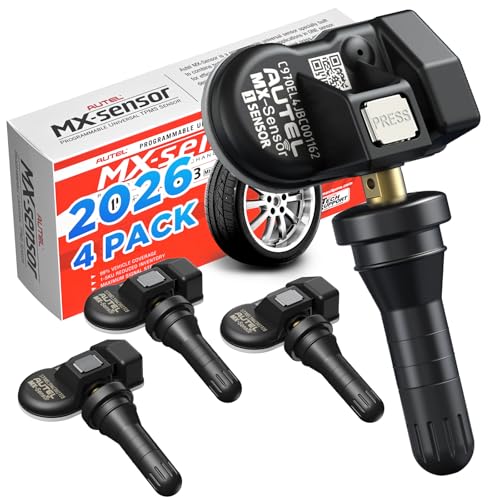
This set covers about 99% of TPMS-equipped passenger cars because it bundles both 315MHz and 433MHz radio bands into each unit. When you buy the Autel MX-Sensor 4-Pack, you get a sensor that can talk to Ford, Chevy, Toyota, Honda, BMW, or VW — almost any brand. It weighs just 15.42 g (about half an ounce), which puts less stress on the valve stem at highway speed. The press-in (snap-in) rubber stem mounts with standard tire equipment.
Unlike the pre-programmed picks below, the Autel needs a separate programming tool (like the Autel TS408 or TS508) to load your car’s data before it works. That means you either own that tool or pay a shop to do it. The upside is unlimited reprogramming: you can move these sensors to a different car later. One buyer reports installing a set in 2020 on a 2010 Ford Explorer, and they have “operated flawlessly since.” Another reviewer shares a clever fix: if your TS408 tool cannot trigger a relearn (the re-pairing step), unplug any 12V phone charger — radio interference from the charger can block the signal.
The MX-Sensor also supports 100% cloning (copying your old sensor’s ID onto the new ones), so a shop can set them up with zero relearn. Autel backs them with a 24-month or 24,000-mile warranty, whichever comes first.
Unlimited Flexibility: One SKU covers vehicles from America, Asia, and Europe — the only limit is needing an Autel tool to program them.
The Catch: Not compatible with 12V/24V commercial trucks, Bluetooth-based TPMS (Tesla, some EVs), or heavily modified tire setups.
Reach for this if: you want one set of sensors that can follow you across different cars, or you maintain a fleet and already have Autel programming gear.
Look elsewhere if: you just want a drop-in replacement for a single car and do not want to buy a programming tool.
2. Masoll TPMS Sensor for GM Vehicles + Relearn Tool
No tire removal, no shop visit — screw it on and sync it yourself.
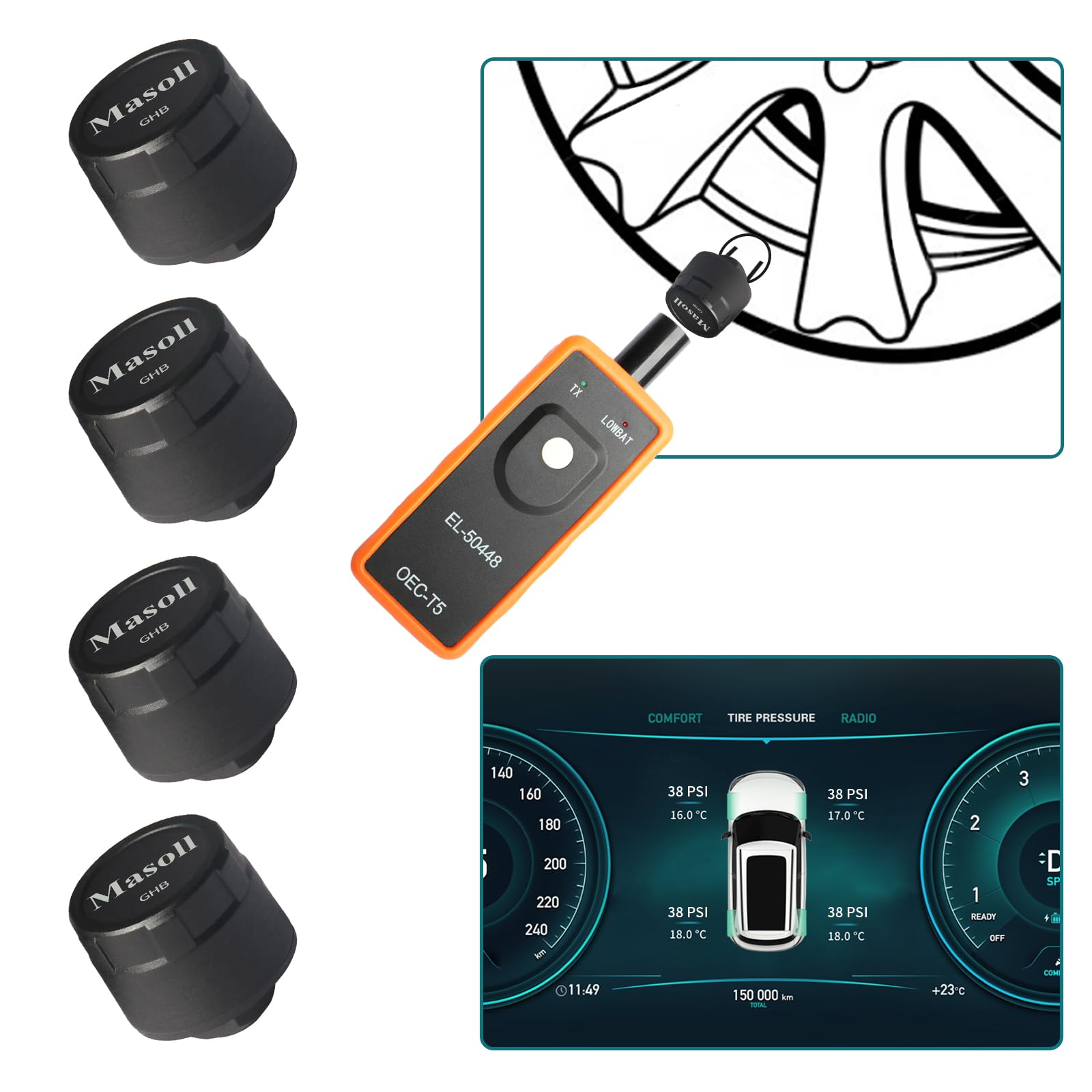
This is the only pick here that uses external sensors (sensors that screw onto your existing valve stem) instead of being mounted inside the tire. You install all four in about five minutes without breaking the tire bead. Masoll includes the EL-50448 TPMS relearn tool in the box, so you do not need a separate scanner. The whole kit works on GM vehicles built after 2006, including Chevy Silverado, Buick, Cadillac, GMC, and Pontiac.
The Gen 2 version launched in 2025 has wider vehicle coverage and stronger transmission signals than the first generation. Accuracy is rated at 1.5 PSI (meaning the reading can be off by up to 1.5 PSI, enough to notice a slow leak but not a tiny pressure change). The battery lasts about two years, and it is replaceable — rare for TPMS sensors, which usually have sealed batteries. One owner who put these on a 2012 Yukon reported it worked after backing up a few feet to trigger the reset, and the dash light turned off immediately. Another reviewer called them “ugly but they work,” noting no leakage after months. The included spare o-rings and theft-prevention nuts add confidence.
A few owners also mentioned theft as a concern, though the locking nuts help.
Five-Minute Fix: Screw-on external sensors with a bundled relearn tool — no tire shop needed.
The Catch: Bulky caps are prone to curb rash and look very different from factory sensors.
Reach for this if: you want to DIY the whole job on your GM vehicle in your driveway without removing wheels.
Look elsewhere if: you prefer the flush look of internal sensors or park in tight spaces where the cap might get snagged.
3. MORESENSOR Signature Series 315MHz TPMS 4-Pack

Pre-programmed for Ford and American-brand vehicles — install and drive.
For owners of Ford, Lincoln, and select American-brand models, this is the most straightforward option. The MORESENSOR Signature Series ships pre-programmed for over 80 American models, including the F-150, Edge, and Explorer. The snap-in (press-in) valve stem installs with a standard tire machine. It carries an IP67 waterproof rating (dust-tight and survives submersion in 1 meter of water for 30 minutes), meaning heavy rain, mud, or shallow puddles will not harm it.
The sensor operates at 315MHz and carries OEM-equivalent part numbers like F2GZ-1A189-A and HC3Z-1A189-A. Buyers report that on a 2021 F-150, the sensors worked after about 10 minutes of highway driving with no relearn needed. Another owner installed them on a 2015 Ford Edge SEL, and a professional tire shop linked them without trouble. A reviewer also noted the “RETRAIN” procedure — not “RELEARN” — was the correct method for their 2020 Explorer, and once they used that process, the sensors paired fine. The battery is rated for 5-8 years, and the sensor can be reprogrammed later with an ATEQ VT56 or Mobiletron PT46/47 tool if you switch vehicles.
MORESENSOR backs the Signature Series with a 3-year limited warranty, which is longer than most competitors. A minority of reviewers did report that their sensors failed to sync even after multiple relearn attempts — if that happens, the company asks you to contact them for a replacement.
Ford Driver’s Shortcut: Pre-programmed for top American models — no coding, just a quick relearn and you are set.
The Catch: A small number of units have failed to sync; you may need a shop with a professional tool to force a link.
Reach for this if: you drive a 2015-2021 F-150, Edge, Explorer, or similar Ford and want a 3-year warranty.
Look elsewhere if: you drive a GM or import — this sensor is tuned for American-brand vehicles.
4. A-Premium 4PCS Pre-Programmed TPMS Sensor (GM, 433MHz)
A pre-programmed four-pack for GM vehicles with a certified NXP chip inside.
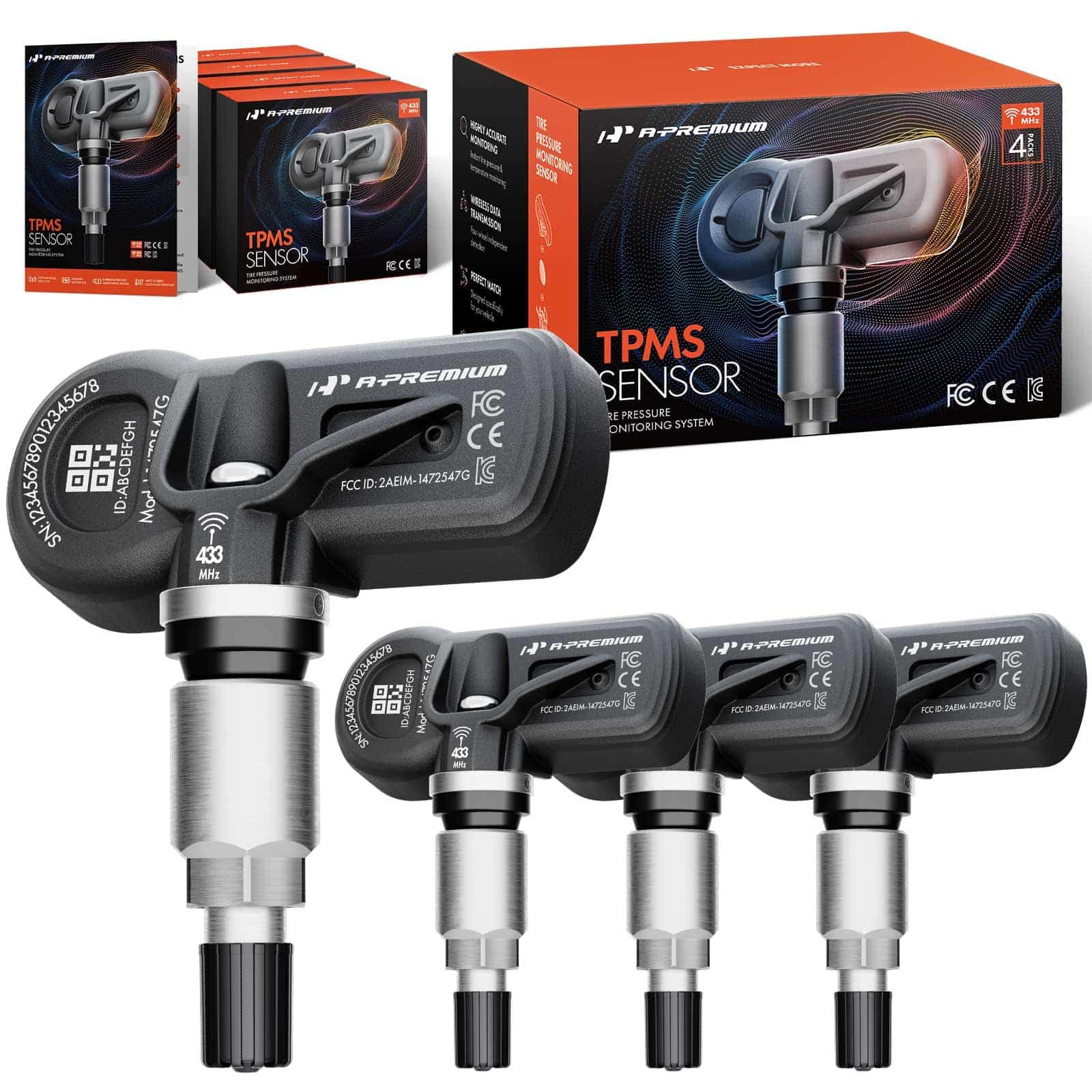
This A-Premium set covers a massive list of GM vehicles — Chevy Silverado, Camaro, Malibu, Cruze, GMC Sierra, Yukon, Cadillac CT6, XT5, Buick Enclave, and more — spanning model years from 2016 through 2024. It runs on 433MHz and carries FCC (Federal Communications Commission) and IC (Industry Canada) certification, meaning it meets federal interference and safety standards. The sensor uses a high-precision NXP chip (a semiconductor from NXP Semiconductors) and has a measurement accuracy of ±0.06 Bar (about ±0.87 PSI), so you get fine-grained pressure data. The measuring range goes from 0 to 900 KPa (0 to 130.53 PSI), handling a compact car or a heavy-duty truck.
Unlike the Masoll kit, these are internal (mount-in) sensors, so you need a tire shop to install them. The valve stem is upgraded aluminum instead of rubber, which resists corrosion better over time. Owners mention that the sensors worked immediately after installation on a 2018 Chevy Cruze and a 2019 Chevy Malibu, with accurate readings after several months. One owner noted that local shops wanted per sensor, making this four-pack a strong value. The accuracy of ±0.06 Bar is tighter than many competitors — you see that detail in real time on your dashboard. A-Premium provides a 2-year guarantee, decent for this price tier. However, one reviewer noted that the sensor did not respond on their 2017 Chevy Silverado even after a mechanic tried to program it, so compatibility is not guaranteed on every GM model despite the long list.
At 0.15 kg, it is lighter than the Jsueng 4-pack (0.2 kg vs 0.15 kg), which slightly reduces unsprung weight (mass not supported by the suspension) — a small plus for ride comfort.
Certified Accuracy: FCC/IC certified NXP chip delivers ±0.06 Bar precision across a wide GM lineup.
The Catch: A small risk of incompatibility on certain model years — double-check your exact VIN against the fitment list.
Reach for this if: you own a Chevy, GMC, Cadillac, or Buick from the 2016-2024 range and want a fully certified sensor.
Look elsewhere if: you drive a Toyota, Honda, or Ford — this sensor is GM-only.
5. Jsueng GM TPMS Sensor 4-Pack (13598773)
The lowest-cost route to killing that TPMS light on your Chevy or Buick.
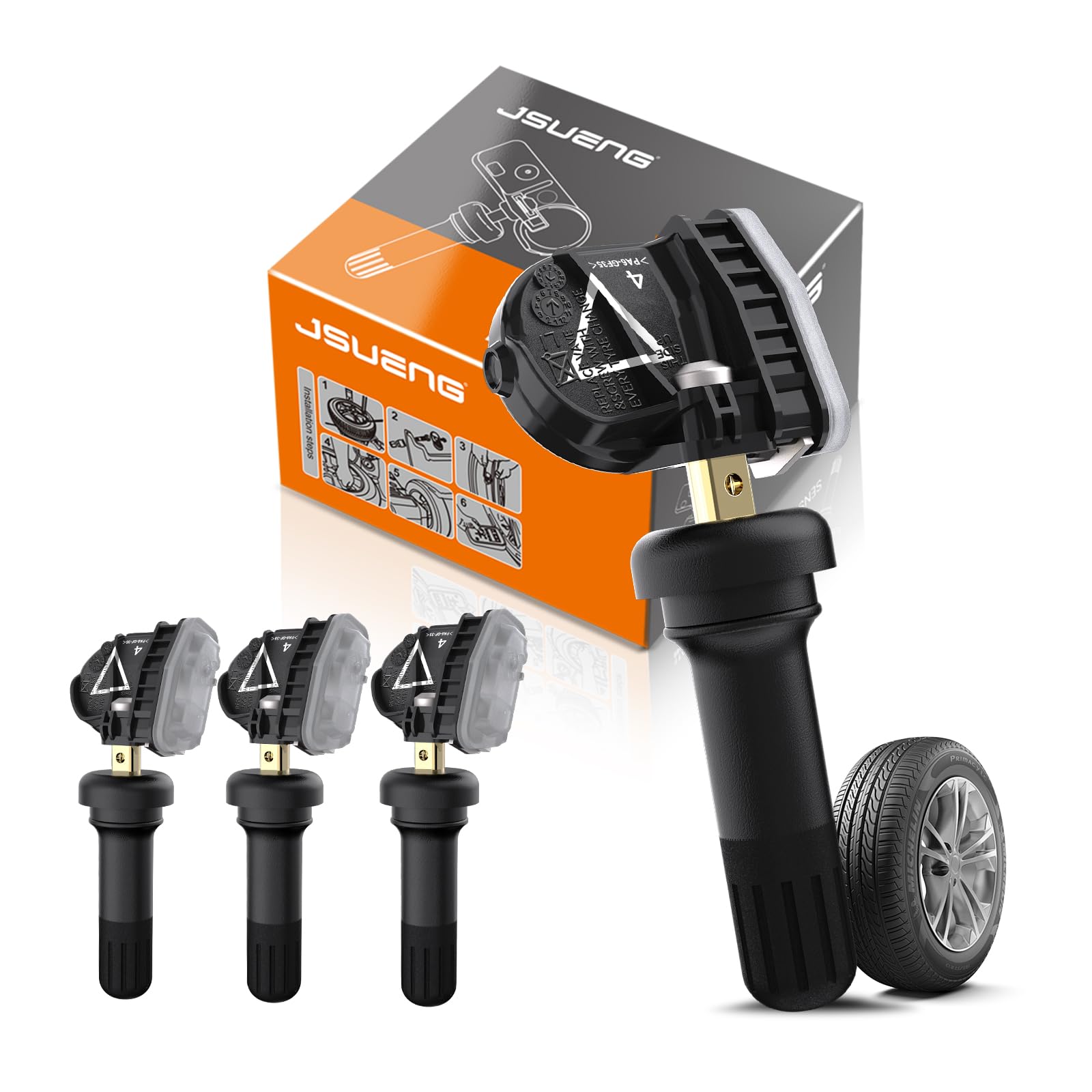
If you drive a late-model GM vehicle and just want the dash warning to go away without spending much, this Jsueng four-pack is the most affordable option. It is pre-programmed with OEM part numbers 13598773, 13512347, and several others, and fits a huge range — Buick Enclave, Encore, LaCrosse, Regal; Cadillac ATS, CT5, Escalade; Chevy Camaro, Cruze, Malibu, Silverado, Tahoe, and many more spanning 2009 through 2025. The sensor uses a CR2032 battery (a common coin-cell battery) and a 900 KPa (130.53 PSI) chip that the maker claims can last 5-8 years under normal use. It operates in temperatures from -40°C to +125°C (-40°F to 257°F).
Customers note these fit perfectly and programmed easily. One owner mentioned they installed them on a 2017 Chevy Cruze at a Discount Tire shop with no issues. Another reviewer said they fit a 2017 Chevy Malibu “like oem no problem.” The company says every sensor undergoes durability tests, high-and-low-temperature tests, and noise tests before shipping. The 1-year guarantee is shorter than what A-Premium or MORESENSOR offers, but at this price point you are not paying for a long warranty period. Just remember: pre-programmed does not mean auto-pair — you still need a relearn procedure after installation using an OBDII tool or a magnet, depending on your vehicle.
The item weight is 4.9 ounces, making it heavier than the A-Premium set (0.15 kg vs 4.9 oz), but that has no practical effect on performance.
Budget-Friendly GM Fix: Four pre-programmed sensors at a price that undercuts most single OEM sensors.
The Catch: The 1-year warranty is half the length of what pricier competitors offer.
Budget value pick: cheapest four-pack for GM owners who plan to keep the car only a few more years and want the light off now.
6. Marsflex TPMS Sensor 42607-33021 (Toyota / Lexus, 315MHz)

The dedicated four-pack for Toyota, Lexus, Scion, and Pontiac Vibe owners.
If you drive a Toyota or Lexus, you do not want to gamble with a universal sensor that might not sync. The Marsflex 42607-33021 is designed specifically for that family — it replaces OE part numbers PMV-107J, 42607-06011, 42607-0C020, and others. It fits models like the RAV4, Camry, Corolla, 4Runner, Tacoma, Tundra, Prius, Highlander, and Lexus ES, GS, RX, and even the Scion line and Pontiac Vibe. The flange-mount design (a metal stem with a flange that bolts to the wheel) is standard for these vehicles and feels solid.
The sensor operates at 315MHz and uses an upgraded battery that handles -40°C to +125°C, with a claimed lifespan of 5-8 years. At 0.2 kg it is slightly heavier than the A-Premium set (0.2 kg vs 0.15 kg), but that difference is negligible once mounted. Reviewers point out that these work perfectly after programming — one owner replaced three dead sensors on a 2013 Toyota Prius and said installation through the wheel hole was easy, though breaking the tire bead and programming took the most time. Another called them a “great alternative” to Denso, noting that the Denso brand was extremely expensive and that they got four Marsflex sensors for the price of one Denso. However, one reviewer cautioned that the product description can be misleading — a 2006 Toyota Tundra could not be programmed using two different scan tools. The company recommends using Autel MaxiTPMS or Launch CRT5011E tools for programming, so check your tool compatibility before buying.
The 1-year warranty is standard for this price tier. Marsflex states every sensor is extensively tested during manufacturing.
Brand-Matched Fit: OE-specific part numbers for Toyota/Lexus/Scion mean less guesswork at the tire shop.
The Catch: Some older Toyota models may require specific high-end programming tools that not every shop has.
Best for: owners of a 2010-2020 Toyota or Lexus who want a direct factory-style replacement without buying a universal sensor and dealing with programming.
Understanding the Specs
Frequency (MHz)
The radio band your sensor uses to talk to your car’s receiver. Most North American vehicles use 315MHz; European and Asian cars typically use 433MHz. If you pick the wrong frequency, your car’s computer will never see the sensor. Some universal sensors, like the Autel MX, include both frequencies in one unit.
Pre-Programmed vs Programmable
A pre-programmed sensor already has the correct vehicle data loaded — you install it and do a relearn. A programmable sensor is blank and needs a special tool (like an Autel TS408) to write the data before installation. Pre-programmed is simpler for DIYers; programmable is more flexible if you change vehicles later.
Measurement Accuracy
How precisely the sensor reads pressure, often expressed in Bar or PSI. For example, the A-Premium sensor lists ±0.06 Bar accuracy, meaning the reading can be off by about 0.87 PSI at most. Higher accuracy means you get a more reliable early warning of a slow leak.
Relearn Procedure
The step your car needs after you install new sensors so the ECU recognizes them. Some cars do an automatic relearn after driving a few minutes. Others need an OBDII scanner, a magnet, or a dedicated activation tool. Check your owner’s manual — if you skip this, the TPMS light stays on.
FAQ
Can I install a TPMS sensor myself or do I need a shop?
What is the difference between 315MHz and 433MHz sensors?
Will any TPMS sensor work with my car?
How long do TPMS sensor batteries last?
What does “relearn” mean and why do I need it?
Can I use a sensor from a different brand on my car?
What is the difference between snap-in and clamp-in sensors?
How do I know if a TPMS sensor is defective?
Can external TPMS sensors be stolen?
Is it safe to drive with the TPMS light on?
Final Thoughts: The Verdict
For most people, the air pressure sensor winner is the Autel MX-Sensor 4-Pack because its dual-frequency (315MHz + 433MHz) design covers nearly any passenger car and its unlimited reprogramming means you can move it to a different vehicle later. If you want a five-minute driveway install on a GM vehicle with no tire removal, grab the Masoll TPMS Kit with Relearn Tool. And for a drop-in Ford replacement with a 3-year warranty, the MORESENSOR Signature Series is the most straightforward choice.
How We Picked
We do not accept paid placement, and we did not hands-on test every unit. Instead, we match each pick to a real buyer and use-case by comparing the manufacturers’ published specifications against the patterns in verified customer reviews — so you get each pick’s real strengths and trade-offs instead of marketing copy.
Sources & Methodology
Specifications: manufacturer listings and product documentation. Review insights: verified customer reviews, as of July 2026. Pricing: not shown on this page (it changes often); check the current price via the retailer link.
As an Amazon Associate, Gadgets Feed earns from qualifying purchases. This does not affect which products we feature.
Product prices and availability are accurate as of the date/time indicated and are subject to change. Any price and availability information displayed on Amazon at the time of purchase will apply to the purchase of this product. As an Amazon Associate I earn from qualifying purchases.
CERTAIN CONTENT THAT APPEARS ON THIS SITE COMES FROM AMAZON. THIS CONTENT IS PROVIDED "AS IS" AND IS SUBJECT TO CHANGE OR REMOVAL AT ANY TIME.
Amazon and the Amazon logo are trademarks of Amazon.com, Inc. or its affiliates.