
When flu season hits, your indoor air becomes a primary vector. An air purifier targeting flu isn’t about dust or pollen—it’s about capturing viral-laden respiratory droplets and aerosols that linger in the air for hours. The right HEPA system can remove these microscopic particles before they reach your family’s airways.
I’m Min — the co-founder and writer behind Gadgets Feed. For this guide, I’ve spent weeks cross-referencing CADR ratings against real-world capture efficiency at 0.1 microns, analyzing the specific filter media that can trap respiratory viruses, and evaluating which units maintain quiet enough operation for a sick room without sacrificing clean air delivery.
If you need to clear the air in a high-risk household, consult a doctor, but for hardware, you need a machine that moves enough air through a properly rated HEPA filter. I’ve sorted through the specifications to help you find the best air purifier for flu.
How To Choose The Best Air Purifier For Flu
Not every purifier is built to handle the challenge of airborne viruses. Flu-laden particles can be as small as 0.1 to 0.3 microns, often enveloped in respiratory moisture that affects how they behave in airflow. You need a unit that combines high CADR, a sealed HEPA path, and a fan motor capable of turning over room air multiple times per hour.
True HEPA vs HEPA-Type: A Hard Line for Viral Capture
True HEPA filters are rated to capture 99.97% of particles at 0.3 microns, which is the most penetrating particle size (MPPS). Many units labeled “HEPA-type” or “HEPA-grade” use looser media that can let virus aerosols slip through. For flu protection, insist on True HEPA or H13/H14 medical-grade specifications. The Levoit EverestAir-P and Air Oasis iAdaptAir 2.0 both use media that tests well at sub-micron particle sizes.
CADR: The Speed of Viral Removal
Clean Air Delivery Rate (CADR) tells you how quickly the purifier can remove particulate matter from a defined room size. For flu control, look for a CADR of at least 200 CFM for smoke (the smallest simulated particle) in a room around 300 square feet. Higher CADR means the machine can reduce viral load faster—critical when someone in the house is actively shedding virus. The Coway Airmega AP-1512HH(W) delivers a smoke CADR of 233 CFM, making it a fast responder.
Air Changes Per Hour (ACH) and Room Matching
Most homes need 4 to 6 air changes per hour to meaningfully reduce airborne pathogen concentrations. If you place an underpowered unit in a large room, you’ll get less than one change per hour—essentially useless for flu mitigation. Measure your room’s cubic footage and divide by the purifier’s CFM to estimate real ACH. The Winix 5520, for instance, can achieve 5 ACH in a room up to 392 square feet thanks to its high-motor output.
Quick Comparison
On smaller screens, swipe sideways to see the full table.
| Model | Category | Best For | Key Spec | Amazon |
|---|---|---|---|---|
| Coway Airmega AP-1512HH(W) | Premium | Fast viral load reduction | Smoke CADR 233 CFM | Amazon |
| Levoit EverestAir-P | Premium | Large room coverage | CADR 354 CFM | Amazon |
| Air Oasis iAdaptAir 2.0 | Premium | Medical-grade filtration | H13 HEPA, 0.05 micron | Amazon |
| Nuwave OxyPure ZERO | Premium | Zero filter replacements | Coverage 2,002 sq ft | Amazon |
| Blueair Blue 311i+ | Premium | Quiet whole-home coverage | 23 dB, 3,385 sq ft | Amazon |
| WINIX 5520 | Mid-Range | Real-time particulate monitoring | True HEPA, 0.01 micron | Amazon |
| HoMedics 5-in-1 | Mid-Range | Odor and particle dual action | UV-C + HEPA-type | Amazon |
| GermGuardian AC4825E | Budget | Entry-level flu defense | True HEPA, 0.1 micron | Amazon |
| LEVOIT Core 300-P | Budget | Compact bedroom protection | AHAM CADR 167 CFM | Amazon |
In‑Depth Reviews
1. Coway Airmega AP-1512HH(W)
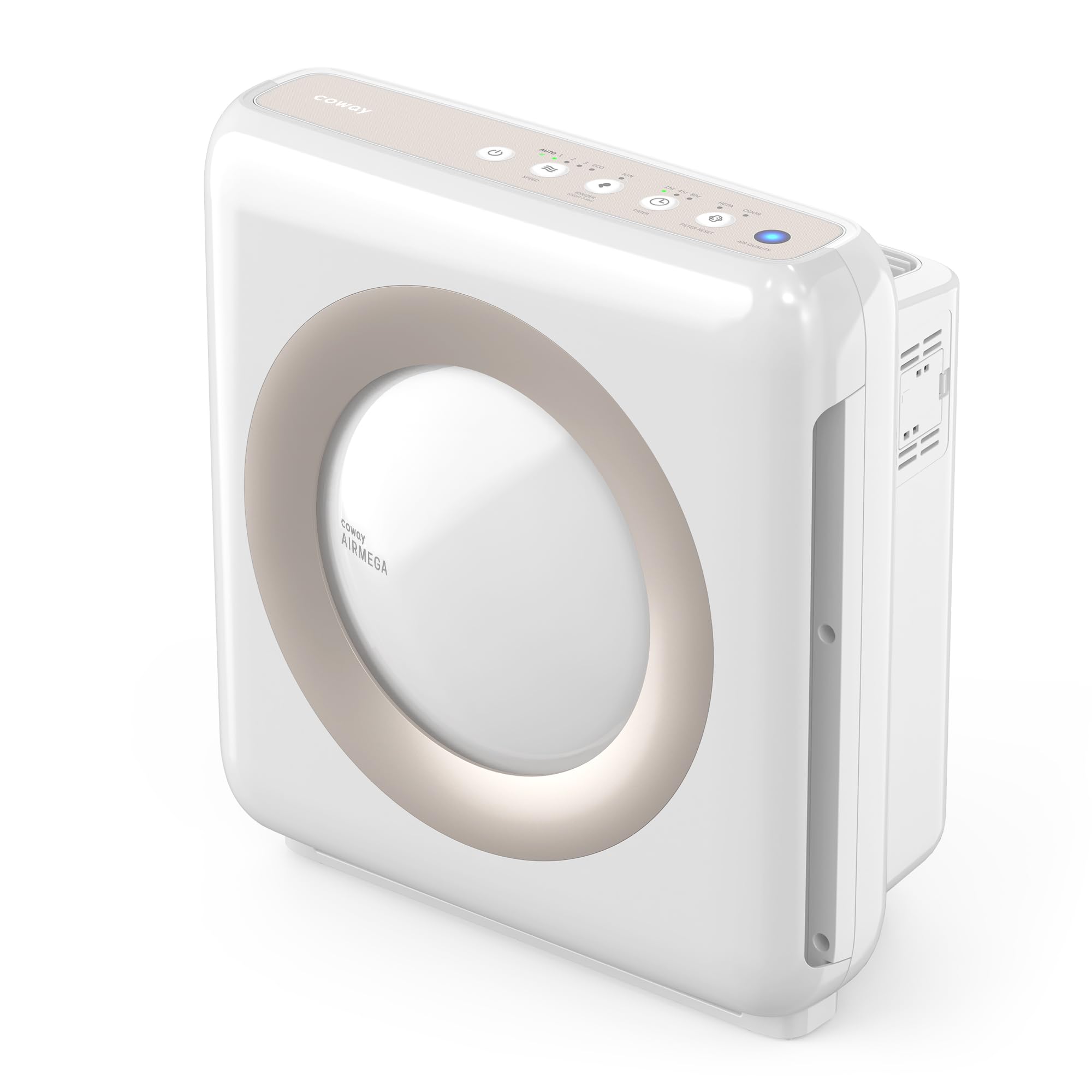
The Coway Airmega has been a Wirecutter top pick for years, and for flu protection the numbers back it up. Its 4-stage filtration pathway includes a washable pre-filter, a deodorization carbon layer, True HEPA, and a Vital Ion option. The smoke CADR of 233 CFM means it can turn over a 361-square-foot room rapidly, reducing the airborne viral load much faster than smaller units. In auto mode, the pollution sensor continuously reads the air and adjusts fan speed—if you or a family member coughs, it responds within seconds.
What sets it apart for flu use is the Eco mode: when the sensor detects no pollution for 30 minutes, the fan shuts off to save energy but instantly reactivates when particles spike. This is ideal for a sick room where you want continuous surveillance without constant fan noise. The noise floor on low is a near-silent 24.4 dB, which means it won’t disturb sleep—critical when rest is the primary recovery tool. The unit pulls 77 watts at max speed, making it one of the more power-efficient premium purifiers.
On high speed, the Coway generates 53.8 dB—noticeable but not deafening. The upward airflow design pushes cleaned air toward the ceiling, promoting better room mixing than front-facing vents. One reviewer with COPD reported it vastly outperformed their previous Alen T100 for symptom relief. The filter replacement indicator checks both the pre-filter and HEPA separately, so you never guess when to swap media. For most households, this is the gold standard for flu-season air defense.
Why it’s great
- High smoke CADR ensures fast virus particle removal
- Auto mode with pollution sensor responds to coughs instantly
- Whisper-quiet low speed for undisturbed sleep
Good to know
- Ionizer may produce trace ozone—use sparingly
- No Wi-Fi or app connectivity
- Replacement filters are proprietary and moderately priced
2. Levoit EverestAir-P

Levoit’s flagship EverestAir-P delivers the highest CADR in this lineup at 354 CFM, covering up to 2,655 square feet in one hour. For flu mitigation in an open-concept home, that raw air-moving power is invaluable—it can clear a living room of aerosolized particles in minutes. The adjustable air outlet pivots from 45° to 90°, so you can direct the cleaned stream toward a sleeping area or a high-traffic zone. It uses a 3-stage filter with an activated carbon pellet layer that delivers 60% more carbon mass than Levoit’s Vital 200S-P, which helps neutralize viral odors and VOCs associated with illness.
What makes this unit exceptional for flu season is the 3-channel laser sensor that monitors PM1.0, PM2.5, and PM10 particle sizes independently. You can see in the VeSync app exactly when particle counts spike after someone coughs or sneezes, giving you real-time feedback on air quality. The HEPA Sleep Mode maintains HEPA-grade filtration while dropping to near-silent levels, which is crucial for a sick room. The washable pre-filter and wheels simplify maintenance—you can roll it from bedroom to living room as needed.
The downsides are the cost: replacement filters run about each and may need swapping every six months with heavy use. The combined carbon-HEPA cartridge means you can’t replace one independently—when the carbon saturates, you lose HEPA performance too. The unit’s size (23 inches tall) is substantial, but the sleek silvery-grey finish blends with most decor. Many users reported a reduction in allergy medication dependency after using this unit, and one reviewer eliminated seasonal meds entirely. If your budget accommodates it, the EverestAir-P is a powerhouse for whole-home flu protection.
Why it’s great
- Highest CADR in the list for rapid viral particle removal
- 3-channel laser sensor gives detailed particle count data
- Adjustable air outlet directs flow where needed
Good to know
- Combined filter means carbon and HEPA must be replaced together
- Replacement filters are expensive at each
- Turbo mode is loud—best used when room is empty
3. Air Oasis iAdaptAir 2.0

The iAdaptAir 2.0 steps into medical-grade territory with its H13 HEPA filter, rated to capture particles as small as 0.05 microns—significantly smaller than the standard 0.3 micron threshold. For flu viruses, which range from 0.08 to 0.12 microns in diameter, this extra margin of capture is meaningful. The 5-stage filtration adds a silver ion screen to inhibit microbial growth on the filter media, a carbon layer for VOCs, bipolar ionization, and UV-C light. This multi-layer approach is recommended by healthcare professionals treating biotoxin illnesses.
At just 7 pounds and measuring 5.4 by 8.5 by 9.7 inches, this is the most compact premium purifier in the lineup. Yet it covers 1,325 square feet in one hour or provides 5 air exchanges per hour in a 265-square-foot room. The auto mode uses a laser particle sensor that displays green, orange, or red status along with a digital particle count—you can watch the number drop after running the unit. The Wi-Fi chip is removable for EMF-sensitive users, a thoughtful design detail. Reviewers consistently praise its near-silent operation, with many saying they forget it’s running.
The trade-offs are real: the maximum CADR is 177 CFM, lower than the Coway or Levoit, meaning it takes longer to clear larger spaces. The app is outdated and the Wi-Fi module uses an older standard with known security vulnerabilities—users recommend placing it on an isolated IoT VLAN. The top light is bright and cannot be turned off, which may disturb sleepers. However, for a bedroom or small living area requiring medical-grade filtration against flu particles, the iAdaptAir 2.0 offers performance that rivals much larger units. Filters last up to 2 years, lowering long-term costs.
Why it’s great
- H13 HEPA captures particles down to 0.05 microns
- Ultra-compact and lightweight for easy room-to-room portability
- 5-stage filtration with UV-C and silver ion screen
Good to know
- CADR of 177 CFM is lower than larger competitors
- Bright top light cannot be dimmed
- Wi-Fi module uses outdated, less secure technology
4. Nuwave OxyPure ZERO

The Nuwave OxyPure ZERO is built on a radical premise: no filter replacements ever. The dual 4-stage system uses stainless steel pre-filters and patented Bio-Guard filters that are washable and reusable. Over a decade, that can save hundreds in replacement costs while maintaining consistent performance. For flu-season use, this is a pragmatic choice—you never have to worry about whether the filter is still effective because you simply rinse and reuse. Intertek lab certification shows it captures up to 100% of airborne particles at 0.1 microns.
Covering up to 2,002 square feet, this is one of the largest-capacity units available, making it suitable for open floor plans or multi-room scenarios during flu outbreaks. The adjustable vents offer 30°, 60°, and 90° angles to direct airflow precisely where it’s needed—point it toward a seating area where someone is recovering. The night-time sleep mode drops to 21.41 dB, the quietest in this comparison, with all indicator lights turning off to prevent light pollution. The NuWave Connect app lets you monitor and control settings remotely.
At 22 pounds and 23 inches tall, this is a substantial appliance—not something you’ll move daily. The sleep mode is genuinely silent, but the auto mode can be erratic, sometimes running on medium fan unnecessarily for hours. Some users noted it does not auto-restart after a power outage, which is a concern if you rely on it for continuous viral load management. The ozone emission removal filter is a unique feature that eliminates toxic ozone to less than 1 ppb, making this a safe choice for those worried about ionization byproducts. For a “set it and forget it” approach to flu protection, the OxyPure ZERO is hard to beat.
Why it’s great
- Washable filters mean zero replacement costs
- Extremely quiet sleep mode at 21.41 dB
- Massive coverage for open floor plans
Good to know
- Heavy at 22 pounds—not easily portable
- Auto mode behavior can be inconsistent
- Does not restart after a power outage
5. Blueair Blue 311i+
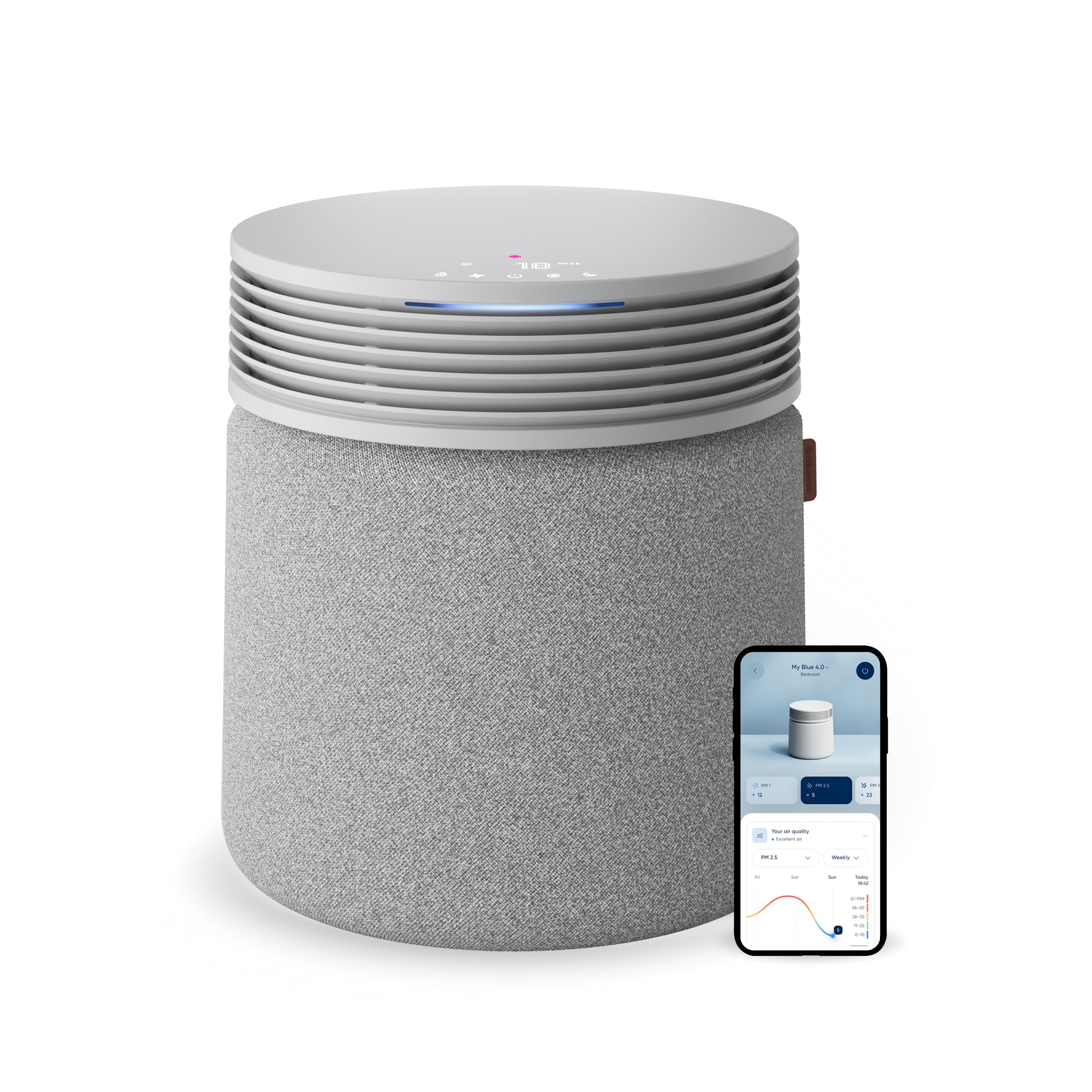
Blueair’s HEPASilent technology uses an electrostatic charge to trap particles without forcing air through dense media, which is why it achieves whisper-quiet operation at just 23 dB on low. For flu protection in a bedroom or nursery, this is a decisive advantage—you can run it 24/7 without disturbing sleep or work. The unit covers up to 3,385 square feet in one hour, the largest footprint in this list, making it ideal for whole-home strategies. Its OdorFence technology uses activated carbon to break down VOCs and odors that accompany illness.
The auto mode intelligently adjusts fan speed based on real-time air quality readings, displayed via a 5-color LED indicator built into the air outlet. The Scandinavian design means it doubles as a side table, with interchangeable pre-filters available in multiple colors to match your decor. The Blueair app offers full control over schedules, fan speed, and air quality data from anywhere. Reviewers consistently note its ability to eliminate moldy smells and reduce sneezing within days of use. One review highlights its effectiveness in a home with 3 cats and 4 kids, keeping the air noticeably fresher.
The main drawback is that the carbon layer is relatively thin—odor removal effectiveness drops after about two weeks of heavy use. The ionization component can cause fine dust to settle on surfaces, which some users find noticeable on dark furniture. While not technically a True HEPA filter (it uses electrostatic media), independent testing shows it captures 99.97% of particles down to 0.1 microns, so viral capture remains strong. The filter lasts 6 months or more, and aftermarket options are available. For quiet, around-the-clock flu defense in large spaces, this is the silent champion.
Why it’s great
- Near-silent at 23 dB for 24/7 use
- Largest coverage area at 3,385 sq ft
- Furniture-grade design with customizable colors
Good to know
- Carbon layer saturates quickly for odor control
- Ionization may cause dust settling on surfaces
- Not a mechanically sealed True HEPA system
6. WINIX 5520
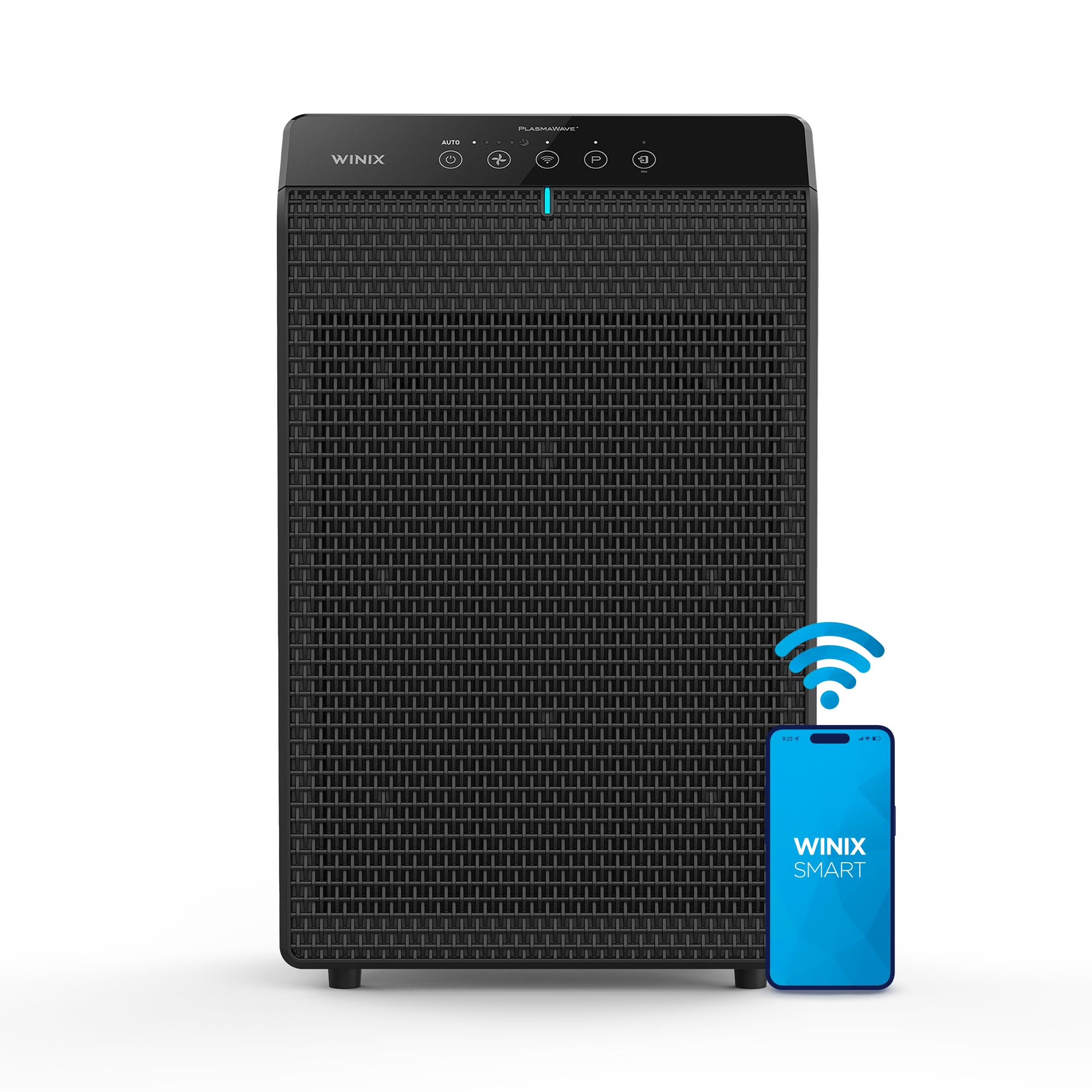
The WINIX 5520 brings professional-grade particulate monitoring to the mid-range price point. Its True HEPA filter captures 99.99% of airborne allergens as small as 0.01 microns, which is an order of magnitude smaller than the standard 0.3 micron rating. For flu virus capture, this extra margin means even the smallest aerosolized particles are reliably trapped. The unit is AHAM Verified at 392 square feet, with a maximum coverage of 1,882 square feet in one hour. The 4-layer filtration includes a washable fine mesh pre-filter, advanced odor control carbon filter, True HEPA, and Winix’s Plasmawave technology.
The standout feature is the air quality indicator with real-time LED feedback, combined with auto mode that adjusts fan speed based on sensor readings. When the room darkens, the sleep mode automatically activates, switching to ultra-quiet energy-efficient operation at 23.5 dB. This light-automated sleep mode means you never have to manually set it before bed—it just adapts. The Winix Smart App adds remote control and monitoring, though integration with Alexa can be finicky according to some users. The magnetic front panel makes filter access tool-free and quick.
The carbon filter is designed as a separate layer that prolongs True HEPA life by capturing VOCs and odors first. Reviewers praise its effectiveness against wildfire smoke, with one user noting it kept their indoor air clear while the outside air was hazardous. The 13.3-pound weight makes it moderately portable, and filters last approximately 12 months at typical use. The Plasmawave ionizer is effective but produces some ozone, so sensitive users may want to keep it off. For a mid-range unit with near-premium sensor technology, the WINIX 5520 delivers exceptional value.
Why it’s great
- Captures particles down to 0.01 microns
- Light-automated sleep mode for convenience
- Separate carbon filter extends HEPA life
Good to know
- Alexa integration can be problematic
- Plasmawave ionizer may produce trace ozone
- Carbon filter is thin and may need frequent replacement
7. HoMedics 5-in-1 UV-C

The HoMedics TotalClean Deluxe 5-in-1 integrates UV-C light technology alongside HEPA-type filtration to target airborne pathogens. While HEPA-type media doesn’t meet the 99.97% 0.3 micron standard of True HEPA, the UV-C chamber provides an additional layer of microbial reduction that can inactivate viruses captured on the filter surface. For flu mitigation, this combined approach offers a secondary defense—particles caught in the pre-filter or carbon layer are exposed to UV-C light. The unit covers rooms up to 1,593 square feet, with 5 speed settings for customized airflow.
A unique feature for flu season is the built-in essential oil tray with three included pads. Adding eucalyptus or peppermint oil can help with nasal congestion while the purifier removes airborne particles. The auto-off timer extends up to 12 hours, letting you run it through an entire sleep cycle. The night-light is optional and can be turned off. The included remote control means you can adjust settings without getting up—useful when you or a family member is feeling unwell. Reviewers note a noticeable reduction in dust build-up and airborne particles within 10 days of use.
The HEPA-type filter is less effective than True HEPA for sub-micron viral particles—this is the unit’s main limitation for flu-specific use. The fan can be loud on the highest settings, though low and auto modes are quiet enough for sleeping. At 25 inches tall, it’s one of the larger units, so floor space is a consideration. The UV-C bulb will need periodic replacement, adding to long-term maintenance. For households where aromatherapy and broad particle reduction are as important as absolute viral capture, the HoMedics offers a differentiated multifunction approach.
Why it’s great
- UV-C light provides secondary microbial reduction
- Essential oil tray supports congestion relief during flu
- Remote control for convenient adjustments from bed
Good to know
- HEPA-type filter is less effective than True HEPA on virus particles
- Loud at high fan speeds
- UV-C bulb requires periodic replacement
8. GermGuardian AC4825E

The GermGuardian AC4825E has been a reliable budget workhorse since 2011, and its True HEPA filter is the key differentiator for flu protection at this price level. It captures 99.97% of allergens as small as 0.1 microns, including the size range of influenza viruses. For a small bedroom (153 square feet), it cycles the air every 12.5 minutes on high, providing 4.8 air changes per hour. The optional UV-C light further reduces airborne bacteria and viruses, though as a secondary treatment rather than primary capture. The activated carbon filter reduces cooking and pet odors that linger during illness.
The three-speed dial includes a quiet sleep mode that’s barely audible on low—a critical feature for a sick room where sleep is paramount. The washable first-stage pre-filter captures larger particles and extends the life of the main HEPA filter, which lasts 6 to 12 months depending on use. The 22-inch tower design is tall and slim, fitting into tight corners. Users with asthma and allergies consistently report reduced symptoms and improved breathing within days. One reviewer noted the unit helped avoid pneumonia during a respiratory illness, crediting the continuous air cleaning.
The downsides are predictable for a budget unit: the UV-C bulb is an extra cost and doesn’t automatically illuminate pathogens—it’s more of a feel-good feature. On high, the unit is noticeably loud at around 50 dB, making it difficult to use in a quiet bedroom at that setting. The controls are basic—no auto mode, timer, or air quality sensor. You must manually adjust speeds throughout the day. The carbon filter is thin and saturates relatively quickly. Despite these limitations, for strict flu-season use in a small bedroom, the GermGuardian provides proven True HEPA filtration at a price that leaves room for a second unit.
Why it’s great
- True HEPA at a budget-friendly price point
- UV-C light adds pathogen reduction
- Washable pre-filter extends HEPA life
Good to know
- No auto mode or air quality sensor
- Loud on high fan setting
- UV-C bulb adds ongoing cost
9. LEVOIT Core 300-P

The Levoit Core 300-P proves you don’t need a massive budget for effective flu-season air purification. With a CADR of 143 CFM for smoke, it delivers 4.8 air changes per hour in a 222-square-foot room and cycles a 1,073-square-foot room once per hour. The 56W high-torque motor is surprisingly powerful for a 7.9-pound unit, and the 3-in-1 filter captures 99.97% of particles at 0.1 to 0.3 microns. For a bedroom or home office where flu exposure is a concern, this compact unit provides solid viral particle capture without dominating the room visually.
QuietKEAP Technology drops noise to a near-silent 24 dB in Sleep Mode, making it virtually unnoticeable during nighttime use. The display lights can be turned off completely, eliminating any light pollution for sensitive sleepers. The timer offers 2, 4, 6, or 8-hour increments, and the check filter indicator takes the guesswork out of maintenance. Multiple filter options are available including a Toxin Absorber for VOCs and a Smoke Remover for wildfire smoke, meaning you can tailor the filtration to your specific seasonal needs. AHAM Verifide certification ensures independent validation of its performance claims.
The limitations are clear: at 7.9 pounds and 14.2 inches tall, it’s not designed for whole-home coverage—you’ll need one unit per room. There’s no air quality sensor, auto mode, or app connectivity, so you must manually select fan speed. The replacement filter costs add up over time, and third-party filters may not fit or perform as well. On high speed, the 50 dB noise level is noticeable but not disruptive. For targeted flu-season protection in a single room where budget is a primary concern, the Core 300-P delivers reliable True HEPA performance in a compact, attractive package.
Why it’s great
- AHAM Verifide for independent performance validation
- Near-silent 24 dB sleep mode
- Compact and lightweight for easy placement
Good to know
- No auto mode or air quality sensor
- Room coverage limited to small spaces
- Replacement filters add ongoing cost
FAQ
Can an air purifier actually capture flu viruses from the air?
What CADR do I need for flu protection in a 300-square-foot room?
Should I run the purifier all day or only when someone is sick?
Final Thoughts: The Verdict
For most users, the best air purifier for flu winner is the Coway Airmega AP-1512HH(W) because it combines a high smoke CADR of 233 CFM with proven True HEPA performance, an auto mode that responds to particle changes in seconds, and quiet enough operation for undisturbed sleep. If you want whole-home coverage with real-time particle data, grab the Levoit EverestAir-P with its 354 CFM CADR and 3-channel laser sensor. And for intensive medical-grade filtration in a compact footprint, nothing beats the Air Oasis iAdaptAir 2.0 with its H13 HEPA and 0.05 micron capture rating.