
That lingering odor of last night’s fish fry or this morning’s bacon doesn’t just vanish — it settles into fabrics, clings to walls, and announces your dinner menu to every guest who walks through the door. Standard air purifiers often lack the carbon mass needed to chemically adsorb and neutralize complex cooking VOCs, leaving your kitchen smelling like a diner long after the stove is off. The right unit combines a dense activated carbon layer with a high-CADR motor to cycle that greasy air through filtration before it embeds itself into your home.
I’m Min — the co-founder and writer behind Gadgets Feed. I’ve spent countless hours analyzing filtration stack configurations, carbon weight specifications, and CADR ratings across dozens of models to isolate which designs actually tackle the molecular structure of food-based odors rather than just masking them with ionizers.
This guide breaks down the seven best contenders for neutralizing kitchen aromas, weighing carbon filter density against airflow efficiency so you can finally cook garlic and onions without your whole house smelling like a trattoria. Find your perfect best air purifier for food smell below.
How To Choose The Best Air Purifier For Food Smell
Fighting food odors requires a fundamentally different filtration approach than trapping dust or pollen. The molecular weight of cooking VOCs — from searing steak to simmering curry — demands dense carbon media and high airflow, not just a fine HEPA mesh. Here are the three pillars to evaluate before buying.
Activated Carbon Mass and Density
The single most important spec for odor neutralization is the weight and quality of the activated carbon layer. A thin, honeycomb-style carbon sheet found in budget units gets saturated within weeks when exposed to daily cooking. Look for models that advertise a thick carbon pellet bed or a dedicated deodorization filter with a measured carbon weight — the heavier the carbon, the longer it chemically adsorbs food VOCs before breakthrough occurs.
Clean Air Delivery Rate (CADR) for Smoke
Food smells travel fast in open-plan homes. The smoke CADR rating (measured in CFM) directly correlates to how quickly the unit can cycle air through the carbon filter. A CADR of 200+ CFM for smoke means the purifier can scrub a 400-square-foot kitchen roughly four times per hour. Higher CADR also prevents odors from migrating into adjacent living spaces during active cooking.
Pre-Filter Design for Grease Particles
Cooking releases aerosolized grease that cling to internal components and degrade carbon performance over time. A washable mesh pre-filter captures these oily particles before they reach the carbon bed, extending filter life and maintaining odor-adsorption efficiency. Units with electrostatic or stainless-steel pre-filters allow you to rinse away grease buildup weekly instead of replacing the main filter monthly.
Quick Comparison
On smaller screens, swipe sideways to see the full table.
| Model | Category | Best For | Key Spec | Amazon |
|---|---|---|---|---|
| Coway Airmega AP-1512HH | Premium | Sensor-driven odor auto-detection | 233 CFM Smoke CADR / 4-Stage Filtration | Amazon |
| PuroAir 240 | Premium | Large room odor clearance | 1,000 sq ft coverage / 3-Layer Filtration | Amazon |
| Winix 5510 | Mid-Range | App-controlled odor management | Advanced Odor Control Carbon Filter / 23.5dB Sleep | Amazon |
| Dhyala KJ02 | Mid-Range | Pet-friendly kitchen odor control | 271 CFM CADR / 5-Stage Filtration | Amazon |
| Levoit Core 300-P | Mid-Range | Quiet bedroom odor neutrality | 143 CFM Smoke CADR / 56W High Torque Motor | Amazon |
| Nuwave OxyPure ZERO | Premium | Zero-waste long-term odor removal | Washable Bio-Guard Filters / 2,002 sq ft Coverage | Amazon |
| GermGuardian AC4825E | Budget | Entry-level cooking scent reduction | Activated Carbon Filter / UV-C Light | Amazon |
In‑Depth Reviews
1. Coway Airmega AP-1512HH
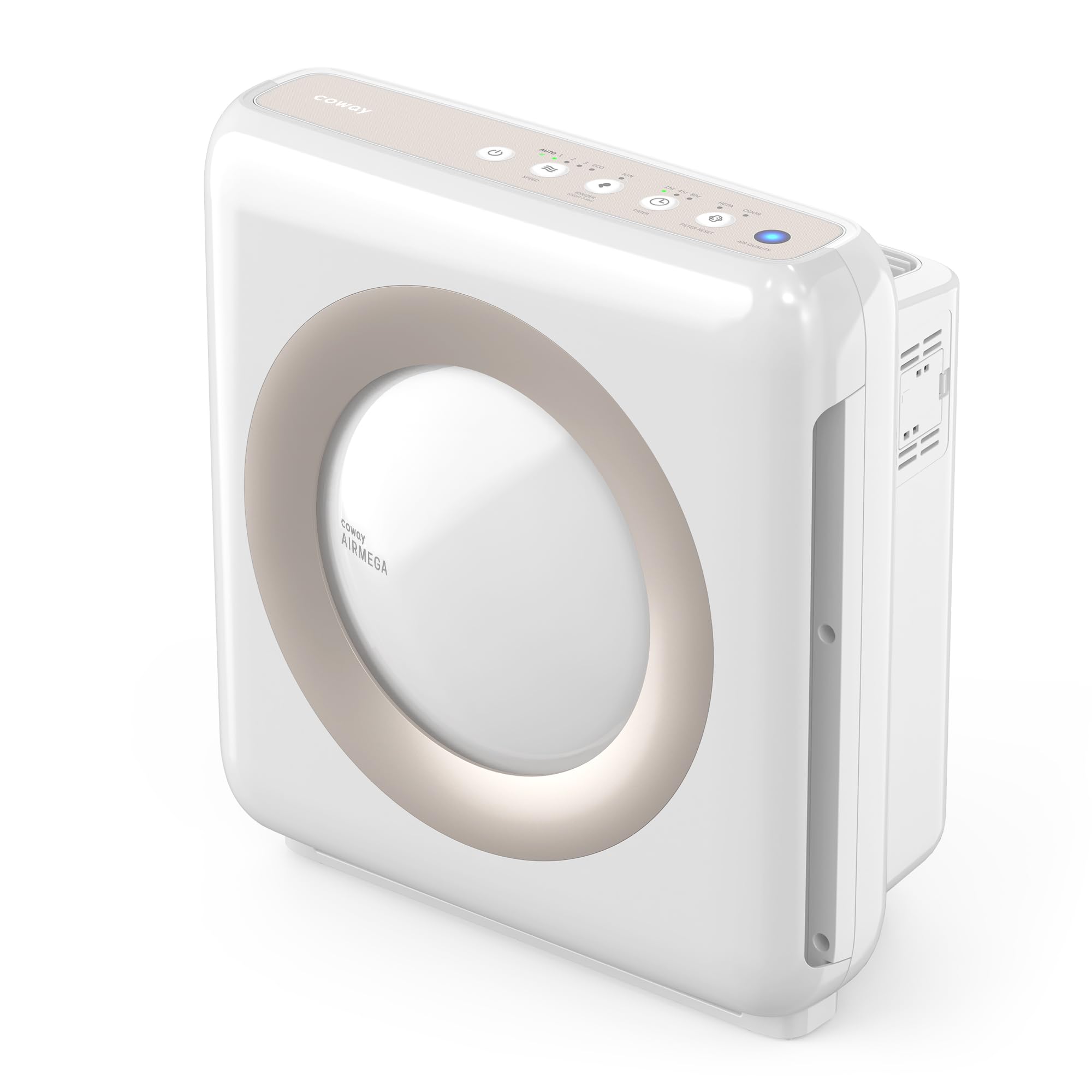
The Coway Airmega AP-1512HH consistently earns its Wirecutter top ranking because its 4-stage system — pre-filter, deodorization carbon filter, True HEPA, and Vital Ion — is engineered specifically for rapid odor detection and neutralization. The pollution sensor reads airborne cooking particles in real time, shifting from blue to red instantly when you sear meat, and the auto mode ramps fan speed to clear the smell within minutes. The 233 CFM smoke CADR means it cycles a standard kitchen volume roughly five times per hour, preventing odors from migrating into adjacent living areas.
Users report the sensor is sensitive enough to detect garlic sautéing from across the room, and the Eco mode automatically shuts the fan off after 30 minutes of clean air, saving energy between meals. The deodorization filter sits behind a washable pre-filter that catches grease splatter, preserving the carbon’s adsorption capacity for months. At 24.4 dB on low, it operates quietly enough to run during dinner prep without competing with conversation.
Reviewers who upgraded from cheaper units noted a dramatic difference in how fast curry and fish smells dissipated — typically within 10 to 15 minutes on auto mode. The only trade-off is the ionizer, which some users found irritating if left on continuously, but it can be toggled off independently. For a balanced mix of sensor accuracy, carbon mass, and trusted CADR performance, this is the reference standard for food odor control.
Why it’s great
- Real-time pollution sensor that auto-adjusts to cooking odors
- Washable pre-filter traps grease before it reaches the carbon bed
- 233 CFM smoke CADR clears large kitchen air quickly
Good to know
- Ionizer may irritate sensitive lungs; can be turned off
- Maximum fan speed is loud at 53.8 dB
2. PuroAir 240
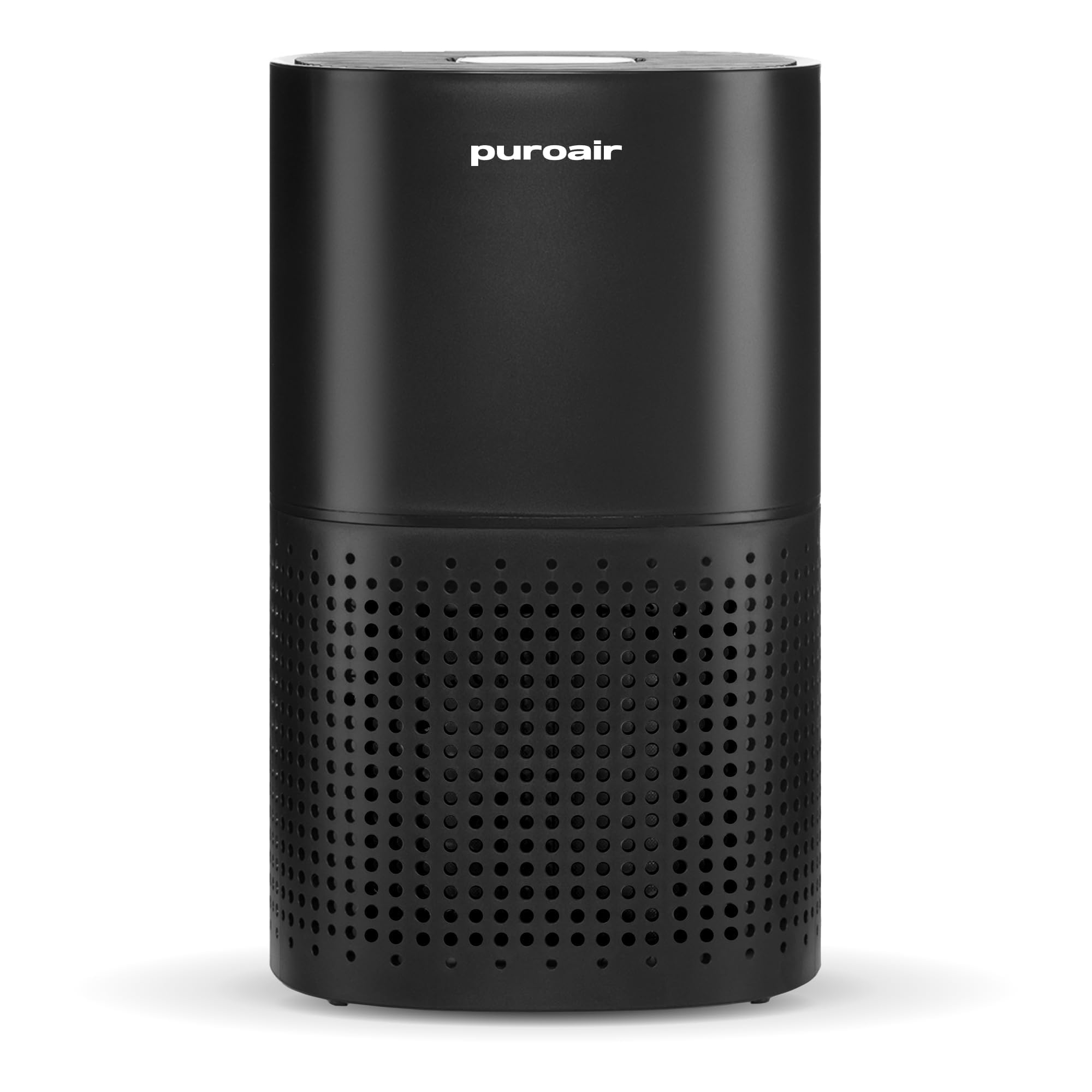
PuroAir markets the 240 as a large-room solution, but its CarbonTech filter layer — a denser activated carbon matrix than typical honeycomb sheets — makes it especially effective at adsorbing the heavy VOCs from frying, grilling, and baking. The 3-layer system (pre-filter, True HEPA, activated carbon) is ISO 17025 certified to capture 99.9% of particles down to 0.3 microns, but the real star for odor work is the carbon mass, which reviews consistently credit for eliminating kitchen smells within 15 to 20 minutes of active cooking.
Users report that the smart particle sensor detects smoke from burnt toast or seared steak almost immediately, switching from sleep mode to higher fan speeds without manual intervention. The 28-inch tower footprint is narrow enough to fit between a counter and a refrigerator, making it practical for tight galley kitchens. At low speed, it runs near-silent at roughly 24 dB, though some users note the medium and high settings produce noticeable white noise that actually helps mask kitchen clatter.
The 2-year risk-free warranty and CARB/ETL certifications add peace of mind for continuous 24/7 operation. The main caveat is that replacement filter costs add up over time — the carbon layer will saturate faster in heavy cooking households, requiring swaps every 6 to 8 months rather than the advertised 12. For open-concept homes where food odors drift into living and dining zones, this unit’s coverage area and carbon density make it a strong contender.
Why it’s great
- CarbonTech filter adsorbs heavy cooking VOCs efficiently
- Smart sensor auto-adjusts to smoke and odor spikes
- Narrow tower design fits small kitchen gaps
Good to know
- Replacement carbon filters cost more and need frequent changes
- Medium and high fan settings produce noticeable noise
3. Winix 5510

The Winix 5510 is the updated generation of the venerable 5500-2, and its primary upgrade — Wi-Fi app control — makes it uniquely useful for scheduling odor clearance around meal times. The Advanced Odor Control Carbon Filter is a dedicated layer specifically designed to reduce VOCs from cooking, pets, and smoke, and it sits behind a washable fine mesh pre-filter that catches airborne grease before it hits the carbon. The AHAM-verified CADR for smoke is competitive in this class, and the 392 sq ft room rating means it can handle a standard kitchen-dining combo without breaking a sweat.
Users praise the auto mode’s sensitivity: the built-in air quality sensor detects food smells within seconds and ramps fan speed from nearly silent (23.5 dB on slowest) to full power. The Winix Smart App lets you turn the unit on 15 minutes before you start cooking, so the carbon bed is already pulling air when the first onion hits the pan. Sleep mode automatically activates when the room darkens, dimming the LED indicator lights and dropping noise to whisper level.
The Plasmawave ionizer is a polarizing feature — some users find it helps neutralize lingering odors, while others disable it due to ozone concerns. The 4-layer filtration (washable pre-filter, carbon, HEPA, ionizer) gives flexibility, but the carbon filter itself is replaceable separately, and at roughly per swap, it’s one of the more affordable consumable options. For tech-savvy cooks who want to pre-cool the air before frying fish, the app integration alone justifies the mid-range price.
Why it’s great
- Wi-Fi app allows pre-scheduled odor clearance before cooking
- Dedicated Advanced Odor Control Carbon Filter for VOCs
- Auto mode responds instantly to cooking smoke
Good to know
- Alexa integration is limited and not truly native
- Plasmawave ionizer may produce trace ozone
4. Dhyala KJ02
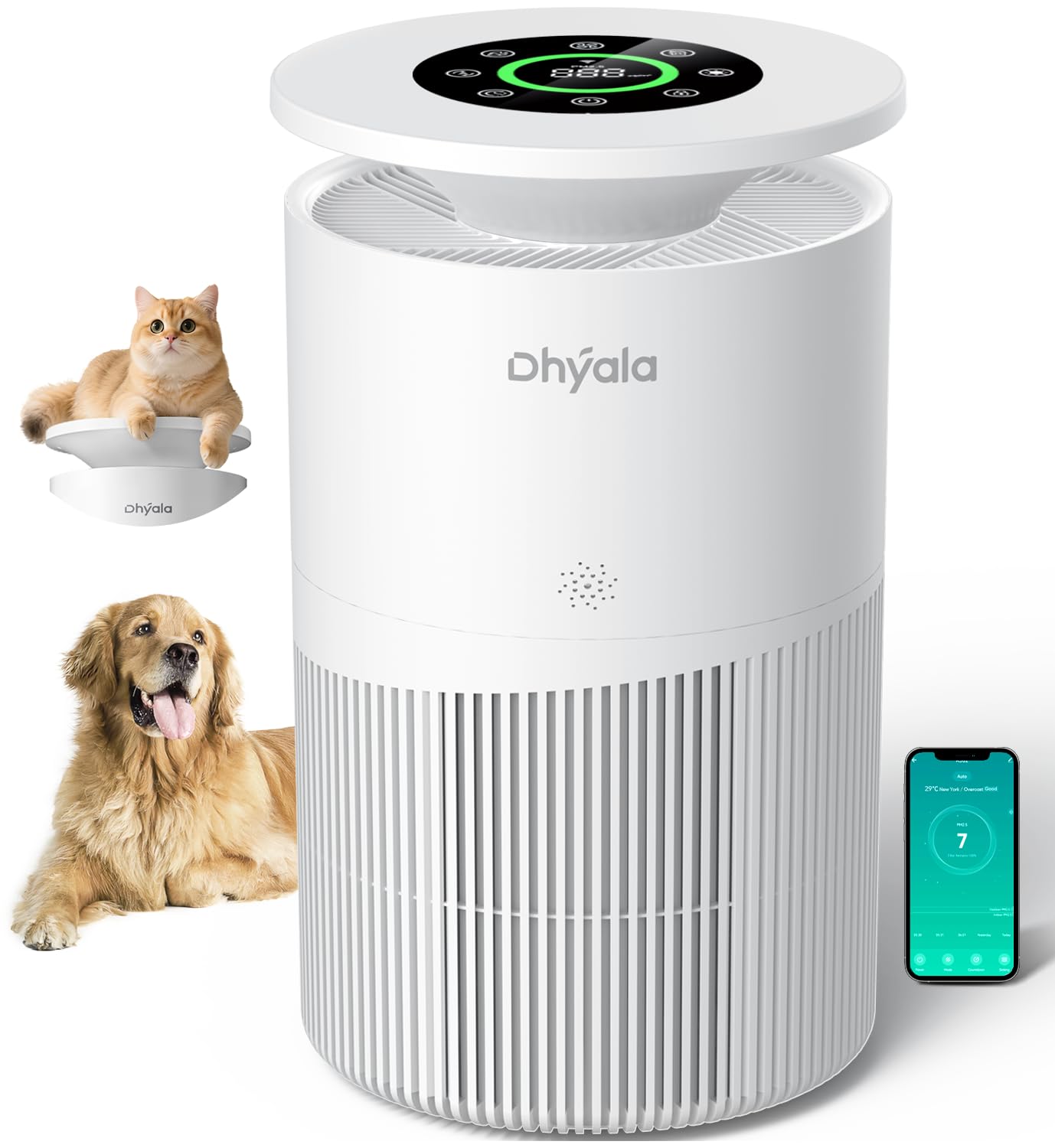
The Dhyala KJ02 delivers a 271 CFM CADR — the highest airflow in this lineup — at a price that undercuts many competitors with similar coverage claims. Its 5-stage filtration system uses electrostatic adsorption on the pre-filter to capture 40% more pet dander and grease than standard 3-layer setups, then passes air through a high-efficiency activated carbon bed that neutralizes food odors with triple the adsorption capacity of conventional filters. The 360-degree intake design pulls smelly air from all directions, which is ideal for open kitchens where odors spread laterally.
Users specifically call out the pet-friendly lying platform on top, which prevents pets from blocking the air outlet while also trapping fur. The smart sensor monitors air quality in real time and adjusts fan speed automatically; reviewers note that cooking bacon triggers the sensor within 30 seconds, switching from silent mode to high until the air clears. The 22 dB sleep mode is among the quietest in this comparison, making it viable for overnight use in kitchens adjacent to bedrooms.
App control via Wi-Fi works with Alexa and Google Assistant, and the large touchscreen display shows real-time particle readings. The main trade-off is that the proprietary filter replacements are less widely available than Levoit or Winix options, and the 2025 manufacture year means long-term reliability data is still emerging. For the price, the combination of high CADR, deep carbon bed, and pet-focused design makes it a compelling value for households that cook frequently and have animals.
Why it’s great
- 271 CFM CADR provides aggressive odor clearance for large kitchens
- 5-stage filtration with electrostatic pre-filter traps grease effectively
- Pet-friendly platform prevents airflow blockage
Good to know
- Replacement filters have limited third-party availability
- Long-term reliability unproven due to recent release
5. Levoit Core 300-P

The Levoit Core 300-P is the smallest and lightest unit in this roundup at under 8 pounds, but its 56W high-torque motor delivers a 143 CFM smoke CADR that punches above its size class. The 3-in-1 filter includes a pre-filter, True HEPA, and activated carbon layer, and Levoit’s filter ecosystem offers specialized options — the Toxin Absorber Filter for heavy VOCs and the Smoke Remover Filter for charring odors — making it highly customizable for different cooking styles. It covers up to 1,073 square feet on a single pass, though effective odor cycling happens in rooms around 220 square feet at 4.8 air changes per hour.
Users consistently highlight the near-silent 24 dB sleep mode, which makes it practical to leave running in a kitchen adjacent to a bedroom overnight. The touch controls include a timer for 2, 4, 6, or 8 hours, and the display lights can be turned off completely — useful for not disturbing a sleeping household. Reviewers specifically call out its effectiveness at reducing cooking odors from frying and grilling in small apartments where the kitchen and living area are combined.
The main limitation is the lack of an auto mode or air quality sensor — all adjustments are manual, so you’ll need to turn it up when you start cooking and remember to switch it back down afterward. The AHAM Verifide certification provides independent validation of its CADR claims, and the multiple filter choices let you optimize for odor-specific needs. For budget-conscious buyers who cook regularly in a compact space, this is the most space-efficient way to eliminate food smells without sacrificing filtration quality.
Why it’s great
- Ultra-compact 8-pound design fits small kitchen counters
- Specialized Toxin Absorber filter targets cooking VOCs
- Sleep mode runs at near-silent 24 dB
Good to know
- No auto mode or air quality sensor
- Manual speed adjustment required when cooking starts
6. Nuwave OxyPure ZERO

The Nuwave OxyPure ZERO eliminates the single biggest recurring cost of odor control: replacement filters. Its dual 4-stage system uses washable stainless-steel pre-filters, ozone emission removal filters, and patented Bio-Guard filters that you rinse under water every 3 to 6 months rather than tossing. The manufacturer claims a 10-year filter lifespan, which radically changes the total cost of ownership for heavy-cooking households that would otherwise burn through carbon filters annually. The unit covers up to 2,002 square feet in one hour, and the adjustable 30°, 60°, and 90° vents let you direct airflow toward the stove or kitchen island.
Users report that the OxyPure ZERO handles extreme odor scenarios — burnt food, fish frying, even wildfire smoke — with a turbo mode that clears the room in 5 to 10 minutes. The built-in sensors detect particulate spikes and switch between auto modes, though some reviewers note the auto mode can behave erratically during power fluctuations. The 21.41 dB sleep mode is the quietest in this lineup, making it suitable for overnight operation without disturbing sleep.
The 22-pound weight and integrated wheels make it easy to roll from kitchen to living area as needed, though the unit is significantly larger than the Levoit or GermGuardian options. The app control allows remote monitoring, and the CARB certification ensures ozone emissions stay below 1 ppb. The standout feature here is the washable carbon-equivalent Bio-Guard technology — for households that cook multiple meals daily and want to avoid recurring filter expenses, this is the most sustainable investment.
Why it’s great
- Washable filters eliminate recurring carbon replacement costs
- Adjustable vents direct airflow toward cooking zones
- Turbo mode clears heavy food odors in under 10 minutes
Good to know
- Large 22-pound unit requires floor space
- Auto mode may not restart after power outages
7. GermGuardian AC4825E

The GermGuardian AC4825E has been a budget staple since 2011, and its longevity in the market speaks to its reliable baseline performance for cooking odor reduction. The activated carbon filter is designed specifically to reduce scents from cooking and pets, and while the carbon layer is thinner than premium units, it provides meaningful odor adsorption for light-to-moderate cooking — think pasta sauces, baked chicken, or morning toast, rather than daily deep-frying. The True HEPA filter captures 99.97% of particles as small as 0.3 microns, and the optional UV-C light helps reduce airborne bacteria that can contribute to stale kitchen smells.
Users consistently report that the unit removes noticeable cooking odors like garlic and onion within 30 to 45 minutes in small to medium rooms up to 153 square feet. The 3-speed dial and UV button are refreshingly simple — no apps, no sensors, just manual control. The washable first-stage pre-filter extends the life of the main filters, though the carbon sheet will need replacement every 3 to 4 months in a cooking-heavy environment. The tower design is slim at 22 inches tall and weighs 8.55 pounds, making it easy to move between kitchen counter and island.
The main trade-offs are noise — the high setting is noticeably loud at around 50 dB, and the unit lacks any auto mode, so you must remember to turn it up during cooking and back down afterward. The UV-C bulb replacement adds a minor ongoing cost, though many users disable the UV feature entirely without affecting odor removal. For entry-level buyers who need a proven, affordable solution for occasional cooking smells, this is the most accessible starting point.
Why it’s great
- Proven 10+ year track record for affordable odor reduction
- Washable pre-filter extends consumable life
- Simple manual controls with no app complexity
Good to know
- Carbon filter needs replacement every 3–4 months with heavy use
- High fan speed is loud; no auto sensor mode
FAQ
How much activated carbon weight is needed to neutralize heavy cooking odors?
Can a HEPA filter alone remove food smells from the air?
Should I place the air purifier on the counter or the floor for best odor removal?
Final Thoughts: The Verdict
For most users, the best air purifier for food smell winner is the Coway Airmega AP-1512HH because its real-time pollution sensor and 233 CFM smoke CADR detect and clear cooking odors automatically without requiring manual intervention. If you want zero ongoing filter costs and washable carbon technology, grab the Nuwave OxyPure ZERO. And for smart scheduling and app-controlled pre-cooling before you start frying, nothing beats the Winix 5510.