
That stale, musty smell that hits you the moment you step into your RV after a rainy night isn’t just unpleasant — it’s a sign of trapped dust, pet dander, cooking odors, and potentially mold spores circulating in a space barely larger than a walk-in closet. In a vehicle where windows stay shut for climate control or security, the air quality can degrade fast, triggering allergies, headaches, and that cabin-fever feeling long before you reach your destination. A dedicated purification unit designed for tight, mobile living spaces is the only practical fix.
I’m Min — the co-founder and writer behind Gadgets Feed. I’ve spent hundreds of hours digging through filtration specs, CADR ratings, noise profiles, and real owner feedback to separate the units that genuinely clean RV air from the ones that just spin a fan.
This guide breaks down seven of the most viable options on the market right now, helping you pinpoint the right air purifier for rv based on your rig’s layout, your power budget, and the specific pollutants you want gone.
How To Choose The Best Air Purifier For RV
RV air is a unique cocktail — diesel fumes from the generator, mold spores from humidity, pet dander in a confined floorplan, and cooking smoke from the galley. A home purifier rated for 500 square feet is overkill and physically too large, while a car purifier often lacks the filter surface area to cycle the air fast enough in a 200-square-foot living space. You need a unit that balances compact footprint, adequate CADR (clean air delivery rate) for the rig’s volume, and power flexibility for battery or generator use. Below are the three filters that matter most.
Filtration Type: HEPA vs. Carbon vs. Ionic
The gold standard for RV use is a multi-stage system with a True HEPA filter (ideally H13 or H14 grade) paired with an activated carbon layer. HEPA mechanically captures 99.97% of particles as small as 0.3 microns — think pollen, dust, mold spores, and pet dander. The carbon stage adsorbs volatile organic compounds (VOCs) from propane fumes, diesel exhaust, and cooking odors. Ionic purifiers produce ozone as a byproduct and offer no particle capture; they can neutralize some smells but do nothing for allergens. Skip ion-only units for a family RV. A true HEPA-carbon combo is the minimum you should accept.
Power Source and Voltage
RVs operate on a mixed electrical system: 12V DC from the house battery when boondocking, and 120V AC from shore power or a generator. A purifier that only runs on 120V AC will drain your inverter battery faster and can’t run while driving unless the inverter is on. Look for models with a USB-C input (5V, often via a 12V-to-USB adapter) or a dedicated 12V cigarette-lighter plug. The best RV purifiers work on both voltages without a bulky inline transformer. If you plan to run the unit 24/7, check the wattage — anything over 10W continuous draw will tax a small battery bank during dry camping.
Size, Mounting, and Portability
A countertop purifier that takes up 8×8 inches of precious galley space is a non-starter for most RV owners. Prioritize units that tuck into a cabinet cutout, mount to a wall near the AC return vent, or sit slim enough to fit on a dash or under a dinette seat. Weight matters too — anything over 5 pounds is harder to stash when traveling. For Class B vans and smaller trailers, the ideal purifier fits in a cupholder or slides into a storage cubby. For larger fifth wheels and motorhomes, a unit that installs directly into the HVAC return duct is the gold standard, as it treats the entire rig’s air volume without taking up floor space.
Quick Comparison
On smaller screens, swipe sideways to see the full table.
| Model | Category | Best For | Key Spec | Amazon |
|---|---|---|---|---|
| Shark NeverChange Compact Pro HP071BRN | Mid-Range | Long-term odor & dust control | HEPA-exceeding filtration, 250 sq ft | Amazon |
| AIRLOCK One | Premium | Fully hidden HVAC integration | Maintenance-free bipolar ionization | Amazon |
| LUFTRUM C401 | Premium | Real-time PM2.5 in vehicle cabin | 5300 RPM fan, auto engine start | Amazon |
| PuroAir 100i | Mid-Range | Smart app control & portability | Wi-Fi, 550 sq ft coverage, 4.6 lb | Amazon |
| Cobectal ZQA-4000B (2-Pack) | Mid-Range | Multi-room coverage on a budget | H14 filter, aroma tray, 2 lb each | Amazon |
| LabCharge Ionic 5-Pack | Budget | Filter-free continuous operation | Ionic only, 0.3 lb each, plug-in | Amazon |
| TDBYWAE MB-032 | Budget | Ultra-compact USB-C car storage | H13 HEPA, 16 dB sleep mode, 1.8 lb | Amazon |
In‑Depth Reviews
1. Shark NeverChange Compact Pro HP071BRN
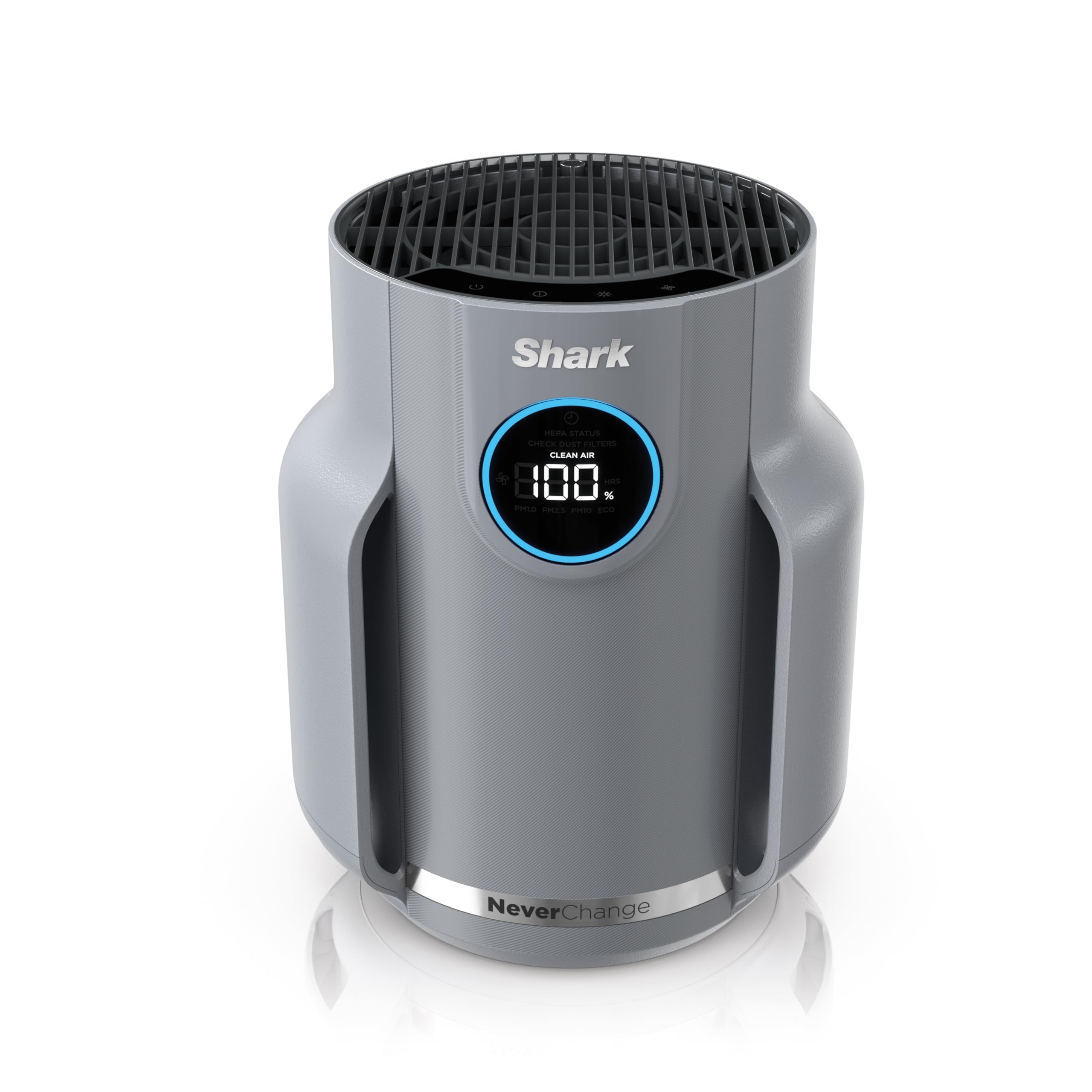
The Shark NeverChange Compact Pro stands out because it exceeds standard HEPA specifications while eliminating the biggest long-term headache of RV ownership — filter replacement logistics. Its NanoSeal media captures 99.98% of particles down to 0.1 microns, which includes diesel particulate matter and fine mold spores common in damp RV environments. The integrated Odor Neutralizer cartridge targets the musty, stale smells that accumulate in a closed cabin, and the Debris Defense washable pre-filter catches pet hair and large dust bunnies before they hit the main filter, extending its lifespan significantly.
The CleanSense IQ display gives you a real-time percentage readout of air quality, so you can actually see the improvement when you run the generator or after cooking bacon. At 4.4 pounds and a 9.21-inch square footprint, it fits neatly on a countertop or a low-profile shelf. The advertised 5-year filter life is a genuine differentiator for full-time RVers who don’t want to hunt down replacement packs in remote locations.
On the downside, this unit runs on standard 120V AC only — there is no USB-C or 12V input, so you need shore power or an inverter to run it. The claimed coverage of 250 square feet is appropriate for a mid-size Class C motorhome but may be insufficient for a large fifth wheel with an open floor plan. The built-in scent cartridge is very subtle and unlikely to mask strong pet or sewage odors on its own.
Why it’s great
- Exceeds HEPA standards for 0.1-micron particle capture
- Filter lasts up to 5 years with zero replacement cost
- Washable pre-filter handles pet hair and large debris
- Real-time air quality percentage display
Good to know
- 120V AC only — not compatible with 12V cigarette-lighter power
- Coverage limited to 250 sq ft, best for smaller rigs
- Built-in scent cartridge is subtle and not refillable
2. AIRLOCK One

The AIRLOCK One is built specifically for the RV and marine environment, and it shows in every design decision. Instead of blowing air through a filter, it uses bipolar ionization to flood the HVAC ductwork with positive and negative ions that neutralize odor-causing molecules and airborne contaminants. There are no fans, no motors, and no consumable parts — the unit is completely silent and requires zero maintenance for up to five years. Installation involves mounting the compact 7x5x2.5-inch housing near the AC return vent and connecting it to 120V AC power, which takes about 15 minutes with basic tools.
Because it treats air through the existing duct system, the AIRLOCK One does not compete for counter space. It processes the entire rig’s air volume passively, making it ideal for large Class A motorhomes and fifth wheels where a standalone purifier would need to be moved from room to room. The UL 867 certification ensures ozone emissions stay within safe limits for enclosed spaces, which is a critical check for any ionization device used in a small area with children or pets.
The tradeoff is equally straightforward: bipolar ionization does not capture particulate matter like dust, pollen, or dander. It neutralizes odors and some VOCs, but if your primary concern is seasonal allergies or visible dust accumulation, you will still need a HEPA-based unit. The price point is also steep relative to fan-based competitors, and the unit requires a permanent 120V AC connection — it cannot be moved to a tow vehicle or used while dry camping unless the generator or inverter is running.
Why it’s great
- Completely silent — no fan or moving parts
- Zero maintenance or filter replacements for up to 5 years
- Installs into existing HVAC ductwork, invisible and out of the way
- UL 867 certified, safe ozone levels for children and pets
Good to know
- Does not capture particulate allergens like dust, pollen, or pet dander
- Requires permanent 120V AC connection and duct access
- Higher upfront cost compared to standalone fan-based units
3. LUFTRUM C401

The LUFTRUM C401 is the most RV-native design in this lineup, originally engineered for passenger vehicles but scaling beautifully to the cab and living area of a Class B van or small trailer. Its defining feature is the built-in PM2.5 particulate sensor that shows you the exact air quality on a display and automatically ramps the fan speed when pollution spikes — useful when you’re idling in a truck stop or driving through a dusty area. The 5300 RPM fan can cycle the air in a large van up to 10 times per hour, and the 4-stage H13 HEPA + carbon filtration handles exhaust fumes, VOCs from plastic interiors, and cooking odors with genuine effectiveness.
The Swedish industrial design is slim and fabric-wrapped, weighing just 1 pound, and it mounts securely to the dashboard, center console, or even a wall using the included 3M adhesive plate. The auto-on/off feature via engine ignition is a brilliant convenience for RVers who drive their rig daily — the unit powers up when you turn the key and shuts down when you park, eliminating battery drain concerns. The 12V cigarette-lighter plug means it works directly off the house battery without an inverter.
However, at 10.82 inches long, the C401 is narrower than a standard cup holder but longer than most dashboards accommodate. The maximum fan speed is noticeably loud, which can be disruptive during quiet reading time. The 1-pound weight is a pro for portability but a con for stability — the included adhesive mount is essential to prevent the unit from sliding during turns. Replacement filters are proprietary and must be sourced from LUFTRUM, so keep a spare in your RV parts bin.
Why it’s great
- Built-in PM2.5 sensor provides real-time air quality data
- Auto start/stop with engine ignition saves battery
- Runs on 12V DC — no inverter needed, ideal for boondocking
- Only 1 pound, compact enough for dash or console mounting
Good to know
- Loud at maximum fan speed (audible in a quiet cabin)
- Proprietary replacement filters required
- Adhesive mount is essential to prevent sliding
4. PuroAir 100i
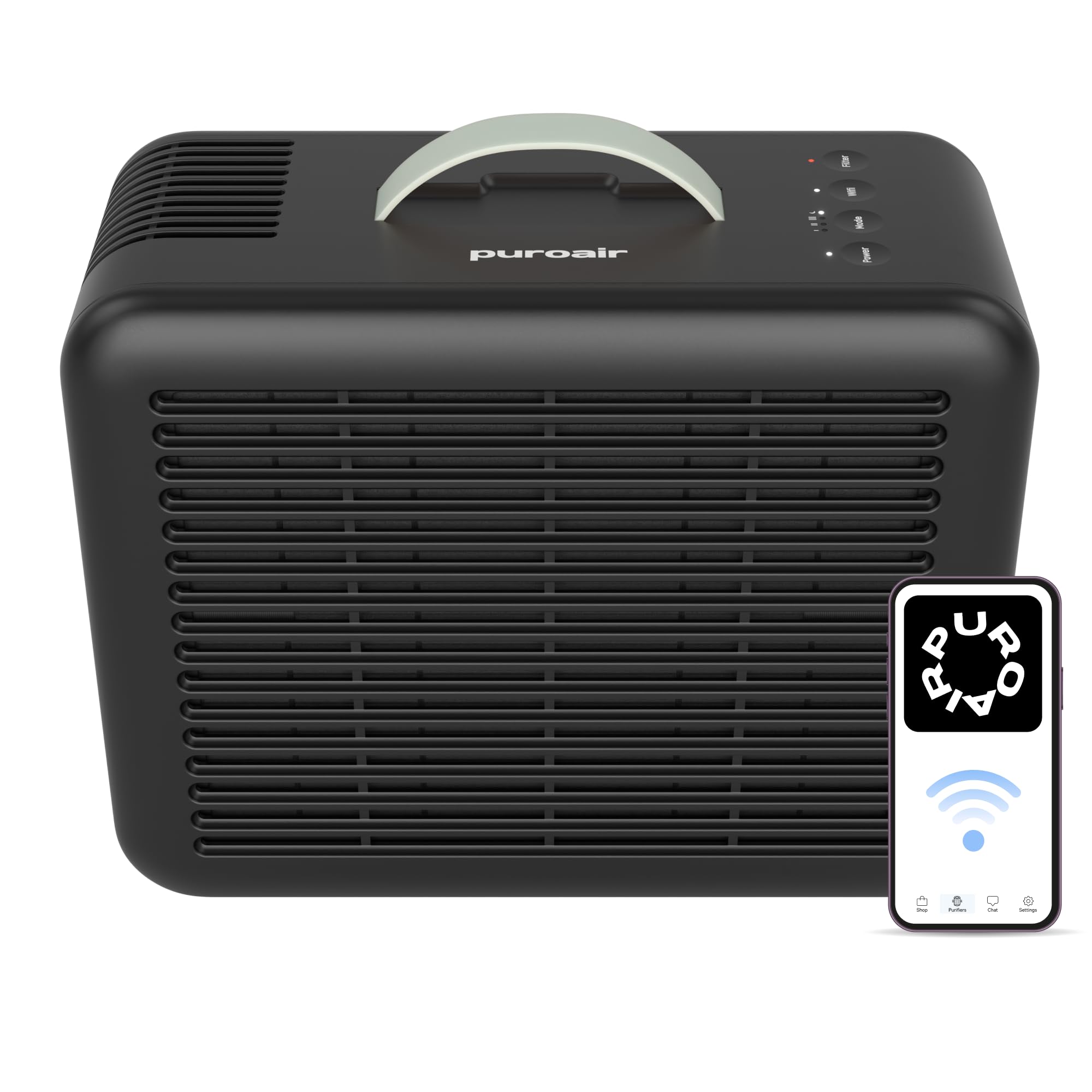
The PuroAir 100i brings smart-home convenience into the RV with full Wi-Fi connectivity via the PuroAir app, allowing you to adjust fan speed, set schedules, and monitor filter life from your phone — a real asset when you’re lounging in the bunk or sitting outside at the campfire. Despite its compact 12.2 x 5.1 x 8.7-inch profile, it claims coverage up to 550 square feet, which is enough to handle the open layout of a larger Class A coach. The 3-stage filtration system (pre-filter + H13 True HEPA + activated carbon) is third-party lab tested for 99.97% capture of particles down to 0.3 microns.
At 4.63 pounds, the PuroAir 100i is light enough to move between the bedroom, dinette, and cab as needed. The magnetic front cover makes filter swaps tool-free and fast. Users consistently praise its whisper-quiet operation on low speed, making it unobtrusive for overnight use. The partnership with the American Lung Association adds a layer of trust for families with asthma or allergy concerns.
The major limitation for RV use is that the 100i runs on 120V AC power only — there is no 12V option. You will need shore power or an inverter to run it, which limits its usefulness during travel or dry camping. The app, while convenient, relies on Wi-Fi; if you’re boondocking without internet, the manual touch controls work fine but lose the remote functionality. The replacement filters are reasonably priced but required every 6-8 months depending on usage.
Why it’s great
- Full Wi-Fi app control for remote adjustment
- Compact design with large 550 sq ft coverage claim
- Whisper-quiet low-speed operation suitable for sleeping
- Easy magnetic filter access with tool-free swaps
Good to know
- 120V AC only — cannot run directly off 12V house battery
- App requires Wi-Fi, not useful for off-grid boondocking
- Filters need replacement every 6-8 months
5. Cobectal ZQA-4000B (2-Pack)
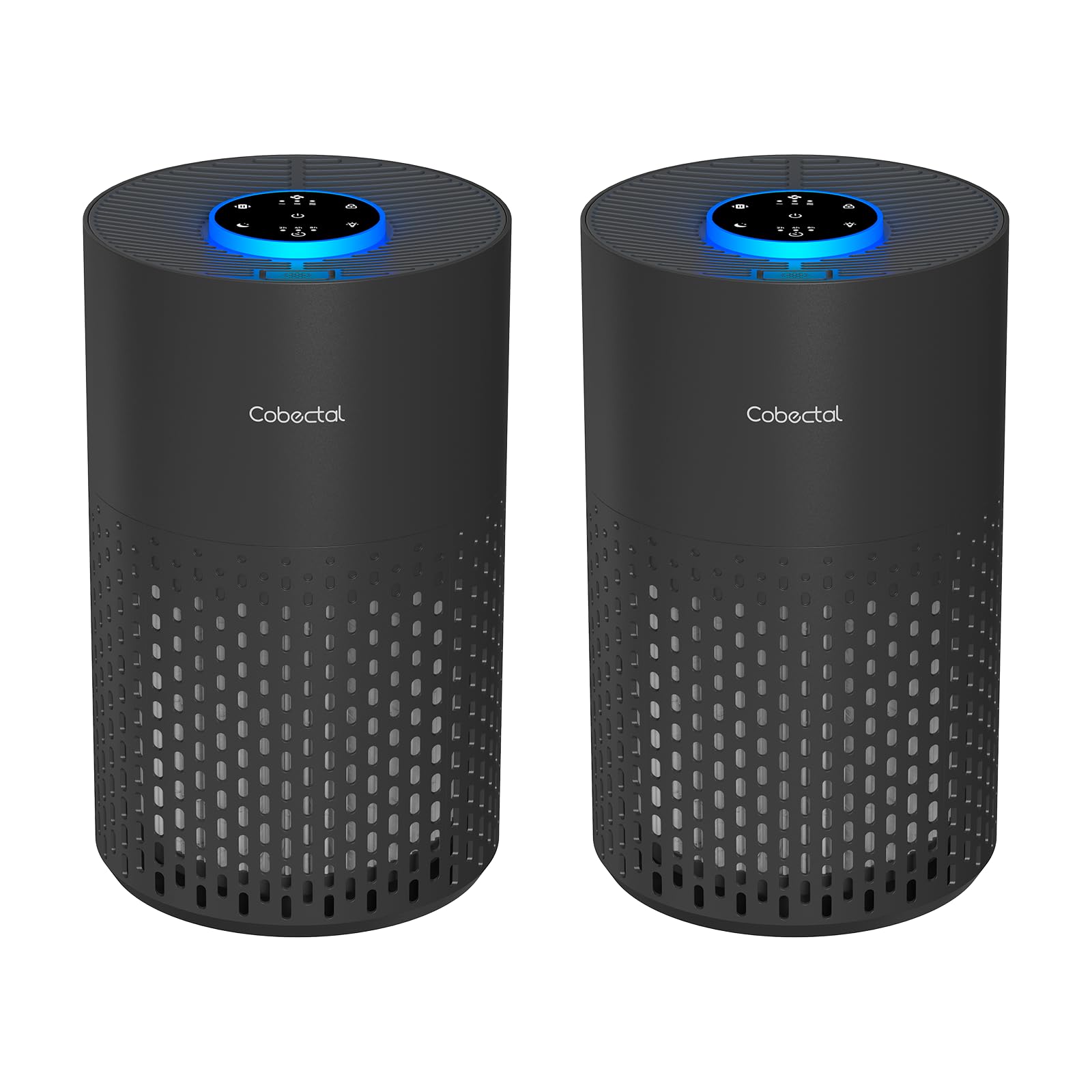
The Cobectal ZQA-4000B 2-Pack is a pragmatic solution for RV owners who want to place a purifier in both the main living area and the bedroom without buying two separate single units. Each unit is rated H14-grade filtration (slightly more efficient than standard H13) and uses a 360-degree air inlet design to pull contaminants from all directions. The combined coverage claim of 1050 square feet means each unit can handle roughly 525 square feet individually, which is generous for a small form factor that stands 11 inches tall and weighs only 2 pounds.
The built-in aroma tray at the top is a surprisingly useful RV feature — a few drops of essential oil can help freshen the cabin after cooking fish or using the bathroom, adding a pleasant fragrance without needing a separate diffuser. The three ambient light colors (white, green, blue) can serve as a dim nightlight in the RV bedroom. The child lock mode and 2H/4H/8H timer give you precise control over run time to conserve battery when on shore power.
On the practical side, these units run on 120V AC power. There is no 12V or USB-C input, so they are limited to times when you’re plugged in or running a generator. The H14 filter replacement cycle is stated at 3-6 months, which is frequent compared to some competitors. Some users report that the medium and high fan settings are noticeably louder than the sleep mode, which may be an issue in a small space where the unit is placed close to the bed.
Why it’s great
- 2-pack covers both living and sleeping areas in one purchase
- H14 filter is slightly more efficient than standard H13
- Aroma tray adds pleasant scent without a separate diffuser
- Child lock and timer settings for battery-aware operation
Good to know
- 120V AC only — not compatible with 12V or USB-C power
- Filters need replacement every 3-6 months
- Medium and high fan settings are audible in a small RV cabin
6. LabCharge Ionic 5-Pack
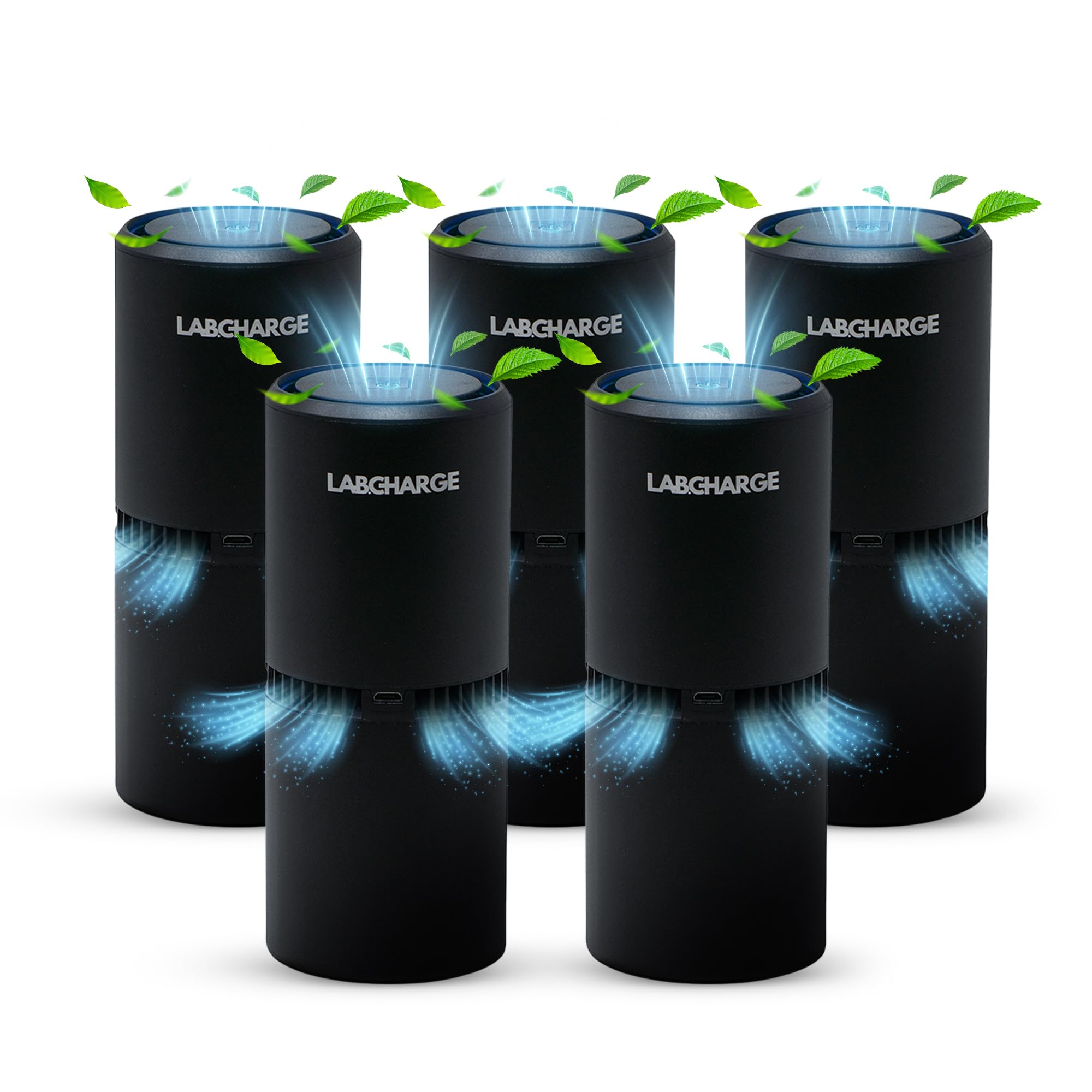
The LabCharge Ionic 5-Pack takes a fundamentally different approach from every other product on this list: it uses high-density ionization instead of a fan and filter to condition the air. Each unit is tiny — 3.5 inches tall and weighing just 0.3 pounds — and simply plugs into a standard 120V AC wall outlet. There are no moving parts, no filters to replace, and no ongoing consumable costs. The pack of five lets you place one in the kitchen, bedroom, bathroom, cab, and storage bay simultaneously for full coverage without any single bulky unit taking up space.
For RV owners whose primary complaint is lingering odors from sewage tanks, cooking, or pets, the ionic technology can neutralize those smell molecules within a few hours. Multiple user reports confirm a noticeable reduction in the stale cabin smell even in older rigs. The zero-maintenance aspect is genuinely compelling for full-time travelers who don’t want to track filter replacement schedules. Each unit draws minimal power, so running all five adds negligible draw to your electrical system.
The critical caveat is that ionization does not remove particulate matter. Dust, pollen, pet dander, and mold spores remain airborne and will still settle on surfaces. If you or your family suffer from seasonal allergies or asthma, you will still need a HEPA-based purifier for actual particle capture. Additionally, some users report that individual units develop a faint buzzing noise after a few weeks of continuous use, and the blue LED light is bright enough to be distracting in a dark bedroom — you may need to cover it with electrical tape.
Why it’s great
- Completely filter-free with zero recurring costs
- Ultra-compact, plugs directly into outlet with no space taken
- 5-pack provides whole-RV coverage in one purchase
- Effectively neutralizes odors within a few hours
Good to know
- Does not capture particulate allergens like dust or dander
- Some units may develop faint buzzing noise over time
- Blue LED light is bright and may need to be covered at night
7. TDBYWAE MB-032
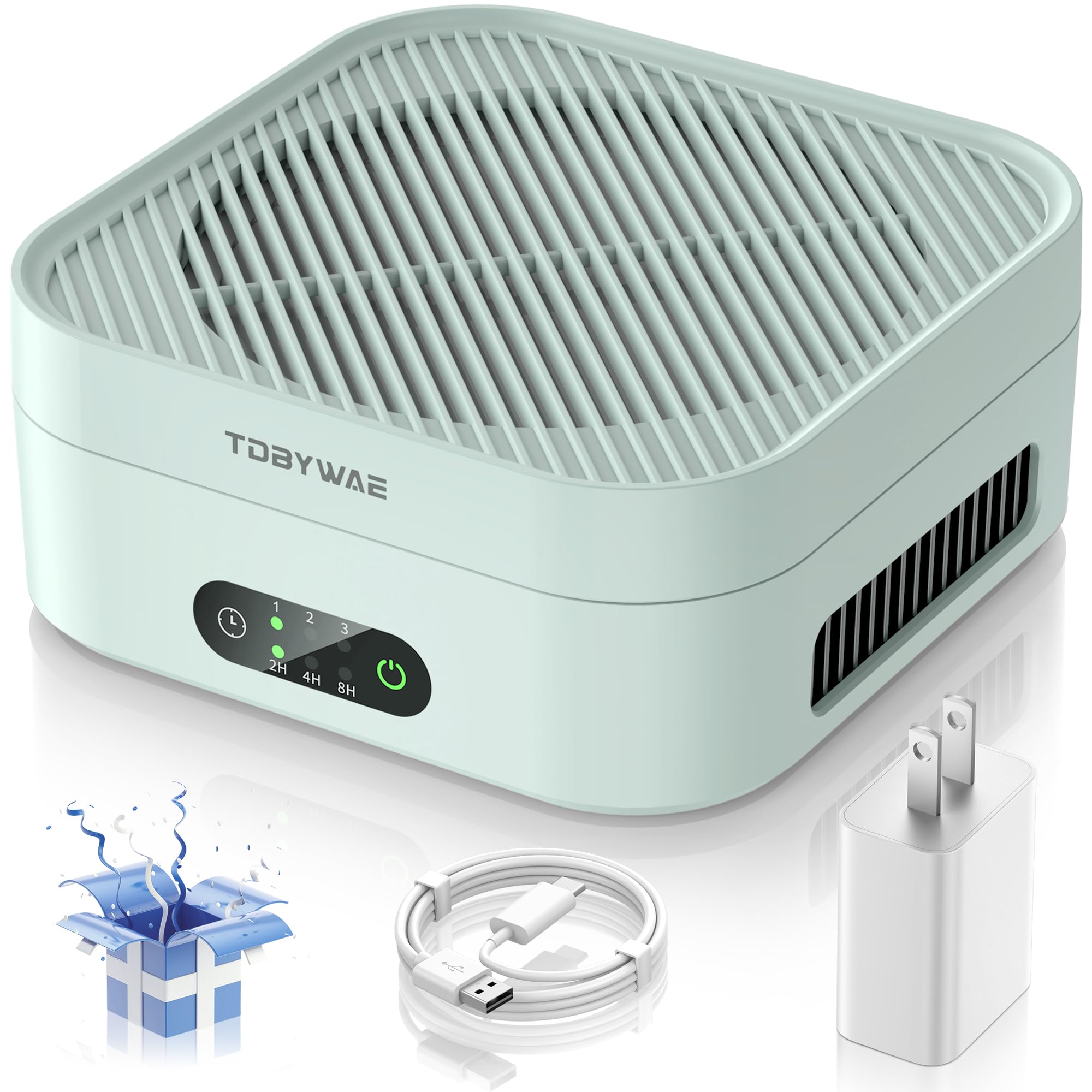
The TDBYWAE MB-032 is proof that a genuinely effective HEPA purifier can fit in the palm of your hand. At just 8.4 x 8.4 x 5 inches and 1.8 pounds, this unit is small enough to stash in a cup holder, a glove box, or a small cubby under the dinette seat. Despite its size, it packs a true H13 3-stage filtration system (pre-filter, True HEPA, activated carbon) that handles dust, pollen, smoke, pet dander, and odors. The max coverage claim of 600 square feet is ambitious for the form factor — you should expect effective cleaning in zones up to 230 square feet with four air changes per hour.
The standout feature for RV use is the USB-C power input. You can plug it into a standard 12V-to-USB adapter in your vehicle, run it off a power bank while dry camping, or connect to a wall charger when on shore power. This flexibility is unmatched in this price tier. The magnetic top cover makes filter swaps tool-free and quick. The dedicated sleep mode operates at a genuinely quiet 16 dB — quieter than a whisper — which is perfect for running overnight in the RV bedroom or while driving.
The tradeoff for the small size is filter surface area: the HEPA pack is small and will saturate faster in a dusty or smoky environment compared to larger units. You should plan to replace the filter every 3-4 months if you use the purifier daily. The touch controls are simple but lack a timer beyond the 2H/4H/8H presets, and there is no air quality sensor or smart connectivity. For owners of small RVs, vans, or trailers who want a HEPA solution that runs on any power source, this is the most versatile entry point.
Why it’s great
- USB-C power input works with 12V adapters, power banks, or AC
- Ultra-compact design fits in cup holders and small cubbies
- Genuine H13 HEPA + carbon filtration in a tiny footprint
- 16 dB sleep mode is truly silent for overnight or driving use
Good to know
- Small filter surface area requires replacement every 3-4 months
- No air quality sensor or smart connectivity
- 600 sq ft max coverage is optimistic — effective range is ~230 sq ft
FAQ
Can I run an air purifier in my RV while driving down the road?
Will an air purifier actually help with RV mold and mildew smells?
Final Thoughts: The Verdict
For most users, the best air purifier for rv winner is the Shark NeverChange Compact Pro HP071BRN because it delivers true HEPA-exceeding filtration with a 5-year filter life, a washable pre-filter that handles pet hair, and a real-time air quality display — all in a compact 9-inch footprint that fits a countertop or shelf in any rig. If you want fully silent, maintenance-free odor control with invisible HVAC integration, grab the AIRLOCK One. And for small vans or boondocking setups where 12V power and an ultra-compact size are non-negotiable, nothing beats the TDBYWAE MB-032 for true HEPA purification on any power source.