
Our readers keep the lights on and my morning glass full of iced black tea. As an Amazon Associate, I earn from qualifying purchases.
Specs are compiled from manufacturer listings and verified buyer reviews and can change over time — please confirm the key details on the product page before buying.
Wood smoke is not like kitchen steam. It carries fine ash and tar droplets that hang in a room for hours, settle on every surface, and creep into the bedroom long after the fire is out. Every pick below is a verified true-HEPA machine, meaning it filters through a sealed HEPA media layer rather than just an ionizer or a filterless gimmick.
I’m Min — the founder and writer behind Gadgets Feed. This guide is built by comparing the manufacturers’ published specifications and the patterns across verified customer reviews, so you get each pick’s real strengths and trade-offs instead of marketing spin.
You will see coverage numbers, filtration classes, noise figures, and the honest trade-offs owners live with.
Our Picks at a Glance

How To Choose The Best Air Purifier For Wood Stove
A wood stove throws off two different problems: solid smoke particles and gas-phase odors from creosote and resin. A machine that handles one well can still fail at the other. Below are the four things that decide whether a unit actually clears a stove room or just looks busy.
Smoke CADR is the number that matters
CADR stands for Clean Air Delivery Rate, a lab-measured airflow number in cubic feet per minute for a specific pollutant. A separate smoke CADR tells you how fast the machine clears smoke, not just dust. A high smoke number means the fan and filter are moving real air, so the room recovers faster after you reload the stove. For a wood stove, ignore the giant “up to X sq ft” figure on the front of the box and look for the smoke-specific figure in the specs or the AHAM listing.
True HEPA versus “HEPA-type” filters
True HEPA means the filter meets a tested efficiency standard for trapping very small particles. A HEPA-type or HEPA-style filter is a looser claim and often lets more fine smoke slip through.
Carbon is what kills the smell
HEPA captures particles but does almost nothing for the gas you smell. Activated carbon handles that. A thick carbon layer, or one boosted with a second gas-capturing media, is what makes a room stop smelling like a chimney. Thin carbon sheets fade fast, so the thickness of the carbon stage is worth checking.
Noise, because you will run it overnight
Stove smoke lingers after bedtime, so you want a unit you can leave running. Look for a low-speed noise figure in decibels (dB, the standard loudness scale) and a sleep mode that dims the display lights.
Quick Comparison
| Model | Best For | Coverage (1 hr) | Filtration | Filtration Efficiency | Amazon |
|---|---|---|---|---|---|
| LEVOIT Core 400S-P★ Best Overall | Best Overall | 1,733 sq ft | 3-in-1 True HEPA | 99.97% at 0.1–0.3 microns (lab tested) | Amazon |
| Dhyala KJ02Best Value | Pet-and-smoke homes on a mid-range budget | 3,620 sq ft | 5-stage HEPA | 40% more dander capture (vs. 3-layer filters) | Amazon |
| WINIX 5520Top Performer | Second-hand smoke next to the kitchen | 1,882 sq ft | True HEPA + carbon | 99.99% down to 0.3 microns | Amazon |
| Honeywell HPA304 | Long-term wood-stove homes that want durability | 2,250 sq ft | True HEPA + carbon | Traps up to 99.97% of airborne allergens | Amazon |
| PuroAir 400 | Whole-room freshness with quiet running | 2,000 sq ft | 3-layer HEPA | Up to 99.9% of pollutants | Amazon |
| Shark NeverChange Max HP301 | No-fuss filtration with no yearly filter swaps | 1,300 sq ft | HEPA-exceeding filter | 99.98% of particles, down to 0.2 microns | Amazon |
| AirDoctor AD3500 | Maximum filtration at the smallest particle size | 2,520 sq ft | 3-stage UltraHEPA | 99.99% down to 0.003 microns | Amazon |
| Medify MA-112 V3.0 | The largest rooms and the toughest smoke loads | 4,455 sq ft | Dual HEPA H13 | 99.9% down to 0.3 microns | Amazon |
In‑Depth Reviews
1. LEVOIT Smart Air Purifiers for Home Large Room Up to 1733 Ft² Core 400S-P
Our pick — over 4.5★ from 24,500+ verified ratings; the strongest balance of quality and price.
The auto sensor that clocks smoke the second you open the stove door.
Here is the standout figure before anything else: the Core 400S-P carries a verified smoke CADR of 231 CFM. CADR is the tested number for how many cubic feet of cleaned air the machine pushes out per minute, and 231 is a serious figure for smoke specifically. Pair that with 240 CFM for dust and 259 CFM for pollen, and the machine is built to move real air, not just tick a box. AHAM Verifide means an independent body tested it for performance, safety, and energy use — that is third-party proof, not a self-claim.
The living proof shows up on the display. As owners put it, the unit auto-adjusts for smoke, with PM2.5 (a laser reading of fine smoke particles) dropping from 185 to under 20 within one hour, and down to 001 by the two-hour mark. The AirSight Plus laser sensor scans the surrounding air and keeps the number updating live, so you watch the room clear instead of guessing. Set it to Auto and it ramps the fan on its own when the stove is reloaded, then settles back down when the air is clean.
What wins people over most is raw effectiveness, with noise level a close second — the machine is soundless at the sleep setting and only ramps noticeably at the top speed. Owners run it for a full weekend of wildfire smoke, and the app-compatible setup connects to an existing smart-home app for remote monitoring. The 3-year update from a long-term owner is a good sign: no issues, still working, still earning the same high marks.
What earns the top spot
- Smoke CADR of 231 CFM, with 240 CFM dust and 259 CFM pollen figures verified by AHAM.
- Auto mode drops PM2.5 from 185 to under 20 in an hour of stove-running, down to 001 by hour two.
- 3-in-1 filter hits 99.97% filtration efficiency on 0.1–0.3 micron particles, independently lab tested.
- Soundless at the sleep setting, so it can sit next to the bed through the night.
What to weigh up
- Replacement filters run about twice a year, and the genuine sets are not cheap.
- Value for money is the one aspect owners split on — worth it for the filtration, pricier than mid-tier rivals.
- Top fan speed is audible, so you will want the sleep setting for the bedside.
Pick this if: you burn wood nightly and want a machine that reacts to smoke on its own before you notice the haze.
Think twice if: you want a filter you never touch — this one wants fresh media roughly every five months of hard use.
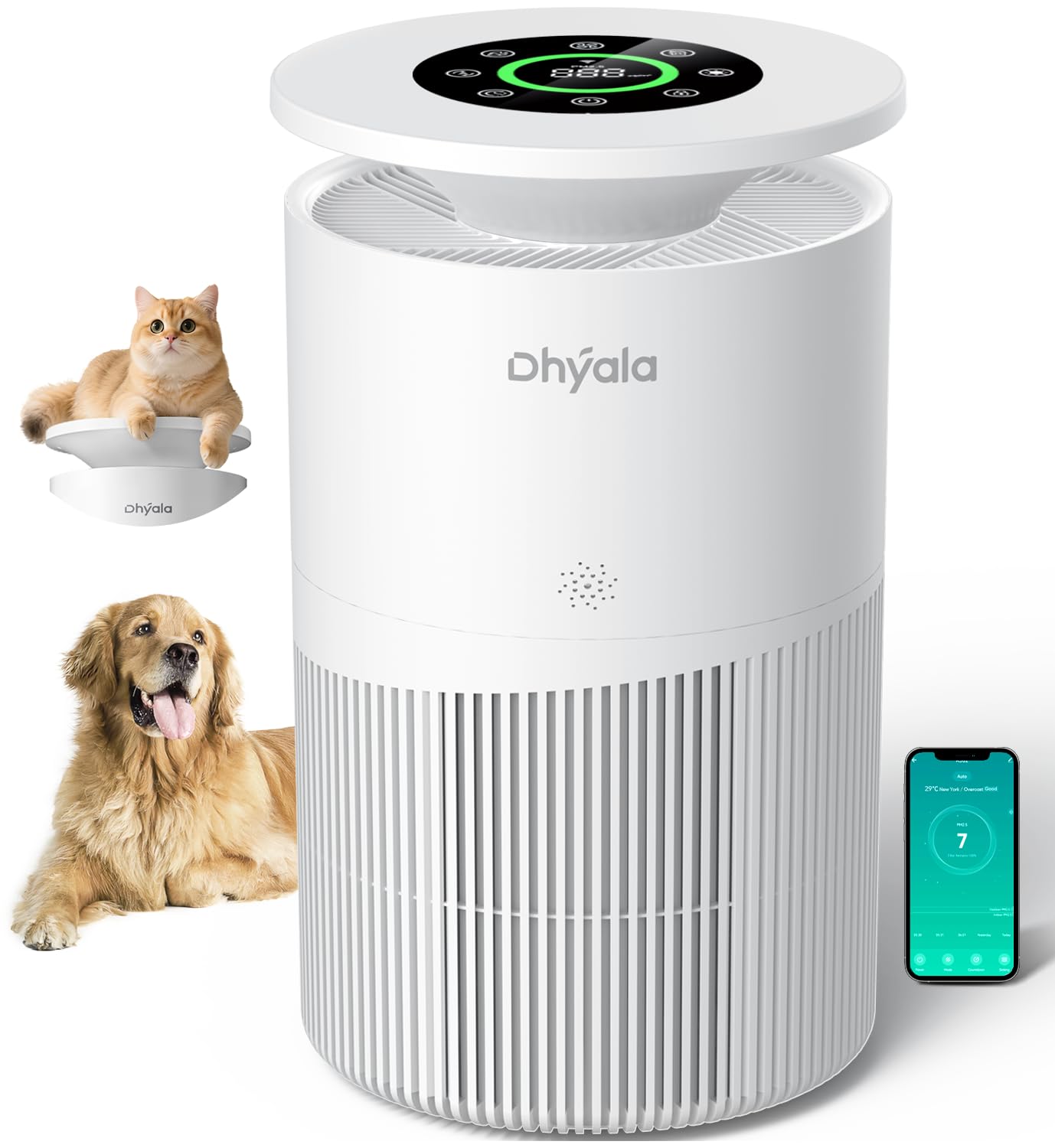
2. Dhyala KJ02 H13 True HEPA Air Purifier, 3620 Ft², WiFi
Five filter stages and a 271 CFM CADR for a price that undercuts most of this list.
If smoke is the enemy, the Dhyala’s headline figure is a CADR of 271 CFM, which it claims cleans spaces up to 3,620 sq ft in one hour. That is based on testing the brand says was done by ISO 17025 certified labs. The pre-filter uses electrostatic adsorption — a charged media that grabs particles as they pass — and the brand says it captures 40% more pet dander, fur, and dust than a standard 3-layer filter setup.
For a stove room, the carbon stage matters most. The high-efficiency activated carbon layer, rated at 3X the adsorption capacity of conventional filters, is the part that neutralizes the smoke and cooking-odor punch. Auto mode leans on a built-in smart sensor that watches air quality and ramps power when the room gets dirty. Sleep mode drops the fan to a whisper and the noise down to 22 dB — the quietest single figure on this whole list.
Owners consistently flag two things: how well it works the moment it comes from the start, and how adjustable the noise is. It gets dog hair and dust down visibly, and clears cooking smells after meals. One caveat worth knowing: it filters the air, not the floor. A few owners expecting it to vacuum-up surface pet hair have been disappointed, though every one of them confirmed airborne particles dropped and the room felt fresher. Give it a few weeks — dust filtration typically shows up in the first couple of weeks of running.
Where it wins: the 22 dB sleep figure and the 271 CFM CADR together cover a large open-concept room without waking anyone in it.
Who this fits: pet owners and wood-stove users in one house — the pet lying platform and bite-proof cord are built for exactly that mix.
Reach for this if you want the quietest sleep mode and a large coverage number without stepping up to the premium tier.
Look elsewhere if you expect the unit to pull hair off carpets — it handles what floats, not what lands.
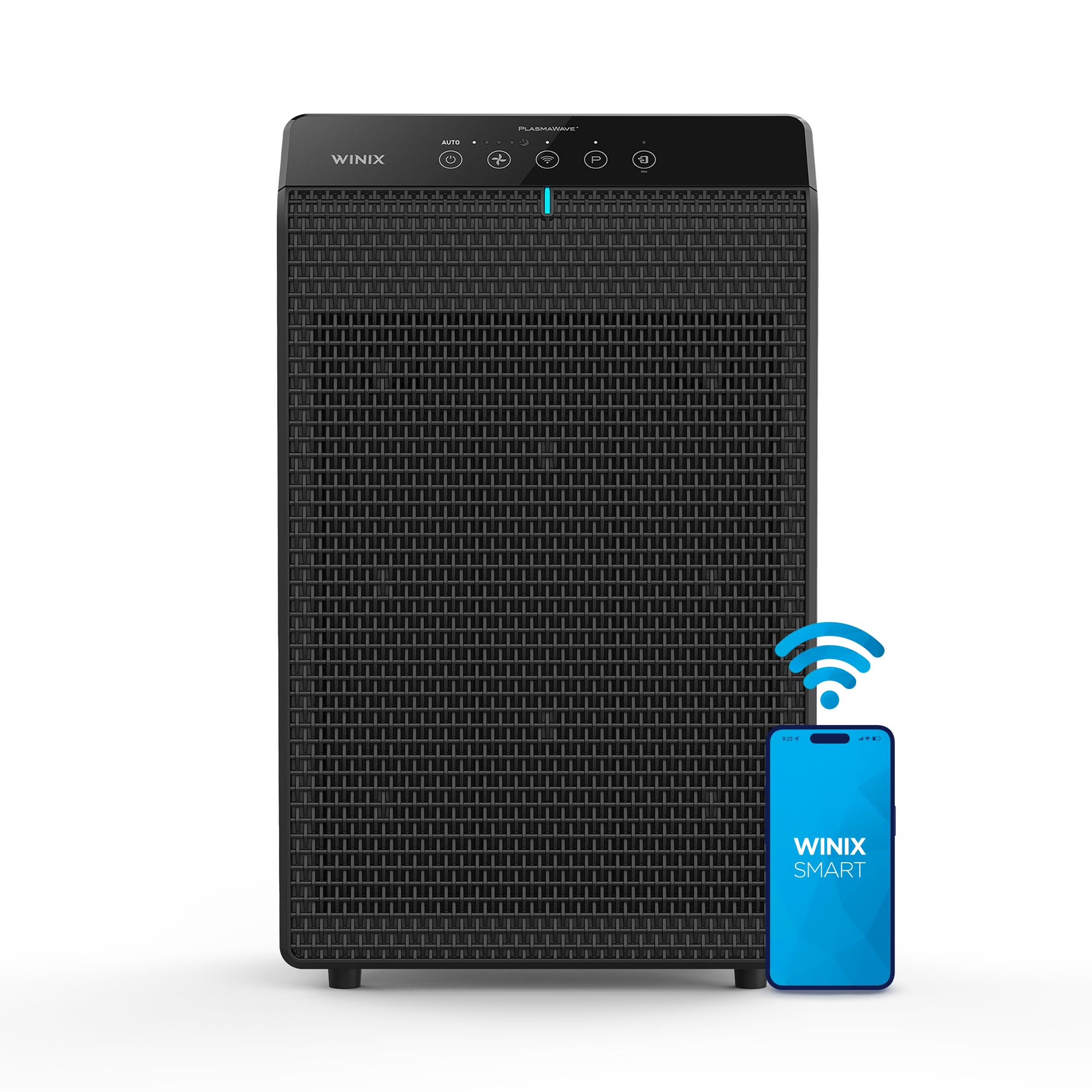
3. WINIX 5520 Air Purifier, 1882 Ft², True HEPA and Auto Mode
The smoke-clearing veteran with the washable pre-filter and a 0.01-micron particle claim.
Winix has been the go-to low-cost smoke machine for a long time, and the 5520 keeps the recipe. Its True HEPA layer is rated to capture 99.99% of airborne allergens including smoke, dust, and pet dander down to 0.3 microns. The washable fine-mesh pre-filter takes the biggest particles first — the part that catches the coarse ash wood stoves throw — and rinses clean under a tap.
Coverage sits at 1,882 sq ft in one hour, or 941 sq ft in thirty minutes, or 470 sq ft in fifteen. AHAM Verified and UL Certified cover the third-party testing side. Auto mode uses a built-in air-quality sensor to raise and lower fan speed on its own, and the light-sensing dimmer auto-activates Sleep Mode when the room goes dark — a nice touch for a bedroom near the stove.
Durability is the one mixed signal in an otherwise strong review picture; some buyers want to see the machine last more years before awarding top marks. But the day-to-day story is consistent: it eats cooking smoke and cooking odors, the carbon filter handles the creosote smell, and the auto mode detects cooking smoke, coughs, and sneezes by switching its indicator light from orange to red. A recurring gripe is the app — a small slice of owners find it laggy or unresponsive. The physical controls and the remote cover you if that happens.
Suits you when: the stove is close to the kitchen and you want one machine tuning itself for both smoke sources.
Skip the app expectation: remote control via Winix Smart works for most, but the on-unit panel is the more reliable route.
4. Honeywell AllergenPlus HEPA Air Purifier, HPA304
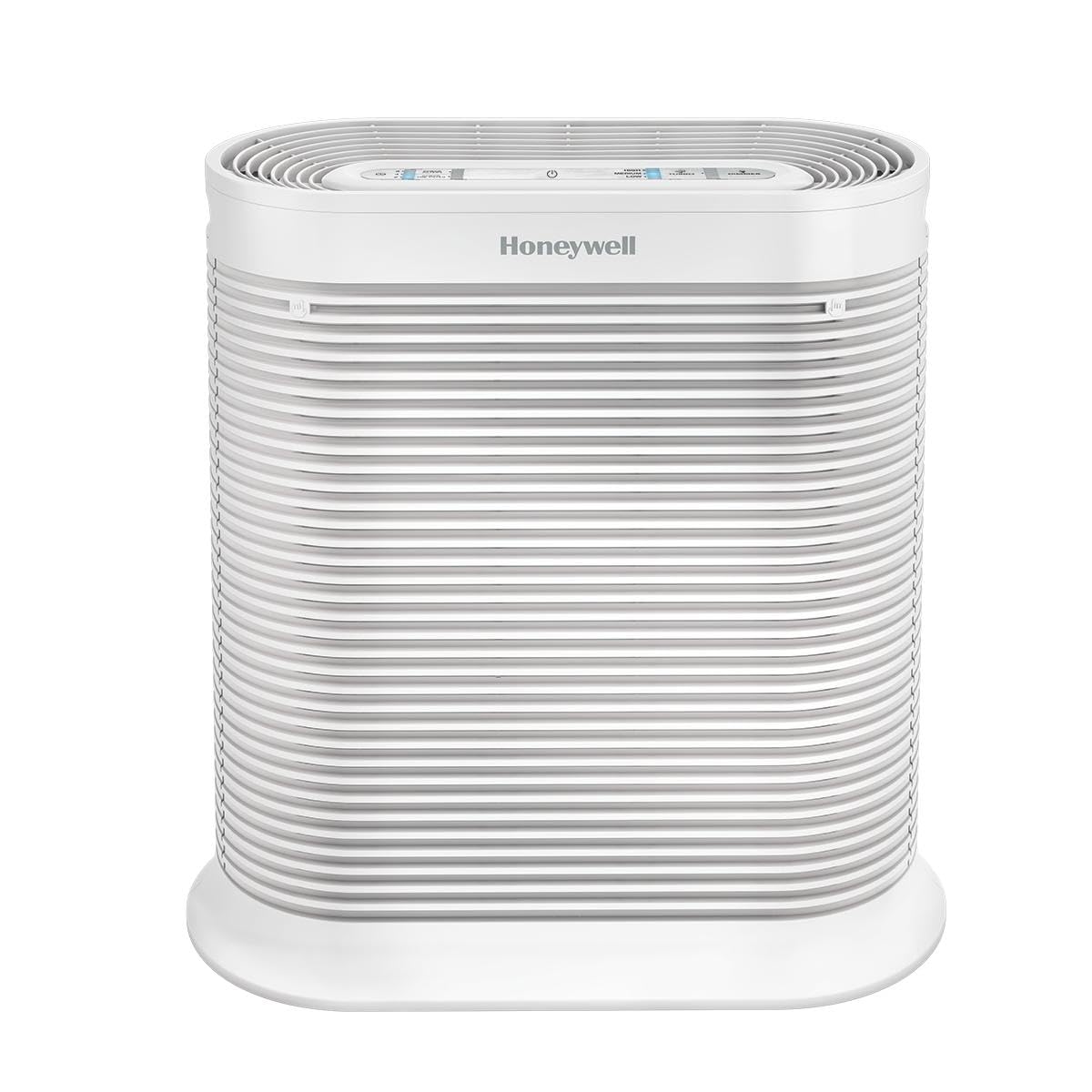
Built like a workhorse appliance — the machine owners keep running for a decade.
Honeywell’s HPA304 is the one for people who think in decades, not seasons. The Allergen Plus series cleans up to 2,250 sq ft in 60 minutes at one air change per hour, and the HEPA filter traps up to 99.97% of microscopic airborne allergens. There are three air cleaning levels including a Turbo Clean setting for when the smoke is thick.
Owners treat these units like appliances. Long-term users report multiple units still running after seven to ten years of daily work, with one heavy-shedder cat-plus-two-dogs household running a unit at top speed all day with no degradation. The front-intake, top-rear-exhaust design means you can place it against a wall, and the blue display light can be switched off for a bedroom.
The honest trade-offs are noise and maintenance. Noise is the most-discussed aspect and the verdict there is split — owners find it near-silent on its lowest Germ setting and pleasant for white noise on the upper levels, but the top speeds are loud enough that some move it out of the bedroom. The pre-filter also fouls quickly with stove ash; a few owners blow it out with an air compressor periodically rather than replace it. Worth knowing: Honeywell recommends its own genuine filters for the best results rather than compatible replacements.
Why owners keep them
- Long-term durability is the standout — several buyers report seven to ten years of continuous use with no loss of power.
- Front-intake, top-rear exhaust design lets it sit flush against a wall to save floor space.
- Big coverage — 2,250 sq ft in 60 minutes at one air change per hour.
- Dimmable or fully off blue light for bedtime.
The honest caveats
- Top speeds are loud enough that some owners move it away from sleeping areas.
- Stove ash clogs the pre-filter fast — plan to clean it often.
- Genuine Honeywell filters are recommended over third-party replacements.
The right call for: a stove room you want covered for a decade, not a single winter.
Not for you if: the machine has to sit next to the bed and stay silent at high fan speeds.
5. PuroAir 400 HEPA Air Purifier, 2,000 Ft²
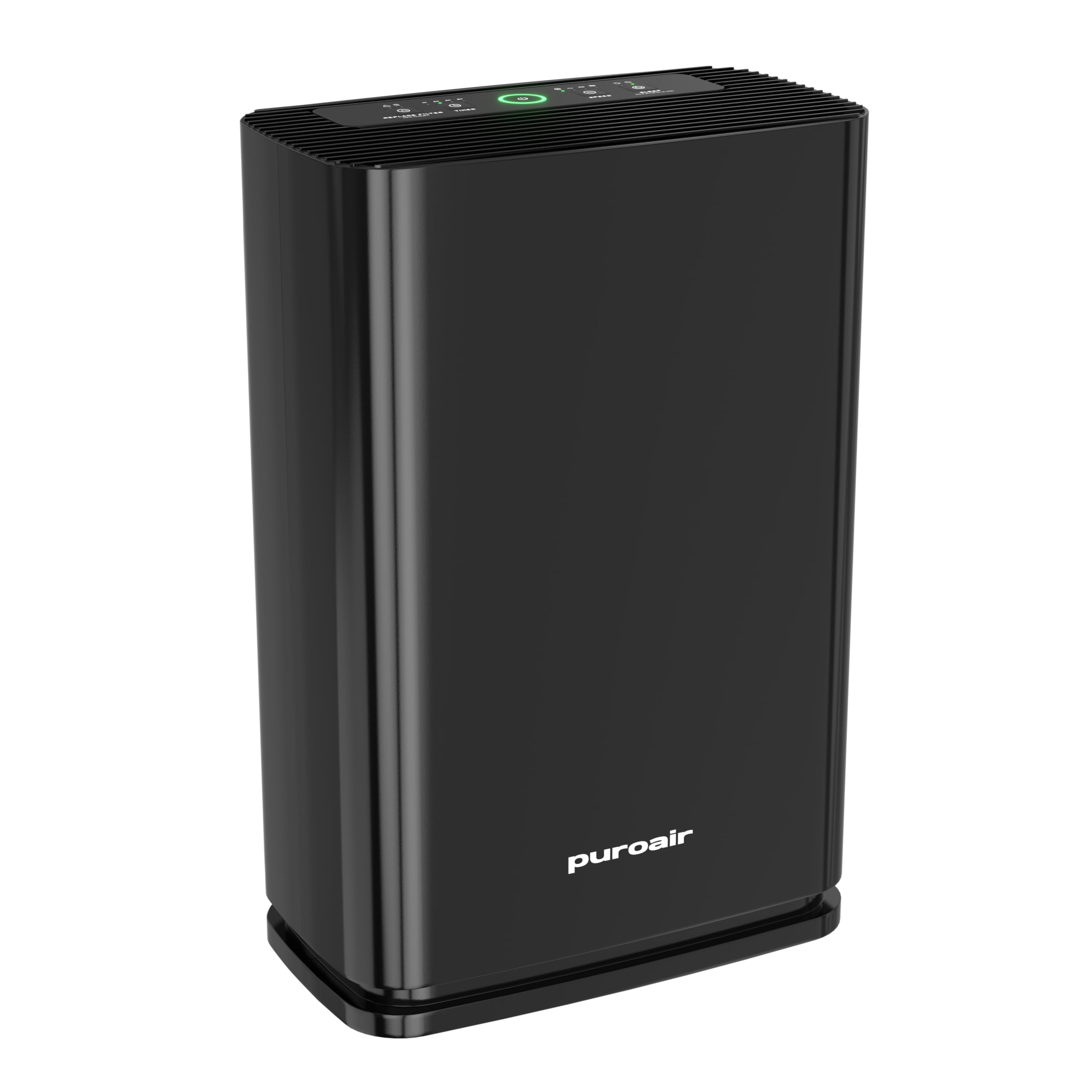
The quiet house-freshener that empties a smokey room without sounding like a fan.
PuroAir’s 400 covers rooms up to 2,000 sq ft in one hour, and its 3-layer filtration (pre-filter, HEPA, activated carbon) is designed to grab up to 99.9% of pollutants including smoke, dust, pet dander, and VOCs. A smart particle sensor watches air quality and boosts fan power when it detects trouble, then drops back down when the air is clean. It is certified by CARB, ETL, ISO, and UL, so the safety side is verified by outside bodies too.
The most-reported aspect across owners is raw performance, with quiet operation running a close second. Four units in one home across a living room, two offices, and a bedroom is a common pattern; users place them where the air matters and leave them running around the clock. The sleep mode is the standout for a bedroom — it drops the fan and light output to near-nothing.
What it does best is the freshness effect. Owners coming back to a closed-up house after a hot spell say the air still feels as fresh as if the windows had been open, with no stale smell. The honest limit is the value calculation: filters are on the pricier side across brand lines, and a slice of owners wish they had gone bigger on coverage. If your stove room is only slightly smaller than the rating, it works fine; if it is much larger, expect longer recovery times.
The strong suit: odor removal — the combination of a thick carbon stage and a sensitive particle sensor means smells leave the room fast.
Worth noting: replacement filters are the long-term cost of ownership, not the initial purchase.
Made for: an open living space where the smoke smell, not just the particles, is the problem.
Consider skipping if your stove room is dramatically larger than the stated coverage — you will want the higher-CADR picks below.
6. Shark NeverChange Air Purifier Max, HP301

The one machine on the list that promises you will not swap a filter for five years.
The Shark NeverChange Max is designed for the buyer who hates maintenance. The headline claim is NeverChange filtration: the brand says the filter lasts five years, so you skip the replacement-filter cost that the top ten competitor units charge. CleanSense IQ shows a real-time percentage on the display, so you watch the number climb as the air clears. The Anti-Allergen NanoSeal filter exceeds HEPA standards and traps 99.98% of particles down to 0.2 microns.
Coverage is 1,300 sq ft in one hour, which is enough for a great room or an open-plan living space with the stove at one end. A Debris Defense washable screen pulls in the big stuff — hair, dust, dander — before it reaches the HEPA, and you vacuum or rinse it clean in seconds. The Odor Neutralizer Technology cartridge is the part that specifically targets smoke and cooking smells.
The recurring gripe is the maintenance paradox: a few owners find the NeverChange filter actually needs replacing yearly under heavy grit load, and the machine starts to whistle if the side screens are not vacuumed regularly. It is worth knowing that the filter life may be shorter than the name implies for a real wood-stove room with ash in the air. That said, most owners land on effective and quiet, with visible dust reduction within days and a display that climbs steadily toward clean.
Best suited to: a large open living room where you want low-maintenance filtration and real-time air quality feedback.
Think about the cartridge: the Odor Neutralizer works, but if you want the purest gas capture for creosote, the heavier carbon layers of the picks below do more.
7. AIRDOCTOR AD3500 Air Purifier
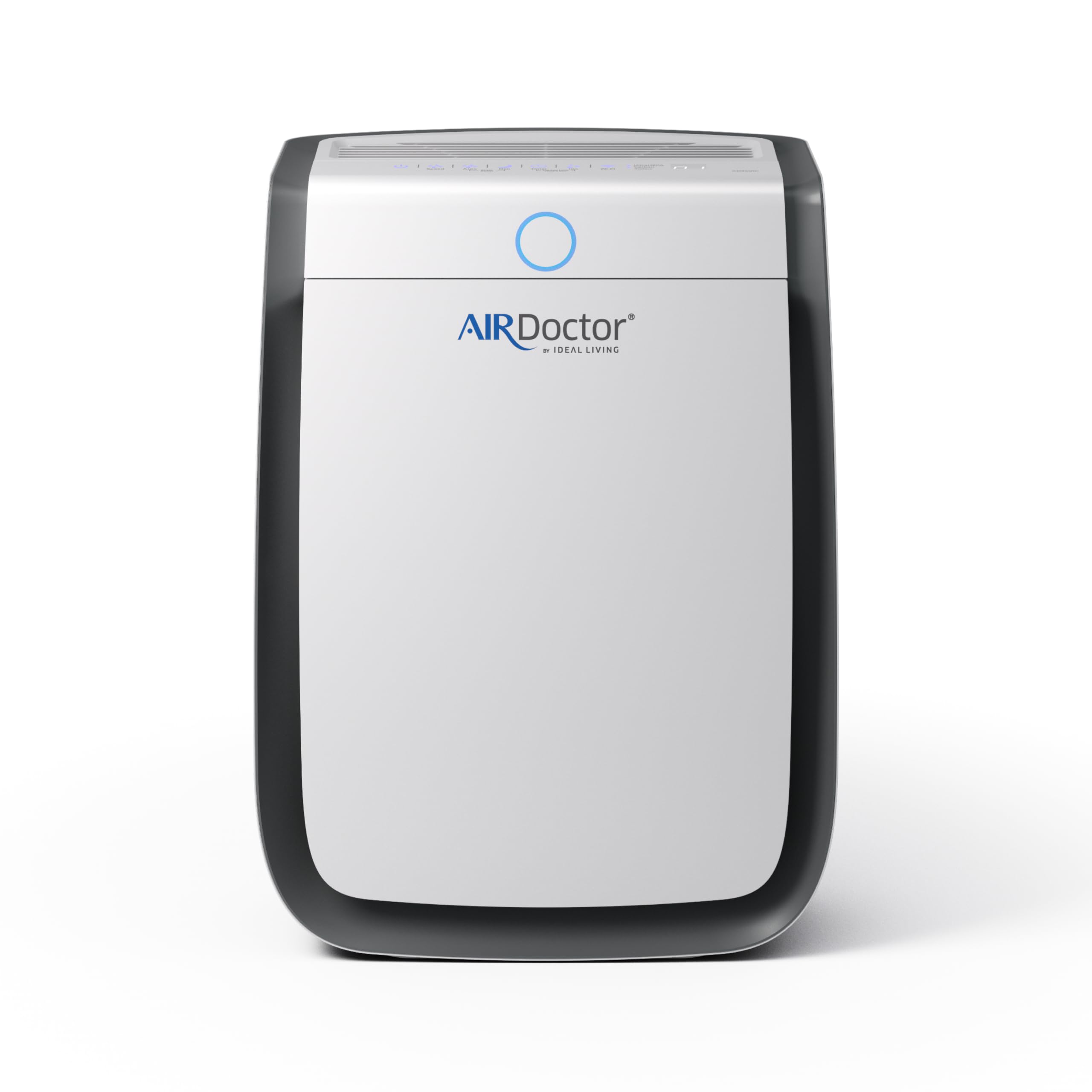
The purifier built around the smallest particle capture on the list — UltraHEPA rated to 0.003 microns.
The AirDoctor AD3500 is the premium end of this list, and the number that justifies it is in the name: UltraHEPA filtration captures 99.99% of airborne particles at 0.003 microns. For a wood-stove room, the interesting pairing is that ultra-fine filtration with the premium activated carbon filter, which adds potassium permanganate to the carbon. That second media is specifically included to break down gases and airborne chemicals — the stuff that makes wood smoke and creosote smell impossible to clear with HEPA alone.
Coverage is 2,520 sq ft in one hour, or 630 sq ft in fifteen minutes if you want to clean one room fast. The Halo display shows color-coded air quality in real time via a PM2.5 sensor, and Auto mode ramps fan speed and hits Boost when it detects trouble. Owners mention it kicks into high and clears smoke from a burnt pizza — and that the auto reacts instantly to cooking and candle smoke — which is the exact behavior a wood-stove owner wants.
The honest limit is the long-run consumables bill. The UltraHEPA filters and carbon filters are expensive, and the carbon replacement interval is about six months. A few owners flag that the Turbo speed is loud and the unit is slightly bulky in a small room. But the filter quality is the story here: sleep mode dims the display and runs quiet enough to leave on overnight, and the machine visibly pulls dust from the air at high fan speed.
Why the premium is justified
- UltraHEPA filtration at 99.99% capture down to 0.003 microns — the finest particle rating on this list.
- Premium activated carbon with potassium permanganate tackles the gas-phase side of wood smoke.
- Halo display with color-coded PM2.5 feedback plus instant-reacting Auto Mode with Boost.
- Quiet sleep mode with a dimmed display for overnight use.
Where the costs live
- Carbon filter replacements about every six months plus an annual UltraHEPA filter change.
- Turbo speed is loud enough that owners typically run it in bursts, not as the default.
- Bulky footprint — bigger than the mid-range picks in this list.
Pick this for: someone whose reason for buying is ultra-fine particle filtration specifically, and who wants the machine to react before they feel the smoke.
Weigh this if: you want low consumables cost — the filter quality comes with a recurring bill.
8. Medify MA-112 Air Purifier V3.0 with HEPA Filter

Dual-sided filters and the biggest coverage figure on the list — for the workshop-sized smoke problem.
If your stove sits in a huge space — a converted barn, an open workshop, a big great room with high ceilings — the Medify MA-112 is the largest-capacity machine here. Its dual HEPA H13 filters are rated to remove 99.9% of particles including smoke, pollen, pet dander, and VOCs down to 0.3 microns. Two-sided air intake is designed to draw more air than a single-sided design, which is exactly what you want in a big, tall room.
The control set is the largest here too: 4 fan speeds, a 0-8 hour timer, an ionizer, a dust sensor, sleep mode, a filter replacement indicator, auto mode, a PM2.5 pollution indicator, and a child lock. At the lowest fan, the machine runs virtually silent for sleep mode use. It carries CARB and ETL certification and a lifetime warranty when registered in the USA.
Noise is the most-discussed aspect, and the honest split is that owners find it extremely quiet on low and loud on the highest setting — which is exactly what you would expect from a machine sized to move air in a big space. There is a small pattern of quality control quirks on some units, so it is worth ordering early and checking the unit carefully on arrival. The working unit, however, is repeatedly called excellent — it clears a 400 sq ft room’s smoke in a short window and drops the cooking-smell level enough that owners no longer need to open the door.
Reach for this if: your stove space is unusually big and you need the extra airflow a dual-filter design provides.
skip it if: you want a small-footprint machine — at this size, it wants real floor space.
Understanding the Specs
CADR and What It Means for You
CADR stands for Clean Air Delivery Rate — a lab number in cubic feet per minute measuring how much clean air the machine pushes into a room for one specific pollutant. Smoke, dust, and pollen each get their own figure because they behave differently in the air. A high smoke CADR directly shortens the time between lighting the stove and breathing clean air again. If the listing hides the CADR and only shows a big coverage number, dig for the smoke figure — it is the one that matters for wood stoves.
HEPA Grades and Micron Ratings
A micron is one-millionth of a meter — tiny enough that all smoke particles fall well below the eye’s ability to see them. True HEPA, HEPA H13, and UltraHEPA are all tiers of the same idea: a dense media layer that traps particles down to a stated micron size at a stated efficiency. UltraHEPA on the AirDoctor goes down to 0.003 microns; the WINIX 5520 claims capture down to 0.3 microns; the Medify MA-112 covers to 0.3 microns. The tighter the micron rating, the more smoke particles it can catch.
Activated Carbon and Odor Control
Activated carbon is a porous form of charcoal that adsorbs — grabs and holds — the gas-phase molecules that HEPA misses. Creosote smell, resin, and wood-smoke odor are all gas-phase. More carbon, and thicker carbon, means longer odor control. Some filters add a second gas-capturing media like potassium permanganate for extra breakdown of complex gases. If a filter is a thin sheet, expect the smell control to fade faster.
Decibels and Sleep Mode
A decibel (dB) is the standard unit for loudness. For reference, a quiet bedroom is around 30 dB, and a running refrigerator is around 40. The 22 dB figure on the Dhyala KJ02 and the 23.5 dB figure on the WINIX 5520 detail the lowest speeds, not the maximums — the loudest speeds on any of these will be considerably louder. Sleep mode typically drops fan speed to the minimum and dims or blanks the display lights.
FAQ
What size air purifier do I need for a wood stove room?
Does a HEPA filter really remove wood smoke?
Can I run an air purifier at the same time as a wood stove?
How often do I need to change the filter on a purifier in a smoke-heavy home?
Is HEPA H13 better than UltraHEPA?
Will an air purifier help with the creosote smell in my house?
How quiet is a purifier at night near a wood stove?
Can I use the purifier in a room with a cat or dog and a wood stove?
Does the purifier need to be near the wood stove?
How much should I budget for filters per year on a wood-stove purifier?
Final Thoughts: The Verdict
Pairing a wood stove with an air purifier is not a one-size-fits-all choice. For most wood-stove homes, the winning combination is real smoke CADR — meaning a tested airflow figure for smoke specifically — paired with a strong carbon stage. The LEVOIT Core 400S-P takes the top spot because its 231 CFM smoke CADR and AHAM-verified build give you third-party proof that it clears smoke fast, and the PM2.5 auto-sensor behavior owners describe is exactly what a stove room needs. If you want the biggest filter capture in the smallest particle size, the AirDoctor AD3500 and its 0.003-micron UltraHEPA rating is the premium answer. And if the stove lives in a genuinely huge space, the Medify MA-112 is the one that can cycle that much air. Start with the LEVOIT if you want the safest all-round pick.
How We Picked
We do not accept paid placement. Every pick is matched to a real buyer and a real use-case; we do not hands-on test units.
Sources & Methodology
Specifications: manufacturer listings and product documentation. Review insights: verified customer reviews, as of September 2026. Pricing: not shown on this page (it changes often); check the current price via the retailer link.
As an Amazon Associate, Gadgets Feed earns from qualifying purchases. This does not affect which products we feature.