
Our readers keep the lights on and my morning glass full of iced black tea. As an Amazon Associate, I earn from qualifying purchases.
Specs are compiled from manufacturer listings and verified buyer reviews and can change over time — please confirm the key details on the product page before buying.
The air in your home isn’t just hot or cold — it’s a mix of gases and particles you can’t see, and it changes with cooking, candles, and even how many people are in a room. An air quality meter turns that invisible mix into a number you can act on, telling you when to crack a window before a headache starts. This guide focuses on the sensor inside each unit, because that part decides whether you get trustworthy readings or just a pretty display.
I’m Min — the founder and writer behind Gadgets Feed. This guide is built by comparing the manufacturers’ published specifications and the patterns across verified customer reviews, so you get each pick’s real strengths and trade-offs instead of marketing spin.
You’ll learn which sensors actually detect carbon dioxide, particles, and volatile compounds, and why a bigger claimed spec list doesn’t always mean a better meter. This is the honest breakdown you need before choosing the best air quality meter for your home, office, or nursery.
Our Picks at a Glance

How To Choose The Best Air Quality Meter
Buyers often fixate on how many parameters a meter claims to track, yet the true test is how it detects just one or two of them. A unit with a long list of features can still stumble on the reading that matters most to you, like CO2 in a home office.
Identify Your Primary Pollutant
Start with what you’re trying to solve. If it’s stale air causing drowsiness, you need a CO2 monitor. If it’s wildfire smoke or dust, a PM2.5 particle counter is the priority. If you’re worried about new furniture or paint, you’ll want formaldehyde (HCHO) and TVOC sensing — these force different sensor technologies into the same box.
Look at the Sensor, Not the Brand
CO2 meters use either NDIR (non-dispersive infrared) or photoacoustic sensing, and both can be precise, but the accuracy spec tells the real story. For particles and gases, a laser sensor handles dust well, while a semiconductor sensor is needed for chemical vapors. A meter that names its sensor and gives an accuracy range is more credible than one that stays silent.
Quick Comparison
| Model | Best For | CO2 Range | Power Source | Display Size | Amazon |
|---|---|---|---|---|---|
| U UNNI CO2 Monitor★ Best Overall | Budget CO2 tracking with a big display | 400–5000 PPM | USB / 3x AAA backup | — | Amazon |
| Temtop C1Top Performer | Portable CO2 spotting with long standby | 400–5000 PPM | Battery (70-day) | — | Amazon |
| LifeBasis 11-in-1 | Multi-parameter checking on a budget | — | 2500mAh battery | — | Amazon |
| GoveeLife H5140 | Smart app tracking and alerts | — | AC / USB-C | 4.82 inches | Amazon |
| Sainlogic 16-in-1 | Large display and no-app simplicity | — | 2500mAh battery | 7.2 inches | Amazon |
| YNAK 16-in-1 | Wildfire-season readiness with a huge screen | — | Wall / D battery backup | 7 inches | Amazon |
| EG Air Quality Monitor | Deep VOCs and formaldehyde spot checks | — | 2200mAh battery | 2.8 inches | Amazon |
In‑Depth Reviews
1. U UNNI CO2 Monitor
Our pick — over 4★ from 300+ verified ratings; the strongest balance of quality and price.
The reliable and affordable tracker for spotting stuffy rooms and knowing when to vent.
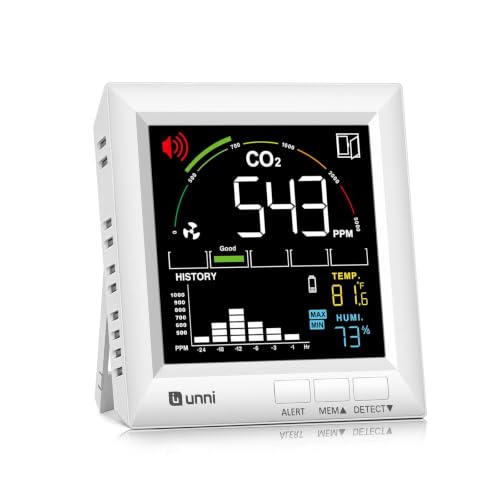
You can trust the number on this screen for real decisions like opening a window, because it reads true — buyers report it picks up 401ppm outdoors and 568ppm indoors, climbing noticeably when people or candles are present. The Swiss-made photoacoustic sensor (a sensor that measures gas by detecting sound waves from light absorption) detects CO2 across a range of 400 to 5000 PPM with an accuracy of +/- 5% plus 50 PPM. The large display shows a 24-hour CO2 history chart, temperature, and humidity at a glance, and it runs on USB power while keeping a 3 x AAA battery backup for when the power goes out.
Unlike the Temtop below, which is battery-focused, this one is designed to stay plugged in and read from across the room. Buyers consistently praise the functionality and easy-to-read display, noting the alarm triggers above 1000ppm with a ventilation icon — a helpful nudge in a nursery or home office. The main trade-offs are physical: it doesn’t come with batteries or a wall plug, the alarm rings for a full minute without a silent option, and the fan and window icons take time to interpret, though a few found the sensitivity almost too sharp, catching 450ppm alone and 550ppm after smoking.
Owners confirmed the alarm triggered correctly during cooking and fireplace use, providing reliable protection for households with children or elderly relatives. This is a value pick, but it doesn’t compromise on the sensor that matters.
Why Owners Stick With It
- Accurate Swiss photoacoustic sensor with a 400–5000 PPM range
- Large display with trend graph and temperature/humidity
- Adjustable alarm volume and CO2 alert from 800–2400 PPM
Small Annoyances to Know
- No batteries or wall plug included in the box
- Alarm rings for one minute and can’t be silenced
- Fan and window icons can be confusing at first
Reach for this if: you want a dependable, budget-friendly CO2 monitor that stays put on a desk or wall and tells you when to open a window.
Look elsewhere if: you need a silent overnight mode, since the alarm can’t be muted once it starts.
2. Temtop CO2 Monitor
The featherweight CO2 spot-checker that runs for weeks and nails the reading.
Move this meter from the bedroom to the office to the car without hunting for an outlet — the highlight is a claimed 70-day battery standby, powered by a photoacoustic sensor with dual detection modes that keeps power use minimal. Despite that portability, it’s no lightweight on accuracy: a Swiss-engineered NDIR sensor (a sensor that measures gas by detecting infrared light absorption) delivers ±40 ppm +5% of reading within the critical 400–2500 ppm range, resolving down to 1 ppm with a rapid 5-second refresh. Owners mention it does exactly what they hoped, with one checking a bedroom that hit 1100–1200ppm overnight and dropped by half in minutes once patio doors opened.
What wins people over is the build and ease of use, since it’s ready to go straight from the start and includes a magnet back for quick mounting, plus it tracks humidity accurately when compared against multiple other units. Unlike the U UNNI’s always-on USB design, this meter is built for undisturbed rest — you can disable both audio alerts and the display illumination for sleep. The honest trade-off is that the screen has no backlight, which makes it hard to read in dim light, and there’s no Bluetooth, so you’re relying on the on-device readings rather than an app.
It’s the go-to for post-incident reassurance, such as after a vehicle was left running in a garage, where the reliable readings offer genuine confidence. It tracks CO2, temperature, and humidity, and we strongly recommend it for nurseries, offices, and grow tents.
Best for: portable, long-lasting CO2 and humidity monitoring in multiple rooms without constant charging.
A fair caution: the non-backlit screen loses readability in low light, and there’s no app or Bluetooth to review history.
3. LifeBasis Air Quality Monitor

An 11-in-1 detector for families who want the whole picture without a big budget.
The appeal here is breadth — this monitor tracks 11 indexes at once, including AQI, CO2, PM1.0, PM2.5, PM10, HCHO, TVOC, temperature, and humidity, so you get a room-wide snapshot rather than a single gas. It stacks multiple sensor types — NDIR infrared for CO2, a laser particle sensor, a semiconductor sensor, and a photoelectric sensor — which lets it respond quickly across different pollutants. With a 2500mAh battery and USB-C charging, it delivers an honest 11 to 12 hours of continuous use on a full charge, making it genuinely portable around the house.
What owners rave about is the portability and the easy-to-read display, since the stand makes it simple to place anywhere and the color-coded icons shift from green to red as levels climb. Real-world testing shows it shines during wildfire smoke, where PM2.5 readings correlated with local EPA data, and in bedrooms where CO2 dropped from 950ppm to the 450–500ppm range after ventilating. TVOC and HCHO readings can be inconsistent, and a few units arrived faulty, so purchase from a retailer with reliable support.
There’s a required 30-minute outdoor calibration before first use, which some find tedious but worth it for the improved trust in the numbers. For the budget tier, this is a solid all-rounder that doesn’t demand an app to function.
Why it stands out: 11 simultaneous readings on a bright, color-coded LCD with a real 11-hour portable runtime.
Who should skip it: anyone needing lab-grade precision on TVOC or formaldehyde, since those readings are the least reliable here.
4. GoveeLife Smart Air Quality Monitor H5140
The app-connected CO2 sentinel for home offices where stale air kills focus.
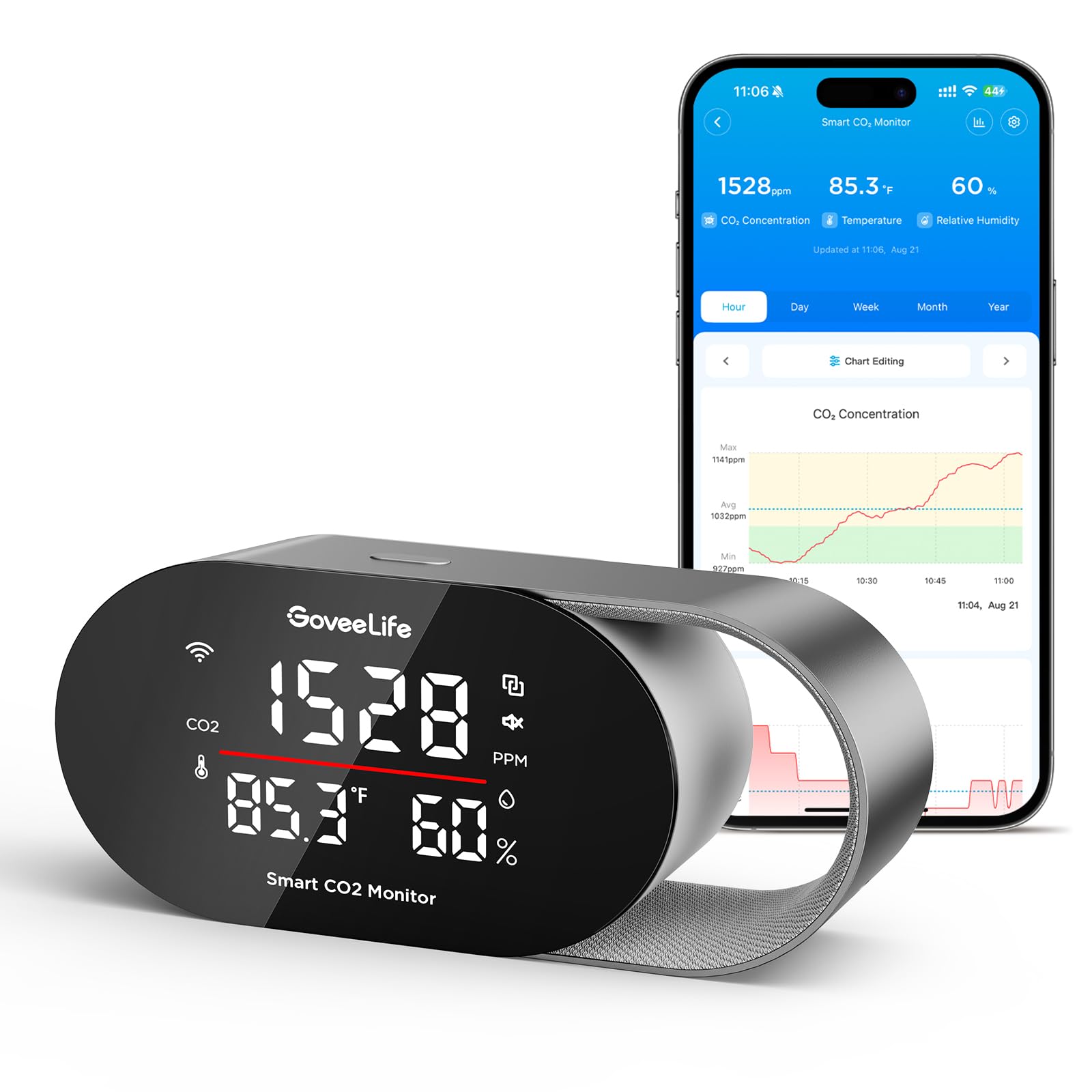
This is the smart-home choice, and its superpower is that it doesn’t just show you a number — it files it away and warns you through three channels at once. The SCD4x CO2 sensor (photoacoustic NDIR principle) delivers accuracy of ±(40ppm + 5%) with a 5-second refresh and built-in pressure compensation, so altitude doesn’t throw off your readings. The 4-in-1 display shows CO2, temperature, humidity, and a clock, but the real depth lives in the app: two years of interactive history charts and CSV export for medical consultations or energy planning.
What wins owners over is the triple alert system — a built-in buzzer, instant app notifications, and email reports — which is exactly what a home office worker needs when CO2 hits 1500ppm with the door shut, a level linked to those afternoon headaches. Unlike the simpler U UNNI and Temtop units, this one connects to Alexa and Google Assistant, so you can ask for readings by voice and even link it to humidifiers or tower fans, though air purifiers can’t be linked since they don’t remove CO2. The recurring gripe is the screen — it can be too bright at night, and while the scheduled-off function works, setting it can feel buggy; it’s also strictly AC-powered, so there’s no battery to move it around freely.
Owners confirm the temperature matches their thermostat and the accuracy holds up near an open window with readings in the 400s. It’s the only pick with remote monitoring and two-year historical trends.
The Connected Upside
- Two-year data history with CSV export from the app
- Triple alerts: buzzer, app notification, and email
- Voice control via Alexa and Google Assistant
The Wired Downside
- No battery — it runs only on AC or a USB-C power bank
- Screen can disrupt sleep without careful scheduling
Pick this for: data-driven types who want CO2 history, remote alerts, and smart-home voice control in a permanent desk setup.
Think twice if: you need to roam between rooms without outlets, since this one prefers to stay plugged in.
5. Sainlogic Air Quality Monitor

The glanceable 7.2-inch monitor that tracks nine parameters with no app required.
The defining feature here is the screen — a 7.2-inch display with generously sized text and three adjustable brightness levels, which makes it readable from across the living room while the kids play. It tracks 9 essential indicators — CO2, PM2.5, PM10, PM1.0, AQI, HCHO, TVOC, temperature, and humidity — and adds 7 user-defined alert thresholds you can customize for what matters in your home. The high-precision sensor samples at 1.5-second intervals and refreshes every 1 to 2 seconds, so you’re watching live data rather than a lagging average.
What owners appreciate most is that it works immediately from the start with zero WiFi or app setup — just power it on and it starts reading, which is a relief compared to the GoveeLife’s configuration dance. The tri-color LED system shifts automatically, and once any reading hits Level 4 or higher, a flashing “Open Windows for Ventilation” prompt appears — a clear nudge for allergy sufferers or households with infants. It runs on a built-in 2500mAh rechargeable battery for up to 8 hours of wireless use, recharging over USB-C, and its compact 1.5-pound body is easy to move from the nursery to the kitchen.
Owners simply call it accurate, easy to use, and quick to set up, and the single-press mute keeps the audible alarms from becoming a nuisance while visual alerts stay active. Choose this for a large, clear display that’s readable from across the room without needing an app.
The standout: a massive 7.2-inch display that auto-brightens to max the moment an alert triggers, so you never miss a warning.
The trade-off: with no WiFi or app, you get live readings but no historical data logging or remote access.
6. YNAK 16 in 1 Air Quality Monitor
The wildfire-season sentinel with a huge 7-inch screen and honest readings.
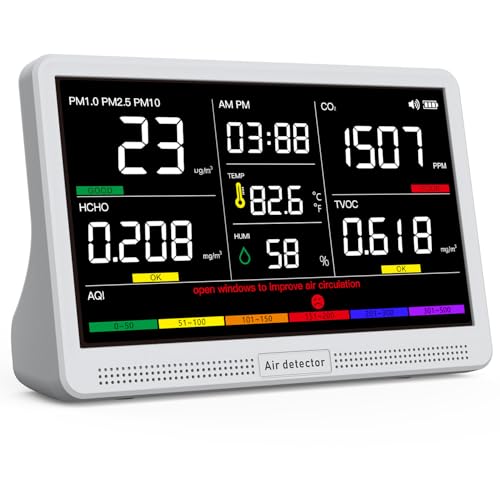
This one is built for the smoky months, and its claim to fame is the 7-inch LED display that gives you an instant, menu-free view of CO2, PM2.5, PM1.0, PM10, HCHO, TVOC, temperature, humidity, and AQI all at once. The “16-in-1” name breaks down to 9 key detectable parameters plus 7 distinct AQI alert buzzers, so you’re getting real-time warnings across the full pollutant spectrum, not just one gas. It relies on external high-precision sensors with 0.001-unit accuracy that sample the air directly through an enhanced airflow design, which means it catches even slight changes from cooking or candles quickly.
What wins owners over is the reliability and the color-coded alert bar that makes it obvious when the air is good, plus the fact that it needs no app — it’s plug-and-play, and it worked right from the start for buyers monitoring near a dump and interstate. One owner’s unit matched a neighbor’s professional monitor outdoors and held time accuracy within 0.1°F of calibrated thermometers over a month, which is strong real-world validation for amateur use. Accuracy feedback is mixed, with some units showing odd readings after a few days, and the company notes it’s for general monitoring, not medical-grade use.
It’s wall-powered with a backup D battery, so it stays on even during power blips, and the mute button silences alarms while keeping visual alerts active. This is a solid choice for families who want a big, clear dashboard during wildfire season without paying for smart-home extras.
Its best move: a 7-inch screen with three brightness settings and 7 alert buzzers that make changing air quality impossible to ignore.
The honest fit: great for general day-to-day monitoring, but buyers with respiratory conditions needing clinical precision should look at medical-grade gear instead.
7. EG Air Quality Monitor

The deep-dive VOC hunter for new furniture, off-gassing floors, and car air.
If you suspect formaldehyde or chemical vapors are the problem, this is the specialist — it’s designed around a laser sensor for PM2.5 dust plus a second electrochemical semiconductor sensor dedicated to formaldehyde and natural/synthetic volatile organic compounds. The built-in fan actively draws ambient air in for real-time measurements, and the whole unit runs on a 2200mAh battery for continuous monitoring up to 2 days, or via DC 5V micro USB when you’re parked near an outlet. Its most urgent use case is detecting off-gassing from new household materials, where it caught formaldehyde at.500 and VOC at 7.500 from flooring in one buyer’s home.
What owners praise most is how effectively it detects pollution sources — smoke, VOCs, and formaldehyde from cars and furniture all show up clearly, which makes it ideal for spot-checking a hotel room, a car, or a nursery after renovations. The display is a clear 2.8-inch color LCD, compact enough to carry anywhere, and USA-based support includes a 20+ page eBook on gas and air quality hazards. It lacks saved history, calibration resets periodically, and the soldered battery isn’t replaceable, though one unit lasted 4 years in a truck.
It’s reliable for relative comparisons between rooms or over time, but some owners found absolute pollutant readings inconsistent after charging. This is the pick for sniffing out chemical sources rather than daily ambient tracking.
Its Real Strengths
- Dedicated semiconductor sensor for HCHO and TVOC detection
- Built-in fan pulls air for fast real-time readings
- Highly sensitive to smoke and off-gassing from materials
Its Real Limits
- No data logging or history storage
- Battery is soldered in and not replaceable
- Calibration resets periodically and needs redoing
Choose it for: spot-checking specific rooms, cars, or new furniture for chemical off-gassing rather than permanent whole-home tracking.
Pass on it if: you want continuous logged data or a long-lived battery you can swap out yourself.
Understanding the Specs
NDIR vs Photoacoustic CO2 Sensors
The two main ways meters detect carbon dioxide are NDIR and photoacoustic sensing. NDIR shines light through an air sample and measures how much is absorbed; photoacoustic sensors measure the sound pressure created when gas molecules absorb light. Both can be precise, but the accuracy spec — like ±40 ppm — tells you how much you can trust the number, which matters in a stuffy home office.
PM2.5, TVOC, and HCHO
PM2.5 tracks fine particles under 2.5 microns that can travel deep into your lungs, while TVOC covers the gases that create most household odors, and HCHO specifically targets formaldehyde from new materials. These use different sensor technologies — laser for particles, semiconductor or electrochemical for gases — so a meter that claims all three must juggle separate sensing methods.
FAQ
What does an air quality meter actually measure?
Will a CO2 monitor detect carbon monoxide?
How often do I need to calibrate an air quality meter?
Is the 7-inch display worth it over a smaller screen?
Can I use these monitors to check air quality in a car?
Do I need an app for these air quality meters?
How long does the battery last on a wireless model?
What does the PPM number mean for CO2 levels?
Are these accurate enough for medical conditions like asthma?
Which sensor is best for detecting wildfire smoke?
Final Thoughts: The Verdict
If you want one dependable pick, the winner is the U UNNI CO2 Monitor because it pairs Swiss-made sensor accuracy with a large, readable display at a price that undercuts everything else — a value that’s tough to top. If you want app-based history and remote alerts, grab the GoveeLife H5140 instead. And for wildfire season or a room where you need the whole picture at a glance, the YNAK 16-in-1 with its 7-inch screen is the one to reach for.
How We Picked
We do not accept paid placement. Every pick is matched to a real buyer and a real use-case; we do not hands-on test units.
Sources & Methodology
Specifications: manufacturer listings and product documentation. Review insights: verified customer reviews, as of August 2026. Pricing: not shown on this page (it changes often); check the current price via the retailer link.
As an Amazon Associate, Gadgets Feed earns from qualifying purchases. This does not affect which products we feature.