
Mold doesn’t need visible water stains to thrive — it only needs damp air. An air quality monitor that tracks humidity, temperature, and airborne particulates is the only way to catch the conditions that allow mold to colonize your walls, carpets, and HVAC ducts before you smell the musty odor.
I’m Min — the co-founder and writer behind Gadgets Feed. After hundreds of hours spent cross-referencing sensor specifications, calibration procedures, and ventilation science, I’ve assembled the definitive guide to selecting an air quality monitor that can actually help you prevent and detect mold-friendly environments.
Whether you live in a humid climate, have experienced a water leak, or simply want to protect your family from hidden spore growth, this analysis of the best air quality monitor for mold covers every essential spec you need to make a confident purchase.
How To Choose The Best Air Quality Monitor For Mold
Not every air quality monitor is useful for mold detection. Many inexpensive units only measure CO2, which tells you nothing about the moisture and particulate conditions that breed spores. To select a monitor that genuinely helps you prevent mold, you need to prioritize four specific features.
Relative Humidity Accuracy
Mold requires relative humidity above 60% RH to begin growing. A monitor with ±2% RH accuracy or better gives you actionable warnings before condensation forms on windows or inside walls. Avoid any unit that omits humidity entirely or advertises accuracy worse than ±5% RH.
PM2.5 and PM10 Particle Detection
Active mold colonies release spores and fragments into the air as respirable particles (PM2.5) and larger settleable particles (PM10). A laser particle counter that can detect both size fractions provides direct evidence of airborne mold activity — not just the risk of it. Without PM sensing, you are flying blind on whether spores are already circulating.
TVOC and Formaldehyde Detection
Mold emits microbial volatile organic compounds (mVOCs) that produce that characteristic musty smell. A TVOC sensor with HCHO (formaldehyde) detection helps identify hidden mold behind walls or under flooring where visible growth is impossible to spot. These sensors are sensitive to many household chemicals, so learn to interpret spikes near cleaning products versus sustained elevated readings from mold.
Data Logging and Trend Analysis
Mold conditions develop over hours and days, not minutes. A monitor that exports data to Excel or shows a 12‑hour histogram lets you spot patterns — like humidity peaking every night above 65% RH or PM counts rising after rain. Models with 30‑day app history are superior to units that only show the current reading.
Quick Comparison
On smaller screens, swipe sideways to see the full table.
| Model | Category | Best For | Key Spec | Amazon |
|---|---|---|---|---|
| 16 in 1 Air Quality Monitor | Mid-Range | Huge display, multi‑pollutant tracking | 7‑inch LED display, 2500mAh battery | Amazon |
| BREATHE Airmonitor Plus | Mid-Range | App‑based remote monitoring | 30‑day data history in app | Amazon |
| KDWKD Air Quality Monitor | Mid-Range | Portable room‑to‑room use | 9‑hour battery runtime | Amazon |
| Sainlogic 16 in 1 | Mid-Range | High‑precision VOC detection | 0.001 sensitivity, 7.2‑inch screen | Amazon |
| Temtop LKC‑1000S+ | Premium | Data export, long‑term trending | 20,000‑hour laser sensor lifespan | Amazon |
| Qingping Air Monitor 2 | Premium | Smart home integration | 254 PPI IPS touchscreen | Amazon |
| Aranet4 Home | Premium | Ultra‑long battery, CO2 accuracy | NDIR CO2 sensor, 4‑year battery life | Amazon |
In‑Depth Reviews
1. Sainlogic 16 in 1 Air Quality Monitor

The Sainlogic 16 in 1 earns the top spot because it delivers 0.001‑level detection sensitivity for HCHO, TVOC, and PM fractions, paired with tri‑color AQI alerts that flash a “Open Windows for Ventilation” warning at level 4 and above. This is exactly the kind of actionable feedback you need when humidity creeps toward 60% RH or PM counts spike from circulating spores — you don’t have to interpret raw numbers.
The 7.2‑inch screen offers three brightness levels and automatically maxes out when any parameter triggers an alert, so warnings remain visible from across the room. No WiFi or app is required — just power it on and the display shows CO2, PM2.5, PM10, PM1.0, HCHO, TVOC, temperature, humidity, and AQI immediately. The 2500mAh battery provides up to 8 hours of cordless use, letting you carry it from the basement to the attic to find problem zones.
User‑definable alert thresholds across 7 parameters give you precise control over when the alarm sounds. The one‑touch reset button simplifies recalibration, and the USB‑C charging avoids proprietary cables. For a device that covers every mold‑relevant pollutant without forcing you into an app ecosystem, the Sainlogic is the most complete drop‑in solution available.
Why it’s great
- 0.001 sensitivity catches tiny changes in HCHO and TVOC from hidden mold sources
- Large 7.2‑inch display with tri‑color visual alerts, no app needed
- 8‑hour battery lets you scan every room for damp and particulate issues
Good to know
- Sensors can be affected by perfumes and strong odors — avoid direct exposure
- Calibration reset required periodically for sustained accuracy
2. Temtop LKC‑1000S+ Air Quality Monitor
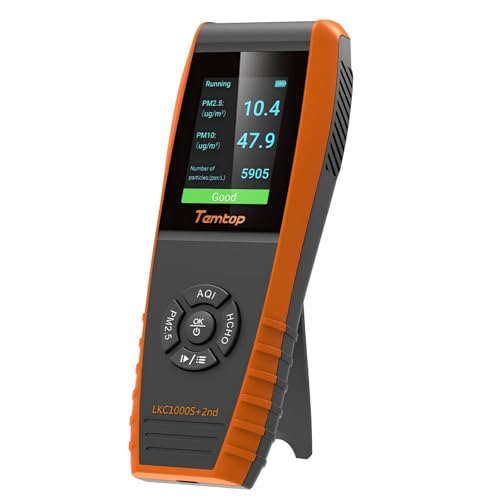
The Temtop LKC‑1000S+ is built for users who need to track mold‑related trends over weeks and months, not just glance at instantaneous numbers. Its built‑in histogram displays the last 12 hours of PM2.5 changes, and data can be exported to an Excel spreadsheet for detailed review of up to 3 months of continuous recordings. This long‑term perspective is invaluable for spotting humidity and particulate patterns that precede visible mold growth.
The Dart electrochemical formaldehyde sensor is pre‑calibrated and delivers an R² correlation up to 0.999 under ideal conditions, making it one of the more reliable consumer‑grade HCHO detectors on the market. The laser particle sensor supports 20,000 hours of operation, so you won’t need a replacement for years. It measures PM2.5, PM10, formaldehyde, TVOC, humidity, temperature, and AQI — covering the full spectrum of mold‑relevant factors.
Some users report that the stand is unstable and the device can fall backward easily, and the battery life is adequate for room‑to‑room sessions but not long enough for all‑night portable monitoring. The VOC sensor is sensitive enough to detect gas leaks and vehicle exhaust, which also means it can be confused by air fresheners and cleaning products if you don’t read the instructions. For data‑driven households, the Temtop is a serious tool.
Why it’s great
- Histogram and Excel export reveal long‑term humidity and PM patterns
- Dart electrochemical HCHO sensor offers high civilian‑grade accuracy
- 20,000‑hour laser sensor lifespan means years of reliable service
Good to know
- Stand is poorly designed — the unit can tip backward easily
- Formaldehyde sensor can be thrown off by alcohol and air fresheners
3. Qingping Air Monitor Gen 2

The Qingping Air Monitor Gen 2 stands out for its replaceable PM sensor — a contact‑point design that makes maintenance simple if the particle counter degrades over time. The 4‑inch IPS touchscreen with 254 PPI provides crisp, swipeable interaction, and color indicators under every metric let you assess air quality at a glance without digging into menus. It measures PM2.5, PM10, CO2, eTVOC, temperature, humidity, and noise — though note it does not measure formaldehyde.
Smart home compatibility via the Qingping+ app gives you remote monitoring and 30‑day data history, which is helpful for tracking humidity trends when you are away from home. The device supports both 2.4GHz and 5GHz WiFi, and firmware updates are delivered over the air. The replaceable PM sensor is a forward‑thinking design choice that extends the device’s usable life well beyond typical monitors.
The battery lasts only about 3 hours when unplugged, which makes it a desk‑top unit rather than a portable scanner for multiple rooms. Several users report that the USB‑C charging is finicky — it must use a 5V 1A adapter, and fast chargers can overheat and damage the battery. If you keep it plugged in as a stationary monitor and avoid high‑voltage adapters, it delivers excellent data for a single room.
Why it’s great
- Replaceable PM sensor extends device lifespan significantly
- 4‑inch 254 PPI touchscreen with color‑coded metrics
- 30‑day app history and remote monitoring via Qingping+
Good to know
- Does not measure formaldehyde — important if HCHO is a concern
- Requires 5V 1A adapter; fast chargers may damage the battery
4. Aranet4 Home
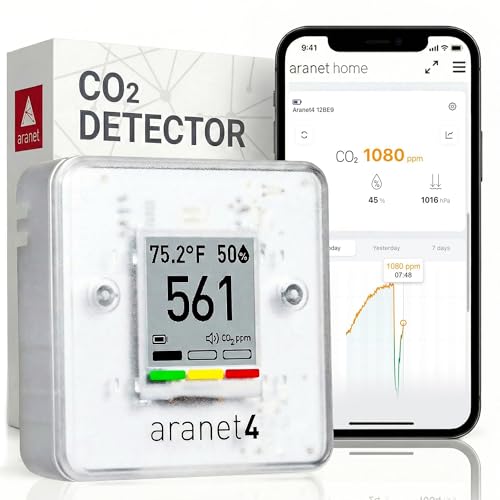
The Aranet4 is a category specialist: an NDIR CO2 monitor with temperature, relative humidity, and atmospheric pressure sensing, all running on 2 AA batteries that can last up to 4 years. Its e‑ink display is perpetually readable without consuming power, and the prominent color‑coded CO2 number (green/yellow/red) instantly tells you when ventilation is needed. For mold prevention, the humidity and CO2 axes are critical — high CO2 means poor ventilation, which leads to condensation and damp surfaces where mold thrives.
The free companion app provides up to 90 days of historical data with graphs, allowing you to spot ventilation patterns and humidity spikes over time. At just 3.67 ounces and 2.76 inches square, the Aranet4 is genuinely portable — toss it in a bag to check air quality at the office, in a hotel room, or in a vacation rental where mold might be hidden. The NDIR sensor is the gold standard for CO2 accuracy in the consumer market, and outdoor calibration can bring readings within 10‑15 ppm of reference instruments.
The trade‑off is that the Aranet4 measures no PM, no TVOC, and no formaldehyde. It is not a comprehensive mold detector — it tells you when conditions are right for mold to grow (high humidity, poor ventilation) but cannot detect spores already in the air. The e‑ink display flashes briefly during refresh and has no backlight, and the device uses Bluetooth Low Energy only (no WiFi). For targeted ventilation and moisture management, it is unmatched; for full mold detection, pair it with a device that reads PM2.5.
Why it’s great
- NDIR CO2 sensor is the most accurate consumer‑grade option available
- Up to 4 years on 2 AA batteries — truly set‑and‑forget
- Lightweight and portable for checking humidity in any room
Good to know
- No PM, TVOC, or formaldehyde sensors — not a standalone mold detector
- No WiFi; Bluetooth range may limit data access from far rooms
5. 16 in 1 Air Quality Monitor Indoor (YNAK)
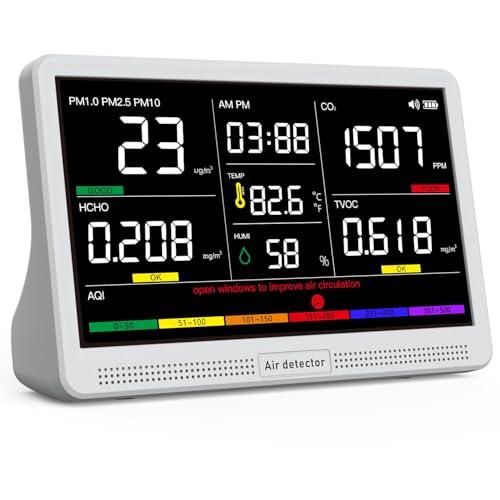
Seven alert buzzers cover each pollutant group, and the mute button lets you silence alarms while keeping visual warnings active. The display has three brightness settings and shows every reading simultaneously without menu navigation — ideal for quick scans in problem rooms like bathrooms and basements.
The external high‑precision sensors claim 0.001‑unit accuracy, and the 2500mAh battery supports up to 8 hours of cordless use. Real‑world user reports confirm that the device responds instantly to cooking smoke, candles, and even hairspray — the same sensitivity you need for detecting mold‑related VOC spikes. The calibration is within industry standards, though the manufacturer warns against exposing sensors to perfumes and strong odors.
The main downsides are that the “16‑in‑1” label is partly a marketing construct (combining 9 parameters with 7 alert types), and some users found initial readings suspiciously low even when strong chemical cleaners were in use. For general mold‑condition monitoring where budget matters, this unit delivers nearly every useful sensor type without needing an app or subscription.
Why it’s great
- 7‑inch display shows all 9 parameters simultaneously — no menu scrolling
- External sensor array with fast response time for PM and VOC spikes
- Great price for the number of sensors included
Good to know
- “16‑in‑1” counting is inflated — it’s really 9 parameters plus 7 alert types
- Initial accuracy may drift; periodic calibration checks recommended
6. BREATHE Airmonitor Plus
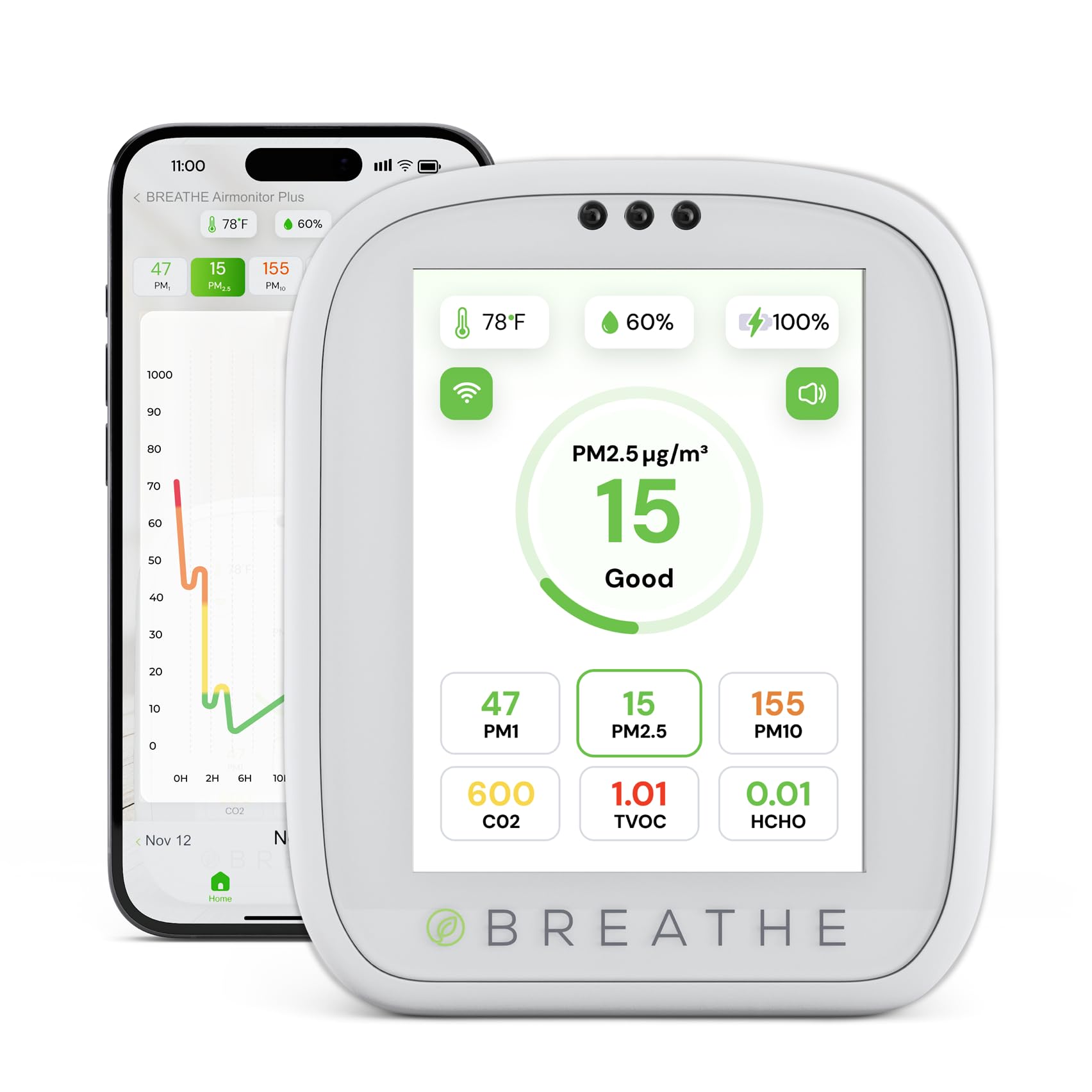
The BREATHE Airmonitor Plus combines CO2, PM1, PM2.5, PM10, TVOC, formaldehyde, temperature, and humidity detection into a compact white enclosure that looks more at home on a desk than most industrial‑looking monitors. The free Breathe Tech app provides remote monitoring, instant push alerts, and 30‑day data history — so you can check humidity trends from work or vacation. The app also tracks changes caused by cooking, cleaning products, HVAC cycles, and occupancy, helping you identify exactly when mold‑favorable conditions arise.
Setup takes under 30 seconds, and the sensor array captures both particle and gas data simultaneously, giving a deeper picture than a basic CO2‑only monitor. The manufacturer explicitly markets it as an “indoor mold solution” because humidity and particulate tracking form the core of early mold detection. Modern aesthetic and small footprint (1.4 x 2.8 x 3.3 inches) make it unobtrusive enough for bedrooms and living rooms.
Several users report that automatic recalibration (occurring every 1‑2 days) can drop CO2 readings artificially low — from 850 ppm to 450 ppm — creating a false sense of safety. A manual recalibration procedure (take outside, wait, press button 3 times) is needed daily for accurate readings. The battery lasts only a few hours, so constant plugging is required, and the display proximity sensor for dimming does not always function reliably.
Why it’s great
- Full sensor suite: PM1, PM2.5, PM10, CO2, TVOC, HCHO, temp, humidity
- App with 30‑day history and remote push alerts
- Compact, modern design fits any room aesthetic
Good to know
- Auto‑recalibration can falsely lower CO2 readings — requires daily manual reset
- Needs to stay plugged in for continuous monitoring; battery is short
7. KDWKD Air Quality Monitor
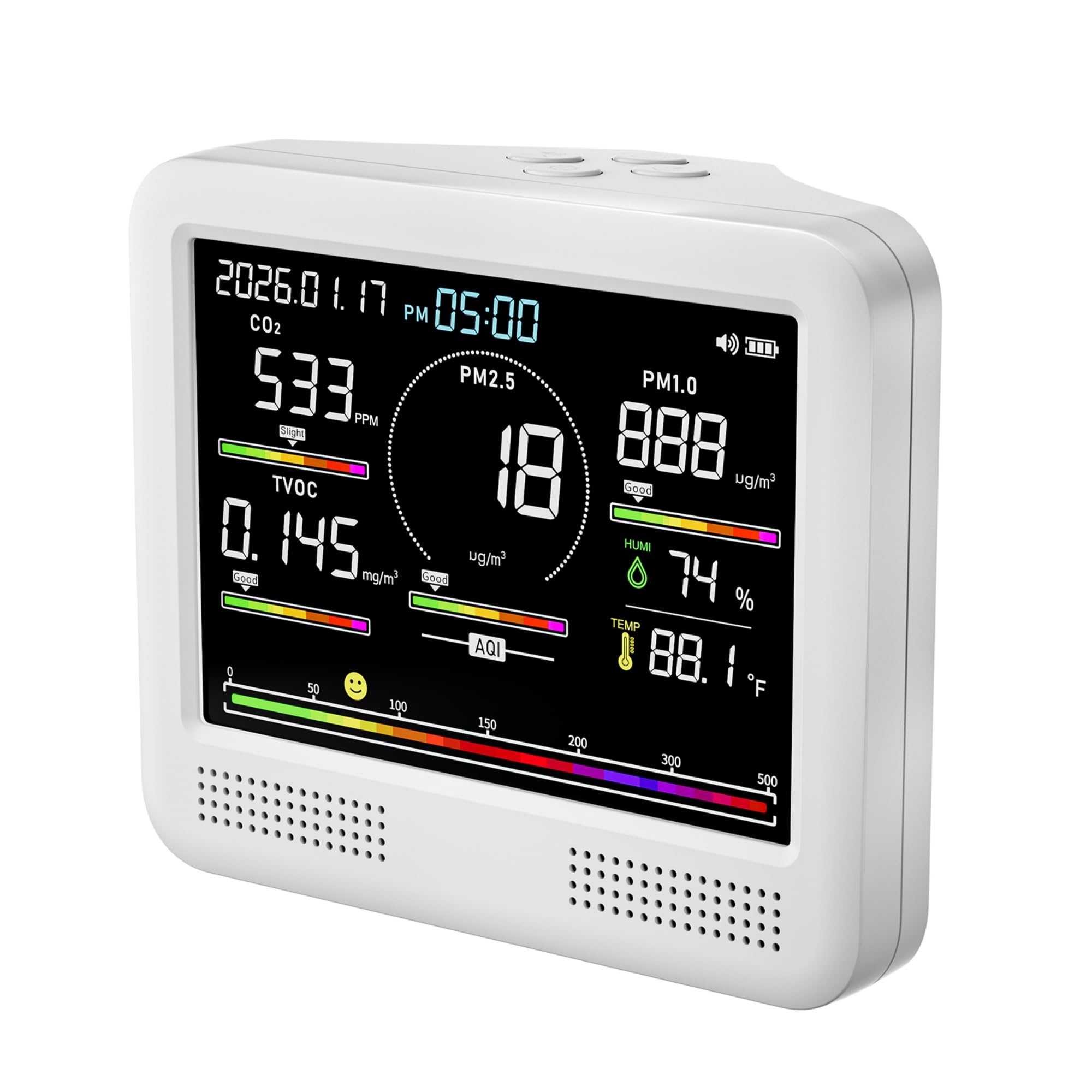
The KDWKD Air Quality Monitor is the most budget‑friendly entry on this list, yet it still tracks CO2, PM0.3 through PM10 fractions, HCHO, TVOC, temperature, and humidity. The built‑in rechargeable battery delivers up to 9 hours of operation, making it genuinely portable for scanning multiple rooms throughout the day. The large color screen shows AQI levels, temperature, humidity, and battery status at a glance, with an audible alarm for threshold breaches.
Users confirm that it is useful for monitoring VOCs and formaldehyde fumes in new construction or after remodeling — two scenarios that can overlap with mold risks if moisture is also present. The compact and lightweight design lets you carry it easily from the basement to the bedroom to the kitchen, where cooking smoke and steam can create the humidity spikes that precede mold growth.
The main caveat is that some customer reviews on Amazon are clearly for unrelated products (wire fencing, cables), which indicates a listing quality issue rather than a product flaw. Several verified buyers note that the monitor works well for its price point, but you should verify that you are ordering the correct item. For the price, it provides the most essential mold‑detection sensors without premium frills like app connectivity or data export.
Why it’s great
- 9‑hour battery is longest runtime for a sub‑ monitor on this list
- Covers CO2, PM fractions, HCHO, TVOC, temp, and humidity
- Very affordable entry point for multi‑room mold condition checks
Good to know
- Amazon listing has mixed reviews for unrelated products — verify order
- No app, data export, or long‑term trend tracking
FAQ
Can an air quality monitor detect mold directly?
What humidity level should trigger an alarm for mold prevention?
Why does my monitor show high TVOC even without visible mold?
Final Thoughts: The Verdict
For most users, the best air quality monitor for mold winner is the Sainlogic 16 in 1 because it combines 0.001‑level detection sensitivity, a massive 7.2‑inch display, and tri‑color AQI alerts without requiring a smartphone app. If you need long‑term data export and high‑accuracy formaldehyde sensing, grab the Temtop LKC‑1000S+. And for portable ventilation monitoring with unmatched battery life and NDIR CO2 precision, nothing beats the Aranet4 Home.