
Indoor air is a cocktail of invisible particles, gasses, and vapors. The difference between a productive, restful space and one that leaves you sluggish or with a headache often comes down to what your nose cannot detect. An air quality monitor turns that invisible world into a readable, actionable data set.
I’m Min — the co-founder and writer behind Gadgets Feed. I’ve spent many hours cross-referencing sensor technologies like NDIR CO₂, laser particle counters, and photoionization detectors to separate real measurement from marketing fluff for this guide.
Whether you manage allergies at home, work in a home office, or monitor a newly renovated space, a reliable monitor delivers clarity. This guide breaks down the best air quality monitor for every room and scenario.
How To Choose The Best Air Quality Monitor
An air quality monitor is only as useful as the accuracy of its sensors and your ability to act on its data. Choosing the right one means understanding what each sensor type detects, how the display communicates risk, and whether the device fits your daily routine.
Sensor Types and What They Measure
The three core sensor categories are CO₂ (usually NDIR, measuring ppm), particle counters (laser-based, measuring PM1.0, PM2.5, PM10), and gas-phase sensors (measuring TVOC and HCHO). Some monitors also include temperature and humidity sensors, which affect how mold and VOC concentrations behave.
Display and Alert Clarity
A large, color-coded screen that changes from green to yellow to red gives you instant situational awareness without needing to interpret numbers. Some models also offer audible alarms and app notifications, which are vital for catching spikes when you’re in another room or asleep.
Power and Portability
Battery-powered monitors let you move from bedroom to kitchen to garage, comparing air quality across zones. AC-powered units provide continuous, uninterrupted data and are better for fixed monitoring in a nursery or office. Some premium models offer both, though battery life is a trade-off with screen brightness and sensor refresh rate.
Quick Comparison
On smaller screens, swipe sideways to see the full table.
| Model | Category | Best For | Key Spec | Amazon |
|---|---|---|---|---|
| bonoch AirSentry | Premium | Whole-home with 12-hour battery | 3500mAh battery, 7″ display | Amazon |
| BREATHE Airmonitor Plus | Premium | App-driven trend analysis | CO₂ + PM1, PM2.5, PM10, TVOC, HCHO | Amazon |
| KDWKD 16-in-1 | Premium | Extreme sensor density (PM0.3 to PM10) | 12 sensor types including PM0.3 | Amazon |
| YNAK AK22A | Mid-range | Large 7-inch display for shared spaces | 7″ LED, 9 AQI parameters + 7 alarms | Amazon |
| GoveeLife H5140 | Mid-range | CO₂-focused with smart home routines | NDIR SCD4x, ±(40ppm+5%) accuracy | Amazon |
| Amazon Smart Air Quality Monitor | Mid-range | Seamless Alexa ecosystem integration | 2-pack, measures PM2.5, VOCs, CO, humidity | Amazon |
| LifeBasis 11-in-1 | Budget | Entry-level with CO₂ and particle sensing | 2500mAh battery, dual alert (visual + sound) | Amazon |
In‑Depth Reviews
1. bonoch AirSentry 16-in-1
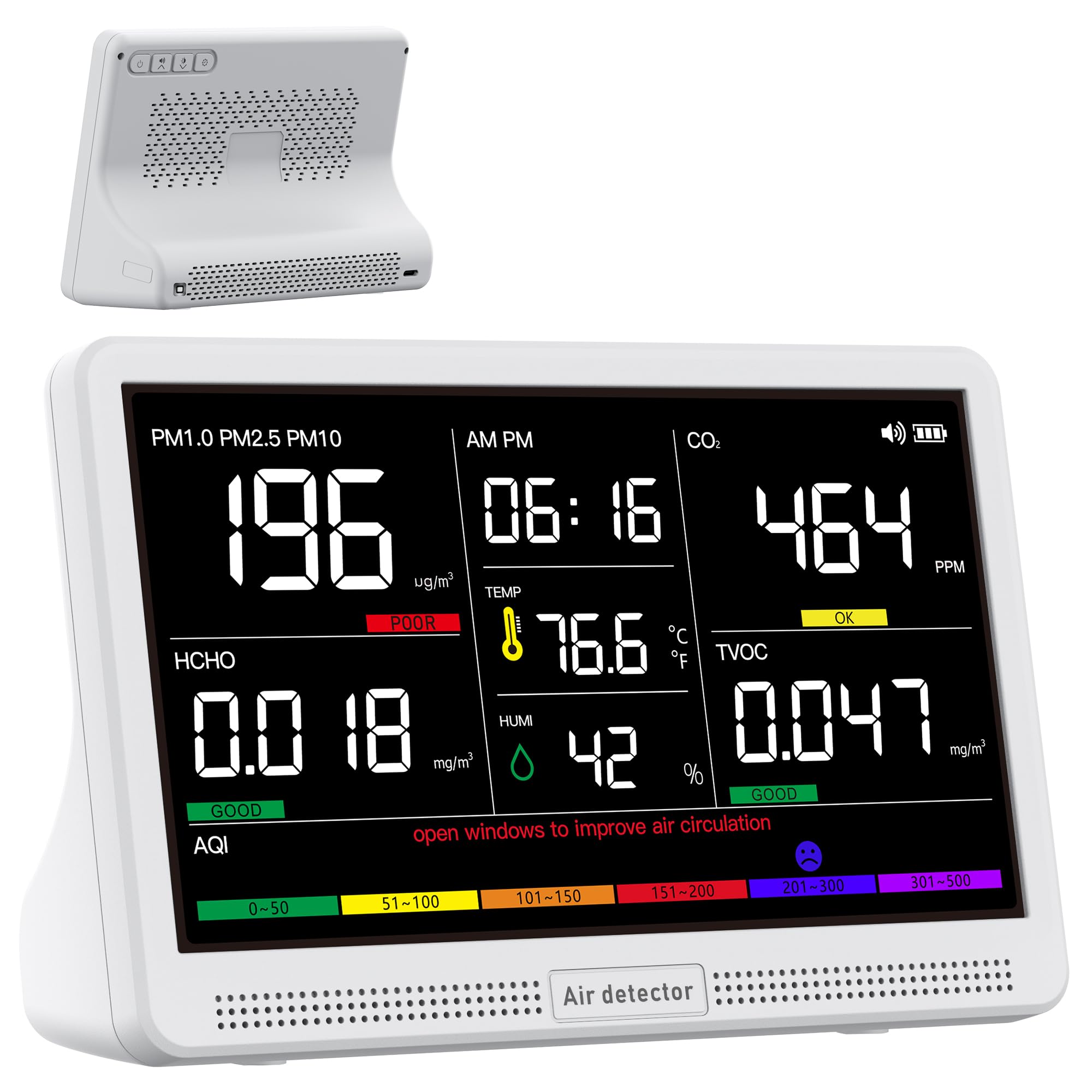
The bonoch AirSentry tops the list because it delivers the longest cordless runtime among any monitor here — a full 12 hours on a single charge from its 3500mAh battery. That capacity lets you move room to room without hunting for an outlet, tracking CO₂, PM2.5, PM1.0, PM10, HCHO, TVOC, temperature, and humidity all on a giant 7-inch LED display.
Its external high-precision sensors read to 0.001 unit accuracy, meaning you’ll catch small shifts from cooking, candles, or a freshly painted wall. The 7 distinct AQI alarm buzzers are configurable, and a mute button silences them when you need quiet. The screen offers three brightness levels, so it won’t wash you out at night.
Some reviewers note the back buttons feel slightly sticky, and the manual is basic, but the battery life and sheer breadth of measurements make it the most versatile all-purpose pick for families, allergy sufferers, and anyone monitoring multiple rooms.
Why it’s great
- Longest battery (12h) for whole-home portability
- 7-inch screen visible from across a room
- 0.001 precision on all key gasses and particles
Good to know
- Back buttons feel a bit stiff
- Manual lacks depth; some trial-and-error setup
2. BREATHE Airmonitor Plus
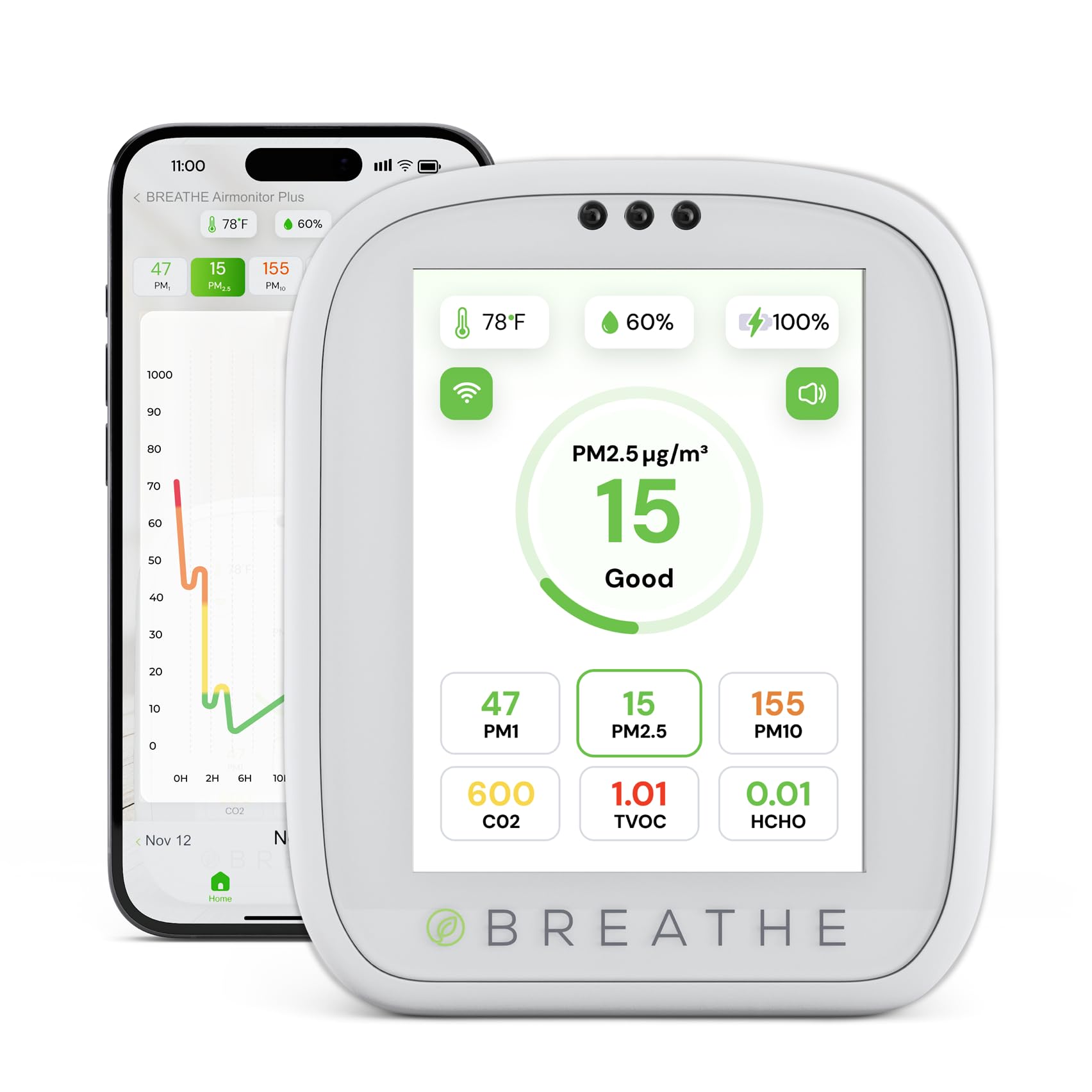
The BREATHE Airmonitor Plus takes a different approach: instead of a massive self-contained screen, it relies on a companion app for remote monitoring, 30-day data history, and push alerts. Its sensor suite covers CO₂, PM1, PM2.5, PM10, TVOC, formaldehyde (HCHO), temperature, and humidity — making it one of the most complete sensing packages in this guide.
Users in poorly ventilated offices have reported CO₂ readings climbing to 4,500 ppm, dropping to 405 ppm after opening windows — data that directly correlates with alertness and focus. The device is compact at just 3.3″ tall and weighs 4 ounces, though it requires AC power for continuous data logging.
The auto-recalibration feature has frustrated some users, as it can falsely lower CO₂ readings over 1-2 days. A manual recalibration (take outside for 5 minutes) solves this, but it’s an extra step. The app also needs improvement on alarm thresholds and notification controls.
Why it’s great
- Full particle + gas + humidity suite in one device
- 30-day trend data via free app
- Compact, modern design fits any desk
Good to know
- Auto-recalibration can mask rising CO₂
- Battery lasts only a few hours; best plugged in
3. KDWKD 16-in-1 Air Quality Monitor
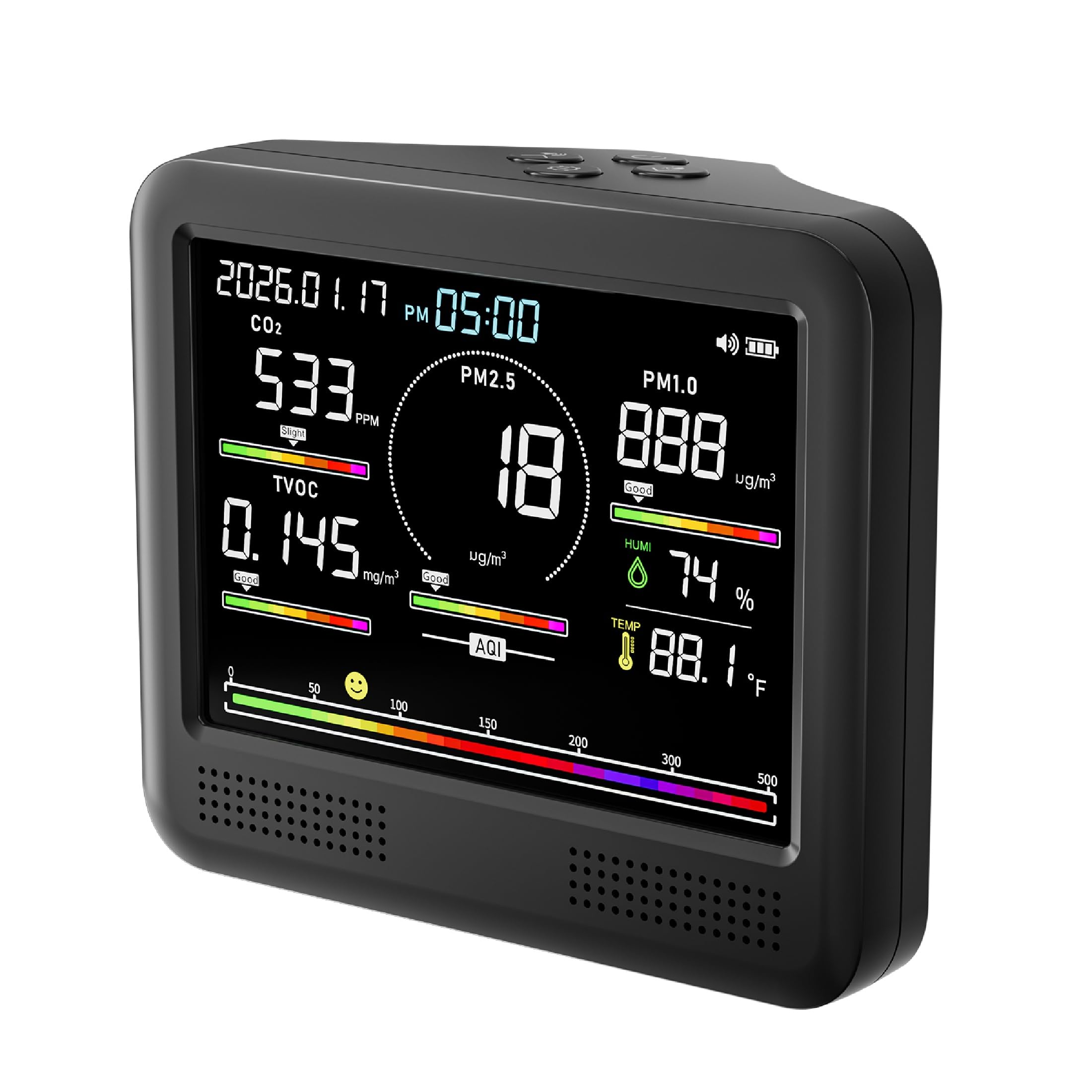
Where other monitors stop at PM2.5 and PM10, the KDWKD goes deeper by also measuring PM0.3 and PM0.5 in addition to PM1.0, PM5.0, and PM10. This means it catches ultra-fine particles from laser printers, cooking oil smoke, and wildfire haze that larger-particle sensors might miss. It also tracks CO₂, HCHO, TVOC, C6H6 (benzene), temperature, and humidity — a total of 12 sensor inputs.
The 7-level AQI color display changes from green (good) to red (danger) with an optional audible alarm. A built-in rechargeable battery provides up to 9 hours of runtime, letting you take it between rooms or even to an RV. The compact size works well on desks or bedside tables.
Some customer reviews are mixed because the product listing was incorrectly merged with a fencing cable, but the actual monitor itself receives positive feedback for detecting VOCs and formaldehyde in newly renovated spaces. The ABS enclosure is lightweight, and it comes with a USB-C cable and charging adapter.
Why it’s great
- Detects PM0.3 — catches ultra-fine particles
- 12 different sensor measurements in one device
- Portable 9-hour battery for multi-room use
Good to know
- Some listing data incorrectly merged with unrelated product
- Not as many verified reviews as others on this list
4. YNAK AK22A 16-in-1
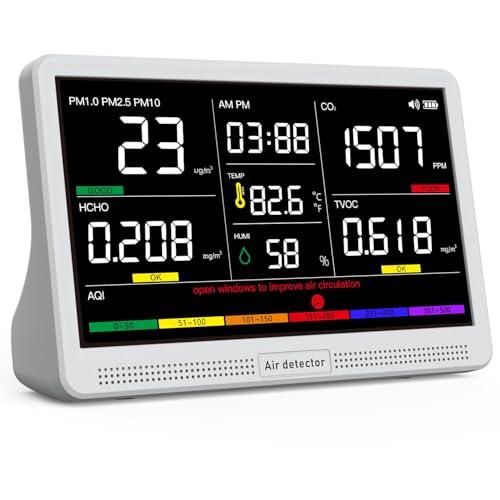
The YNAK AK22A is the monitor for shared spaces where everyone needs to see the reading at once. Its 7-inch LED display shows CO₂, PM2.5, PM1.0, PM10, HCHO, TVOC, temperature, humidity, AQI, and time simultaneously without any menu navigation — the entire dashboard is visible in one glance. Three brightness settings adapt the screen to day or night conditions.
It uses external high-precision sensors that sample air directly, achieving 0.001-unit accuracy for gas readings. The 7 distinct AQI alert buzzers cover each pollutant type, and a mute button lets you silence alarms during sleep. A 2500mAh battery gives up to 8 hours of cordless use, enough to move between rooms for a full day’s monitoring.
Some users found initial readings all green even when strong chemical odors were present, suggesting the HCHO and TVOC sensors might need an outdoor calibration cycle. Overall, the combination of screen size, sensor count, and moderate price point makes it a strong choice for family rooms and open-plan offices.
Why it’s great
- Unified 7-inch display shows all metrics at once
- 0.001 accuracy from external NDIR and laser sensors
- 8-hour battery supports daily multi-room checks
Good to know
- TVOC/HCHO sensors may read green initially when air is poor
- Calibration instructions not always clear
5. GoveeLife H5140
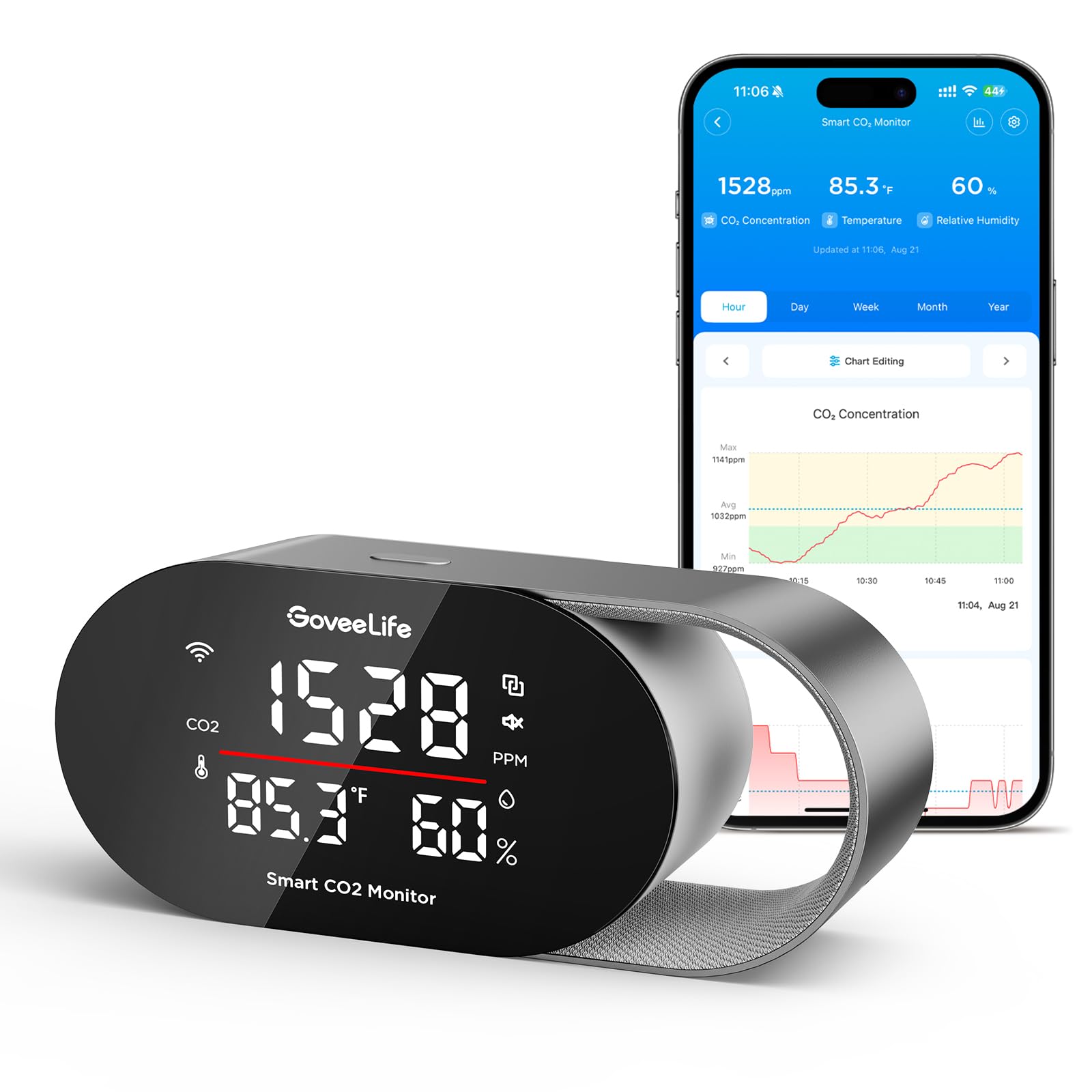
The GoveeLife H5140 is purpose-built for CO₂ monitoring, using the Sensirion SCD4x sensor — a photoacoustic NDIR design that delivers accuracy of ±(40ppm + 5%) with a 5-second refresh rate. This is the same sensor technology found in professional-grade CO₂ meters used by building scientists. It also tracks temperature, humidity, dew point, and VPD, making it a favorite among plant growers and WFH professionals.
The triple alert system (buzzer, app notification, and email report) triggers at user-defined CO₂ thresholds. Smart home integration with Alexa and Google Assistant lets you query CO₂ levels by voice and trigger routines — for example, turning on a tower fan when CO₂ exceeds 1,000 ppm. Historical data exports in CSV format are useful for sleep doctors or energy efficiency audits.
This unit is AC-powered, so it never needs recharging, but it also lacks a battery and a particulate sensor. If you need PM2.5 or TVOC data, this isn’t your monitor. Some users report occasional Wi-Fi disconnections when placed far from the router.
Why it’s great
- Industrial-grade NDIR CO₂ sensor with 5s refresh
- Voice control and smart home routines
- CSV export for data-driven decisions
Good to know
- No particulate sensor (PM2.5/PM10 missing)
- AC-only; not portable between rooms
6. Amazon Smart Air Quality Monitor (2-Pack)
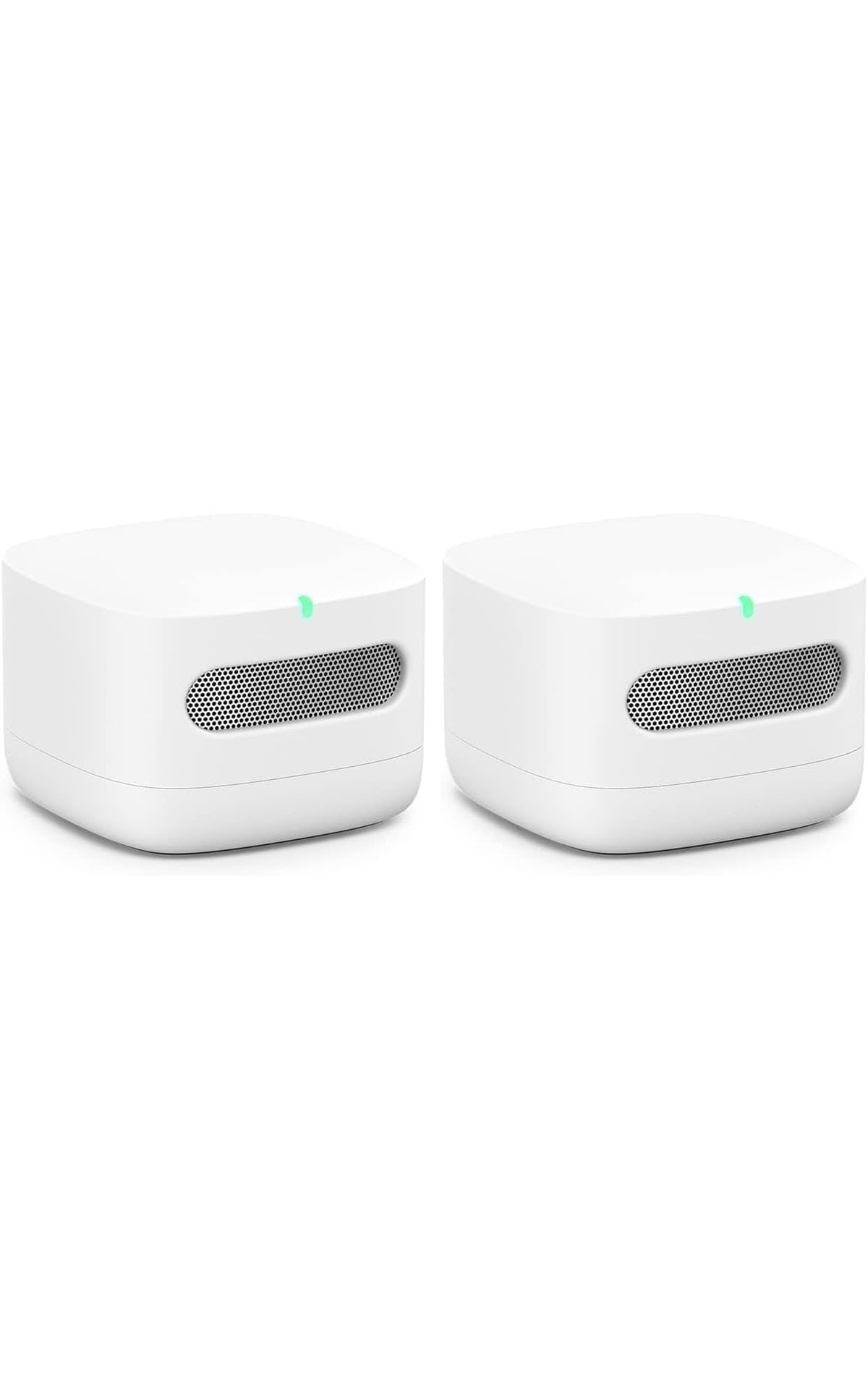
The Amazon Smart Air Quality Monitor is the only device on this list that ships as a 2-pack, making it ideal for monitoring two separate rooms — say, a nursery and a home office — with one purchase. It measures PM2.5, VOCs, carbon monoxide (CO), humidity, and temperature, and reports a single easy-to-understand air quality score through the Alexa app.
Its real advantage is deep Alexa integration. You can set routines that trigger smart plugs, air purifiers, dehumidifiers, or fans when sensor thresholds are crossed — no IFTTT or third-party hub required. The color-coded LED gives an instant visual of current air quality, though it glows bright red when triggered and cannot be dimmed.
Setup is effortless for anyone already in the Amazon ecosystem: plug it in and open the app. The VOC sensor is very sensitive and may misinterpret food odors as pollution (toast can drop the score to 20), and the weekly IAQ display bug (showing daily low instead of average) is a known annoyance.
Why it’s great
- 2-pack covers two rooms out of the box
- Direct Alexa Routine triggers (air purifiers, fans)
- Detects carbon monoxide — a safety feature others lack
Good to know
- Overly sensitive VOC sensor flags normal cooking
- Weekly average display bug not yet patched
7. LifeBasis 11-in-1

The LifeBasis 11-in-1 is the most affordable model here that still includes a genuine NDIR infrared CO₂ sensor, laser particle counter, and semiconductor sensors for TVOC and HCHO. It tracks AQI, PM1.0, PM2.5, PM10, CO₂, HCHO, TVOC, and particles alongside temperature and humidity — all on a compact LCD screen with color-coded alerts.
The dual alert system (color-changing icon plus a ticking sound) escalates from green (good) through yellow, orange, and red as concentrations rise. A 2500mAh battery delivers 11-12 hours of continuous use, letting you run a full day of monitoring on a single charge. Users confirm PM2.5 readings closely match higher-end units like PurpleAir, and the manual outdoor CO₂ calibration is a rarely seen bonus at this tier.
The display is smaller than the 7-inch screens on premium models, and it lacks Wi-Fi or Bluetooth connectivity — there is no app, no data export, and no smart home integration. The faint fan hum from the particle sensor is noticeable in quiet rooms.
Why it’s great
- Genuine NDIR CO₂ sensor at an entry-level price
- 12-hour battery life matches much more expensive models
- PM2.5 accuracy correlates with professional monitors
Good to know
- No app, Wi-Fi, or data logging
- Faint internal fan noise in silent rooms
FAQ
What is the difference between TVOC and HCHO sensors?
Do I need an air quality monitor if I already have an air purifier?
Why does my CO₂ reading drop when I go outside with the monitor?
Final Thoughts: The Verdict
For most users, the air quality monitor winner is the bonoch AirSentry because it combines a 12-hour battery, a massive 7-inch display, and full-spectrum sensing (CO₂, PM, HCHO, TVOC) in one portable package. If you want deep smart home integration and data analytics, grab the GoveeLife H5140. And for a two-room setup that works seamlessly with Alexa, nothing beats the Amazon Smart Air Quality Monitor 2-Pack.