
Our readers keep the lights on and my morning glass full of iced black tea. As an Amazon Associate, I earn from qualifying purchases.
Specs are compiled from manufacturer listings and verified buyer reviews and can change over time — please confirm the key details on the product page before buying.
You spend a third of your life asleep and countless hours working in rooms that may be slowly filling with the one thing you cannot see, smell, or taste: carbon dioxide. A home air quality test reveals whether your stuffy head, afternoon fatigue, or foggy thinking is actually a ventilation problem that a cracked window can solve in minutes. The best monitors for this job track CO₂ in real time, show you the spike when the door is closed, and quietly prove when your air is fresh again.
I’m Min — the founder and writer behind Gadgets Feed. This guide is built by comparing the manufacturers’ published specifications and the patterns across verified customer reviews, so you get each pick’s real strengths and trade-offs instead of marketing spin.
These reviews cover the range from plug-in smart monitors to portable lab-style testers, so you can find the right air quality test for home without guessing which sensor tech actually matters.
Our Picks at a Glance

How To Choose The Best Air Quality Test For Home
Before you buy, you need to know what you are trying to catch. A monitor that tracks dust particles will not tell you if your bedroom is suffocating from stale air, and a CO₂-only meter will miss the formaldehyde seeping from new furniture. Match the sensor to the problem you actually suspect.
CO₂ sensing technology: NDIR is the gold standard
The most reliable CO₂ monitors use NDIR (non-dispersive infrared) sensing, which shines a light through an air sample to measure how much carbon dioxide absorbs it. It is the proven, stable approach. Newer budget models sometimes use a photoacoustic sensor, which measures sound waves from gas molecules instead — it can be very power-efficient but behaves differently. A good CO₂ meter should show accuracy around ±40ppm plus 5% of the reading, which is precise enough to catch a stuffy room before you feel it.
Real-time readings vs long-term trends
Some monitors refresh every 5 seconds, which catches sudden spikes when you cook or close a window. Others are better at showing you the bigger picture — how CO₂ builds overnight in a bedroom, for instance. Decide if you want to react to problems immediately or understand patterns over weeks. App-connected models store weeks or years of history; standalone units often only show the current number.
Power: always-on plug-in vs portable battery
Air quality problems do not keep office hours, so a monitor that runs 24/7 on wall power never misses a nighttime CO₂ spike. But if you want to move the device from the nursery to the car to a hotel room, a rechargeable battery is essential. Some units bridge both worlds: a battery for portability plus a USB cable for continuous monitoring. Consider where you will actually use it most before you choose.
Quick Comparison
| Model | Best For | CO₂ Accuracy | Refresh Rate | Power | Amazon |
|---|---|---|---|---|---|
| GoveeLife H5140★ Best Overall | Smart home CO₂ tracking | ±(40ppm + 5%) | 5 seconds | AC plug-in | Amazon |
| Temtop C1Best Value | Budget bedroom monitoring | ±40ppm +5% | 5 seconds | 70-day battery | Amazon |
| LifeBasis 11-in-1 | Multi-gas portable checks | NDIR sensor | Real-time | 11-12 hr battery | Amazon |
| YNAK 16-in-1 | Large display whole-room view | 0.001 accuracy | Real-time | Wall + battery backup | Amazon |
| EG Air Monitor | Formaldehyde & VOC spot checks | Laser + EC sensor | Real-time fan | 2200mAh battery | Amazon |
| BREATHE Airmonitor Plus | App-based 8-in-1 analysis | NDIR sensor | Real-time | 6-hr battery | Amazon |
| Temtop LKC-1000S+ | Professional data export | Dart electrochemical | Real-time | 6-8 hr battery | Amazon |
In‑Depth Reviews
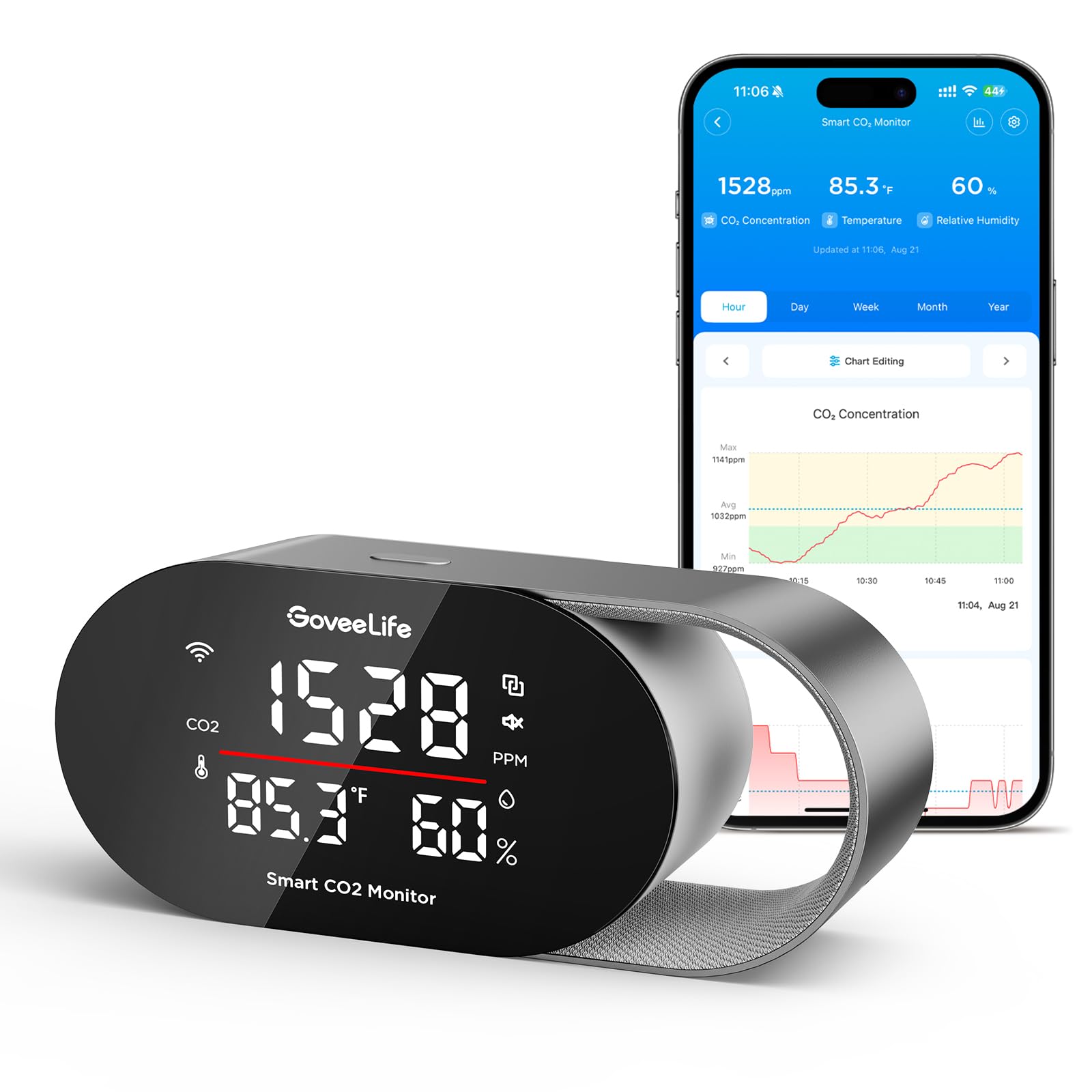
1. GoveeLife Smart Air Quality Monitor CO2 Detector H5140
Our pick — over 4★ from 200+ verified ratings; the strongest balance of quality and price.
The WFH essential that turns invisible CO₂ buildup into a clear five-second warning.
This monitor pays for itself the first time it catches your home office hitting a CO₂ level that makes focusing a struggle. It runs on a SCD4x CO₂ sensor using photoacoustic NDIR technology, which measures gas by sensing the pressure waves it creates, and holds accuracy to ±(40ppm + 5%) with a rapid 5-second refresh rate. Buyers report catching their closed office at 1500 ppm, then watching headaches ease and alertness climb after opening a door or window.
The 4.82-inch display shows CO₂, temperature in °F/°C, humidity, and a built-in clock, all readable from across a desk. A tri-color light bar and triple alert system — a buzzer, app notifications, and email reports — fire when your custom thresholds are crossed. You can query it by voice through Alexa or Google Assistant, and it links intelligently to humidifiers and tower fans, though it will not connect to Govee air purifiers since purifiers cannot reduce CO₂.
The catch is power: it is AC-only with a USB-C cable and no battery, so it is tied to an outlet unless you run it off a power bank. Setup is straightforward and the app tracks up to two years of history with exportable CSV reports, which is rare at this level. It weighs 5.28 ounces, making it noticeably lighter than its closest competitor at 4.96 ounces — a difference you feel only if you carry it around.
Why buyers love it
- Makes invisible CO₂ problems visible in real time
- Clear, easy-to-read display and remarkably capable app
- Triple alerts: buzzer, app push, and email reports
The honest trade-offs
- No internal battery — needs an outlet or power bank
- WiFi setup can occasionally need a phone settings tweak
- CO₂ only; it won’t measure dust or formaldehyde
Reach for this if: you work or sleep in a closed room and want app-driven trend tracking plus voice control to keep CO₂ in check.
Look elsewhere if: you need a battery-powered unit to roam room to room, since this one prefers to stay plugged in.
2. Temtop CO2 Monitor Indoor Air Quality Monitor
A featherweight CO₂ detective with a 70-day battery that vanishes into any room.
You get accurate CO₂ readings without an app, WiFi, or a wall cord. A Swiss-engineered NDIR sensor (a non-dispersive infrared sensor that measures carbon dioxide by light absorption) delivers accuracy of ±40 ppm plus 5% of the reading in the 400–2500 ppm range, refreshing every 5 seconds with 1 ppm resolution. One buyer put it simply: “This monitor is doing exactly what I was hoping it would do” — after a family scare with a vehicle running in an enclosed garage, it delivered the confidence they needed.
What makes it special is the recently introduced photoacoustic CO₂ sensor that powers a 70-day battery life — weeks of monitoring between charges instead of days. At 4.96 ounces, it is about 6% lighter than the GoveeLife H5140 above, and the slim metal-and-plastic body includes a magnet back so you can stick it to a fridge or a shelf. The unlit LCD display is a deliberate feature: no glow means it is an ideal bedroom companion for light-sensitive sleepers.
The display gives a general average rather than showing every acute spike, which makes it less startling than some rivals but also less revealing for people chasing sudden changes. Accuracy is solid for general environmental sense rather than laboratory precision. It covers CO₂, temperature from 14°F to 140°F, and humidity from 0–99% RH, and it works in nurseries, offices, grow tents, and schools alike.
Quietly brilliant for: anyone who wants set-and-forget CO₂ monitoring in a bedroom, nursery, or office without app fatigue — the 70-day battery and magnet mount make it easy.
The short version: a compact, long-lasting CO₂ meter that trades flashy features for dependable simplicity and a genuinely useful battery.
One note: it reads CO₂ only — carbon monoxide and dust particles are outside its job description.
3. LifeBasis Air Quality Monitor Indoor, 11-in-1 Air Quality Detector

The room-to-room detective that hunts down dust, gas, and formaldehyde with one portable unit.
If you suspect multiple problems — wildfire smoke, a new couch off-gassing, or a stuffy bedroom — this single device chases them all. It monitors 11 indexes including AQI, CO₂, PM1.0, PM2.5, PM10, particles, HCHO formaldehyde, TVOC, temperature, and humidity, with a dual visual-and-audible alert system. Four sensor types work together: an NDIR infrared CO₂ sensor, a laser particle sensor, a semiconductor sensor, and a photoelectric sensor, so different pollutants get the right detection method.
Owners mention PM2.5 readings that correlate with local EPA wildfire smoke data, helping one household manage asthma and allergy symptoms. Another found CO₂ accurate through the morning, watching it drop from 950 to 450–500 ppm after ventilation. The 2500mAh battery delivers 11–12 hours of continuous use on a full charge through the Type-C port, so it genuinely travels from the bedroom to the car to the office.
The interface uses a color-coded LCD where each gas icon shifts through four grades — green for good, yellow for moderate, orange for poor, and red for abnormal — with a ticking alert when levels pass normal. Screen brightness is adjustable. Accuracy feedback is genuinely mixed, with some units arriving glitchy before the company corrected them, so treat initial readings with skepticism until the device stabilizes. A 30-minute outdoor CO₂ calibration helps lock in trustworthy numbers.
What stands out
- 11-parameter detection in a carry-anywhere body
- Portable 2500mAh battery with 11–12 hours of use
- Color-coded grades make readings instantly understandable
What to watch
- Accuracy is the most-discussed topic, with mixed owner reports
- Needs outdoor calibration for best CO₂ results
- Single back vent can make readings less representative
Pick this if: you want one portable tester that covers gases and particles, and you are comfortable doing a quick outdoor calibration.
Think twice if: you need reference-grade precision — this is a strong consumer tool, not a lab instrument.
4. YNAK 16-in-1 Air Quality Monitor with 7-inch Display
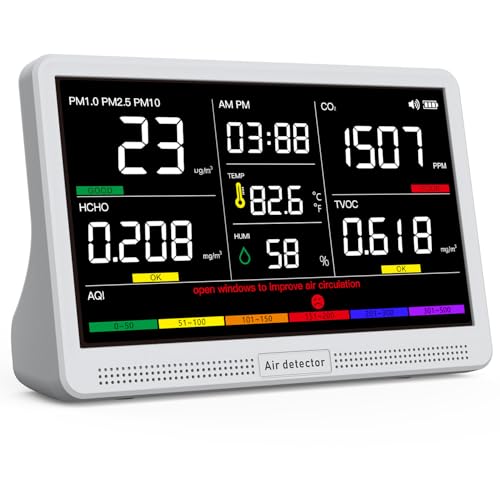
The room-scale command center whose 7-inch screen makes air quality a family conversation.
Most monitors make you squint at a two-inch screen; this one puts a 7-inch LED display on your wall or shelf that is readable from across the room. It tracks 9 key parameters — CO₂, PM2.5, PM1.0, PM10, HCHO, TVOC, temperature, humidity, AQI — plus time, with 7 distinct AQI alert buzzers. External high-precision sensors deliver readings down to 0.001 units by sampling the air directly, and three brightness settings adapt to any lighting.
Buyers describe watching the display like “reality TV,” with readings responding quickly when cooking, candles, or open windows change the air. One household runs two units in separate spaces and loves that the whole family can read the huge screen at a glance — it doubles as a clock and needs no app at all. It runs on wall power with a D battery backup, so a power outage does not silence your monitoring.
The honest limits: there is no data history charting or app connectivity, so you cannot review yesterday’s trend unless you were watching in real time. Some units trigger frequent TVOC and CO₂ false alarms in the first 24 hours before settling down, and the vendor’s response has been to offer an upgraded 18-in-1 model with 15-day recording. Accuracy feedback is mixed overall, so treat it as a reliable directional guide rather than a calibrated instrument.
Best for family rooms: the massive display and color alerts mean everyone — kids included — can see when to crack a window without needing a phone app.
Who it suits: households that want a prominent, easy-to-read monitor for a living space or open-plan area, not a data-hoarding analyst.
Who it doesn’t: trend-trackers who need historical graphs, since there is no app and no stored history.
5. EG Air Quality Monitor & Formaldehyde Detector

The spot-check specialist that sniffs out formaldehyde and VOCs from new furniture and fresh paint.
Bring home a new dresser, a fresh coat of paint, or a suspicious “new car smell” and this meter tells you what is in the air. It measures formaldehyde (HCHO), total volatile organic compounds (TVOC), and PM2.5 fine dust (particles under 2.5 micrometers that travel deep into the respiratory tract). A built-in fan actively draws air across the sensors for real-time measurements, using a laser sensor for dust and a separate electrochemical semiconductor sensor for formaldehyde and organic compounds.
Its sensitivity is the thing owners rave about — the functionality and monitoring capabilities are what win people over most. The device has detected VOCs from smoke, waste, and new furniture or cars, and it proved essential for pet bird owners who need to know the air is safe. The 2200mAh battery powers portable use when DC 5V micro USB charging is unavailable, and data appears on a clear 2.8-inch color LCD. A 20+ page eBook on gas and air quality hazards ships with it.
The weaknesses are real: there is no saved history, calibration resets every time you power cycle, and there is no data export — so it is strictly a spot-check tool, not a trend tracker. Battery life draws the most negative feedback, with some units no longer holding a charge after years of use, and the battery is soldered in and non-replaceable. Accuracy is mixed in owner reports, so use it for relative comparisons and direction rather than absolute judgments.
Its superpower
- Highly sensitive real-time HCHO, TVOC, and PM2.5 detection
- Built-in fan pulls air in for fast response
- Portable with 2200mAh battery and included eBook
Its limitations
- No history saving, data export, or calibration retention
- Non-replaceable soldered battery that fades over time
- Temperamental on absolute accuracy
Grab it for: on-demand checks of new furniture, renovations, or car interiors where you need to know if off-gassing is happening right now.
skip it if: you want continuous 24/7 trend logging — this meter is built for spot tests, not long-term records.
6. BREATHE Airmonitor Plus Indoor Air Quality Monitor
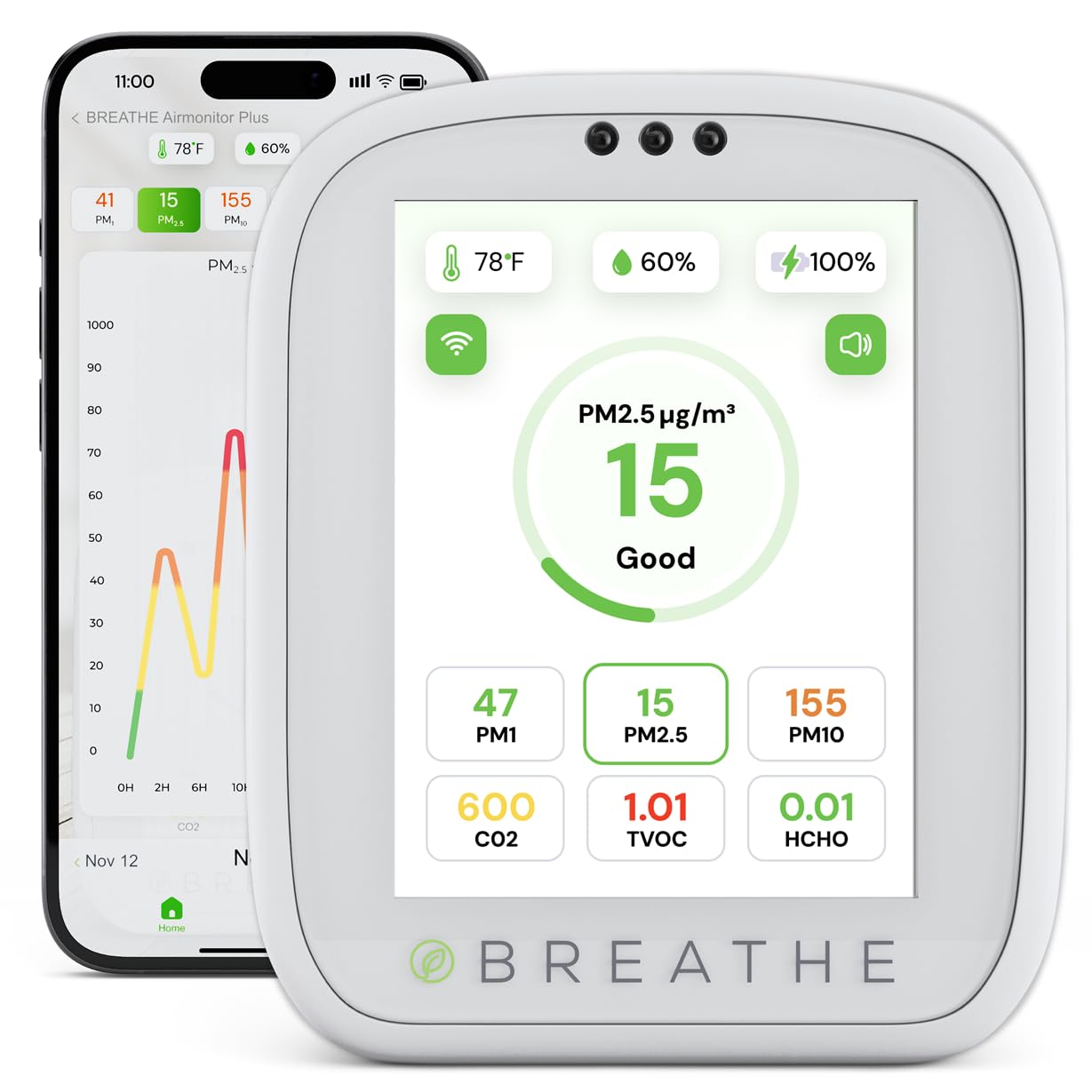
The compact 8-in-1 analyst that graphs 90 days of your air and tells you when to open a window.
For the data-driven homeowner, this Gen 2 monitor pairs professional-grade sensing with an app that actually shows you the story of your air. It tracks CO₂, PM1, PM2.5, PM10, TVOC, formaldehyde, temperature, and humidity in real time, combining NDIR CO₂ measurement with laser particle sensing and dedicated TVOC and formaldehyde detection. The free Breathe Tech app connects over 2.4 GHz Wi-Fi for remote readings, configurable CO₂ and PM2.5 alerts, and up to 90 days of stored history with exportable data.
The insights are genuinely useful: buyers discovered nighttime CO₂ in bedrooms that explained poor sleep, caught office CO₂ at 4,500 ppm in poorly ventilated spaces, and watched readings validate against occupancy patterns. Its compact size and ease of use earn steady praise, and it can run on its 6-hour rechargeable battery or stay connected via USB-C for continuous monitoring. A 2-year manufacturer warranty backs the unit.
Battery life is the sore spot. Despite the advertised 6 hours, several customers note the battery draining far faster — in some cases within about an hour — so plan to keep it plugged in for reliability. Wi-Fi pairing can be finicky, with a known fix involving draining the battery and holding the power button for 10 seconds while plugging in. The display is bright with no working auto-off proximity sensor, which matters in a dark bedroom. Accuracy is mixed, especially on temperature and humidity versus other sensors.
Where it shines: the 90-day historical graphs and configurable alerts make it the best choice for spotting slow-burning patterns like overnight CO₂ buildup that single readings miss.
Choose it if: you value deep app analytics and long-term trend review over raw portability.
Be ready for: keeping it plugged in most of the time, since real-world battery life trails the 6-hour spec.
7. Temtop Air Quality Monitor PM2.5 PM10 Particle Counter
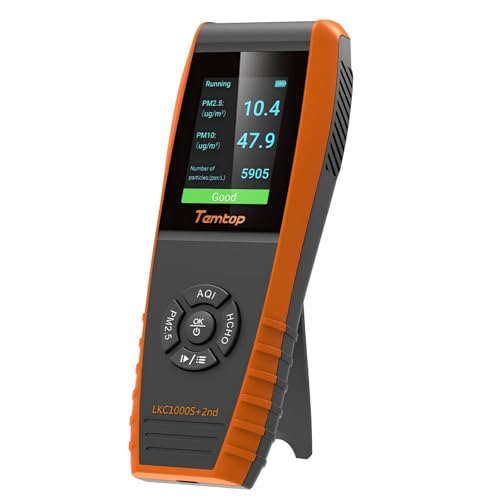
The lab-leaning tester that exports Excel spreadsheets and names its pollution sources with a 12-hour trend graph.
Prove to a landlord, a contractor, or yourself that renovation fumes or new flooring are the problem with this meter that documents it. It tracks PM2.5, PM10, HCHO, VOCs, humidity, temperature, and AQI in one device, powered by a laser particle sensor with a 3-year designed lifespan and a Dart electrochemical HCHO sensor — explicitly not a cheap semiconductor — delivering lab-tested accuracy with R² up to 0.999 (a statistical measure where 1.0 means perfect correlation). A built-in 12-hour trend histogram helps you spot peaks and verify when ventilation actually works.
The defining feature is data export: log all 7 parameters continuously via USB and export to Excel spreadsheets, with no subscription and no app required. For 24/7 monitoring, connect via the included Type-C cable; for room-to-room checks, the built-in battery supports 6–8 hours of portable use. The large IPS color display shows green, yellow, or red at a glance, and the unit is factory-calibrated and ready to use from the start. A 12-month Temtop warranty and US-based support back it.
Dust from new furniture or flooring shows up immediately, making it the recommended choice for people with chemical sensitivities. But reliability is the most-discussed topic here, and it cuts both ways: some reviewers point out the sensor failing after roughly 22 months of use, with PM2.5 and PM10 readings drifting 1.5 to 2 times too high just before the support window closed. Value draws some negative feedback given the price, so weigh the professional export capability against the durability concerns.
Why it earns its keep
- Excel data export with no subscription for professional reporting
- Dart electrochemical HCHO sensor, not a cheap semiconductor
- 12-hour trend histogram IDs pollution sources by time
Where it wobbles
- Reliability is the most-discussed concern among owners
- Some sensors drift out of spec after about 22 months
- Premium price tag with mixed value feedback
Choose it for: renovation monitoring, long-term health tracking, or any situation where you need shareable data that a professional will take seriously.
Hesitate if: you want a decade of trouble-free service from a single unit — sensor lifespan is a genuine question mark here.
Understanding the Specs
NDIR vs photoacoustic CO₂ sensing
NDIR (non-dispersive infrared) sensing shines infrared light through an air sample and measures how much CO₂ absorbs it — the proven, stable gold standard used in the GoveeLife and Temtop C1. Photoacoustic sensing, used in the Temtop C1’s newer battery mode, measures the sound waves that gas molecules create when heated by light. Both can be accurate; NDIR tends to be more consistent over years, while photoacoustic can be more power-efficient for battery life.
ppm accuracy and what it means
CO₂ accuracy is stated as something like ±(40ppm + 5%), meaning the reading can be off by 40 parts per million plus 5% of the measured value. Outdoor air sits around 400–450 ppm; indoor levels above 1,000 ppm often start to feel stuffy, and many people report drowsiness and headaches above 1,500 ppm. A monitor with 5-second refresh shows spikes quickly when you close a door or add people to a room.
PM2.5, PM10, and particle sensing
PM2.5 refers to fine dust particles under 2.5 microns that travel deep into the lungs, while PM10 captures larger particles like pollen and dust. Laser particle sensors count these by scattering light off passing particles. If you care about wildfire smoke, cooking fumes, or dust from a renovation, you need a monitor with laser particle sensing — a CO₂-only meter won’t see them.
HCHO and TVOC: the chemical layer
HCHO is formaldehyde, a gas released by new furniture, pressed wood, paints, and adhesives. TVOC (total volatile organic compounds) covers the broader family of natural and synthetic chemicals that cause most odors. Electrochemical sensors detect these gases, and they need to be kept away from perfumes and strong cleaning agents to stay accurate. If you are testing a new home or recent renovation, this is the measurement you actually care about.
FAQ
What is the difference between CO₂ and CO monitors?
What CO₂ level should trigger me to open a window?
Why does a 5-second refresh rate matter?
Can these monitors detect mold or radon?
How long do the batteries last on portable monitors?
Do I need a monitor with an app?
What is the difference between electrochemical and semiconductor sensors for formaldehyde?
Will these monitors work in a car or hotel room?
How long does a particle sensor last?
Do I need to calibrate my new air quality monitor?
Final Thoughts: The Verdict
For most homes, the best air quality test for home is the GoveeLife H5140 because it pairs lab-grade CO₂ accuracy with an app that shows you years of trends and alerts you the moment a closed room turns stuffy. If you want the simplicity of a battery-powered unit that sits quietly in a bedroom for weeks without charging, the Temtop C1 is the value pick to grab. And if you suspect formaldehyde or dust from new furniture or a renovation, the EG Air Monitor or the data-exporting Temtop LKC-1000S+ will give you the answers you need to act.
How We Picked
We do not accept paid placement. Every pick is matched to a real buyer and a real use-case; we do not hands-on test units.
Sources & Methodology
Specifications: manufacturer listings and product documentation. Review insights: verified customer reviews, as of September 2026. Pricing: not shown on this page (it changes often); check the current price via the retailer link.
As an Amazon Associate, Gadgets Feed earns from qualifying purchases. This does not affect which products we feature.