
Our readers keep the lights on and my morning glass full of iced black tea. As an Amazon Associate, I earn from qualifying purchases.
Specs are compiled from manufacturer listings and verified buyer reviews and can change over time — please confirm the key details on the product page before buying.
If you have ever dragged a screaming pancake compressor into a finished room and watched everyone cover their ears, you already know the real problem with this category: noise and air delivery, not marketing. Here is the honest answer up front. For most home and garage buyers, the Bostitch BTFP1KIT combo is the safest all-round buy because it pairs a 6.0 gallon tank with an included 18-gauge brad nailer. If silence matters more than tank size, the Limodot 1-gallon unit runs at 68 dB and weighs 29.7 pounds. Every pick below combines both parts you actually need — an air tank and a compressor — so nothing here leaves you hunting for a separate tank.
I’m Min — the founder and writer behind Gadgets Feed. This guide is built by comparing the manufacturers’ published specifications and the patterns across verified customer reviews, so you get each pick’s real strengths and trade-offs instead of marketing spin.
You do not need a shop full of tools to get this right. Match tank size and airflow to the job, check the decibel rating before you buy, and the rest falls into place — that is the whole game with any air tank and compressor.
Our Picks at a Glance

How To Choose The Best Air Tank And Compressor
The wrong purchase here is almost always a tank that is too small for the tools you run, or a pump so loud you stop using it. Fix those two things and everything else is detail. Work through the four checkpoints below before you commit.
Start with the tool, not the tank
Every air tool has an appetite, measured in CFM (cubic feet per minute — the volume of air the compressor can push out continuously). A brad nailer sips air. An impact wrench or a grinder gulps it. If your pump’s CFM at 90 PSI is lower than the tool’s demand, the tank empties faster than the motor refills it, and you end up waiting. Buy for the hungriest tool you own, not the one in your hand today.
Tank size buys you recovery time
Gallons (the tank’s internal volume) are a buffer. A bigger tank lets you fire more nails or run a blow gun longer before the motor kicks back on, then gives the pump room to catch up. Small tanks with quick refill can still feel responsive, but sustained work always favors volume.
Decibels decide where you can work
A decibel (dB) measures sound pressure, and normal speech sits around 60 dB. Compressors with a rating near 59 or 60 dB let you hold a conversation while the pump cycles, which is the difference between a compressor you leave in the garage and one you happily carry indoors. Units rated in the high 70s are for outdoor or well-ventilated jobs.
Oil-free versus oil-lubricated pumps
An oil-free pump has no crankcase oil to check, top up, or change, so routine ownership is simpler. Oil-free motors also tend to start more willingly in cold weather. The trade-off is that oil-lubricated pumps historically handle heavy continuous duty better — if you plan to run a compressor hard all day, factor that in.
Quick Comparison
| Model | Best For | Tank Size | Max PSI | Weight | Amazon |
|---|---|---|---|---|---|
| Bostitch BTFP1KIT★ Best Overall | Trim and molding work with a nailer included | 6 gallons | 150 PSI | 2.7 lb | Amazon |
| Limodot Quiet Oil-Free 1-GallonQuietest Pick | Indoor work where noise is the deal-breaker | 1 gallon | — | 29.7 lb | Amazon |
| VEVOR 6.3 Gallon 2 HP | Tire inflation and mobile detailing on the move | 6.3 gallons | 116 PSI | 43 lb | Amazon |
| ECOMAX 6 Gallon Pancake | A complete accessory kit in one box | 6 gallons | 150 PSI | 34.17 lb | Amazon |
| Stealth SAQ-1234 | Airbrushing and quiet indoor hobby work | 2 gallons | 125 PSI | 41.9 lb | Amazon |
| Metabo HPT EC28M | Carrying room to room for small stapling jobs | 1 gallon | — | 25.2 lb | Amazon |
| Makita MAC320Q | Heavy trim runs that need fast recovery | 3 gallons | — | 25.79 kg | Amazon |
In‑Depth Reviews
1. Bostitch BTFP1KIT 1-Tool and Compressor Combo Kit
Our pick — over 4.5★ from 850+ verified ratings; the strongest balance of quality and price.
A trim-ready kit with a 6-gallon tank, a 150 PSI ceiling, and the nailer already in the box.
If you are finishing a room — baseboards, door casings, crown molding — this is the box that gets you there without a second trip to the store. The tank holds 6.0 gallons (22.7 liters), which is the biggest buffer on this list. That size lets the included SB-1850BN 18-gauge brad nailer (a tool that drives thin headless nails for trim work) fire through a long molding run before the motor needs to catch up.
The pump delivers 2.6 SCFM at 90 PSI. SCFM is standard cubic feet per minute — a standardized measure of how much air the pump can push continuously. That figure sets a clear boundary, and buyers report it plainly: “2.6 SCFM @ 90 psi is not enough air to run impacts, ratchets or grinders.” For tires, brad nailers, and staplers it is plenty. For a garage full of high-demand air tools, it is not, and no amount of tank volume changes that.
What wins people over is build quality — the most-praised thing about this kit by a wide margin — followed by how it performs project after project. Noise lands right in the middle: a 78.5 dBA rating for a machine this size, and owners split between calling it relatively quiet and a bit loud. The clear strength is the whole package: 1/4-inch by 15-foot PVC air hose and fittings come with it, and the pump is oil-free, so there is no oil to top up. Buyers also flag that the kit runs fine on a 15A household circuit without tripping the breaker, which makes it a realistic indoor homeowner tool rather than a shop-only machine.
Where This Kit Earns Its Spot
- 150 max PSI and a 6.0 gallon (22.7 L) tank — the largest buffer in this lineup, so a trim run is never cut short.
- Oil-free, maintenance-free pump plus 1/4-inch by 15-foot PVC hose and fittings in the box.
- 18-gauge brad nailer drives 5/8-inch to 2-inch brads, covering most interior trim work.
- Designed to start easily in cold weather on a 14-gauge or larger extension cord up to 50 feet.
Sizing It To Your Tools
- 2.6 SCFM at 90 PSI leaves no headroom for impacts, ratchets, or grinders.
- 78.5 dBA is not a silent machine — plan on ear protection for long sessions, and expect the noise question to divide owners.
- The 2.7-pound listed item weight reads like a spec-sheet entry, so measure your carry space before assuming it slots onto a low shelf.
Buy it for the box, not the badge: Trim carpenters, DIY renovators, and anyone who wants a compressor and an 18-gauge nailer in a single purchase.
Weigh this first: If you plan to run an impact wrench or a die grinder, that 2.6 SCFM pump is the wrong ceiling for you.
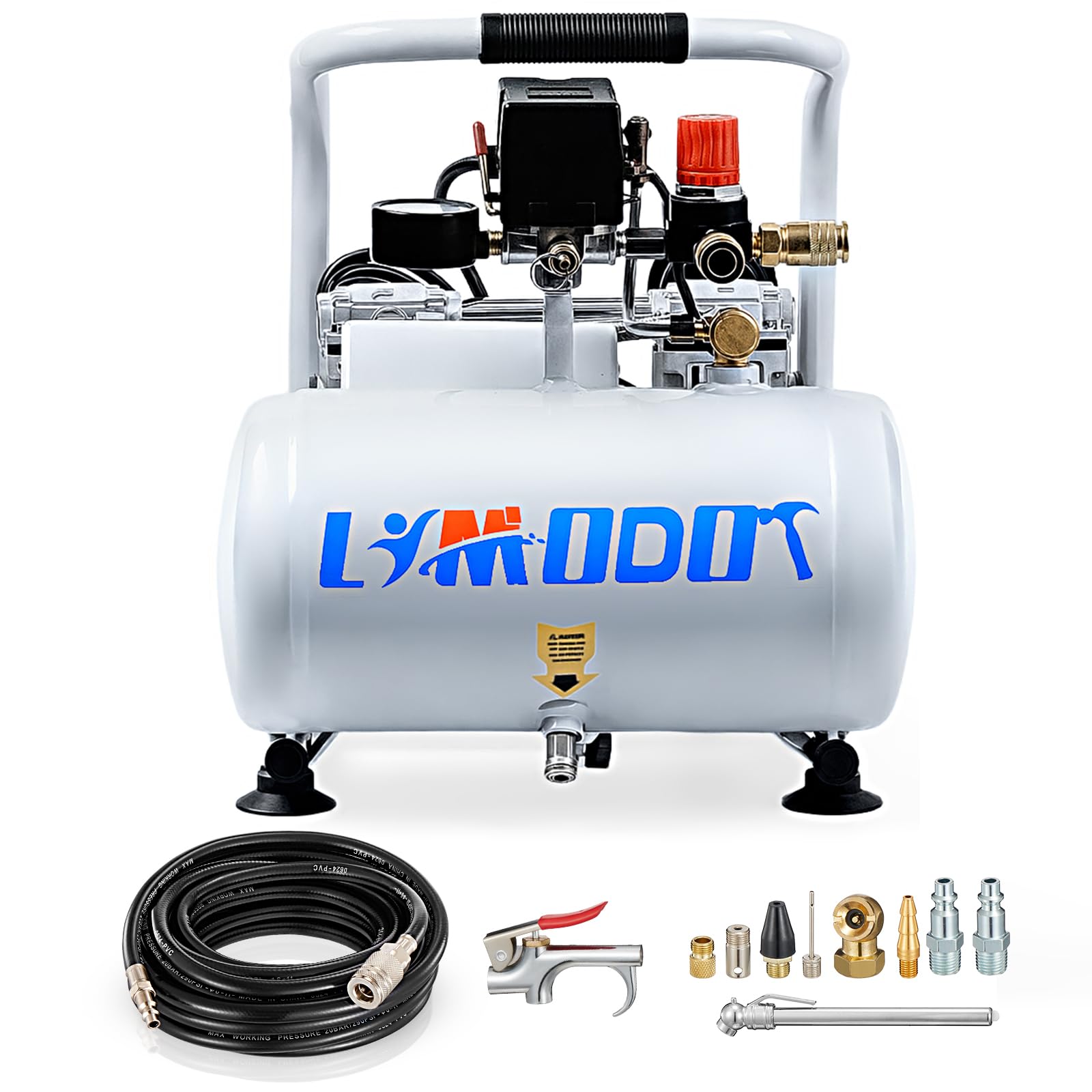
2. Quiet Oil-Free Electric Air Compressor, 68 dB, 1 Gallon Air Tank
Built for people who want to spray, nail, and inflate indoors without drowning out the room.
You can run this compressor indoors without shouting over it, because it puts out just 68 dB. A decibel (dB) measures sound pressure, and 68 dB is about the level of a normal conversation, not a bark. That is what makes this Limodot unit a genuinely indoor-friendly compressor instead of one you keep in the garage. The motor behind it is an induction type (a motor design with fewer moving contact parts than a brushed motor) rated at 1 HP, spinning at a low 3240 RPM to keep the noise down while still delivering air.
Delivery matters just as much as the sound floor. The pump moves 2.8 CFM at 40 PSI and 1.6 CFM at 90 PSI — CFM being the volume of air it pushes out continuously. That is enough for staple guns, brad nailers, roofing and framing nailers, airbrushes, blow guns, air drills, HVLP spray guns, and pneumatic screwdrivers. Refill and recovery are quick too: empty to full in about 40 seconds, with a 15-second recovery window so you are not standing around waiting between passes. Compare that to the Bostitch above, whose pump sits at 2.6 SCFM at 90 PSI on a much larger 6-gallon tank — different philosophies, different jobs.
What wins people over here is the noise level, and it is not close — the quiet operation is the most-discussed thing about this compressor by a wide margin. Performance comes in a strong second. In practice that plays out as a machine that airs up fast and holds it: owners mention it reaching working pressure in seconds, and the tank holding 90+ PSI for days between sessions. The kit is generous too — a 25-foot PVC air hose, a 1/4-inch quick-connect fitting, and an 11-piece air tool accessory set are all in the box. The honest caveat: plan to assemble the wheels and mufflers yourself, and double-check the fittings, because a few owners found they needed to source a plug to fully seal the pressure regulator.
What stands out most: you never have to change oil or swap filters, because the design is oil-free. And the low-speed induction motor starts reliably in cold weather. Those are two headaches a lot of budget compressors hand you up front.
The fair warning: a 1-gallon tank and 1.6 CFM at 90 PSI is a small air reserve. Owners note the compressor tops out at a hard ceiling for anything hungrier than a nailer or airbrush, so match this to light and hobby work rather than sustained high-draw tools.
Point it at hobby and finish work: Airbrushers, modelers, and indoor craftspeople who value a conversation-level machine over tank volume.
Pass on it for heavy tools: If your week involves impact wrenches, grinders, or long continuous spray sessions, that 1.6 CFM figure will run out before your patience does.
3. VEVOR 6.3 Gallon 2 HP Air Compressor, Max 116PSI, Oil Free Compressor Tank

A 6.3-gallon wheeled tank that quietly handles tires, air shocks, and detailing rigs.
If you are a mobile detailer or you have a fleet of tires to top up, this VEVOR makes its case on airflow. The oil-free motor runs at 1450W and drives a 3500 r/min pump that delivers 3.35 CFM at 90 PSI. CFM (cubic feet per minute) is the volume of air the pump moves; PSI (pounds per square inch) is the pressure pushing it. That 3.35 CFM holds up against the 2.4 CFM listed for the smaller 1-gallon Limodot above, and it keeps a Tornador-style cleaning tool fed at full capability rather than sputtering. The 6.3-gallon tank (24 liters) sits under that output. Max pressure lands at 116 PSI, so there is headroom for tire inflation, auto repair, spray painting, and woodwork nailing.
Quiet operation is what people notice first, and by a wide margin it is the leading point of praise for this machine. Refill speed and compact size round out the positives, with owners describing it as small and light yet powerful, and one buyer noting a full fill at 120 PSI in about a minute. It rolls on caster wheels with a handle for moving around a driveway or a bay.
Now the honest part. Performance and pressure output are the top-discussed topics overall, and they draw genuinely mixed reactions — some units run strong and build pressure fast, while a handful of customers note trouble starting or weak output. Durability also shows up as a minority concern, with the wheels and handle drawing criticism for feeling flimsier than the tank itself. On the build side the tank is reassuring: a 3-layer construction, Q235B structural steel, and smooth welding rated to 3.5 Mpa maximum bearing pressure (Mpa is a metric unit of pressure), plus automatic overheating protection and pressure-relief safeguards.
Consider the plumbing quirks: the motor gets warm on long runs, and this unit is picky about power. Owners found it works reliably on one solid cord but can fault on daisy-chained extension cords, so run it from a dedicated circuit where possible.
What you get up front: the box includes the compressor, a foot pad, two casters, and two silencers, and the dual-outlet setup lets you run two hoses at once if you add your own quick connects.
Made for the driveway and the bay: Detailers, home mechanics, and anyone inflating tires or running a spray gun away from a wall outlet.
Think twice if the pump gets a workout: if you need sustained, all-day high-pressure output, the mixed performance feedback on this one is worth weighing against the Makita or Bostitch above.
4. ECOMAX Air Compressor 6 Gallon 150 PSI Pancake Portable Oil-free Tank with 10 PCS Accessories Kit
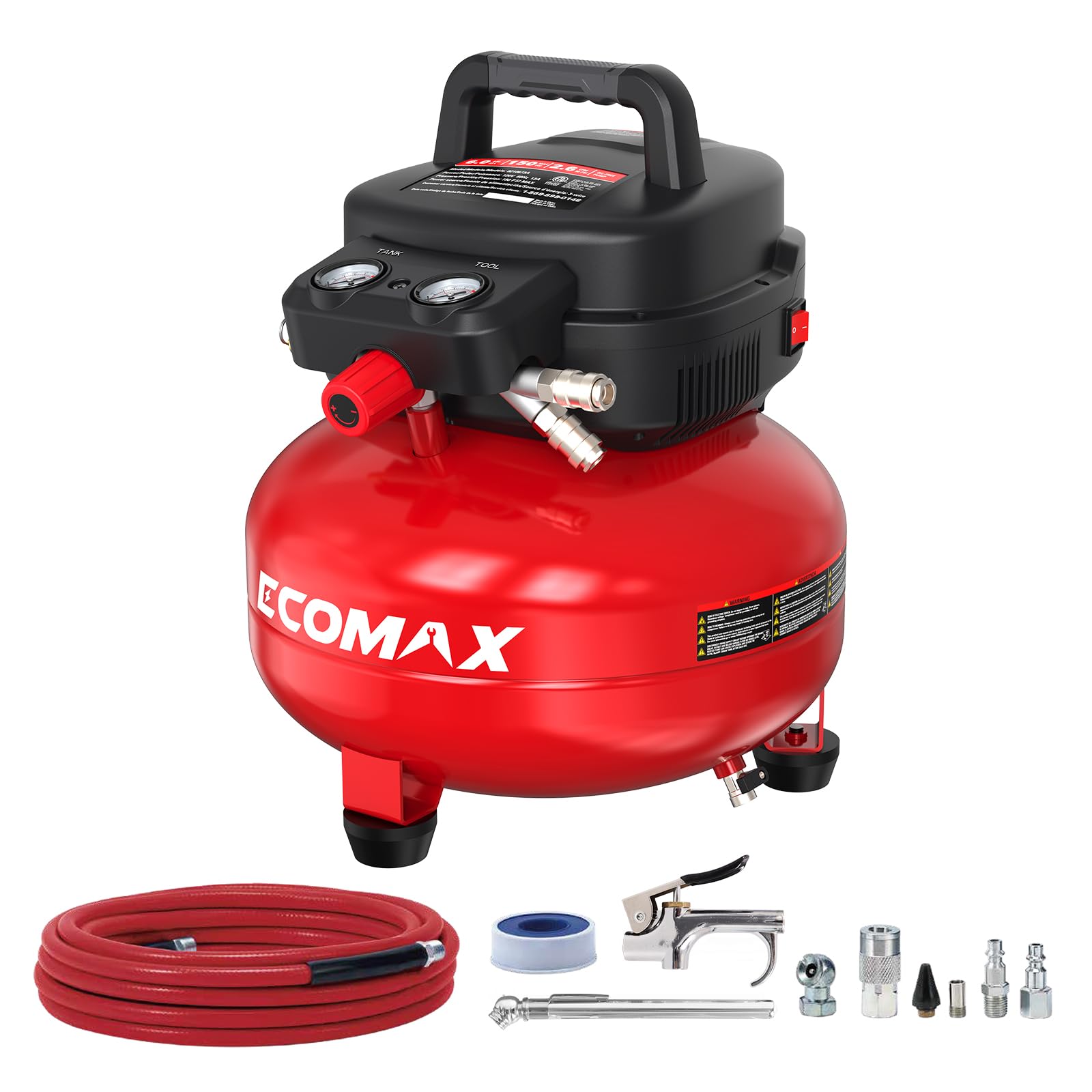
Everything in one box, from the pancake tank to the tire chuck and blow gun.
If your frustration with this category is buying a compressor and then realizing you still need a hose, a chuck, and a blow gun, this one closes that gap. ECOMAX ships a 10-piece accessory kit: a 1/4-inch by 25-foot PVC air hose, thread seal tape, a 1/4 FNTP ball foot air chuck (FNTP is a thread standard for air fittings), two 1/4 NPT auto plugs (NPT is a common US pipe thread), a 1/4 NPT auto coupler, a tire pressure gauge, a nozzle, a high-performance blow gun, and a sleeve. That complete-kit angle is exactly what earns the most praise from owners.
The hardware underneath matches it. You get a 150 PSI maximum on a 6-gallon pancake tank (a pancake is a flat, wide tank shape that keeps the machine low and stable on the floor), a 1.5 HP motor, and 3 cubic inches per minute of air delivery at 90 PSI. Dual gauges let you read tank pressure and adjustable outflow pressure at the same time, dual quick couplers let two tools stay hooked up, and a winding bracket keeps the power cord tidy. The pump is oil-free, and the 34.17-pound build carries via a flip-up handle.
Here is where it differs from the quiet-first machines on this list. ECOMAX tells you the truth in the specs and owners confirm it: this compressor is loud. Noise is the one point that draws consistent criticism, with buyers describing it as very loud while still functional. Weigh that against what it does well — it fills fast, it is light enough to pick up and carry out to the driveway, and it handles tire filling, blowing debris off an RC chassis, and running a motorcycle lift. One practical note worth heeding: seal the threads before you fire it up, or you will chase small leaks.
The durable verdict from the garage: owners keep coming back to the two-gauge layout and the fast recharge after a sustained air release, and the low-voltage and cold-weather start capability makes it a realistic winter tool.
Best for one-stop buyers: Anyone who wants a compressor plus every fitting and tool to run it, without a second order.
Know what you are trading: you are accepting real volume at the cost of decibels — leave this one in the garage or wear hearing protection.
5. Stealth Air Compressor 2 Gallon, 3/4 HP Oil-Free Compressor, Less than 60dB Ultra Quiet Electric Air Compressor, Max 125 PSI (SAQ-1234)

A sub-60 dB two-gallon tank tuned for airbrush artists and finish nailers.
The airbrushing crowd has a specific enemy: pulsing. A compressor that cycles on and off mid-panel ruins a smooth gradient, and that is exactly what the Stealth solves. Its 3/4 HP motor and 125 PSI ceiling team up with a 2-gallon Q235B steel tank, and it carries a rating under 60 decibels — quieter than a normal conversation. Buyers describe running it at 15 to 50 PSI for acrylics, enamels, and varnishes without the pump pulsing or running constantly in the background.
Airflow is honest about its limits. The pump delivers 2.8 CFM at 40 PSI and 1.8 CFM at 90 PSI, which is enough to run a finish nailer all day and to top up tires — including filling heavy truck and fifth-wheel tires up to 100 PSI — but not enough to feed a grinding or cutting tool. The motor sips power at a 5.5A maximum draw (A is amps, the rate of electrical current), so it will not trip a household circuit or dim the lights when it kicks in. The tank body is light and fitted with a rubber-reinforced handle and base, and the compressor totes between the garage and a workroom without a second person.
What owners praise most is the quiet running, with the powerful feel of the pump close behind. A reliable detail across the reviews: the oil-free design plus a safety valve and overheat protection, with a stated life cycle of over 1000 hours and a limited lifetime warranty. On the negative side, a couple of practical notes surface rather than a pattern. One owner could not disassemble the intake filter to clean or replace the element as the manual described, and another described the machine as a little heavy for moving around. A slow pressure leak of about 8 PSI per hour also turned up once — worth a soap-and-water check on the fittings when it arrives.
Why It Wins the Quiet Hobby Jobs
- Under-60 dB rating with a low-vibration design and soundproofing built in.
- 2.8 CFM at 40 PSI and 1.8 CFM at 90 PSI, enough for a finish nailer all day.
- 5.5A maximum draw, so it does not flicker household lights when it cycles.
- Over 1000-hour life cycle on the pump with a limited lifetime warranty.
Where It Asks You To Adjust
- A few reviewers point out the intake filter will not come apart for cleaning as the manual states.
- Described as a little heavy for a 2-gallon unit — the 41.9-pound total is not featherweight.
- Occasional air seepage at the fittings, so a quick leak check on arrival pays off.
Reach for this if: You airbrush, model, or finish-cap nail indoors and want the tank to stay quiet while the tank stays fed.
Look elsewhere if: Your tools demand real sustained CFM — this is a fine-tuned hobby machine, not a shop workhorse.
6. Metabo HPT Quiet Air Compressor, Portable 1 Gallon Oil-Free, EC28M

Light enough to one-hand between rooms, and quiet enough that nobody notices when it fires.
This one is for the person who carries a compressor rather than parks it. Weighing 25.2 pounds with an ergonomically shaped rubber handle and a steel roll cage, the Metabo HPT EC28M is built to move. A 1-gallon tank sits under that frame, which is small — but the point here is portability and silence, not volume.
On the quiet front it holds the second-lowest rating in this lineup at 59 dB — low enough that a normal conversation can happen while the compressor is cycling. A universal quick coupler switches between framing, siding, finish, and roofing nailers without hunting for adapters, and the integrated control panel lets you dial in PSI accurately. The pump is oil-free for maintenance-free running, and an overload protection circuit cuts power if the motor gets pushed too hard.
Quiet is the headline the owners agree on, and it lands cleanly: the sound floor is what people mention most, with performance as a reliable second. The catch is airflow, and it is a real one. With no CFM figure published for this model and a 1-gallon tank, shoppers say it simply cannot feed demanding tools — one put it bluntly, that there is “about one second reserve for an air tool or blow gun.” It excels at brad and finish nailing, stapling, and light inflation, and it hands you a one-year professional warranty. Reliability and pressure can be a mixed bag across the broader review pool, so treat the small-job use case as the ceiling.
The carrying comfort is the whole pitch: the rubberized handle and roll cage make this the easiest of the group to carry onto a site, and at conversation-level noise you can run it in an occupied room.
Match it to the small stuff: the 1-gallon tank is not sized for spray guns or impacts — this is a trim-and-staple companion, and going bigger means stepping up to the Makita below.
Suits the trim specialist: Installers moving room to room with a finish nailer and a small box of staples.
Wrong fit if you need reach: A 1-gallon tank with limited output will disappoint anyone reaching for continuous spray or impact work.
7. Makita MAC320Q Quiet Series 1-1/2 HP, 3 Gallon, Oil-Free, Electric Air Compressor

A roll-cage tank built to keep firing when the job does not stop.
The Makita MAC320Q is where this lineup turns into a professional tool. A 1-1/2 HP oil-free dual-piston pump sits over a 3-gallon tank, and the whole thing runs at a low 1,750 RPM — the slower spin is what the maker points to for longer motor and pump life. Complete roll-cage construction protects it across job-site, transport, and storage duty. Quiet Series design keeps it at 60 dB, so you can talk over it, and the dual-piston pump means continuous recovery rather than a single-thump tank refill.
Recovery is where owners get excited. Buyers upgrading from a smaller 1-gallon unit describe the tank recharging in seconds and staying ahead of the draw, going further than the smaller machines at holding sustained pressure while a tool runs. That is the case for stepping up here: the 3-gallon buffer plus fast recharge keeps a continuous spray or finish run flowing instead of stalling. A second tool port removes the need for a splitter if you run two hoses, and dual gauges sit behind the cage.
Quiet running is the most-praised feature, and it is emphatic — one buyer summed up the shift: “the tools are now the noisiest.” Solid build quality lands high in the praise too. The honest trade-offs are weight and price. This is a heavier machine than the 1-gallon portables, and pricing reflects the professional build. The pressure-control dialing also draws mixed reactions, and the weight is the most-cited downside — several buyers report it runs a few pounds heavier than expected. Note too that a couple of listings describe a 12-inch by 12-inch by 12-inch size, which owners say reads smaller than the unit actually measures, so measure your storage spot first.
Where It Earns the Extra
- 1,750 RPM running speed for longer motor and pump life.
- 3-gallon tank with recharges measured in seconds, not minutes.
- Roll-cage construction for job-site and transport protection.
- 60 dB operation plus a second tool port that removes the need for a splitter.
The Honest Trade-Offs
- Noticeably heavier than the 1-gallon portables — measure your carry distance first.
- Premium-tier pricing for the professional build.
- Pressure-control adjustments draw mixed reviews.
Built for the working pro: Trim and finish crews who want a compressor that keeps up with continuous tool use and rolls back into the truck afterward.
Overkill for hobbyists: If you spray occasionally or just top up tires, the lighter, less expensive picks above fit your week better.
Understanding the Specs
Tank Size in Gallons
Gallons measure the tank’s internal volume, and more gallons means a longer buffer before the pump restarts. A 6.0-gallon tank like the Bostitch lets you fire a nailer through a whole molding run before it cycles; a 1-gallon tank like the Limodot or Metabo HPT is built for quick touch-up jobs. For a compressor used in the field, the tank size decides how long you work before the motor cuts in.
Airflow in CFM and the PSI Ceiling
CFM (cubic feet per minute) is the volume of air the pump can push out continuously, while PSI is the pressure that air is stored at. A tool needs both — high PSI without enough CFM still stalls on a tool that gulps air. The VEVOR delivers 3.35 CFM at 90 PSI and the Bostitch 2.6 SCFM at 90 PSI, and pairing that number with your tool’s demand is the single biggest buying decision. An impact wrench or grinder wants more than either offers; a brad nailer asks for far less.
FAQ
Can I run an impact wrench with any of these compressors?
What does oil-free actually mean for maintenance?
How quiet is a quiet compressor in real use?
Is a bigger tank always better than a smaller one?
What size hose do these compressors use?
Can I plug these into a standard household outlet?
How often does the tank need to be drained?
Will an 18-gauge brad nailer work on a small compressor?
What is the difference between PSI at the tank and PSI at the tool?
Can a small compressor fill large truck tires?
Final Thoughts: The Verdict
For most people, the best air tank and compressor here is the Bostitch BTFP1KIT, because it pairs the largest tank in the group — 6.0 gallons at 150 PSI — with an 18-gauge brad nailer already in the box, and it runs on a household circuit without tripping. If noise is your deciding factor rather than tank volume, the Limodot 1-gallon earns its place at 68 dB with a full 25-foot hose and 11-piece accessory kit included. For continuous trim work that keeps up with the tool, the Makita MAC320Q delivers the 3-gallon tank and fast recharge a paid crew needs, and the roll-cage build means it survives the truck ride home too.
Before you order, check the two numbers that actually govern a compressor: the CFM at 90 PSI and the decibel rating. Match the first to your hungriest tool and the second to the room you plan to work in, and any of these picks will keep you running for years.
How We Picked
We do not accept paid placement. Every pick is matched to a real buyer and a real use-case; we do not hands-on test units.
Sources & Methodology
Specifications: manufacturer listings and product documentation. Review insights: verified customer reviews, as of September 2026. Pricing: not shown on this page (it changes often); check the current price via the retailer link.
As an Amazon Associate, Gadgets Feed earns from qualifying purchases. This does not affect which products we feature.