
Our readers keep the lights on and my morning glass full of iced black tea. As an Amazon Associate, I earn from qualifying purchases.
Specs are compiled from manufacturer listings and verified buyer reviews and can change over time — please confirm the key details on the product page before buying.
Indoor air often holds more carbon dioxide than you realize. Stuffy rooms and afternoon brain fog frequently trace back to CO2 accumulating in a sealed space. An air tester tracks that CO2 rise and signals when to open a window for fresh air.
I’m Min — the founder and writer behind Gadgets Feed. This guide is built by comparing the manufacturers’ published specifications and the patterns across verified customer reviews, so you get each pick’s real strengths and trade-offs instead of marketing spin.
From pocketable CO2-only meters to whole-room radon detectors with smartphone apps, this guide sorts the genuinely useful monitors from the gimmicks, so you can confidently choose the right air tester for home use and breathe easier.
Our Picks at a Glance

How To Choose The Best Air Tester For Home
Choosing an air tester begins with identifying your primary pollutant concern. Sensor types vary by pollutant, so a general monitor may miss targeted threats like radon or gas leaks.
CO2 is the baseline for comfort and focus
CO2 is the gas you exhale with every breath. In a closed room, CO2 levels climb and can cause drowsiness and poor focus. A CO2 reading is the most practical daily metric, revealing when ventilation is insufficient.
Particulates and chemicals for the bigger picture
If you live near a busy road, suffer from allergies, or recently renovated, you also want PM2.5 (tiny particles that can settle deep in the lungs) and HCHO (formaldehyde, often off-gassed by new furniture). Monitors that measure these use different sensors — laser-based for particles and electrochemical for chemicals.
Radon needs its own dedicated tool
Radon is a colorless, odorless radioactive gas that can enter through foundations and accumulate in basements. It cannot be detected by a standard CO2 or particulate monitor. Testing for it requires a specialized device that samples continuously over days or weeks to draw an accurate average.
Check the power and display before you buy
A monitor you must remember to recharge becomes a monitor you stop using. Many units are designed to stay plugged in for 24/7 coverage. Also think about the screen: a large display you can read from across the room matters far more than a tiny one on a desk.
Quick Comparison
| Model | Best For | Key Pollutants | Battery Life | Display Size | Amazon |
|---|---|---|---|---|---|
| Dienmern 8-in-1★ Best Overall | Budget all-rounder CO2 monitoring | CO2, AQI, temp, humidity, HCHO, TVOC | 1600mAh, up to 72 hrs | Large HD | Amazon |
| GoveeLife H5140Smart Home Pick | Smart home integration & app alerts | CO2, temp, humidity | Plug-in AC power | 4.82 inches | Amazon |
| Sainlogic 16-in-1Best Value | Large room display, no app needed | CO2, PM2.5, PM10, PM1.0, AQI, HCHO, TVOC, temp, humidity | 2500mAh, up to 8 hrs | 7.2 inches | Amazon |
| YNAK 16-in-1 Wildfire | Whole-family glanceable readings | CO2, PM2.5, PM1.0, PM10, HCHO, TVOC, AQI, temp, humidity | 2500mAh, up to 8 hrs | 7 inches LED | Amazon |
| Temtop C1 | Lightweight CO2 portability | CO2, temp, humidity | 70-day standby | Compact | Amazon |
| Airthings Corentium Home 2 | Basement radon & humidity tracking | Radon, temp, humidity | 2 AA batteries | Compact e-ink | Amazon |
| Qingping Air Monitor Gen 2 | Touchscreen detail in the bedroom | PM2.5, PM10, CO2, eTVOC, noise, temp, humidity | Up to 3 hrs | 4-inch touchscreen | Amazon |
| Temtop LKC-1000S+ | Formaldehyde & particle trend logging | PM2.5, PM10, HCHO, TVOC, temp, humidity, AQI | 6-8 hours | Color IPS | Amazon |
| Airthings View Radon | WiFi radon alerts & remote monitoring | Radon, temp, humidity | 6 AA, up to 3 yrs | eInk | Amazon |
In‑Depth Reviews
1. Dienmern 8-in-1 CO2 Detector
Our pick — over 4.5★ from 250+ verified ratings; the strongest balance of quality and price.
A pocket-sized 8-in-1 monitor that proves the crowd right on both usefulness and battery reality.
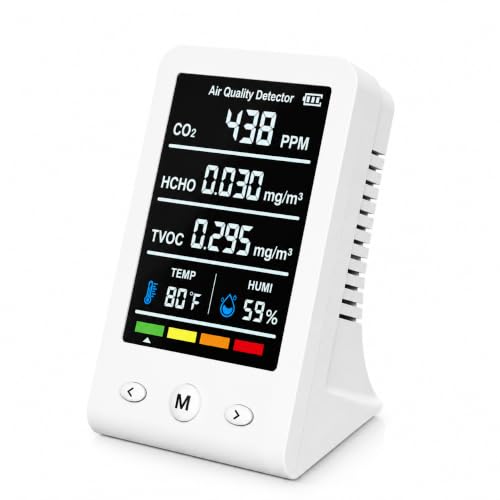
What wins people over is the balance of scope and simplicity. The Dienmern tracks CO2, AQI, temperature, humidity, HCHO (formaldehyde), and TVOC — six indoor indicators in one device that fits in a travel bag at just 8.8 ounces. It refreshes readings every second using high-precision sensors, so you can literally breathe on it and watch the number spike instantly.
The 1600mAh rechargeable lithium battery is rated for up to 72 hours of continuous use on a single charge, which is generous for a monitor this small. That is the spec sheet talking, though. In practice, buyers report the battery realistically lasts about 24 hours of active monitoring, so if you plan to plant it on a shelf for permanent duty, keep the USB cable within reach. The large HD screen with an intuitive interface makes it easy to check your indoor status at a glance, day or night.
You get a clear signal to open a window during long desk sessions, and one bedroom user found it accurate enough to trust for nightly confidence. If you want one affordable monitor that covers the basics thoroughly, this is it.
Why it leads: Six key readings, a 72-hour-rated battery, and a sub-9-ounce body make this the most all-around home value in the group.
Reality check: Owners consistently note the battery drains far faster than the 72-hour claim under real continuous use — treat it as a mostly-plugged-in monitor.
Reach for this if: You want one budget-friendly device that covers CO2 plus the most common household air factors without needing an app.
Look elsewhere if: You need a 24/7 wire-free device that never touches a charger — realistic runtimes will disappoint.
2. GoveeLife Smart Air Quality Monitor H5140
The smart-home thinker that connects CO2 readings to Alexa, humidifiers, and two years of visual history.
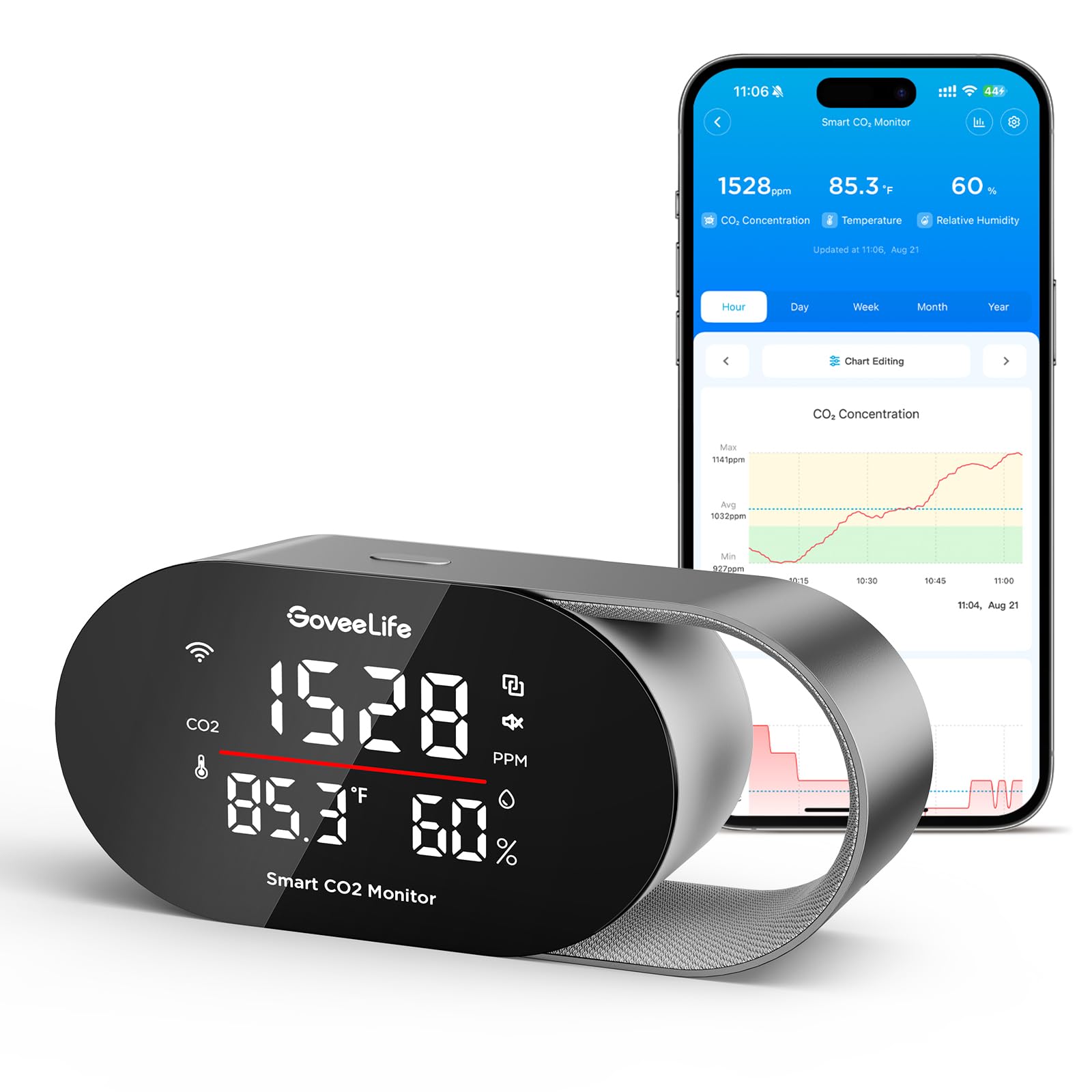
This is the pick for people who want their air data to do something, not just sit on a screen. The GoveeLife H5140 uses the SCD4x sensor — a photoacoustic NDIR type — for accuracy of ±(40ppm + 5%) with a 5-second refresh rate and built-in pressure compensation, so altitude changes do not throw off the numbers. It shows four essentials at once: real-time CO2, temperature, humidity, and a built-in clock.
What separates it is the triple alert system. When CO2, temperature, or humidity crosses thresholds you set, it fires a built-in buzzer, an instant app notification, and a detailed email report. That makes it especially appealing for families with children or elderly members. The tri-color light bar dims on your schedule, and the app charts up to two years of historical data you can export as CSV reports.
Home-office users found it genuinely actionable: when the office CO2 hit 1500 with the door shut, opening the window cleared the headache and restored alertness. It is AC-powered with no battery at all, which means 24/7 monitoring that never sleeps — just make sure you have an outlet where you want to place it.
The smart factor: Query readings by voice through Alexa or Google Assistant, or chain it to Govee humidifiers and tower fans for automated air management.
The catch: No battery means zero portability, and app-based owners note initial WiFi pairing can occasionally need a phone settings tweak.
Best for: Smart-home builders who want alerts on their phone and two years of trend data, not just a number on a shelf.
Not if: You want a battery-powered unit you can move from room to room freely.
3. Sainlogic 16-in-1 Air Quality Monitor
A 7.2-inch display that reads like a dashboard and never asks you to install an app.
If there is one thing everyone agrees on, it is that this screen is the star. The Sainlogic 16-in-1 tracks nine environmental indicators — CO2, PM2.5, PM10, PM1.0, AQI, HCHO, TVOC, temperature, and humidity — and puts them all on a 7.2-inch display with three adjustable brightness levels. The backlight automatically jumps to full brightness the moment any parameter triggers an alert, so a warning is impossible to miss from across the room.
The sensor samples at 1.5-second intervals with 0.001-level detection sensitivity, refreshing every 1 to 2 seconds. Temperature runs from 14°F to 122°F accurate to within ±1°F to ±3°F, and humidity reads 0% to 99% RH within ±2% to ±3% RH. There are 7 user-defined alert thresholds, and once any reading hits Level 4 or higher, the display flashes an “Open Windows for Ventilation” prompt.
It operates with zero app or WiFi requirement — power it on and it just works. The built-in 2500mAh battery supports up to 8 hours of wireless use all-day per full charge, recharged via USB-C. This one weighs 1.5 pounds, so it is not a pocket companion, but it earns its place in a living room or nursery where the whole family can see it.
The room-spanning strengths
- Bright 7.2-inch display readable from across the room
- 9 parameters with 7 customizable alert thresholds
- 8-hour battery for cord-free placement
The honest trade-offs
- Heavier and bulkier than pocket monitors
- No app or remote monitoring features
- Battery needs daily recharging if left wireless
Grab it for: A family living area where a large, instantly readable screen and no-app simplicity beat portable convenience.
skip it if: You need remote alerts on your phone while away from the house.
4. YNAK 16-in-1 Wildfire Air Quality Monitor
Brings wildfire-season awareness to a 7-inch screen every room can read at a glance.
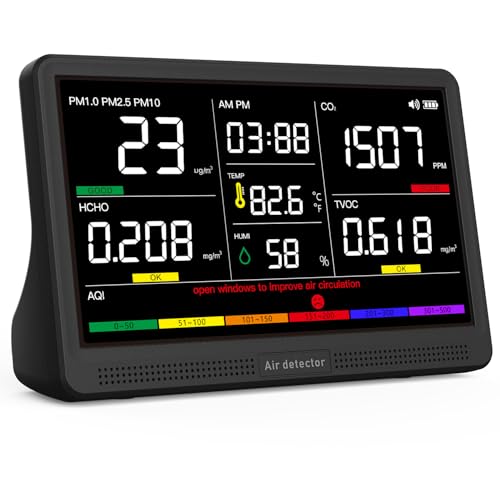
Buyers in wildfire country will tell you this is the monitor that made them watch their air “like it’s reality TV,” as the review pages sum it up. The YNAK 16-in-1 tracks CO2, PM2.5, PM1.0, PM10, HCHO, TVOC, temperature, humidity, and AQI in real time, with 7 distinct alert buzzers for different pollutant thresholds. The 7-inch LED display offers three brightness settings and needs no menu navigation.
The sensor boasts 0.001-unit accuracy with enhanced air-holes for better airflow sampling. It responds fast to changes — cooking, candles, and open windows show up in readings almost immediately. A built-in 2500mAh battery gives up to 8 hours of cordless use, recharged over USB-C, with a charging adapter included in the box.
The caution is worth knowing: the manufacturer explicitly warns to avoid interference from perfumes and other strong odors, and some owners note accuracy can drift and benefit from outdoor recalibration. This is a general monitoring tool, not a medical-grade instrument, and the maker is honest about that distinction.
What excites owners: The giant 7-inch screen doubles as a clock and lets the whole household check air status without an app.
The fit note: Accuracy ratings are split — treat it as a reliable early-warning dashboard, not a lab instrument, and recalibrate outdoors occasionally.
Best suited to: Households that want a big, obvious, no-app display for everyday air awareness in the living area.
Think twice if: You need clinical-grade precision for a specific respiratory condition — consider consulting a specialist device instead.
5. Temtop C1 CO2 Monitor

A featherweight at 4.96 ounces that checks CO2, temperature, and humidity with surprising accuracy focus.
Owners mention it “doing exactly what I was hoping it would do” — after a family member accidentally ran a vehicle in an enclosed garage, the Temtop C1 confirmed the air was safe again. It measures CO2 across 400–5000 PPM (parts per million, the standard unit for carbon dioxide), acts as a thermometer from -10°C to 60°C (14°F to 140°F), and tracks humidity up to 99% RH (relative humidity, the percentage of moisture in the air).
The Swiss-engineered sensor uses NDIR (non-dispersive infrared) technology for accuracy of ±40 ppm +5% of reading in the critical 400–2500 ppm range. It refreshes every 5 seconds with 1 ppm resolution, which is responsive enough to catch subtle CO2 fluctuations. At 4.96 ounces, it is 77% lighter than the Dienmern 8-in-1 above — genuinely a pocket device you can carry room to room.
A magnet back makes it convenient to stick on a fridge or metal shelf, and a 70-day standby battery life means it sips power between uses. The trade-off is clear, though: the display has no backlight, so it is tough to read in a dark bedroom. Some owners note it shows a general average rather than sharp spikes, which makes it less startling but also less dramatic.
The lightweight advantage: At 4.96 ounces with a magnet back, it disappears onto any metal surface and checks any room on a whim.
The honest limits: No backlight makes night reading a strain, and the averaged readings smooth out sudden changes — great for calm, not for alarm.
Reach for this if: You want an ultralight, accurate CO2 spot-checker you can stick anywhere and forget until needed.
Look elsewhere if: You need a glowing night display or want to track sudden pollution spikes sharply.
6. Airthings Corentium Home 2
The radar for basement air, giving you short-term and long-term radon averages without any lab fees.
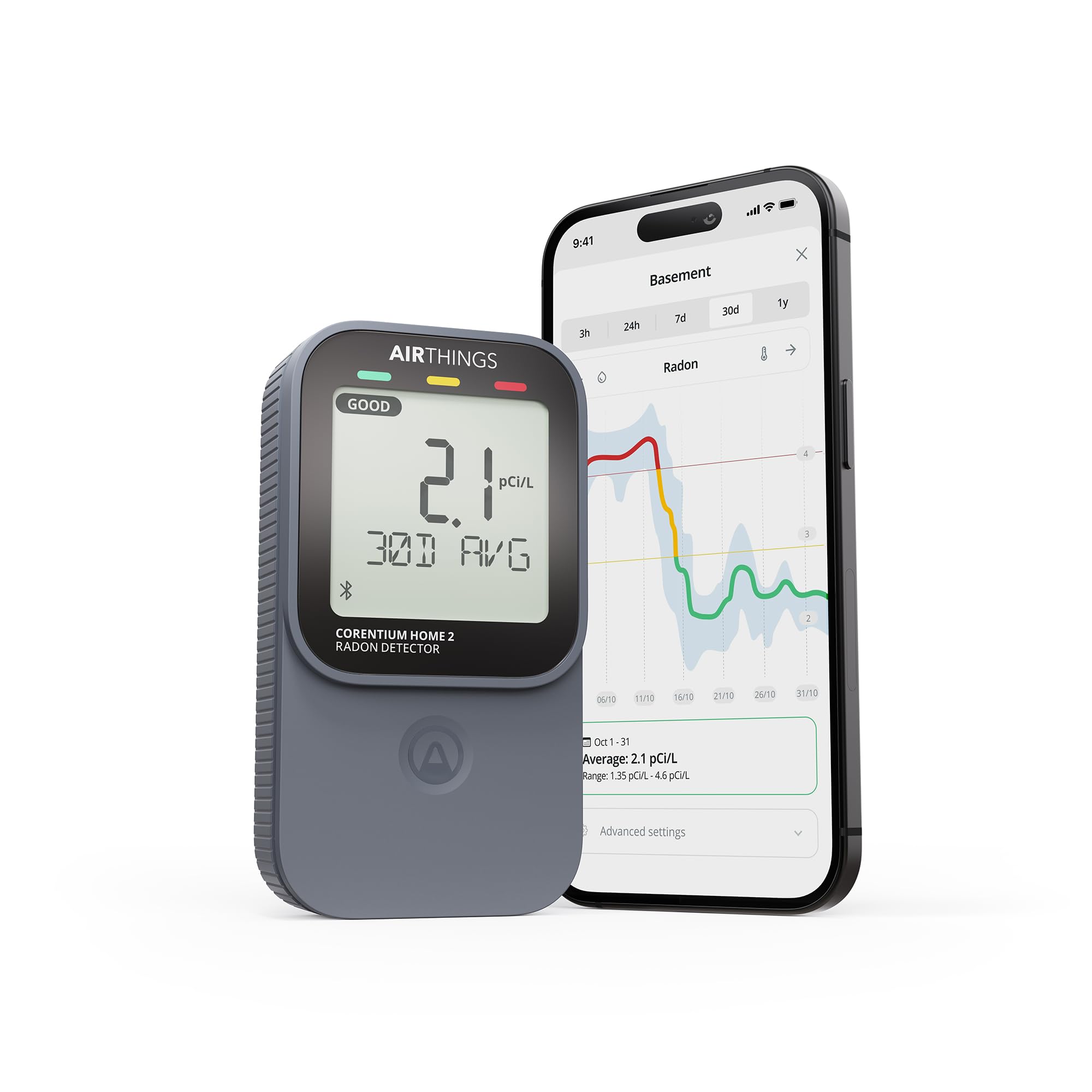
Radon is the one home air threat that a standard CO2 monitor completely misses, and that is exactly why this device exists. The Airthings Corentium Home 2 uses the company’s patented radon sensing technology — the same proven accuracy as the original — now upgraded with Bluetooth connectivity and bonus temperature and humidity sensors. It runs on 2 AA batteries with no installation required, so you can set it in a basement and leave it.
The redesigned display shows short-term and long-term radon averages alongside current environmental readings, with simple GOOD, FAIR, or POOR indicators for instant understanding. Alpha spectrometry drives hourly sampling, and rolling averages display over 24 hours, 7 days, 30 days, and up to one year. That long-term view is what buyers call a “good investment” for anyone in a high-radon area — knowing your actual levels beats guessing.
You get confidence in basements, where radon (a radioactive gas that can seep from the ground) tends to accumulate. Pair it with an Airthings Hub or View series monitor and you open up 24/7 remote monitoring with real-time data and notifications wherever you are. It is a premium price for sure, but a one-time investment with no subscription.
The professional edge: The same sensing tech used and recommended by thousands of radon professionals and home inspectors, now in a consumer-friendly package.
The honest note: The price tag is the main hurdle — but this is purpose-built for a threat most general monitors cannot see at all.
Best for: Homeowners in high-radon areas who want continuous, battery-powered monitoring with no lab fees or waiting.
Not for: Anyone who only needs basic CO2 and particulate readings — you would be overpaying for a gas you may not have.
7. Qingping Air Monitor Gen 2

A 254-PPI touchscreen that packs seven metrics, noise level included, into a desk-friendly package.
What makes the Qingping Gen 2 stand out is its high-resolution 4-inch IPS touchscreen at 254 PPI (pixels per inch — the sharpness of the display). You operate it by tapping and sliding, with auto-adjusting brightness and a color indicator under every metric: temperature, humidity, CO2, PM2.5, PM10, eTVOC, and even the noise level of your room. It doubles as a clock with a multi-alarm function.
The PM sensor is replaceable, connecting through contact points with a magnetically attached back cover, which makes future maintenance genuinely easy. Connected to 2.4GHz or 5GHz Wi-Fi, it feeds all seven metrics to the Qingping+ app with 30 days of exportable historical data. The app charts show how badly CO2 accumulates at a desk — one owner was surprised by the buildup during a workday.
The battery is the recurring gripe here. The product works up to 3 hours after a full charge and is meant to stay plugged into USB power daily. There is also no formaldehyde measurement, and it is sensitive to power input — the maker specifies 5V⎓1A and warns that quick-charge USB-C adapters can overheat it.
What feels premium
- Crisp 254-PPI touchscreen with tap-and-slide control
- Replaceable PM sensor for easy future maintenance
- Monitors noise level plus six other air metrics
Where it stumbles
- Battery life of roughly 3 hours forces permanent plug-in
- Power-sensitive — quick chargers can cause overheating issues
- Occasional units have failed within a week of use
The fit: Detail-oriented owners who want a gorgeous touchscreen desk monitor with noise tracking and a proper app.
The caution: If you demand long battery freedom or worry about reliability, this needs a permanent USB spot and careful power choice.
8. Temtop LKC-1000S+ Air Quality Monitor
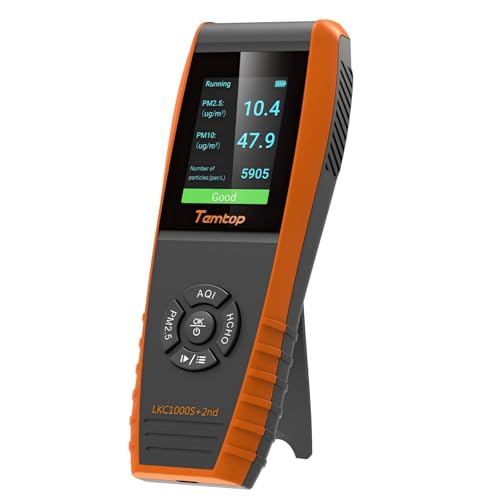
The data-driven monitor for formaldehyde hunting, exporting three months of readings to Excel.
This is the tool for people who do not just want to know the air is bad — they want to know why and when. The Temtop LKC-1000S+ tracks PM2.5, PM10, HCHO (formaldehyde), TVOCs, humidity, temperature, and AQI in one device. It is powered by a laser particle sensor with a 3-year designed lifespan and a Dart electrochemical HCHO sensor — not a cheap semiconductor — delivering lab-tested accuracy with an R² up to 0.999.
The killer feature is trend detection. A built-in 12-hour trend histogram helps you spot peaks from cooking, incense, or renovation fumes and instantly verify whether your ventilation actually worked. You can log all seven parameters continuously via USB and export to Excel spreadsheets for professional reporting, with no subscription or app required.
Buyers with chemical sensitivities and post-renovation households found it detected formaldehyde from new furniture and flooring reliably. It is factory-calibrated and ready from the start, with a large IPS color display that shows green/yellow/red at a glance. The built-in battery supports 6-8 hours of room-to-room spot checks, and it plugs in via Type-C for 24/7 duty.
The professional angle: R² accuracy up to 0.999 and 3-month Excel export make this the pick for remodeling safety and long-term health tracking.
The warning signs: Some units have seen sensor failure after 22 months of use, and humidity can cause reading fluctuations — budget for that longevity risk.
Best suited to: Health-conscious buyers fresh off a renovation who want formaldehyde-specific data they can export and even share with professionals.
Not if: You want a basic always-on living-room display — the trend-logging depth would be wasted on simple daily checks.
9. Airthings View Radon

WiFi-connected radon detection with a wave-to-display eInk screen and a 3-year battery lifetime.
You get radon data on your phone no matter where you are. The Airthings View Radon is the most accurate and sturdy radon sensor in the company’s lineup, also measuring humidity and temperature. It runs on 6 AA batteries with up to a 3-year battery lifetime, or you can plug it in via USB, which turns it into a hub that brings other Airthings devices online.
The Calm Tech Display lets you set your view preferences, or wave a hand in front of it to trigger sensor levels. The eInk screen shows up to four values with simple color coding, and the free Airthings app provides full readings, graphs, notifications, and insights. Buyers who tested five units over four months found readings consistent and accurate over time, even catching radon peaks as high as 20 pci/l with typical levels between 3-9 depending on room and weather.
For families verifying that a mitigation system is actually working, or for remote monitoring of a basement, owners say this is essential gear. The free 5-year extended warranty — available with registration within 30 days of purchase — adds real longevity cover, though some customers note mixed experiences with customer support.
The connectivity win: WiFi means you check radon, temp, and humidity from anywhere, with graphs that make trends obvious.
The honest trade-off: A premium price, and a minority of buyers hit connectivity or app issues — while most owners find both flawless.
Choose this if: You need remote radon alerts and long battery life, or you want a device that doubles as the hub for a growing Airthings system.
pass on it if: You are on a tighter budget or only need basic radon averages — the Corentium Home 2 covers that at a lower premium.
Understanding the Specs
NDIR vs. photoacoustic CO2 sensors
Two main technologies measure CO2 accurately. NDIR (non-dispersive infrared) shines a light through an air sample and measures how much is absorbed — it is the classic, reliable standard. Photoacoustic sensors, like the one in the GoveeLife H5140 and the Temtop C1, also use infrared but measure the sound wave generated by the gas instead, which can cut power use dramatically. Both give accurate readings in the ±40ppm range that matters for home use.
Particulate sensors (PM2.5 and PM10)
A laser particle sensor works by shining a laser through an air stream and counting the particles that scatter the light. PM2.5 refers to particles smaller than 2.5 micrometers — small enough to reach deep into the lungs — while PM10 includes larger dust and pollen. A monitor that reports both gives you a fuller picture of indoor air, especially if you live near traffic or wildfire zones.
Electrochemical sensors for formaldehyde
Formaldehyde (HCHO) is a common off-gas from new furniture, flooring, and paint. Electrochemical sensors — like the Dart sensor in the Temtop LKC-1000S+ — react chemically with the gas to produce a measurable signal. These are far more accurate than the cheap semiconductor sensors found in budget units, and they are the right choice if you recently renovated or bought new furniture.
Radon sensing via alpha spectrometry
Radon decays into radioactive particles that emit alpha radiation, and a radon detector counts those emissions to estimate the gas concentration in the air. Because radon levels fluctuate by the hour and the season, a continuous monitor that averages readings over 24 hours, 7 days, and 30 days gives a far truer picture than a one-time test kit. Battery-powered radon detectors like the Airthings models sample continuously for weeks without lab fees.
FAQ
What does a normal indoor CO2 level look like?
Will an air tester detect a gas leak or carbon monoxide?
How long should I run a radon test in my home?
Do air quality monitors need WiFi or an app to work?
Should I leave my monitor plugged in all the time?
What is the difference between PM2.5 and PM10?
Why does my monitor show different readings in different rooms?
Can a monitor tell me if my air purifier is working?
How accurate are budget air quality monitors?
Do I need a separate monitor for formaldehyde?
Final Thoughts: The Verdict
For most houses, the best all-round choice is the Dienmern 8-in-1 because it covers six key air indicators at a budget-friendly price with a battery you can actually carry around. If your priority is smart-home convenience and app-driven alerts, the GoveeLife H5140 adds voice control and two years of trend data. And if you have a basement or live in a radon-prone area, the Airthings Corentium Home 2 is the only pick here that can see that invisible gas at all — the crowd favorite with 4.5 stars and hundreds of owners behind it.
How We Picked
We do not accept paid placement. Every pick is matched to a real buyer and a real use-case; we do not hands-on test units.
Sources & Methodology
Specifications: manufacturer listings and product documentation. Review insights: verified customer reviews, as of August 2026. Pricing: not shown on this page (it changes often); check the current price via the retailer link.
As an Amazon Associate, Gadgets Feed earns from qualifying purchases. This does not affect which products we feature.