
When your outdoor wood furnace sends 180°F water into a plenum, the difference between a warm house and a cold repair bill comes down to a single welded seam. An air-to-water heat exchanger has no moving parts — its entire personality is forged by the thickness of its copper tubes, the density of its aluminum fins, and the integrity of its brazed joints. One micro-leak at a contact point and you’re draining boiler fluid into your ductwork, chasing a drip that robs you of BTU by BTU.
I’m Min — the co-founder and writer behind Gadgets Feed. I’ve spent dozens of hours cross-referencing manufacturer specs on copper-wall thickness, fin count per inch, port sizes, and case material across the most popular residential heat exchanger models so you don’t have to guess which unit will last through a second season.
Whether you are retrofitting a pole barn, upgrading a furnace plenum, or building a greenhouse heating loop, finding the right best air to water heat exchanger means matching duct dimensions to coil surface area and port configuration without overpaying for a branded case you do not need.
How To Choose The Best Air To Water Heat Exchanger
Every heat exchanger is a trade-off between surface area, material conductivity, and installation complexity. The goal is to pull as many British Thermal Units (BTU) out of your boiler loop as possible while keeping air resistance low enough that your furnace fan does not struggle. Three factors dominate the decision.
Copper Tube Rows and Wall Thickness
Three-row coils with 3/8″ seamless copper tubes are the residential standard for a reason — they balance water volume with surface contact. Thicker walls resist pitting from oxygenated boiler water, but the real durability comes from high-pressure vacuum brazing at every joint. A unit that arrives under vacuum from the factory has already passed the hardest test it will ever face.
Aluminum Fin Count and Coating
Twelve fins per inch is the density most furnace blowers can push air through without creating back-pressure. Epoxy-coated fins resist the corrosion that comes from constant condensation on the fins when the coil is used for cooling. Uncoated raw aluminum fins will oxidize and lose efficiency over time in humid environments.
Case vs Uncased Design
A cased unit (steel shell with flanged edges) bolts directly into a plenum and looks clean. An uncased coil drops into an existing sheet metal box and saves 40-60 percent of the cost. The heat transfer is identical — the case only provides mounting convenience and airflow direction. If you are fabricating your own ductwork, skip the case and pocket the savings.
Quick Comparison
On smaller screens, swipe sideways to see the full table.
| Model | Category | Best For | Key Spec | Amazon |
|---|---|---|---|---|
| A. O. Smith ATI-310CX3 | Premium | Whole-home tankless integration | 190,000 BTU with scale prevention | Amazon |
| Ranein 190k BTU | Premium | High-demand multi-outlet homes | 8.5 GPM at 190,000 BTU | Amazon |
| FOGATTI 180S | Mid-Range | Outdoor tankless on-demand heat | 8.1 GPM, 180,000 BTU | Amazon |
| GPOAS 24×24 | Premium | Large duct retrofits | 24″ x 24″ cased 306 steel | Amazon |
| Outdoor Furnace Supply 20×20 | Mid-Range | Direct wood boiler replacement | 1″ copper ports, 20″x20″ | Amazon |
| GPOAS 22×24 | Mid-Range | Medium duct, greenhouse heating | 22″ x 24″ cased 306 steel | Amazon |
| Outdoor Furnace Supply 18×20 | Mid-Range | Compact retrofit for Hardy furnace | 18″ x 20″, 1″ copper ports | Amazon |
| AB 20×20 | Budget | Budget-conscious workshop heat | 160,000 Btu, wavy fins | Amazon |
| VEVOR 20×20 | Budget | First-time uncased installation | 160 kBtu, 242 epoxy fins | Amazon |
In‑Depth Reviews
1. A. O. Smith ProLine XE ATI-310CX3
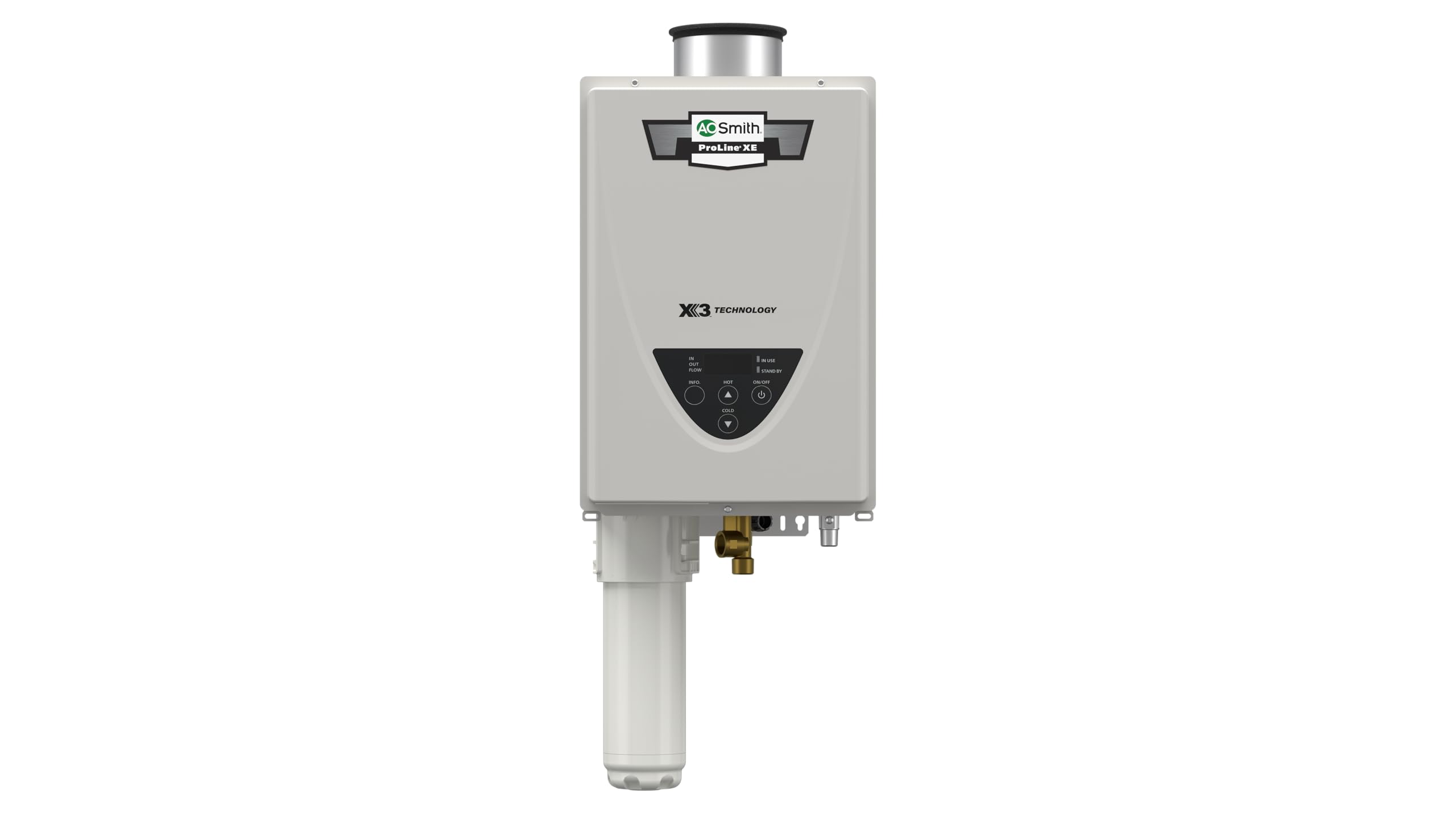
The A. O. Smith ATI-310CX3 is a tankless water heater with an integrated commercial-grade copper heat exchanger that delivers 8.0 GPM at 190,000 BTU. What sets it apart in a heat exchanger conversation is the X3 Scale Prevention Technology — a built-in system that maintains like-new heat transfer efficiency without requiring annual descaling or isolation valves. The 0.81 UEF rating means you are losing very little energy to standby losses, making it one of the most thermally efficient options for a whole-home loop.
The heat exchanger itself uses a 15-year limited warranty on the residential application, backed by A. O. Smith’s service network. The concentric vent system (APNC35) simplifies through-wall exhaust routing, and the included propane conversion kit makes fuel switching straightforward. At 51 pounds, it is the heaviest unit in this roundup because the copper heat exchanger is physically larger and denser than the stainless steel alternatives.
Feedback from owners consistently mentions consistent 115°F output even with multiple fixtures running simultaneously, with several DIY installers noting the integrated filter catches debris before it reaches the heat exchanger core. Professional installation is recommended, and the venting requirements are specific — but for a permanent whole-home solution that eliminates descaling forever, this unit is hard to beat.
Why it’s great
- X3 scale prevention eliminates annual descaling maintenance
- Commercial-grade copper heat exchanger with 15-year warranty
- Concentric vent simplifies through-wall exhaust routing
Good to know
- Requires specific concentric vent kit (sold separately)
- Professional installation strongly recommended for warranty
- Heavier than comparable tankless units at 51 lbs
2. Ranein 190,000 BTU Tankless Water Heater
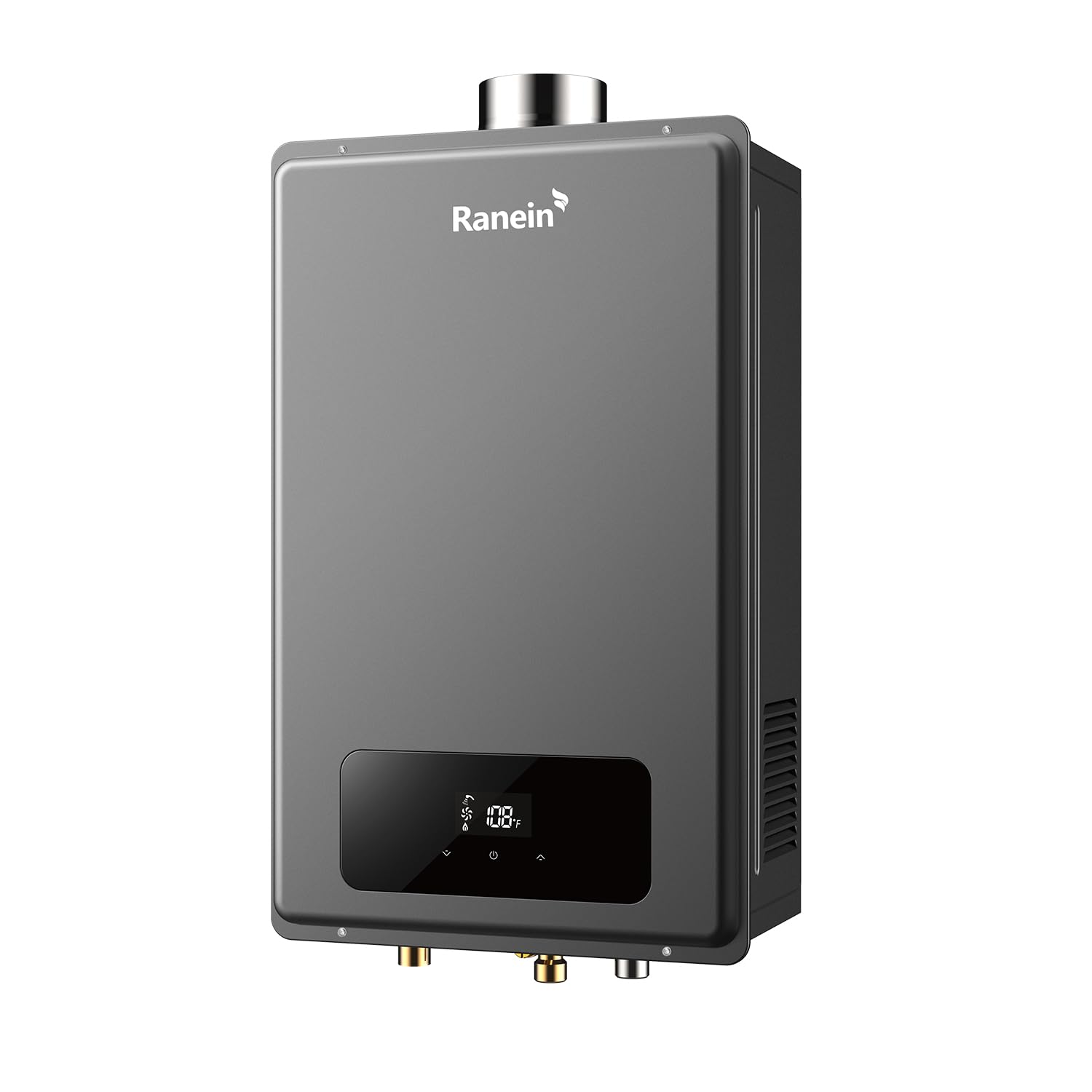
The Ranein tankless unit pushes 190,000 BTU with a flow rate of 8.5 GPM, making it the highest-capacity whole-home heat source in this review. The bottom-mounted fan design prevents smoke backflow and automatically adjusts rotation speed based on external wind pressure and water temperature. This modulation means the heat exchanger receives a consistent oxygen supply for complete combustion, which directly translates to thermal efficiency at the coil level.
Installation uses standard 3/4″ NPT fittings, and the compact frame (24.25″ x 15.08″ x 8.07″) fits into tight mechanical spaces. Owners running on propane report a 30-pound tank lasting three months for daily showers and dishwashing, with inlet temperatures around 62°F and output reaching 127°F. The unit is rated for 4-6 outlet points simultaneously, which covers most suburban homes without a second loop.
The two-year manufacturer warranty covers the entire unit, and customer service has been responsive when parts fail — multiple users report full replacements at no cost within the warranty window. For buyers who want the maximum BTU output in a tankless package without the A. O. Smith premium, this is the pragmatic pick.
Why it’s great
- Highest flow rate at 8.5 GPM in this comparison
- Auto-modulating fan adjusts to wind and temperature changes
- Compact footprint fits tight mechanical closets
Good to know
- Requires separate shut-off valves for each water line
- Not recommended for altitudes above 2,000 feet
- Propane conversion may need a bladder tank for low-pressure wells
3. GPOAS 24×24 Water To Air Heat Exchanger

The GPOAS 24×24 is a cased coil designed for large duct retrofits where plenum space is generous. The 306 stainless steel case wraps around a 3-row core of 3/8″ seamless copper tubes with 12 aluminum fins per inch, delivering 24.8 pounds of mass that soaks up boiler heat and transfers it to forced air. The four thickened MNPT ports simplify plumbing by providing solid threading that does not strip under repeated torque.
Buyers have repurposed this unit creatively — one buried a 100-gallon stock tank with a boiler loop and used this coil to keep a 50-gallon nesting tank ice-free at 45-65°F through a Midwest winter. Others have mounted it in office plenums with a 20″ box fan and a fountain pump circulating ice water to create a DIY air conditioning loop. The epoxy-coated fins resist the condensation that forms during summer cooling, so the coil does not degrade when used for dual-season service.
The only recurring note from owners is that the packaging is minimal — a slightly bent supply tube on arrival is not uncommon, but the copper can be straightened without damaging the brazed joints. For the largest duct opening in this roundup, this is the coil that fills it.
Why it’s great
- Largest physical size (24×24) for maximum surface area
- 306 steel case provides rigid mounting flange
- Epoxy-coated fins resist condensation corrosion
Good to know
- Packaging can allow minor tube bending in shipping
- Surface water stains on copper from manufacturing process
- Requires plenum that can accept 25-inch-wide frame
4. Outdoor Furnace Supply 20×20 Water to Air Heat Exchanger

Outdoor Furnace Supply’s 20×20 uncased coil is a direct-fit replacement for wood boiler installations. The 1″ copper ports match the output of most outdoor furnaces without needing a reducer bushing, and the uncased design drops directly into a fabricated sheet metal plenum. At 160 kBtu, it is rated for 1,600 square feet when paired with 180°F water and a standard furnace fan — two units can cover larger spaces in series.
Owners report running this coil for three years straight before a leak developed at a brazed joint, which is consistent with the longevity of most mid-range copper coils that run at high temperature daily. One user heated a 1,600-square-foot home with two of these units in parallel, maintaining comfortable temperatures through winter without the furnace cycling excessively.
The lack of a case keeps the price down, but it also means you need to build or modify your own plenum box. For anyone who has access to basic sheet metal tools, that is a simple Saturday project that saves serious money over a branded cased unit.
Why it’s great
- 1″ copper ports match standard wood boiler outputs
- Uncased design saves 40-60% over cased equivalents
- Proven three-year lifespan on continuous use
Good to know
- Requires custom plenum or sheet metal box
- No epoxy coating on fins for corrosion resistance
- Some units report leaking at brazed joints after 3+ years
5. GPOAS 22×24 Water To Air Heat Exchanger

The GPOAS 22×24 sits between the standard 20×20 and the oversized 24×24, making it the ideal choice for medium plenums that cannot accommodate the full 25-inch width but still need more surface area than the smallest coils. The 306 steel case provides a rigid flange for bolting into existing ductwork, and the four thickened MNPT ports simplify the plumbing hookup without needing adapters.
Buyers have used this coil successfully for both heating and cooling applications. One user turned it into a stock tank heater for livestock, circulating boiler water through buried insulated pipe to keep a 100-gallon tank ice-free. Another repurposed the coil as a DIY air conditioner by running ice water from a cooler through the coil with a fountain pump, with a 20″ box fan blowing across the fins. The epoxy-coated fins handle condensation from both winter and summer cycles without corrosion.
The surface water stains on the copper from the forging process are cosmetic only — owners confirm they do not affect performance. At 22 pounds, it is manageable for a single person to slide into a plenum opening without a lift assist.
Why it’s great
- Fits medium plenums where 24×24 is too large
- Epoxy-coated fins for dual heating/cooling use
- Steel case provides clean mounting and airflow direction
Good to know
- Copper tubes may show water stains from manufacturing
- Packaging is minimal and can allow tube bending
- No scale prevention or descaling accessories included
6. Outdoor Furnace Supply 18×20 Water to Air Heat Exchanger
The 18×20 is the smallest uncased coil in this roundup, specifically designed as a drop-in replacement for Hardy brand furnaces with cracked exchangers. The 1″ copper connections align with Hardy’s stock port configuration, so this swap takes about an hour with no modification to the existing plenum. It is also popular in greenhouse heating loops where duct space is limited but 180°F boiler water is available.
One owner connected this coil to a wood boiler line and mounted a 20″ box fan behind it controlled by a thermostat, successfully heating a 15×25 greenhouse through a full winter. Another retrofit a 32×40 pole barn, reporting that the coil kept the space comfortable with no complaints after modifying the casing slightly. The uncased design means you are fabricating your own mounting frame, but the core itself is identical in quality to the larger units from the same manufacturer.
Build quality reviews are uniformly positive, with users describing the coil as “just as good as any” when compared to more expensive branded units. The compact size also makes shipping cheaper and faster, with most units arriving well-packaged and undamaged.
Why it’s great
- Direct replacement for Hardy furnace cracked exchangers
- Compact enough for tight greenhouse and barn installs
- Best price per BTU in the uncased category
Good to know
- Uncased — requires custom sheet metal box or existing plenum
- Smaller surface area limits total heat output
- No epoxy coating on fins
7. AB 20×20 Water to Air Heat Exchanger

The AB 20×20 uses wavy aluminum fins rather than straight fins — a design that increases surface area contact by 10-20 percent over flat-fin equivalents. This geometry bonus allows the same physical footprint (20×20 inches) to transfer more heat without increasing air resistance significantly. The 3/8″ seamless copper tubes and 12 fins per inch are the same density used in premium coils, but AB achieves it at a lower price point by using base brazing at edges rather than full vacuum brazing.
Owners report successful integration with outdoor wood boilers, direct connection to pipeline with clamps or welding. The epoxy-coated fins protect against corrosion, and the unit ships with steel shell support around the core for rigidity. After two years of continuous wood boiler service, one user reported no leaks and would repurchase without hesitation.
The main trade-off is that the initial unit may arrive with cosmetic surface marks on the copper from the high-temperature forging process, and the packaging is not reinforced enough to prevent minor tube distortion in transit. For a budget-conscious buyer who can straighten a tube with pliers, the savings are substantial.
Why it’s great
- Wavy fins provide 10-20% better heat transfer than straight fins
- Epoxy coating protects against condensation corrosion
- Two-year track record with no reported leaks
Good to know
- Base brazed rather than vacuum brazed at all joints
- Some units arrive with minor tube distortion
- Cosmetic water stains on copper during production
8. VEVOR 20×20 Heat Exchanger

The VEVOR 20×20 is the entry-level champion of this roundup, and for good reason — it delivers the same 20×20 footprint and 3-row copper core as units costing 50 percent more. The key difference is that VEVOR uses high-pressure vacuum brazing, the same process used by premium brands, to ensure leak resistance at every joint. The 242 epoxy-coated aluminum fins are the highest count in the 20×20 category, maximizing the surface area available for heat transfer.
Customer reviews consistently praise the build quality relative to the price point. One buyer replaced a cased brand coil with this uncased VEVOR unit, saving hundreds and reporting that the installation in existing ductwork was straightforward. The 19.14-pound weight makes it easy to handle alone, and the CE certification provides a baseline quality assurance that is rare at this tier.
The lack of a metal case means you must provide your own mounting frame, and the operating temperature range of -40°F to 356°F is wider than most residential systems will ever need. For first-time buyers who are not sure whether a heat exchanger will solve their heating problem, this is the lowest-risk entry point.
Why it’s great
- High-pressure vacuum brazing prevents micro-leaks
- 242 epoxy-coated fins in a 20×20 footprint
- CE certified quality at entry-level pricing
Good to know
- Uncased coil requires custom plenum fabrication
- No included mounting hardware or brackets
- Limited brand support compared to established manufacturers
9. FOGATTI Instagas Comfort 180S
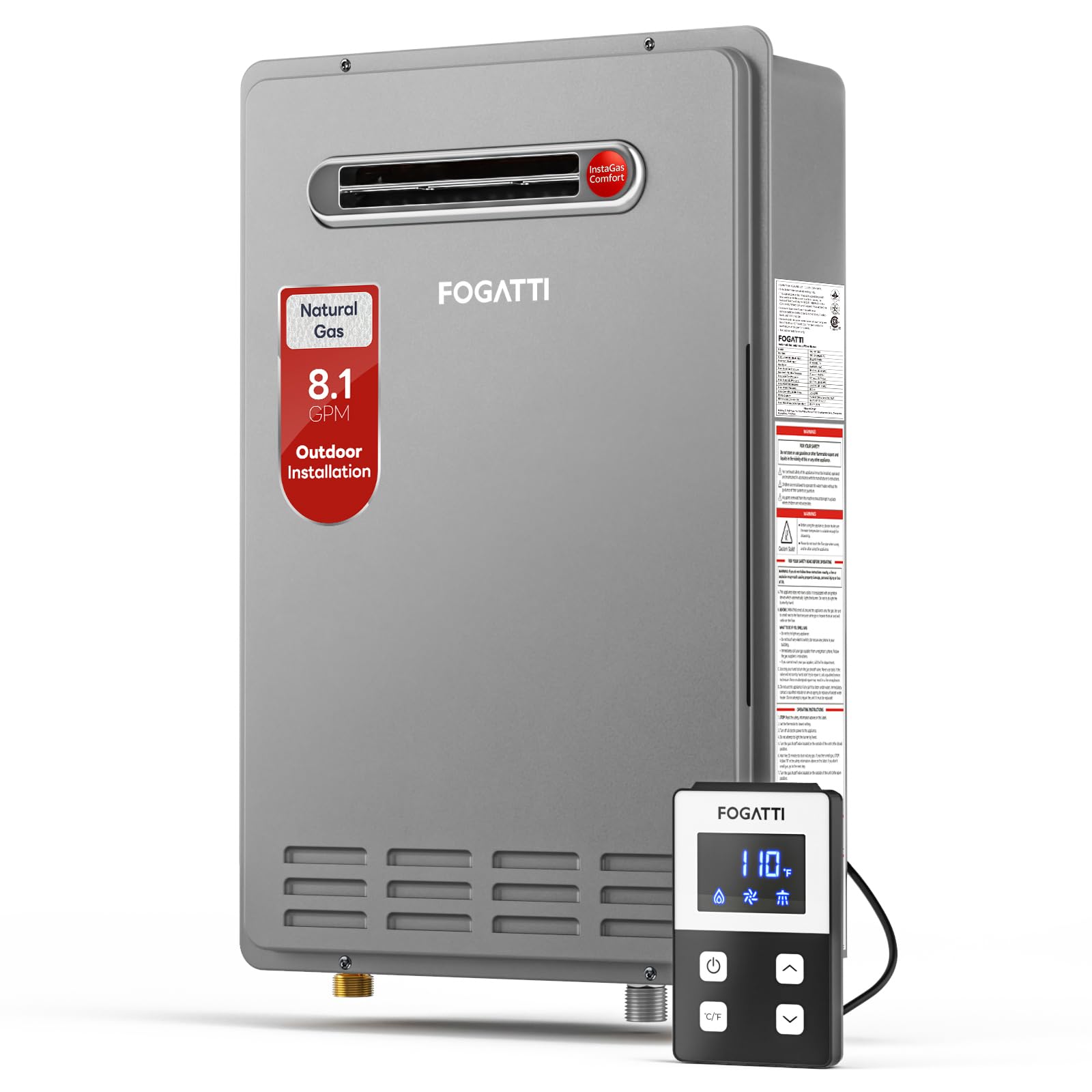
The FOGATTI 180S is an outdoor-rated tankless water heater with an oxygen-free copper heat exchanger and a 304 stainless steel burner. Its 180,000 BTU output at 8.1 GPM covers 3-5 simultaneous outlet points, and the bottom-mounted fan design prevents smoke backflow for safer operation in outdoor enclosures. The included remote control panel mounts indoors so you can adjust temperature without stepping outside in winter.
The heat exchanger itself uses a four-stage combustion system with advanced water servo technology that maintains water temperature within ±1°F of the set point. Owners report that the unit fires instantly when a faucet opens, with no preheat delay. The CSA certification covers safety standards, and the active anti-freeze feature is critical for outdoor installations in climates where temperatures drop below 5°F — though the manufacturer still recommends draining the unit if it will sit unused for long periods.
Some buyers found the installation instructions unclear, particularly around the required pressure regulator size, but the manufacturer support team provided resolutions over the phone. For an outdoor installation where you need continuous hot water without a storage tank, this unit delivers consistent performance with a 2-year whole-unit warranty and 5-year heat exchanger coverage.
Why it’s great
- Outdoor-rated design with bottom-mounted fan for safety
- ±1°F temperature precision with servo control
- Oxygen-free copper heat exchanger and 304 stainless burner
Good to know
- Installation instructions could be clearer
- Active anti-freeze limited; drain needed below 5°F
- Not recommended for altitudes above 2,000 feet
FAQ
Can an air-to-water heat exchanger be used for cooling as well as heating?
What size heat exchanger do I need for a 1,500 square foot home?
Why do some heat exchangers arrive under vacuum?
Is an uncased coil worse than a cased coil?
Final Thoughts: The Verdict
For most users, the best air to water heat exchanger winner is the GPOAS 24×24 because it pairs the largest physical surface area with a 306 steel case and epoxy-coated fins, making it the most versatile option for both heating and cooling in large residential or workshop spaces. If you want a budget-friendly uncased coil that punches above its price with vacuum brazing and 242 fins, grab the VEVOR 20×20. And for a permanent whole-home tankless solution with built-in scale prevention that eliminates annual descaling, nothing beats the A. O. Smith ATI-310CX3.