
Our readers keep the lights on and my morning glass full of iced black tea. As an Amazon Associate, I earn from qualifying purchases.
Specs are compiled from manufacturer listings and verified buyer reviews and can change over time — please confirm the key details on the product page before buying.
You put your hand near a vent and it “feels fine” — that is not a measurement, and it will not balance an HVAC system or settle a complaint about a weak register. What you actually need is a number in feet per minute, and the honest shortcut is a hot-wire probe that reaches into the duct instead of a spinning fan cup held outside the grille. This guide sorts the field by use case: in-duct diagnosis, quick spot checks, or logging data for a report.
I’m Min — the founder and writer behind Gadgets Feed. This guide is built by comparing the manufacturers’ published specifications and the patterns across verified customer reviews, so you get each pick’s real strengths and trade-offs instead of marketing spin.
You need a number you can trust at a vent, and the meter you pick depends on where that vent sits. Some meters slide a slim probe through a vent slot, others just get pointed at open air, and a few push readings to your phone. The picks below cover all three jobs, each listing probe type, range, and data logging so you can match the tool to the work.
Our Picks at a Glance


How To Choose The Best Air Velocity Meter
The first fork in the road is probe type, because it decides where the meter can physically go. A hot-wire probe is a thin heated element on a stick — it slides through a vent slot and reads the moving air by how much it cools the wire. A vane anemometer uses a small fan, and it needs open space in front of it to spin cleanly. Buy for the ducts and openings you actually face, not the widest spec sheet.
Probe reach decides where you can measure
If your work is registers, return grilles, and tight duct runs, reach is the spec that saves you time. The testo 405i’s hinged shaft extends to 15″, while the PM8915’s remote stainless probe runs 42″ long on a long cable. Compare that to a pocket meter with a fold-up housing that tops out at 9″ — fine for a wall vent, cramped inside a trunk line.
Velocity range versus low-flow sensitivity
Ask what the floor of the range is, not just the ceiling. A wind checker rated from 0 to 100.8 mph is aimed at outdoor gusting, but HVAC balancing lives at the quiet end — low flows that a sensitive hot-wire element can pick up. If your readings are usually gentle register flow, prioritize a meter that reads very low air movements; if you chase open-air wind, a higher ceiling matters more.
Volume readings need duct area
Velocity in feet per minute is one thing; volume in CFM — cubic feet per minute, the actual amount of air moving through the duct — is what balancing reports want. You get there by entering the duct’s cross-sectional area into the meter. Several picks here do that math for you once the area is input, which beats doing it by hand on a clipboard in a hot attic.
How you will record the numbers
A record you can hand to a client is what separates a hobby check from professional service work. Some meters freeze a reading with a data hold button (a button that locks the number on screen); others store hundreds of measurements, export over USB, or push live figures to a phone app. Decide up front if you need a record or just a number you glance at and forget.
Quick Comparison
| Model | Best For | Probe Type | Speed Range | Data Logging | Amazon |
|---|---|---|---|---|---|
| testo 405i★ Best Overall | In-duct HVAC diagnosis with app readouts | Hot-wire, 15″ telescopic shaft | Not stated | Bluetooth app storage and reports | Amazon |
| VEVOR Split Handheld EM2250Budget Champion | Budget 4-in-1 wind and airflow checks | Split vane on 6.6 ft cord | 0 to 100.8 mph | USB to PC | Amazon |
| BTMETER BT-100APPMost Popular | Phone-linked logging on a tripod | Fixed 8-vane sensor | 0.67 to 67.1 mph | Bluetooth app, Excel/TXT export | Amazon |
| Kethvoz KE-846A | Technicians who store large data sets | Split fan on extendable cord | 0.3 to 45 m/s | 600 groups onboard | Amazon |
| AOPUTTRIVER AP-856A | USB report building on a Windows PC | Detachable extendable probe | Up to 100 mph | 600 sets via USB | Amazon |
| Triplett AM200 | Pocket carry with a splash-rated housing | Fold-up housing, extends to 9″ | Not stated | Data hold only | Amazon |
| Primyteion PM8915 | Deep duct readings without blocking flow | Hot-wire, 42″ remote probe | Not stated | Max/Min/Avg on LCD | Amazon |
| BTMETER BT-5000Y | Rechargeable thermal probe with a color screen | Hot-wire, telescopic thermal probe | 0.2 to 67 mph | Data hold and unit conversion | Amazon |
| Triplett CFM100 | Direct volume readings with stored duct areas | Fixed sensor, no probe extension stated | Not stated | Min/Max/Avg recall (2 hour max) | Amazon |
In‑Depth Reviews
1. testo 405i Anemometer Handheld
Our pick — 4.5+★ from 600+ verified ratings; the strongest balance of quality and price.
A hinged hot-wire probe that reaches deep into ductwork and sends the numbers to your phone.
This meter earns its spot by measuring air velocity and temperature inside a duct, then working out volume flow once you feed in the duct dimensions — the job that pays. Its measuring element is a hot-wire sensor (a heated element that reads airflow by how quickly moving air cools it), so it handles the gentle, low-speed flow at a register better than a spinning fan. That element sits on a hinged, telescopic shaft that extends up to 15″, so a run buried behind a grille is still within reach during an inspection.
At 0.23 kg it is far lighter than the Kethvoz KE-846A at 0.9 kg, so it disappears into a tool bag and does not drag on a ladder. Bluetooth 4.0 (a short-range wireless link) pairs it with a phone or tablet, and the Smart Probe app shows readings as tables and graphs. That is the part technicians tend to value most, because the data can be stored, pulled back up, or dropped into a custom report without retyping anything.
What owners praise most is plainly the functionality: it does the velocity, temperature, and in-duct airflow jobs reliably, and ease of use runs right behind it. The recurring caveat is connectivity, not measurement — the app wants both Bluetooth and GPS switched on before it will link, so treat the pairing step as a small setup ritual rather than a one-tap affair. This is the crowd favorite of the group at 4.5+ stars across 600+ ratings.
What earns its place on the truck
- Hot-wire sensor reads low duct flows a vane cup can miss
- 15″ hinged telescopic shaft reaches tight vents and trunk lines
- At 0.23 kg it slips into a bag and climbs ladders easily
- Bluetooth 4.0 with the Smart Probe app for tables, graphs, and reports
Worth knowing before you order
- The app needs Bluetooth and GPS on before it connects
- Runs on 3 AAA batteries rather than a rechargeable cell
Made for: HVAC service and commissioning work where you need a duct reading logged to a phone report.
Think twice if: you want a simple standalone screen with no app pairing step at all.
2. VEVOR Split Handheld Anemometer EM2250
Four measurements in one meter, a lit screen for dark crawlspaces, and a cord long enough to stand back.
Pick this one when you want one instrument that covers wind speed, air temperature, airflow, and wind chill without spending a lot. The speed range runs from 0 to 100.8 mph at 5% + 0.5 m/s accuracy, and the temperature reads 14 to 140℉ at ±3.6℉. Six units — m/s, km/h, ft/min, mph, knots, with bft supported — mean you can match whatever the job sheet asks for, and the MAX/MIN/AVG/CU display keeps the peaks and averages visible.
The standout for indoor work is the LED backlight on the screen, since a dim mechanical room or a vent behind furniture is exactly where a dim LCD becomes useless. It carries an IP44 rating (protection against small solids and splashing water, excluding the vane unit) so a bit of rain or snow during an outdoor check is not a disaster. A 6.6 ft extendable cord lets you hold the body and place the sensor higher up, and it shuts off after 5 minutes of inactivity with a low-battery alert to warn you first.
Design is the bright spot in owner feedback, and reliability splits — plenty of units work exactly as expected while others have had issues, so buy with that in mind and check it thoroughly on arrival. It is also the chunkiest body here: 10.63 x 8.39 x 2.28 inches against the BT-100APP at 3.54 x 1.57 x 6.69 inches, so it is a bag meter rather than a pocket one. At 2 pounds it is a deliberate tool, not a featherweight.
Where it makes sense: an entry-level meter that covers several measurement jobs and adds a USB port to push data to a Windows PC.
The honest limit: the split design and larger body suit bench or site use more than shirt-pocket carry.
Reach for this if: budget is tight and you want one handheld to cover wind, temperature, and airflow checks.
Look elsewhere if: you need a slim probe that slides inside a duct — this vane sits on a cord outside the opening.
3. BTMETER BT-100APP Bluetooth Anemometer
The meter that pairs to your phone and logs readings while it sits on a tripod.
For anyone who wants continuous readings without holding a meter for ten minutes, the 1/4″ metal hole in the base is the detail that matters — it screws onto a tripod and keeps measuring while you work elsewhere. Wind speed is measured from 0.67 to 67.1 mph at ±5% of readings, with temperature from 14℉ to 113℉ at ±2℃ and a resolution of 0.1 m/s. Two temperature sensors and 8 vanes make the element sensitive enough to read very low air flows in HVAC installation and duct vents.
Buyers report that build quality is what wins them over, with ease of use right behind — helped by the dead-simple layout. One LCD shows wind speed in five units (m/s, km/h, ft/min, knots, mph), temperature in ℃ or ℉, plus wind chill and battery level. The CFM formula (cubic feet per minute, your volume-flow figure) is printed right on the meter, so you multiply average air velocity in FPM by duct cross-sectional area in ft² and you have your number without hunting through a manual.
Where it gets sticky is the app. Bluetooth pairing and the app experience draw mixed reports — some owners find the Bluetooth feature great and the app useful, while others run into the app not connecting or not being available in the Google Play store. Check you can source the app on your phone before relying on logging for a paid job. This is the most widely adopted meter in the group at 4.0+ stars across 800+ ratings, and at 155 g it is genuinely pocketable.
Why it suits tripod testing
- 1/4″ base hole lets it run hands-free on a tripod for long tests
- 8 vanes read very low air flows in vents and ducts
- 155 g body slips into a jacket pocket
- Logs and exports data in Excel or TXT from the app
Sort before you depend on it
- The app availability varies by phone store — test pairing early
- Ceiling tops out at 67.1 mph, so it is not a high-wind outdoor tool
Best fit: HVAC checks and long stationary tests where you want the phone to hold the record.
Skip if: you refuse to depend on a phone app for logging and want onboard storage instead.
4. Kethvoz KE-846A HVAC CFM Meter
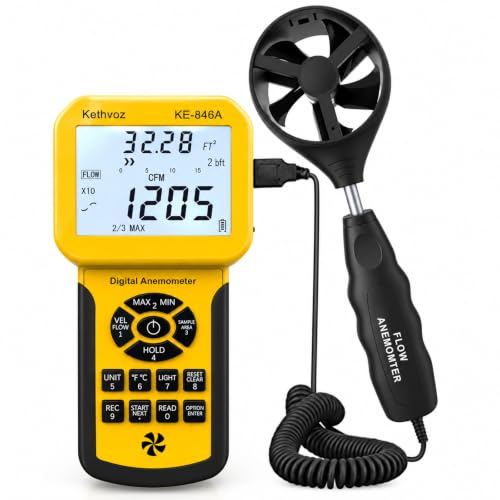
Built for technicians who need hundreds of stored readings and a sensor on a long reach.
Start with the accuracy figure, because it is the reason this meter is pitched at HVAC professionals: ±3% of reading with a resolution of 0.01 m/s (a fine step between readings, so you see small changes clearly). Air speed spans 0.3 to 45 m/s, temperature covers 32℉ to 113℉ with a ℃/℉ switch, and air volume reads 0 to 999,900 ft³/min with CFM/CMM switching. The wind sensor uses a low-friction bearing so it catches moving air sensitively rather than stalling at the low end.
It holds 600 groups of wind measurements in memory, and a single button freezes a reading for later review — a genuine time-saver when you are tracing a duct run and cannot write while balanced on a ladder. Four measurement modes (Max, Min, 2/3 Max, Average) and five velocity units cover most balancing routines. The separated fan sensor extends up to 2 m, so overhead vents are reachable with the body held safely at chest height.
The catch is weight and bulk. At 0.9 kg versus the testo 405i at 0.23 kg, that is a difference you notice hanging off a ladder strap all afternoon. It ships with a portable case, and the auto power-off and backlit HD LCD are both there. For an industrial-feeling instrument the trade is clear: more storage and a longer sensor reach, carried in a heavier body.
The professional angle: a big onboard memory and a fine 0.01 m/s resolution push this toward service and commissioning work, not casual checks.
Backed by: lifetime technical support and a carrying case in the box, which matters when the meter rides in a van every day.
Choose this when: you are documenting a lot of readings per job and want them stored in the meter itself.
Look on if: you mostly work one-handed in tight spots where 0.9 kg gets tiring.
5. AOPUTTRIVER AP-856A CFM Meter

The value pick that turns site readings into a clean report on a Windows laptop.
If your job ends with a document somebody else reads, the USB path is the headline. This meter measures air volume directly in CFM or CMM once you input the duct cross-sectional area (0.001 to 9999), and the included cable pipes up to 600 measurement sets into Windows software as you record. It also reads wind velocity in five units (m/s, km/h, ft/min, knots, mph) and temperature from 32℉ to 113℉, so a single pass covers the basics of a building inspection.
Accuracy is stated at ±3% + 0.2 rdg across a wind range up to 100 mph (45 m/s), with air flow up to 999,900 CFM/CMM at 0.001 resolution. The large LCD shows speed, airflow, temperature, and the Beaufort scale at the same time, and the backlight keeps it readable in a dim basement. MAX, MIN, AVG, and 2/3 MAX functions let you judge whether a duct is steady or surging, and data hold freezes a number before it scrolls away.
Owners describe it as straightforward to run and good value for the outlay, but accuracy draws a split response rather than uniform praise — so treat it as a solid working meter and check it against a known reference if a reading looks odd. The detachable extendable probe with its flexible cable gets deep into ducts and vents. One 9V battery (included) with a low-battery indicator plus a 5-minute auto power-off covers a day of spot checks, and it carries a 2-year manufacturer warranty.
Picks itself for: building inspections and compliance paperwork where the USB export does the reporting for you.
Go another way if: you want wireless logging instead of a cable and a Windows-only software disc.
6. Triplett AM200 Pocket Thermo-Anemometer

Shirt-pocket carry with a fold-up head that reaches 9″ and survives a splash.
This one lives in a pocket and gets pulled out for a quick look, which suits a quick check rather than a full service call. Air velocity, temperature, and wind chill all show on a dual LCD with multifunction indicators, so you read two values side by side instead of scrolling. The fold-up protective housing extends to 9″ for reach into a wall vent, and it doubles as a shield when the meter is folded shut.
The averaging mode is the quietly useful feature — you can set a 5, 10, or 13-second average, which smooths out a fluttering reading from a register that makes air move unevenly. That is the difference between a number that holds steady and one that bounces around while you try to write it down. A Max Display recalls the highest reading since the meter was powered on, and a Data Hold button freezes the screen for an easy copy.
Durability gets attention here in a way the others do not: the housing is rated water resistant to 3ft (1m), so a dropped meter in a damp crawlspace or a splash from a condensate line is survivable. It runs off a single CR2032 coin cell (included) with a lanyard, and the auto power-off conserves that small battery. Owners rate it favorably at 4.0+ stars, and the aluminum, glass, metal, plastic, and stainless steel build feels sturdier than its pocket size suggests. The trade-off is that 9″ of reach will not get you into a long trunk line.
Where it shines: fast spot checks on accessible vents where a full-size split meter is overkill.
Small-cell reality: a CR2032 coin battery is easy to swap but will not run as long between changes as AAA.
Suits you when: you want a rugged little meter that lives in a pocket for quick balancing checks.
Not your tool if: the work sits deep inside ductwork beyond the 9″ fold-up reach.
7. Primyteion PM8915 Hot Wire Anemometer
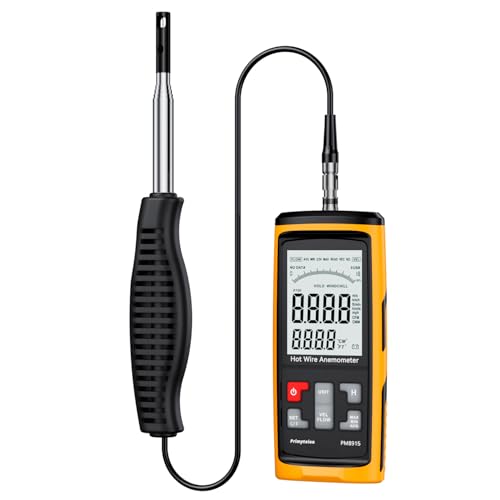
A thin hot-wire tip on a long probe that slips through the grille without disturbing the flow.
Reaching into a duct is one problem; measuring without changing the airflow is another. A hot-wire probe solves the second one — because there is no spinning fan to obstruct the moving air, the reading reflects what is actually passing through rather than what a fan cup has disturbed. The remote stainless probe here runs 42″ (1070 mm) with a 66.9″ (1.7 m) cable, and it retracts from 533 to 2100 mm, so you can physically insert the tip before it passes through the vent grille.
The probe tip is 9mm in diameter — slim enough for tight slots — and the meter covers wind speed in m/s, km/h, ft/min, knots, or mph, temperature in ℃ or ℉, and airflow in CFM or CMM. It calculates volume once you multiply wind speed by duct cross-sectional area. On screen you get the Beaufort scale, current, Max, Min, average, and 2/3V max wind speeds, plus wind chill and a low-battery indicator with auto power off.
It arrives with a hard carrying case, a USB Type-C charging cable, an adjustment certificate, and a manual — the certificate is a nice touch for anyone handing readings to a client. At 8 ounces it stays light on a long inspection. The trade is that pricing sits at the premium end for a meter of this class, so it earns its place when deep, non-intrusive duct work is your daily reality rather than an occasional task.
What the long probe delivers
- 42″ stainless probe on a 66.9″ cable reaches deep into duct runs
- 9mm tip slides through tight grilles without blocking the flow
- Recharges over USB Type-C instead of buying batteries
- Hard case and adjustment certificate included
Weigh against your day
- Premium-tier spend for a single-purpose instrument
- No phone app or USB data export for logging
Worth it for: anyone who measures inside ducts and needs the probe to sit in the airstream without disturbing it.
Pass if: your checks happen at the open grille face, where a shorter, cheaper probe does the same job.
8. BTMETER BT-5000Y Hot Wire Anemometer

A rechargeable thermal probe with a big color screen for HVAC duct and vent diagnostics.
A built-in 600mAh Li-Ion cell (a rechargeable battery) ends the hunt for disposables: it charges over USB Type-C in about 2.5 hrs and runs through a day of vent checks, with an auto power-off to stretch runtime. The probe is a telescopic thermal design at 11.75 x 1.61 x 0.93 inches, and the protective cover is dustproof and waterproof, which matters when a meter rides loose in a van.
Measurement covers air velocity from 0.2 to 67 mph at ±5%, airflow volume from 0 to 999,900 ft³/min in CFM or CMM, and temperature from 32℉ to 113℉. The large color LCD shows wind speed, airflow, and temperature together with max, min, and average values, and touch keys plus unit conversion and data hold round out the controls. Quality is what people rave about most here, and a compact body adds to the field-friendly feel.
Two honest notes come straight from owner experience. Accuracy draws mixed reactions — some find it pretty accurate while others report it missing wind speed measurements — so verify against a reference early if precision matters for a report. And the backlight has drawn durability complaints, with one report of it lasting only about 2 seconds, so treat the screen lighting as a nice extra rather than something to count on in a dark space. At 4.0+ stars across 300+ ratings, most owners are clearly getting good use out of it.
The rechargeable win: USB Type-C charging at roughly 2.5 hrs means no last-minute battery run before a call.
Screen caveat: the color LCD is a pleasure to read, but the backlight is the weakest point in the owner record.
Great match for: technicians who want a rechargeable thermal probe and a bright color readout in the field.
Consider alternatives if: you depend on a backlight in dark voids — that is the part owners flag most.
9. Triplett CFM100 CFM/CMM Thermo-Anemometer

Stores the duct areas you measure most often, so a volume reading is one button away.
The feature worth understanding here is the memory location for area size — one stored slot each for CFM and CMM. On a balancing job you measure the same ducts over and over, and remembering that cross-sectional figure means you are not re-entering numbers every visit. It measures air velocity, air flow volume, and temperature, and the side-mounted function keys let you work the meter one-handed while the dual backlit LCD stays readable in a dim mechanical room.
Min, Max, and Avg recall pulls back the highest, lowest, and average readings from up to a two-hour window, which is a meaningful record when you need to show a duct was steady over time. Data Hold freezes the display for copying a figure, and auto power-off with a disable option saves the three AAA batteries while still letting you run a long test when you need to. It ships with the meter, batteries, and a pouch case.
This one sits at the top of the premium tier, and the build reflects it: a 16-ounce body in ABS plastic and stainless steel with a 1-year manufacturer warranty. The trade-off is that it is a fixed-sensor meter with no probe extension stated, so the reach into a deep duct run is limited to how far you can position the body itself. Owners rate it well at 4.0+ stars, and it suits anyone who values repeatable volume readings over the ability to slide a probe around inside ductwork.
Best for: balancing techs who measure the same duct areas repeatedly and want the figure remembered for them.
Not ideal if: you need a long probe to reach into trunk lines rather than measuring at the opening.
Understanding the Specs
Hot-Wire Versus Vane Sensors
A hot-wire sensor is a thin heated element that reads airflow by how much it cools — because nothing spins, it measures gently moving air in a duct without disturbing it. A vane sensor spins a small fan, so it needs clear space in front to turn accurately. For register and duct work the hot-wire style is usually the better fit; for open-air wind it is fine to go either way.
CFM and CMM Explained
CFM stands for cubic feet per minute — the volume of air moving through a duct, not just its speed. CMM is the metric version. You get either one by entering the duct’s cross-sectional area into the meter, which then multiplies your velocity reading by that area. It is why the area memory on a dedicated CFM meter is such a practical touch.
Accuracy Ratings
An accuracy figure like ±3% of reading tells you how far a measurement may land from the true value, which matters most at the low end of a range. The finer the resolution — 0.01 m/s versus 0.1 m/s — the more clearly you see small changes. Treat both as guidance and check against a known reference when a reading decides a paid report.
Units and Range Fit
Meters that switch among m/s, km/h, ft/min, knots, and mph simply save you converting numbers by hand. The ceiling of the range tells you whether it can chase gusty open-air wind, while the floor tells you whether it reads a quiet register. Match the range to your common readings, not the biggest number on the box.
FAQ
Do I really need a hot-wire probe for measuring vents?
How do I get a CFM reading from my meter?
What is the difference between CFM and CMM?
Can I connect an air velocity meter to my phone?
How long does the battery last on a handheld anemometer?
What does a resolution of 0.01 m/s actually buy me?
Is a water-resistant rating important for an anemometer?
Should I pick a split-sensor meter or a single body meter?
Can I export readings to a computer for a report?
How deep into a duct can these meters actually reach?
Final Thoughts: The Verdict
For most HVAC and diagnostic work, the air velocity meter to reach for is the testo 405i — a hot-wire probe that reads low duct flows without disturbing them, a 15″ shaft that gets where your arm will not, and Bluetooth logging that lands straight in a report. If you want a phone-linked tripod logger without the app gamble, look at the BTMETER BT-100APP. And when a long, non-intrusive probe is the whole point of the job, the Primyteion PM8915 puts 42 inches of stainless steel into the airstream.
How We Picked
We do not accept paid placement. Every pick is matched to a real buyer and a real use-case; we do not hands-on test units.
Sources & Methodology
Specifications: manufacturer listings and product documentation. Review insights: verified customer reviews, as of November 2026. Pricing: not shown on this page (it changes often); check the current price via the retailer link.
As an Amazon Associate, Gadgets Feed earns from qualifying purchases. This does not affect which products we feature.