
The difference between a crisp, clean basecoat on a Space Marine and a spattered, orange-peel mess is almost always the tool in your hand. A miniature is a demanding canvas — every rough edge and inconsistent spray line is magnified at an inch away. This guide filters through the noise to find the airbrush that delivers the atomization control and trigger precision your models actually deserve.
I’m Min — the co-founder and writer behind Gadgets Feed. I’ve spent hundreds of hours cross-referencing needle sizes, nozzle designs, compressor CFM ratings, and real-world user feedback on clogging and cleaning cycles to separate airbrushes that genuinely improve miniature painting from those that just add frustration.
The goal here is simple: to help you find the very best airbrush for miniatures no matter your budget, by breaking down the specs that actually matter for your next project.
How To Choose The Best Airbrush For Miniatures
Picking the right brush for miniature painting comes down to three core pillars: the needle/nozzle size that governs your line width, the trigger mechanism that controls your paint flow, and the build quality that determines how often you’ll be cleaning clogs instead of painting. A cheap brush with a loose nozzle will fight you on every layer.
Needle Size: The Narrow Path to Detail
For miniatures, a 0.2mm to 0.35mm needle is the sweet spot. A 0.2mm nozzle is exceptional for fine lines, zenithal prime, and small-scale detail work, but it requires heavily thinned paints and is prone to clogging if you don’t filter your paint. A 0.35mm or 0.4mm is more forgiving, handling base coats and gradients while still being capable of reasonable detail. Larger 0.5mm needles are for priming or spraying thicker mediums like varnish — too broad for most miniature-specific work.
Dual-Action vs. Single-Action: The Control Factor
Every serious recommendation on this list uses a dual-action trigger. This press-down-for-air, pull-back-for-paint mechanism lets you adjust paint volume on the fly without stopping your stroke. A single-action brush forces you to set a fixed paint flow, making seamless blends and fine highlights nearly impossible to achieve on a model.
Compressor and Pressure Consistency
The airbrush is only half the equation. You need a compressor that delivers stable, adjustable pressure — typically between 15 and 30 PSI for miniature acrylics. A unit with a tank or a smart electric piston that auto-starts to maintain pressure is ideal. Fluctuations in air cause sputtering that ruins a wet blend and leaves speckled texture on your model.
Quick Comparison
On smaller screens, swipe sideways to see the full table.
| Model | Category | Best For | Key Spec | Amazon |
|---|---|---|---|---|
| Harder & Steenbeck Evolution 2024 CRplus | Premium | Pro detail & precision | 0.28mm self-centering nozzle | Amazon |
| Iwata Eclipse HP-CS Value Set | Premium | Versatile all-in-one kit | E3 threadless nozzle | Amazon |
| Harder & Steenbeck Ultra 2024 | Mid-range | Hassle-free entry to pro gear | 0.45mm modular nozzle | Amazon |
| Gaahleri Premium Mobius 0.3mm | Mid-range | Budget-friendly precision | Spiral MAC nozzle design | Amazon |
| Gaahleri Turbox Mini Kit | Mid-range | Compact desktop setup | Digital pressure display | Amazon |
| Timbertech AS18-2K Kit | Budget | Entry-level starter kit | 23 LPM oil-less compressor | Amazon |
| Gocheer Airbrush Kit | Budget | Learning multiple nozzle sizes | 3-speed adjustable PSI | Amazon |
In‑Depth Reviews
1. Harder & Steenbeck Evolution 2024 CRplus

The H&S Evolution is the benchmark for serious miniature work. Its 0.28mm self-centering nozzle delivers hair-thin lines and exceptional atomization straight out of the box — no fiddling with alignment screws or worrying about an off-center spray pattern. The entire brush disassembles by hand, making color changes and deep cleaning a matter of seconds, not headaches.
Experienced painters will immediately feel the difference in trigger control. The resistance is linear and predictable, allowing you to pull back incrementally for precise glaze coverage or fine highlight work. It ships with a 2ml cup that is ideal for the small volumes of paint used on a single model, and it is compatible with a wide range of nozzle sizes (0.28mm to 0.6mm) for when you need to prime or varnish.
While this is a premium tool, the value is in the longevity and reliability it introduces to your painting sessions. You stop fighting clogs and start trusting your spray arm.
Why it’s great
- Sprays smooth, clean lines with minimal tip dry at 20 PSI
- Tool-free disassembly for quick cleaning and maintenance
- Self-centering nozzle ensures consistent atomization every time
Good to know
- Some units may arrive with a slightly over-tightened handle that requires a simple adjustment
- Premium price point, but competitive for German-engineered airbrushes
2. Harder & Steenbeck Ultra 2024

The Ultra 2024 is the gateway into German airbrush engineering without requiring a fortune. It features the same self-centering nozzle concept as the Evolution, but with a larger 0.45mm bore that makes it more forgiving for beginners who haven’t dialed in their paint thinning yet. It can handle primer and base coats beautifully while still stepping down to fine detail work.
The most clever feature is the integrated micro-cup socket in the body. You can load tiny amounts of paint directly into the brush without the main cup, keeping your sightline clear for precise freehand work. The preset system allows you to lock in needle position for primer, base, and detail, which removes a layer of guesswork when you’re learning trigger control.
Build quality is rock solid — one review mentions surviving a drop onto hardwood without losing performance. It is modular and fully compatible with the Evolution’s FineLine head system, so you can upgrade the nozzle to 0.28mm later.
Why it’s great
- Preset needle limiter takes the guesswork out of adjusting paint flow
- Durable enough to survive occasional drops without losing calibration
- Micro-cup socket is a game-changer for small paint volumes
Good to know
- 0.45mm nozzle is less suited for ultra-fine freehand lines than a 0.2mm brush
- Requires purchase of a separate air hose and compressor
3. Iwata Eclipse HP-CS Value Set
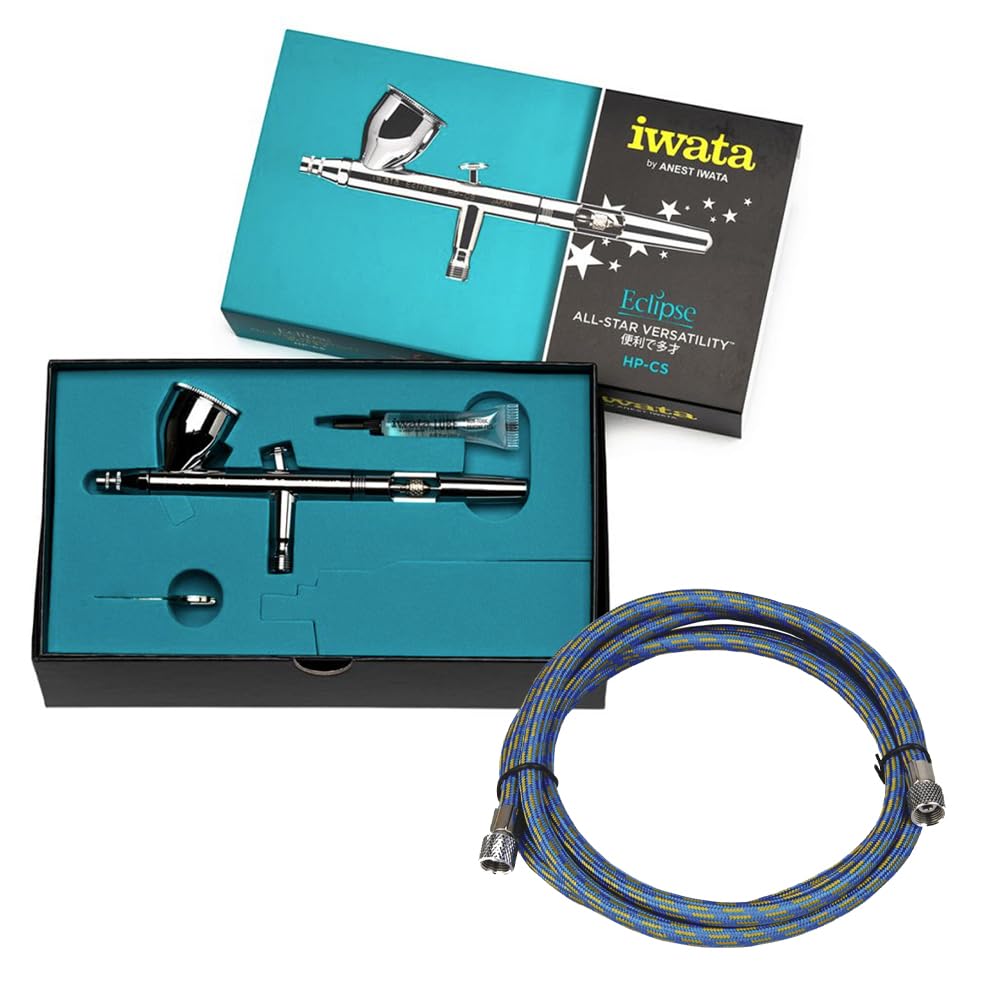
The Iwata Eclipse HP-CS is a legendary workhorse in the miniature painting world. Its 0.35mm nozzle hits the perfect middle ground: fine enough for detailed highlights and small-scale models, yet wide enough to push slightly thicker paints without constant clogging. The break-resistant spring-steel needle adds durability that budget brushes simply cannot match.
The value set sweetens the deal by including a 10-foot braided hose, a bottle of Medea cleaner, Createx paint, and a beginner’s guide. The E3 compression-fit nozzle is threadless, so there are no delicate threads to cross-thread or strip during cleaning. The quick-flush cutaway handle lets you access the needle for fast cleaning between color changes, which is crucial when working on a single model with multiple hues.
You can spray a very narrow pattern at low PSI without swapping tips, making it a genuine one-brush solution. Heavier than cheap alternatives, the weight provides steadier control when holding fine lines.
Why it’s great
- E3 threadless nozzle eliminates the risk of stripping threads
- Quick-flush handle allows rapid needle cleaning during a session
- Sprays fine lines and broad coverage with the same nozzle
Good to know
- Small nozzle parts can be easily lost if you don’t use a dedicated cleaning tray
- Needle packing seals can degrade over time with heavy solvent use
4. Gaahleri Premium Mobius 0.3mm
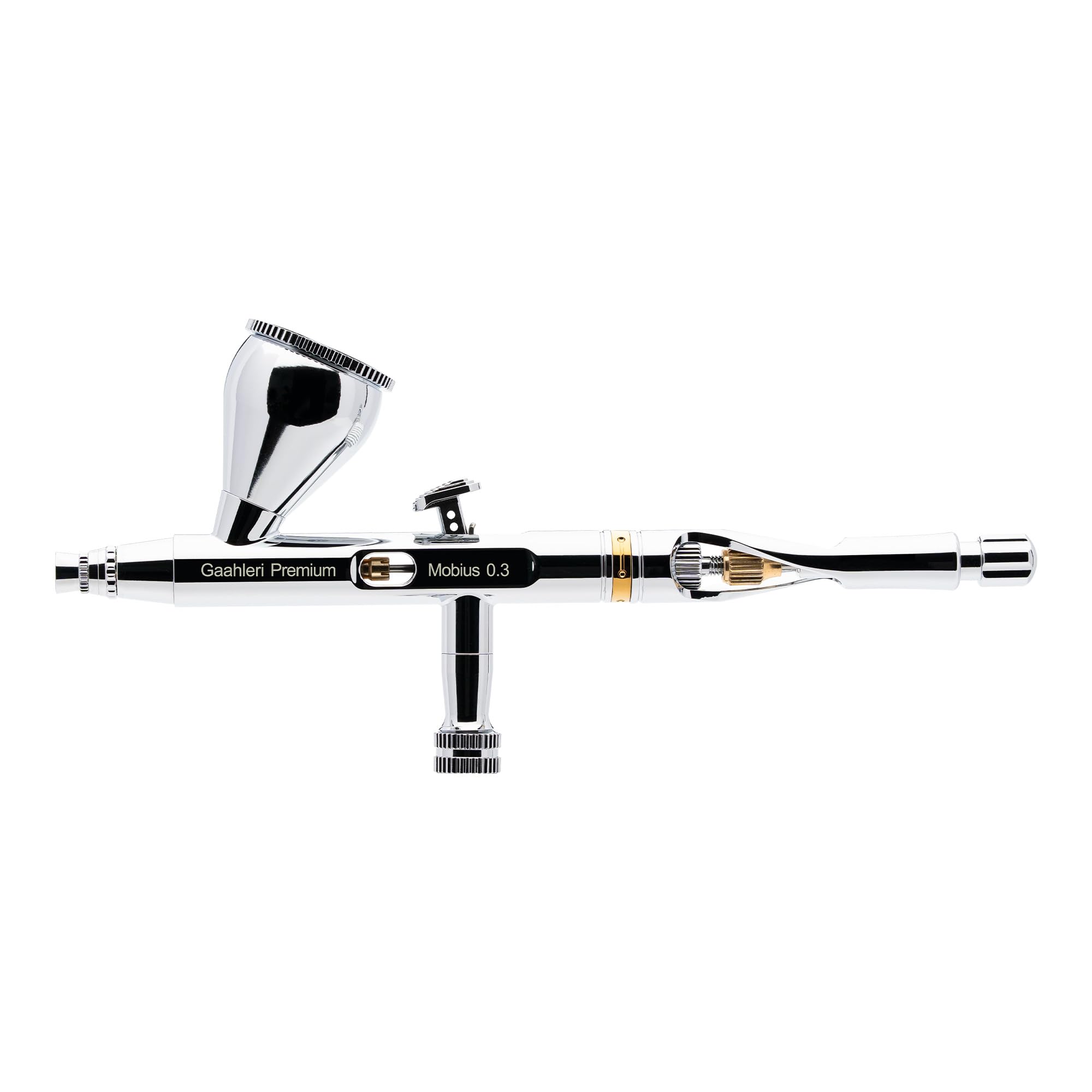
Gaahleri’s Mobius series punches far above its mid-range price. The 0.3mm needle with the patent-pending Spiral Micro Air Channel (MAC) nozzle delivers stable, uniform airflow that handles low-pressure atomization remarkably well. Users report painting successfully with unthinned acrylics at 15 PSI, which is rare for a brush in this bracket.
The ergonomic design is well-considered. The square lever eliminates trigger stutter and reduces finger fatigue during long sessions, and the patent-pending cutaway provides visual feedback on the trigger mechanism while also allowing you to adjust spring tension directly. The ultra-mirror-finished cup minimizes paint accumulation, making it easier to clean between colors.
It clogs far less than pricier models according to user feedback, and disassembly is straightforward. For the price, it offers a professional feel that is competitive with brands costing double.
Why it’s great
- Sprays unthinned paint at low PSI with minimal issues
- Adjustable trigger spring tension for customized feel
- Smooth mirror-finish cup resists paint buildup and cleans quickly
Good to know
- The nozzle can unthread easily if you are not careful during cleaning
- Not a full kit — requires a separate compressor and hose
5. Gaahleri Turbox Mini Kit
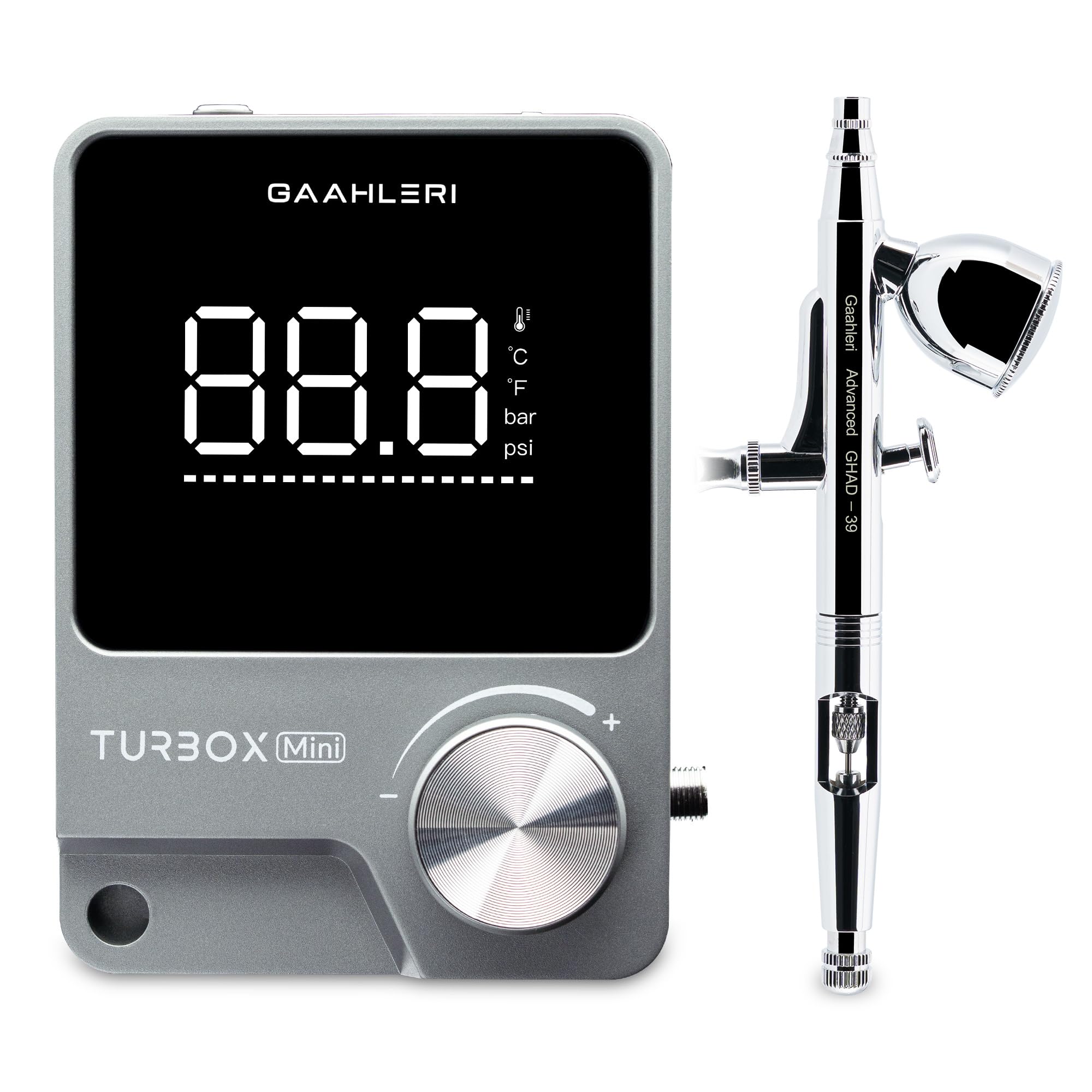
This is the complete desktop solution for painters with limited space. The compressor measures just 5.5 x 3.9 x 2.3 inches and weighs only 1.32 lbs, yet it delivers stable working pressure between 10-20 PSI — perfectly within range for miniature acrylics. The digital display shows real-time PSI, so you always know exactly where your air pressure sits.
The compressor features 18 gear settings accessible via a simple dial, allowing you to switch between low, medium, and high presets by pressing the dial. The included GHAD-39 airbrush has a 0.35mm nozzle, which is a solid all-rounder for everything from priming to detail work. Noise output is under 48 dB at one meter, which is quiet enough for a shared apartment.
The built-in overheat protection and smart temperature control add peace of mind for extended painting sessions. This kit is ready out of the box with air hose and holder included.
Why it’s great
- Extremely compact compressor fits on any desk without dominating it
- Digital PSI display removes pressure guesswork
- Quiet enough for nighttime painting without disturbing others
Good to know
- Maximum PSI is limited compared to a full-size tank compressor
- The included airbrush is single-caliber (0.35mm), no nozzle swap in the box
6. Timbertech AS18-2K Kit

The Timbertech AS18-2K is a practical entry point that includes everything you need to get started: an oil-less compressor with 23 LPM airflow, a basic double-action gravity-feed airbrush with a 0.3mm nozzle, a 6-foot hose, cleaning brushes, and sample paints. The compressor features auto-start/stop between 3 and 4 bar, which keeps pressure consistent without a tank.
At 47 dB, it is noticeably quiet for a piston compressor and does not require the same maintenance as oil-lubricated units. The built-in regulator and moisture trap are essential for miniature work — they ensure dry, consistent air that prevents water beading in your paint. The included airbrush is decent but basic; it performs well for practice and learning trigger control without the fear of damaging an expensive tool.
Users find the compressor itself to be a reliable foundation that can be paired with a better brush later. The sample paints are low quality, so budget for a good acrylic paint set immediately.
Why it’s great
- Quiet, oil-less compressor with auto on/off for pressure stability
- Integrated moisture trap is essential for preventing splatter
- Includes cleaning tools and sample paints for immediate use
Good to know
- Included airbrush is basic and may need replacement for serious detail work
- Maximum output is around 30 PSI, lower than advertised 58 PSI in real use
7. Gocheer Airbrush Kit

The Gocheer kit is designed for the absolute beginner. Its compressor offers three fixed pressure settings (25, 30, and 40 PSI) that you click between with a button — no gauges to learn. The kit includes three nozzle sizes (0.2mm, 0.3mm, and 0.5mm), giving you the flexibility to experiment with fine detail lines, medium coverage, and thick primer without buying additional parts.
The dual-action brush itself has an adjustable tailstock for needle retraction, and the 20cc/40cc gravity cups are generous for larger projects. The comprehensive accessory pack includes an oil-water separator, cleaning tools, and a dismantling tool. Many beginners report achieving a professional smooth finish quickly thanks to the easy pressure selection.
However, reliability is a concern. A small but notable number of users report compressor failure after limited use, and the compressor can lose pressure over time. This kit is best seen as a low-cost learning platform.
Why it’s great
- Three included nozzle sizes allow experimentation with different techniques
- Simple 3-setting pressure button is very beginner-friendly
- Complete kit with cleaning tools, separator, and cups out of the box
Good to know
- Compressor reliability is inconsistent — some units fail after minimal use
- Plastic compressor build feels less durable than metal alternatives
FAQ
What PSI should I use for miniature painting?
Do I need a compressor with an air tank for miniatures?
How often should I clean my airbrush?
Final Thoughts: The Verdict
For most users, the best airbrush for miniatures winner is the Harder & Steenbeck Evolution 2024 CRplus because its 0.28mm self-centering nozzle and tool-free maintenance deliver professional-level precision and reliability. If you want a brilliant all-in-one kit with durable build quality, grab the Iwata Eclipse HP-CS Value Set. And for the best value-to-performance ratio, nothing beats the Gaahleri Premium Mobius 0.3mm.