
An airbrush that clogs mid-stroke or feels like a wobbly toy in your hand kills the joy of any project. The real question isn’t which one has the fanciest name — it’s which dual-action (press down for air, pull back for paint) gravity feed (paint cup sits on top, using gravity to flow) model delivers reliable spray without constant cleanup headaches. This guide compares six leading airbrushes across value tiers, from a workhorse with a pistol grip to a professional kit, so you can pick the one that actually fits your hand and your budget.
I’m Min — the co-founder and writer behind Gadgets Feed. This guide is built by comparing the manufacturers’ published specifications and the patterns across verified customer reviews, so you get each pick’s real strengths and trade-offs instead of marketing spin.
After digging through hundreds of real user reports and studying the specs that actually matter — needle size (the diameter of the nozzle opening, measured in millimeters), cup capacity, and feed type — here is your clear-eyed breakdown of the best airbrush options right now, free of hype and full of honest trade-offs.
How To Choose The Best Airbrush
Picking an airbrush comes down to three decisions that shape every spray session: how you feed the paint, how you control the trigger, and what size needle you use. Get these right, and you avoid most clogging, splattering, and hand fatigue headaches before you even start.
Feed Type: Gravity vs. Siphon
Gravity feed airbrushes have a small cup mounted on top of the brush. Paint drops down into the nozzle by gravity, so you use less paint and the brush works at lower air pressure — great for detail work and switching colors quickly. Siphon feed airbrushes use a bottle attached underneath; the air stream sucks paint up into the brush. Siphon feeds hold more paint and are common for larger coverage jobs like T-shirt painting or automotive touch-ups, but they waste more paint and require higher pressure to operate.
Trigger Control: Single vs. Dual Action
A single action airbrush delivers air and paint together at a fixed ratio — you control the spray width by twisting the tip. A dual action airbrush lets you press down for air and pull back for paint in one continuous motion, so you can vary line width and paint flow mid-stroke without stopping. Dual action gives you far more control for fading, shading, and fine detail, which is why almost every professional artist uses one.
Needle Size: What 0.38mm vs 0.5mm Actually Means
The needle size, measured in millimeters, determines the width of the spray pattern and the thickness of paint the brush can handle. A 0.3mm or 0.38mm needle is perfect for fine lines, model details, and thin inks. A 0.5mm needle handles thicker paints like primer or enamel without clogging. Many kits now include two or three interchangeable needle sizes so you can swap between detail and coverage work from the same brush.
Build Materials and Ergonomic Design
Look for a body made from metal or durable nylon that resists corrosion from solvents and cleaners. A pistol grip shape, where the trigger sits at an angle like a real gun, reduces hand fatigue significantly during long sessions compared to a straight pen-style body. A self-centering nozzle, which drops into place and aligns itself automatically, makes cleaning and reassembly much faster and less frustrating.
Quick Comparison
On smaller screens, swipe sideways to see the full table.
| Model | Category | Best For | Key Spec | Amazon |
|---|---|---|---|---|
| Gaahleri GHAD-68 | Gravity Feed | Long sessions / hand comfort | 0.38 & 0.5mm needles, pistol grip | Amazon |
| Iwata Eclipse HP-CS | Gravity Feed | Pro detail / all-purpose workhorse | 0.35mm E3 nozzle, 7ml cup | Amazon |
| Harder & Steenbeck ULTRA 2024 | Gravity Feed | Beginners / frustration-free learning | 0.45mm self-centering nozzle | Amazon |
| Paasche H-Set | Siphon Feed | Thick paints / beginners | 3 head sizes (0.45 / 0.65 / 1.05mm) | Amazon |
| Master Airbrush G79 | Gravity Feed | Variety of needle sizes / versatility | 0.3 / 0.5 / 0.8mm needles | Amazon |
| High Air Flow Cordless Kit | Cordless / Single Action | Portability / on-the-go spraying | Dual pressure (15 / 27 psi) | Amazon |
In‑Depth Reviews
1. Gaahleri Airbrush Kit GHAD-68
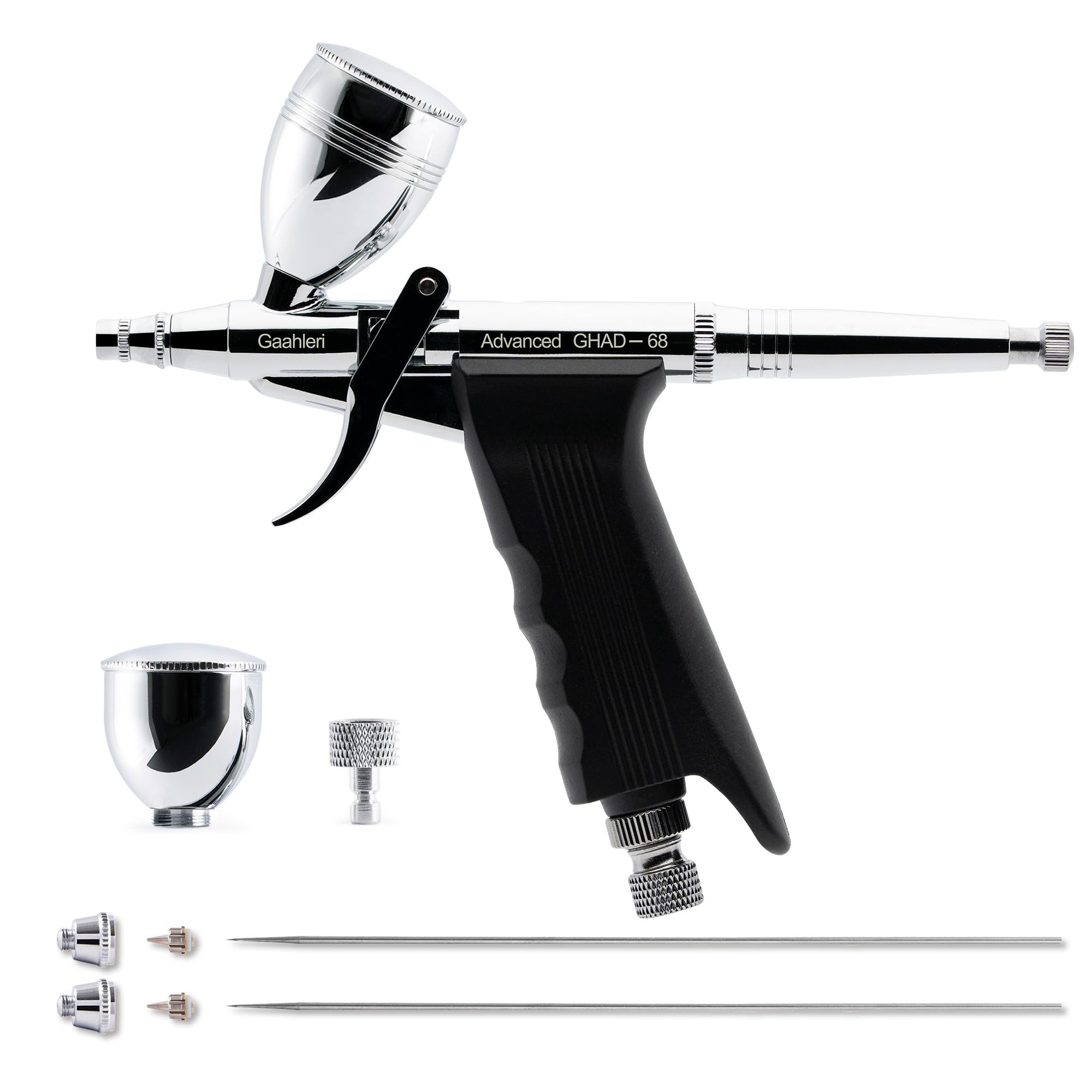
The Gaahleri GHAD-68 earns the top spot because it pairs a pistol grip design — shaped like a real gun so your fingers don’t cramp — with two needle sizes (0.38mm and 0.5mm) and two cup sizes (1/4 oz and 1/2 oz), all for a mid-range price that undercuts most competitors by a wide margin. This airbrush is ideal for anyone who spends hours on models, leather patches, or makeup and wants a brush that feels balanced in the hand from the first trigger pull.
Its 8 Micro-Air-Channel (MAC) system inside the nozzle ensures the spray stays consistent even during fine detail work, and the self-centering drop-in nozzle makes cleaning far less tedious — you just drop the new nozzle in and it aligns itself. At just 192 grams (6.8 ounces), it is lighter than the Iwata Eclipse HP-CS but feels more substantial than the Master G79, striking a sweet spot between weight and control. Buyers report that the pistol trigger design “reduces fatigue, improves control” during long sessions, and one reviewer noted that even after an initial clogging issue, the seller replaced the unit free of charge with zero hassle.
The one honest trade-off is that the included instruction guide is limited, and beginners may need to watch video tutorials to learn proper cleaning and thinning technique — improper thinning is a common cause of sputtering across all airbrushes. Skip this one if you want a perfectly polished out-of-box manual; the Harder & Steenbeck ULTRA 2024 provides more hand-holding for new users. But the Gaahleri delivers professional-grade spray quality and ergonomic comfort at a price that leaves room in your budget for a compressor and paints.
Why it’s great
- Pistol grip reduces hand fatigue noticeably during extended use
- Two needle sets (0.38mm and 0.5mm) cover detail to broad coverage
- Quick self-centering nozzle simplifies cleaning and reassembly
- Excellent customer service — seller replaced a defective unit free of charge
Good to know
- Instructions are sparse; expect to rely on online video tutorials
- One seal failure reported (spare parts included in box)
- Not as fine-tuned as premium German or Japanese airbrushes for ultra-detailed work
2. Iwata Eclipse HP-CS Airbrush Value Set
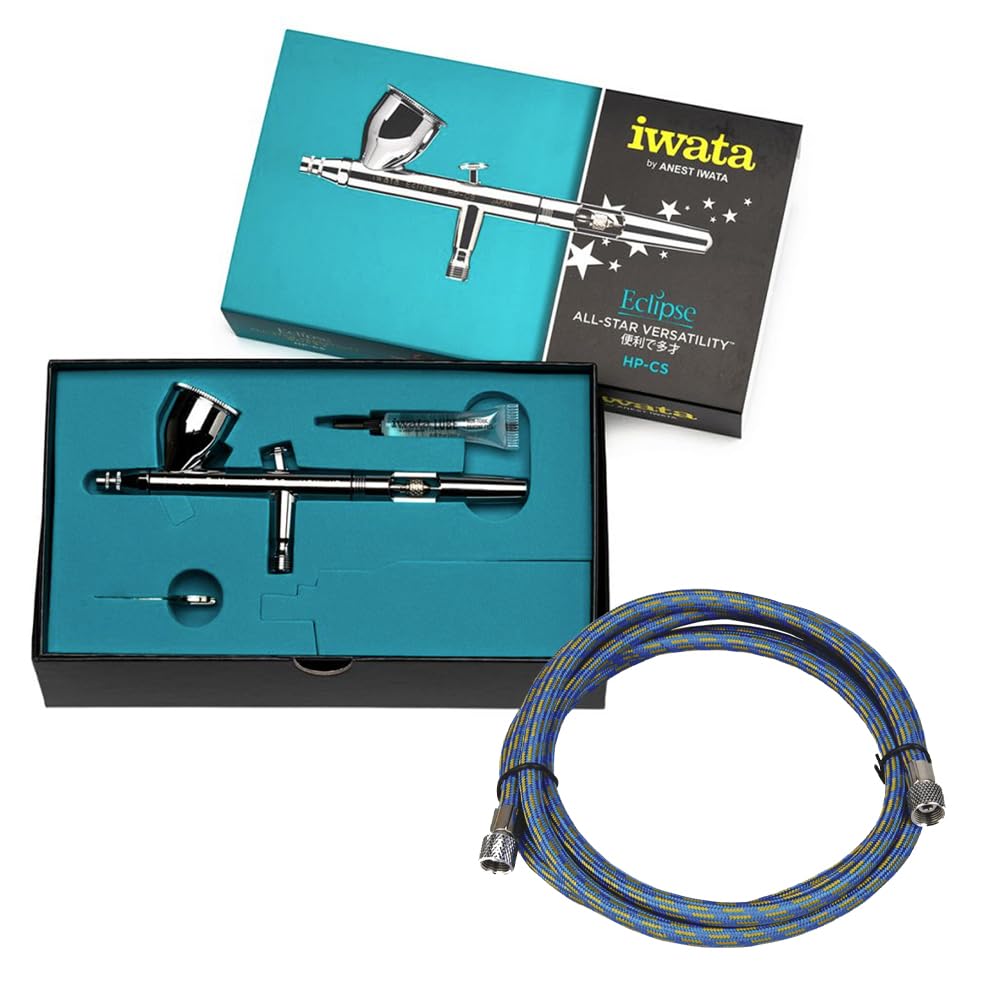
The Iwata Eclipse HP-CS outshines the Gaahleri GHAD-68 on build quality and spray precision — it uses a compression-fit E3 nozzle that has no threads to strip or cross-thread, a break-resistant spring-steel needle, and solvent-resistant packings that hold up to years of use with aggressive thinners. It beats the Gaahleri’s spray control by delivering finer lines without changing the tip or needle, thanks to its 0.35mm E3 nozzle and superb trigger sensitivity that owners mention “allows detecting different paint pigments.” This is the airbrush for serious model painters, custom automotive artists, and cosplay creators who need reliable, clog-free performance every session.
The set includes a 10-foot braided hose, 1 oz bottle of Createx paint, 1 oz Medea cleaner, and a beginner’s guide, so you can start spraying right out of the box. At 0.64 kg (1.4 pounds), it is heavier than the Gaahleri, which many users actually prefer because the extra weight provides steadier control for fine lines. One buyer who switched from a Badger 150 reported that the Iwata’s two-way control was “more predictable” and that paint residue “doesn’t stick” to the internal surfaces — massive wins for anyone tired of battling clogs mid-project.
You are paying for Japanese engineering that rarely clogs, cleans faster than any other brush in this lineup, and delivers the kind of repeatable performance that saves you time and paint on every project. Choose the Iwata Eclipse HP-CS over the top pick if you prioritize long-term durability and clog-free reliability over a lower upfront cost.
Where it shines
- Compression-fit E3 nozzle has no threads to strip or cross-thread
- Break-resistant spring-steel needle and solvent-resistant packings
- Sprays very fine patterns without changing the tip or needle
- Complete starter kit includes hose, paint, cleaner, and guide
Worth noting
- Premium price — the most expensive airbrush reviewed here
- Heavier frame requires some getting used to if you are switching from a lightweight brush
- Nozzle has four small parts to track during disassembly
3. Harder & Steenbeck ULTRA 2024 Airbrush

If you have ever been frustrated by an airbrush that clogs minutes after cleaning, the Harder & Steenbeck ULTRA 2024 is engineered specifically to remove that pain. Its 0.45mm self-centering nozzle — which supersedes the older 0.4mm headset — aligns itself automatically when you reassemble it, so you never have to fiddle with centering or worry about an off-axis spray pattern. One buyer who struggled with cheaper brushes said that after a month of daily use with the same cleaning routine, this brush “works flawlessly” while the others constantly clogged.
The ULTRA 2024 includes a 5ml paint cup with an integrated micro-cup socket built into the body, allowing you to use tiny drops of paint directly without swapping cups — keeping your line of sight clear for detail work. It also features a trigger stop that prevents beginners from pulling too far back and over-spraying, which is a common mistake that wastes paint and causes splatter. The entire brush disassembles by hand without tools, making cleanup as fast as possible for a newcomer.
The catch is the price sits in the premium tier, and at 0.45mm, the single included needle is less versatile than kits that include both a fine (0.38mm) and medium (0.5mm) option. However, the ULTRA 2024 is fully modular and backward compatible with higher-detail FineLine head systems from the Infinity airbrush, so you can upgrade later without buying a whole new brush. The standout spec is the tool-free assembly — a design feature that makes this the least intimidating airbrush for a beginner who wants to learn without fighting the tool.
What stands out
- Self-centering nozzle eliminates alignment headaches during cleaning
- Trigger stop prevents beginner over-spraying mistakes
- Tool-free disassembly speeds up maintenance and learning
- Modular system is upgradable with higher-detail head sets
The trade-offs
- Single 0.45mm needle — less versatile than dual-needle kits
- Premium price puts it above entry-level budgets
- Micro-cup socket takes practice to use without spilling
4. Paasche H-Set Single Action Siphon Feed Airbrush

The single most important spec for an airbrush used with thick paints like enamels or textiles is the needle size range, and the Paasche H-Set gives you three head sizes: 0.45mm (size 1), 0.65mm (size 3), and 1.05mm (size 5). That 1.05mm head is the widest opening in this entire comparison, meaning it can spray thick canvas paints and primers that would instantly clog a 0.38mm nozzle. At 8 ounces, it is also the lightest airbrush here, making it easy to maneuver for long periods without arm fatigue.
The downside is that the Paasche H is a single-action airbrush — you twist the tip to set your spray width before you pull the trigger, rather than controlling air and paint independently mid-stroke. This makes it less suited for detailed shading or fading compared to dual-action brushes like the Gaahleri or Iwata. Experienced users note that the trigger feels “rougher and harder to control” than pricier models, and the siphon feed (bottle underneath) wastes more paint than gravity feed because you have to fill the bottle even for small jobs.
Where the Paasche H-Set earns its value is in reliability and simplicity for beginners who want to paint larger surfaces without investing in a dual-action system. It has been unchanged for over 30 years — a design so proven that professionals still recommend it for scale modeling with enamel paints. Just be careful with the delicate needles during assembly, and always thin your paint to a milk-like consistency first; as customers note, “improper thinning causes sputtering,” which is the most common beginner mistake with this brush. For the price of a single dual-action brush, you get three nozzle sizes and a proven design that has outlasted dozens of competitors, making this the best price-to-value pick for beginners and enamel painters.
The upsides
- Three head sizes (0.45 / 0.65 / 1.05mm) handle thick paints easily
- Lightest airbrush in the lineup at just 8 ounces
- Proven, decades-old design trusted by scale modelers
- Made in the USA with solid build quality
Keep in mind
- Single action limits control for detailed shading and fading
- Siphon feed wastes more paint than gravity feed designs
- Needles are delicate and easily damaged during assembly
- Requires a adapter for standard compressor fittings
5. Master Airbrush Model G79 All-Purpose Set

What you actually get at this lower price is the widest needle selection of any airbrush here — 0.3mm, 0.5mm, and 0.8mm — plus three gravity feed cups (1/16 oz, 1/6 oz, and 1/2 oz), all for a mid-range price that undercuts the Gaahleri while offering more sizing options. This makes it the best pick for someone who paints a variety of materials — fine detail on miniatures one day, then broader coverage on auto graphics the next — without buying separate brushes. The 0.8mm needle is particularly useful for spraying metallics and thicker lacquers that smaller nozzles struggle with.
Reviewers point out the trigger is smooth, the atomization (the process of breaking paint into a fine mist) is good for the price, and cleanup is easier than cheaper pen-style brushes. One user who compared it directly to the Iwata Eclipse HP-CS noted that while the G79 is “not as fine as Iwata Revolution,” it is “perfect for large areas and thinned lacquers/acrylics.” The included 6-foot braided hose, nozzle wrench, and molded plastic storage case give you a complete starter setup.
The honest downside is that the G79 has noticeable quality control issues: multiple shoppers say receiving units with broken cases, missing parts, and no proper shipping box. One reviewer received two damaged units before getting a working one. If you are willing to accept a slightly rougher out-of-box experience in exchange for versatile needle options at a low price, the G79 delivers solid spray performance once you get a clean unit — making it the exact budget buyer it is perfect for.
Why we’d pick it
- Three needle sizes (0.3 / 0.5 / 0.8mm) cover fine detail to heavy coverage
- Three gravity feed cups included for quick paint changes
- Self-centering drop-in nozzles simplify cleaning
- Smooth trigger and good atomization at a budget price
A few caveats
- Frequent quality control issues — broken boxes and missing parts reported
- Not as refined for ultra-fine detail as premium Japanese or German brushes
- Missing quick-release connector and scratched pistol grip on some units
6. High Air Flow Cordless Airbrush Kit

This cordless airbrush is perfect for the on-the-go artist or barber who needs to spray ink, dye, makeup, or temporary tattoos in locations where a traditional compressor is impractical — at a craft fair, a barber chair, or a convention booth. At 1.12 pounds and measuring just 5.98 x 1.57 x 6.69 inches, it is 71% smaller in one dimension than the Paasche H-Set’s box, making it the only airbrush here you can easily throw in a bag for on-site work. It offers two pressure settings: level 1 at 27 psi for spraying heavier liquids, and level 2 at 15 psi for lighter density sprays.
Compared to the other picks in this guide, the High Air Flow Cordless Kit is the only one that bundles the compressor and brush into a single handheld unit with a rechargeable battery — no hose, no separate tank, no power cord. The single-action trigger (air flows whenever you pull, and paint flow is controlled by how far back you pull) is simpler to learn than dual action, and the kit includes a cleaning brush set, wrench, and three paint cups. Reviewers praise its long battery life and note that the pressure-sensitive trigger “balances ease of use with professional results” even after a year of ownership.
The honest weakness is reliability: the single-action design gives you less spray control than any dual-action brush here, and a notable number of buyers report units that never turned on out of the box. One frustrated reviewer wrote, “I left it charging for hours and it never turned on this is garbage.” If you need uncompromised spray quality for serious artwork, stick with the Gaahleri or Iwata, but if portability is your non-negotiable requirement, this kit is the only truly cordless option in the pool.
Strong points
- Completely cordless and handheld — no compressor or hose needed
- Two pressure settings (15 and 27 psi) for different paint viscosities
- Long battery life praised by long-term users
- Lightweight at just 1.12 pounds for easy portability
Before you buy
- Single action limits control for detailed work
- Several owners mention receiving units that do not turn on
- Less spray precision than any dual-action gravity feed brush
Understanding the Specs
Dual Action vs. Single Action
Dual action means the trigger controls two things in one motion: pressing down releases air, and pulling back releases paint. This lets you change line width and paint flow mid-stroke without stopping, which is essential for gradients, fades, and fine details. Single action locks the air and paint together at a fixed ratio — you set the spray width by twisting the tip before you spray. Single action is simpler to learn but far less versatile for artistic work.
Gravity Feed vs. Siphon Feed
Gravity feed places a small cup on top of the brush so paint drops into the nozzle by gravity. This uses less paint, allows lower operating pressure, and makes color changes faster since you can empty a tiny cup quickly. Siphon feed uses a bottle underneath the brush, where air suction pulls paint upward. Siphon feeds hold more paint and handle thicker materials better, but they waste more paint and need higher air pressure to function.
Needle Size and Spray Pattern
Needle size, measured in millimeters (like 0.38mm or 0.5mm), determines the width of your spray pattern. Smaller needles (0.3mm to 0.38mm) produce very fine lines suitable for model details, veins, and tiny highlights. Medium needles (0.4mm to 0.5mm) are the most versatile for general painting. Larger needles (0.8mm and above) handle thick paints like primer, enamel, and fabric paint without clogging. Many kits include two interchangeable needle sizes so you can switch between tasks without buying a second brush.
Self-Centering Nozzles and Cleaning Ease
A self-centering nozzle drops into the airbrush head and aligns itself automatically when tightened, so you never have to manually adjust the needle position after cleaning. This is a huge time-saver because misaligned nozzles cause lopsided spray patterns and sputtering. Cheaper airbrushes require you to adjust the nozzle centering by hand, which takes practice and patience. Self-centering designs also reduce the risk of damaging the delicate needle tip during reassembly.
FAQ
What is the difference between 0.38mm and 0.5mm airbrush needles?
Why does my airbrush keep clogging even after I clean it?
Can I use any airbrush for cake decorating or makeup application?
Do I need a separate compressor for a gravity feed airbrush?
Final Thoughts: The Verdict
If you want one dependable pick, the best airbrush winner is the Gaahleri GHAD-68 because it combines a fatigue-fighting pistol grip, two useful needle sizes, and a self-centering nozzle at a price that leaves room for a good compressor. If you want unmatched precision and clog-free reliability for serious professional work, grab the Iwata Eclipse HP-CS. And for a beginner who wants the least frustrating learning curve, the Harder & Steenbeck ULTRA 2024 delivers tool-free maintenance and a trigger stop that prevents rookie mistakes before they happen.