
Our readers keep the lights on and my morning glass full of iced black tea. As an Amazon Associate, I earn from qualifying purchases.
Specs are compiled from manufacturer listings and verified buyer reviews and can change over time — please confirm the key details on the product page before buying.
Living in a van turns brutal the moment summer hits. You need real air conditioning that runs off your 12V house battery, not a generator hauling fuel. The best pick here cools in minutes, sips power while you sleep, and installs without major roof surgery. This guide breaks down 11 rooftop and split systems built for vans, trucks, and campers, so you can stay cold off-grid.
I’m Min — the founder and writer behind Gadgets Feed. This guide is built by comparing the manufacturers’ published specifications and the patterns across verified customer reviews, so you get each pick’s real strengths and trade-offs instead of marketing spin.
Figuring out the right aircon for van means matching BTU output, power draw, and physical fit to your exact setup, not just grabbing the biggest unit. The winner balances all three to give you dependable cooling night after night.
Our Picks at a Glance
How To Choose The Best Aircon For Van
Choosing a van air conditioner is a balancing act between three things: how much cooling you need, how much battery power you have, and where you can physically mount the unit. Getting one wrong makes the whole system useless, so start with your van’s real constraints.
Match BTU to Your Van Size
BTU measures raw cooling output. A 10,000 BTU unit handles a well-insulated van or small camper, while a 16,000 BTU unit is for larger rigs up to 24 feet. Undersized units run constantly and drain your battery; oversized units short-cycle and waste power.
The 12V Power Question
Every unit here runs directly off 12V DC, which is the key for off-grid living. But the amps they draw vary wildly — from around 15A in eco mode to over 50A in turbo. You need lithium batteries and a healthy solar setup to run one overnight without killing your bank.
Rooftop vs. Split Systems
Rooftop units drop into a standard 14×14 inch vent cutout and are the easiest to seal. Split systems mount the compressor separately and give you more placement options, but require routing refrigerant lines between the two halves during installation.
Quick Comparison
| Model | Best For | Cooling Power | Power Draw | Form Factor | Amazon |
|---|---|---|---|---|---|
| Outequip 10K BTU★ Best Overall | Overall Performance | 10,000 BTU | 960 watts | Rooftop | Amazon |
| CNCEST 11K BTUBest Value | Budget Split System | 11,000 BTU | 400 watts | Split | Amazon |
| Treeligo 11K RooftopHeating & Cooling | Heating & Cooling | 11,000 BTU | 330–1,000W | Rooftop | Amazon |
| Aspligo 10K Under Dash | Flexible Under-Dash Install | 10,000 BTU | 550–600W | Split System | Amazon |
| Gouku 10.5K BTU | Heavy-Duty Truck Use | 10,500 BTU | — | Mini-Split | Amazon |
| Treeligo 12K Mini Split | Largest Cooling & Airflow | 12,000 BTU | 960W | Mini Split | Amazon |
| Gidrox 10K Rooftop | Smart App Control | 10,000 BTU | 350–700W | Rooftop | Amazon |
| Outequip Summit 2 | Premium Build with Heater | 10,000 BTU | 960 watts | Rooftop | Amazon |
| OutEquip Black 10K | Quiet, Low Profile | 10,000 BTU | 960 watts | Rooftop | Amazon |
| TOSOT 16K BTU | Large RVs & Heat Pump | 16,000 BTU | 800W max | Rooftop | Amazon |
| Gidrox 12K Heat Pump | All-Season Comfort | 12,000 BTU | 350W avg | Rooftop | Amazon |
In‑Depth Reviews
1. Outequip RV Air Conditioner
Our pick — over 4.5★ from 90+ verified ratings; the strongest balance of quality and price.
The lightweight rooftop unit that installs solo and cools a trailer in brutal desert sun.
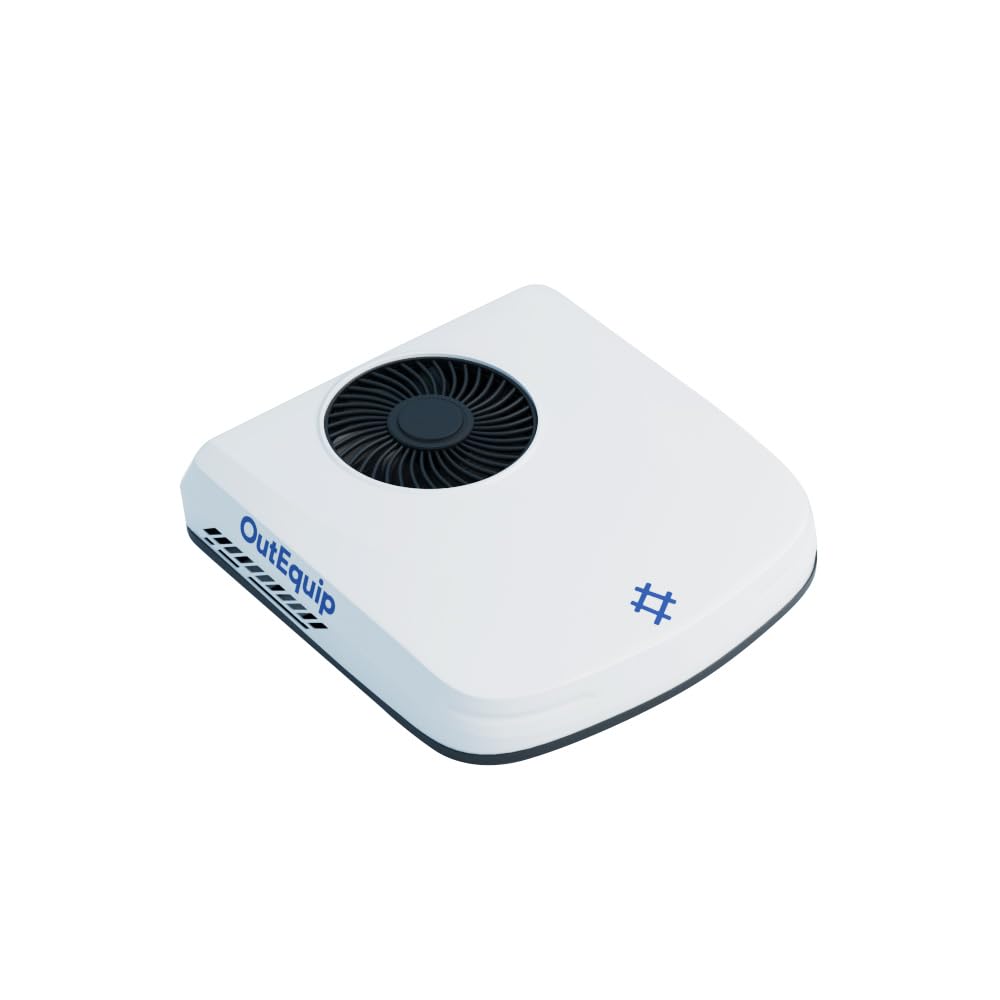
This is the unit that keeps coming up in owner stories as the one that just works. At 43 lbs, it’s light enough for one person to wrangle onto the roof, and the low-profile design fits a 14×14 opening with no major modifications. It’s a 10,000 BTU rooftop AC that cools a 7×14 insulated trailer in 100°F+ sun, which is exactly the kind of real-world claim that earns trust.
Power-wise, it’s built for off-grid life. It draws around 50A when starting up, then drops to about 30A once it’s holding temperature thanks to its variable-speed compressor. On a 360Ah battery, buyers report 6-7 hours of cooling; with a 480Ah bank you can stretch that to 8 hours, and up to 10 hours with 600Ah. The 960W annual energy consumption rating puts it in a different league vs. the 400W draw of the budget CNCEST split unit — you trade a little efficiency for a much more reliable overall package.
What wins people over is the cooling performance — it’s the single most-praised aspect. The brushless copper motor fans keep it quieter than a roof vent, and the spring-supported mounts cut vibration. Owners in Texas and Phoenix report it holds 80°F cabin temps in 105°F heat. The remote control with eco, sleep, and turbo modes is a nice touch, and the UV-stabilized ABS shell plus zinc-coated condenser handle sun and rain without degrading.
The Winning Streak
- 43 lb weight makes solo roof install practical
- Drops to ~30A draw once temperature is held
- Quiet brushless motor fans on the exterior
- 8-10 hours runtime on 480-600Ah battery banks
What to Watch
- Draws ~50A at startup, needs a beefy battery bank
- Gasket and bolt torque instructions are unclear
- Potential for unit tilt if roof sealant isn’t level
Your best bet if: you want a proven, quiet rooftop AC that one person can install and that sips power once the cabin is cool.
Think twice if: your battery bank is under ~300Ah — this unit wants real capacity to run all night.
2. CNCEST 12V DC Split Air Conditioner
The budget split system that sips just 400W while pushing serious cold air.
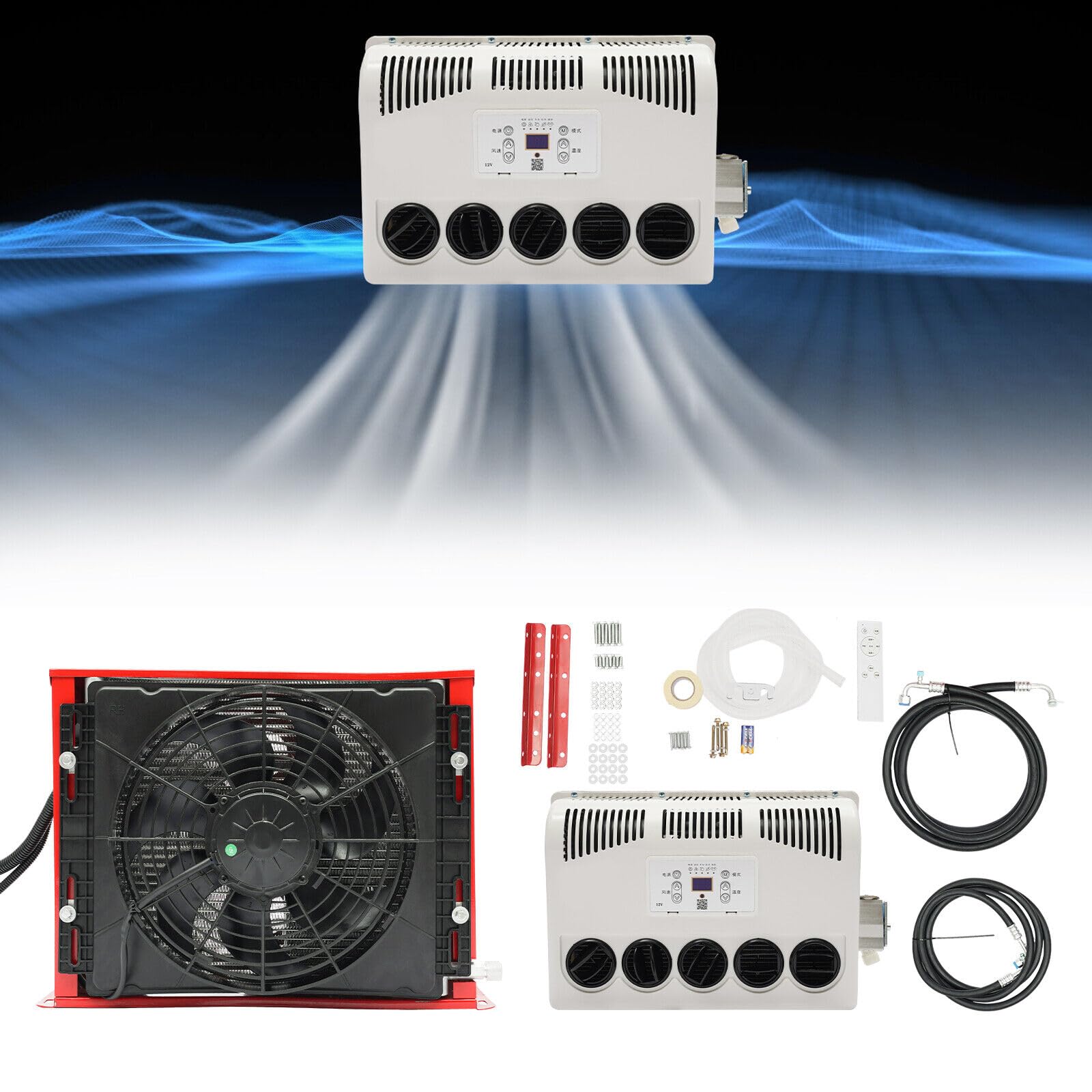
For truckers and van lifers watching every amp, this split unit’s 400W operating power is the headline. It’s an 11,000 BTU system, so it actually beats the more expensive Outequip on raw cooling output at 11,000 versus 10,000 BTU, while using 400W versus the Outequip 960W. The heavy-duty iron outer case is built for the abuse of a semi cab, and the high-efficiency aluminum condenser sheds heat fast.
Installation is remarkably simple, which is a recurring theme in owner feedback. It’s a true split design, so the compressor mounts separately from the blower, giving you flexibility on where to route things. The built-in under-voltage protection cuts power below 11V, which protects your battery from being drained flat. On a 100Ah battery, you can expect 1-3 hours of runtime after parking — perfect for a quick nap on a break.
The catch is reliability. While some owners mention it “freezes you out” in Georgia heat and runs perfectly in trucks, others had condensers develop leaks after only two months of use. As customers note: “Purchased for my semi works OK for about two months condenser started leaking.” The 5-speed fan, digital display, and remote control are all there, but the quality control is inconsistent compared to premium picks.
Smart buy if: you’re on a tight budget and want a split unit that uses minimal power to cool a cab or small van.
Reality check: some units leak refrigerant from the condenser early on, so budget for a warranty claim or replacement.
3. Treeligo 11000 BTU Rooftop
A rooftop unit that heats and cools, running off battery or solar without a generator.
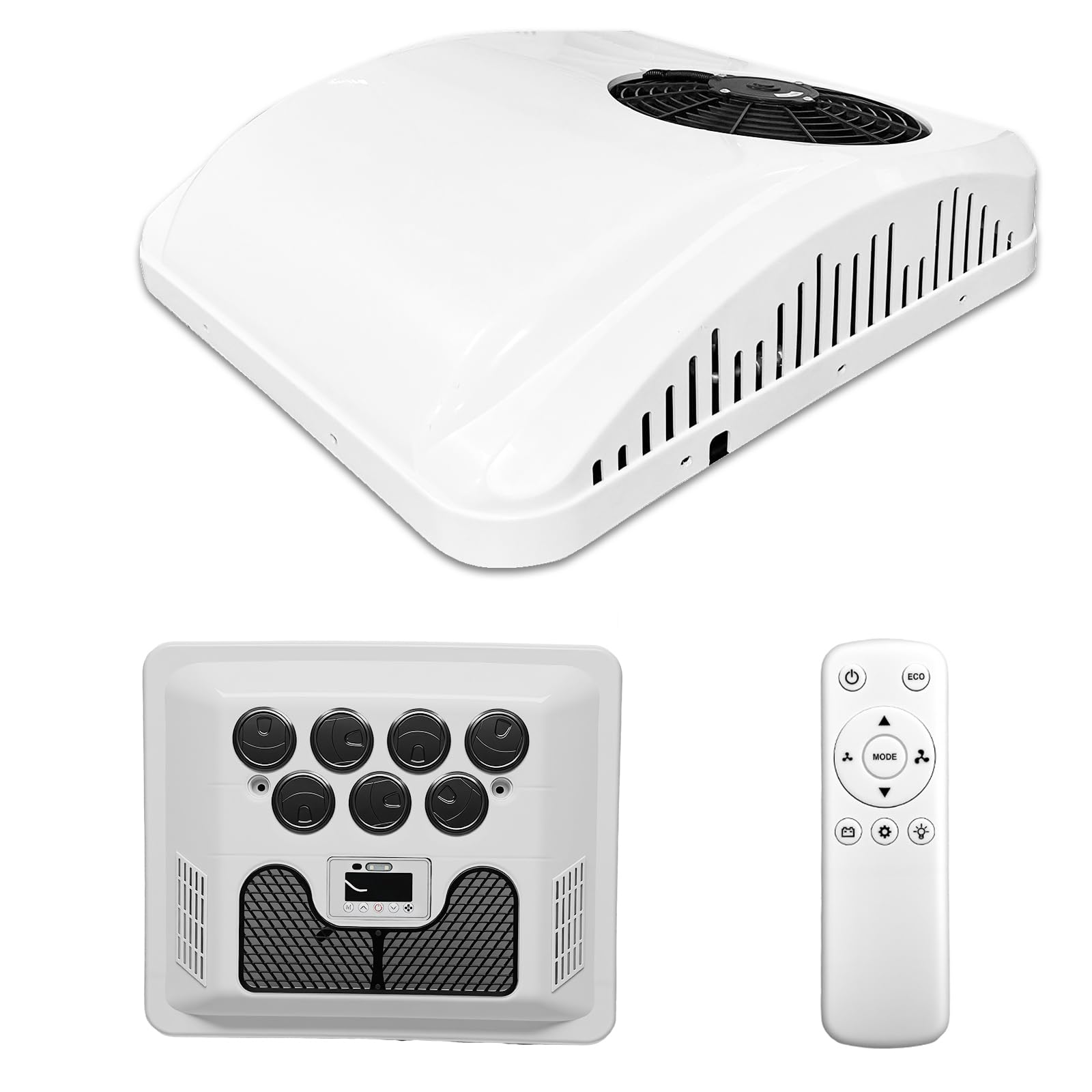
Most 12V van ACs cool only. This Treeligo is one of the few that also delivers 4,000 BTU of heat, making it a true four-season option for van lifers. The 11,000 BTU cooling power adjusts the indoor temperature within 5 minutes, and the inverter compressor ramps from 330W to 1,000W depending on the mode, so it’s not wasting power when the cabin is already cool.
The compact footprint is a major win — the outdoor unit measures 28.4″ x 26.2″ x 7.1″, and it only needs a minimum roof opening of 12.60″ x 10.24″ for installation. That’s smaller than the standard 14×14 cutout most RVs have ready, so you have room for error. Operation stays below 45 decibels, which means you can actually sleep with it running.
Owners running it on 3x100W solar panels with a pair of 12V 100Ah batteries report it cools a 5th wheel bedroom fast in 100°F heat. However, some users hit a wall with error codes like 2P/3P/4P and locked modes that support couldn’t resolve. In high humidity, it struggles to keep up, and the included 6-gauge cables are too thin for a 200Ah battery — replacing them with 4-gauge fixes the drop.
Year-round pick: the only rooftop unit here that adds real heating, so it earns its place in a 4-season van build.
Look out for: control panel error codes that can lock the unit, and thin wiring that needs upgrading for larger battery banks.
4. Aspligo Under Dash AC Kit

A 10,000 BTU under-dash kit that ditches the roof cutout entirely.
Not every van owner wants to cut a hole in the roof. This Aspligo kit mounts the blower under the dash and installs the compressor and condenser separately, so it works for vehicles where a rooftop unit won’t fit. The 20CC electric scroll compressor delivers 10,000 BTU of cooling, and the integrated receiver dryer and condenser design reduces leak points compared to older split kits.
It’s a solid fit for skoolies and work vans. One owner put it in a 2005 Savana skoolie and noted the compressor comes pre-oiled with about 20 oz, which saves a messy step. The low-voltage protection prevents the battery from being drained flat, and it runs off the battery after the engine is off, so you can keep it blowing during a lunch break.
That said, this one is for experienced mechanics. The instructions are basic, and while a novice managed it, the hardest part is mounting the compressor and condenser securely. There are also a few reports of units arriving damaged or not cooling, and the warranty process was rough in those cases. Weigh the risk against the flexibility of an under-dash layout.
Mechanic’s choice: the right call when a roof cutout is off the table, but only if you’re handy with mounting hardware.
Heads up: sourcing R134A refrigerant is on you, and a few units arrive DOA, so buy with a return-friendly seller.
5. Gouku 12V Split AC
Built for semi cabs with thick wiring and a 10,500 BTU punch for overnight rest.
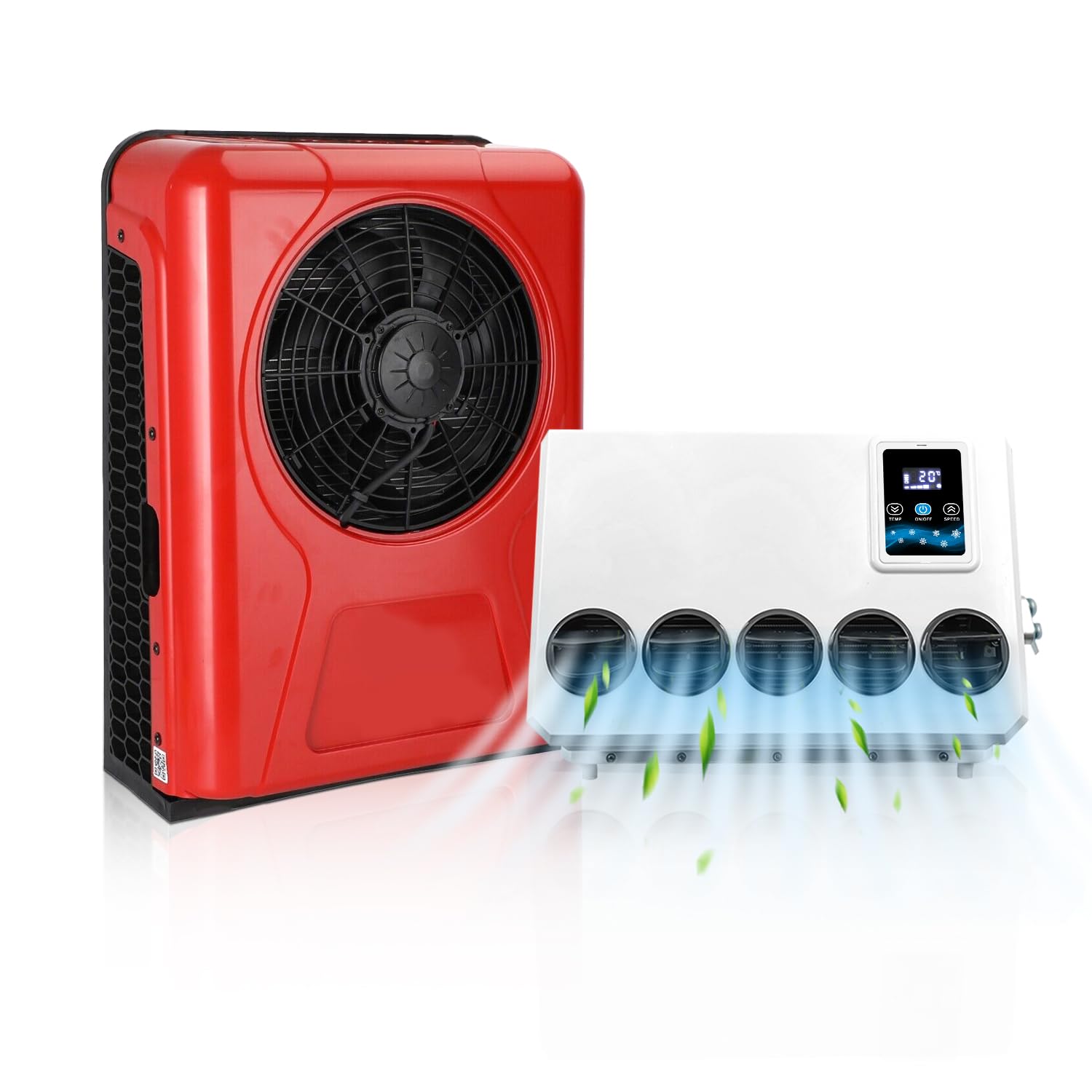
This mini-split is aimed squarely at truckers who live in the cab. It’s a 10,500 BTU unit with upgraded 12mm² wiring to handle the current without overheating, solving a problem buyers flagged with earlier versions. The aluminium alloy construction keeps it light while the rotary scroll compressor does the heavy lifting. It’s a cooling-only unit, so don’t expect heat.
This unit demands serious battery capacity. The seller is upfront: you need over 350Ah to get the advertised cooling — 3 hours in the day, 6 hours at night. One trucker runs it on a 2x300Ah LiFePO4 bank with a Renogy 60A DC-DC charger, and reports it held 75°F in 100°F heat using 88% of the battery over 34 hours. That’s real-world proof it works, but it shows the appetite.
The caveats are real. Functionality is the most-discussed aspect, and it’s honestly mixed — some units work flawlessly while others arrive with issues. One buyer had a screw drilled straight through the condenser tube, and the exposed electrical terminals lack weather covers, which risks corrosion. If you’re comparing it to the Treeligo 12K mini split above, the Treeligo offers more airflow at 350 CFM and better build consistency, but the Gouku is cheaper.
Overnight trucking: with a 600Ah+ bank and solar, this keeps a cab cold through a hot night shift.
Not for small banks: under 350Ah, it won’t run as advertised, and the red case shows corrosion risk on exposed terminals.
6. Treeligo 12K Mini Split
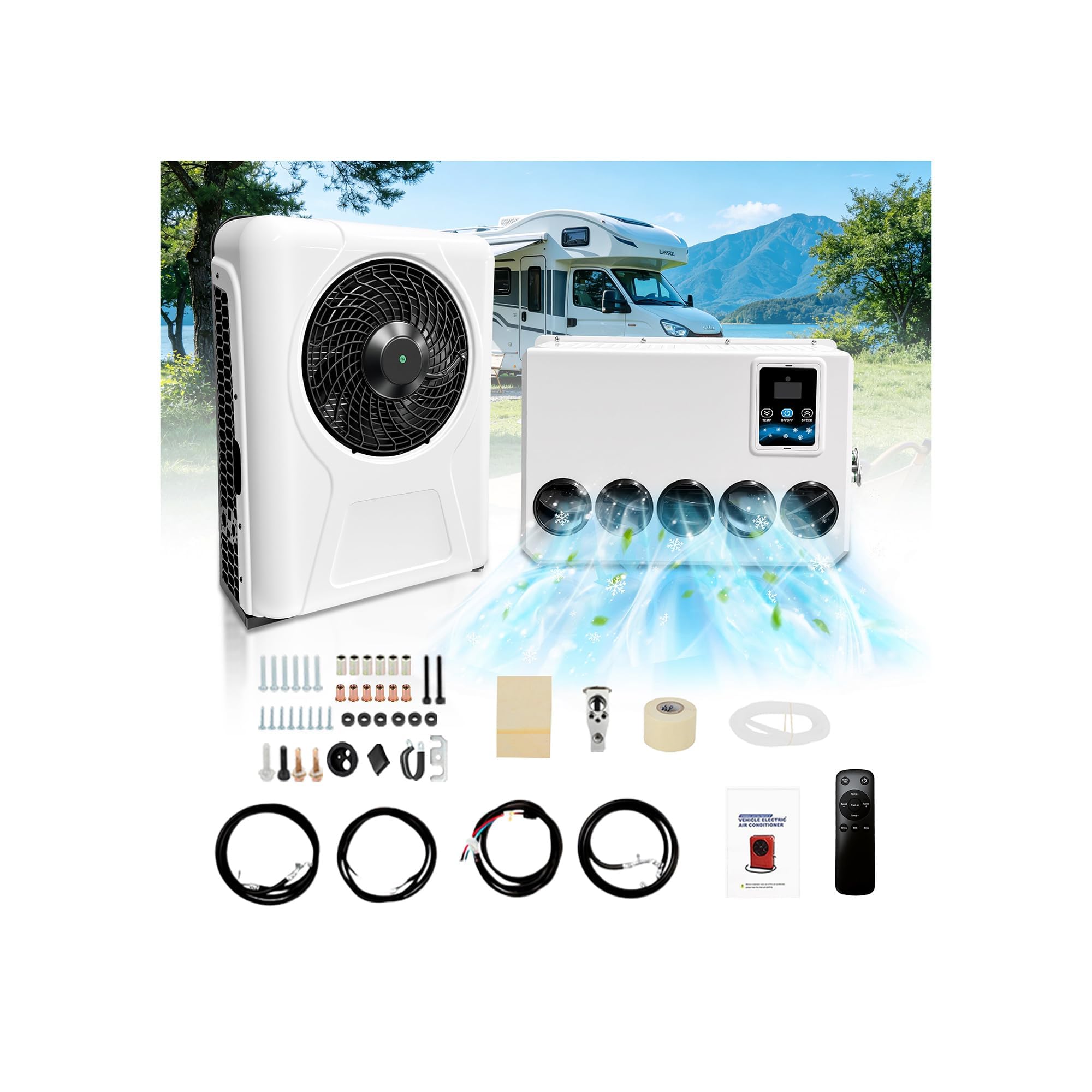
The most powerful split unit on this list, moving 350 CFM of ice-cold air.
When you need maximum cooling in a van, this Treeligo delivers the biggest punch at 12,000 BTU with a 350 CFM airflow volume. The 360° omnidirectional airflow design eliminates dead spots, so the back of a cargo van gets as cold as the front. It runs on 960W rated power with a stable 40-60A current, making it efficient enough for long idle periods.
The size matters. The indoor unit measures 17.95 x 6.22 x 12.6 inches, compact enough to mount on a wall or under a bunk, while the outdoor unit at 26.22 x 19.09 x 8.66 inches handles the condenser. Reviewers point out it blows air at 42°F on a simple deep-cycle battery, and “it’s will run u out the truck” is a pretty strong endorsement from a semi driver.
The trade-off is installation quirks. All the hoses exit on the right side, which forces creative routing if you want a left-hand install. The rubber grommet for power wires is weak and needs reinforcing, and the control panel only reads Celsius. Some units ice up on the expansion valve in humid conditions, so airflow over the indoor coil matters more than you’d think.
Max cold: the 12K BTU output and 350 CFM airflow make this the strongest split system for a larger van.
Install skill needed: right-side-only hose exits and a weak grommet mean this isn’t a plug-and-play job.
7. Gidrox 10K Rooftop AC
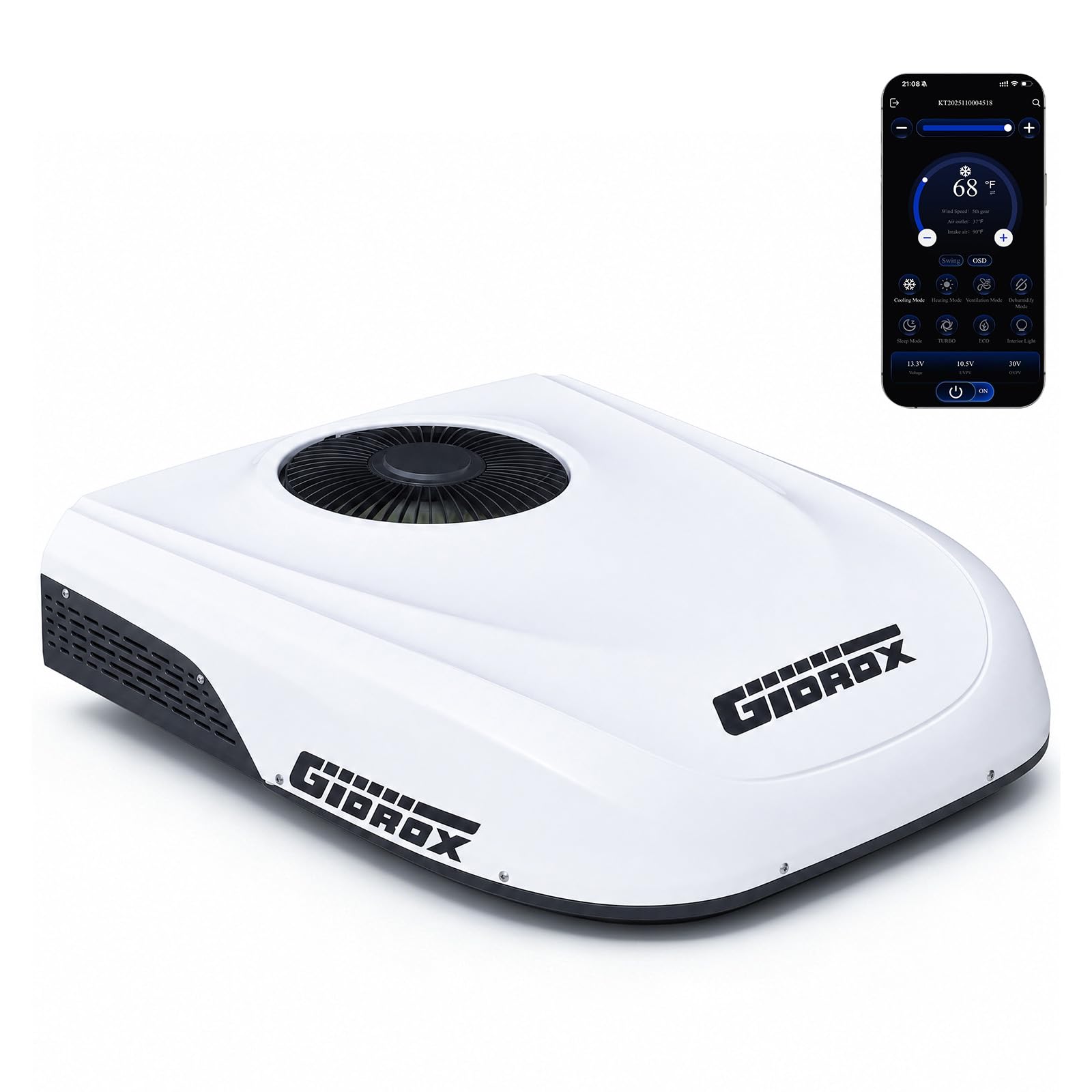
A rooftop unit you can control from your phone, running at a library-quiet 40dB.
This Gidrox brings modern smart control to van cooling. You get three ways to control it — a smartphone app via Bluetooth, an infrared remote, and physical buttons on the unit itself. It’s a 10,000 BTU rooftop AC with inverter technology that cools within 3 minutes and holds a steady temperature without constant compressor cycling.
The power numbers are excellent for off-grid. It averages just 350W during nighttime operation in 30°C ambient, and Sleep mode drops it to 40dB — genuinely quiet enough for a light sleeper. The 3-mode system (Turbo, ECO, Sleep) lets you choose between rapid cooling and battery-sipping efficiency. At 54 lbs total, it’s manageable for a two-person install.
Owners verified a range of power draws: 250W for the dehumidifier, 350W in eco, 420W in standard cooling, and 650-700W in turbo. One camper ran it for a week on a 600Ah bank with 800W of solar. The main complaint is the eco mode locks at 79°F and there’s no battery cutoff setting, so you’ll want to watch your voltage manually on long nights.
The Digital Edge
- Bluetooth app + remote + panel triple control
- 350W average draw at night in 30°C weather
- 40dB sleep mode for undisturbed rest
- Cools within 3 minutes on turbo
Know Before You Buy
- Eco mode locks at 79°F with no temperature override
- No battery cutoff protection built in
- Wiring through walls is tight; plan a cable trough
Reach for this if: you want app control and whisper-quiet sleep mode from a rooftop unit that sips power overnight.
Look elsewhere if: you want hands-off voltage protection — this one needs you to manage battery level yourself.
8. Outequip Summit 2 with Heater
The highest-rated pick on this list, pairing 10K BTU cooling with a 4.5K BTU PTC heater.
When installation ease is your priority, this is the unit owners talk about. It’s the same 10,000 BTU rooftop platform as our top pick, but adds a 4,500 BTU PTC heater for shoulder-season warmth. The key difference is the build: owners praise the accurate instructions and the inclusion of a 15ft 6AWG wire and fuse, so you’re not hunting for parts. One van owner had it fully installed in 4 hours with zero interior drips after running it in South Carolina heat and humidity.
This is the crowd favorite for a reason — the crowd here is large and vocal. Installation is the most-praised aspect, with owners noting it’s lighter than the Dometic it replaces, quieter both inside and out, and runs off battery and solar thanks to the efficient inverter technology. It’s compatible with 12V, 24V, and 48V systems, which is rare flexibility. The Bluetooth app adds easy control without hunting for the remote.
The numbers back the praise: it draws about 600W max, runs at 40dB, and stands just 6″ tall. The 43 lb weight and low profile make it an easy swap for an old roof vent. It cools a 2020 Ford Transit 250 effectively even in full sun. The only real gripes are the lid screws being hard to remove during install, and the fragile connectors needing spare parts on hand.
Premium install: clear instructions, included wiring, and a 4-hour install window make this the easiest rooftop upgrade.
Not for arctic cold: the 4,500 BTU heater is for mild mornings, not freezing winters — you’ll still need a separate heat source.
9. OutEquip Black 10K Rooftop
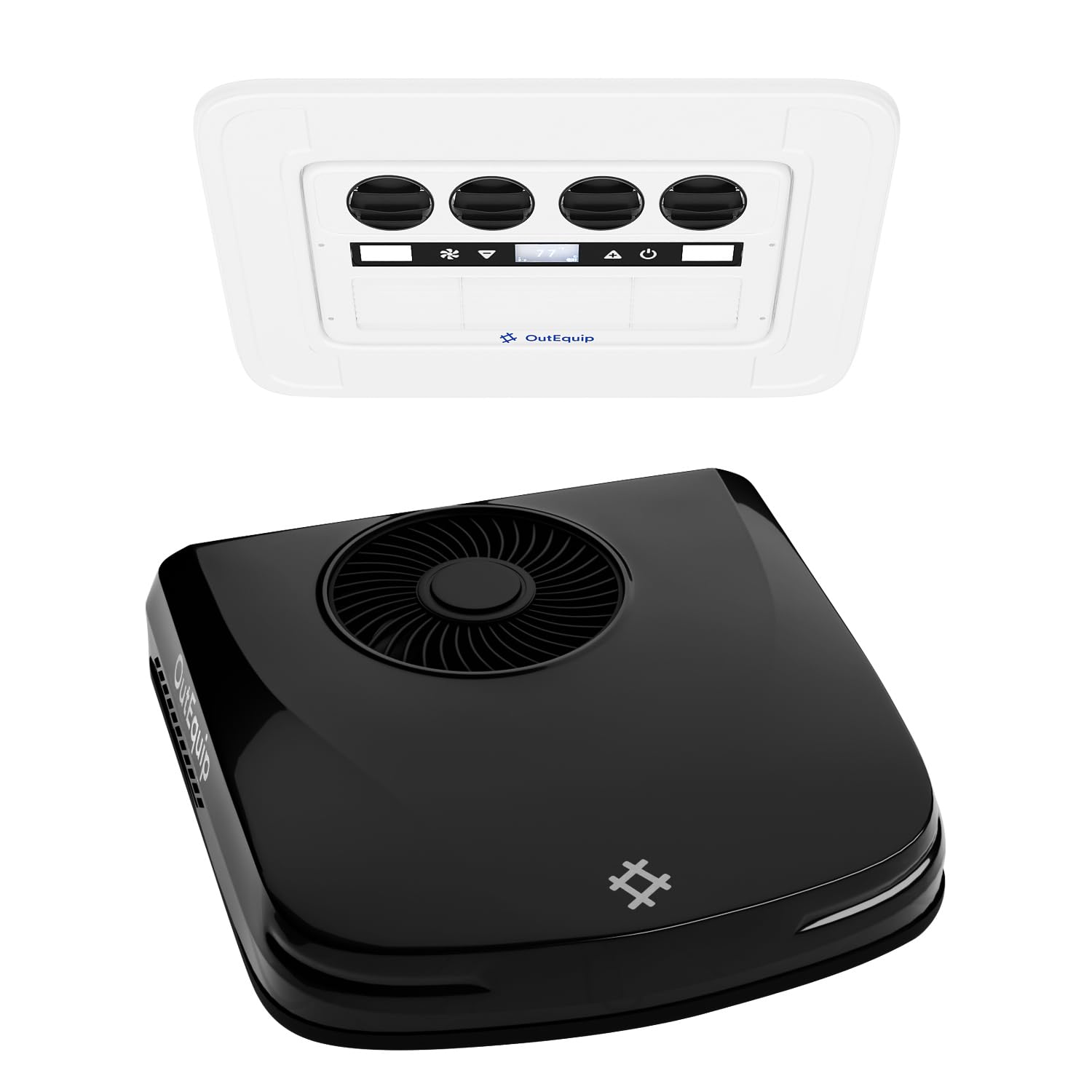
A black low-profile rooftop unit that handles Arizona heat while staying whisper-quiet.
If you want your van to look as good as it feels, this sleek black-housing unit is the one. It’s a 10,000 BTU rooftop AC that cools within 15 minutes, and the dual brushless copper motor fans with anti-vibration mounting keep it quiet enough to sleep through. The UV-resistant ABS housing and zinc-coated condenser are built for extreme sun and rain.
This is the unit for hot climates. One owner put it in a truck topper to cool their dog in Arizona heat and reported cold air in minutes. The power draw tops out around 650W and drops at lower settings, making it workable with a 480Ah house bank for up to 8 hours. Quality is the most-praised aspect, and it shows in the fit and finish.
There are a few quirks worth knowing. The heater is noisy and not worth using, the remote beeps on every button press, and there’s no Bluetooth or app control. The mounting brackets run short if your van roof is thick. But for someone replacing an old Dometic 110V unit, it’s lighter, quieter, and lower-profile while actually running off your 12V system.
Aesthetic win: the black low-profile shell looks factory-fitted and still cools hard in desert heat.
Keep it simple: skip the heater, ignore the beeping remote, and use it purely for cooling in hot-weather builds.
10. TOSOT 16K BTU Rooftop

Serious 16,000 BTU cooling for RVs up to 24 feet, with a heat pump for spring and fall.
For a large van or small RV, this TOSOT is the brute-force option. It pushes 16,000 BTU of cooling and 12,500 BTU of heat pump warmth, working in ambient temps from 23°F to 115°F. That makes it a year-round solution for Class B and C rigs, travel trailers, and even teardrop campers. It’s non-ducted, so it drops into a standard 14.25″ x 14.25″ rooftop opening.
The efficiency is the surprise. Owners measured just 800W on high cooling mode, which is outstanding for this output level and ideal for boondocking on a generator or inverter. It kept a 23ft trailer at 70°F in 105°F heat, ran while towing, and didn’t leak. The 43dB operation means owners can finally sleep with it running.
Smart control comes via the Gree+ app with WiFi, plus a remote. The heat pump quality is a standout, letting you skip the noisy propane furnace for mild mornings. The one recurring complaint is weak airflow on some units, so the air doesn’t always reach the far corners of a long rig. At 600 square feet of floor area coverage, it’s built for space, not just a small camper.
Heavy Duty Wins
- 12,500 BTU heat pump covers shoulder seasons
- 800W max draw for a 16K BTU unit
- WiFi + remote control via Gree+ app
- Works in ambient temps from 23°F to 115°F
Size It Right
- Airflow is weak on some units — long rigs may need fan assist
- Ships in 2 packages; wait for both before installing
- Brand longevity is unproven long-term
Best for big rigs: 16,000 BTU covers RVs up to 24 feet and still runs on 800W, which is remarkable efficiency.
Skip if: your van is under ~12 feet — this much cooling will short-cycle and waste power in a small cabin.
11. Gidrox 12K Heat Pump
The biggest rooftop unit that still runs all night on a 400Ah battery, adding a heat pump.
This Gidrox tops the rooftop lineup at 12,000 BTU cooling with a 9,000 BTU heat pump, giving you more power than the 10K options while keeping the same smart app control. It’s a 12V DC unit with a HEPA filter, which is a nice bonus for allergy sufferers in dusty campsites. The inverter compressor and brushless fan keep it at a library-quiet 40dB in Sleep mode.
The power management is the real story. It averages just 350W at night in 30°C ambient and can run all night on a 400Ah battery. The EER rating up to 12.3 tells you it’s not wasting energy. It fits the same standard 14″x14″ roof cutout and includes a 19.7 ft power cable, so most of the install work is done.
Owners note it’s noticeably lighter than old-school rooftop units, making it a manageable two-person job. The Bluetooth app works well, though there’s no WiFi. Realistic expectations matter here: one owner compared its cooling to a “good 8k window unit” — powerful, but not as icy as a 13.5K traditional AC. The heater is effective but uses more power, around 550W, so it’s not a free lunch.
Balanced power: the 12K BTU output with heat pump makes this the most versatile rooftop unit for year-round van life.
Manage expectations: it cools well but won’t freeze you out like a big 13.5K ducted unit, and the heater taxes the battery.
Understanding the Specs
BTU Cooling Power
BTU (British Thermal Units) measures how much heat the unit can remove per hour. A 10,000 BTU unit suits a well-insulated van or small camper. The 12,000 BTU units handle larger spaces. The 16,000 BTU TOSOT covers RVs up to 24 feet. Match the BTU to your van’s size or you’ll waste battery power on a unit that’s too big or runs constantly because it’s too small.
Amp Draw & Battery Bank
The single most important spec for van life is how many amps the unit pulls. Startup draws can hit 50A before dropping to 30A at steady state. The most efficient units average 350W at night. A 400Ah battery bank is the realistic minimum for all-night use; 480-600Ah banks give you 8-10 hours. If your bank is under 300Ah, you’ll need solar or a generator to keep up.
FAQ
What size battery bank do I need to run a 12V van AC all night?
How many amps does a 12V van air conditioner draw?
What is the difference between a rooftop and a split van AC?
Can I run a 12V van air conditioner with solar panels?
Do these van AC units also provide heating?
What roof opening size do I need for a rooftop van AC?
How long does installation take?
Which van AC is best for a large RV or trailer over 20 feet?
Final Thoughts: The Verdict
For most van dwellers, the aircon for van winner is the Outequip 10K BTU because it balances a light 43 lb install weight, quiet operation, and efficient power draw that owners have proven in Texas and Arizona heat. If you want heating for year-round use, grab the Treeligo 11K with heater or the Gidrox 12K heat pump. And for a large RV up to 24 feet, the TOSOT 16K BTU is the one to reach for.
How We Picked
We do not accept paid placement. Every pick is matched to a real buyer and a real use-case; we do not hands-on test units.
Sources & Methodology
Specifications: manufacturer listings and product documentation. Review insights: verified customer reviews, as of August 2026. Pricing: not shown on this page (it changes often); check the current price via the retailer link.
As an Amazon Associate, Gadgets Feed earns from qualifying purchases. This does not affect which products we feature.