
Our readers keep the lights on and my morning glass full of iced black tea. As an Amazon Associate, I earn from qualifying purchases.
Specs are compiled from manufacturer listings and verified buyer reviews and can change over time — please confirm the key details on the product page before buying.
You are losing cool air, you have checked every line you can see with soapy water, and the leak is still winning. The right sniffer turns a weekend of head-scratching into a ten-minute find. This guide walks through the nine most reliable models for tracking down refrigerant leaks in home ACs, car systems, and commercial gear — without the jargon or the guesswork.
I’m Min — the founder and writer behind Gadgets Feed. This guide is built by comparing the manufacturers’ published specifications and the patterns across verified customer reviews, so you get each pick’s real strengths and trade-offs instead of marketing spin.
Whether you are a DIY homeowner or a seasoned tech, these are the most dependable picks for the job. — the best aircon leak detector for your situation depends on whether you value portability, pinpoint accuracy, or the ability to handle both car and home systems without missing a beat.
Our Picks at a Glance

How To Choose The Best Aircon Leak Detector
Picking the right sniffer depends on a few key decisions: where you are using it, what kind of gas you need to track, and how deep into the equipment you need to reach.: where you are using it, what kind of gas you need to track, and how deep into the equipment you need to reach.
Sensor Type — Infrared vs. Heated Diode vs. Corona
Infrared sensors last longer and resist false alarms from non-refrigerant vapors (materials like cleaning sprays). Heated-diode sensors are fast but more fragile (the sensor element can burn out in heavy use). Corona sensors (the oldest type) are the most affordable. For occasional home use, a corona or diode sensor works fine. For professional daily use, the added cost of an infrared unit pays off in consistency.
Sensitivity (oz/yr)
This is the smallest leak the detector can catch, measured in ounces of refrigerant per year. A rating of 0.14 oz/yr catches very slow leaks that soap bubbles simply cannot see, so you can find pinholes. A rating of 0.21 oz/yr is still good for most repairs but may miss a tiny pinhole. Lower numbers mean better detection.
Rechargeable vs. Disposable Batteries
A built-in rechargeable battery (especially USB-C) saves you from buying AAA packs, but if you only use the tool once a year, replaceable cells mean you are never stuck waiting for a charge.
Flexible Probe Length
Car engine bays and sealed AC cabinets are tight spaces. A rigid probe works for open lines, but a flexible gooseneck that reaches 14 inches or more lets you get behind compressors and inside ductwork without disassembling everything.
Quick Comparison
| Model | Best For | Sensitivity | Power Source | Screen Type | Amazon |
|---|---|---|---|---|---|
| SENSYX SFD201★ Best Overall | Refrigerant & combustible gas | Adjustable H/L | Rechargeable Li-ion | Large Color LCD | Amazon |
| TOPTES RT-389Precision Choice | Professional precision | 3g/yr (0.1 oz/yr) | 2000mAh Rechargeable | TFT Color Display | Amazon |
| Elitech ILD-200Sensor Longevity | Long-life infrared accuracy | 0.14 oz/yr | Rechargeable | 2.8″ Large Screen | Amazon |
| POROMETISTO HLD01 | Color-coded quick reads | 16~200 ppm | USB-C Rechargeable | LCD 3-Color | Amazon |
| Simbow WJL-6000PRO | All-day field work | Adjustable | 1800mAh Rechargeable | Digital Display | Amazon |
| SENSYX SFD200 | Broad refrigerant coverage | Adjustable H/L | Rechargeable Li-ion | Large Color LCD | Amazon |
| Aprvtio WJL-6000PRO | Entry-level DIY value | 0.14 oz/yr | Battery Powered | LCD Screen | Amazon |
| Wale&Morn WJL-6000PRO | Budget halogen detection | 0.14 oz/yr | AAA Batteries | LCD Screen | Amazon |
| Elitech CLD-100 | Classic corona-sensor value | 0.21 oz/yr | 4×AAA Batteries | None (Audible) | Amazon |
In‑Depth Reviews
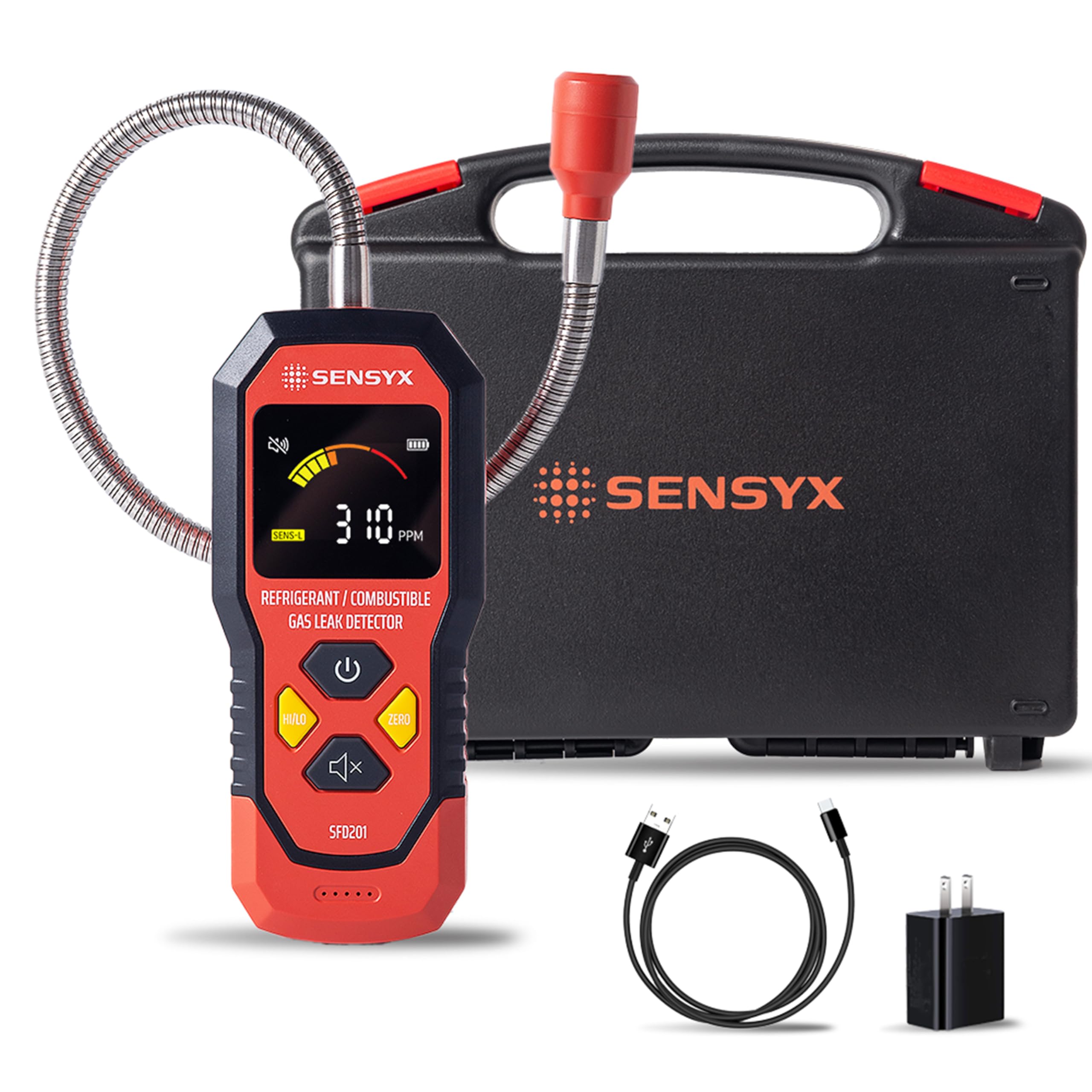
1. SENSYX SFD201 — HVAC Refrigerant and Combustible Gas Leak Detector
Our pick — 4.5★ from 300+ verified ratings; the strongest balance of quality and price.
The one tool that sniffs both cold gas and a gas leak from the stove.
The SFD201 is the rare detector that handles two jobs: it finds refrigerant leaks from your AC and also sniffs combustible gas like methane, propane, and isobutane. That means one device covers your home HVAC and your gas cooktop, furnace, or garage heater. The large color LCD screen shows the leak level clearly, and the adjustable High/Low sensitivity helps you dial down false alarms in dirty environments.
Buyers report that “this found the leak in minutes that I tried to find for weeks using the bubble method” — a common story across the reviews. The device meets UL1484 safety standards, and the built-in rechargeable lithium battery charges via USB-C. The trade-off: you have to turn it on in the same area you are testing, not outside, or you risk a false positive during warm-up.
dual gas detection
- Detects both halogen refrigerants and combustible gas (R50/Methane to R600a/Isobutane)
- Rechargeable lithium battery with USB-C — no hunting for AAA cells
- Large color LCD with clear leakage-level display
steep learning curve
- Must warm up and calibrate in the same room as the test to avoid false positives
- The sensitivity is very high — some owners find it triggers too easily in a shop with chemical vapors
versatile pick: you want a single tool that finds both refrigerant leaks and gas leaks, and you prefer the convenience of USB-C recharging.
patience required: you need to work immediately in an area already contaminated with cleaning solvents — the high sensitivity may false-alarm until you get the hang of the calibration routine.
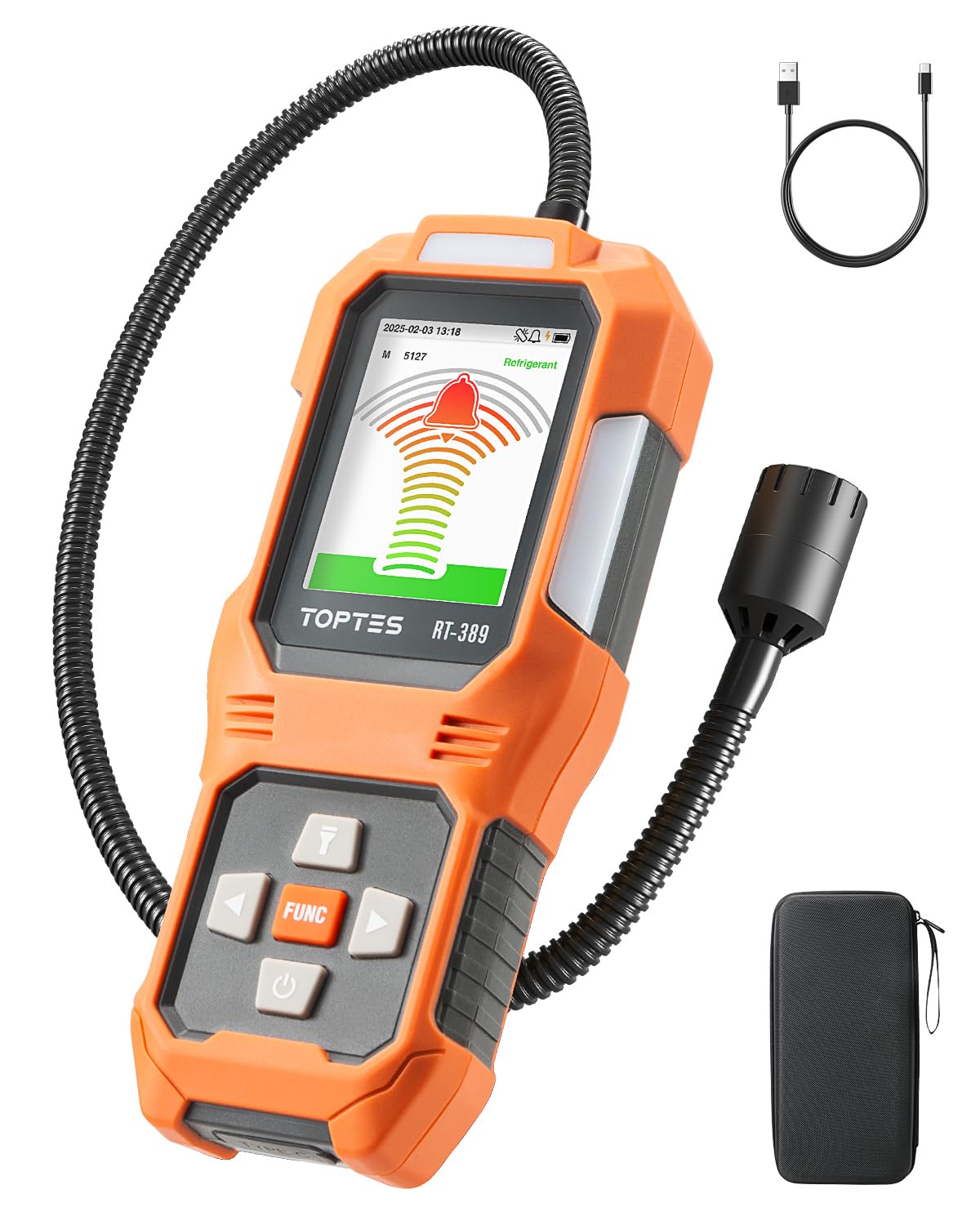
2. TOPTES RT-389 — Rechargeable Refrigerant Leak Detector
The professional-grade sniffer that sees pinholes at 3 grams per year.
The RT-389 packs a Japanese semiconductor sensor that reads down to 3g/yr (about 0.1 oz/yr) — among the most sensitive settings on this list. It gives you three sensitivity modes (High, Middle, Low) and three alert types: sound at 90dB (about as loud as a lawnmower), a visual screen indicator, and a vibration alarm, each independently toggleable. The vibrating alarm is a standout feature for noisy shop floors where you might miss a beep. The 14.5-inch flexible gooseneck makes it easy to snake behind compressors and deep into ductwork. The TFT color display shows a real-time concentration curve and a funnel chart, and the 2000mAh battery with USB-C charging runs for over 8 hours. Owners mention that it “found a pinhole AC leak in 10 min” and saved a significant repair bill.
The catch is that cleaning chemicals, soap, and windshield washer fluid can trigger false positives until you get familiar with its calibration. One owner noted it took some time to learn, but once dialed in, it found leaks invisible to the naked eye. The build uses high-strength engineering plastic and is rated as waterproof, explosion-proof, and dustproof. Compared to the Simbow WJL-6000PRO, the RT-389’s vibration alarm gives an extra layer of certainty in a noisy workshop where beeps get lost.
budget choice: anyone who needs to find the smallest possible leak in a busy environment, especially if they want the security of a vibration alarm.
pro jobs: occasional users on a strict budget who may not need the professional-level sensitivity and multiple alarm modes.
3. Elitech ILD-200 — Infrared Refrigerant Leak Detector
Infrared accuracy that keeps running long after a heated diode would quit.
The ILD-200 uses an infrared sensor — not a heated diode or corona — which gives it strong resistance to false alarms from non-refrigerant vapors (like cleaning sprays). Its maximum sensitivity is 0.14 oz/yr, and sensitivity adjusts across High, Medium, and Low levels. The 2.8-inch large screen has a peak display that shows you exactly where the concentration is highest, guiding your probe toward the leak. With a claimed 10-year sensor life, this unit justifies its premium price for professionals who work daily with AC systems. Customers note it is “way better than my other current meter at picking up smaller leaks, at least for R410” and that the sensor is fast and easy to use. It needs a warm-up in clean air and periodic purging, but owners agree that for multi-head mini-splits and hidden flares, this tool is invaluable. It is a significantly more sensitive option for modern mini-splits than the budget Elitech CLD-100.
At 14.88 ounces, it is noticeably heavier than the compact SENSYX models, and the sensor is sensitive enough that some beginners found it easy to damage if handled roughly. But the reliability feedback is strong — what owners appreciate most is the functionality (44 source mentions) and build quality (26 mentions).
accuracy first: you need a long-lasting infrared sensor that resists false positives and you are working on modern systems like multi-head mini-splits.
cost matters: you are a very occasional user who may let the tool sit for years — the rechargeable battery may degrade faster than replaceable cells.
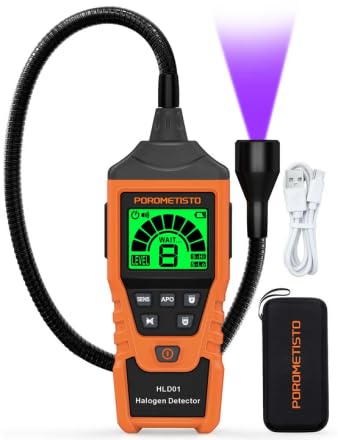
4. POROMETISTO HLD01 — 2-in-1 Rechargeable Halogen Detector
A three-color dashboard that tells you at a glance how bad the leak is.
The HLD01 uses a color-coded LCD screen: green (0–16 ppm) for safe, yellow (16–85 ppm) for caution, and red (above 85 ppm) for warning. This makes it among the most intuitive detectors for a beginner or a homeowner who just wants a simple “is this bad?” answer. It detects CFCs, HCFCs, HFCs, and HFOs across a measurement range of 16 to 200 ppm. Two calibration modes (automatic and manual) help you avoid false alarms in different environments. The unit also includes an extended hose for hard-to-reach spots and both a white LED and a purple UV light for dye-aided leak seeking. Owners are impressed with the sensitivity on R410A systems, and the USB-C rechargeable battery eliminates the need for disposable cells. One owner noted “I was really impressed with the sensitivity of this detector. I found my leak on a 410a system.”
The practical downside is that some wish it used disposable batteries for long-term storage — a rechargeable cell that sits in a drawer for a year may not hold a charge. The build quality is solid, and the included cloth carry bag is a nice touch for keeping it clean in a service van.
combo tool: homeowners and DIYers who want an instant visual readout of leak severity without guessing at beep patterns.
tight spaces: you will only use the tool once every two years — a rechargeable battery may self-discharge faster than AAA cells in storage.
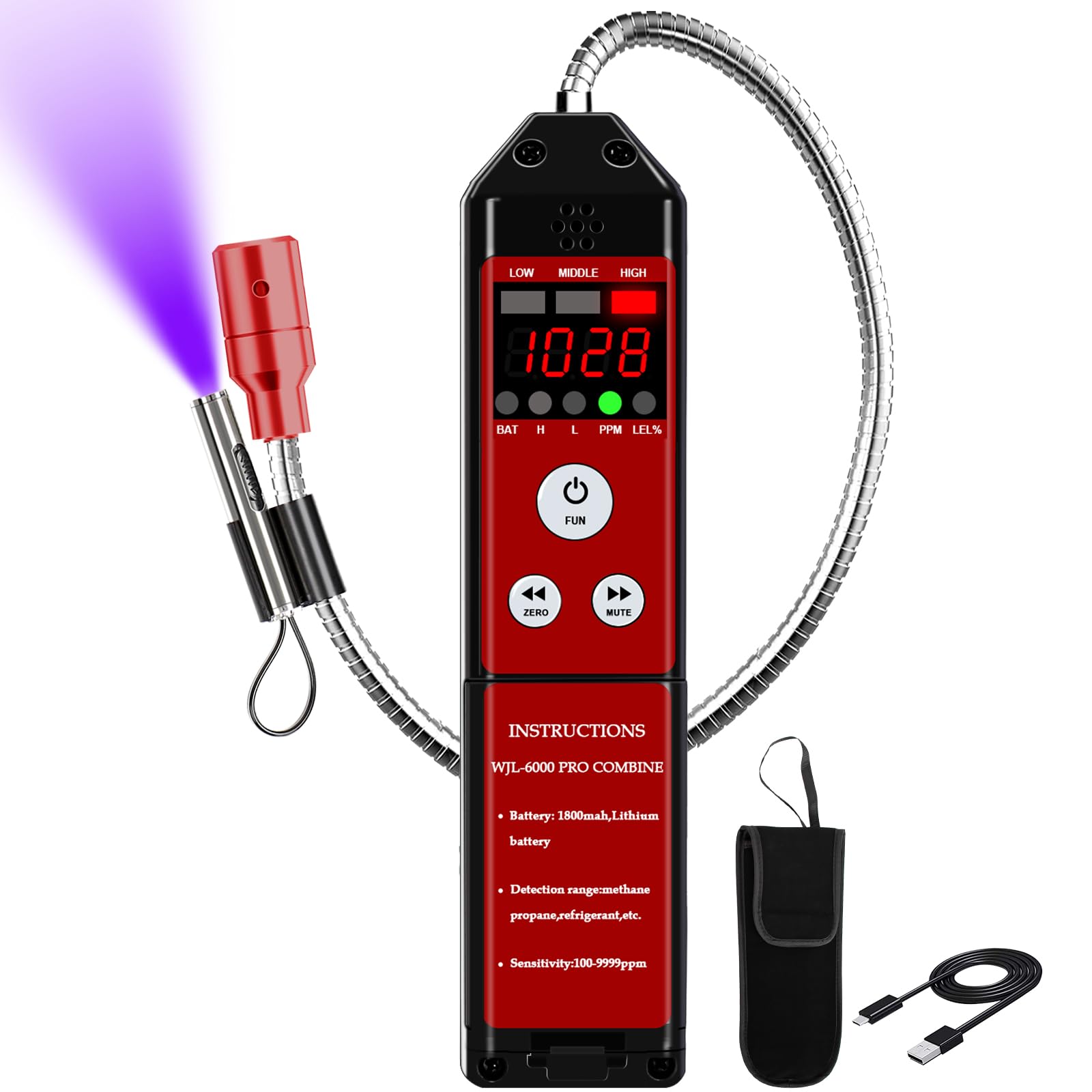
5. Simbow WJL-6000PRO — Metal Probe Refrigerant Detector
A rugged metal probe and a battery that lasts a full day on a charge.
With an 1800mAh rechargeable battery, the Simbow WJL-6000PRO delivers over 20 hours of continuous operation — enough for a full work week between charges. The probe is made of solid metal, not plastic, which means it bends into tight engine bays and AC vents without snapping. The device reads both PPM (for pinpointing small leaks) and %LEL (for monitoring gas safety levels near flammable concentrations). It covers the full refrigerant spectrum: CFCs, HCFCs, HFCs, HFOs, Blends, and PFCs. The audible and visual alarms include a mute button for quiet indoor work, and auto-calibration on startup helps stabilize readings. One owner confirmed its effectiveness: “I used this tool to find a leak on my neighbors 14-year-old AC’s Air Handler and when the tech arrived the following day, he found the exact same leak with his professional equipment.”
The trade-off: sensitivity needs to be turned up high to catch the smallest leaks, and some owners found it “good enough” rather than outstanding. But at a mid-range price point, it offers the best battery life and a more durable probe than many competitors. Unlike the TOPTES RT-389, which uses a plastic body, the Simbow uses a metal probe for extra durability.
tough jobs: technicians or property managers who need a full day of leak hunting without carrying spare batteries, and who appreciate a probe that won’t break on the job.
light duty: you need the highest absolute sensitivity (below 0.14 oz/yr) for pinpointing micro-leaks in critical systems.
6. SENSYX SFD200 — Rechargeable Halogen Freon Sniffer
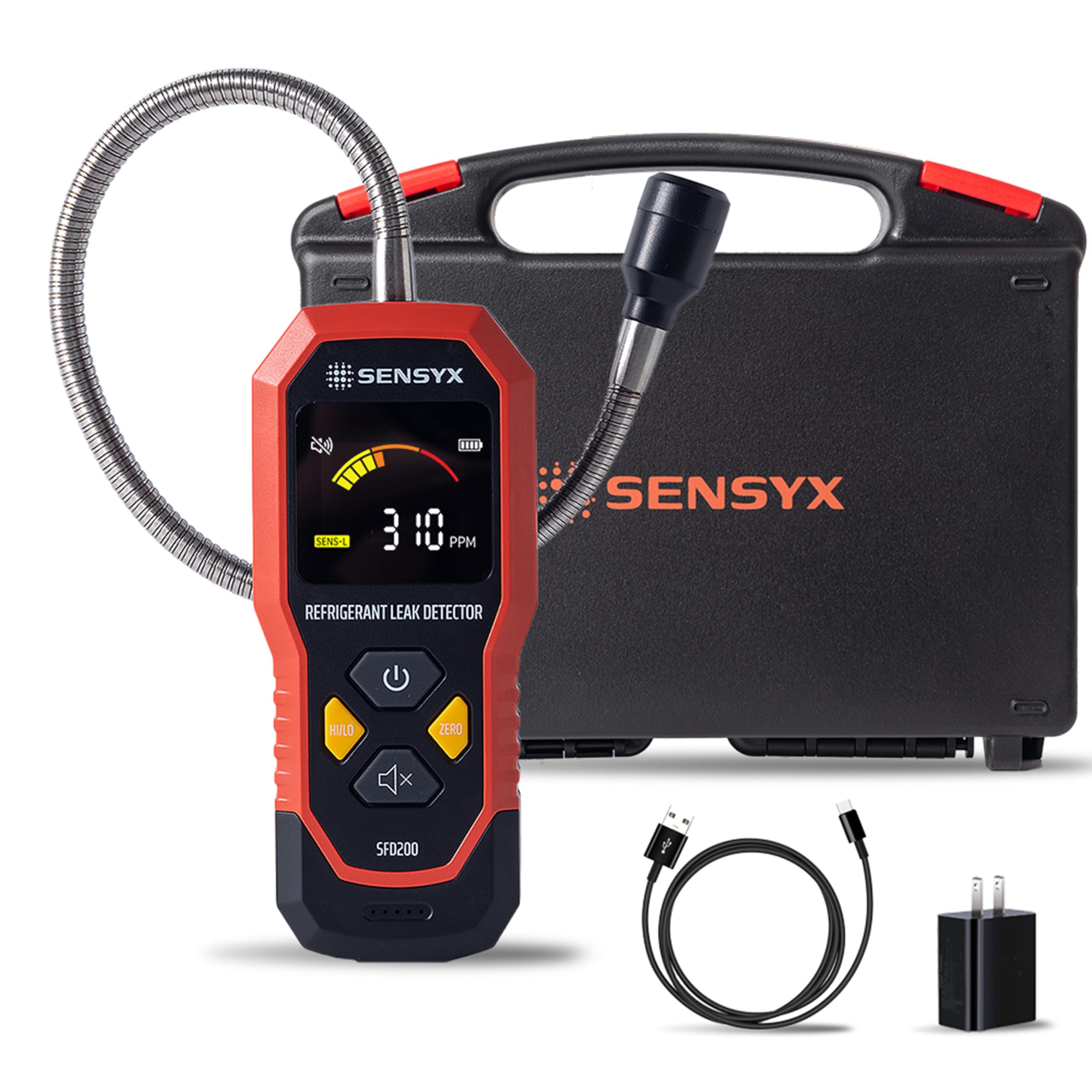
A wide-spectrum sniffer for anyone who works with multiple refrigerant types.
The SFD200 detects a massive list of halogen refrigerants, from R11 and R22 to R410A and R1234yf, making it the broadest-compatibility tool in the SENSYX lineup. It shares the same large color LCD screen and USB-C rechargeable battery as the SFD201, but skips the combustible gas detection — keeping the price lower for users who only need refrigerant sniffing. The adjustable High/Low sensitivity and UL1484 safety rating are carried over. One impressed repairman confirmed a stubborn AC leak, noting it gave him the confidence to recommend a new unit without second-guessing. Another owner reported it “detects gases almost immediately” and is great for both propane and AC leaks.
However, some users found the lack of any sensitivity adjustment buttons frustrating — the unit triggers false alarms in environments with new rubber, running motors, or fresh plastic ventilation tubing. For a clean shop or home use, it works beautifully. For a busy service environment, the constant chirping can become tiresome. This makes it trickier than the SENSYX SFD201 for use around fresh rubber parts.
quick checks: you need one tool that covers the widest range of refrigerants for home and auto, and you prefer simplicity over manual controls.
long sessions: your work area is full of chemical vapors or new rubber that will trigger false positives — you may want a model with adjustable sensitivity modes.
7. Aprvtio WJL-6000PRO — Freon Leak Detector with UV Light
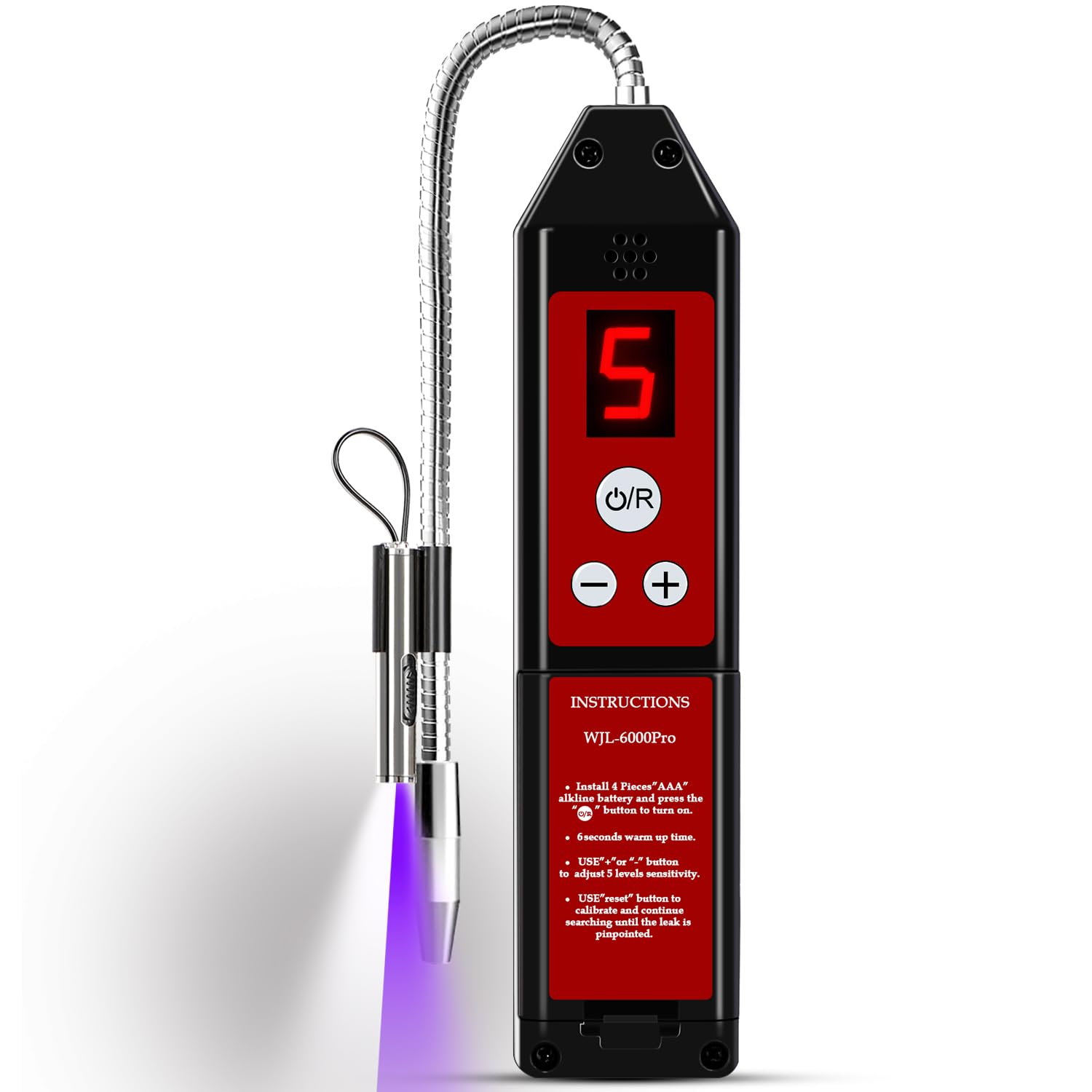
The entry-level sniffer that brings UV dye verification to private garages.
This WJL-6000PRO variant includes a white LED flashlight and a UV lamp that works with fluorescent dyes, so you can double-verify a leak source. The sensitivity is rated at 0.14 oz/yr, and the 7.9-inch flexible probe snakes into tight spots. The LCD screen shows both the current sensitivity setting and the gas leakage level, and the multi-alarm system increases beep frequency as you approach the source. Buyers consistently call it easy to use and good value. One owner summarizes: “Works great and is very easy to use. It quickly detected the refrigerant leak and helped me find the problem in minutes.” It runs on AAA batteries, which is good for occasional users who want the tool ready after a year in storage — but some owners found the included light could be better.
The honest caveat: reliability feedback is mixed — a portion of units had inconsistent performance, and some owners reported that theirs did not work at all. For a budget-friendly price, it is an excellent starter tool for confirming a suspected leak, but professionals who need 100% reliability every day may want to invest in a higher-tier model. Compared to the TOPTES RT-389, the Aprvtio’s sensitivity of 0.14 oz/yr is slightly less keen, and its build quality is less consistent.
visual aid: DIY homeowners who want an affordable first tool to check their car or central AC, and who appreciate the UV verification feature.
power users: you need a tool you can depend on for daily professional use without occasional quality variation.
8. Wale&Morn WJL-6000PRO — Halogen Leak Detector with LCD
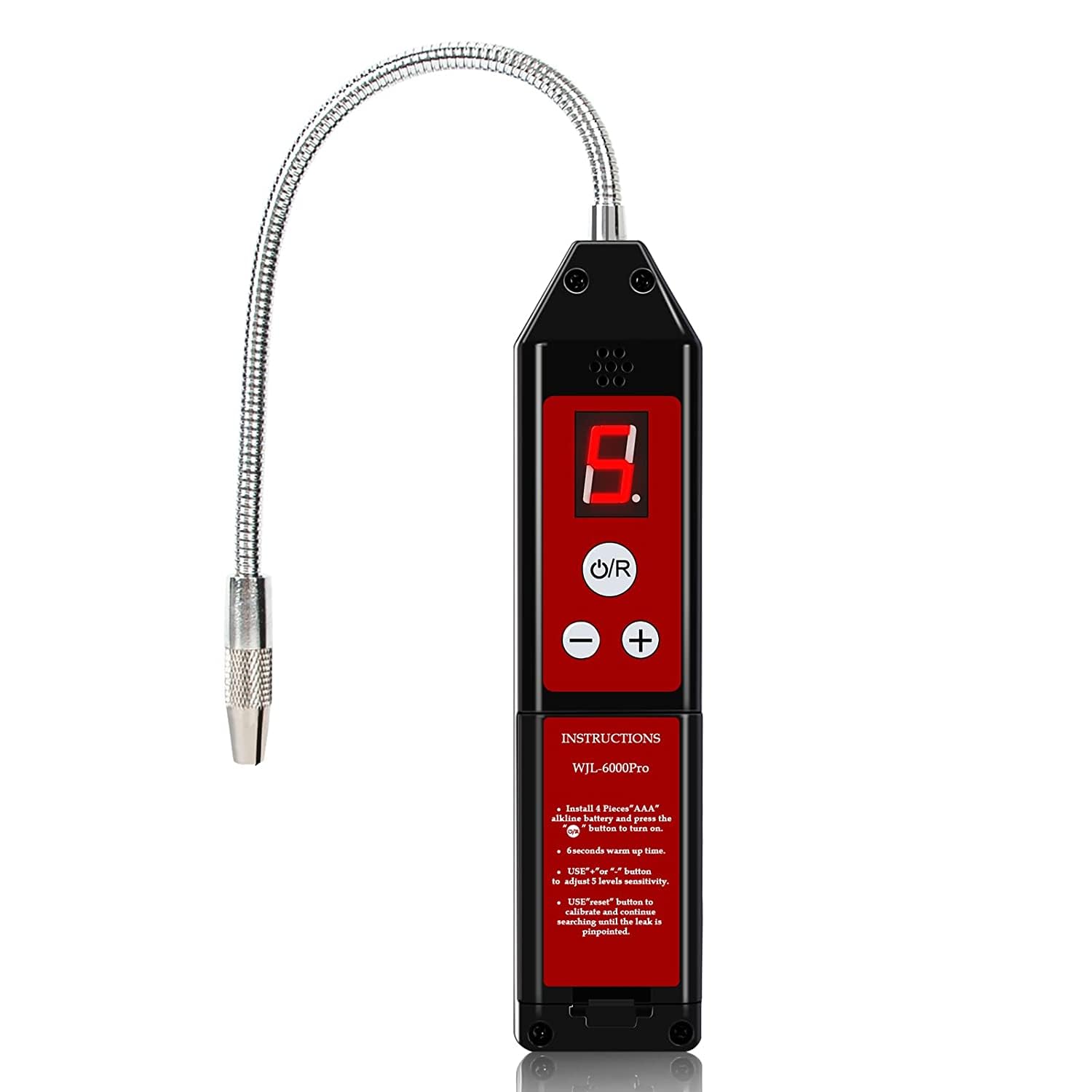
A low-cost halogen sniffer with a claimed 50-hour battery run on AAA cells.
The WJL-6000PRO from Wale&Morn is the most affordable pick on the list. It matches the 0.14 oz/yr sensitivity of the Aprvtio variant but uses a fixed probe. The LCD screen shows the leakage level and the sensitivity setting. It claims to run for 50 hours on four AAA batteries — one of the longest run-time claims on any battery-powered detector here. It includes auto-calibration and dual audible/visual alarms. Some owners find it works as well as larger, more expensive units when used patiently — as the instructions state: “your leak is slow so you need to seek the leak slowly.” The probe is significantly larger than the compact SENSYX models — at 9.5 inches deep, it is physically bigger, which may be a factor in tight spaces.
The honest reality is that a portion of units arrive non-functional or fail shortly after delivery — the most common complaint is “the item is not working, I put batteries but not functioning, no light, no flash.” Accuracy is also questioned, with at least one owner calling it “not very accurate” and “very noisy.” For the price, it is worth a try if you are on a tight budget, but plan to test it immediately. Compared to the Simbow WJL-6000PRO, the Wale&Morn uses AAA batteries instead of a rechargeable pack, so it won’t leave you waiting for a charge if it sits unused.
easy reading: someone who needs the most affordable entry into refrigerant detection and is willing to accept a gamble on QC.
speed needed: anyone who needs guaranteed reliability on the first use — the risk of a dead-on-arrival unit is real.
9. Elitech CLD-100 — Classic Corona Refrigerant Detector

The affordable corona sensor that found the leak dye could not see.
The CLD-100 is an upgraded version of the popular WJL-6000, using a traditional corona sensor with an updated analog circuit. It triggers on all halogenated refrigerants including R11, R22, R134A, R404a, and R410A. The sensitivity is 0.21 oz/yr — adequate for most DIY situations but not as keen as the 0.14 oz/yr units above. A 6-second preheating time means you are not waiting around. The flexible 8.26-inch probe reaches into tight engine bays, and the audible plus visual alarm makes tracking straightforward. Reviewers point out finding leaks quickly: “Found the leak in minutes and ended up using it on several other cars.” It runs on 4 AAA batteries, which are not included. The functionality is what owners praise most (46 mentions), and the value-for-money scores well (16 mentions).
The mixed reality is that leakage detection performance is inconsistent: some owners say it finds major leaks easily, while others report it only works once and then stops being reliable. It is a solid, ultra-budget option for a single-use or occasional job, but not the right tool for a tech who needs a daily driver. Compared to the Elitech ILD-200, the CLD-100’s corona sensor is less resistant to false alarms and has a shorter lifespan.
old reliable: one-time fixes where you know there is a sizable leak and you just need a cheap tool to pinpoint it.
modern needs: you need repeatable, long-term reliability across many AC systems — consider the infrared or semiconductor models for consistent performance.
Understanding the Specs
Sensitivity (oz/yr)
This spec tells you the smallest leak the detector can catch, measured in ounces per year. A figure like 0.14 oz/yr means it can detect a leak as small as 0.14 ounces of refrigerant escaping over a whole year — about the size of a pinhole. Lower numbers are better. The 0.21 oz/yr detectors are fine for visible or moderate leaks, but 0.14 oz/yr or lower is what you want for tracking down slow, hidden leaks that soapy water misses entirely.
Sensor Type
The sensor is the nose of the tool. Corona sensors (oldest type, cheapest) work fine for big leaks but struggle with tiny ones and can drift. Heated diode sensors (common in the WJL-6000 family) are faster and more sensitive but can burn out if exposed to high concentrations for too long. Infrared sensors (Elitech ILD-200) resist false alarms from non-refrigerant vapors and last much longer, but cost more. For occasional home use, a corona or diode sensor is sufficient. For professional or daily work, the extra cost of infrared pays for itself in fewer false calls and longer life.
FAQ
Can I use a refrigerant leak detector on my car AC?
What is the difference between 0.14 oz/yr and 0.21 oz/yr sensitivity?
Why does my leak detector keep false alarming?
How long do the sensors last?
Do I need a rechargeable or battery-powered detector?
Can a leak detector find gas leaks from my stove or furnace?
Will a leak detector work on R410A mini-splits?
Is the flexible probe important?
Final Thoughts: The Verdict
For most buyers, the best aircon leak detector is the SENSYX SFD201 because it covers both refrigerant and combustible gas with a rechargeable battery and a clear color screen — all at a fair price. If you need the highest sensitivity and a vibration alarm for noisy shops, grab the TOPTES RT-389. And for those who want an infrared sensor with a 10-year lifespan and professional-grade consistency, the Elitech ILD-200 is the one to reach for.
How We Picked
We do not accept paid placement. Every pick is matched to a real buyer and a real use-case; we do not hands-on test units.
Sources & Methodology
Specifications: manufacturer listings and product documentation. Review insights: verified customer reviews, as of July 2026. Pricing: not shown on this page (it changes often); check the current price via the retailer link.
As an Amazon Associate, Gadgets Feed earns from qualifying purchases. This does not affect which products we feature.