
The cockpit is a cacophony of engine noise, wind shear, and radio chatter. Having a VHF transceiver that cuts through that noise isn’t a luxury—it’s a safety-critical tool for talking to towers, monitoring CTAF, or picking up an AWOS update before you spin up. The wrong radio leaves you fumbling with squelch knobs and missing calls from ATC.
I’m Min — the co-founder and writer behind Gadgets Feed. I’ve spent countless hours researching the technical specifications, memory channel counts, battery chemistries, and waterproofing standards that separate a great aviation handheld from a frustrating toy, ensuring this guide only recommends gear that performs when the static is at its worst.
Whether you’re a flight instructor sending a student solo or a pilot looking for a dependable backup, choosing the right unit means decoding features like PEP output, ILS capability, and IP water resistance. This guide cuts through the noise to help you find the best aircraft vhf radio for your specific mission profile and budget.
How To Choose The Best Aircraft VHF Radio
Picking the right VHF airband radio depends on matching its core capabilities to your actual flying environment—whether you’re backing up a panel-mounted unit in a Cessna, monitoring on the ramp, or teaching pattern work. Focus on these four areas before you click “buy.”
Transmit Power (PEP vs. Carrier Watts)
Aviation handhelds are rated for peak envelope power (PEP), which is the best measure of a radio’s ability to punch through noise. Look for at least 5 to 6 watts PEP for decent ground-to-air range. A 6-watt PEP radio like the Sporty’s PJ2+ will generally reach a tower 10 to 15 miles away line-of-site, while a lower-power unit might struggle beyond the pattern.
Channel Spacing & Memory Capacity
Older radios ran on 25 kHz spacing, but modern airspace increasingly requires 8.33 kHz compatibility—especially in Europe and for IFR operations. A unit that only supports 25 kHz will miss traffic on tightly-spaced channels. Memory channels matter too: 250 to 760 slots let you store local CTAF, ATIS, and approach frequencies without entering them by hand every flight.
Battery Type & Charging Flexibility
Lithium-ion packs are standard in most modern handhelds—they hold a charge longer and don’t suffer from the memory effect of older Ni-Cads. Check if the radio offers USB-C charging for convenience or a drop-in cradle for the flight bag. If you fly infrequently, a radio that runs on standard AA batteries (like the Yaesu FTA550) might be more practical, as lithium cells won’t swell over months of storage.
NAV/COM vs. Comm-Only
Comm-only radios handle transmit and receive on airband frequencies (118 to 136.975 MHz). NAV/COM units add the ability to receive VOR and ILS signals, allowing you to practice approaches or monitor a localizer without the panel. If you’re a student pilot or fly IFR, a NAV/COM like the Yaesu FTA550 can be a valuable training aid and backup.
Quick Comparison
On smaller screens, swipe sideways to see the full table.
| Model | Category | Best For | Key Spec | Amazon |
|---|---|---|---|---|
| AnyTone AT-588Max | Mobile | Off-road Convoys | 70W VHF / Air Band RX | Amazon |
| Wouxun KG-S74A | Handheld | Ground-to-Air Value | 6W PEP / USB-C / IP67 | Amazon |
| BTECH UV-PRO | Handheld | App-Connected Ham | Dual Band / APRS / GPS | Amazon |
| AnyTone AT-5888UV | Mobile | Dual Band Mobile | 50W/40W / 758 Channels | Amazon |
| Yaesu FTA-250L | Handheld | Compact Backup | 5W TX / 250 Memories / IPX5 | Amazon |
| Sporty’s PJ2+ COM | Handheld | Flight Bag Essential | 6W PEP / 760 Channels | Amazon |
| Yaesu FTA550 | Handheld | NAV/COM & ILS | 108-136.975 MHz / VOR Rx | Amazon |
| Icom IC-A16 | Handheld | Durable All-Rounder | Li-Ion / 200 Ch / 17hrs | Amazon |
| Icom IC-A16B | Handheld | Premium Bluetooth | Bluetooth / 6W / 1500mW | Amazon |
In‑Depth Reviews
1. Sporty’s PJ2+ COM

The Sporty’s PJ2+ hits the sweet spot for pilots who want a no-fuss backup that simply works. Its 6-watt PEP output provides strong ground-to-air reach, and the dedicated “flip-flop” button and oversized keypad make frequency entry fast without fumbling through nested menus. The built-in dual PJ headset jacks mean you never need an adapter—just plug in your headset and transmit.
Power comes from six AA batteries, which is a double-edged sword: they stay shelf-stable for years, but you’ll want to remove them during storage to prevent corrosion. The USB-C port provides direct power from a panel or power bank, effectively sidestepping the battery concern during flights. With 760 memory channels, you can store every CTAF, ATIS, and tower frequency you regularly use.
Owners consistently praise its audio clarity and solid build. The main critique is that the AA battery tray can feel bulky compared to proprietary lithium packs, but the tradeoff for never dealing with a swollen Li-Ion battery after months in the flight bag is worth it for many pilots. For a clean, reliable COM radio, this is the benchmark.
Why it’s great
- No adapter needed for standard aviation headsets
- Simple, uncluttered interface for emergency use
- Strong 6W PEP transmission range
Good to know
- Uses AA batteries (not rechargeable pack included)
- Limited to COM only—no VOR/ILS receive
2. Icom IC-A16B 51 USA
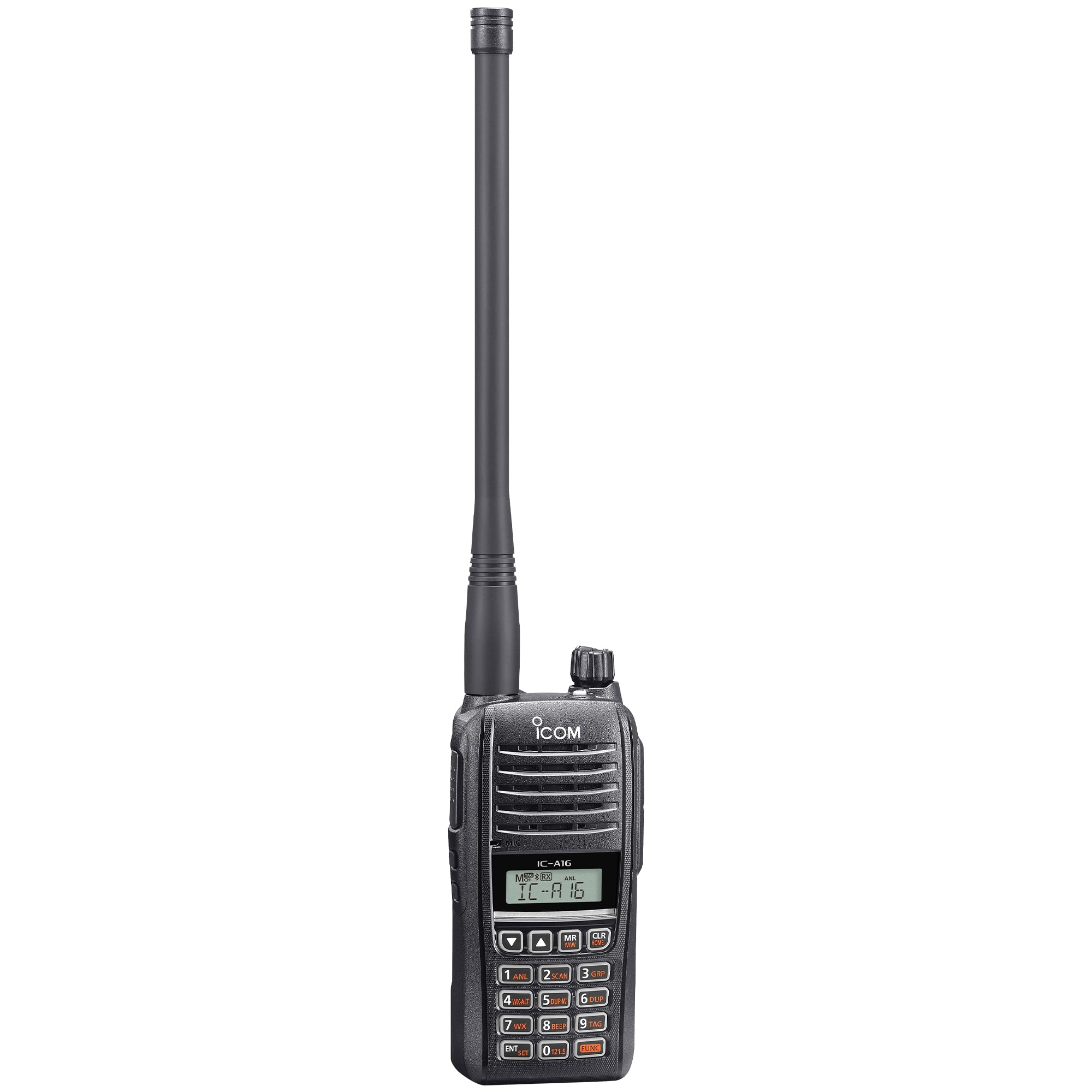
The Icom IC-A16B is the top-tier choice for pilots who demand the latest connectivity. Its built-in Bluetooth lets you pair wirelessly with headsets like the Bose A20, cutting the cable clutter in the cockpit. The 1500 mW speaker output is remarkably loud—helpful when the engine is running and you’re scanning for traffic—while the 6W PEP transmit power keeps you solidly connected.
This radio supports both 8.33 kHz and 25 kHz channel spacing, making it fully compatible with modern European airspace and future US requirements. The 2400 mAh Li-Ion battery delivers up to 17 hours of operation, and the IP67 waterproof rating means a rain-soaked ramp walk won’t kill your comms. The LCD display and illuminated keypad are sharply readable in low-light cockpits.
Where the A16B stumbles is its menu complexity—pairing Bluetooth requires digging into submenus, and there’s no USB-C charging (it relies on a drop-in cradle). The belt clip attaches to the battery pack, which feels less secure than the chassis-mounted clips on rival units. Still, for Bluetooth audio convenience and rugged build quality, this radio is tough to beat.
Why it’s great
- Wireless Bluetooth audio connection for cleaner cockpit
- Excellent 1500 mW speaker clarity
- IP67 dust and water resistance
Good to know
- Bluetooth pairing is cumbersome through complex menus
- No USB charging; requires drop-in cradle
3. Icom IC-A16

If you need the rugged Icom DNA but don’t require Bluetooth, the IC-A16 is the pragmatic pick. It shares the same IP67 waterproof housing, 6W PEP output, and 2400 mAh Li-Ion battery (17-hour runtime) as its Bluetooth-enabled sibling, but sheds the wireless complexity. The dedicated 121.5 MHz emergency channel button gives you instant access to guard frequency.
The receiver covers 108 to 136.99166 MHz for transmit and also picks up the VHF FM band for weather broadcasts. The 200 memory channels are ample for storing local frequencies, and the side-tone function lets you hear your own voice through a connected headset—a useful feedback tool for checking mic technique. Owners note the noise reduction effectively cuts engine drone.
The main downsides are programming complexity—the manual is sparse on group memory and scan details, and you’ll likely need YouTube to unlock full functionality. The belt clip attached to the battery is another weak point reported by field users. For a durable, no-nonsense handheld from a trusted brand, the IC-A16 delivers consistent performance.
Why it’s great
- Instant-access 121.5 MHz emergency button
- Long 17-hour battery life from 2400 mAh pack
- Rugged IP67 build for tough environments
Good to know
- Programming menu is non-intuitive
- Belt clip attached to battery, not chassis
4. Yaesu FTA550

The Yaesu FTA550 stands apart because it’s a true NAV/COM, not just a COM radio. It receives VOR and ILS signals across 108 to 136.975 MHz, allowing you to monitor localizer approaches or practice VOR tracking without your panel. This makes it a powerful training aid for student pilots and a genuine backup for IFR operations.
Power comes from two AA batteries, which is a deliberate design choice for reliability—no lithium pack to swell or fail over years of storage. The included AA battery tray with an extra slot for spare cells is a nice touch. The headset adapter comes in the box, so you’re not hunting for an extra purchase. With 200 memory channels and 8.33 kHz narrow-band support, it’s fully modern.
Critiques include the tight AA battery compartment—users report needing a screwdriver to pry them out. The antenna lacks a positive click lock and can loosen over time. Transmit tests show solid tower readability from 5 to 8 miles. For a pilot who wants to squeeze the most out of a handheld, especially for training, the FTA550 is a versatile choice.
Why it’s great
- ILS and VOR receive for training/backup
- Simple AA battery power (no proprietary pack)
- Headset adapter included
Good to know
- AA battery compartment is very tight
- Antenna can loosen without positive click
5. Yaesu FTA-250L
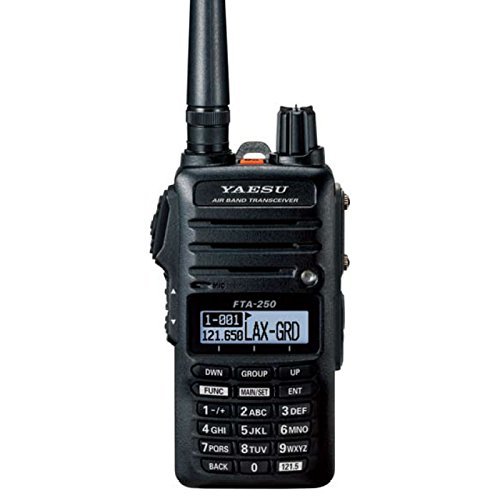
The Yaesu FTA-250L is the pocket-sized backup that slips into any flight bag without adding bulk. At just over an inch thick and weighing next to nothing with the 1950 mAh Li-Ion battery, it provides 5 watts of transmit power—enough for solid pattern and short cross-country communication. The 250 memory channels with alphanumeric labeling make frequency management straightforward.
The digital squelch is a standout feature—it’s much sharper than old analog squelch circuits, cutting out background hiss before you even hear it. The IPX5 rating means it’s splash-proof, so a drink spill or light rain won’t ruin your day. The drop-in charging cradle and included 12V adapter keep it topped off in the car or hangar.
On the downside, the audio output is a modest 700 mW, which can be hard to hear in a noisy cockpit without a headset adapter (included). The LCD, while clear, is relatively basic. For a pilot who simply needs a reliable, compact backup that recharges conveniently, the FTA-250L hits the mark at a reasonable cost.
Why it’s great
- Very compact and lightweight for flight bag
- Rapid digital squelch cuts static cleanly
- Drop-in charging cradle included
Good to know
- 700 mW speaker may be quiet in loud cockpit
- LCD display is basic and not backlit
6. Wouxun KG-S74A

The Wouxun KG-S74A delivers the highest power-to-cost ratio among the handhelds tested here. With up to 6 watts PEP output and a superheterodyne receiver, it punches above its weight class for ground-to-air communication. The 400 memory channels plus 5 NOAA weather alert notifications give you serious storage and situational awareness.
USB-C charging is a standout feature at this tier—you can top up from any laptop or power bank without hunting for proprietary cables. The IP67 rating means it’s fully submersible, so rain or ramp dust won’t cause issues. The backlit LCD and programmable side keys let you create shortcuts for your most-used frequencies.
Where it falls short is transmit-only utility: it’s a COM radio with no NAV capability. Some users report confusing programming for the memory channels, and the included headset adapter panel has room for improvement. For a pilot on a budget who needs a capable backup or a CFI for ground monitoring, the KG-S74A offers serious value.
Why it’s great
- High 6W PEP output for the price
- Convenient USB-C charging
- Fully IP67 submersible protection
Good to know
- No VOR or ILS receive
- Programming memory can be tricky
7. AnyTone AT-588Max
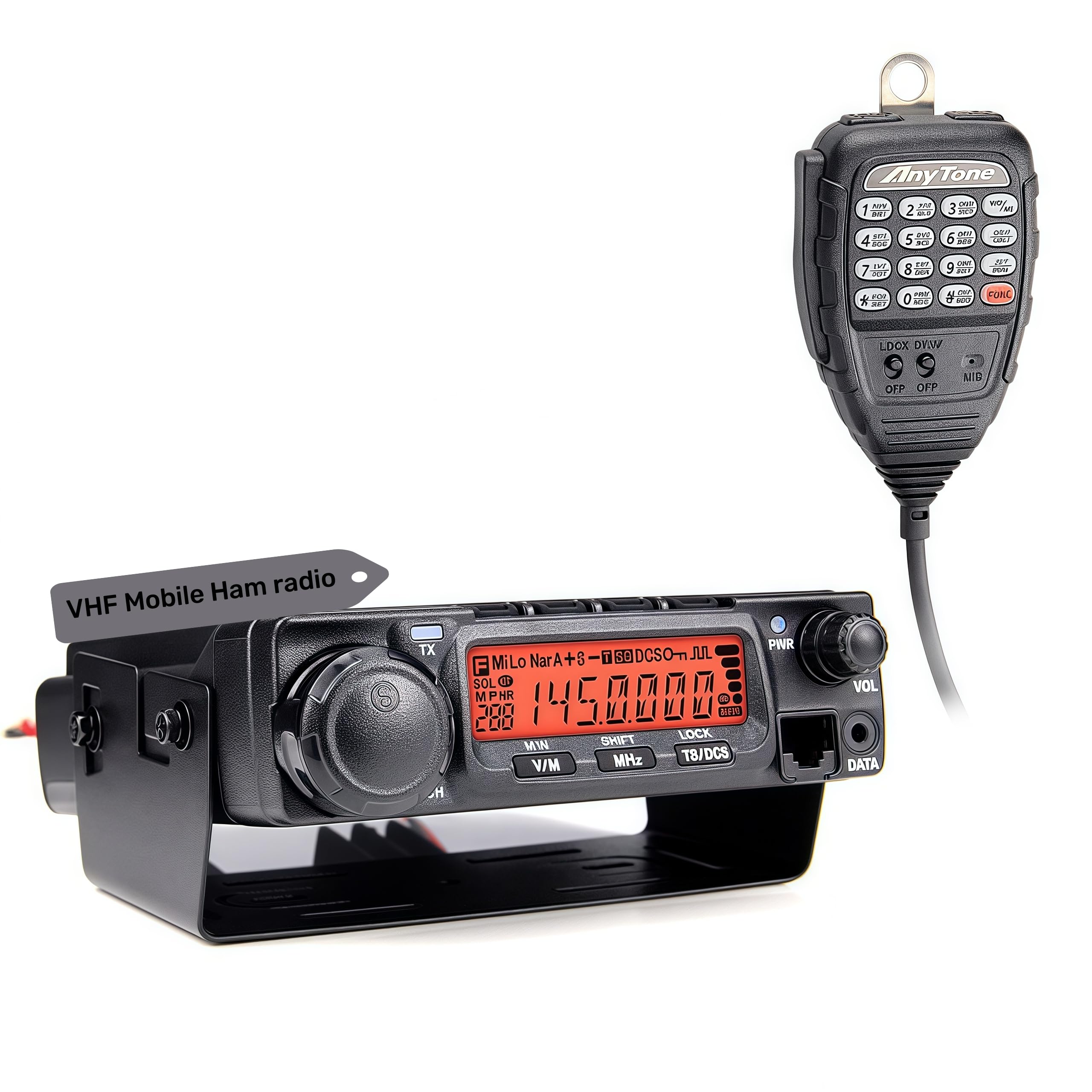
The AnyTone AT-588Max is a mobile rig, not a handheld—it’s designed for installation in a vehicle. Pumping 70 watts on the VHF band, it offers far more transmit power than any handheld, making it ideal for off-road convoy communication where range and building penetration matter. The 510 memory channels let you program frequencies for each trail or highway segment.
It includes AI noise cancellation for both transmit and receive, actively filtering engine roar and wind noise—a game changer for off-road convoys in Jeeps or trucks with soft tops. The Air Band receive (AM) lets you monitor aviation frequencies, which is a unique bonus for aviation enthusiasts who also hit the trails. The 32-level adjustable LCD stays readable from glare to pitch black.
Programming is the Achilles’ heel: the software isn’t easily available, and hand-programming 510 channels is painful. Some users report the included cable lacks downloadable software. For those willing to invest the programming time, the AT-588Max is a monster for VHF comms with a side of aviation monitoring.
Why it’s great
- Massive 70W VHF output for long range
- AI noise cancellation for noisy vehicles
- Air Band AM receive for aviation fans
Good to know
- Mobile installation requires power and antenna
- Software programming not user-friendly
8. BTECH UV-PRO
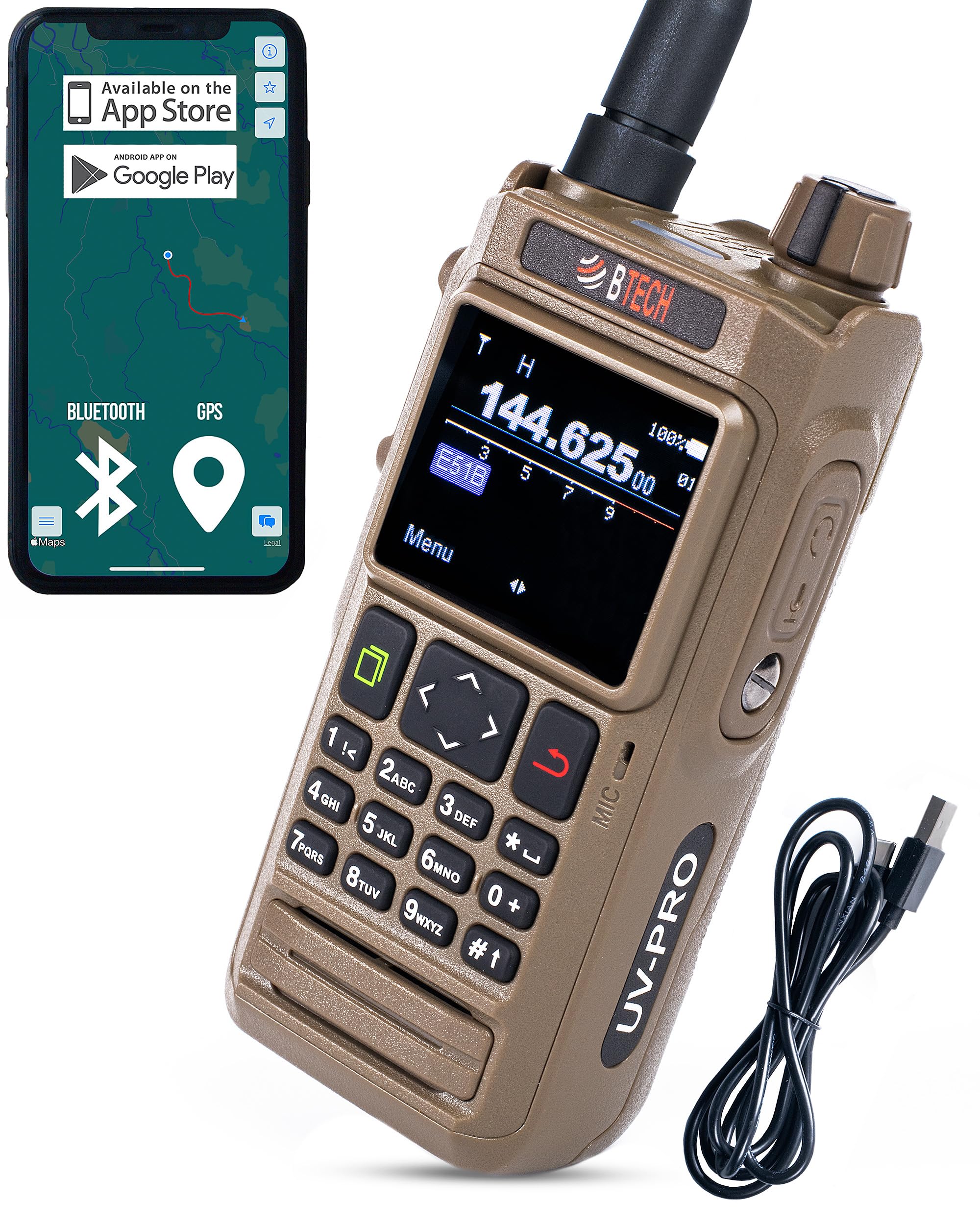
The BTECH UV-PRO is a dual-band amateur radio that includes aviation band scanning as a secondary feature. It’s designed for the licensed ham operator who also wants to listen to airband traffic. It provides VHF and UHF transmit (amateur bands), with receive-only coverage of 118-137 MHz aviation frequencies plus NOAA weather alerts.
Its standout feature is the built-in Bluetooth for audio and data connections, plus integrated GPS and APRS support. The companion BTECH UV app lets you program channels from your phone—a huge convenience compared to traditional radio programming. The IP67 rating means it survives wet and dusty conditions, and the 2600 mAh battery keeps it running all day.
This is not a primary aviation radio for pilots—it’s an amateur-focused transceiver with airband scanning. The aviation receive lacks the sensitivity of a dedicated Yaesu or Icom airband unit. Perfect for a ham who wants to keep an ear on the airport while on the trail, but not a replacement for a true airband transceiver.
Why it’s great
- Smartphone programming via app is very convenient
- Built-in Bluetooth and GPS for modern use
- IP67 rugged design
Good to know
- Aviation receive is a secondary feature, not primary
- Requires amateur radio license to transmit
9. AnyTone AT-5888UV

The AnyTone AT-5888UV is a full dual-band mobile transceiver delivering 50 watts on VHF and 40 watts on UHF. It supports cross-band repeat, letting you bridge VHF and UHF traffic—handy for multi-band ham nets or emergency coordination. The large twin LCD displays show dual receive status for both bands simultaneously.
With 758 memory channels, CTCSS/DCS encoding, DTMF and 5-tone signaling, it’s packed with features for serious amateur use. The remote-mountable faceplate uses a standard CAT5 cable, making installation in tight vehicle spots clean. CHIRP support makes programming relatively straightforward compared to some other mobile rigs.
Reliability concerns appear in long-term reviews—some users report transmit audio failure after extended use. The scanning speed is slower than some competitors, with an audible tick as it sweeps channels. While the feature set is impressive for the price, the build quality and long-term durability don’t match premium brands like Icom.
Why it’s great
- Powerful 50W/40W dual-band output
- Cross-band repeat function for repeater bridging
- Remote-mountable faceplate for flexible install
Good to know
- Reported reliability issues with transmit audio
- Slow scanning speed with audible tick
FAQ
Do I need a license to transmit on an aircraft VHF radio?
Can I listen to ATC with a ham radio or scanner?
What is the range of a typical handheld aviation radio?
Final Thoughts: The Verdict
For most users, the best aircraft vhf radio winner is the Sporty’s PJ2+ COM because it balances simple operation, strong 6W PEP output, and essential pilot-friendly features like direct headset jacks and a large keypad, all at a fair price. If you want Bluetooth connectivity for a wireless cockpit, grab the Icom IC-A16B. And for NAV/COM capability with ILS and VOR receive as a training tool or backup, nothing beats the Yaesu FTA550.