
That single wall unit that rattles your kitchen window, the floor-standing monster that steals valuable square footage, or the central air system you can’t retrofit into your older home — ductless mini splits are the only elegant answer. But the market is flooded with off-brands promising 21 SEER2 ratings at prices that raise every skeptical eyebrow. You need to separate the units that actually hold vacuum from the ones that leak refrigerant within a year, and that distinction comes down to compressor quality, copper line-set material, and the honesty of the inverter technology.
I’m Min — the co-founder and writer behind Gadgets Feed. I’ve spent hundreds of hours cross-referencing technical spec sheets, parsing AHRI certification databases, and mapping real-world BTU-to-square-footage ratios to identify which mini split systems actually deliver on their efficiency promises without burying you in warranty fine print.
Whether you are cooling a 750-square-foot workshop or a 1,250-square-foot open-concept home, this guide breaks down the electrical requirements, refrigerant types, and inverter performance curves that define the best aire acondicionado mini split for your specific space.
How To Choose The Best Aire Acondicionado Mini Split
The wrong mini split will either freeze you out while doubling your electric bill or fail to keep a small bedroom comfortable on a 95-degree afternoon. Understanding the three specifications that actually define performance — BTU capacity, SEER2 efficiency, and inverter compressor type — eliminates guesswork and prevents the sunk cost of a unit that doesn’t fit your space.
BTU Capacity and Room Coverage
BTU (British Thermal Unit) is the raw cooling power of the system. A 12,000 BTU unit typically covers 450 to 750 square feet, but ceiling height and sun exposure shift that range dramatically. A 1,000-square-foot garage with 12-foot ceilings and poor insulation may need 18,000 BTU, while a well-sealed 750-square-foot bedroom can be perfectly served by 9,000 BTU. Oversizing causes short cycling — the compressor turns on and off repeatedly, wearing out faster and failing to dehumidify properly. Undersizing forces the inverter to run at maximum capacity constantly, raising energy consumption and reducing lifespan. Measure your space’s actual volume and factor in window direction and insulation quality before matching BTU to square footage.
SEER2 Ratings and Real Energy Savings
SEER2 (Seasonal Energy Efficiency Ratio 2) is the updated metric for modern HVAC testing that accounts for external static pressure from the ductwork — or in the case of mini splits, the line-set configuration. A 21 SEER2 unit uses roughly 30% less electricity than a 14 SEER2 model under identical conditions. However, that premium is only realized if the unit is installed correctly with proper refrigerant charge and line-set length. A poorly installed 21 SEER2 system can underperform a correctly installed 17 SEER2 system. Always verify AHRI certification for the specific outdoor and indoor unit combination you are buying — that certificate is the only guarantee that the efficiency rating is legitimate.
Inverter Compressor and Voltage Requirements
Inverter compressors vary the motor speed to maintain a set temperature without cycling on and off. This reduces power draw by up to 50% compared to a fixed-speed compressor and keeps the indoor temperature within one degree of the set point. Not all inverter systems are equal — some use a rotary scroll compressor (more durable, better for extreme temperatures) while others use a twin-rotary design (quieter, more efficient at partial loads). Voltage is equally critical: 115V units can often plug into a standard outlet with a dedicated 20-amp breaker, making them truly DIY-friendly for smaller spaces. 208-230V units require a dedicated double-pole breaker and professional electrical work but deliver higher BTU capacity and better heating performance in sub-freezing conditions.
Quick Comparison
On smaller screens, swipe sideways to see the full table.
| Model | Category | Best For | Key Spec | Amazon |
|---|---|---|---|---|
| Albott 12,000 BTU | Mid-Range | 750 sq. ft. all-season DIY | SEER2 18, 29dB noise floor | Amazon |
| ROVSUN 11,500 BTU | Mid-Range | Wi-Fi/voice control value | 17 SEER2, 29 dBa low speed | Amazon |
| Mountman 12,000 BTU | Mid-Range | Ultra-quiet 26dB operation | 19 SEER2, R32 refrigerant | Amazon |
| Confortotal 12,000 BTU | Mid-Range | Plug-in 110V simplicity | 115V, Wi-Fi with Alexa | Amazon |
| COSTWAY 12,000 BTU | Mid-Range | Highest SEER2 21 value | 21 SEER2, 208-230V | Amazon |
| YITAHOME 18,000 BTU | Mid-Range | Large 1,250 sq. ft. coverage | 21 SEER2, 1.5 ton heat pump | Amazon |
| DELLA Vario 18,000 BTU | Premium | Reliability with 5-star support | 21 SEER2, 32 dBa noise | Amazon |
| Cooper & Hunter 18,000 BTU | Premium | Solid build, U.S. support | 19.2 SEER2, 16ft line set | Amazon |
| MRCOOL 24,000 BTU | Premium | Pro install, 2-ton capacity | 17 SEER, 230V inverter | Amazon |
| Senville AURA 24,000 BTU | Premium | Extreme cold -22°F heating | 21.5 SEER, Energy Star | Amazon |
| Cooper & Hunter Dual 9k+12k | Premium | Two-zone whole-home comfort | 22.5 SEER, 21.3 SEER2 | Amazon |
In‑Depth Reviews
1. COSTWAY 12,000 BTU Airtural Series

The COSTWAY Airtural Series hits the sweet spot of the mini split market with a genuine 21 SEER2 rating backed by ETL and AHRI certification — not just a marketing number. The 12,000 BTU capacity comfortably handles 750 square feet, and the 208-230V inverter compressor ramps smoothly rather than cycling on and off, which keeps the indoor temperature within one degree of the set point without the drafty blast of a fixed-speed unit.
The self-cleaning function reaches 135°F to dry the evaporator coil, reducing mold growth that plagues many budget-friendly mini splits in humid climates. The included 13-foot copper line set and communication wire cover most standard installations, and the 353 CFM 4D airflow swings left-right and up-down for even distribution. Owners report the outdoor unit remains whisper quiet even during defrost cycles, and the unit has held up over multiple seasons without refrigerant loss.
Five-year parts coverage and an eight-year compressor warranty provide significant peace of mind for the price tier. The only notable limitation is the remote’s temperature display calibration — some users find the set point needs to be two degrees higher than the actual room temperature you want. For a ductless system that delivers premium efficiency without the premium price tag, this is the benchmark.
Why it’s great
- Verified 21 SEER2 with AHRI certificate for real energy savings
- Self-cleaning 135°F cycle prevents coil mold and maintains efficiency
- Quiet operation rated by multiple owners as near-silent indoors
Good to know
- Remote temperature readout runs about 2°F higher than actual room temp
- Requires 208-230V dedicated circuit — not a plug-in 115V model
- Drain hose material is basic; upgrading to a PVC line is recommended
2. Albott 12,000 BTU Mini Split
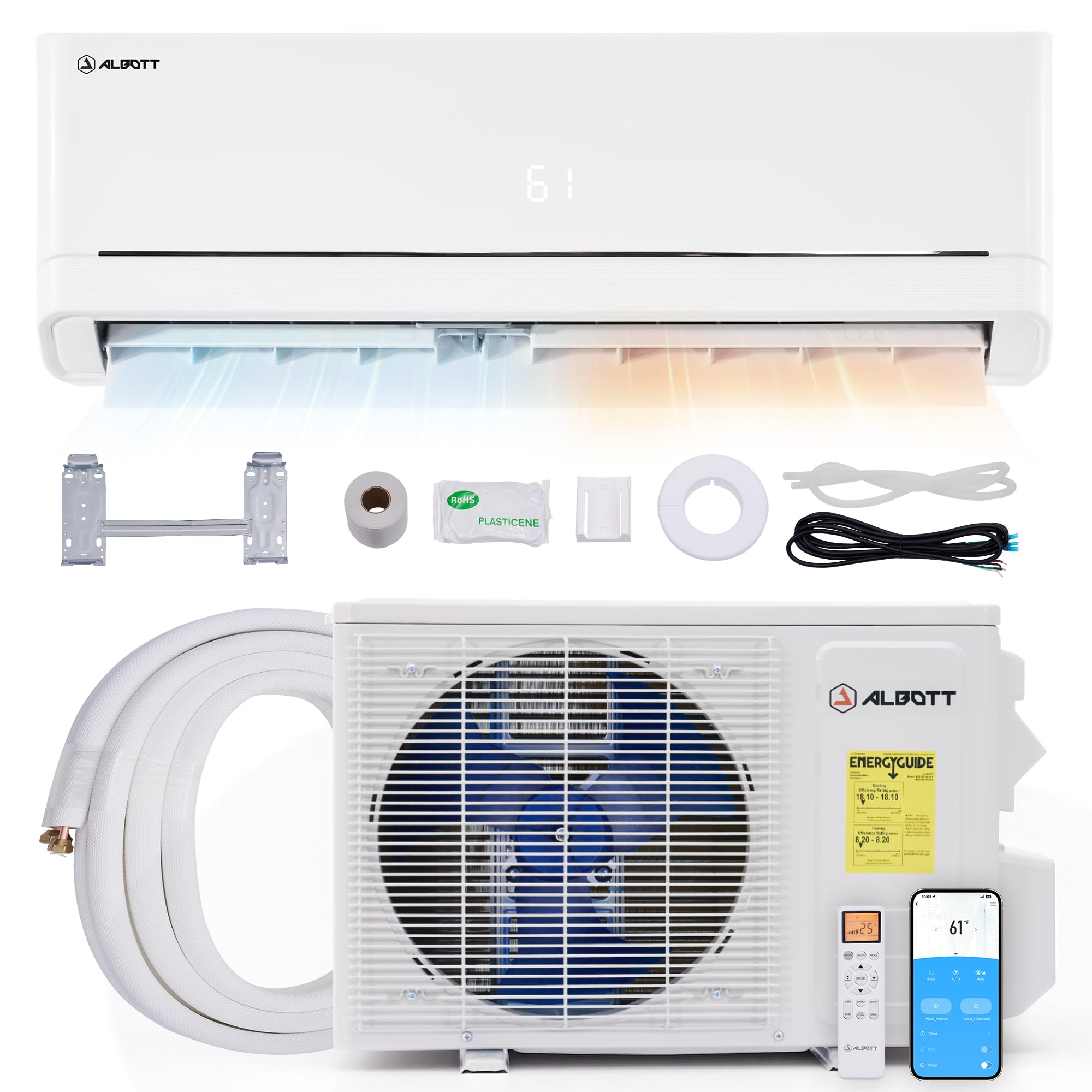
The Albott 12,000 BTU system stands out for two reasons: the 115V power requirement means it connects to a standard outlet through a dedicated 20-amp breaker, eliminating the need for expensive 240V electrical work, and the measured noise floor of 29dB makes it one of the quietest indoor units in the mid-range category. The inverter heat pump covers the full 61°F to 90°F range and operates in extreme ambient conditions from 5°F to 122°F, which is exceptional for a sub- system.
The SEER2 18 rating translates to roughly 25% less electricity consumption than a 14 SEER2 unit, and the rotary scroll compressor is built to handle the stress of DIY installations where precise vacuum may not be achieved on the first attempt. The self-cleaning function and easily removable air blades simplify maintenance, and the 12,000 BTU output easily chills a 750-square-foot insulated space. Owners consistently report that the cooling output feels significantly stronger than the window units they replaced.
The primary caveat is the installation: the unit does not include a rear protection grille for the outdoor condenser, and the 5-year compressor warranty requires proof of professional installation in some cases. The Wi-Fi functionality has been reported as unreliable by some users, so treat the smart features as a bonus rather than a core selling point. For a straightforward, high-performance 115V system, this is a strong pick.
Why it’s great
- 115V plug-in capability avoids expensive 240V electrical work
- 29dB noise floor is genuinely whisper-quiet for a 12k BTU unit
- Operates in extreme temperatures from 5°F to 122°F
Good to know
- No rear protection grille included for the outdoor condenser
- Wi-Fi and app control functionality has mixed reliability reports
- Installation requires separate purchase of Nylog and vacuum pump
3. DELLA Vario 18,000 BTU

The DELLA Vario Series 18,000 BTU unit delivers the rare combination of a verified 21 SEER2 rating with heat pump performance down to -4°F, making it a genuine four-season solution for colder climates. The DC inverter technology adjusts compressor speed in fine increments, maintaining the set temperature within one degree while drawing significantly less power than the fixed-speed alternatives that dominate the budget tier. The 1.5-ton system covers up to 1,000 square feet comfortably.
The 4D airflow system offers independent control of horizontal and vertical louvers, eliminating the hot and cold spots common with single-direction wall units. The I Feel mode shifts temperature sensing to the remote control, so the unit conditions the air around the user instead of the air around the wall-mounted sensor. The included 16.4-foot copper line set is pre-flared and insulated, and the drain pipe extends 78.7 inches to reach most condensate pump locations.
What truly separates DELLA from the competition is the customer support responsiveness — multiple owners report immediate replacement of defective indoor units without the typical runaround. The main downside is the hard-drawn copper tubing in the line set, which requires annealing before flaring if you need to shorten the lines for a custom installation. Professional installation is strongly recommended and required for warranty validity.
Why it’s great
- Verified 21 SEER2 with AHRI certification for legitimate efficiency
- I Feel mode senses temperature at the remote for personalized comfort
- Customer support is unusually responsive — indoor unit replacement without hassle
Good to know
- Hard-drawn copper lines require annealing before custom flaring
- Professional installation required for warranty — no DIY option
- Heating capacity drops noticeably below -4°F ambient temperature
4. YITAHOME 18,000 BTU
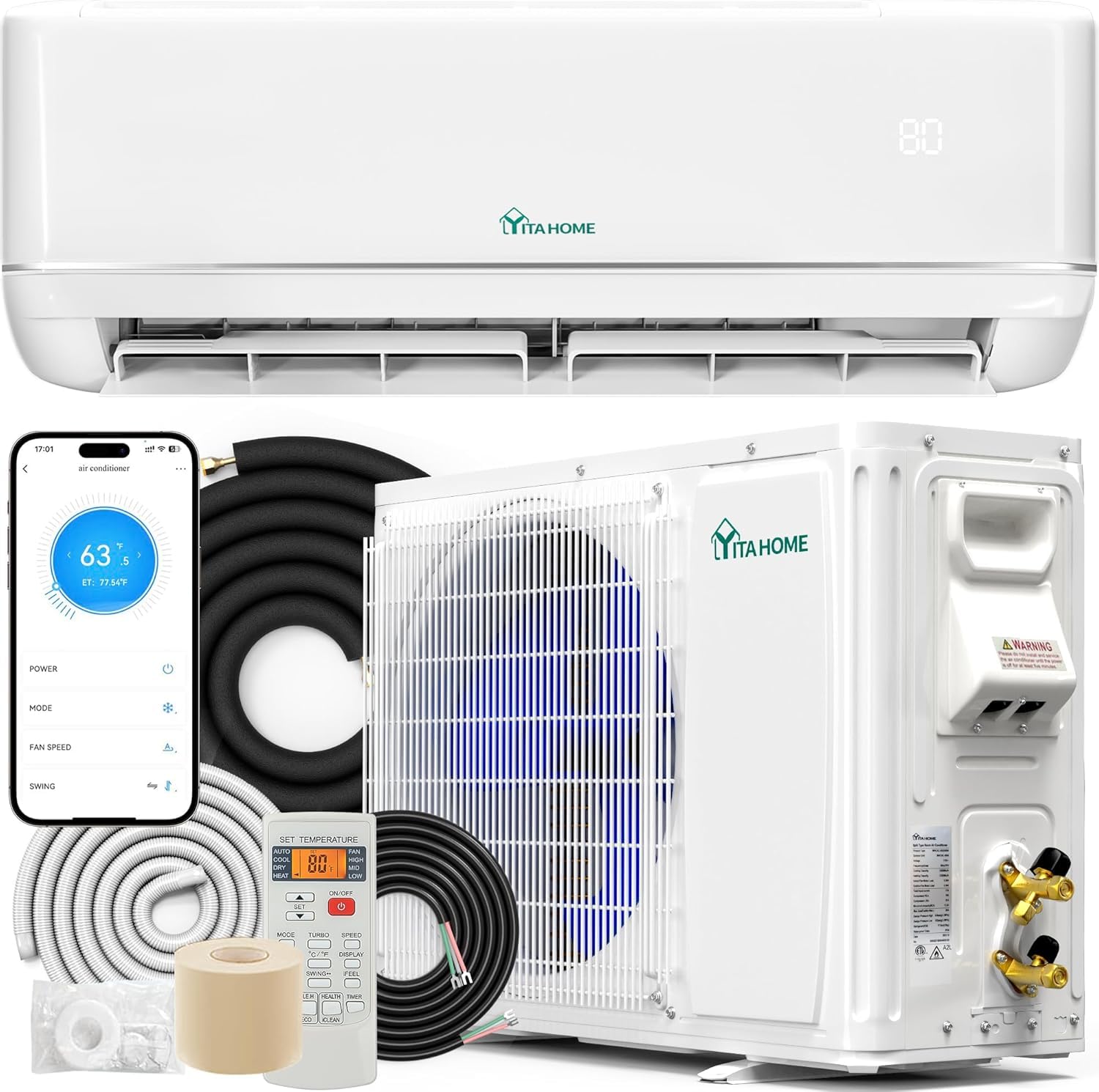
The YITAHOME 18,000 BTU system is engineered for larger single-zone spaces, covering up to 1,250 square feet with a 21 SEER2 rating that approaches premium-tier efficiency. The 1.5-ton inverter compressor uses R32 refrigerant, which has a Global Warming Potential of 675 — roughly one-third that of R410A — making this a more eco-conscious choice for buyers who care about refrigerant impact. The unit offers five modes (Auto, Cooling, Drying, Heating, Fan) and four fan speeds up to Turbo.
The self-cleaning function reaches 135°F, and the system includes an air purification filter with negative ion and electrostatic PM2.5 removal — a rare inclusion at this price point. The iFEEL mode mirrors the remote-sensing approach of premium brands, and the 4D air circulation distributes airflow up to 50 feet. The all-weather performance spans 5°F to 118°F, though owners in Texas summers report the ECO mode maintains temperature efficiently even during triple-digit heat.
The most significant limitation is the blower behavior — some owners report the indoor fan does not shut off when the set temperature is reached, leading to overcooling by several degrees. The Wi-Fi app setup instructions are notoriously poor, requiring patience to connect. The outdoor unit lacks a side protection grille, so mounting location needs to account for physical debris. For a budget-friendly large-coverage system, the performance per dollar is impressive.
Why it’s great
- Covers up to 1,250 square feet with 21 SEER2 efficiency
- R32 refrigerant with lower environmental impact than R410A
- Built-in air purification with PM2.5 and negative ion filtration
Good to know
- Indoor fan may continue running after set temp, causing overcooling
- Wi-Fi app setup is frustrating and poorly documented
- No side protection grille on outdoor condenser unit
5. Mountman 12,000 BTU
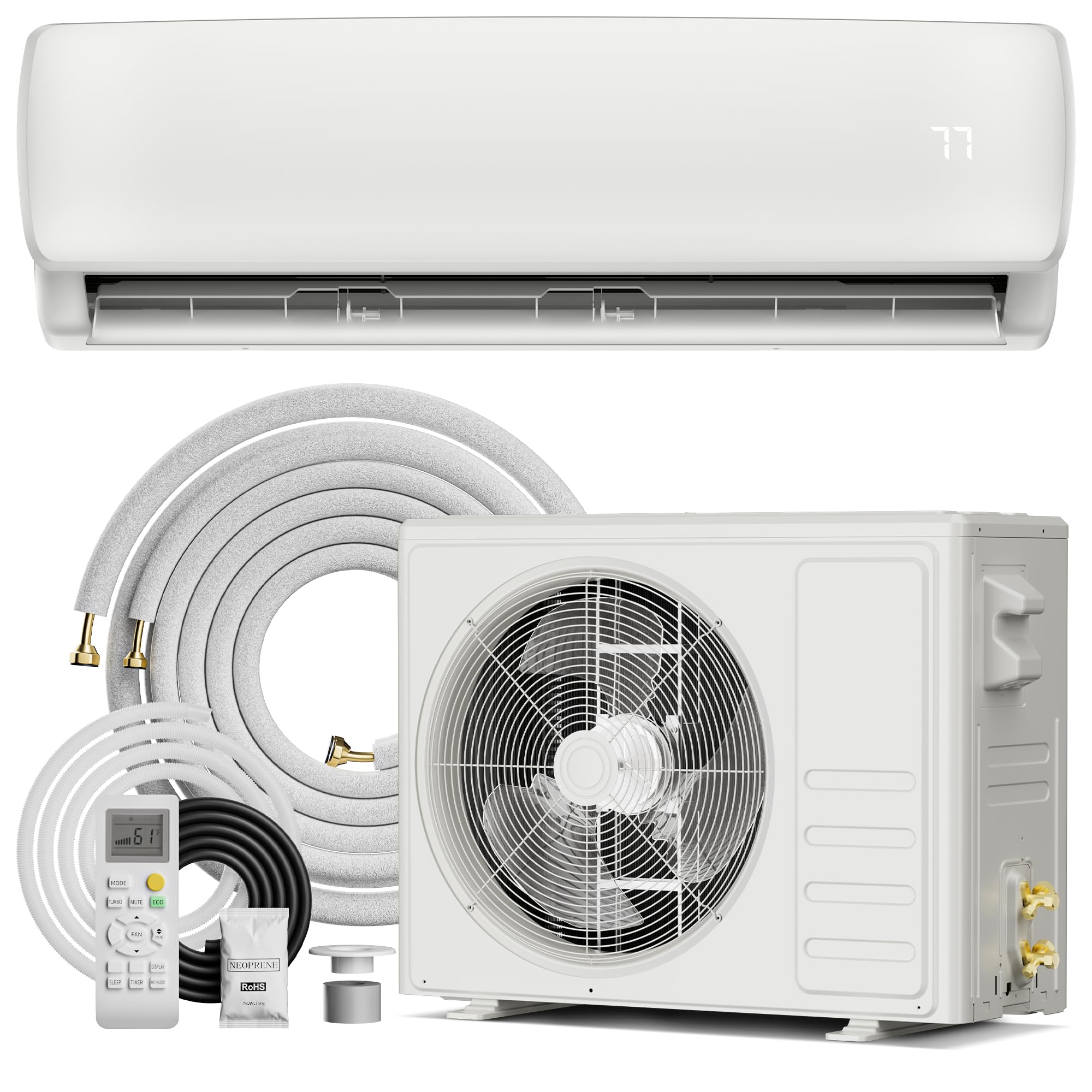
The Mountman 12,000 BTU mini split prioritizes acoustic comfort above all else, with a dedicated Sleep Mode that drops the indoor unit noise floor to 26dB — quieter than a library. The 19 SEER2 rating delivers strong efficiency without demanding the 240V circuit that higher-SEER units typically require, and the 110/120V power input makes this a viable option for rooms where running a new 240V line is impractical. The 12,000 BTU output covers up to 750 square feet with the rotary scroll inverter compressor.
The four operating modes (Cool, Heat, Dry, Fan) are supplemented by ECO mode, which claims up to 30% energy savings, and Turbo Boost for rapid temperature changes. The self-cleaning function and washable anti-dust filter reduce maintenance frequency, and the automatic defrost function intelligently activates during heating cycles to prevent coil icing. The 110/120V compatibility means owners have successfully used this unit in garages and workshops where only standard outlets exist.
Installation is straightforward for a handy DIYer, but the included manual is poorly translated and omits critical instructions for vacuum charging. The wall plate uses 12-inch mounting centers instead of the standard 16 or 20 inches, which may require additional wall anchors. Customer support responsiveness has been inconsistent. For buyers who prioritize bedroom and nursery silence over brand recognition, this is a compelling option.
Why it’s great
- Industry-leading 26dB noise floor in Sleep Mode for undisturbed rest
- 110/120V operation eliminates need for 240V electrical work
- ECO mode delivers up to 30% energy savings at partial load
Good to know
- Installation manual is poorly translated and missing vacuum procedures
- Wall mounting plate uses non-standard 12-inch center spacing
- Customer support is inconsistent in response time
6. Cooper & Hunter 18,000 BTU MIA Series

The Cooper & Hunter MIA Series 18,000 BTU unit is one of the most established names in the ductless mini split space, with a 19.2 SEER2 rating and a build quality that HVAC technicians consistently respect. The 1.5-ton system operates on 230V and includes a Smart Kit adapter for app and voice control — no separate purchase required. The 16-foot pre-flared copper line set, communication cable, and drainage extension provide enough length for most single-wall installations without splicing.
The inverter compressor is a rotary scroll design, which handles the stress of extreme temperature swings better than some twin-rotary alternatives. The system is ETL Intertek approved, UL Listed, and AHRI Certified, providing three layers of third-party validation that the efficiency claims are accurate. The indoor unit distributes air evenly through a wide louver that oscillates vertically and horizontally, and the noise level remains unobtrusive even in a bedroom environment.
The Achilles heel for some owners is the copper line set quality — a small number of units have experienced line set failures within the first year, and the warranty explicitly excludes the line set as an “accessory,” leaving owners responsible for repair costs. U.S.-based technical support is available and responsive, but the warranty limitation is a real consideration. For buyers who factor in build quality and brand longevity over the lowest possible upfront cost, this unit justifies its premium.
Why it’s great
- ETL, UL, and AHRI certified — triple-verified performance claims
- Smart Kit included for app and voice control without extra purchase
- U.S.-based technical support is genuinely helpful and responsive
Good to know
- Copper line set is treated as an accessory and excluded from warranty
- Some units have experienced premature line set failures
- Freight delivery only — carrier coordinates drop-off timing
7. Senville AURA 24,000 BTU

The Senville AURA Series 24,000 BTU system is designed for buyers who need reliable heating performance in climates where winter temperatures regularly drop below freezing. The Energy Star certified DC inverter maintains heat pump functionality down to -22°F, which is a full 17 degrees lower than most competing systems. The 21.5 SEER rating places this among the most efficient 2-ton units available, and the UL and AHRI certifications verify the performance claims.
The system draws only 3 to 4 amps per leg at 240V when running at partial load, making it significantly more energy-efficient than electric resistance heating during shoulder seasons. The included 16-foot line set and communication wire cover standard installations, though the power cable is noticeably shorter than the line set — you may need to source additional electrical cable for remote outdoor unit placement. The wall-mounted indoor unit is larger than average, which accommodates the larger heat exchanger needed for extreme cold performance.
Heating performance below 44°F requires patience — the unit can struggle to raise the temperature in multiple distant rooms from a single zone, and the defrost cycle activates more frequently in wet snow conditions. The Senville app is not available; voice control is routed through Alexa, which works reliably once set up. For a shop, large garage, or open-concept home in a cold climate, this is the most capable heating performer in the lineup.
Why it’s great
- Heat pump operates down to -22°F — best cold-weather performance here
- 21.5 SEER rating delivers exceptional efficiency for a 2-ton unit
- UL and AHRI certified for verified performance
Good to know
- Power cable is shorter than the 16ft line set — may need extension
- No dedicated Senville app — voice control is Alexa-only
- Indoor wall unit is physically larger than standard 2-ton heads
8. ROVSUN 11,500 BTU

The ROVSUN 11,500 BTU system brings Wi-Fi and Alexa/Google Assistant voice control to the mid-range at a price that undercuts most smart-enabled competitors by a wide margin. The 17 SEER2 rating is modest compared to the 19 and 21 SEER2 units in this guide, but the inverter compressor still delivers roughly 25% energy savings compared to a 14 SEER2 fixed-speed unit. The 115V power requirement means this connects to a standard 20-amp dedicated circuit — no expensive electrical panel upgrades needed.
The system includes automatic defrosting, self-diagnosis, a 24-hour timer, and ECO mode alongside the standard heating, cooling, dehumidification, and fan functions. The operating temperature range spans 5°F to 122°F, and the indoor unit runs at 29 dBa on low speed — genuinely quiet enough for a bedroom. Owners consistently report that the cooling output feels disproportionately powerful for the 11,500 BTU rating, likely because the inverter compressor delivers consistent airflow rather than cycling on and off.
The installation requires a dedicated 20-amp circuit with 12/2 wire, which a handy DIYer can run but a novice should hire out. Customer support responsiveness is a major red flag — multiple owners report zero response after weeks of trying to troubleshoot non-functional units. The Wi-Fi setup can be frustrating, and some units have failed completely within three weeks of installation. For buyers who accept the risk in exchange for smart features at the lowest possible entry price, this delivers.
Why it’s great
- Wi-Fi and Alexa/Google voice control at the lowest price point
- 115V on a 20-amp circuit — no 240V electrical work required
- 29 dBa low-speed operation is genuinely bedroom-quiet
Good to know
- Customer support is unresponsive to post-purchase issues
- Some units have failed completely within the first three weeks
- Wi-Fi app setup is finicky and sometimes non-functional
9. MRCOOL 24,000 BTU Advantage
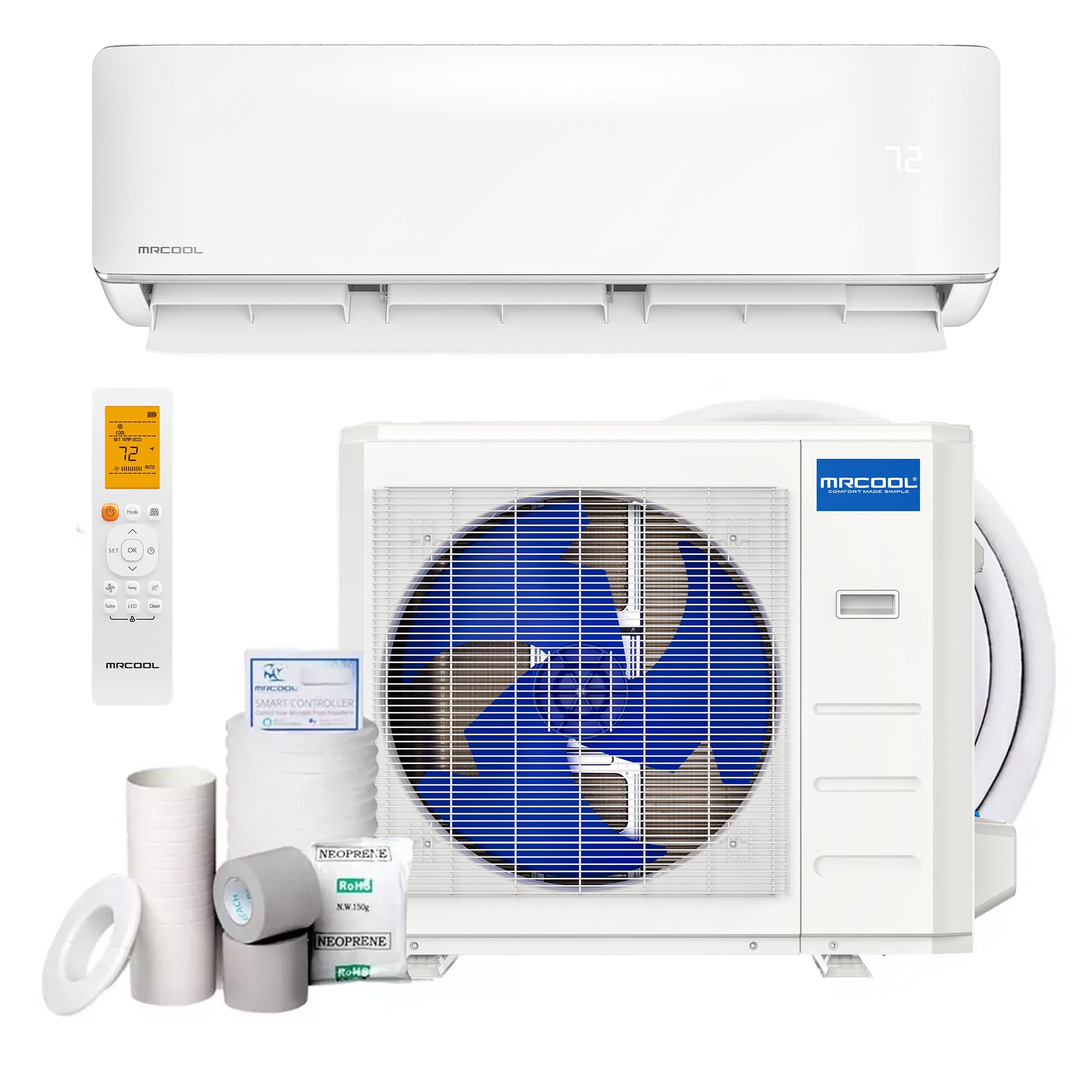
The MRCOOL Advantage Series 24,000 BTU system is the most recognized brand name in this comparison, and the build quality reflects years of ductless HVAC engineering. The 2-ton (24,000 BTU) capacity handles spaces up to 1,000 square feet with significant heat loads, including poorly insulated garages, home additions with large windows, and commercial workshop spaces. The 230V inverter compressor maintains steady temperature control without the energy spikes of a fixed-speed unit.
The system is Energy Star certified, and the 17 SEER rating is conservative compared to the competition — MRCOOL prioritizes reliability and parts availability over chasing the highest efficiency number. The included line set features spring-style bending supports that make routing around obstacles significantly easier than the unprotected copper lines on cheaper units. The washable filter is accessible without disassembling the indoor unit, and the remote control includes a large backlit display that is easy to read in dim workshop lighting.
The critical distinction for this unit: it is NOT the MRCOOL DIY series — this is a professional-install-only system. Owners who mistakenly buy this thinking it is the DIY model face expensive delays finding a technician willing to install customer-supplied equipment. Heating performance below 40°F is merely adequate; the unit goes into defrost mode frequently in wet cold, and maintaining 68°F in an uninsulated garage becomes challenging. For buyers with professional installation access who need proven durability, MRCOOL delivers.
Why it’s great
- MRCOOL is the most recognized brand with proven parts availability
- Spring-supported line set bends easily without kinking
- Energy Star certified with conservative but reliable 17 SEER rating
Good to know
- NOT a DIY model — professional installation is mandatory
- Heating efficiency drops off significantly below 40°F ambient
- Mounting bracket measurements in manual are ambiguous
10. Confortotal 12,000 BTU

The Confortotal 12,000 BTU mini split prioritizes simplicity above all else: it plugs directly into a standard 115V outlet with a dedicated 20-amp breaker, eliminating the electrical complexity that intimidates first-time mini split buyers. The 1-ton system covers up to 750 square feet with a rotary scroll inverter compressor, and the included Wi-Fi module is compatible with Alexa and Google Assistant — though the Smart Life app connection process can be finicky.
Owners consistently praise the dehumidification performance, with the unit pulling humidity from 60% down to 50% within an hour of operation in humid climates. The cooling output is described as “ice cold” by multiple reviewers, and the indoor unit is remarkably quiet for a budget-tier system — roughly 40dB, comparable to a low-setting ceiling fan. The ability to plug into an existing outlet makes this the most accessible entry point for DIY installation, assuming you have a vacuum pump, gauges, and Nylog for the flare connections.
The heating function is the weakest aspect — a significant number of owners report that the heat pump fails to produce warm air in heating mode, even at above-freezing outdoor temperatures. Customer support is largely unresponsive to these heating complaints, which represents a real risk for buyers who need year-round performance. For a strictly cooling application in a garage, shed, or summer bedroom, this is the most cost- effective option available.
Why it’s great
- Plugs into standard 115V outlet — no electrician required
- Excellent dehumidification — drops from 60% to 50% in one hour
- Cooling output is powerful and consistently described as “ice cold”
Good to know
- Heat pump frequently fails to produce warm air in heating mode
- Customer support is unresponsive to heating-related issues
- Wi-Fi app (Smart Life) connection process is finicky
11. Cooper & Hunter Dual 9,000 + 12,000 BTU

The Cooper & Hunter Dual Zone Olivia Series solves the single-zone limitation by connecting two independent air handlers — a 9,000 BTU unit and a 12,000 BTU unit — to a single 18,000 BTU outdoor condenser. This configuration allows separate temperature control for two rooms, such as living room and primary bedroom, without installing two complete outdoor units. The 22.5 SEER rating is the highest in this comparison, and the system is UL Listed, AHRI Certified, and Energy Star rated.
Each air handler includes a smart port adapter that connects to the Cooper & Hunter Remote app, allowing independent scheduling, temperature adjustment, and mode selection for each zone from a smartphone. The 25-foot pre-flared copper line sets and communication wires provide generous length for routing to separated rooms, and the whisper technology keeps each indoor unit unobtrusive. The system delivers heat pump performance down to -13°F, making it viable for cold climates.
The installation complexity is significantly higher than a single-zone system — not only does each line set need proper vacuum and flaring, but the refrigerant charge must be balanced for both zones, which requires professional calculation. The copper lines in the kit are 1/2-inch diameter and stiff, making routing around obstacles challenging. Finding an HVAC technician willing to install a customer-purchased dual-zone system can be difficult in some markets. For homeowners with two rooms that need independent conditioning, this is the most efficient single-outdoor-unit solution.
Why it’s great
- Two independent zones from one outdoor unit — saves exterior wall space
- 22.5 SEER rating is the highest efficiency in this comparison
- Heat pump operates down to -13°F for cold-climate usability
Good to know
- Installation is significantly more complex than single-zone systems
- 1/2-inch copper lines are stiff and difficult to route around obstacles
- Finding a technician to install customer-purchased dual zones can be hard
FAQ
Can I install a mini split myself without a license?
What size mini split do I need for a 1,000 square foot garage?
Why does my mini split blow cold air in heat mode when it’s below freezing?
How long does a mini split compressor typically last?
Should I buy a 115V or 230V mini split for my home?
Final Thoughts: The Verdict
For most users, the aire acondicionado mini split winner is the COSTWAY 12,000 BTU Airtural Series because it delivers a verified 21 SEER2 rating, self-cleaning functionality, and a 750-square-foot capacity at a mid-range price that undercuts premium competitors by hundreds of dollars. If you need extreme cold heating down to -22°F for a workshop or cold-climate home, grab the Senville AURA 24,000 BTU. And for a dual-zone whole-home solution without installing two outdoor units, nothing beats the Cooper & Hunter Dual Zone 9,000 + 12,000 BTU.