
Balancing an HVAC system or verifying fume hood performance without reliable airflow data is guesswork dressed as expertise. The difference between a comfortable building and a complaint log often comes down to a single decimal point on a vane or hot-wire sensor.
I’m Min — the co-founder and writer behind Gadgets Feed. This guide compiles hundreds of hours spent cross-referencing manufacturer datasheets, schematics, and user-reported accuracy benchmarks to identify the tools that deliver trustworthy velocity, volume, and temperature readings across commercial, industrial, and field-service environments.
Whether you commission lab certifications, fine-tune residential ductwork, or monitor environmental conditions for athletic safety, the right instrument changes how you diagnose air movement. Here is my analysis of the best airflow measurement device for every tier of professional need.
How To Choose The Best Airflow Measurement Device
Selecting the right airflow meter starts with understanding the physical environment you are measuring. A vane anemometer excels in grille and register face velocities where the air stream is fully developed, while a hot-wire sensor handles low-velocity duct traverses with less turbulence error. The decision also hinges on whether you need differential pressure for building envelope diagnostics or simply a spot-check velocity reading.
Sensor Type: Vane vs. Hot-Wire vs. Pitot
Vane anemometers use a rotating impeller to measure airflow — they are robust, easy to clean, and accurate above 50 FPM but struggle in very low velocity or obstructed ducts. Hot-wire sensors detect air movement by measuring heat dissipation from a heated element; they handle velocities as low as 0 FPM and work well in tight spaces, though the wire is fragile and susceptible to dust buildup. Pitot tubes measure differential pressure and are the standard for high-velocity duct traverses, but they require a manometer and straight duct runs for reliable readings.
Key Metrics: Accuracy, Range, and Resolution
Look for a stated accuracy of ±3% of reading or better. The measurement range must cover your application — residential supply registers rarely exceed 800 FPM, while industrial exhaust stacks can push 5,000 FPM. Resolution matters for low-velocity work: a device that resolves 0.001 m/s is essential for lab fume hood face velocity checks, whereas 0.1 m/s is adequate for general HVAC balancing.
Data Logging and Connectivity
For commissioning reports or archival tracking, choose a meter with Bluetooth or USB data export. The ability to store timed/multipoint averages directly on the device saves hours compared to manual recording. Wireless probes like the Testo 405i stream real-time graphs to a smartphone app, which is invaluable for monitoring transient flow behavior during system startups.
Quick Comparison
On smaller screens, swipe sideways to see the full table.
| Model | Category | Best For | Key Spec | Amazon |
|---|---|---|---|---|
| AOPUTTRIVER AP-846A | Mid-Range Vane | Cost-effective HVAC balancing | 0.001–100 mph range | Amazon |
| Testo 410i | Premium Wireless Vane | Smart multi-point averaging | Bluetooth 4.0, ±0.4% accuracy | Amazon |
| Testo 405i | Mid-Range Hot-Wire | Low-velocity duct traverses | 15″ telescoping shaft | Amazon |
| Fieldpiece AAV3 | Premium Vane Accessory | Modular field-service toolkit | Oversized vane head | Amazon |
| Kestrel 3000 | Premium Pocket Weather | Outdoor & heat stress monitoring | IP-67 rated, MIL-STD-810G | Amazon |
| Fieldpiece STA2 | Premium In-Duct Hot-Wire | Professional air balancing | 38″ telescoping probe | Amazon |
| Fluke 922 | Premium Multi-Function | Pressure + velocity combo diagnostics | 2-year warranty, manometer included | Amazon |
In‑Depth Reviews
1. AOPUTTRIVER AP-846A

The AOPUTTRIVER AP-846A delivers a 0.001–100 mph measurement span with ±3% accuracy, making it a strong entry point for residential HVAC balancing and basic duct verification. The 1.69 x 2.3-inch backlit display shows wind speed in five selectable units and includes a dedicated CFM mode that calculates volumetric flow based on user-entered duct area. Users report readings within 4% of a flow hood after proper setup, which is impressive for a device at this level.
Practical features include a data hold function, MAX/MIN/AVG recording, and an auto power-off after five minutes of inactivity. The unit ships with a 9V battery and a two-year technical support commitment from the manufacturer. The built-in vane is sensitive enough to register low air movement from a small desk fan, yet robust enough for standard supply register checks. The temperature sensor reads from 32 to 113°F and can be toggled between Celsius and Fahrenheit.
The biggest drawback is the user manual, which multiple customers describe as poorly translated and difficult to follow. The accompanying software for data recording does not function reliably on Windows 10 or XP. For technicians who prefer a straightforward handheld meter without needing app connectivity or advanced averaging routines, this model offers an honest value. The CFM calculation accuracy depends entirely on the duct area you input, so take the time to measure properly.
Why it’s great
- 0.001 mph resolution enables low-velocity detection
- CFM mode with area input for volumetric estimation
- Direct comparison to a flow hood within 4% accuracy
Good to know
- Poorly written user manual complicates setup
- Data software not compatible with Windows 10 or XP
2. Testo 410i

The Testo 410i is a smart vane anemometer probe that pairs via Bluetooth 4.0 to a smartphone or tablet running the Testo Smart Probes app. It measures air velocity, volume flow, and temperature, and automatically calculates volume flow once you enter duct dimensions through the app. The timed and multipoint averaging function delivers accurate airflow profiles across grilles and registers, which is essential for proper system balancing.
Multiple 410i probes can be used simultaneously to measure volume flow at several points in a system, enabling real-time comparison across zones. The design is compact at 6.06 x 1.69 x 0.83 inches and weighs only 276 grams, so it fits in a standard tool pouch. The app allows graphing, data storage, and report generation, though some users note the app occasionally disconnects and lacks notification for software updates.
This is not a replacement for a calibrated flow hood on large commercial diffusers, but it provides a reliable rough estimate for supply duct diagnostics. The build quality feels premium, and the probe connects seamlessly to the app every time. For technicians who want to modernize their toolkit with wireless data capture and avoid manual note-taking, the 410i is a strong upgrade.
Why it’s great
- Wireless multipoint averaging for accurate profiles
- Compatible with Testo Smart Probes app for data logging
- Simultaneous measurement with multiple probes
Good to know
- App can disconnect randomly from the probe
- Not a substitute for a certified flow hood on large diffusers
3. Testo 405i

The Testo 405i uses a hot-wire sensor to deliver precise in-duct airflow measurements even at very low velocities where vane anemometers struggle. The hinged telescopic shaft extends up to 15 inches, allowing the sensor to reach deep into ducts, vents, and confined spaces without disturbing the airflow upstream. This is especially valuable for residential supply runs and minisplit unit checks where access is limited.
It connects to a smartphone via Bluetooth 4.0 and displays velocity, temperature, and calculated volume flow through the Testo Smart Probes app. The app plots data in real-time as tables and graphs, and all collected measurements can be saved, exported, or included in custom reports. The device runs on three AAA batteries, and users report several hours of field use on a single set. The measurement accuracy is rated at ±0.9°F for temperature.
The hot-wire bulb is sensitive to dust and debris accumulation, which can drift readings over time if not cleaned regularly. Some users also note the probe cannot be easily mounted to standard tube fittings like Swagelok, limiting its use for fixed test setups. Despite these quirks, the 405i has become a go-to for dust collection system balancing and fume hood spot-checks between annual certifications.
Why it’s great
- Hot-wire sensor for accurate low-velocity measurements
- 15″ telescoping shaft reaches deep into ducts
- Bluetooth streaming to smartphone app for graphing
Good to know
- Hot-wire bulb prone to dust buildup
- No standard mounting thread for stationary experiments
4. Fieldpiece AAV3
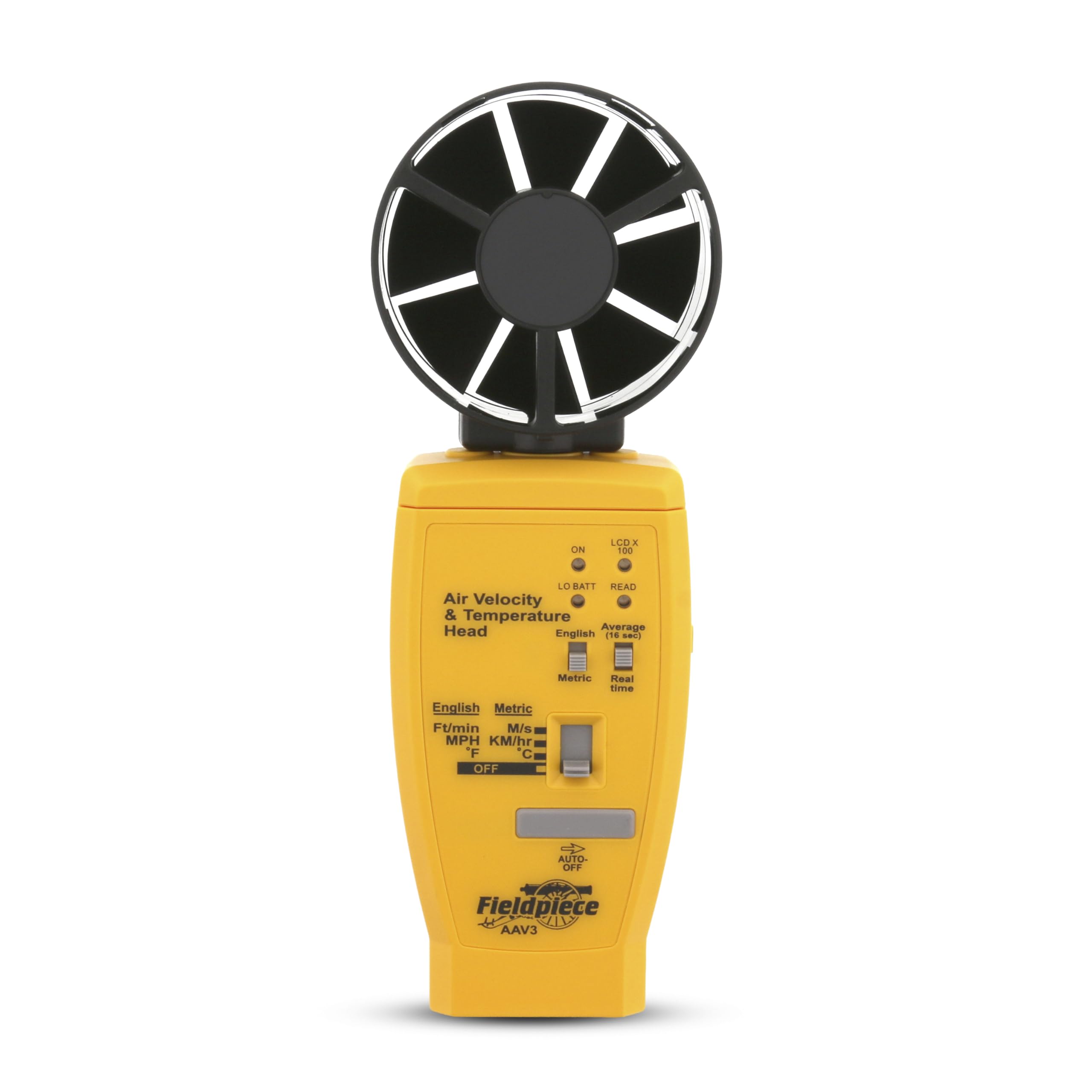
The Fieldpiece AAV3 is an air velocity and temperature accessory head that attaches to the Fieldpiece modular “stick” meter system. It measures airflow in feet per minute, meters per second, mph, and km/h, with a temperature readout in °F or °C. The oversized vane design captures more air across registers, improving reading consistency compared to smaller sensor heads. The real-time and average measurement modes provide stable data during HVAC commissioning.
The unit is built from unusually durable plastic and feels substantial in the hand — not a light piece of consumer equipment but a genuine field-service tool. Fieldpiece has supported the same stick meter platform for years, so users can swap heads without buying entire new instruments. The auto power-off and low battery indicator help preserve battery life during long service calls.
Because this is an accessory head rather than a standalone meter, you need a compatible Fieldpiece base meter to use it. The lack of built-in data logging means all recording must happen on the base instrument. For technicians already invested in the Fieldpiece ecosystem, this is an excellent expansion that adds airflow diagnostics without the cost of a dedicated anemometer. New adopters should factor in the cost of the base meter.
Why it’s great
- Oversized vane for more consistent register readings
- Modular — works with Fieldpiece stick meters
- Durable plastic built for daily field use
Good to know
- Requires compatible Fieldpiece base meter
- No built-in data logging on the head
5. Kestrel 3000

The Kestrel 3000 is a rugged, pocket-sized weather meter that measures wind speed, heat stress index, relative humidity, dew point, temperature, and wind chill. The large replaceable impeller, responsive temperature sensor, and temperature-corrected humidity chamber deliver NIST-certified accuracy. The unit is waterproof to IP-67, floats, and has been drop-tested to MIL-STD-810G, making it suitable for construction sites, outdoor athletic events, and agricultural monitoring.
The clear LCD display shows current, average, and maximum wind speeds, and the slip-on protective cover includes a lanyard for hands-free carrying. The CR2032 coin cell battery provides up to five years of typical use. Users specifically highlight its performance in extreme environments like Death Valley for ultramarathon support, where it reliably logged heat stress data in 120°F conditions.
The temperature sensor has a noticeable delay — it takes up to two minutes to stabilize after moving to a new location, and stirring the unit reduces that time. The Kestrel also lacks data logging, meaning you must manually record readings. For safety officers, coaches, and farmers who need a portable environmental sensor rather than an HVAC duct tool, this is the gold standard. The five-year warranty adds peace of mind.
Why it’s great
- IP-67 waterproof and MIL-STD-810G drop-rated
- NIST-certified measurements for regulatory compliance
- 5-year battery life on a single coin cell
Good to know
- Temperature sensor requires up to 2 minutes to stabilize
- No data logging or Bluetooth connectivity
6. Fieldpiece STA2
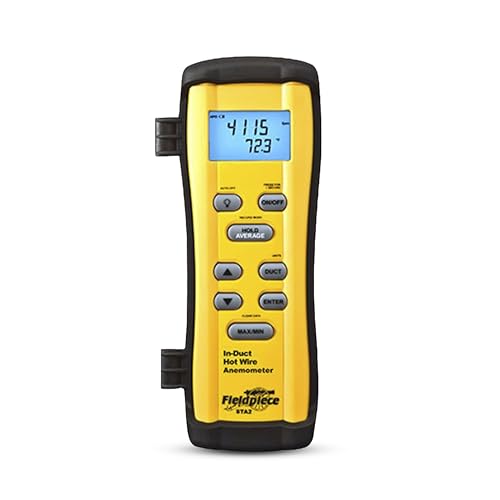
The Fieldpiece STA2 is a dedicated in-duct hot-wire anemometer designed specifically for HVAC air balancing professionals. Its 38-inch telescoping probe with laser-etched depth markings ensures accurate positioning during duct traverses, allowing you to measure velocity, temperature, and calculate CFM directly inside round and rectangular ducts without a bulky capture hood. The dual display shows airflow and temperature simultaneously, speeding up on-site diagnostics.
The tool includes a stabilizing cone and a magnetic hanger for hands-free operation, while the averaging function helps mitigate turbulence errors inherent in in-duct measurements. Users report that after a short learning curve, they were able to deliver more accurate service call results and diagnose low-flow minisplit units that were impossible to check with a hood. The STA2 runs on a single 9V battery and includes auto power-off for battery conservation.
The device is not as accurate as a certified flow hood for large commercial diffusers, but it consistently delivers readings within 90% of hood accuracy with far greater convenience. The learning curve involves understanding proper probe placement and traverse patterns to avoid turbulence-induced error. For technicians who regularly balance residential and light commercial systems, the STA2 replaces the need to haul heavy hoods into crawlspaces and attics.
Why it’s great
- 38″ telescoping probe with depth markings for accurate traverses
- Hands-free magnetic hanger for in-duct use
- Averaging function reduces turbulence error
Good to know
- Requires practice to master traverse technique
- Less accurate than flow hood on large commercial diffusers
7. Fluke 922
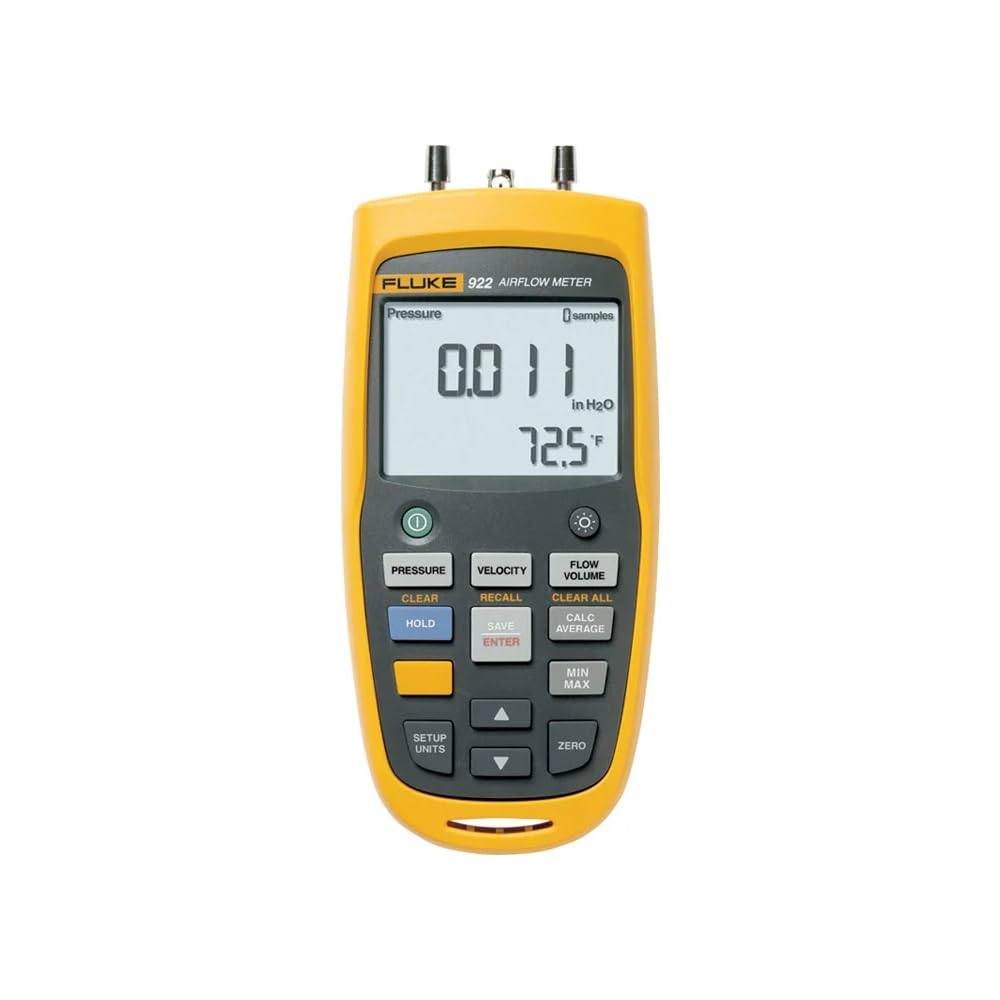
The Fluke 922 combines an airflow meter with a differential pressure manometer in a single rugged package. It measures pressure drops across filters, coils, and dampers, calculates air velocity and volume flow from pressure readings, and monitors indoor versus outdoor pressure relationships. This makes it an ideal tool for building envelope diagnostics, ventilation optimization, and checking filter loading without needing separate instruments.
The device includes automatic frequency control for stable readings, adjustable limits for faster pass/fail testing, and a two-year warranty. It weighs 0.69 kilograms and measures 2.99 x 9.17 x 5.98 inches — portable enough for daily carry. Users appreciate its ease of use and reliability in harsh environments, though some note the temperature sensor has a slight offset (reads 62 at a true 60°F), making differential temperature measurements less precise.
For federal and EPA work requiring NIST traceability down to 0.001″ WC, some users prefer the Inflitec brand. The Fluke 922 also serves as a viable backup to expensive Shortridge hoods. If your work involves filter pressure drop, space pressurization, and ventilation audits, this combined instrument saves tool pouch space. It is the most expensive unit here, but the dual functionality justifies the investment for serious HVAC diagnosticians.
Why it’s great
- Combines airflow meter and manometer in one tool
- Monitors filter pressure drops and building envelope
- 2-year warranty and rugged Fluke build quality
Good to know
- Temperature sensor offset may affect differential temp readings
- Not NIST traceable to 0.001″ WC for EPA compliance
FAQ
Can an airflow measurement device replace a certified flow hood for TAB work?
What is the difference between a hot-wire and a vane anemometer?
Final Thoughts: The Verdict
For most users, the best airflow measurement device winner is the Testo 405i because its hot-wire sensor and 15-inch telescoping probe handle everything from duct traverses to fume hood spot-checks with smartphone app integration. If you want a rugged outdoor meter that doubles as a heat stress monitor, grab the Kestrel 3000. And for professional in-duct air balancing without lugging a flow hood, nothing beats the Fieldpiece STA2.