
Flying at altitude inside a pressurized aluminum tube, the air you breathe is a precise blend of engine bleed air and recirculated cabin atmosphere. When a faulty seal, a leaking hydraulic fluid line, or a cracked engine compressor sends carbon monoxide into that air supply, the effects are insidious — headache, disorientation, cognitive fog, and before you know it, unconsciousness. The cabin pressurization system masks these symptoms because altitude itself causes mild hypoxia, and the two conditions feel eerily similar. A dedicated sensor is your only early warning system.
I’m Min — the co-founder and writer behind Gadgets Feed. I’ve spent countless hours dissecting electrochemical sensor datasheets, cross-referencing UL 2034 certification revisions, and combing through field reports from pilots, RV travelers, and backcountry campers to identify which portable detectors actually deliver reliable readings in the tight, vibration-prone environment of a small aircraft cabin.
The choice narrows to a handful of portable units that balance sensor accuracy, alarm audibility over engine noise, and battery endurance for multi-leg days. This guide cuts through the spec sheet clutter to help you find the right best airplane co detector for your specific flying mission and risk tolerance.
How To Choose The Best Airplane CO Detector
Picking a CO monitor for aviation requires weighing a few distinct factors that a household alarm simply ignores. The sensor type, alarm threshold, battery endurance, and physical durability all matter differently when your life depends on a device clipped to a kneeboard or seat pocket at 10,000 feet.
Sensor Technology — Electrochemical Is Non-Negotiable
Electrochemical cells detect CO by measuring a chemical reaction current that scales linearly with gas concentration. They resist the humidity swings and temperature gradients found in a cockpit far better than cheaper metal-oxide semiconductor sensors. Look for a sensor rated for linear accuracy across 0–500 ppm, with a stated lifespan of at least three years under periodic use.
Alarm Threshold — Low-Level vs. Mandatory Evacuation
UL 2034 home alarms trigger around 70 ppm after 60 minutes. In an airplane, prolonged exposure to 35 ppm can already degrade cognitive performance. Premium portable detectors let you set a pre-alarm at 10–20 ppm, giving you time to troubleshoot — such as checking cabin heat or adjusting vents — before reaching the 200 ppm evacuation threshold.
Battery and Power Considerations
A detector that dies mid-route is useless. Rechargeable units with at least 10 hours of continuous runtime cover a full day of flying. Swappable AA or CR123 options offer contingency if you cannot access a power outlet between legs. Units with low-battery visual warnings prevent you from starting a flight with a blind sensor.
Quick Comparison
On smaller screens, swipe sideways to see the full table.
| Model | Category | Best For | Key Spec | Amazon |
|---|---|---|---|---|
| Sensorcon INS-CO-02 | Premium Portable | Full-Day Cockpit Monitoring | IP67, 0–1999 ppm, 35/200 ppm alarms | Amazon |
| Sensorcon Inspector 2 Kit | Professional Kit | HVAC & Pre-Flight Inspection | Pump-probe, 80–85 dB, 200 ppm ceiling | Amazon |
| Forensics Detectors FD CO | Pro Travel | Low-Level Detect & NIST Calibration | 0–1000 ppm, rechargeable 10 hr, NIST cert. | Amazon |
| TopTes Guard-533 | Value Portable | Backcountry Camping & GA Flying | 120 hr standby, back clip, 999 records | Amazon |
| HEIMAN C1-R 3-Pack | Cabin Placement | Home Hangar & Multi-Point Safety | FIGARO TGS5141, 10 yr sensor, 85 dB | Amazon |
| Kidde Smart CO Alarm | Smart Hybrid | Connected Hangar & IAQ Monitoring | Wi-Fi, IAQ, AA backup, UL 2034 5th Ed. | Amazon |
| MSA ALTAIR 4XR | Industrial Multigas | Confined Space & Multi-Gas Safety | O2, H2S, CO + LEL, IP68, 24 hr run | Amazon |
In‑Depth Reviews
1. Sensorcon INS-CO-02 Industrial CO Monitor
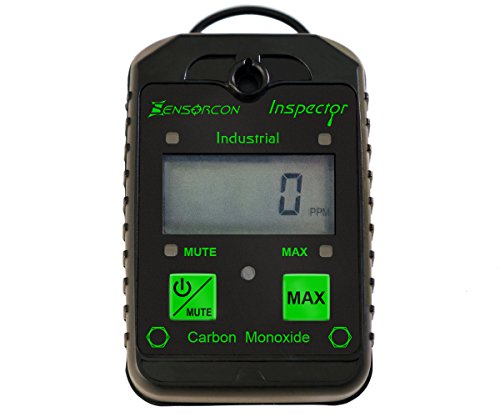
The Sensorcon INS-CO-02 is the gold standard for pilots who need a continuous, real-time CO reading without fiddling with menus or phone apps. Its true 0–1999 ppm range and instant LCD display mean you see a number, not just a traffic-light green-to-red indicator. The device runs on a single user-replaceable CR123 battery that lasts up to two years under normal use — a massive advantage over rechargeable units that require mid-trip recharging.
Durability is a clear strong suit. The IP67 rating means rain, snow, or a spilled water bottle inside the cockpit won’t compromise the sensor. The vibrating alert combined with a 70 dB audible alarm ensures you catch warnings even with a headset on or engine noise at cruise RPM.
The main caveat is the default high alarm threshold of 70 ppm, which matches UL 2034 standards but may feel too high for pilots who want early warning at 10–20 ppm. The low-level alert kicks in at 35 ppm, so you do get intermediate notice, but the absence of a user-customizable pre-alarm may leave some safety-conscious flyers wanting more granularity.
Why it’s great
- True 0–1999 ppm continuous readout with 1 ppm resolution
- Two-year battery life on one CR123 cell
- IP67 waterproof, MIL-STD-810G drop-rated
Good to know
- High alarm fixed at 70 ppm; no sub-35 ppm pre-alarm
- No backlight on the display for night flying
2. Sensorcon Inspector 2 CO Detector Kit
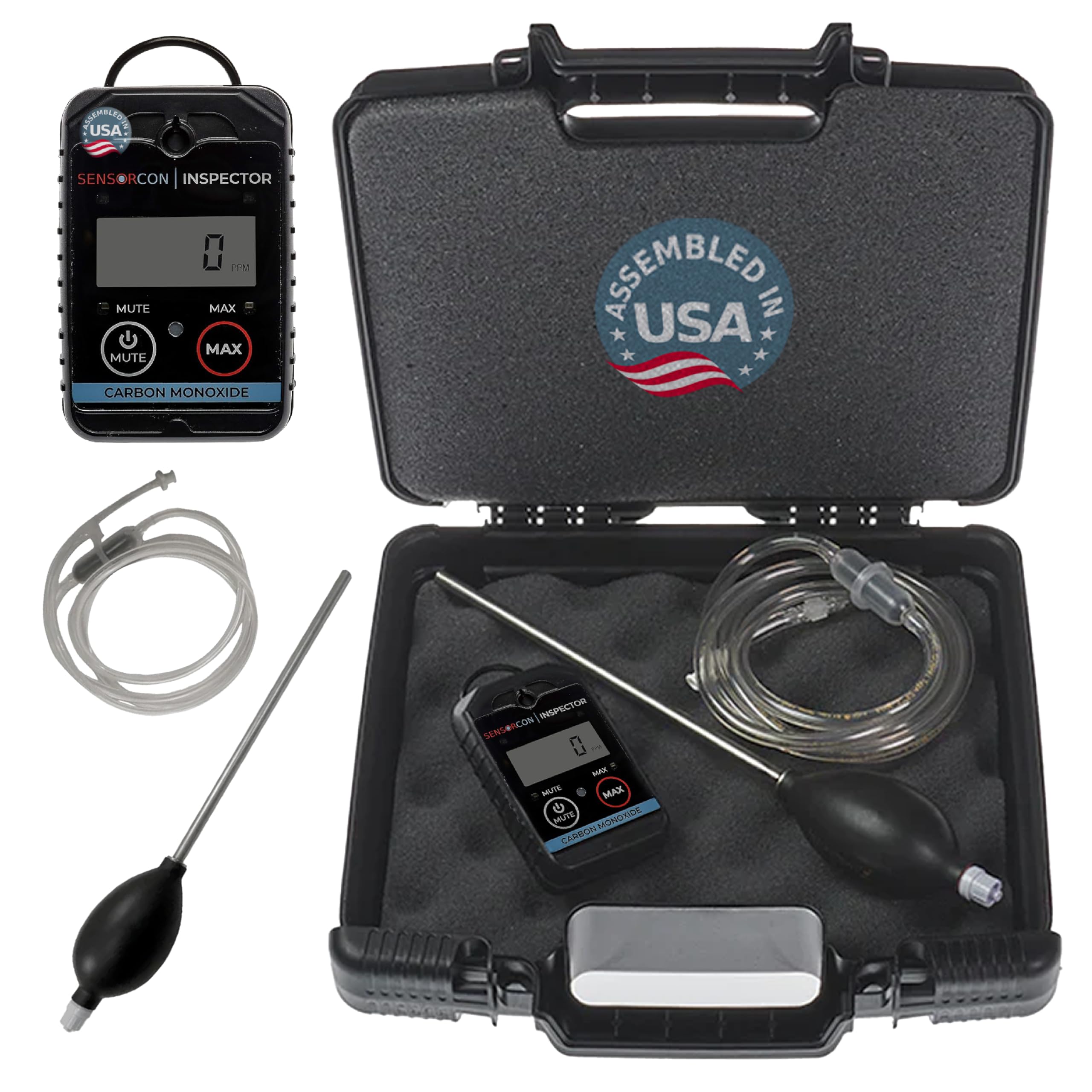
The Inspector 2 Kit takes the core Sensorcon CO monitor and adds a hand-pump sampler and flexible probe, turning it into a tool for spot-checking exhaust vents, cabin heat exchangers, and engine compartments. For the serious pilot-owner who also flies pre-buy inspections, this kit eliminates guesswork when sniffing for CO leaks in hard-to-reach spots behind the panel or around the muffler shroud.
Alarm thresholds are pre-set at 35 ppm low-level and 200 ppm ceiling — the same logic the standalone unit uses, but the probe attachment allows targeted sampling rather than relying on ambient diffusion. The IP67-rated monitor itself remains fully waterproof and shock-resistant, and the hard-shell storage case keeps everything organized between flights. Home inspectors and HVAC techs regularly praise its real-time response versus averaging-type household detectors.
On the downside, recovery after high-concentration exposure can be slow. Some users found that power-cycling the unit at the countdown-2 mark speeds the return to baseline. The lack of a display backlight also persists here, which can be a minor annoyance in a dim cockpit or hangar bay.
Why it’s great
- Pump-probe for targeted exhaust and cabin heat inspection
- IP67-rated monitor survives dust and spray
- Pre-set 35/200 ppm thresholds match professional safety standards
Good to know
- Slow sensor recovery after high-CO hits
- No backlight or vibrating alarm on the base unit
3. Forensics Detectors Carbon Monoxide Meter

The Forensics Detectors CO meter stands out for its factory NIST traceable calibration certificate — a document that matters if you ever need to defend your readings in a maintenance dispute or incident report. The 0–1000 ppm span with 1 ppm resolution covers the entire range you would ever encounter in a piston single or turboprop cabin, and the ±5% FS error rating gives you reliable trend data.
Its multi-alarm system — adjustable audio, visual, and vibration — lets you set a low-level pre-alarm as low as 1 ppm, far below the 35–70 ppm thresholds of most competitors. This makes it invaluable for pilots who want to catch a developing CO leak at the earliest possible stage. The internal 1500 mAh Li-Ion battery provides about 10 hours of continuous run time, enough for a full day of flying, and recharges via micro-USB.
Keep in mind the sensor lifespan is roughly 2–3 years, and the manual recommends recalibration every six months if you use it for professional work. The micro-USB port feels dated in a USB-C era, and some users noted the belt clip can feel flimsy compared to the rugged Sensorcon units. Still, for low-level detection at a mid-range price, this unit is tough to beat.
Why it’s great
- NIST calibration certificate included with each unit
- Adjustable pre-alarm as low as 1 ppm
- Rechargeable 1500 mAh battery for all-day flying
Good to know
- 2-3 year sensor life before requiring replacement
- Micro-USB charging instead of USB-C
4. TopTes Guard-533 Portable CO Detector
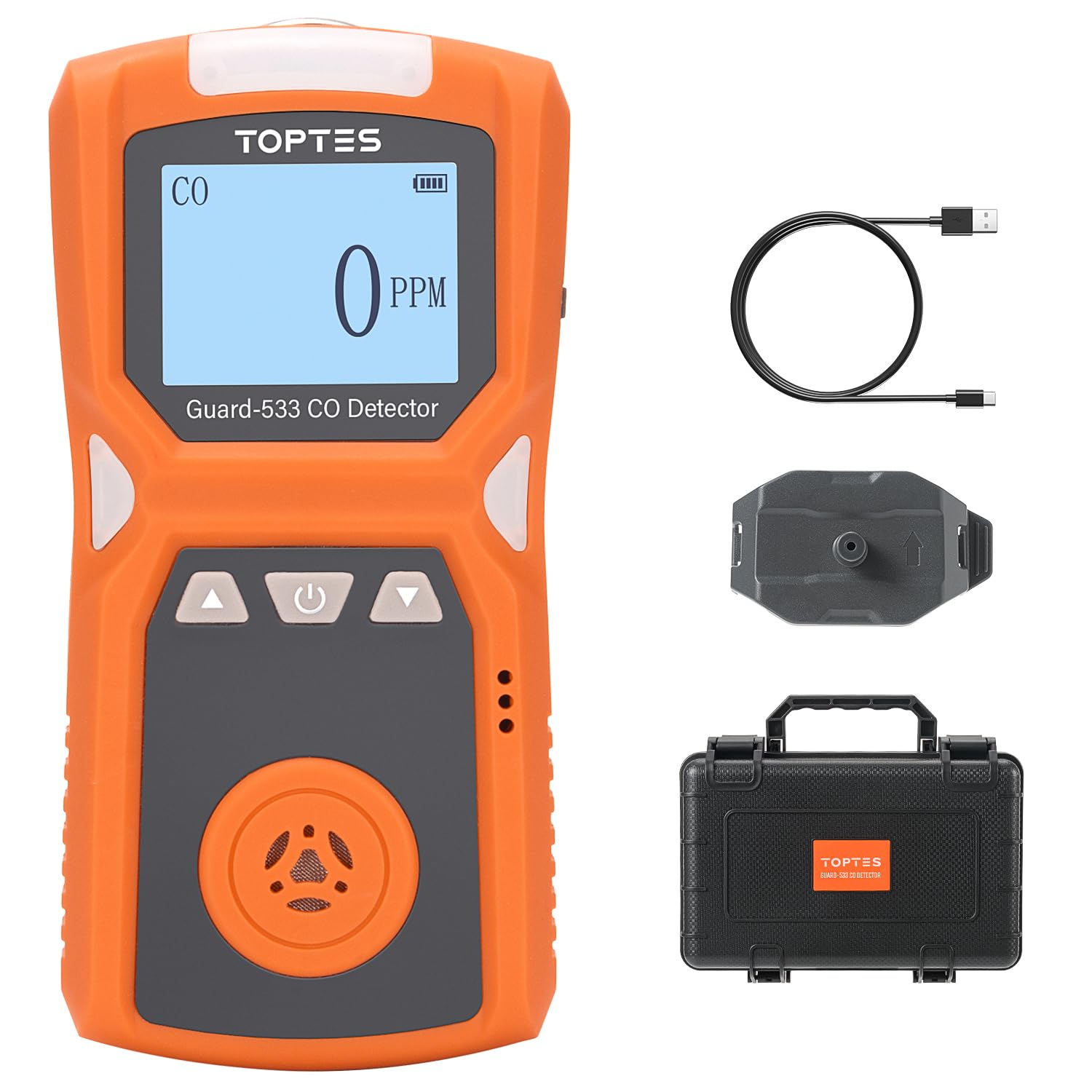
The TopTes Guard-533 is a strong entry-level choice for GA pilots who want a dedicated CO sensor without spending premium-tier money. Its 120-hour standby time means you can leave it powered on for multiple flight days without worrying about charging, and the back clip design lets you attach it to a kneeboard, seat pocket, or flight bag strap for hands-free use during pre-flight checks.
Triple alert modes — visual, audible, and vibration — cover the same bases as more expensive units. The automatic record storage (up to 999 events) is a feature usually reserved for industrial-grade detectors, giving you a digital log you can review after landing to see peak CO exposure. The explosion-proof housing adds a layer of safety if you ever use it near fuel vapors during pre-flight.
Downsides include a confusing user manual that makes initial configuration unnecessarily difficult, and a mini-USB charging port that feels fragile. One unit arrived with a broken charging-port flap out of the box, raising some build-quality concerns. Still, for the price, it offers an impressive feature set for the budget-conscious aviator.
Why it’s great
- 120-hour standby battery for multi-leg trips
- Back clip for easy mounting on kneeboard or pocket
- Automatic storage of up to 999 alarm events
Good to know
- Mini-USB charging port with fragile flap
- Manual is dense and hard to follow for first-time users
5. HEIMAN C1-R CO Detector 3-Pack
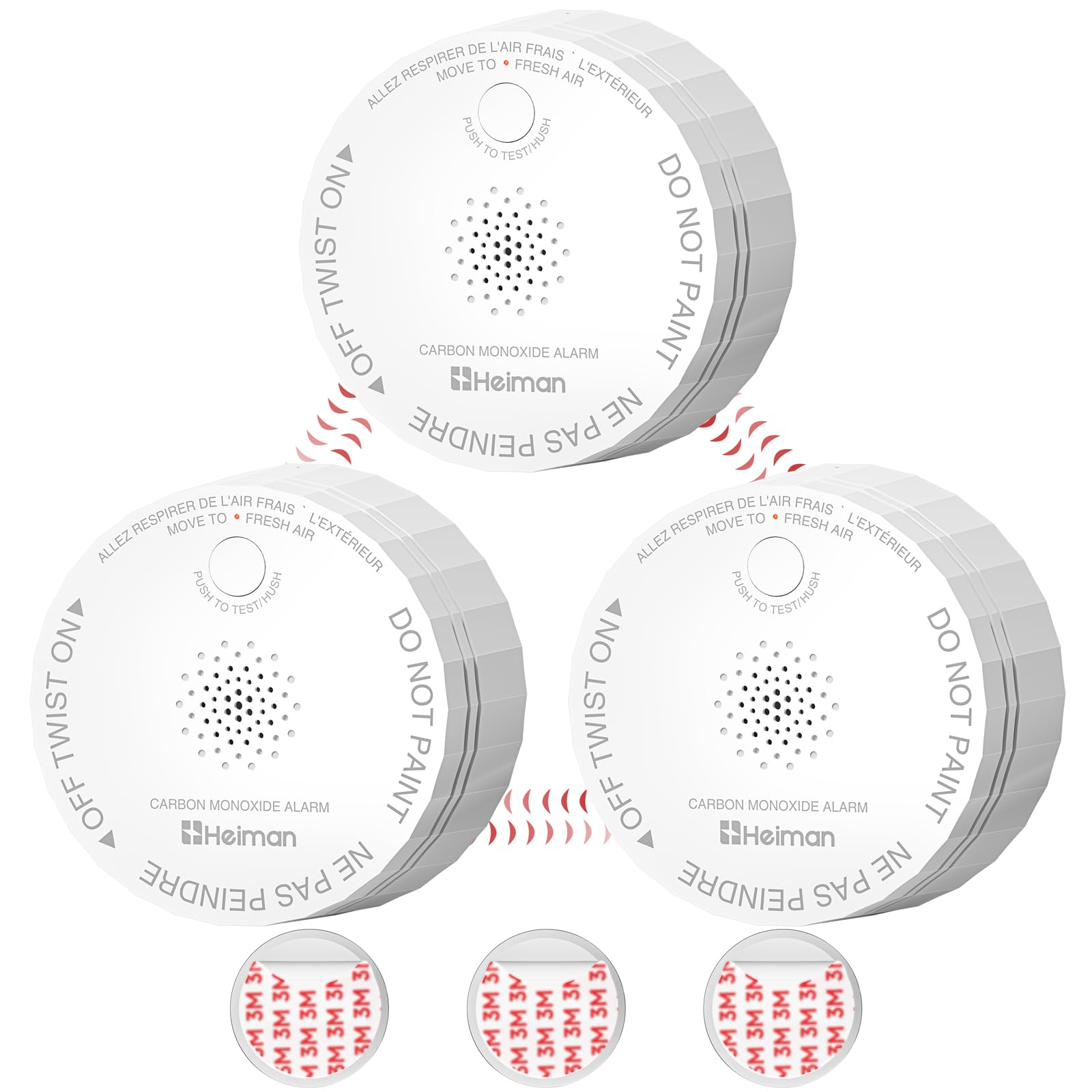
The HEIMAN C1-R 3-pack brings the Japan-made FIGARO TGS5141 electrochemical sensor — one of the most respected OEM sensors in the industry — to the consumer space at a per-unit cost that makes whole-fleet or whole-building coverage affordable. For a flight school, an FBO hangar, or a pilot who owns multiple aircraft and a home hangar, this pack allows you to place a detector in each cabin and the hangar office simultaneously.
Wireless interconnection means if one unit detects CO, all linked units sound a loud 85 dB alarm — useful for large hangars or multi-room shop spaces. The UL 2034 5th Edition certification and CSFM approval give you the same compliance stamp found on units costing three times as much. Battery operation with a 10-year sensor life and included batteries means zero wiring during installation.
These are not portable monitors you clip to a kneeboard — they are fixed-position alarms. The lack of a numerical display and the absence of vibration alerts limit their utility as in-flight primary detectors. They work best as supplemental cabin or hangar protection rather than your main cockpit CO watchdog.
Why it’s great
- FIGARO TGS5141 sensor with 10-year accuracy spec
- Wireless interconnect between units for wide-area coverage
- UL 2034 5th Ed. and CSFM certified at a low per-unit cost
Good to know
- No numerical CO ppm readout or vibration alarm
- Fixed-position design, not portable for kneeboard use
6. Kidde Smart CO Detector & Air Quality Monitor
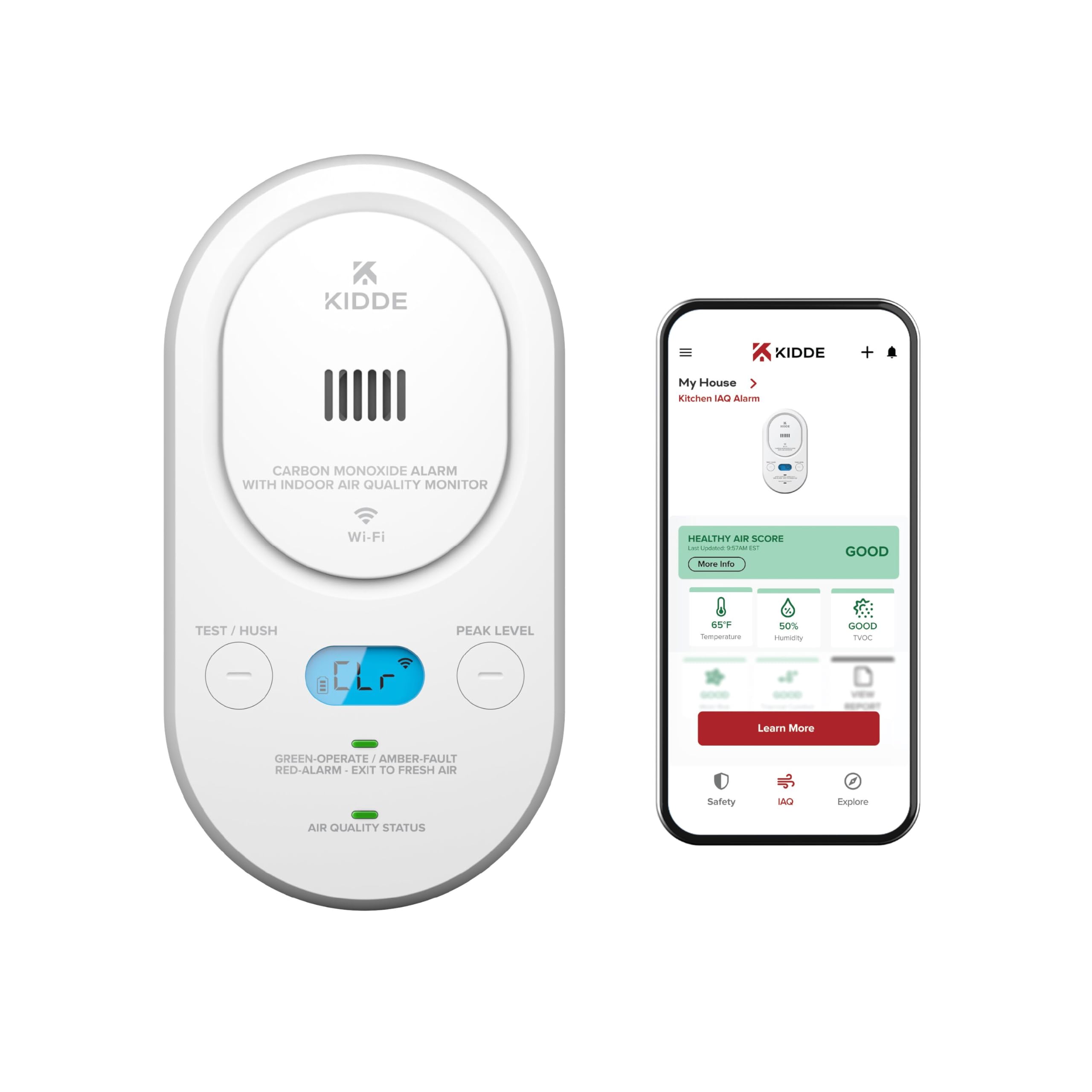
The Kidde Smart brings CO detection together with indoor air quality monitoring — including TVOC and humidity — in a single plug-in unit with AA battery backup. For a pilot who also runs a home hangar, this device delivers smartphone push notifications when CO is detected, even when you are away from the property, adding an extra layer of security for stored aircraft.
The advanced low-level CO technology triggers a distinct alert pattern at 30–70 ppm, giving earlier warning than standard UL 2034 alarms that wait until 70 ppm. The rotating plug accommodates both vertical and horizontal outlets, and the 85 dB alarm is loud enough to hear across a two-car hangar. The Kidde app provides weekly IAQ trend reports and optional mold risk insights via a subscription.
This is a fixed-position household alarm, not a portable aircraft detector. It requires a 120V outlet and 2.4 GHz Wi-Fi to function at its full smart capability. One user reported the plug did not fit a standard US outlet, which indicates some batch-to-batch variance in the plug prong alignment.
Why it’s great
- Real-time push notifications via 2.4 GHz Wi-Fi
- Low-level CO alert at 30–70 ppm with distinct pattern
- Monitors TVOC, humidity, and temperature alongside CO
Good to know
- Requires a 120V outlet and Wi-Fi for smart features
- Not designed for portable in-flight use
7. MSA ALTAIR 4XR Multigas Detector

The MSA ALTAIR 4XR goes far beyond a dedicated CO monitor by packaging four-gas detection — oxygen, hydrogen sulfide, carbon monoxide, and lower explosive limit — into a single ruggedized handheld. For pilots who also work in confined spaces, maintain aircraft fuel systems, or fly into remote strips where fuel vapor and oxygen deficiency are credible risks, this is the ultimate situational awareness tool.
Its XCell sensor technology virtually eliminates cross-channel interference, so CO readings remain accurate even in the presence of hydrogen or propane fumes. The IP68 rating certifies it as fully dust-tight and submersible beyond one meter, and MIL-STD-810G drop protection means it survives falls onto concrete from cockpit seat height. The rechargeable Li-polymer battery delivers a full 24 hours of continuous runtime on a single charge — enough for the longest multi-day commercial flight duty cycles.
The significant drawbacks are the price tag and the complexity. This unit is industrial-grade, designed for professionals who have been trained on bump testing and calibration gas. Some buyers received units without the Bluetooth module that the listing photos suggested, and the sheer weight of features (500+ event log, 50 hours of data recording) can overwhelm a pilot who just wants a simple CO monitor for the cockpit.
Why it’s great
- Four-gas detection: O2, H2S, CO, and LEL
- IP68 rated and 25-ft drop survival certified
- 24-hour continuous runtime on one charge
Good to know
- Premium price reflects industrial-grade sensor array
- Bluetooth not guaranteed on all stock units
FAQ
Can I use a standard home carbon monoxide detector in an airplane?
How often should I calibrate or bump test my portable CO detector?
What ppm level should I set my pre-alarm to in a piston single?
How does altitude affect the readings of an electrochemical CO sensor?
Final Thoughts: The Verdict
For most pilots, the best airplane co detector winner is the Sensorcon INS-CO-02 because its continuous 0–1999 ppm readout, two-year battery life, and IP67 durability cover every in-flight scenario without adding complexity. If you want adjustable low-level alarms down to 1 ppm with a NIST-traceable calibration certificate, grab the Forensics Detectors CO Meter. And for multi-gas protection in confined spaces or fuel-system work, nothing beats the MSA ALTAIR 4XR.