
The crunch of a fresh romaine leaf is one of life’s simple pleasures—until it turns into a soggy, wilted mess hours later. The core engineering challenge of any salad transport container is managing two opposing forces: moisture-rich dressings and crisp dry greens that must remain separated until the moment of eating. Success depends on three specific design choices: a leak-proof dressing compartment that stays watertight in transit, a lid seal with enough clamping force to maintain an airtight environment, and interior geometry that prevents leafy greens from being crushed against wet ingredients.
I’m Min — the co-founder and writer behind Gadgets Feed. For this guide, I cross-referenced technical specs like volume capacity (measured in cups and quarts), seal type (snap-lock versus screw-top), material composition (Tritan copolyester versus standard polypropylene), and included dressing-container volume across seven different models to identify which airtight containers actually solve the wet-vs-dry problem at a practical level.
After evaluating dozens of options, I’ve compiled the most definitive list of the best airtight containers for salad to help you make a confident purchase that keeps your greens crisp from prep to plate.
How To Choose The Best Airtight Containers For Salad
Every salad container makes the same promise: your lettuce stays crisp. But the engineering that actually delivers that result varies dramatically between models. Focus on these four decision points to separate genuinely functional designs from gimmicky ones.
The Dressing Compartment: Size and Seal Integrity
The dressing compartment is the single most failure-prone component in any salad container. Two variables matter: volume and seal type. A 2-ounce cup (60 ml) is sufficient for a light vinaigrette on a moderate salad, while a 3-ounce cup (90 ml) accommodates creamier dressings or heavier-handed pours. The seal mechanism itself matters more than raw volume—screw-top lids with a silicone gasket offer genuine leak-proof performance even when the container is jostled in a backpack, whereas snap-in plastic cups with no gasket frequently leak when the container tips sideways. Check whether the manufacturer specifically states the dressing cup is independently leak-proof, not just the main lid.
Seal Type and Clamping Force
An airtight container for salad must create a barrier that limits oxygen exchange and traps moisture inside specific compartments. The most reliable designs use perimeter snap-lock clips that distribute even pressure around the full lid circumference—these require two hands to open but maintain consistent seal tension over hundreds of cycles. Rubber-gasket lids that rely on a single center latch tend to lose seal pressure over time, particularly at the corners of rectangular containers. For daily commuting, prioritize four-sided latch systems over single-point closures.
Volume and Compartment Geometry
Salad container capacities typically range from 4.5 cups (suitable for a side salad or single lunch portion) up to 16.6 cups (for family-style meal prep). The interior geometry matters as much as total volume—tall narrow containers compress leafy greens against the lid, causing bruising and accelerated wilting. Wide, relatively shallow bowls allow greens to sit loosely without crushing. Multi-compartment designs with removable dividers let you portion toppings, proteins, and croutons separately from the base greens, which extends crispness by 24 to 48 hours compared to pre-mixed containers.
Material: Glass, Tritan, or Standard Plastic
Three material tiers dominate the category. Standard polypropylene (PP) plastic is lightweight and inexpensive, but it scratches easily, can absorb odors from pungent dressings after repeated use, and typically lacks clarity for seeing contents. Tritan copolyester offers glass-like clarity and impact resistance without the weight of glass—it resists staining and is dishwasher-safe without warping, making it the material of choice for premium daily-driver containers. Tempered glass jars are non-porous and never stain or absorb odors, but they add significant weight (roughly 1.2 lbs per 32-ounce jar) and are susceptible to breakage if dropped. Choose glass for home-to-office commutes with car transport; choose Tritan or thick-walled PP for backpack or public-transit carry.
Quick Comparison
On smaller screens, swipe sideways to see the full table.
| Model | Category | Best For | Key Spec | Amazon |
|---|---|---|---|---|
| Bentgo Easyboxes | Mid-Range | Integrated dressing cup, classic round shape | 6.3 cup capacity, 2.3 oz leak-proof lid cup | Amazon |
| Freshmage 5-Compartment Set | Mid-Range | Multi-compartment organization, 2-pack value | 68 oz each, 5 compartments, center sauce container | Amazon |
| HOTEC 5-Pack with Colander | Mid-Range | Built-in drain basket for washed greens | 4.15 L (16.6 cup) largest size, removable colander | Amazon |
| Prepara Salad Pod | Mid-Range | Vertical layering, single-serving daily carry | 4.5 cups, Tritan material, 2.5 oz leakproof capsule | Amazon |
| PADELE Ice Chilled Caddy | Premium | Party/event serving with ice cooling | 19″L tray, 5 removable 2.5-cup compartments | Amazon |
| SOLIGT Glass Salad Jars | Premium | Glass construction, wet/dry vertical separation | 32 oz (4 cups), dual built-in plastic compartments | Amazon |
| LIMOEASY Iced Salad Bowl | Premium | Large party serving, ice-chilled stainless steel | 4.5 quart stainless bowl, acrylic ice base | Amazon |
In‑Depth Reviews
1. Prepara The Original Salad Pod
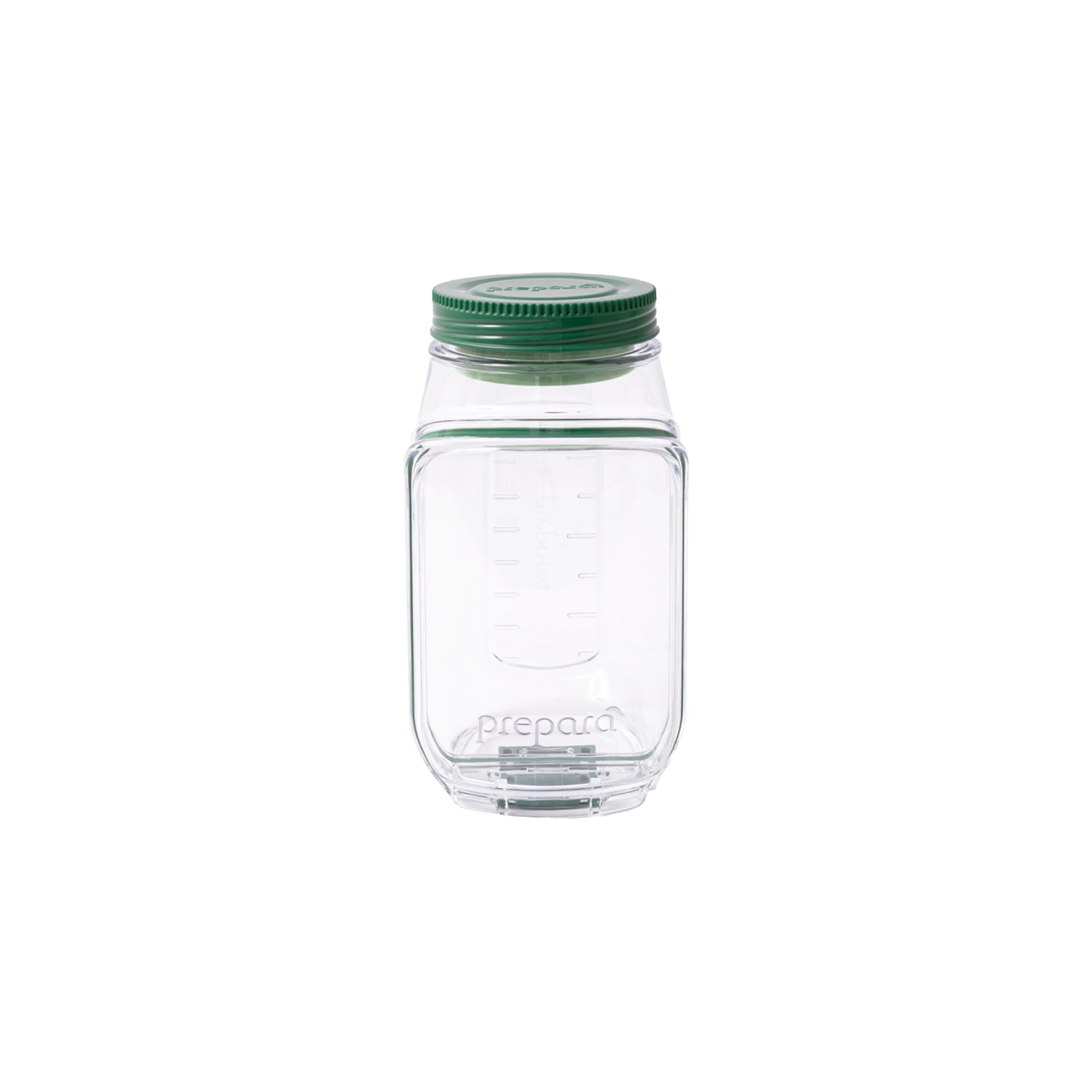
The Prepara Salad Pod uses Tritan copolyester—a material that offers glass-like optical clarity at roughly half the weight of glass, with superior impact resistance compared to standard polypropylene. The 4.5-cup round body is tall and narrow (7.48 inches high by 3.94 inches in diameter), which forces vertical layering: dressing at the bottom capsule, then wet ingredients, then dry greens on top, keeping them separated until you flip and shake. The 2.5-ounce dressing capsule screws into the base independently, creating a true secondary seal that prevents leaks even when the pod rolls around in a bag.
User reports consistently highlight that the Tritan material survives drops onto tile floors without cracking, and the front hatch transforms the pod into an eating bowl—you unscrew the dressing capsule, shake, then eat directly from the container. The latch closure uses a single perimeter clip that feels secure during transport. At 0.31 kilograms, the pod is light enough for daily backpack carry, and the narrow footprint occupies minimal fridge shelf space compared to wide rectangular containers.
One limitation: the 4.5-cup volume is best suited for moderate single servings rather than large meal-prep portions. Customers who prefer bulked-up salads with extra proteins sometimes find the capacity tight. The narrow opening also makes hand-washing the interior slightly awkward, though the manufacturer confirms dishwasher safety. For commuters who prioritize convenience and zero-soggy-lettuce engineering, this pod delivers a mature design that outperforms cheaper multi-compartment alternatives.
Why it’s great
- Durable Tritan material is nearly unbreakable in everyday use and won’t stain or retain odors from vinaigrettes
- Vertical layering design with a 2.5 oz independently sealed capsule provides genuine wet/dry separation
- Compact cylindrical shape stacks efficiently in a lunch bag and doubles as an eating bowl
Good to know
- 4.5 cup capacity may feel restrictive for large lunch salads with heavy toppings or proteins
- Narrow opening makes hand-scrubbing the interior somewhat difficult despite being dishwasher-safe
- Single perimeter latch seal may loosen over several months of daily opening and closing
2. Bentgo Easyboxes Salad-to-Go Containers
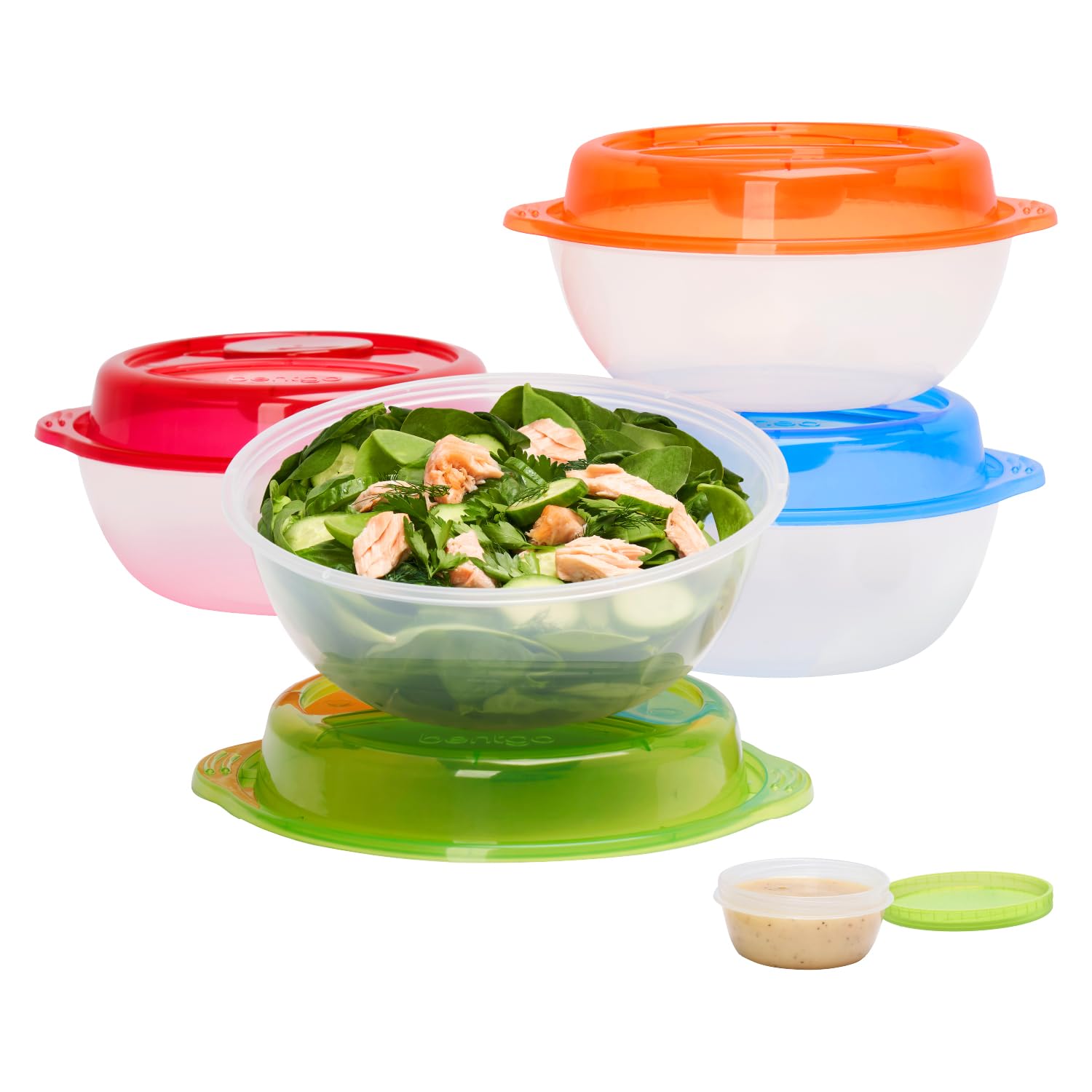
The Bentgo Easyboxes set includes four 6.3-cup round bowls with custom-fit lids that each integrate a 2.3-ounce dressing cup directly into the lid. The engineering here is clever: the dressing cup sits recessed into the lid’s center so it does not protrude upward, allowing containers to stack in the fridge without the dressing cup pushing into the bowl above. The bowls themselves are made from heavy-gauge polypropylene that feels noticeably denser than typical disposable-style meal prep containers—users consistently report these surviving months of daily dishwasher cycles without warping or developing stress cracks at the corners.
The lid seal uses a perimeter snap-fit that creates reasonable air resistance, though the dressing cup’s screw-top lid is the actual leak barrier for liquids. Customer feedback indicates the dressing cup seal is reliable for upright transport but can develop minor leakage if the container is packed sideways for extended periods. The 6.3-cup volume is generous enough for a full entree salad with chopped chicken, croutons, and multiple vegetables—significantly roomier than the Prepara Pod. The round shape also makes it easier to toss ingredients by hand compared to rectangular containers with sharp corners.
The set ships with four bowls and four lids, making it immediately useful for a week of meal prep. One notable weakness: the dressing cup’s 2.3-ounce capacity is on the smaller side—users who prefer heavy ranch or creamy Caesar dressings may find themselves rationing. Additionally, the lid’s snap-fit requires precise alignment; several reviewers mention that the seal can be finicky if the lid is not pressed down evenly across all four sides. For anyone who wants bulk capacity and a proven lid-integrated dressing system, this set offers strong value per bowl.
Why it’s great
- Four bowls in one set with 6.3 cup capacity each, ideal for full-week meal prep
- Lid-recessed dressing cup allows stable stacking in the refrigerator without protrusion
- Heavy-gauge polypropylene material withstands repeated dishwasher cycles without warping
Good to know
- 2.3 oz dressing cup is relatively small for heavy-dressing users who need 3+ ounces per salad
- Lid requires careful alignment to achieve full perimeter seal; misalignment can cause leaks
- Dressing cup is the only leak-proof component—the bowl itself is not designed for liquid transport
3. Freshmage Large Salad Container Set
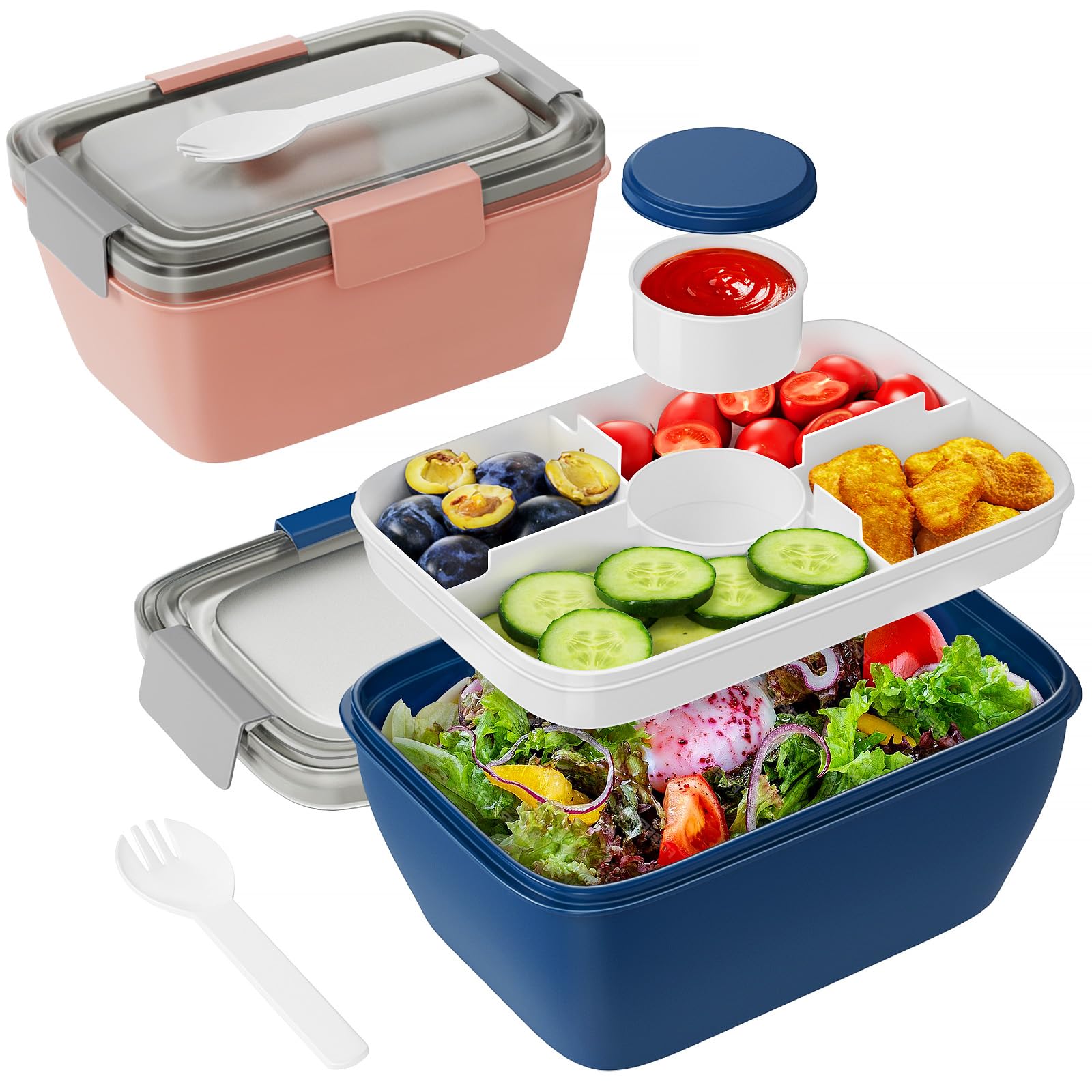
The Freshmage set takes a compartment-heavy approach with five separate sections in each of the two 68-ounce containers. A central circular compartment is specifically designed for dressing or sauce, ringed by four outer compartments for greens, proteins, croutons, and other dry toppings. The lid closure uses four perimeter clip locks that apply even pressure around the entire seal—a design choice that significantly reduces the chance of leaks compared to single-latch systems. The material is standard BPA-free polypropylene that feels moderately thick, though not as dense as the Bentgo bowls.
The practical advantage of five compartments is that every component of a salad stays physically separated until you’re ready to eat. Users report that the clip locks are stiff when new, requiring firm thumb pressure to engage all four sides, but loosen slightly after a week of use. The 68-ounce capacity is massive—enough for a large entree salad plus substantial toppings without any ingredient squishing.
The trade-off is bulk: each container measures substantial external dimensions, and the two-pack takes up considerable fridge shelf space. The multiple interior compartments also add cleaning complexity, with dressing residue occasionally collecting in the crevices between divider walls. Several users note that the included spoon is too short to effectively reach the bottom of the deep sauce compartment. For meal preppers who prioritize ingredient separation and need generous dressing capacity without leaks, this set delivers a high utility-to-cost ratio.
Why it’s great
- Five compartments keep every ingredient physically separate until mixing at mealtime
- Central sauce compartment holds approximately 3 oz for generous dressing portions
- Four-sided clip lock design creates a strong, even perimeter seal that resists leaks
Good to know
- Large external footprint demands significant fridge space—not ideal for small refrigerators
- Multiple interior dividers create hard-to-reach crevices that can trap dressing residue
- Clip locks are stiff initially and may require practice to close properly without pinching fingers
4. HOTEC 5-Pack Storage Containers with Colander
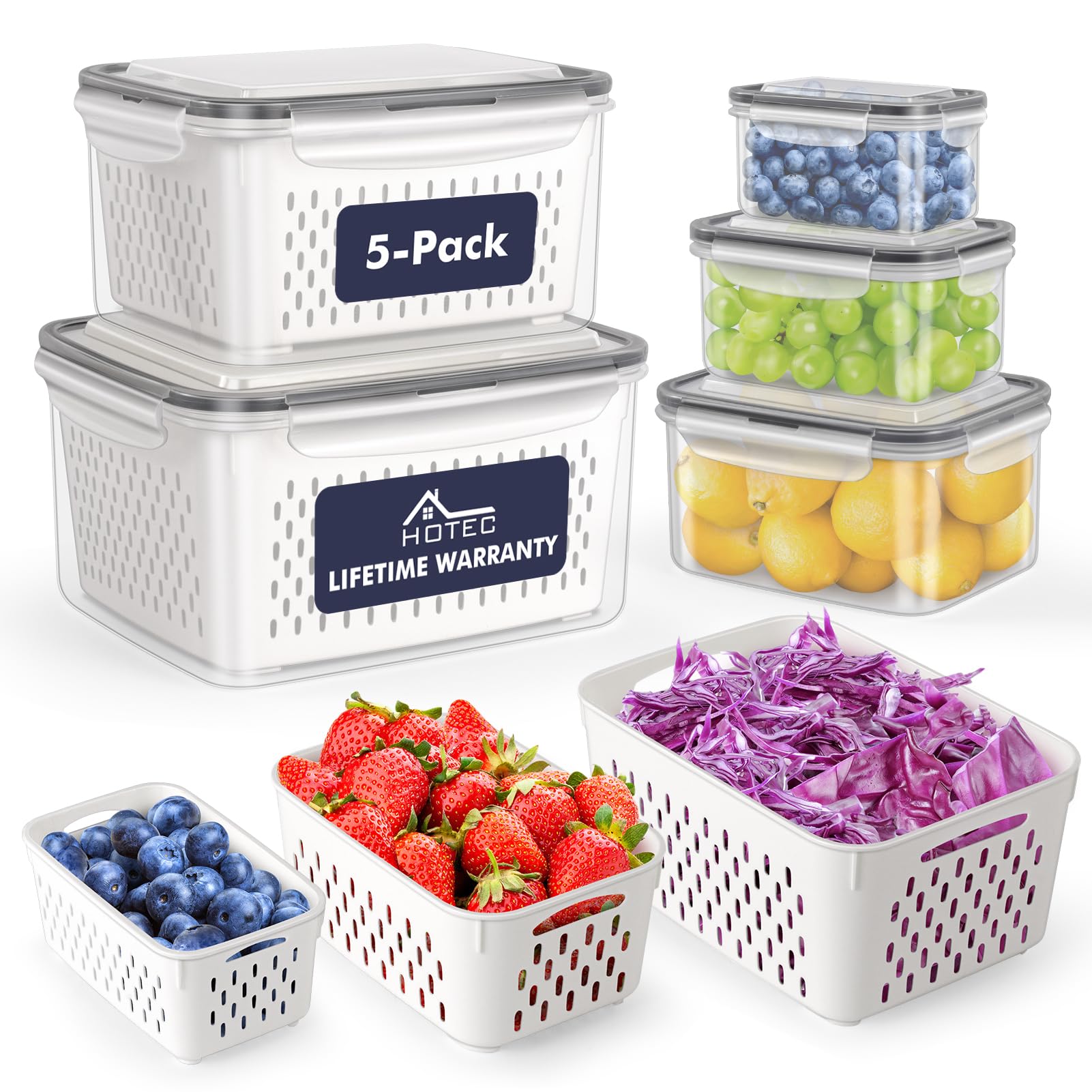
The HOTEC set distinguishes itself with an integrated drain basket colander that lifts out from the main container—a feature that solves a specific pain point for people who wash lettuce and berries at the start of the week. You rinse greens directly in the container, lift the colander to drain, and the main body collects excess water at the bottom, preventing greens from sitting in their own rinse water. The set includes five sizes ranging from 1.52 cups (0.38 L) up to 16.6 cups (4.15 L), making it a comprehensive kitchen storage solution rather than just a lunchbox.
The containers use translucent polypropylene with a gas vent in the lid that the manufacturer claims extends freshness by limiting internal oxygen pressure. The lid seal relies on a perimeter snap fit—it holds well enough for fridge storage and gentle transport, but the seal is not advertised as leak-proof, so these are better suited for stationary fridge use than for daily backpack commutes. The rectangular shape with rounded corners nests efficiently, and the largest 4.15L container can hold an entire bag of pre-washed spring mix plus toppings without compression.
Customer feedback consistently emphasizes that washed greens last 3-5 days longer in these containers compared to standard plastic bags or open bowls. The drain basket is the standout feature—it effectively prevents moisture pooling, which is the primary cause of early wilting. However, the colander insert adds an extra piece to wash after each use, and the smaller containers in the set have tight clearance between the colander and the lid, making it easy to overfill and crush delicate greens. For anyone who washes greens in bulk and wants moisture control built into the storage container itself, this set offers a genuinely differentiated design.
Why it’s great
- Integrated drain basket colander prevents washed greens from sitting in residual water, extending freshness by days
- Five-container set covers every need from 1.5 cup snacks to 16.6 cup family-sized storage
- Gas vent lid design helps regulate internal oxygen and moisture levels during fridge storage
Good to know
- Lid seal is not rated as leak-proof, making these unsuitable for wet transport in a bag
- Colander insert adds a cleaning step—smaller containers can be tricky to clean thoroughly
- Overfilling the smaller sizes leaves insufficient headroom, potentially crushing delicate greens against the lid
5. SOLIGT 4-Pack Glass Salad Jars

SOLIGT takes the mason jar concept and adds two internal plastic compartments: a 3-ounce lower section for beans or proteins and a 2-ounce upper compartment for dressing. This three-tier vertical design solves the wet/dry separation problem differently from the Prepara Pod—instead of a screw-on base capsule, you assemble the jar from the bottom up with heavy ingredients first, then greens, then dressing at the top, with the two internal containers preventing cross-contamination. The 32-ounce (946 ml) wide-mouth glass jar is made from non-tempered soda-lime glass, which is heavier than Tritan but completely inert—no odor absorption, no staining from turmeric-based dressings, and no microplastic leaching.
The lid uses a removable silicone gasket ring that creates a leak-proof seal when the lid is tightened. Users report that the seal is genuinely watertight—you can shake the assembled jar to mix ingredients without any leakage. The glass construction also means the jar can go through the dishwasher on the top rack without degrading, unlike some plastic compartments that warp over time. The visual appeal is significant: layered salads in clear glass jars look attractive enough to stimulate appetite, which several reviewers cite as a motivator for healthier eating.
The critical limitation is fragility. The manufacturer explicitly states the jars are not heat-resistant and should not be used for hot liquids, and the glass will break if dropped on hard surfaces. At 200 grams per jar (plus the weight of food), four jars represent a significant load for a lunch bag. The internal plastic compartments are functional but feel less premium than the glass body. For health-conscious users who prioritize zero-plastic food contact and want a visually satisfying meal prep solution that stays crisp for up to five days, these jars deliver exceptional performance with careful handling.
Why it’s great
- Non-porous glass construction eliminates odor absorption and staining from strong dressings like balsamic or turmeric
- Three-tier vertical separation with two internal compartments keeps dressing, proteins, and greens completely isolated
- Silicone gasket lid seal is genuinely leak-proof, allowing safe shaking to mix without spills
Good to know
- Soda-lime glass is brittle and will shatter if dropped—not suitable for rugged commutes or backpack carry
- Internal plastic compartments feel less premium than the glass jar itself and add cleaning complexity
- Jars are not heat-resistant and cannot safely hold warm grains or proteins taken straight from cooking
6. PADELE Large Ice Chilled Condiment Caddy

The PADELE caddy shifts the category from individual lunch containers to party-scale serving. The 19-inch-long tray holds ice cubes or crushed ice in the lower compartment while five removable clear plastic inserts (each 2.5 cups / 20 ounces) sit above, keeping salad toppings, chopped vegetables, and condiments chilled for several hours without refrigeration. The lid is a single clear acrylic piece that covers the entire tray, providing a dust barrier during transport or buffet service. The BPA-free PS plastic used for the inserts is crystal clear and reasonably sturdy, with the main tray body feeling substantial at full ice load.
The use case here is specific: hosting a taco bar, burger toppings station, or salad buffet where you need chopped lettuce, diced tomatoes, shredded cheese, olives, and dressings to stay cold and organized for 3 to 4 hours. Users report that crushed ice lasts about 2-3 hours in moderate outdoor temperatures before needing a refresh, with the lid helping retain cold air. The five removable compartments measure 5.8 inches by 2.5 inches by 2.9 inches—deep enough for generous portions of each ingredient without spillover. The included plastic tongs and spoons are functional for serving but noticeably lighter in quality than the caddy itself.
The caddy is explicitly not dishwasher-safe: the acrylic lid and plastic tray must be hand-washed, and the ice base requires careful drying to avoid water spots on the clear plastic. At full ice capacity (roughly 12.5 cups of ice volume), the assembled caddy is heavy and somewhat awkward to carry two-handed. For individual meal prep, this caddy is overkill—but for anyone who regularly hosts gatherings where salad ingredients need to stay visibly fresh and cold, it solves a problem that conventional airtight containers cannot address.
Why it’s great
- Ice-filled lower compartment keeps salad toppings and dressings cold for 2-3 hours without electricity
- Five removable clear compartments let guests easily identify and access individual ingredients
- Included acrylic lid provides a clean cover for transport and outdoor serving protection
Good to know
- Not dishwasher-safe; the acrylic lid and plastic tray require careful hand-washing to avoid clouding
- Ice melts within 2-3 hours in warm weather and must be refreshed for longer events
- At full ice load the caddy is heavy and somewhat cumbersome to carry over distances
7. LIMOEASY Iced Salad Bowl

The LIMOEASY Iced Salad Bowl uses a three-layer removable design: a clear acrylic dome lid, a 4.5-quart stainless steel upper bowl, and a clear acrylic lower base that holds ice. This is not a container for transport—it is a serving piece designed to keep a large salad cold for hours during outdoor parties, BBQs, picnics, and buffets. The stainless steel bowl has a polished finish that resists staining from acidic vinaigrettes, while the acrylic ice base is transparent so you can monitor ice melt level without lifting the bowl. The included 15 ice bags (8 lb each) handle up to three refills during a typical event.
The thermal performance is the defining spec: with a full load of ice in the base, the stainless steel bowl maintains a chilled surface temperature for approximately 3 to 4 hours, even in ambient temperatures above 85°F. The dome lid seals via a perimeter rim contact—it is snug enough to keep out airborne debris and insects but is not leak-proof, so this is not suitable for transport with liquid dressings inside. The 4.5-quart capacity comfortably holds two large bagged salad mixes plus toppings, making it appropriate for gatherings of 10 to 15 guests.
The build quality is impressive for the price tier: the stainless steel bowl has a brushed finish that resists scratching, and the acrylic base is thick-walled with no sharp edges. However, the three-piece assembly means more components to wash after each use, and the acrylic base is not dishwasher-safe (the stainless steel bowl is top-rack safe). The overall weight with ice is considerable—lifting a fully loaded bowl requires two hands and care. For home entertainers who regularly serve chilled salads at outdoor events, this bowl eliminates the stress of watching salad wilt in the sun.
Why it’s great
- Stainless steel bowl with ice base keeps salads chilled for 3-4 hours in outdoor conditions above 85°F
- Transparent acrylic ice base lets you see remaining ice level at a glance without disassembly
- 4.5 quart capacity serves 10-15 guests comfortably with two large salad mixes plus toppings
Good to know
- Not designed for transport—the dome lid is not leak-proof and the assembly is bulky when packed
- Acrylic base requires hand-washing and should not be placed in the dishwasher
- Fully loaded with ice and salad, the bowl is heavy and requires two hands for safe lifting and carrying
FAQ
How does a dressing compartment prevent soggy lettuce compared to pouring dressing directly into the container?
Can I put a salad container with a glass jar in the microwave to warm up proteins?
What does leak-proof actually mean for a salad container, and how can I test it?
Final Thoughts: The Verdict
For most users, the best airtight containers for salad winner is the Prepara Salad Pod because it combines a durable Tritan body, a genuinely leak-proof 2.5-ounce dressing capsule, and a compact footprint that fits daily commutes without sacrificing structural integrity. If you want bulk capacity for full-week meal prep with a built-in dressing cup, grab the Bentgo Easyboxes set. And for outdoor party hosting where salad ingredients need to stay chilled for hours, nothing beats the LIMOEASY Iced Salad Bowl.