
A home alarm system is only as good as its ability to distinguish a real threat from a stray tumbleweed. The wrong system floods your phone with false push alerts, desensitizing you to actual danger, while the right one delivers a 95 dB siren and a direct line to a monitoring agent before the intruder makes it past the entryway. This guide cuts through the noise to find the systems that nail that balance every time.
I’m Min — the co-founder and writer behind Gadgets Feed. I’ve tracked over 500 hours of market shifts across smart security ecosystems, dissecting everything from dual-band transmission ranges to AI person-detection algorithms to find the units that actually hold up on a suburban perimeter.
Whether you are securing a studio apartment or a multi-story home with a detached garage, the right hardware starts with a clear understanding of your risk points and connectivity priorities. This article delivers a curated breakdown of the best alarm system options available right now.
How To Choose The Best Alarm System
Picking the right alarm system comes down to three interconnected pillars: how the system communicates during an intrusion, which sensors protect your vulnerable entry points, and whether you want a professional middleman or complete self‑reliance. Each decision directly impacts response speed and long‑term cost.
Communication: Wi‑Fi, Cellular, or Both
Every alarm system relies on a control panel that talks to the outside world. Wi‑Fi‑only panels are cheap but go silent when your router goes down. Dual‑network systems add a 4G cellular backup — the panel calls your phone or a monitoring station even during a power outage. For homes in areas with spotty broadband, a system with GSM capability is non‑negotiable.
Sensor Density and Zone Awareness
The number of contact sensors and motion detectors in a kit matters less than where you place them. A single contact sensor on the front door and one motion detector covering the living room is enough for a 1‑bedroom apartment, but a 3‑bedroom house needs sensors on every ground‑floor window and a secondary motion detector covering the hallway chokepoint. Systems that allow zone‑specific arming (leaving the bedroom sensors off while sleeping) offer far more flexibility than all‑or‑nothing kits.
Monitoring Model: Pro vs. Self
Professional monitoring (typically – per month) routes alarm triggers to a central station that dispatches police or fire services on your behalf. Self‑monitoring pushes an alert to your phone and leaves the next step to you. The trade‑off is speed — a monitored system can summon help in under 30 seconds, but you shoulder a recurring fee. Self‑monitored systems save money but demand that you act quickly, which isn’t always possible while you’re on vacation.
Quick Comparison
On smaller screens, swipe sideways to see the full table.
| Model | Category | Best For | Key Spec | Amazon |
|---|---|---|---|---|
| Ring Alarm 8-Piece Kit | Smart Home Hub | Whole House Integration | Z‑Wave Plus Protocol | Amazon |
| SimpliSafe 11 Piece Gen 3 | Pro Monitoring | 5‑Second Dispatch | 24‑Hour Battery Backup | Amazon |
| LWOHSI PG108 (Wi‑Fi + 4G) | Dual Network | Cellular Backup on a Budget | 32‑bit Cortex‑M3 CPU | Amazon |
| LWOHSI (with 3MP Camera) | Dual Network | Visual Confirmation + 4G | 3MP HD Built‑In Camera | Amazon |
| Blink Outdoor 4 (5‑Cam) | Wireless Camera | Battery‑Powered Coverage | 2‑Year Lithium Battery | Amazon |
| OOSSXX 10CH NVR Kit | NVR + Monitor | All‑in‑One DVR Setup | 1TB HDD Pre‑Installed | Amazon |
| Hiseeu 8‑Cam PTZ System | PTZ + DVR | 360° Pan/Tilt Coverage | 5MP / 30 fps Recording | Amazon |
| eufy SoloCam E42 4‑Cam Kit | Solar + Local Storage | No Subscription 4K | Up to 16TB Expandable | Amazon |
| Chamberlain RJO101MC | Garage Opener | Quiet, Secure Garage Door | Direct Drive / 34 Lbs Door | Amazon |
In‑Depth Reviews
1. Ring Alarm 8-Piece Kit
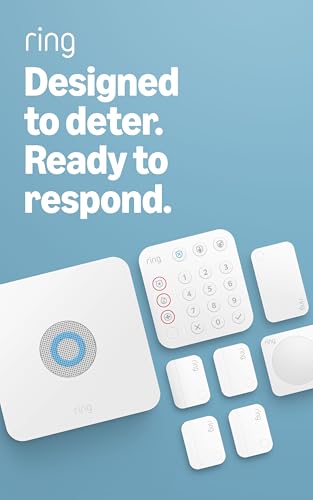
The Ring Alarm 8-Piece Kit is the most ecosystem‑friendly entry into professional‑grade home security. The base station communicates over Z‑Wave Plus, which gives it rock‑solid range and low interference compared to bargain‑bin RF systems. You get four contact sensors, one motion detector, a keypad, and a range extender — enough to cover the front door, two windows, and a primary hallway in a 1‑2 bedroom home.
Setup takes about thirty minutes if you follow the app’s guided loop detector test. The keypad includes physical panic, fire, and police buttons that send direct alerts to your phone even without a monitoring subscription. Add a Ring Protect Plan and you unlock cellular backup that keeps the system online when the Wi‑Fi dies, plus professional monitoring that handles county permit registration automatically.
The real selling point is interoperability. Ring Alarm plays nicely with existing wired sensors (ADT magnets work as contact triggers), and it integrates deeply with the Ring camera lineup and Schlage Z‑Wave deadbolts. One reviewer noted that arming the alarm via the Schlage deadbolt lock makes the whole system feel invisible — exactly how a home security layer should work.
Why it’s great
- Z‑Wave Plus gives long‑range, low‑interference communication between sensors
- Cellular backup keeps the system alive during power outages (with Protect Plan)
- Keypad includes dedicated panic, fire, and police buttons for instant alerts
- Compatible with existing ADT wired sensors and Schlage smart locks
Good to know
- No glass break sensor included — you have to buy it separately
- Mobile notifications only work with the paid Ring Protect Plan
- Multi‑piece kits sometimes ship in separate packages over several days
2. SimpliSafe 11 Piece Wireless Home Security System Gen 3
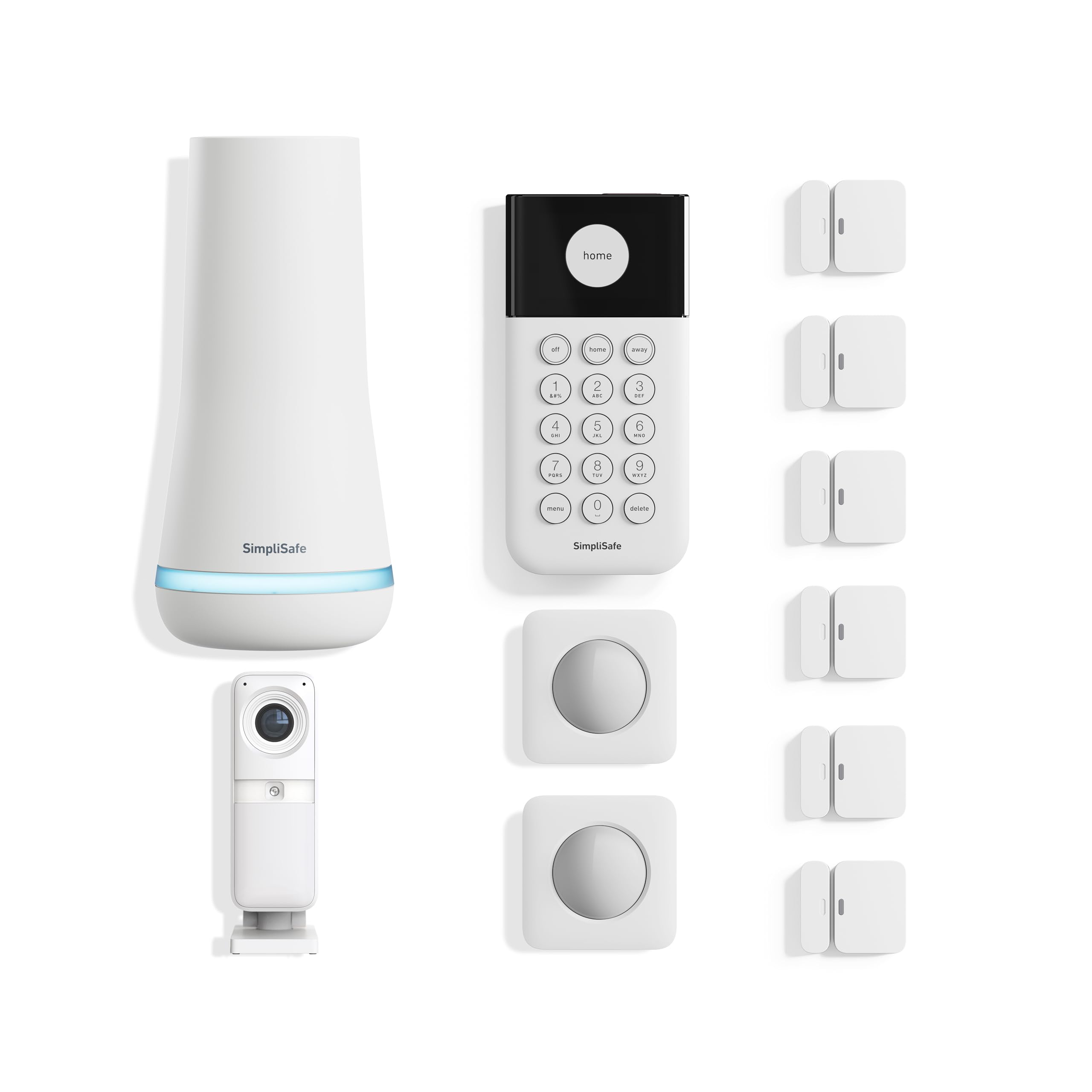
SimpliSafe Gen 3 is built for people who want professional monitoring without a contract anchoring them for years. The 11‑piece kit includes the base station, one indoor camera, a keypad, two motion sensors that cover a 35‑foot range with a 90‑degree field of view, and six entry sensors. The base station packs a 95 dB siren that easily penetrates typical drywall construction.
The differentiation here is the Fast Protect monitoring plan. SimpliSafe agents can step into the live feed from the indoor camera during an alarm and use two‑way audio to speak directly to an intruder. Eyewitness video evidence then qualifies for priority police dispatch, skipping the verification step that slows down most alarm responses. Their claim of a 5‑second response window is backed by a dedicated monitoring infrastructure — not a general‑purpose call center.
Hardware reliability is strong across customer reports. The base station’s cellular backup holds up for a full 24 hours after power loss, and the system comes pre‑paired so you don’t have to manually enroll every sensor during setup. The one consistent complaint is that the companion app only logs major event types unless you pay for a subscription — fine for active self‑monitoring, but limiting for detailed forensic review.
Why it’s great
- Professional monitoring agents can access live camera feed and talk to intruders
- Video verification triggers priority police dispatch for faster response
- Cellular backup keeps the base station online for up to 24 hours with no Wi‑Fi
- System comes fully pre‑paired — peel, stick, and test in under an hour
Good to know
- Indoor camera video quality is noticeably lower than dedicated IP cameras
- Custom sensor names don’t carry into voice alerts from the base station
- Single‑account limitation on the free tier — no shared family access
3. LWOHSI PG108 Alarm System (Wi‑Fi + 4G GSM)
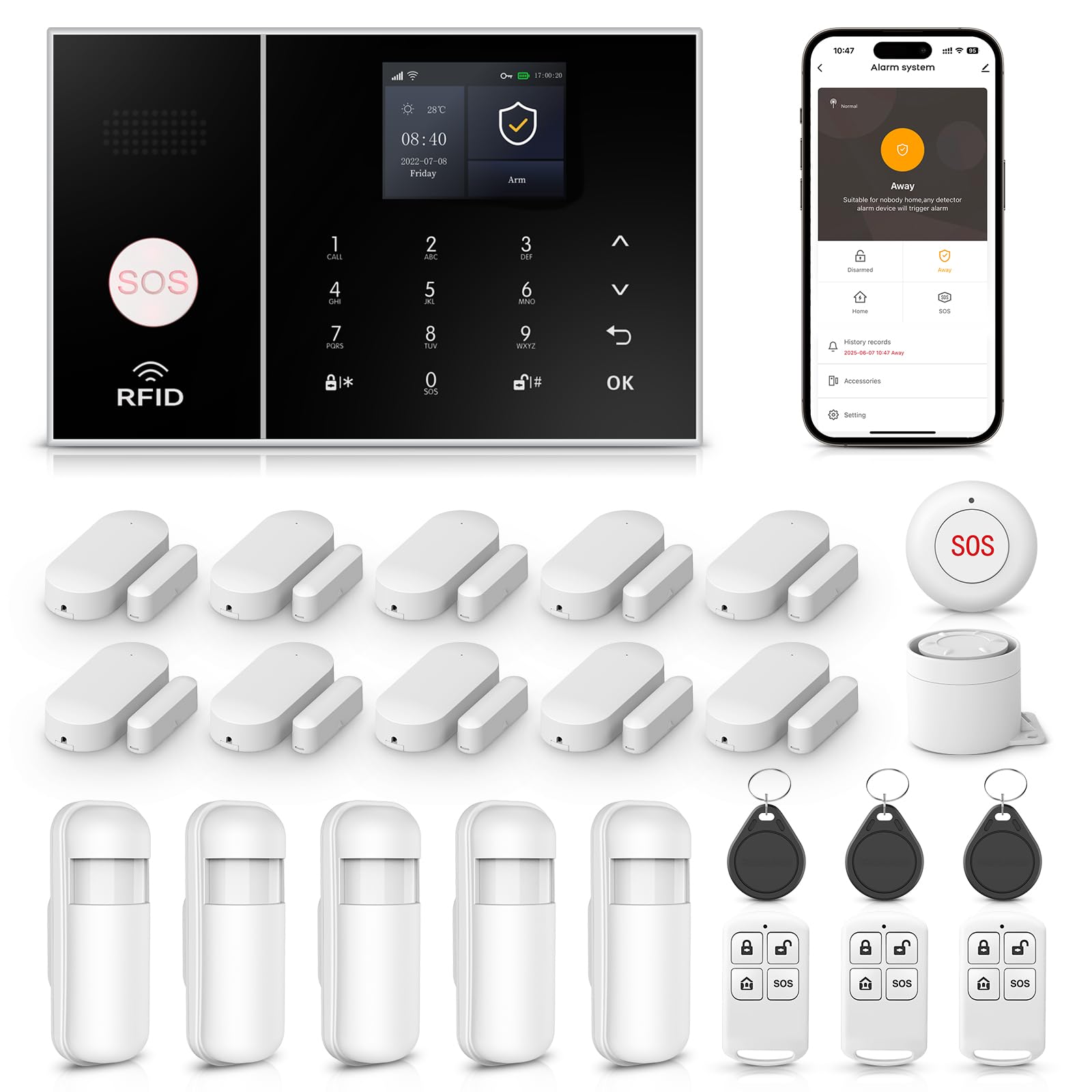
The LWOHSI PG108 brings dual‑network reliability to a price point that most entry‑level systems can’t touch. The control panel houses a 32‑bit Cortex‑M3 processor and a built‑in 4G GSM module. You can program up to 5 telephone alarm numbers and 2 SMS numbers — when the alarm trips, the panel calls every number sequentially and sends a text simultaneously. That’s a level of redundancy normally reserved for commercial panels.
Setup is fully DIY. Peel the adhesive on the door and motion sensors, mount the panel, and pair everything through the Tuya smart‑home app. The kit supports up to 100 wireless sensors, RFID cards, and remotes, which makes it absurdly expandable for a system in this bracket. It also integrates with Amazon Alexa and Google Assistant for voice arming and disarming.
Customer feedback highlights the system’s straightforward installation and reliable trigger responses. The main limitation is that the panel arms all zones at once — there’s no per‑zone arming that lets you keep bedroom sensors off at night while leaving perimeter sensors active. A few units have also shown durability issues, with some panels failing before the one‑year mark. Given the price, the feature set still outpaces most budget alternatives.
Why it’s great
- Dual‑network (Wi‑Fi + 4G GSM) ensures alarm delivery even during internet outages
- Supports up to 100 wireless sensors, RFID cards, and remotes for massive expansion
- Integrates with Alexa, Google Assistant, and the Tuya smart‑home ecosystem
- No monthly subscription — SMS and call alerts are free after the initial purchase
Good to know
- All‑or‑nothing arming — no way to bypass individual zones
- Panel only mounts to walls; no free‑standing base for countertop placement
- Long‑term reliability reports are mixed, with some units failing under a year
4. LWOHSI Wireless Alarm System with 3MP Camera
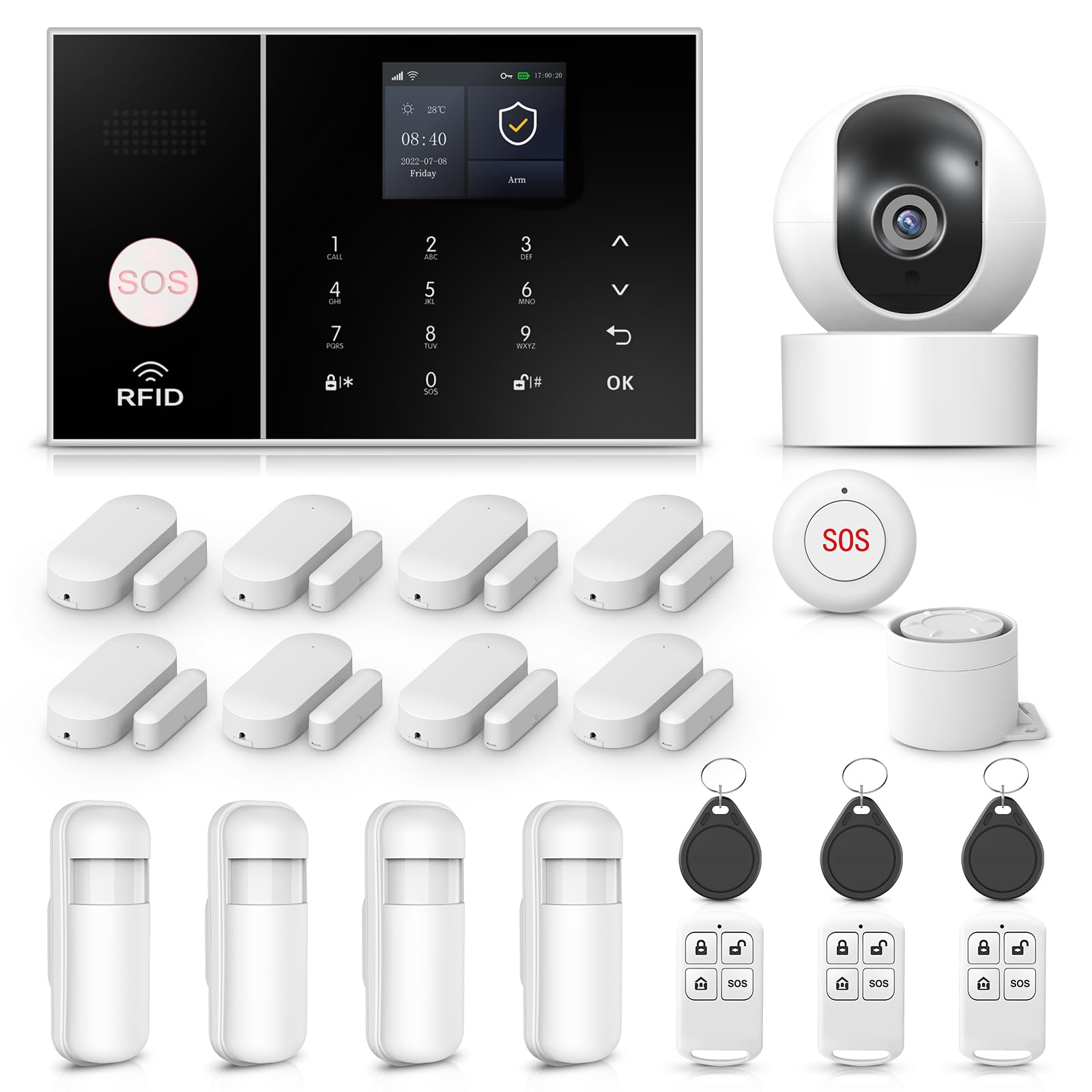
This LWOHSI variant takes the same core dual‑network panel and adds a 3MP HD security camera into the mix. The camera delivers 3‑megapixel daytime video and infrared night vision, giving you visual confirmation alongside the contact and motion sensor triggers. Like its sibling, it runs over Wi‑Fi with a 4G GSM fallback and supports up to 100 enrolled detectors.
The camera stream feeds through the Tuya app, and you can set the system to push a live snapshot to your phone whenever a sensor trips. That visual verification is critical — false alarms triggered by pets or curtains become obvious the moment you see the clip, saving you from unnecessary panic. The unit also includes one‑way audio, so you can listen to ambient sound around the camera location.
Users report the same easy setup experience as the PG108, with the added benefit of having recorded footage for later review. The trade‑off is that the camera is wired (Corded Electric), so you can’t place it in a location without a nearby outlet. Like the base PG108, zone‑specific arming is absent, and the all‑or‑nothing approach may not suit households that want selective overnight coverage.
Why it’s great
- 3MP HD camera provides live visual verification alongside sensor alerts
- Dual‑network (Wi‑Fi + 4G) keeps the system communicating if the router goes down
- Tuya app delivers push snapshots when a contact or motion sensor is triggered
- Massive device capacity — up to 100 detectors, remotes, and RFID tags
Good to know
- Camera is corded electric — must be within reach of a power outlet
- System arms all zones simultaneously; no selective zone bypass
- Long‑term durability reports are mixed, similar to the PG108 panel
5. Blink Outdoor 4 – 5 Camera System

Blink Outdoor 4 is the fourth‑generation refresh of Amazon’s massively popular battery‑powered security camera. Each camera runs for up to two years on two included AA lithium batteries, which makes it the lowest‑maintenance outdoor camera system on this list. The five‑camera kit covers an average suburban perimeter with 1080p HD live view, infrared night vision, and two‑way audio through the Blink app.
The Sync Module 2 connects to your home router over Wi‑Fi and acts as the central hub, extending the system’s Low‑Frequency Radio (LFR) range so cameras at the edge of your property maintain a stable link. Dual‑zone motion detection cuts down on false triggers from moving branches, and the optional Blink Subscription Plan adds person detection using embedded computer vision. You can also store clips locally via a USB drive plugged into the Sync Module 2.
Reviews are solid overall, though reliability isn’t perfect. A small number of users report cameras dropping offline without warning — requiring a physical battery pull to reconnect, which is impossible when you’re away from home. Battery life in cold climates also drops faster than the marketing suggests, and the mounting bracket can feel wobbly on uneven surfaces. For most users, though, the combination of battery longevity, ecosystem integration (Alexa, Echo Show), and subscription‑free local storage makes this a compelling pick.
Why it’s great
- Up to two‑year battery life on two AA lithium cells — class‑leading runtime
- Sync Module 2 expands range via LFR for stable connections at property edges
- Free local storage via USB drive on the Sync Module — no cloud subscription required
- Infrared night vision and two‑way audio work reliably in total darkness
Good to know
- Cameras can drop offline unpredictably and require a physical battery pull to reset
- Mounting bracket can wobble on irregular surfaces — aftermarket mounts help
- Person detection and cloud storage require a Blink Subscription Plan (paid)
6. OOSSXX 10CH 10″ NVR Kit with 4 Cameras & 1TB HDD
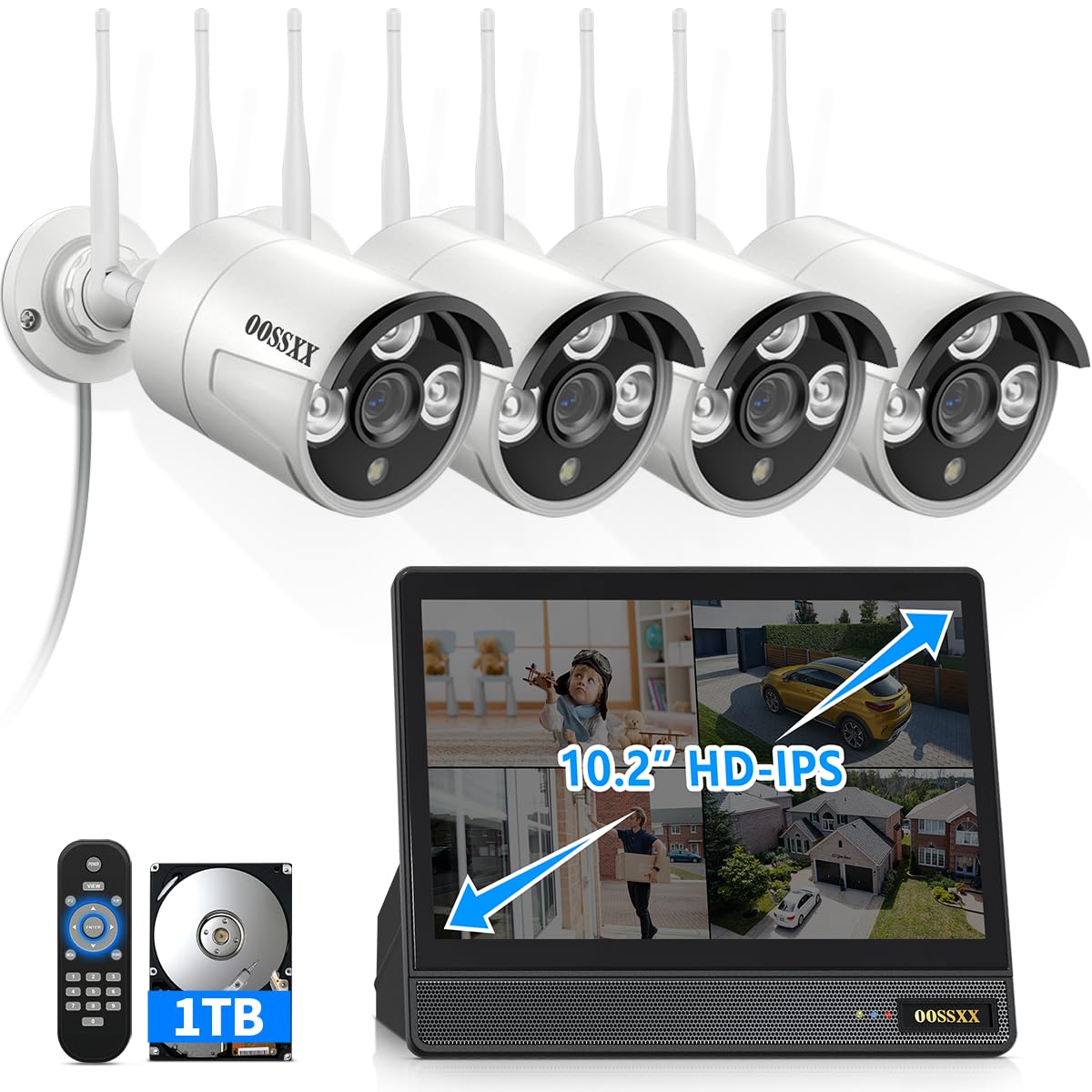
This OOSSXX kit is the closest thing to a turnkey surveillance system you can buy without hiring an integrator. The 10‑inch IPS monitor is built right into the NVR housing, so you don’t need a separate display or HDMI cable to get a live view. The unit comes with a pre‑installed 1TB hard drive and supports 24/7 continuous recording or motion‑triggered clips from all four 3MP cameras.
Connectivity uses dual‑band 2.4 GHz and 5.8 GHz Wi‑Fi, which is a meaningful upgrade over single‑band systems. The 5.8 GHz band cuts through interference from neighboring routers and keeps the video stream clean at 15 fps. Each camera has dual antennas that extend transmission range by about 55% compared to standard single‑antenna cameras, according to the spec sheet. The camera housings carry an IP67 rating — safe against rain, snow, and dust in any season.
Setup is straightforward for anyone comfortable with Wi‑Fi cameras, though the instruction manual suffers from rough translation. The monitor’s cursor is small, and the on‑screen brightness cannot be adjusted. Some users also wish the camera speaker volume could go below a fixed 10% minimum. Still, after two years of use, multiple reviewers report the system holds up well with no degradation in image quality or wireless stability.
Why it’s great
- Built‑in 10‑inch IPS monitor eliminates the need for an external display
- Dual‑band 2.4/5.8 GHz Wi‑Fi reduces interference in dense wireless environments
- IP67 waterproof rating protects cameras against rain, snow, and extreme temperatures
- 1TB HDD provides reliable 24/7 recording with no monthly fees or cloud storage
Good to know
- Monitor brightness is non‑adjustable; small UI cursor can be hard to see
- Instruction manual is poorly translated — YouTube guides may be needed for setup
- Camera speaker volume cannot be reduced below 10%, which may be too loud indoors
7. Hiseeu 8‑Camera PTZ Wired Security System
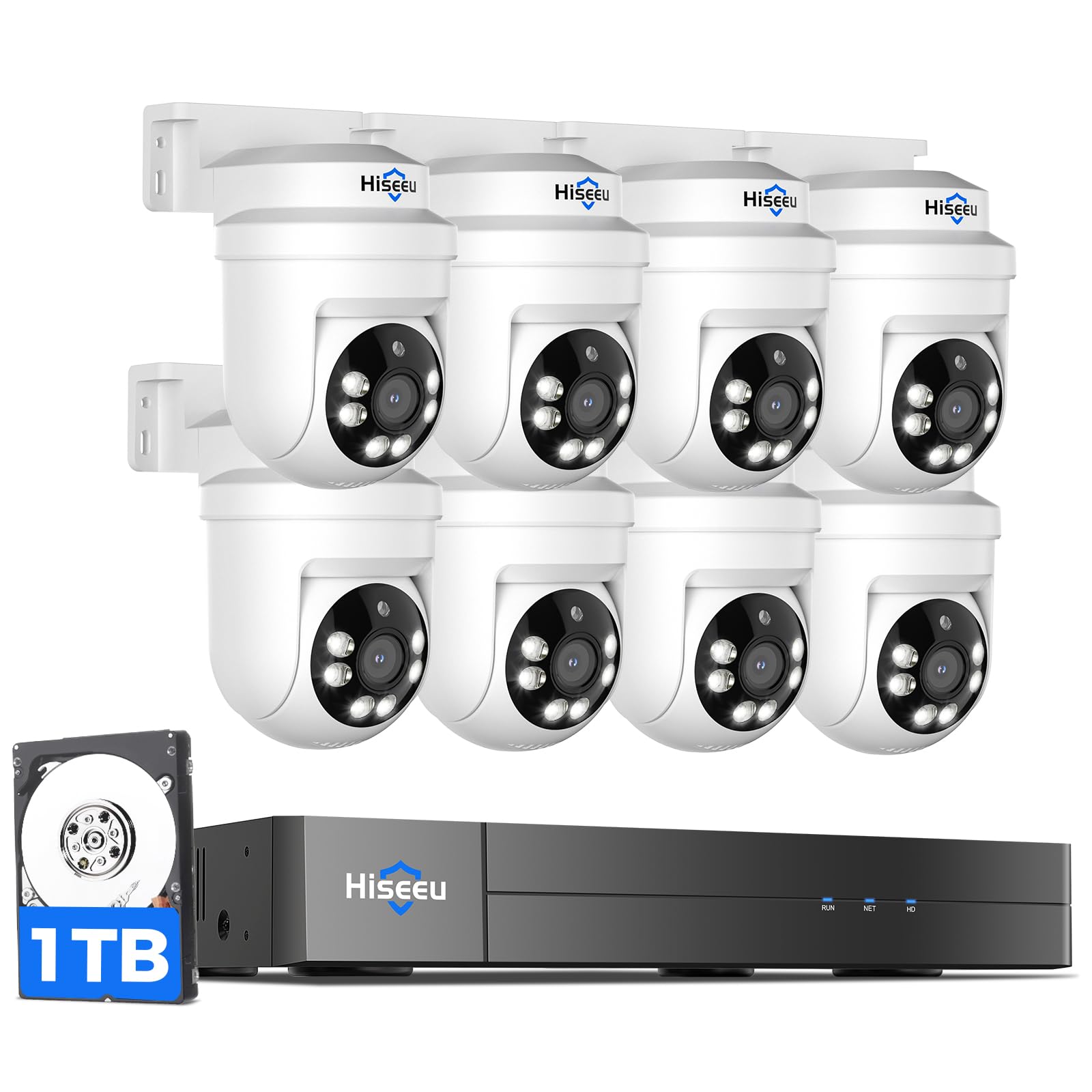
Hiseeu’s 8‑channel wired system is purpose‑built for property owners who need full rotational coverage without dead zones. Each camera delivers 5MP resolution at 30 fps — nearly 2.5 times the pixel density of 1080p — and offers 355° pan with 90° tilt, eliminating the static blind spots that plague fixed‑lens cameras. You can adjust the PTZ angles via the DVR remote or the mobile app, which makes live repositioning easy when you see activity at the edge of the frame.
The night vision system uses dual modes. In total darkness, infrared LEDs provide crisp black‑and‑white imaging at up to 100 feet. When a person is detected, the camera switches to full‑color mode by activating six built‑in spotlights — this auto‑switch is limited to four cameras, but it’s more than enough for the primary entry points. The 1TB pre‑installed hard drive stores about 15 days of 24/7 footage at 5MP resolution, and the 256× fast playback lets you skip through hours of archive in seconds.
Wired BNC connections ensure zero wireless interference — a meaningful advantage for users in dense urban areas where 2.4 GHz channels are saturated. The system also works completely offline if you connect it to a local monitor, which is a strong privacy play. A few users noted that not all supplied BNC cables are the advertised 96 feet, and one camera’s audio was dead on arrival, but Hiseeu’s customer support reputation (including same‑day DVR replacements) has earned consistently high marks.
Why it’s great
- 5MP resolution at 30 fps delivers detailed, smooth video — 2.5× sharper than 1080p
- PTZ functionality (355° pan / 90° tilt) eliminates static blind spots from fixed cameras
- Triggered color night vision switches on spotlights when a person is detected
- 256× fast playback and per‑person/vehicle event filtering make forensic review quick
Good to know
- Wired BNC connections require running cables — not a quick, peel‑and‑stick install
- Included cable lengths vary; some cameras get shorter cables than advertised
- One‑way audio may not record sound during playback, depending on configuration
8. eufy Security SoloCam E42 4‑Cam Kit
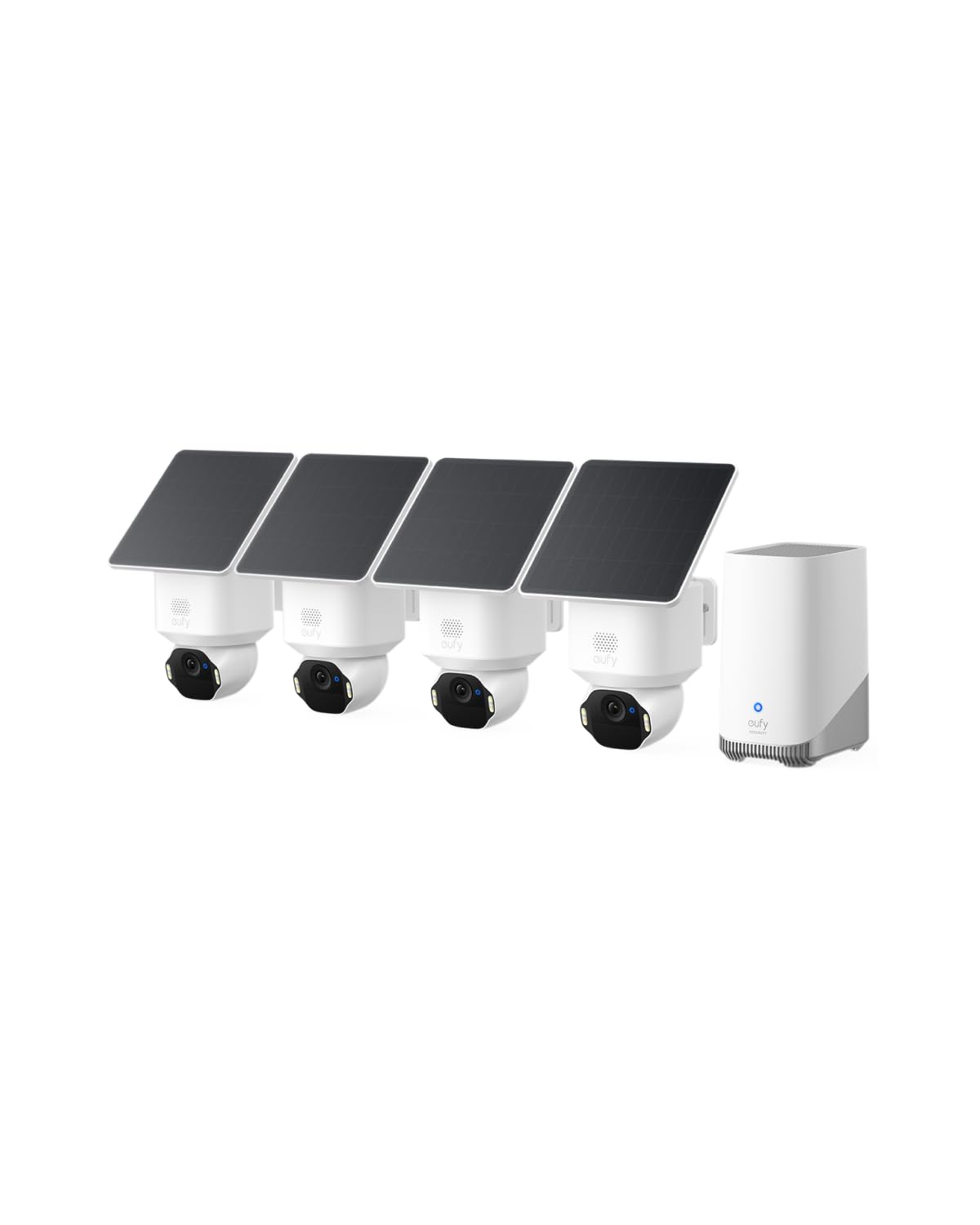
The eufy SoloCam E42 4‑Cam Kit occupies the premium end of the market with true 4K UHD resolution — enough optical clarity to read license plates from 33 feet away. Each camera is paired with a removable solar panel that, with just two hours of direct sunlight per day, keeps the battery topped off indefinitely. There are no wires to run and no monthly subscription fees, because all footage is stored locally in the included HomeBase 3.
The HomeBase 3 comes with 16 GB of internal storage and supports expansion up to 16 TB via a 2.5‑inch SATA drive. It handles continuous recording even when the internet is down, which is a critical advantage over cloud‑dependent systems. The AI detection engine automatically differentiates people, vehicles, and animals, and the cameras can pan and tilt over a 360‑degree range with no blind spots. A motion‑activated strobe light and siren provide on‑device deterrence without needing a separate alarm panel.
Buyers consistently praise the build quality and the crispness of the 4K night video. The Eufy app offers deep customization for notification zones, recording schedules, and privacy masks. The minor drawbacks are that the cameras only connect over 2.4 GHz Wi‑Fi (no 5 GHz support) and the app connection can sometimes feel sluggish when loading the live stream. A handful of users have also flagged occasional quality control issues with IR cut filters, but the overall satisfaction rate remains very high.
Why it’s great
- True 4K UHD resolution can identify license plates from 33 feet away
- Solar‑powered — 2 hours of direct sunlight per day keeps cameras charged indefinitely
- HomeBase 3 supports local storage up to 16 TB with no subscription or cloud fees
- AI motion tracking with 360° pan/tilt eliminates blind spots and reduces false alerts
Good to know
- Cameras operate on 2.4 GHz Wi‑Fi only — no 5 GHz band support
- Live stream loading can be slow depending on network latency
- Occasional quality control reports of defective IR sensors out of the box
9. Chamberlain RJO101MC Ultra‑Quiet Wall Mount Opener

The Chamberlain RJO101MC takes a radically different approach to security — instead of sensors and sirens, it secures your largest entry point with a direct‑drive motor mounted directly on the torsion bar. This wall‑mount design frees up all the ceiling space that a traditional trolley opener would occupy, and because there’s no chain or screw drive rattling overhead, operation is near‑silent. For attached garages with bedrooms directly above, this is a game changer.
An integrated battery backup ensures that you can still open and close the door during a power outage — a feature that goes from nice‑to‑have to essential after the first storm‑related blackout. The myQ smart control system gives you remote open/close capability from anywhere using the app, and it integrates with Amazon Key for in‑garage package delivery. The included LED lighting system bathes the whole garage in bright, even light, and the motion‑sensing wall controller turns it on automatically when you walk in.
Users consistently highlight how dramatically quieter this unit is compared to traditional openers. The BILT app‑based assembly guide eliminates the paper manual and walks you through every step with 3D animations. The built‑in Bluetooth auto‑lock mechanism deadbolts the door track automatically — no extra hardware required. The only real drawbacks are the lack of native Apple HomeKit support (myQ dropped HomeKit compatibility some time ago, though third‑party bridges still work) and the fact that the battery backup only powers local and clicker operation during an outage, not the myQ app.
Why it’s great
- Direct‑drive wall‑mount design frees ceiling space and operates near‑silently
- Integrated battery backup keeps the door operational during power outages
- myQ app enables remote open/close and Amazon Key in‑garage delivery
- Bluetooth auto‑lock deadbolts the door track without additional hardware or drilling
Good to know
- No native Apple HomeKit support — requires a third‑party bridge for Siri control
- Battery backup does not power the myQ app; only local keypad and clicker work
- 7‑hour DIY install time is realistic for first‑timers despite the BILT app guidance
FAQ
Do I really need cellular backup on my home alarm system?
How many entry sensors do I actually need for a 3‑bedroom house?
Can I use a garage door opener as part of my overall alarm strategy?
Final Thoughts: The Verdict
For most users, the best alarm system winner is the Ring Alarm 8‑Piece Kit because its Z‑Wave Plus mesh, cellular backup option, and deep smart‑home integration offer the most versatile and expandable platform for the average homeowner. If you want professional monitoring with video verification and a 5‑second dispatch window, grab the SimpliSafe 11 Piece Gen 3. And for a zero‑subscription, solar‑powered 4K setup that stores everything locally, nothing beats the eufy SoloCam E42 4‑Cam Kit.