
When child custody is on the line, a single disputed alcohol test can change a parenting plan. The difference between a reliable evidential-grade device and a cheap novelty breathalyzer often comes down to fuel-cell sensor technology, memory logging with date and time stamps, and calibration protocols that hold up to scrutiny. Choosing the wrong unit — one that drifts after a few months or fails to store results — can undermine the very proof you’re trying to establish.
I’m Min — the co-founder and writer behind Gadgets Feed. I’ve spent years analyzing the technical specifications, sensor accuracy data, and compliance certifications (DOT/NHTSA, FDA 510(k)) that separate a merely accurate breathalyzer from one that can produce a defensible chain of custody.
This guide cuts through marketing claims to focus on the concrete metrics that matter: fuel cell vs. semiconductor sensors, result memory capacity, calibration intervals, and which units meet the evidential standards that courts recognize. Whether you are a parent, an attorney, or a guardian ad litem, understanding these differences is the foundation of selecting the best alcohol testing devices for child custody cases.
How To Choose The Best Alcohol Testing Devices For Child Custody Cases
Selecting an alcohol testing device for a custody context is fundamentally different from buying one for a party or personal curiosity. You need a unit that produces repeatable, logged results with a verifiable calibration history — because the data may be entered as evidence. Here are the three most important factors to weigh before purchasing.
Fuel Cell Sensors vs. Semiconductor Sensors
This is the single most important technical decision. Fuel cell sensors — found in units like the BACtrack S80 and iSOBER 70 — oxidize alcohol on a platinum electrode and produce an electrical current proportional to BAC. They are selective for ethanol, don’t drift with temperature, and maintain accuracy over thousands of tests with proper annual calibration. Semiconductor sensors, by contrast, are cheaper but react to many compounds (acetone, cigarette smoke, even humidity) and degrade faster. For custody applications, spend the extra money for a fuel cell device. Non-negotiable.
Result Memory and Date/Time Logging
It is not enough to know today’s BAC. The device must store each reading with an accurate date and time stamp to create a record that can be correlated with parenting time schedules, visits, or other events. Units like the iSOBER 70 store 100 results with timestamps; others store 10. For custody tracking, look for a minimum of 50-test memory. Some app-connected models (iSOBER 10) also log GPS location and a photo, which adds another layer of verifiability — though you must confirm the app’s data cannot be edited.
Calibration Requirements and Evidential Certification
Every alcohol testing device requires periodic recalibration because sensors age. Standard intervals are 12 months or 1,000 tests, whichever comes first. Devices like the AlcoMate Revo TS200 use replaceable sensor modules (PRISM technology) that eliminate the need to ship the unit to a lab — you swap the cartridge yourself. Crucially, check whether the manufacturer offers US-based recalibration and whether the device holds DOT/NHTSA evidential approval or merely a screening designation. Evidential units have tighter tolerances (typically ±0.005% BAC) and are more likely to be accepted in court.
Quick Comparison
On smaller screens, swipe sideways to see the full table.
| Model | Category | Best For | Key Spec | Amazon |
|---|---|---|---|---|
| BACtrack S80 | Professional Fuel Cell | Wirecutter recommended accuracy | Xtend Fuel Cell, ±0.005% at 0.100% | Amazon |
| iSOBER 70 Premium | Evidential Fuel Cell | 100-test memory with 3-decimal display | NHTSA evidential spec, 100-test log | Amazon |
| AlcoMate Revo TS200 | Replaceable PRISM Sensor | No-lab calibration, longest sensor life | 1000-test PRISM module, ±0.005% at 0.100% | Amazon |
| AlcoMate Premium AL7000 | Replaceable PRISM Sensor | Budget-friendly PRISM reliability | 200-test PRISM module, ±0.01 at 0.100% | Amazon |
| BACtrack Eclipse | Police-Grade Fuel Cell | 1000-test durability and storage | 100-test memory, 1000 tests per unit | Amazon |
| iSOBER 10 App-Connected | Smart Fuel Cell | Photo and GPS logging with app | App sync with photo, GPS, 0.00–0.40% range | Amazon |
| iSOBER 30 Fuel Cell | Entry Fuel Cell | Basic portable logging on a budget | 10-test memory with date/time, 0.00–0.40% | Amazon |
In‑Depth Reviews
1. BACtrack S80 Breathalyzer

The BACtrack S80 uses the largest platinum-based Xtend Fuel Cell Sensor in the consumer market, delivering the same technology hospitals and law enforcement rely on. It earned the top recommendation from Wirecutter after 65 hours of testing that included side-by-side comparisons with police equipment. With one-button operation and a simple two-AA-battery design, this unit produces consistent readings at ±0.005% BAC tolerance — the kind of repeatability a court expects to see in a screening device.
The S80 stores only the last reading on its screen (no built-in memory log), which means you must manually record each result in a journal if you are building a custody record. DOT/NHTSA approval and FDA 510(k) clearance give it the regulatory footprint that attorneys recognize. Calibration is required every 12 months or 1,000 tests through BACtrack’s US-based service, and the device comes with a one-year warranty, a hard case, and a supply of mouthpieces.
Where the S80 truly shines is accuracy confidence: users consistently report readings that match or beat Interlock devices, and the fast refresh time (about 10 seconds between tests) makes it practical for repeated checks during a parenting window. The lack of internal result storage is its only real limitation for custody scenarios — pair it with a written log and you have a reliable screening tool that is hard to challenge on technical grounds.
Why it’s great
- Wirecutter #1 pick, verified side-by-side with police equipment
- XTend Fuel Cell sensor for ±0.005% accuracy at 0.100% BAC
- Simple one-button operation, no app or phone needed
Good to know
- No internal result memory — you must manually log each reading
- Requires annual recalibration or after 1,000 tests
- Heavier (5.6 oz) than some pocket-sized competition
2. iSOBER 70 Premium Breathalyzer

The iSOBER 70 is the only unit in this lineup that meets NHTSA’s evidential model specification while also storing 100 test results with exact date and time stamps. Its OLED display reads BAC to three decimal places (e.g., 0.050% versus just 0.05%), which matters when borderline readings could be scrutinized in court. The fuel cell sensor is accurate to within ±5% at 0.050% BAC, and the device operates reliably from 23°F to 104°F.
Calibration is recommended every 12 months or 1,000 tests and is performed in the US using NHTSA-approved wet-gas equipment. The manufacturer has 22 years of experience building police-grade breathalyzers, and the 70’s internal memory cannot be deleted by the user — an important chain-of-custody detail. The unit runs on two AAA batteries and includes a calibration reminder that alerts the user before the sensor drifts outside spec.
Some users reported a “flow” error if they did not blow hard enough, but this is common across fuel cell units and actually protects against false low readings from weak samples. The 100-test memory — searchable by date — makes this the strongest candidate for anyone who needs to produce a printed or photographed log of BAC readings over time. Pair it with the manufacturer’s recommended US recalibration service, and you have a device that is difficult to dismiss as unreliable.
Why it’s great
- 100-test memory with unerasable date/time stamps
- Meets NHTSA evidential model specification
- OLED display to 3 decimal places (±5% at 0.050% BAC)
Good to know
- Requires consistent strong blow to avoid “flow” errors
- Calibration required every 12 months or 1,000 tests
- Some units shipped with expired calibration from older stock
3. AlcoMate Revo TS200 Professional

The AlcoMate Revo TS200 eliminates the single biggest maintenance headache of fuel cell devices — shipping the unit to a lab for recalibration — through its patented PRISM (Pre-calibrated Replaceable Intelligent Sensor Module) system. When the sensor reaches 1,000 tests or 12 months, you simply pop in a new module and the device is factory-fresh again. The fuel cell sensor delivers ±0.005% accuracy at 0.100% BAC, matching the S80 and iSOBER 70 in precision.
The TS200 is DOT/NHTSA approved for law enforcement use and displays results on a clear 4-digit LED. It does not store readings internally, so like the S80, you will need to maintain a separate log. The device is lightweight at 11.68 ounces with batteries, and it includes a hard carrying case and 5 mouthpieces. The initial purchase price is higher than most competitors, but the PRISM module replaces the need for annual calibration service fees, which can offset the cost over two to three years of regular use.
One consistent complaint is battery life: several users report the device drains AAA batteries after only 5-6 tests, though this may be related to the “Air 9” low-battery warning being overly conservative. Keep spare batteries on hand and the TS200 produces some of the most consistent readings in this class, especially across multiple back-to-back tests where other units sometimes drift.
Why it’s great
- PRISM module eliminates lab calibration — just swap the sensor
- ±0.005% accuracy at 0.100% BAC, DOT/NHTSA approved
- 1,000 test lifespan per module before replacement
Good to know
- No internal memory log — all results must be recorded manually
- Battery life is short; frequent replacements needed
- Higher upfront purchase price than comparable fuel cell units
4. BACtrack Eclipse Professional Breathalyzer
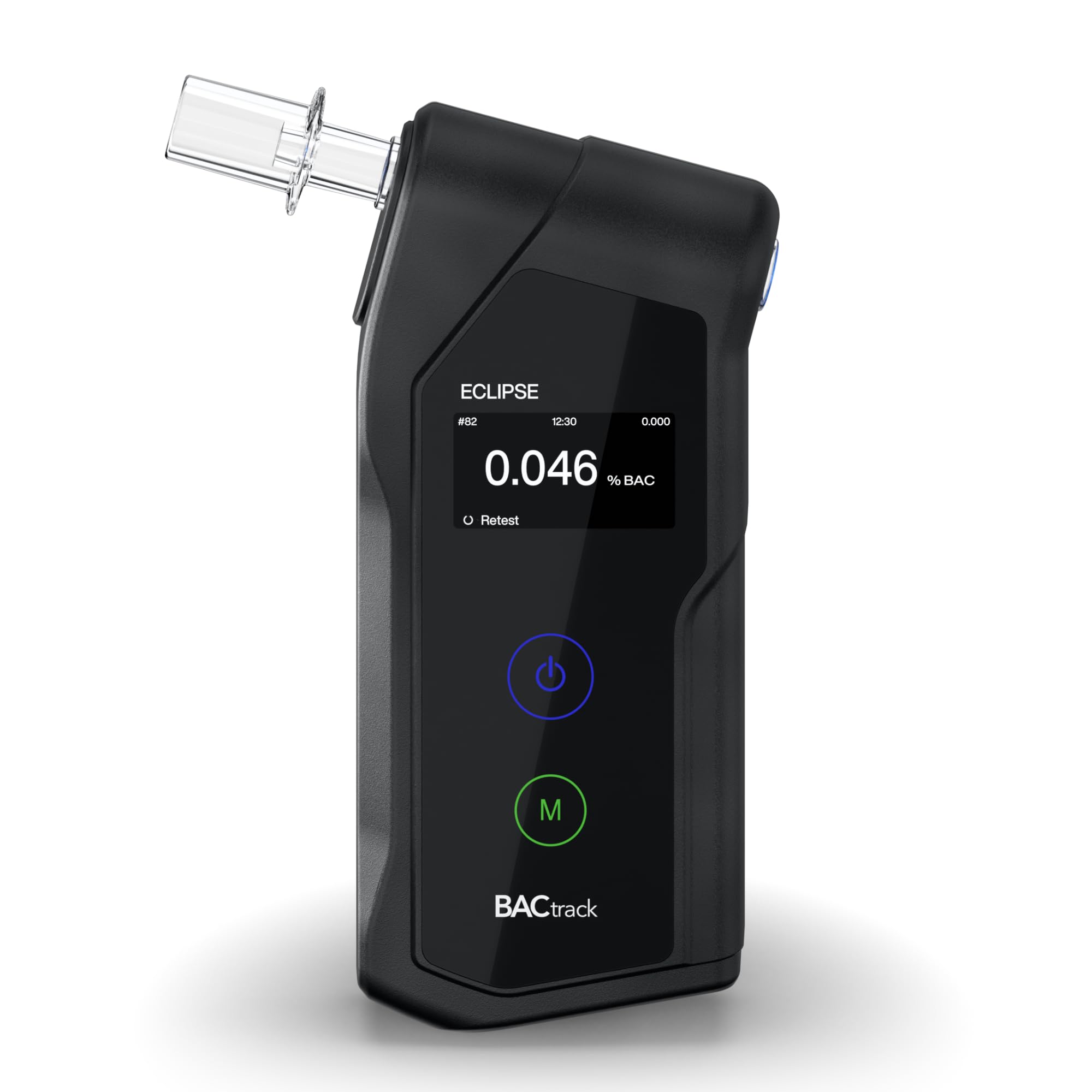
The BACtrack Eclipse brings the same professional-grade Xtend Fuel Cell Sensor as the S80 but adds internal storage for the last 100 results — a major advantage for custody tracking. The bright LCD display can show 5 international units of measure, and the device is designed to deliver consistent accuracy for up to 1,000 tests before requiring recalibration. It runs on two AA batteries and comes in a zippered case with 6 washable mouthpieces.
Users consistently praise the Eclipse’s fast warm-up time and one-button operation. The 100-test memory makes it easy to scroll back through recent readings, though the device does not export data to a computer or app — you will need to photograph or transcribe the log manually. Annual recalibration costs roughly through BACtrack and is recommended after 1,000 tests. The unit is slightly heavier at 9.91 ounces but feels solid in hand.
The Eclipse sits in an awkward spot between the S80 and the iSOBER 70: it has the memory the S80 lacks, but it does not meet NHTSA’s evidential spec like the iSOBER 70 does. For custody applications where evidential certification matters, the iSOBER 70 is the stronger choice. But if your primary need is reliable fuel cell accuracy with a built-in log of the last 100 tests without paying for evidential certification, the Eclipse is a capable middle ground.
Why it’s great
- 100-test internal memory with date/time stamps
- Xten Fuel Cell sensor for 1,000 tests between calibrations
- Bright LCD, 6 washable mouthpieces included
Good to know
- No evidential-grade NHTSA certification
- No app or export — results must be logged manually from screen
- Heavier than the S80, less pocket-friendly
5. AlcoMate Premium AL7000 Breathalyzer

The AlcoMate AL7000 uses the same patented PRISM replaceable sensor technology as the Revo TS200 but at a lower price point and with a shorter module lifespan — 200 tests or 12 months before the sensor cartridge needs swapping. The precision oxide semiconductor sensor delivers ±0.01% accuracy at 0.100% BAC, which is one decimal place less precise than the top-tier fuel cell units but still within the range accepted by many courts for screening purposes.
The device is DOT and NHTSA approved, and it features one-button operation with a clear 4-digit LED display. It runs on two AAA batteries and is lightweight at 8.47 ounces. The AL7000 does not store previous results — it only shows the current reading — so manual logging is once again required. The PRISM system means you do not need to ship the device for calibration; you order a replacement sensor module and swap it in seconds.
The value proposition here is clear: you get DOT/NHTSA approval and a replaceable sensor at roughly half the price of the TS200. However, the sensor is semiconductor-based, not fuel cell, which means it can be influenced by acetone, smoke, and other substances more easily. In a custody context where every reading might be challenged, the lower specificity of the semiconductor sensor is a real risk. For a budget-conscious buyer who understands this limitation, the AL7000 remains a functional screening tool.
Why it’s great
- PRISM module in a more affordable package
- DOT and NHTSA approved for legal screening use
- No lab calibration — swap the sensor yourself in seconds
Good to know
- Semiconductor sensor, not fuel cell — less specific for ethanol
- Only 200 tests per PRISM module (vs. 1,000 on TS200)
- No internal result memory
6. iSOBER 10 App-Connected Breathalyzer

The iSOBER 10 is the only device here that captures a photo and GPS location with each test when paired with the free iSOBER app — features that directly address the chain-of-custody concerns in custody disputes. The fuel cell sensor delivers the same professional-grade accuracy as the larger iSOBER models, with readings from 0.00% to 0.40% BAC and a 10-second response time. The app logs each result with a timestamp, location, and optional photo of the person being tested, and it can email or text the report immediately.
There is no subscription fee, which is a critical advantage over some home-based monitoring systems that charge monthly. The app also includes a sensor health check that alerts the user before the unit needs servicing. The device itself works standalone as well, giving instant BAC readings without needing a phone nearby. Calibration is still required every 12 months or 1,000 tests, and the unit runs on two AAA batteries.
The main tradeoff is that the app captures data on the phone, not on the device itself, so the phone’s security settings and data integrity matter. If someone has access to the phone, they could potentially delete or edit the log. The iSOBER 10 also drew mixed reviews on consistency — some users reported readings that varied widely minutes apart, though this may be linked to mouth alcohol contamination rather than sensor drift. For the photo-and-location feature alone, it is a strong adjunct to a primary evidential device.
Why it’s great
- Photo and GPS logging with each test via free app
- Fuel cell sensor with 10-second response time
- Standalone mode works without a phone
Good to know
- Data lives on the phone — can be edited or deleted
- Some users report inconsistent readings between tests
- Requires annual calibration like all fuel cell units
7. iSOBER 30 Fuel Cell Breathalyzer

The iSOBER 30 is the budget-friendly entry point into the fuel cell sensor world, and at 2.33 ounces it is the most portable device in this lineup. It stores the last 10 test results with date and time stamps — enough to build a short-term log but insufficient for tracking over weeks without clearing old data. The unit is DOT and NHTSA compliant and FDA 510(k) cleared, giving it the same regulatory base as the more expensive iSOBER models.
Calibration is recommended every 12 months or 1,000 tests through Sentech’s US-based service, and the manufacturer has two decades of experience building law enforcement breathalyzers. The device runs on two AAA batteries and comes with a hard carrying case. The simple interface shows only the current reading and the last 10 stored results, accessible through a menu button. It is genuinely pocketable — small enough to carry inconspicuously to any location.
The tradeoff for the price and size is clear: only 10 memory slots. Once the 11th test is performed, the oldest result is automatically deleted. For a week-long parenting time check that involves multiple tests per day, the memory will cycle through and potentially overwrite earlier readings. This limits the iSOBER 30 to short-duration monitoring or as a quick screening supplement to a device with deeper memory. It is a capable starter unit, but custody documentation demands more storage.
Why it’s great
- Genuine fuel cell sensor at an entry-level price
- DOT/NHTSA compliant and FDA 510(k) cleared
- Extremely portable at 2.33 ounces with hard case
Good to know
- Only 10-test memory — old results auto-overwrite
- Requires annual calibration service
- No app connectivity or advanced logging features
FAQ
How many memory slots do I need for custody tracking?
Does a DOT or NHTSA approval guarantee court admissibility?
Can an app-connected breathalyzer improve chain of custody?
Final Thoughts: The Verdict
For most users, the best alcohol testing devices for child custody cases winner is the BACtrack S80 because it combines professional-grade fuel cell accuracy with the strongest independent recommendation from Wirecutter, though you must manually log every result. If you want an evidential-grade device with deep built-in memory, grab the iSOBER 70 Premium. And for a no-calibration-hassle option with the longest sensor life, nothing beats the AlcoMate Revo TS200 with its swap-in PRISM module.