
Our readers keep the lights on and my morning glass full of iced black tea. As an Amazon Associate, I earn from qualifying purchases.
Specs are compiled from manufacturer listings and verified buyer reviews and can change over time — please confirm the key details on the product page before buying.
Three things decide which alfalfa pellet bag is right for your horse: the ingredient claim on the label, the bag weight, and whether your horse cleans up its bucket. This shortlist covers four bags that horse and small-livestock owners keep coming back to, from a 40 lb non-GMO bag to a certified organic option with a published protein number.
I’m Min — the founder and writer behind Gadgets Feed. This guide is built by comparing the manufacturers’ published specifications and the patterns across verified customer reviews, so you get each pick’s real strengths and trade-offs instead of marketing spin.
You’ll see what each bag actually contains, how the pellet form affects dust and waste, and which size makes sense for a single pony versus a full barn. Here’s how to compare the alfalfa pellets for horses options by ingredient claim, bag weight, and pellet texture.
Our Picks at a Glance

How To Choose The Best Alfalfa Pellets For Horses
Alfalfa pellets are chopped and compressed alfalfa hay, so they store in less space and make less mess than loose hay. Before you buy, answer three practical questions: what is in the bag, how much feed you get, and whether the pellets stay intact instead of crumbling into dust.
Read the ingredient claim before anything else
A claim like Non-GMO or Certified Organic tells you how the alfalfa was grown and handled, and it sits right on the front of the bag. The Stampede bag carries a Non-GMO claim and adds that it has no pellet binders, so the only ingredient is alfalfa itself. The New Country Organics bag carries a Certified Organic and Non-GMO claim, which is a stricter label than Non-GMO alone. If your barn or your buyer requires a certified organic feed, that word “Certified” is the one you check for.
Match the pellet texture to your feeding setup
Pellets are meant to be low-dust and low-waste, and the FAMILY FARM AND FEED listing describes its pellets as waste and dust free. That matters if you feed in a stall or a small pen, where loose hay blows around and gets trampled. A finer, more powdery product can be harder to handle — buyers of the New Country Organics bag note it runs powdery — so decide up front if you want tidy pellets or a product you can spread easily by hand.
Pick the bag size that fits your herd
Bag size is the clearest dividing line on this list. A 5 lb bag suits a rabbit, a guinea pig, or a single small animal. A 40 lb bag is sized for a horse or a mixed small-livestock group. Larger bags lower your cost per pound and mean fewer reorders, but they also need dry, rodent-proof storage. Buy the bag size you can finish before the pellets go stale.
Quick Comparison
| Model | Best For | Bag Weight | Ingredient Claim | Form | Amazon |
|---|---|---|---|---|---|
| Stampede Alfalfa Pellets, Non-GMO★ Best Overall | Everyday feeding for horses and mixed livestock | 40 pounds | Non-GMO | Pellet | Amazon |
| FAMILY FARM AND FEED Alfalfa Hay Pellets | Small pets and small animals on a budget | 5 pounds | Non-GMO, High Protein | Pellet | Amazon |
| New Country Organics Alfalfa Pellets | Organic-focused buyers and garden use | 50 pounds | Certified Organic, Non-GMO | Pellet | Amazon |
| Standlee Organic Alfalfa Pellets | Certified organic feeding for horses | 10 pounds | Organic, USDA Certified, GMO Free | Pellet | Amazon |
In‑Depth Reviews
1. Stampede Alfalfa Pellets, Non-GMO – Perfect for Rabbits, Goats, Equine, and More! (40 lb)
Our pick — over 4.5★ from 50+ verified ratings; the strongest balance of quality and price.
Forty pounds of pure alfalfa with nothing else in the bag, and horses clean it up fast.
If you want one bag that covers a horse, a goat, and a rabbit without a second thought, this is the safest pick on the list. It weighs 40 pounds and it is a single-ingredient product: sun-cured alfalfa, a Non-GMO claim, and no pellet binders holding the pellet together. That last detail is the one buyers keep coming back for, because there is no filler or glue mixed in with the forage.
What wins people over is simple — the taste. Picky eaters take to it, and one horse owner describes a pony that gets these pellets every winter day when he comes in from the field, and that he “marches in to get them.” That is the behavior you want when the weather turns and your horse needs extra forage. The bag also holds up for garden use, with buyers reporting it as a cheap nitrogen source for roses and plants when they have extra left over.
Compared with the 5 lb FAMILY FARM AND FEED bag, this one carries eight times the weight, so it suits a horse rather than a hutch. Buyers report the pellets arrive as a clean, large bag with a rich, fresh smell, and the value holds up against pricier bags. The honest catch is storage: 40 pounds of pellets needs a dry bin with a tight lid, because moisture is what turns a good bag into a clumpy one.
What Owners Keep Coming Back For
- Pure alfalfa with no pellet binders — one ingredient, nothing hidden
- Non-GMO claim and natural sun curing
- Taste is what buyers rave about, so even picky horses clean up
- 40 lb bag gives real value per pound for a horse or mixed herd
Where It Falls Short
- Needs dry, sealed storage to stay fresh between feedings
- Breed recommendation is listed for small breeds, so check it against your horse before ordering
Buy this if: you feed a horse, pony, or mixed group and want one honest 40 lb bag of pure alfalfa with no binders.
Think twice if: you only keep a rabbit or two — the smaller 5 lb bag will stay fresher for you.
2. Alfalfa Hay Food | Small Pet | Young and Adult | Pellets | 5 Pounds

A tight five-pound bag of sun-dried western forage that small animals tear straight through.
This is the bag for the keeper with a rabbit, a guinea pig, or a tortoise rather than a full-sized horse, and its size keeps the alfalfa fresh instead of going stale in a corner of the barn. The listing is built around a simple promise: premium western forage that is dried by the sun, a Non-GMO claim, and a high-protein nutrient claim. It pours out as waste and dust free pellets, so less of it ends up on the floor of the hutch.
Freshness is what carries this bag. The listing promises you will smell the fresh summer cut grass when you open it, and the reviews back that up in blunt terms — one buyer simply says “Very fresh. Rabbits tore through it.” Quality and effectiveness are the two things owners bring up again and again, with several using it around the garden as well. Owners mention spreading it near plants as a natural nitrogen source, and one uses a handful in the bottom of each tomato planting hole for a slow feed as it breaks down.
Stack it against the Stampede bag and the trade-off is obvious: you get 5 pounds here versus 40 pounds there, so the Stampede wins on volume for a horse while this one wins on freshness for a single small animal. The honest limit is that a tortoise may take its time adjusting to a new pellet, and one buyer notes exactly that — so if you are switching a picky reptile over, mix it in gradually rather than filling the bowl.
Freshness wins: Customers note the bag opening with a strong fresh-cut grass smell, and small animals like rabbits work through it quickly.
Garden bonus: Reviewers point out using the surplus as a natural nitrogen feed around tomatoes and other plants, so a spare scoop is never wasted.
Worth grabbing when: you keep a rabbit, guinea pig, or tortoise and want a modest bag that stays fresh to the last scoop.
Not your bag if: you are feeding a horse — step up to the 40 lb sizes instead of buying this one repeatedly.
3. New Country Organics | Alfalfa Pellets for Livestock | Certified Organic and Non-GMO (10 lbs)
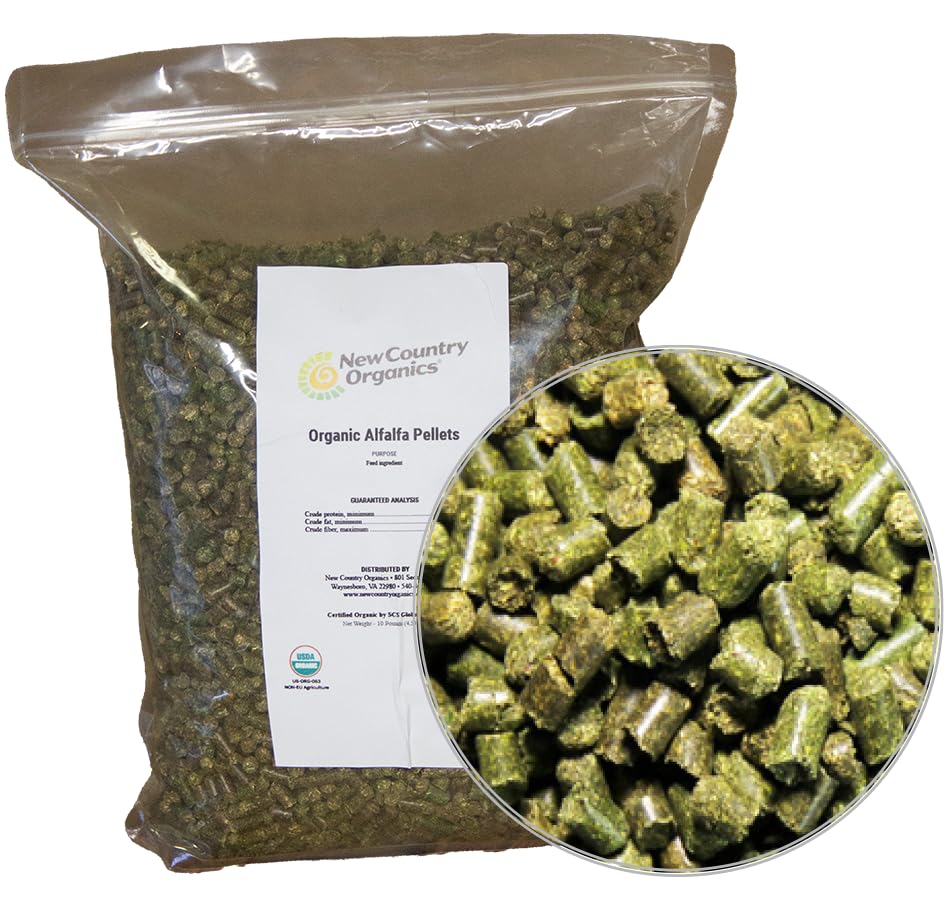
The only bag here with published protein, fat, and fiber numbers, plus a Certified Organic label.
Most alfalfa bags make you guess at the nutrition. This one prints it: 17% protein, 1.5% fat, and 32% fiber, and the manufacturer describes it as a highly digestible, premium protein source built for maintenance and higher-energy diets. If you are feeding a horse that needs more than hay alone, those numbers are what you compare against your feed plan. The Certified Organic and Non-GMO claim is the strictest ingredient claim in this lineup.
The pellets run powdery, and that is the trade-off you accept for the organic pedigree. It spreads easily by hand — thin enough to scatter over a bed without digging it in — but it makes a little mess while you handle it. What the bag does well is perform. Effectiveness is what owners bring up first, and roses come up right behind it. The review pages sum it up with a gardener who reports it brought green areas back toward health, and another who watched a veteran golf-course keeper use it to treat the soil rather than the grass itself.
Against the Standlee bag, this one is the heavier of the two at 50 pounds, and it carries a published protein number that Standlee’s listing does not. That makes it the pick when you want to feed by nutrition figures rather than by feel. One thing to plan for: shoppers say it as powdery enough to need a contained spot when you fill the bucket, so pour it away from a breezy aisle.
Why It Earns Its Spot
- Published nutrition — 17% protein, 1.5% fat, 32% fiber — so you can feed to a plan
- Certified Organic and Non-GMO claim, the strictest label in this lineup
- 50 lb bag, the biggest here, for volume feeders
- Effective enough that owners reuse it for both feed and garden
The Honest Catch
- Runs powdery, so it makes a bit of a mess while you handle it
- Bigger bag means you need dry, sealed storage to keep it from clumping
Pick it for: feeding a horse to a protein target, or any time a Certified Organic claim is non-negotiable for your operation.
skip it if: you hate powdery feed — the cleaner-pouring Stampede pellets will suit you better.
4. Standlee Organic Alfalfa Pellets for Horses, 40 lbs
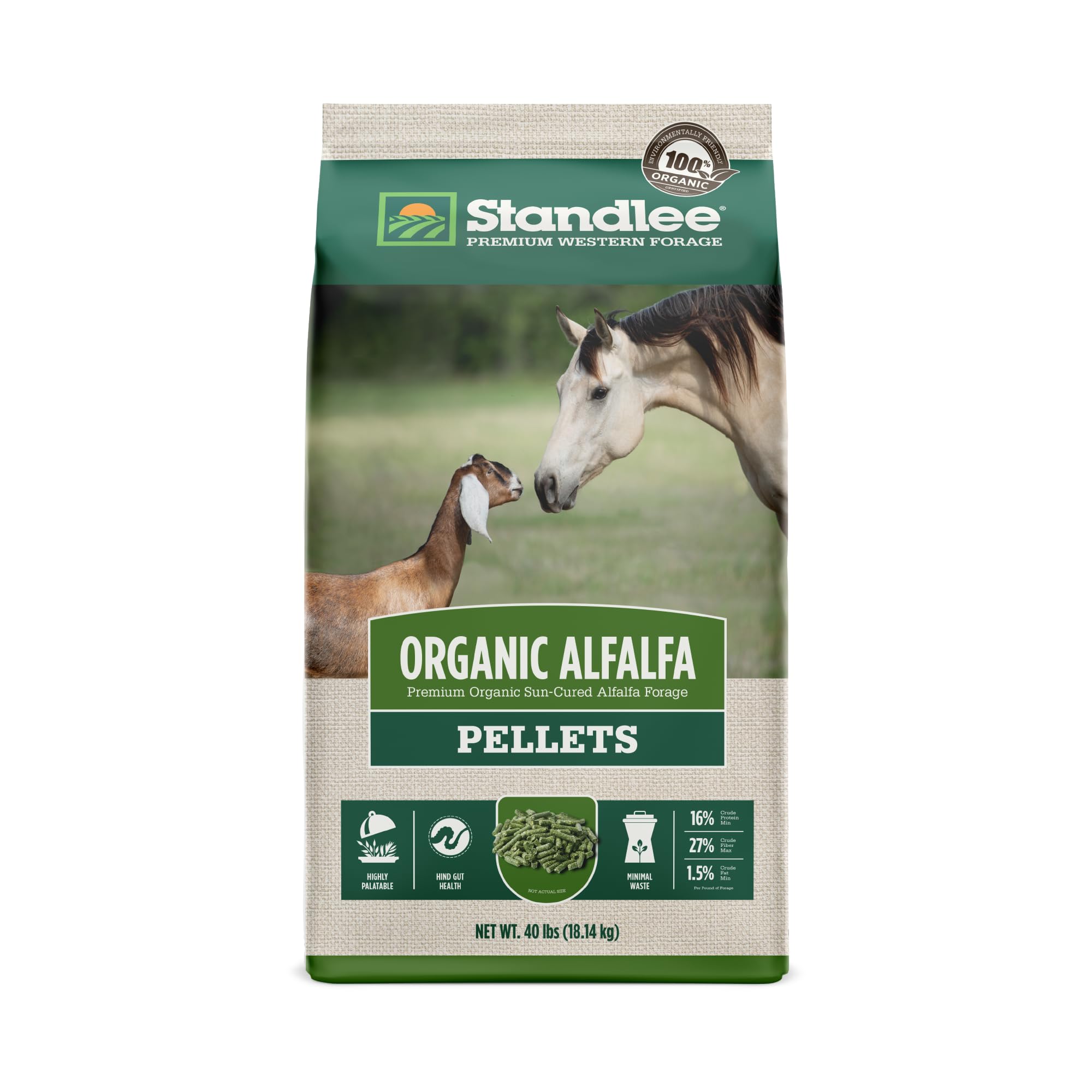
A horse-specific organic pellet with the strongest label claim in the lineup and the toughest caveat.
Standlee’s bag is the one aimed squarely at horse owners, and it carries three label claims at once: Organic, USDA Certified, and GMO Free. The forage is described as all natural and sun-cured, free of additives and preservatives, and hand-sorted before packaging. For a buyer who wants a certified organic pellet built for horses rather than a mixed-livestock bag, that hand-sorted, additive-free description is the reason to choose it.
The product itself earns its keep. A master gardener reports using these pellets as a plant fertilizer, sprinkling a fistful around each plant and watching them flourish, and notes it is natural and plant-based with no animal product in it. So the bag works double duty if you keep a garden alongside your paddock. The listed package size is 40 pounds even though the item weight field reads 10 pounds, so confirm the size you get is the big one before you plan storage around it.
Here is the honest part, and it is about the seller rather than the feed. Buyers report shipping trouble — one describes an order that slipped past its expected date by weeks, and another reports paying a steep mark-up over a farm store and being unable to return it. The pellets themselves are well regarded; the friction sits with the ordering experience. Buy this bag for the organic label and the horse-specific formulation, and order with enough lead time that a delay will not leave you short on feed.
The label case: Organic, USDA Certified, and GMO Free on one bag, with hand-sorted, additive-free sun-cured forage inside.
The repeat gripe: Delivery timing and mark-up come up in the reviews, so plan your reorder window generously.
Reach for this if: a USDA Certified organic horse pellet is what your barn requires, and you can order well ahead of running out.
Look elsewhere if: you need feed this week — the delivery track record on this listing has been uneven, and a barn cannot wait on a late bag.
Understanding the Specs
Bag Weight and What It Means at Feeding Time
The weight on the bag is your first cost-per-pound signal, and it also decides how you store the feed. A 5 lb bag suits a rabbit, guinea pig, or tortoise and stays fresh because you finish it quickly. A 40 lb or 50 lb bag suits a horse or a mixed group and lowers your cost per pound, but it needs a dry bin with a tight lid so moisture does not turn the pellets clumpy. Match the bag to how much your animals actually eat in a few weeks, not to the biggest number on the shelf.
Ingredient Claims: Non-GMO Versus Certified Organic
These two labels are not the same, and the difference matters when your barn or buyer has a rule. A Non-GMO claim means the alfalfa was grown without genetically modified seed. A Certified Organic claim goes further and covers how the crop was grown and handled end to end. Some bags carry both claims at once. If organic is a requirement rather than a preference, look for the word “Certified” on the front of the bag before you compare anything else.
Protein, Fat, and Fiber Numbers
Not every alfalfa bag prints its nutrition, and when one does, it lets you feed to a plan instead of by eye. The New Country Organics bag publishes 17% protein, 1.5% fat, and 32% fiber, which points to a maintenance-to-higher-energy diet. If your horse gets its main ration from hay and you use pellets as a top-up, matching protein and fiber to the rest of the diet keeps the whole plan consistent. If no numbers are listed on a bag, treat it as a general forage and feed it alongside your existing routine.
Pellet Form, Dust, and Waste
Pellets are compressed forage, which is why they store neatly and travel well compared with loose hay. Texture varies between bags — some pour clean and dust free, while others run finer and powdery. Dust-free pellets are easier to feed in a stall or a small pen because less ends up on the ground. Powdery pellets spread easily by hand for garden use but make more mess when you fill a bucket. Decide which matters more to you before you buy.
FAQ
Can horses eat alfalfa pellets instead of hay?
How much alfalfa pellet should I feed my horse each day?
Are these pellets safe for a pony or a smaller horse?
What is the difference between Non-GMO and Certified Organic alfalfa pellets?
Can I use alfalfa pellets as garden fertilizer?
Why do some alfalfa pellets arrive powdery or dusty?
How should I store a 40 lb or 50 lb bag of alfalfa pellets?
Is Standlee Organic Alfalfa Pellets the same as the Stampede Non-GMO pellets?
Will a rabbit or guinea pig eat these same alfalfa pellets?
Final Thoughts: The Verdict
For most horse owners, the alfalfa pellets for horses winner is the Stampede Alfalfa Pellets because it puts 40 pounds of pure alfalfa in the bag with a Non-GMO claim and no pellet binders, and the taste is what keeps horses cleaning up their bucket. If you want published nutrition with a Certified Organic label, grab the New Country Organics Alfalfa Pellets, which lists 17% protein, 1.5% fat, and 32% fiber for feeding to a plan. And for a small pet or a single rabbit where freshness beats volume, the FAMILY FARM AND FEED 5 lb bag is the one to reach for. Whichever you choose, buy the bag size you can finish before it goes stale, and store it dry in a sealed bin.
How We Picked
We do not accept paid placement. Every pick is matched to a real buyer and a real use-case; we do not hands-on test units.
Sources & Methodology
Specifications: manufacturer listings and product documentation. Review insights: verified customer reviews, as of September 2026. Pricing: not shown on this page (it changes often); check the current price via the retailer link.
As an Amazon Associate, Gadgets Feed earns from qualifying purchases. This does not affect which products we feature.