
Our readers keep the lights on and my morning glass full of iced black tea. As an Amazon Associate, I earn from qualifying purchases.
Specs are compiled from manufacturer listings and verified buyer reviews and can change over time — please confirm the key details on the product page before buying.
You want alkaline water without the weekly trip to the store or the guilt of tossing another plastic jug. The real question is which technology—RO with remineralization, gravity filtration, or ionization—delivers the pH and mineral boost you’re paying for. This guide compares the three main ways to make alkaline water at home: reverse osmosis with remineralization, countertop gravity filters, and electric ionizers.
I’m Min — the founder and writer behind Gadgets Feed. This guide is built by comparing the manufacturers’ published specifications and the patterns across verified customer reviews, so you get each pick’s real strengths and trade-offs instead of marketing spin.
From under-sink RO systems to pitcher-style filters, we’ve ranked the top alkaline water dispenser options so you can match one to your kitchen, your budget, and your hydration habits.
Our Picks at a Glance
How To Choose The Best Alkaline Water Dispenser
Before you pick a machine, you need to know how it makes water alkaline. There are three distinct paths, and each one changes your installation, your filter costs, and the taste of the final glass. Match the technology to your kitchen’s plumbing, space, and usage habits, not just the spec sheet.
Pick Your Technology: RO, Gravity, or Ionizer
You want alkaline water, but the path there changes what you get. Reverse osmosis (RO) systems push water through a super-fine membrane to strip out contaminants, then add minerals back in for that alkaline boost. Gravity filters like the Santevia simply pour tap water through a cartridge that raises pH naturally. Electric ionizers use platinum-coated plates to split water into acidic and alkaline streams on demand. Your choice depends on if you want instant hot/cold water, need zero plumbing, or want the deepest contaminant removal.
Think About Filter Life and Gallons
A filter that lasts 24 months sounds great until you realize the upfront cost. Meanwhile, a cheap cartridge that needs replacing every 2 months adds up fast. Look at the total capacity in gallons the filter processes before you swap it out. For a family, a filter that handles 120 gallons in 2 months will feel different than one that runs 24 months before you touch it again. The real cost is in replacement cartridges, not the machine’s upfront price.
Check the pH Range and What’s Inside
Not all “alkaline” water is equal. Some systems boost pH to 8.5, while ionizers can push to 10.5 or higher. Also check whether the system remineralizes with calcium and magnesium—those minerals are what you’re actually after for taste and hydration. A filter that only raises pH without remineralizing with calcium and magnesium misses the point.
Quick Comparison
| Model | Best For | Technology | Filter Life | Installation | Amazon |
|---|---|---|---|---|---|
| Waterdrop X12★ Best Overall | Whole-home purification | Under-Sink RO | 24 months | Under Sink | Amazon |
| Opti ChillBest Value | Fridge-friendly | Gravity Filter | 2 months | Countertop | Amazon |
| Anchor AF-3110Compact Pick | Faucet-attached filtration | Countertop Filter | 6 months | Countertop | Amazon |
| SimPure Y9A | No-plumbing RO | Countertop RO | 6 months | Countertop | Amazon |
| Santevia Glass | Mineral-rich gravity water | Gravity Filter | 2 months | Countertop | Amazon |
| iSpring PH100 | Under-sink alkaline RO | Under-Sink RO | — | Under Sink | Amazon |
| RKIN Zero | Compact no-install RO | Countertop RO | — | Countertop | Amazon |
| AGWIM Ionizer 729 | Adjustable pH on tap | Electric Ionizer | 6 months | Countertop | Amazon |
| iSpring RCD100HCW | Hot and cold RO | Countertop RO | — | Countertop | Amazon |
| Aqua Ionizer Deluxe 7.0 | High-pH enthusiasts | Electric Ionizer | 1 year | Countertop | Amazon |
In-Depth Reviews
1. Waterdrop X12 Alkaline Mineral Reverse Osmosis System
Our pick — over 4.5★ from 300+ verified ratings; the strongest balance of quality and price.
The tankless powerhouse that turns hard tap water into bottled-quality alkaline water on demand.
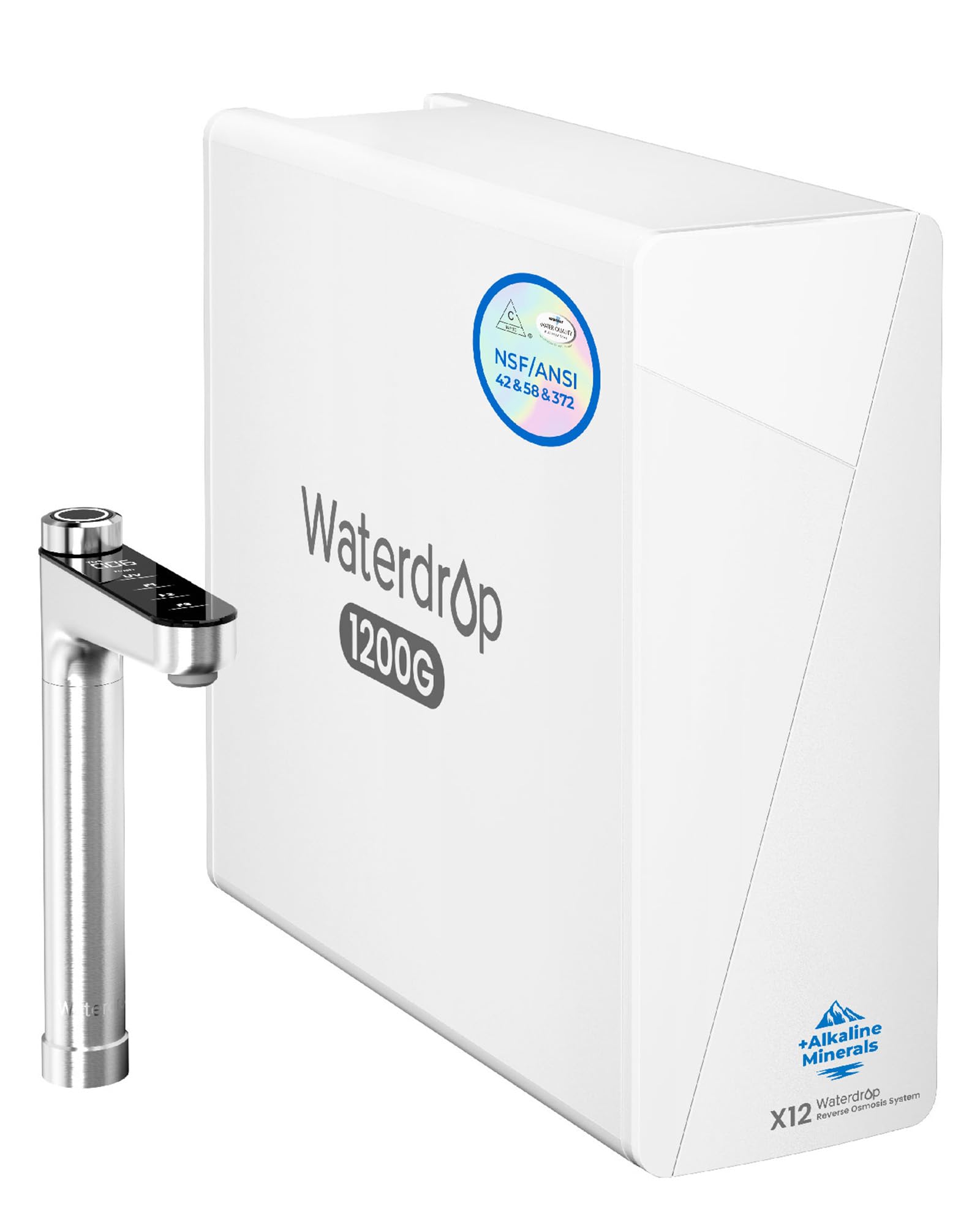
If you want the gold standard of home purification, this under-sink RO system delivers. It runs at 1200 gallons per day—that’s the speed rating—so you never wait for a tank to refill. The 11-stage filtration includes a 0.0001 μm reverse osmosis membrane with 16 layers, tested by SGS to cut TDS, PFOA, PFOS, chlorine, fluoride, arsenic, and lead. It’s also certified by IAPMO R&T against NSF/ANSI 42, 58, and 372 standards, which means third-party verification of what it removes.
What makes it alkaline is the healthy boost-tech stage that adds calcium and magnesium back after purification. Owners consistently report the taste wins blind tests against other systems, and that the mineral boost makes it taste like premium bottled water. The smart silver faucet shows TDS and filter life on a display, and you can set it to dispense exact volumes—handy for filling a 50 oz bottle automatically. The tankless design frees up under-sink space, and installation runs about 35 minutes for most people, though some note the electrical hookup took longer.
Owners with very hard Nevada water report TDS dropping from 130 to 20-35 ppm after filtration. The 3:1 pure-to-drain ratio means you waste less water than typical RO systems, and the 24-month filter life cuts replacement hassle dramatically. Compared to the Opti Chill’s 2-month filter cycle and 2-gallon capacity, the X12’s 24-month life and 1200-gallon daily rating put it in a completely different league for serious home use.
What Wins People Over
- Taste is the most-praised feature by far—owners call the mineral-boosted water better than bottled
- Installation is genuinely DIY-friendly, with filter changes that take minutes thanks to the magnetic lid
- The certified filtration (NSF/ANSI 42 & 58 & 372) gives real confidence
The Honest Trade-Offs
- The smart faucet can feel slightly wobbly, and the unit makes some noise during operation
- This is a premium investment—you’re paying for the certification and speed
- Note that the F1A alkaline replacement filter can slightly raise TDS, which is normal but worth knowing
Your best pick if: you want the deepest filtration with real certification, instant flow, and don’t mind a DIY under-sink project.
A warning: the upfront cost is the highest on this list, so it’s for buyers who value long-term performance over entry price.
2. Opti Chill 2-Gallon Alkaline Water Filter Dispenser
The fridge-shelf filter that gives you alkaline water without a single tool or plumber.
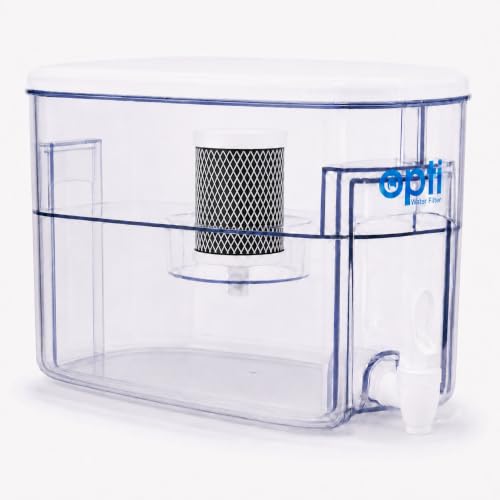
This is the simplest entry into alkaline water. It’s a 2-gallon BPA-free dispenser that sits on a fridge shelf or countertop, with a front-facing spigot. The advanced ionic filtration technology reduces up to 99.99% of select contaminants including lead, chlorine, PFAS, microplastics, and heavy metals—impressive claims for a gravity-fed unit. It naturally raises alkalinity to pH 9.0 while keeping trace minerals like calcium and magnesium in the water.
There’s no plumbing and no electricity required. You pour tap water into the upper reservoir, and gravity pulls it through the filter at a rate of 4 liters per hour. That’s where the catch lives: the filtration speed is genuinely slow. Buyers report it can take a day to produce a full cup if the tank runs dry, so you need to keep topping it up to have water ready. The included filter processes up to 120 gallons and lasts about 2 to 3 months, though some owners see it slow to a drip after a month and need to re-prime it.
What keeps people coming back is the taste. Owners mention the water tastes dramatically better than bottled alkaline water or a standard pitcher filter—crisp, clean, and worth the wait. There have been reports of the spigot leaking around the 6-month mark, but the customer service reputation is strong, with replacement parts sent without hassle. This is the pick for renters or anyone who wants alkaline water with zero installation commitment, but it’s not for heavy households that need gallons a day.
Where It Shines: The taste-to-effort ratio is excellent for light drinkers. For under-sink RO performance without the installation, this delivers surprisingly crisp, mineral-rich water.
Where It Tests Patience: The 2-gallon capacity and slow 4-liter-per-hour flow mean this suits light drinkers or as a secondary water source, not a family’s main supply.
3. Anchor AF-3110 10-Stage Countertop Water Filter
A slim faucet-attached filter with a 1500-gallon capacity that dwarfs fridge pitchers.
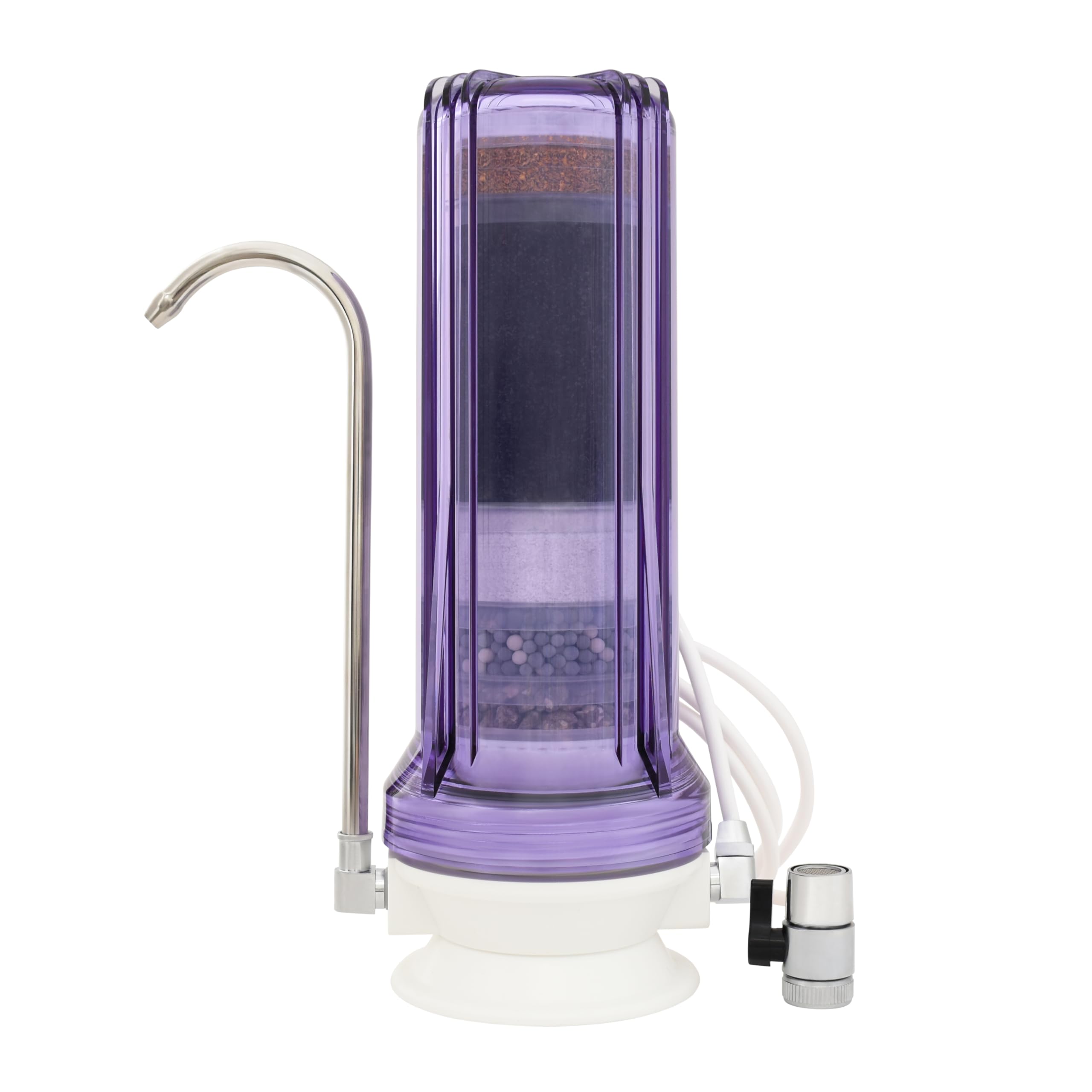
You get filtered alkaline water straight from your tap, with no refilling or storage tanks. This slim, portable unit connects directly to your kitchen faucet and filters instantly. It’s a 10-stage system that uses KDF-55 (a copper-zinc alloy that reacts with and removes heavy metals) to remove up to 99% of water-soluble heavy metals like lead and mercury, plus coconut shell activated carbon to strip chlorine, PFAS such as PFOA and PFOS, and the sulfur compounds that cause rotten egg smells. Mineral stones add calcium, magnesium, potassium, and copper back into the water.
Here’s the standout number: it filters up to 1500 gallons before you replace the cartridge. That’s a massive capacity compared to the Opti Chill’s 2-gallon reservoir and 120-gallon filter. The trade-off is that this system does not reduce TDS or PPM—so if your water is high in dissolved solids you want removed, this isn’t the tool. It’s about alkalizing, remineralizing, and improving taste, not deep purification.
The filter cartridge is recommended for replacement every 6 months, using the Anchor AF-1110. Owners describe the water as distinctly mineral-tasting—great for coffee and for those who like the flavor, but not for people who prefer neutral water. One honest note: it’s designed for fixed goose-neck faucets, not pull-down models with rinse hoses. Some owners have reported a slow drip from the unit, though the improved design with a flat base resolved the worst of the earlier issues. At 5.2 pounds and 13 inches tall, it’s unobtrusive but does occupy your faucet.
The Big Win: A 1500-gallon capacity at this size is exceptional—you’ll replace the cartridge roughly twice a year of heavy use.
Who Should Skip It: If you need TDS reduction or have a pull-down faucet, this design won’t fit your needs.
4. SimPure Y9A UV Countertop Reverse Osmosis Water Filter

Countertop RO that refills from the side—no pulling the unit out from the wall.
This is what happens when you want serious reverse osmosis but can’t install an under-sink system. The SimPure Y9A sits on your counter, plugs into a standard outlet, and needs no plumbing. You fill the side-mounted transparent tank with tap water, and the 300 GPD RO system filters it fast—producing about 4.4 ounces every 10 seconds under standard conditions, which fills an 8-ounce glass in about 18 seconds. That speed beats most countertop RO systems that only manage 50-75 GPD.
The 6-stage filtration uses a 0.0001 μm RO membrane and reduces TDS by up to 99.88%. It’s tested to cut PFAS, lead, chlorine, nitrates, and fluoride. Then the post-mineralization filter adds calcium, magnesium, and potassium back in, bumping the TDS to a target of 50-80 ppm for taste. Owners describe the water as crisp and wonderful, and many report it’s noticeably better than their old pitcher filters. The transparent side tank shows your water level clearly, so you know when to refill.
The clean tank holds only 0.5 gallons, so heavy drinkers will refill it multiple times a day. There’s a recommended daily maintenance routine—replace the water in the feed tank daily and run the flushing function monthly. Some owners note the tank lid bends easily and there are no latches, and a few had to flush the system several times to clear floating particles from the new filters. Filter replacement runs every 6 months for the PPC and ALK filters, and every 9 months for the RO filter.
Why It Works for Renters
- No plumbing means it’s truly plug-and-play—take it with you when you move
- The 300 GPD flow rate means you’re not waiting minutes for a glass
- Remineralization gives it that crisp, mineral taste people love
What to Manage
- Daily refills are part of the routine—this is not a set-and-forget system
- Water comes out at room temperature, so you’ll want a pitcher in the fridge
- Some owners found the filter-life indicator and pouring design need refinement
Reach for this if: you’re an apartment dweller or RV owner who wants real RO purification without drilling into counters.
Look elsewhere if: you want a hands-off system with minimal daily upkeep.
5. Santevia Glass Water Filtration System
A beautifully crafted glass system that filters 90+ impurities and raises pH naturally.
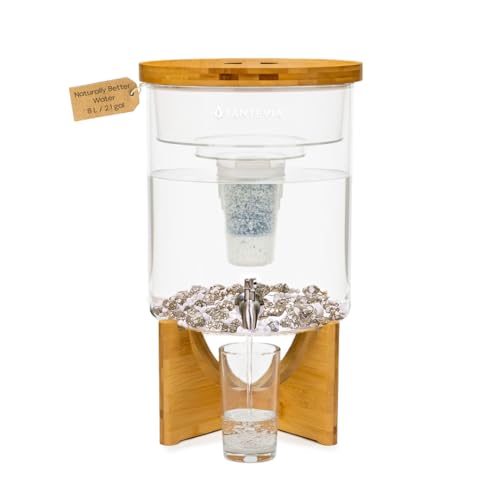
This is the countertop filter that doubles as a kitchen centerpiece. The Santevia Glass features an 8-liter glass reservoir resting on a sustainable bamboo stand—functional and genuinely attractive. It purifies tap water through a MINA Fluoride Filter that removes 99% of fluoride, chlorine, and lead, along with over 90 impurities including heavy metals, PFAS, and VOCs. It’s tested to NSF Standards 42, 53, and 401 for water quality.
what separates it is the remineralization. The system adds back calcium, magnesium, and potassium through mineral stones, which naturally raise the pH by up to +2.0 units. Owners consistently describe the water as smooth, premium, and mineral-rich—many note their families drink noticeably more water because it tastes that good. The MINA filter lasts 2 months (about twice the life of leading brands, according to the maker), and the mineral stones last a full 2 years.
The trade-offs are about practicality. This is a large unit—over 17 inches tall—so it fits in a fridge but takes up serious counter space. Some owners note that only the outer portion of the reservoir is actually glass, with the inner chamber being plastic. And in a few cases, the supplied mineral stones weren’t enough to cover the bottom of the vessel as pictured. The glass reservoir demands careful handling, though the design is sturdy enough for daily use. For those who prioritize aesthetics and mineral content over raw filtration speed, this is a standout.
The Head-Turner: The glass-and-bamboo design means this filter earns its place on the counter, not hidden in a cabinet.
Size Matters: At 8 liters and over 17 inches tall, it’s a commitment in counter space—measure your area first.
6. iSpring PH100 Alkaline Reverse Osmosis Water Filter System

A US-made filter system with a 1:1 waste ratio that water-conscious homes appreciate.
iSpring has a reputation for building reliable RO systems with real support, and the PH100 delivers on that. It’s a 6-stage under-sink system using a Dupont RO membrane that removes up to 99% of over 1,000 contaminants, including lead (up to 98% removal), chlorine, fluoride, arsenic, and asbestos. The standout engineering here is the 1:1 pure-to-waste water ratio—for every gallon of clean water, only one gallon goes down the drain, which is better than many systems that waste 3 or 4 gallons.
The 6th stage is the alkaline remineralization filter, which restores healthy minerals after the RO membrane strips them out. This is crucial because standard RO water can be slightly acidic—below pH 7. This system brings the balance back, producing water that owners describe as having a spring-water taste. The 100 GPD flow rate uses upgraded 3/8-inch fast-flow input and output lines, so you’re not waiting forever for a glass.
Installation is genuinely DIY-friendly, typically taking a couple of hours. The system includes extra tool sets, a clear manual, and installation videos, and it comes with a brushed nickel all-metal faucet that looks like it belongs in a high-end kitchen. US-made replacement filters (search “F9KUS” or “F19K100US”) mean you’re not locked into proprietary cartridges. Some owners found the included instructions confusing with color mismatches, needing YouTube help, and a few noted missing adapters for the leak-stop valve. But the customer support from Atlanta is consistently praised as responsive and helpful.
The Efficiency Angle
- The 1:1 pure-to-waste ratio saves significant water over time compared to standard RO
- Non-proprietary US filters keep replacement costs predictable
- The all-metal faucet adds a premium feel to your sink
Setup Caveats
- Instructions can be confusing—plan to watch a YouTube video
- New filters need a proper purge and flush before first use
- Some kits miss the adapter needed for the leak-stop valve
Choose this for: a dependable under-sink RO with better water efficiency and US-made filters you can actually source.
Know before you buy: the documentation could be clearer, so budget time for setup troubleshooting.
7. RKIN Zero Installation Purifier

A zero-assembly RO that produces AlcaPure alkaline water at a balanced 7-8 pH.
For buyers who want RO purity but refuse to deal with installation, the RKIN Zero is about as plug-and-play as it gets. There’s no assembly, no plumbing, and no faucet connection needed—just plug it in and pour tap water into the top. It’s certified by IAPMO R&T and uses a patented 4-stage filtration system that removes up to 99% of fluoride, chlorine, and heavy metals. The output is AlcaPure alkaline water at a balanced 7-8 pH.
The unit’s standout feature is its 50% recovery rate, which the maker calls the highest among reverse osmosis filters—meaning half the water you pour in becomes clean drinking water. It’s also energy-efficient, using only 30 watts of power. Customers note impressive TDS reductions, with one noting a drop from 87 to 28, and another seeing tap water at 192 drop to 32 through the unit. The taste is described as silky and smooth, with a noticeable improvement that even kids pick up on.
At 23 pounds and over 16 inches tall, this is not a compact appliance—it’s a solid countertop presence. The 0.5-gallon capacity means frequent refilling for heavy users. The honest concern from owners is reliability: some report the unit stopped working after a filter change, and there are mixed experiences with customer support when issues arise. The front panel can feel loose and the flow lever fiddly, but for a single person or light household, the no-install convenience and water quality make it a solid choice.
The Appeal: True RO quality with zero installation barrier—unbox, plug in, and you’re drinking filtered water in minutes.
The Fit Check: The small tank and 23-pound footprint make this best for a single user or as a secondary water source.
8. Alkaline Water Ionizer Machine 729

A countertop ionizer with 7 water settings from pH 4 to 10.5 for every task in your kitchen.
This is a true water ionizer, not just a filter. It attaches to your faucet and uses 5 platinum-coated titanium plates with a Japan-imported ionic membrane to split tap water into alkaline and acidic streams. You get 7 water options: 4 kinds of ionic alkaline water for different uses (food disinfection, cooking, coffee and tea, daily drinking), 1 non-ionized filtered water for medicine and baby formula, and 2 ionic acidic waters for skin washing and sanitizing. The alkaline water has a slightly sweet taste that owners appreciate.
The numbers are what set it apart: it produces water from pH 4 to 10.5, with an ORP rating down to -570mV (a measure of antioxidant potential). The built-in active carbon filter handles harmful pollutants and lasts up to 8000 liters before replacement—at 6-month intervals recommended by the maker. A 3.8-inch color LCD screen displays your settings, and the unit self-cleans to keep the plates working efficiently. It holds WQA and NSF certifications.
This machine requires 110 volts only and will not work with well water. Installation needs a compatible faucet—normal internal thread, external thread, or thread-less—but won’t fit shower or unusual faucets. The water flow must stay between 0.8 and 3.5 L/min for proper ionization, with 2 L/min being the balance. Some owners find the startup music too loud, though it can be turned off. The honest feedback is mixed on long-term reliability: some units have failed after several months, though customer service has a strong record of sending replacements. Owners who’ve had it running for years report it still outputs 10.0+ pH water reliably.
The Flexibility Win
- Seven different water types mean one machine handles drinking, cooking, and cleaning
- The 8000-liter filter capacity is exceptional—replace it roughly twice a year
- Self-cleaning keeps the platinum plates working efficiently
The Reality Check
- Faucet compatibility is limited—measure your threads before buying
- Well water is a hard no for this unit
- Some reviewers point out units failing after several months, though support is responsive
Buy this if: you want full control over your water’s pH and use different water types for different kitchen tasks.
Think twice if: you have well water or an unusual faucet that won’t accommodate the diverter.
9. iSpring RCD100HCW Alkaline Hot & Cold Countertop RO System
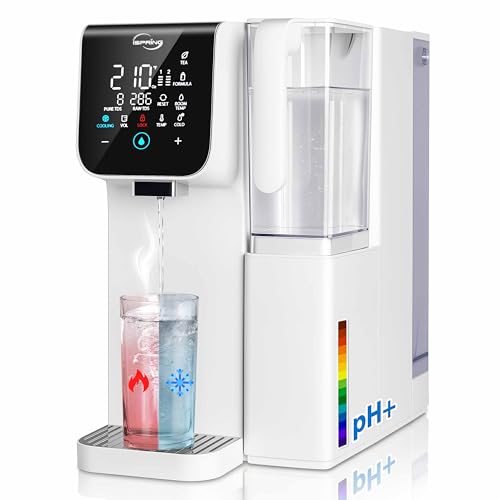
The all-in-one countertop RO that gives you hot tea water and cold alkaline water on demand.
This is the most complete countertop solution on the list. The iSpring RCD100HCW is a countertop reverse osmosis system that requires no plumbing—just a power outlet—and delivers water at 9 different temperatures from 50°F up to 210°F, with 6 one-touch dispensing volumes. The alkaline stage remineralizes the RO water, giving it a spring-tasting quality with a balanced, healthy pH and essential minerals.
The filtration is serious: it reduces over 99% of 1,000+ contaminants including PFAS, vinyl chloride, chlorine, fluoride, lead, arsenic, and asbestos. A real-time TDS monitor tracks both source and filtered water on a smart display, so you can see exactly what’s being removed. The dual removable pitchers are a clever design touch—one stays in use while the other sits in the fridge, so you always have cold water ready.
For households that love tea, hot chocolate, or instant coffee, the instant hot water (up to 210°F, near boiling) is a genuine standout. Shoppers say setup takes under 30 minutes and filter replacement is simple with the twist-and-lock design and built-in filter life monitoring. A family of five stopped buying 8-10 cases of bottled water a month after getting this. The honest caveats: some units have stopped working after several months, though iSpring’s Atlanta-based support is consistently praised for fast, low-maintenance replacements. The dual pitchers need refilling, and there’s a learning curve around flushing new filters and managing the tank—you’ll want to empty and refill at the last third to extend filter life.
Why It Earns Its Place
- Hot and cold in one unit—replaces both your kettle and your water filter
- Real RO purification with TDS monitoring for confidence
- Dual pitchers keep cold water flowing even during heavy use
What to Watch
- Some buyers report units failing after months of use, though support responds quickly
- Filter durability gets mixed feedback—you may replace cartridges sooner than expected
- City water only—this isn’t designed for well water
Your pick if: you want the convenience of instant hot and cold RO water without any under-sink installation.
Consider the alternative: if you don’t need hot water, the under-sink iSpring PH100 gives similar filtration at a lower price.
10. Aqua Ionizer Deluxe 7.0
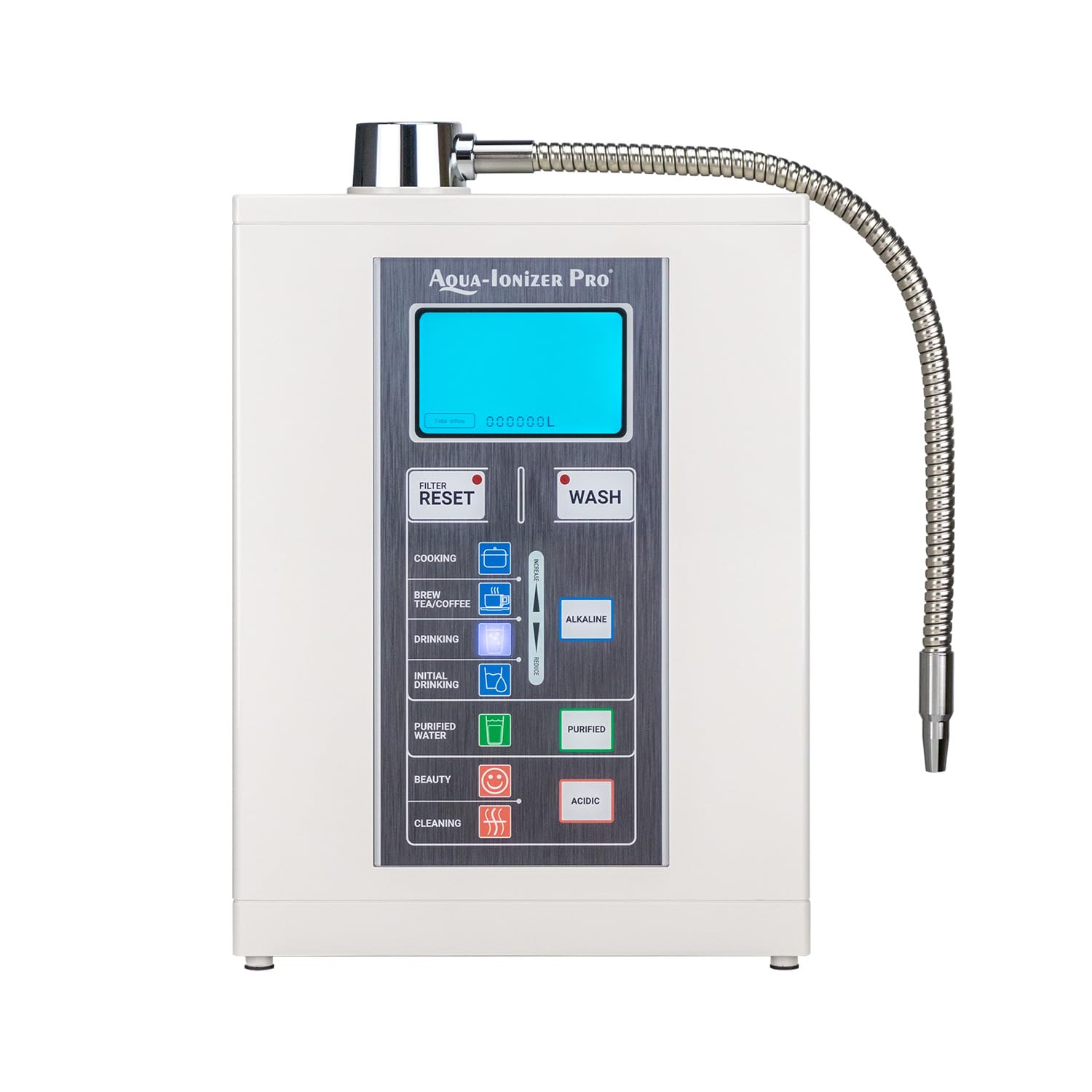
The high-end ionizer that pushes pH to 11.0 with 7 platinum-coated titanium plates.
For the serious alkaline water enthusiast, the Aqua Ionizer Deluxe 7.0 is the machine that does it all. It produces water from pH 4.5 up to 11.0, with fully variable alkaline settings—not just presets. The ORP range goes from +600 to -750mV, meaning you can create water with strong antioxidant potential. Seven platinum-coated titanium plates handle the electrolysis, and the unit cleans itself by reversing polarity after each use, with auto-plate washing every 10.5 gallons.
The built-in active carbon filter is a workhorse: it purifies over 1,585 gallons of water and lasts up to a year before replacement. With 7 water settings, you get 4 continuously variable alkaline options, 1 non-ionized purified water,[…]and 2 acidic presets for cleaning and skin care. Owners consistently praise the machine’s build quality—it’s the most-mentioned aspect by far—and its functionality, with an intuitive backlit LCD making operation simple.
Real-world testing by owners shows tap water at pH 7 with an ORP of +135 transforms into 9.5 pH water at -450 to -475 ORP on the drinking setting, and 11 pH at -815 ORP on the cooking setting. That’s a dramatic shift in both alkalinity and antioxidant potential. The filter replacement cost is a notable win—owners mention replacement filters cost less than, which is affordable for a system in this class. The 5-year warranty adds confidence. The main caveats: the standard faucet connection may not fit designer faucets, and there are isolated reports of units dying after a few months. But the overwhelming sentiment is that this machine delivers on its promises, with many owners reporting years of reliable service.
The Enthusiast’s Choice
- Wide pH range from 4.5 to 11.0 covers every use case from drinking to cleaning
- Filter lasts up to a year and replacement cartridges are affordable
- Self-cleaning plates and a 5-year warranty add long-term value
Before You Commit
- Standard faucet connection may need an adapter for designer fixtures
- It’s a substantial investment—this is top-tier pricing
- A small number of customers note units failing within months
The standout: For maximum control and antioxidant potential, the Deluxe 7.0’s -800mV ORP capability leads the entire list.
The catch: this level of capability comes at a premium price that only makes sense for dedicated alkaline water users.
Understanding the Specs
pH and Alkalinity
pH measures how acidic or alkaline your water is on a scale from 0 to 14, with 7 being neutral. Alkaline water typically sits between 7 and 9.5, though ionizers can push higher. The human body naturally regulates its own pH, so the goal here is taste and mineral content, not “curing” acidity. Systems that remineralize with calcium and magnesium tend to produce water that tastes smoother and more satisfying than water with just a high pH number and nothing else in it.
ORP and Antioxidant Claims
ORP stands for Oxidation-Reduction Potential, measured in millivolts (mV). A negative ORP means the water has antioxidant potential—it can donate electrons. You’ll see numbers like -570mV or -800mV in ionizer specs. Filter-based systems don’t typically list ORP because they don’t change it much. The real question is whether negative ORP water matters for health—the science is still debated, but for taste and the “smooth” mouthfeel, it does make a difference.
TDS: Total Dissolved Solids
TDS measures everything dissolved in your water—both good minerals and bad contaminants. A high TDS (400+ ppm) often means hard water or heavy mineral content. RO systems dramatically reduce TDS, sometimes by 90% or more. But here’s the catch: if you strip out everything, you also remove beneficial minerals. That’s why the best alkaline RO systems remineralize, adding back calcium and magnesium to achieve a TDS of 50-80 ppm—enough for taste, but far cleaner than tap.
Filter Life and Gallons
Filter life is stated either in months (how long until replacement) or gallons (total volume processed). These are two sides of the same coin. A filter rated for 24 months at 1200 gallons per day will last a family a long time. A 2-month filter with 120-gallon capacity needs frequent replacement. When comparing costs, don’t look at the machine price alone—multiply your expected filter replacements over a few years. The cheapest machine with expensive filters can cost more than a premium unit with long-lasting cartridges.
FAQ
What is the difference between an alkaline water filter and a water ionizer?
Can alkaline water dispensers work with well water?
How often do I need to replace the filters on an alkaline water dispenser?
Is alkaline water from a dispenser the same as bottled alkaline water?
Do I need a plumber to install an alkaline water dispenser?
Why does my alkaline water taste different from regular tap water?
Can I install an alkaline water dispenser in an RV or camper?
How much counter space do these units take up?
Why is there wastewater with reverse osmosis systems?
Final Thoughts: The Verdict
The alkaline water dispenser that wins for most households is the Waterdrop X12 because it combines certified NSF/ANSI filtration, a 24-month filter life, and instant 1200-gallon-per-day flow with the widest owner satisfaction on this list. If you want the freedom of zero installation, the SimPure Y9A delivers genuine RO quality on your countertop. And for households that want hot water for tea alongside cold alkaline water, the iSpring RCD100HCW is a standout all-in-one. Whatever you choose, the right system pays for itself by replacing bottled water—the convenience of endless fresh alkaline water at your tap is the real win.
How We Picked
We do not accept paid placement. Every pick is matched to a real buyer and a real use-case; we do not hands-on test units.
Sources & Methodology
Specifications: manufacturer listings and product documentation. Review insights: verified customer reviews, as of September 2026. Pricing: not shown on this page (it changes often); check the current price via the retailer link.
As an Amazon Associate, Gadgets Feed earns from qualifying purchases. This does not affect which products we feature.