
That slick feeling after a rinse, the absence of any metallic or chlorine aftertaste, and a noticeable smoothness on the tongue — that is the sensory signature of restructured water. An alkaline water pitcher doesn’t just filter sediment and odor; it alters the fundamental pH balance of your tap water, adding minerals that shift the reading from neutral (pH 7) to a base range of 8.5 to 9.5. This isn’t a purification step — it’s a chemical recalibration aimed at those who want the theoretical benefits of higher-pH hydration without the recurring cost and plastic waste of bottled alkaline water.
I’m Min — the co-founder and writer behind Gadgets Feed.
The truth is that many entry-level options barely nudge the pH needle, while premium units use patented media to deliver a stable alkaline output across their entire filter lifespan. After close study, I’ve curated the list of the best alkaline water pitcher models that combine genuine pH shifting, certified contaminant reduction, and a durable design that fits your daily routine.
How To Choose The Best Alkaline Water Pitcher
Walking into this category, the biggest trap is assuming that any filter that claims to raise pH is actually an alkalizer. Many standard carbon-block filters may remove chlorine and improve taste, but they will not budge your water’s pH beyond a negligible 0.3 points. A true alkaline pitcher requires a dedicated remineralization stage — typically a bed of bioceramic balls, coral calcium, or magnesium media that actively releases ions into the filtered water. Understanding the media type is the first and most critical filter in your decision-making process.
Filtration Media: Bioceramic vs. Ion-Exchange vs. Carbon Block
The material inside the filter cartridge dictates everything about the output. Carbon block is excellent for physical contaminant reduction (lead, chlorine, VOCs) but does not alkalize on its own. Ion-exchange resin can raise pH, but it does so by swapping calcium and magnesium for sodium — meaning you end up with a higher sodium content in your drinking water. Bioceramic filters use natural ceramic beads infused with minerals like tourmaline and magnesium that catalyze a hydrogen-splitting reaction, generating both alkalinity (pH 8.5–9.5) and a negative oxidation-reduction potential (ORP) without adding sodium. For a truly alkaline output without a salty aftertaste, look for a bioceramic or mineral-infused filter.
Certifications That Actually Matter
Not all claims are backed by standards. The alkaline water pitcher market is rife with brands that claim pH levels of 10+ without independent verification. The most meaningful certifications are NSF/ANSI 42 (taste and odor reduction), NSF/ANSI 53 (health-related contaminant reduction, including lead and VOCs), and NSF/ANSI 372 (lead-free material compliance). For fluoride reduction, specifically look for NSF/ANSI 53 certification that explicitly lists fluoride removal rates. Third-party lab reports with quantified pH and ORP measurements are even more trustworthy than marketing labels, since no single NSF standard currently governs alkalinity claims.
Filter Lifespan and Total Cost Over 12 Months
Consider that a pitcher with a 200-gallon filter life rated for 3 months will require four cartridge changes per year, while a shorter 80-gallon filter might need six or more swaps annually. The upfront price of the pitcher is often a fraction of the long-term expense. Look at the gallon-per-filter ratio and the replacement cartridge cost to estimate your yearly spend. A premium pitcher that uses proprietary filters can cost more in the long run unless the filter life is proportionally longer. The sweet spot is a filter that lasts at least 100 gallons while delivering measurable pH elevation for at least 75% of that volume.
Quick Comparison
On smaller screens, swipe sideways to see the full table.
| Model | Category | Best For | Key Spec | Amazon |
|---|---|---|---|---|
| Alkanatur Drops Pitcher | Premium | High pH & Antioxidants | pH 9 + / -350 ORP / 400L filter life | Amazon |
| Clearly Filtered Pitcher | Premium | Maximum Contaminant Reduction | Targets 365+ contaminants / 100 gal filter | Amazon |
| Waterdrop ED01AW Alkaline | Mid-Range | Electric Convenience + Alkaline | 15 cups / 200 gal / 30-day battery / USB-C | Amazon |
| Alkanatur Alkaline Hydrogen | Premium | Fluoride & Sodium-Free Alkaline | pH 9.5 / 400L / No ion-exchange resin | Amazon |
| Santevia MINA Value Pack | Mid-Range | Mineral Addition on a Budget | 80 gal filter / +2.0 pH / adds Ca, Mg, K | Amazon |
| Waterdrop ED02W Electric | Mid-Range | One-Key Electric Dispensing | 14 cups / 200 gal / 1-sec dispensing / USB-C | Amazon |
| Brita Large 10-Cup Elite | Budget | Everyday Contaminant Reduction | 10 cups / 120 gal / Reduces 99% lead | Amazon |
In‑Depth Reviews
1. Alkanatur Drops Pitcher

The Alkanatur Drops Pitcher is the most technically complete alkaline solution in this lineup, thanks to its patented bioceramic filter that eschews sodium-adding ion-exchange resin entirely. The filter media uses activated coconut carbon and mineral-infused ceramic beads to simultaneously remove chlorine, heavy metals, fluoride, and microplastics while raising the water’s pH to a stable 9 and generating a negative ORP down to -350 mV. That ORP reading is the marker of antioxidant potential — a feature usually reserved for much more expensive countertop ionizers.
With a filter life of 400 liters (roughly 3 months for a family of two), the replacement cycle is competitive for the premium tier, and the package includes a BPA-free water bottle for on-the-go alkaline hydration. The pitcher itself has a 1.4-liter working capacity, which is smaller than some gravity-fed alternatives, but this is a tradeoff for the dense, multi-stage bioceramic cartridge. Customer reports confirm a consistent pH between 8.5 and 8.9 over the first two months of use before a gradual decline — a normal curve for any passive remineralization filter.
Where this pitcher truly distinguishes itself is the certification stack: it carries CE, ROHS, and SGS approvals, plus a certification from the Instituto Cerámico de Galicia associated with the University of Santiago de Compostela. That level of third-party scrutiny is rare in this category. The main consideration is the smaller reservoir size — if you need to fill a 64-ounce bottle in one go, you will need to refill the pitcher twice.
Why it’s great
- Genuine pH 9 with -350 ORP antioxidant performance from a passive filter
- No ion-exchange resin means zero added sodium to your drinking water
- Extensive third-party certifications from European academic and regulatory bodies
Good to know
- 1.4-liter capacity requires multiple refills for larger households
- Some early units showed carbon fines; rinse the filter thoroughly before first use
2. Clearly Filtered Filtered Water Pitcher
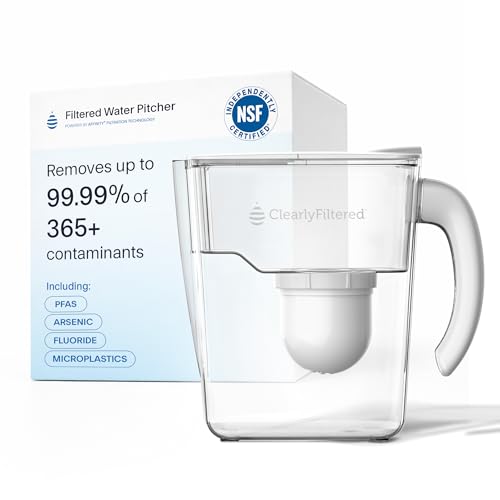
Clearly Filtered positions itself as the most comprehensive contaminant-targeting pitcher on the market, and the data supports the claim. Its proprietary Affinity Filtration Technology uses ionic binding to capture 365+ contaminants — far exceeding the typical 30-to-50-substance target range of standard alkaline pitchers. The included 80-ounce (10-cup) reservoir is made from medical-grade Tritan plastic that is BPA-free and BPS-free, addressing the endocrine-disruptor concerns that often accompany plastic housings. The pitcher is NSF certified to standards 42 and 372 for chlorine reduction and lead-free materials, with independent lab testing for every other contaminant claim publicly available on their site.
The filter life is rated at 100 gallons, or roughly 4 months of daily use, which puts it squarely in the mid-to-premium longevity category. The tradeoff for this high level of contaminant capture is a relatively slow filtration rate — expect approximately 17 minutes for a full pitcher of water. The ergonomics have been improved in this third-generation design with a spill-resistant water dam and a hinge-fill lid that doesn’t require full removal, though some users have noted that the top reservoir can feel loose during pouring if the lid isn’t fully snapped shut.
Unlike dedicated alkaline pitchers, Clearly Filtered focuses primarily on contaminant reduction rather than aggressive pH shifting. While it does preserve beneficial minerals like calcium and magnesium, it does not advertise a specific pH boost in the way that Alkanatur or Santevia do. If your primary goal is removing fluoride, lead, PFAS, and pharmaceuticals with lab-verified certainty, this is the safest bet. If you specifically want to drink water at pH 9+, you may want to pair this with a mineral-additive filter.
Why it’s great
- NSF-certified reduction of 365+ contaminants including fluoride, PFAS, and lead
- Medical-grade Tritan construction is free of BPA, BPS, and phthalates
- Long 100-gallon filter life with transparent, publicly available lab reports
Good to know
- Not designed to aggressively raise pH — alkaline output is minimal
- Slow filtration rate (~17 minutes per full pitcher) requires planning ahead
3. Waterdrop ED01AW Electric Alkaline Water Filter Pitcher

The Waterdrop ED01AW is a compelling hybrid that combines the convenience of an electric countertop dispenser with a dedicated alkaline filter stage. Unlike passive gravity pitchers, this unit dispenses water at the touch of a button, handling up to 15 cups of water with a single fill. Its 5-micron carbon block filter is enhanced with an alkaline slow-release media that raises the pH by 1.5 to 2.5 units from the source water, meaning if your tap starts at pH 7.2, you can expect output in the 8.7 to 9.7 range. The internal rechargeable battery lasts roughly 30 days on a single USB-C charge, assuming daily dispensing of 101 to 135 ounces.
The filter is rated for 200 gallons or 3 months, which translates to a lower annual replacement cost than many premium passive pitchers. The design is compact enough at 12.52 x 12.17 x 7.76 inches to sit on a countertop without dominating the space, and the handle makes it portable for moving between kitchen, RV, or camping trips. The system does not reduce TDS — total dissolved solids remain in the water, which is standard for non-RO alkaline filters but worth noting if you prefer a lower mineral count.
Customer feedback highlights the ease of use across all age ranges, with families reporting that children as young as 5 and seniors up to 82 can operate the one-touch dispensing without issue. The main caveat is that the alkaline boost is most effective when the filter is fresh — the pH elevation tapers as the filter reaches its 200-gallon endpoint. Also, some units have experienced pump failures after extended use, though Waterdrop’s customer service has been responsive in replacing defective units after video verification.
Why it’s great
- Electric dispensing eliminates the need to tip the pitcher — ideal for limited mobility
- 200-gallon filter life reduces replacement frequency compared to 80-gallon competitors
- USB-C rechargeable battery offers 30 days of autonomy without plugging in
Good to know
- Alkaline boost diminishes as the filter approaches its end-of-life
- Does not lower TDS — dissolved solids remain in the output water
4. Alkanatur Alkaline Hydrogen Water Filter Pitcher
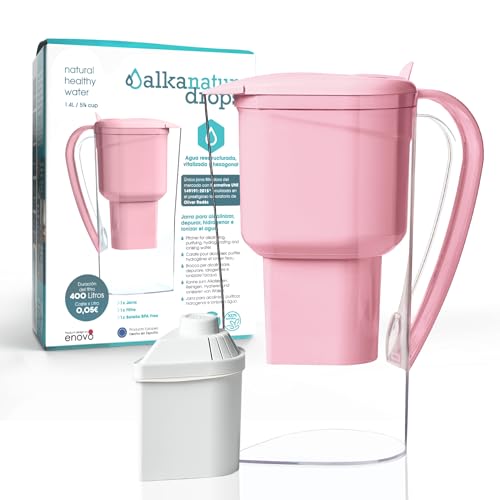
The Alkanatur Alkaline Hydrogen model shares the same core philosophy as the Drops Pitcher — no ion-exchange resin, no added sodium — but introduces a specific focus on hydrogen enrichment alongside alkalinity. The bioceramic filter uses a combination of activated coconut carbon and proprietary ceramic media that creates molecular hydrogen (H₂) as a byproduct of the water restructuring process, potentially offering additional antioxidant properties through dissolved hydrogen gas. The pH output is rated at 9.5, and the ORP can reach -350 mV, both of which are strong metrics for a non-electric pitcher.
The physical design is nearly identical to the Drops model, with a 1.4-liter capacity and a slim, modern silhouette that fits most refrigerator shelves. The included BPA-free water bottle is a useful addition for those who want to prepare alkaline water in advance for work or travel. Filter life is 400 liters or approximately 3 months, and the replacement cartridges are the same as the Drops line, so stock is widely available. Independent pH testing from users shows the unit consistently delivering water at pH 9 in the first month, with a gradual decline to 7.5 by month four — aligning with standard wear patterns for remineralization filters.
The main differentiator here is the hydrogen claim: while the pitcher does generate detectable H₂ levels, they are modest compared to dedicated hydrogen-water generators that output 800-1200 ppb. The Alkanatur is a passive filter first and a hydrogen device second. For buyers whose priority is sodium-free alkaline water with fluoride removal, this is an excellent second option to the Drops Pitcher. If you specifically want high-concentration hydrogen water, you will need an active electrolysis device instead.
Why it’s great
- Proven pH 9.5 output with no sodium from ion-exchange resin
- Generates detectable hydrogen and antioxidant ORP for a passive pitcher
- Includes a BPA-free bottle and has FDA, CE, and ROHS certifications
Good to know
- Hydrogen levels are modest — not comparable to active H₂ generators
- 1.4-liter capacity is small for households that go through 4+ liters daily
5. Santevia MINA Alkaline Water Filter Value Pack

Santevia takes a slightly different approach to alkalization: rather than creating a dramatic pH swing, the MINA filter focuses on adding back essential minerals — calcium, magnesium, and potassium — to the water while filtering out chlorine, lead, and cadmium. The pH is elevated by up to 2.0 units from the source water, so if your tap water is at pH 7.5, you can expect output around pH 9.5. This is the same target as premium pitchers, but the mechanism relies on a granulated activated carbon base with mineral-infused stages rather than bioceramic media.
This value pack includes three filters, each rated for 80 gallons or about 2 months of typical use. The 3-pack format gives you roughly six months of coverage out of the box, which makes the effective per-filter cost competitive even against budget alternatives. The filter cartridge fits Santevia’s MINA slim pitcher, which is a separate purchase, so this pack is intended for existing Santevia users or those buying the pitcher and filter set together. The filters are manufactured in North America, which is a quality signal for buyers who prioritize domestic production standards.
Customer feedback is overwhelmingly positive on taste, with many users noting the water feels “smoother” and “fresher” compared to standard filtered water. You will be changing cartridges roughly every two months, so the ongoing cost is higher than the upfront savings might suggest. If you are okay with more frequent swaps for the benefit of added minerals, this is a strong mid-range option.
Why it’s great
- Delivers a measurable +2.0 pH increase with added calcium, magnesium, and potassium
- Value 3-pack provides six months of coverage at a competitive per-filter price
- Manufactured in North America with granulated activated carbon media
Good to know
- 80-gallon filter life requires replacement every two months — higher annual cost
- Requires the Santevia MINA pitcher body; not a standalone filter system
6. Waterdrop ED02W Compact Electric Water Filter Pitcher

The Waterdrop ED02W is the non-alkaline sibling to the ED01AW, designed for those who prioritize rapid dispensing and contaminant reduction over pH shifting. Its electric pump delivers water in roughly one second at the touch of a button — no tipping, no waiting for gravity to pull water through the filter. This speed makes it a convenient option for busy kitchens, office desks, or RVs where every second counts. The 14-cup capacity is paired with a filter that is NSF/ANSI 42, 53, 401, and 372 certified to reduce 45+ substances including chlorine, lead, mercury, benzene, and microplastics.
The filter lifespan of 200 gallons or 3 months matches the alkaline ED01AW, and the built-in rechargeable battery offers 30 days of use on a single charge via the included USB-C cable. The compact footprint at 10.6 x 4.6 x 10.2 inches fits in most refrigerator doors, and the design includes a drainage hole at the bottom to protect the electronics from accidental water ingress. The system does not lower TDS, so if you are on well water with high mineral content, the taste improvement will come from chlorine and VOC removal rather than total dissolved solids reduction.
For buyers who specifically want alkaline water, this model is not the right choice — it does not include an alkaline remineralization stage. However, if you already have a separate alkalizer or mineral drop system, the ED02W serves as an excellent rapid-dispensing base unit. The one-key operation and long battery life make it particularly attractive for seniors or anyone with arthritis who struggles with lifting a full pitcher. The only consistent complaint is that the dispensing pump is audibly louder than passive pitchers — a tradeoff for the instant flow.
Why it’s great
- Electric dispensing delivers water in one second with no lifting required
- 200-gallon filter life with NSF certifications for 45+ contaminants
- USB-C rechargeable battery lasts 30 days, enabling cordless placement anywhere
Good to know
- No alkaline stage — this is a purifier, not an alkalizer
- Dispensing pump is noticeably louder than gravity-fed pitchers
7. Brita Large 10-Cup Elite Water Filter Pitcher
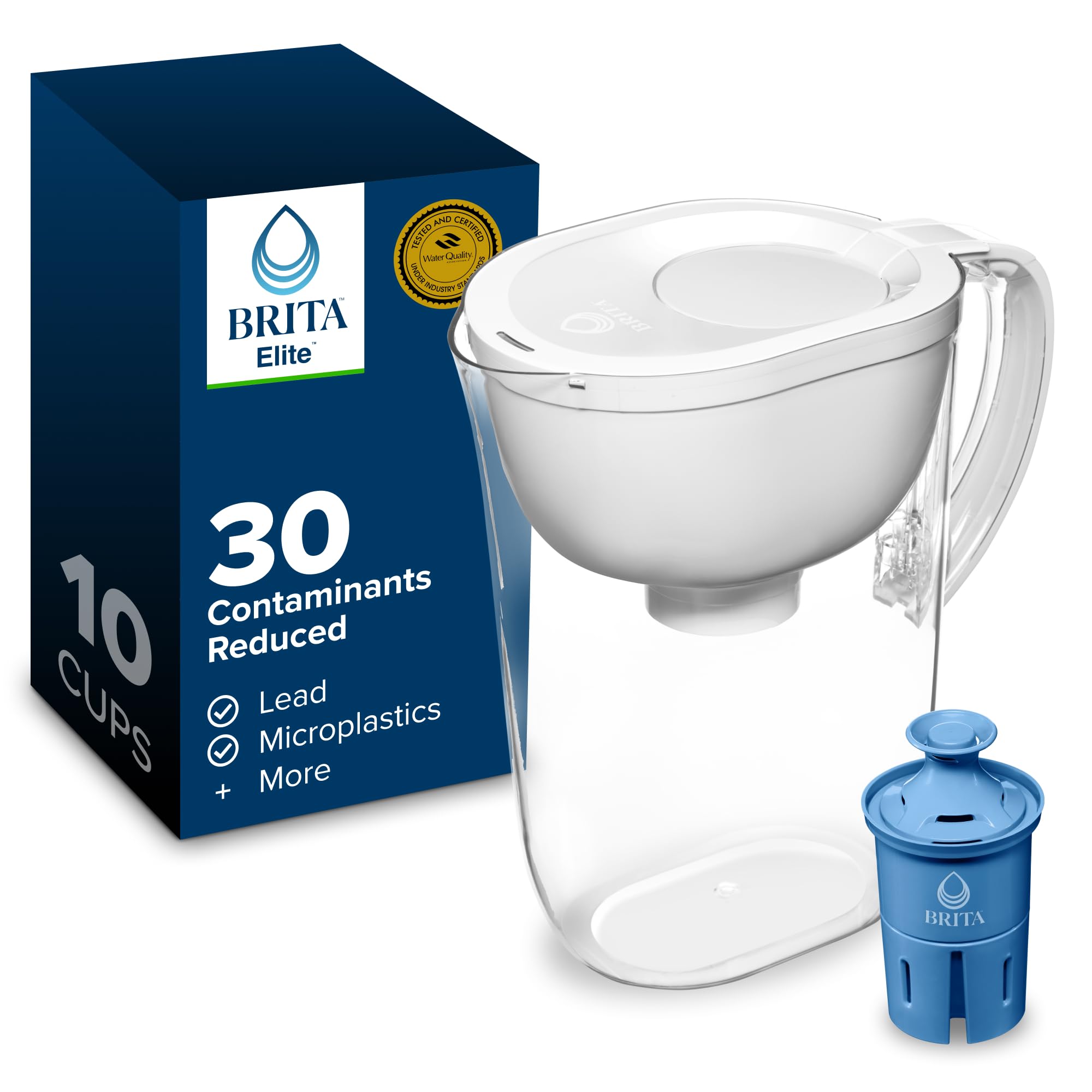
Brita is the household name in water filtration, and the Large 10-Cup Elite Pitcher represents the company’s most capable standard offering. The Elite filter is NSF/ANSI certified to reduce 99% of lead, chlorine, cadmium, mercury, benzene, and asbestos, as well as microplastics and pharmaceuticals. The pitcher holds 10 cups of water and includes a SmartLight electronic indicator that tracks filter life, taking the guesswork out of replacement schedules. The filter lasts for 120 gallons or about 6 months, which is excellent for the budget tier.
From a design perspective, this is a straightforward gravity-fed pitcher with an easy-fill lid and a fridge-friendly shape that measures 10.94 x 5.59 x 10.47 inches. The assembled weight is only 1.3 pounds, making it light to handle even when full. The Elite filter is compatible with all Brita pitchers and dispensers except the Stream series, so if you already own a Brita, you can upgrade just the filter. The main difference between the Elite and standard Brita filters is the broader contaminant target list and the 120-gallon capacity versus the standard 40-gallon.
Where this pitcher falls short for the alkaline-focused buyer is the complete absence of pH elevation. The Elite filter is designed purely for contaminant reduction — it does not add minerals, does not raise pH, and does not generate any antioxidant properties. The water will taste cleaner and lack the chlorine aftertaste of untreated tap water, but it will remain at your source water’s pH. For someone who simply wants cleaner water without the alkalinity feature, this is a reliable, proven, and affordable option. For the alkaline seeker, it is best viewed as a backup or a secondary filter for non-drinking purposes, such as making coffee or tea where neutral water is preferred.
Why it’s great
- NSF-certified reduction of 99% of lead, microplastics, and 30 other contaminants
- 120-gallon filter life is among the longest in the budget tier
- SmartLight indicator removes guesswork from filter replacement timing
Good to know
- Does not raise pH or add minerals — not an alkaline pitcher
- Some users report the curved base makes the pitcher prone to tipping when full
FAQ
Does an alkaline water pitcher actually change the pH of my water?
How often do I need to replace the filter in an alkaline pitcher?
Will an alkaline pitcher remove fluoride from my tap water?
Final Thoughts: The Verdict
For most users, the best alkaline water pitcher winner is the Alkanatur Drops Pitcher because it delivers genuine pH 9 water with antioxidant ORP, uses no sodium-adding ion-exchange resin, and is backed by rigorous European certifications that few competitors match. If you want maximum contaminant reduction with lab-verified fluoride and PFAS removal, grab the Clearly Filtered Pitcher. And for electric dispensing convenience with an alkaline boost and a 200-gallon filter life, nothing beats the Waterdrop ED01AW.