
Our readers keep the lights on and my morning glass full of iced black tea. As an Amazon Associate, I earn from qualifying purchases.
Specs are compiled from manufacturer listings and verified buyer reviews and can change over time — please confirm the key details on the product page before buying.
A home gym usually means one machine that cannot cover chest, back, legs, and arms at once. An all-in-one gym machine replaces that room of single-purpose gear with one station and a built-in weight stack (a column of weights you pin to set resistance, so there are no plates to load). This guide breaks down thirteen machines by weight stack, station count, and build, so you can match one to your space, your height, and your training load.
I’m Min — the founder and writer behind Gadgets Feed. This guide is built by comparing the manufacturers’ published specifications and the patterns across verified customer reviews, so you get each pick’s real strengths and trade-offs instead of marketing spin.
There is one factor most buyers overlook: the stack weight caps how strong you can get. Every pick here runs on a selectorized stack you adjust with a pin instead of loading plates by hand. That convenience is real, but a starter stack that feels heavy in month one can feel light by month six. So before you buy, match the stack to your long-term strength plans, then match the footprint to the room you actually have. That is the shortcut to finding the right all-in-one gym machine.
Our Picks at a Glance


How To Choose The Best All-In-One Gym Machine
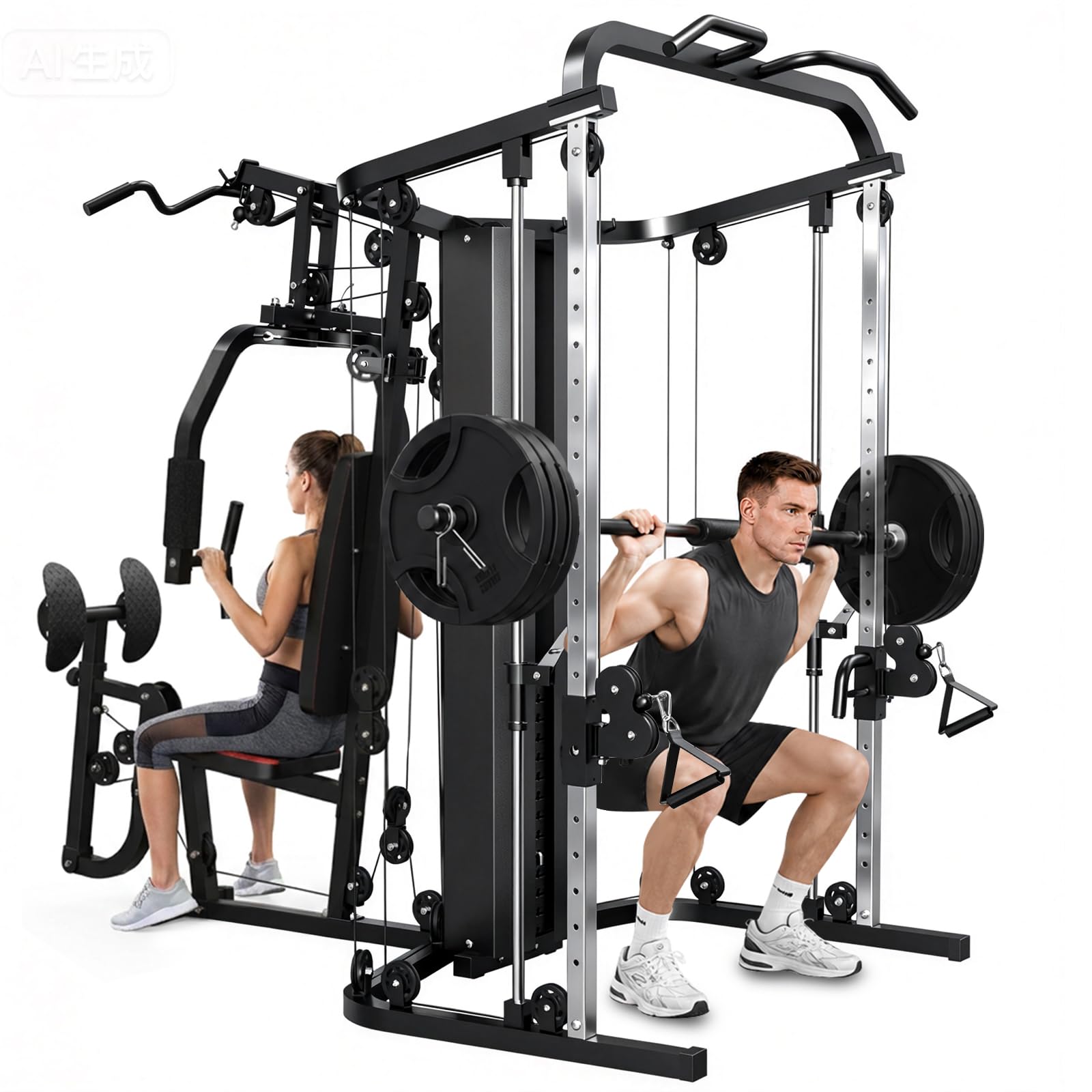
An all-in-one gym packs a weight stack, a pulley system, and several stations — a bench press, lat pulldown, leg extension, and more — into one footprint. That is what separates it from a lone bench or a band set. Four specs decide whether you will still be using the machine a year from now: stack size, footprint, cable ratio, and max weight rating.
Start With The Weight Stack, Not The Price
The weight stack is the column of plates you pin to set your resistance. It sets your strength ceiling. A 120- to 160-pound stack covers a beginner’s first year of light training, but a serious lifter can pin the whole column within months. If you plan to train heavy long-term, choose a machine with a stack you can add to, or one with a 2:1 cable ratio that lets you lift more with less plate weight.
Measure Your Space And Ceiling First
These machines are tall and wide. A full Smith-machine rig can run well over eight feet wide and approach nine feet tall, so a low basement ceiling or a tight apartment corner rules some picks out before you ever read the spec sheet. Measure your width, depth, and ceiling height, then compare them against the machine’s published dimensions. A compact single-stack unit fits where a dual-station rig never will.
Read The Cable Ratio And Pulley Count
A cable ratio describes how much pull you feel for each pound on the stack. On a 2:1 system, a 100-pound stack feels closer to 50 pounds at the handle, which is great for speed and range but weak for heavy pressing. More pulleys generally mean smoother travel — though a very tight stack of pulleys can also add friction that keeps light weights from settling back down.
Quick Comparison
| Model | Best For | Weight Stack | Footprint (D x W x H) | Max Weight Rec. | Amazon |
|---|---|---|---|---|---|
| SunHome Multifunction Home Gym★ Best Overall | Couples training together | 138 lb, independent per side | 96.85″D x 55.12″W x 86.61″H | 138 lb | Amazon |
| Marcy Multifunction Steel Home GymBest Value | Small spaces on a budget | 150 lb selectorized | 68″D x 42″W x 78″H | 300 lb | Amazon |
| Fitvids M750 Home GymBudget Champion | Budget all-rounders | 122.5 lb vinyl | — | 330 lb | Amazon |
| SincMill Full Body Workout Station | Compact setups, shorter users | 160 lb | 74.6″D x 34″W x 79.6″H | 160 lb | Amazon |
| ROBORE 160LB Home Gym System | Beginners, apartment corners | 160 lb | 66″D x 38″W x 79″H | 300 lb | Amazon |
| WFLGFT 148 LB Home Gym | Full-body training in tight rooms | 148 lb waterproof | 63.39″D x 34.65″W x 80.71″H | 450 lb | Amazon |
| Mikolo Home Gym ProStation | Variety on a mid budget | 150 lb (152LB listing) | 75″D x 36.3″W x 80″H | 300 lb | Amazon |
| Fitvids 160 lbs Home Gym | Tighter budgets, casual use | 160 lb vinyl | 79″D x 79″W x 80″H | 375 lb user | Amazon |
| GMWD Dual-Station Smith Machine | Two people, one rig | 121 lb, independent per side | 109.57″D x 71.18″W x 87.83″H | 2000 lb | Amazon |
| DONOW Smith Machine Home Gym | Serious garage gyms | 352 lb total, 2:1 ratio | 54.7″D x 78.58″W x 88″H | 2240 lb | Amazon |
| Major Fitness Drone MAX V | Heavy lifters, small rooms | Dual stack, 1:1 & 2:1 | 5.43″D x 12″W x 80.7″H | 2500 lb | Amazon |
| Body-Solid Multi-Station EXM2500S | Compact 14-station training | 210 lb | 83″D x 51″W x 83″H | 210 lb | Amazon |
| Mikolo M4 2.0 Smith Machine | Refined garage-ready rig | 230 lb (Elite package) | 71″D x 74.4″W x 87.2″H | 2200 lb | Amazon |
In‑Depth Reviews
1. SunHome Multifunction Home Gym Equipment Workout Station
Our pick — over 4.5★ from 250+ verified ratings; the strongest balance of quality and price.
Two-person training without the turn-taking wait — a rare win in home gyms.
The SunHome’s headline act is a genuine dual-station build: a 138-pound selectorized weight stack (the built-in column of weights you pin to set resistance) on each side, so one person can run Smith machine squats while the other does cable crossovers without bumping into anyone. That 138 pounds is also the machine’s listed maximum weight recommendation, which matters if you share the rig with a stronger training partner.
What is baked in is real commercial-grade steel and over 100 synchronized exercise combinations, so a couple can follow the same routine while hitting different muscle groups. That footprint does tell a story, though — at 96.85″D x 55.12″W x 86.61″H this is a big, permanent kind of machine, and compared to the smaller Marcy below, the SunHome takes up a 42% larger footprint. Put it somewhere it can live.
Assembly is a genuine team project. Buyers report it takes roughly four to five hours with two people, and one 230-pound owner confirmed the frame feels sturdy to train on once it is up. The one spec worth watching is adjustability: the seat does not move, which taller lifters may find limiting, and the pulley action is described as a touch clunky compared to higher-end rigs.
Where It Earns Its Keep
- True dual-station design lets two people train at once
- Independent 138-pound stacks suit mixed-skill couples
- 100+ synchronized exercise combinations built in
- Sturdy frame reportedly handles a 230-pound user without flexing
What To Plan Around
- Non-adjustable seat can pinch range of motion for taller users
- Pulley action is described as a touch clunky
- Large footprint won’t fit a tight apartment corner
- Assembly needs two people for the top section
Who it suits best: Couples or training partners in a garage or dedicated home gym who want to work different stations side by side without ever fighting for a turn.
What to size first: That non-adjustable seat — if you are six feet or taller, the fixed seating position is the one spec to trial against your body before committing.
2. Marcy Multifunction Steel Home Gym 150lb Weight Stack Machine
Around 300 pounds of body-weight support in a footprint that tucks into a small room.
If the SunHome’s sheer size got your attention, the Marcy makes the opposite case: a 68″D x 42″W x 78″H frame that slides comfortably into a small home office or spare room. Its 150-pound selectorized stack actually tops the SunHome’s 138-pound stack, and the max weight recommendation reaches 300 pounds — better than double the SunHome’s 138-pound figure. For a plain budget machine, the durabilty ratings show up where it counts.
The feature set is intentionally simple but sensible: dual-action press arms switch between chest press and butterfly with a single pin, the preacher curl pad comes off, and the ergonomic seat is boxed with high-density upholstery. The build quality is around 21 positive counts and the strongest comments land on sturdiness and value. One senior buyer’s six-hour, three-day assembly is worth remembering before you order.
What does divide buyers is assembly — the instructions rate as the biggest mixed bag, with some finding it straightforward and others wishing for more detail. Outside of that, the only real gripes are minor: a few report the bench-press handles lack the cushioned grip the lat bar has, and a discontinued or damaged-in-shipping replacement arrived easily at least once. Neither is a dealbreaker.
Why buyers choose it: The price sits near the bottom of the mid-range tier while the max weight recommendation comfortably clears the field, which makes it the financial balance for a first home gym. Fit-wise, it swallows a small office, basement nook, or spare-bedroom corner where a full rig would not stand a chance.
The assembly reality: Plan on a long, hands-on build and grab a second pair of hands for the top section. If you want a machine that arrives conveniently pre-assembled, this one isn’t it.
Reach for this if: A compact machine that fits a tight room matters more than a huge exercise menu, and you want a solid steel build without stretching to premium money.
Think twice if: You want fast, painless assembly — this is a patient, multi-evening build, and detailed help inside the box is thin.
3. Fitvids Multifunctional Home Gym System M750
A stack of 122.5 pounds, a 400-pound user rating, and every part in the box.
At the very bottom of the price list, the Fitvids M750 still manages a 122.5-pound vinyl weight stack, a 400-pound maximum user weight, and a four-roll leg developer. It runs a 15-pulley high/low system, one of the fuller pulley counts at this price point. The resistance rating is listed up to a 330-pound training load, so there is room left above the base stack.
What owners praise most is value — the count of good-value comments tops the positive aspects by a clear margin, with build quality next. Multiple reviewers specifically notice that they got 122 pounds of stack for less than comparable machines charging near-double the money for less weight. Cables are nylon-coated aircraft-quality tested to a 1000-pound capacity.
Honesty time: assembly is the famous pain point on this machine, and the written instructions are described as vague. Several long-form reviewers relied on the Amazon or YouTube assembly videos instead of the manual. It also arrives coated in a black factory powder that needs wiping off. Budget two people and a full afternoon, and consider ditching the factory handles for better replacements later.
The Case For This Pick
- 122.5-pound stack topped out at a 330-pound training load
- 15-pulley high/low system for smooth, fluid motion
- 400-pound maximum user weight
- Four-roll leg developer plus detachable lat and row bars
Where It Falls Short
- Assembly is genuinely challenging
- Printed instructions are vague; video help is essential
- Factory handles feel cheap and may want replacing
- Cramped for taller users
The verdict: A strong budget-first buy if you can set aside a proper build session and lean on the video — best for tackling your first home gym without a big outlay.
One caveat: Being tall makes the frame feel tight on chest flys and similar moves, so measure against your height before you buy.
4. SincMill Home Gym Multifunctional Full Body Workout Equipment
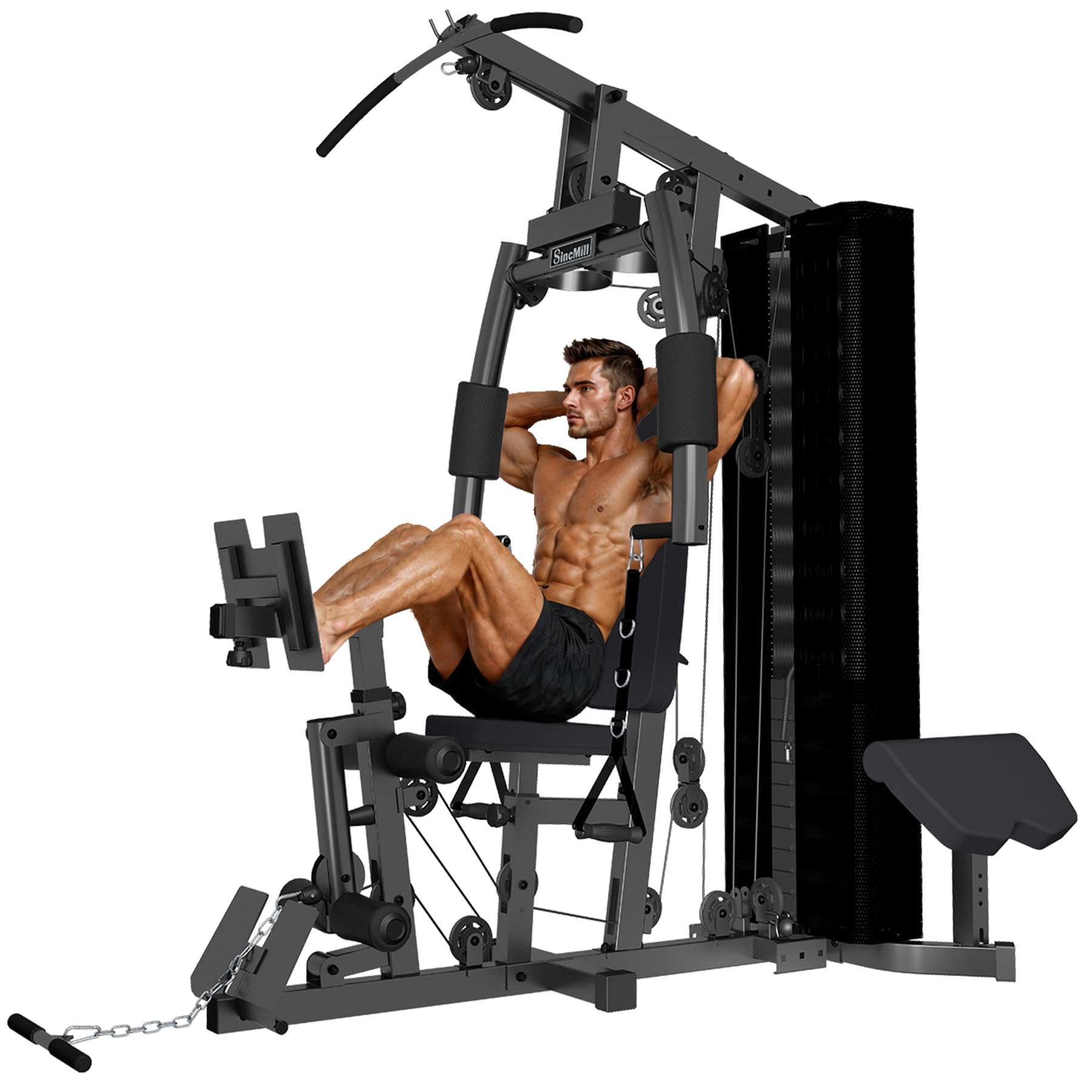
A 34-inch-wide frame with a 160-pound stack — the fit for a tighter room.
Some rooms can handle height but not width. The SincMill’s 74.6″D x 34″W x 79.6″H footprint makes it one of the slimmest in the entire list, and it still packs a 160-pound thick-steel stack with a 160-pound max weight recommendation. If your training corner is a hallway end or a strip of basement wall, this is the shape to look for.
The 160-pound stack is the key spec here compared to the SunHome’s smaller 138 pounds. It also uses a no-manual-adjust design on the press arms: multiple pushing or clamping parts handle the switch, so you don’t re-pin a pad between chest press and butterfly. The elbow pad is removable and height-adjustable. Owners rate the variety of exercises highly — the second-ranked positive aspect after overall quality.
There is a clear population this suits and a clear one it does not: reviewers repeatedly flag it as best for users between roughly 5’2″ and 5’7″, with taller lifters fighting the range of motion on the leg press and seat. The seat itself does not adjust, and heavy users note the 160-pound stack becomes light for leg press over time. Know your height before you commit.
What owners highlight: Assembly runs around three to five hours and several reviewers call the printed instruction book thin for cable routing while praising the manufacturer’s video. One buyer’s enthusiastic take — “My kids and I love this multigym” — shows the machine does suit a whole household in the right size bracket.
Best for: Shorter and average-height users in a narrow space who want a real 160-pound stack without a wide footprint.
Look elsewhere if: You are taller than about 5’7″ — the range of motion on the leg press and flys will feel cramped, and the seat does not adjust.
5. ROBORE Home Gym System with 160LB Weight Stack
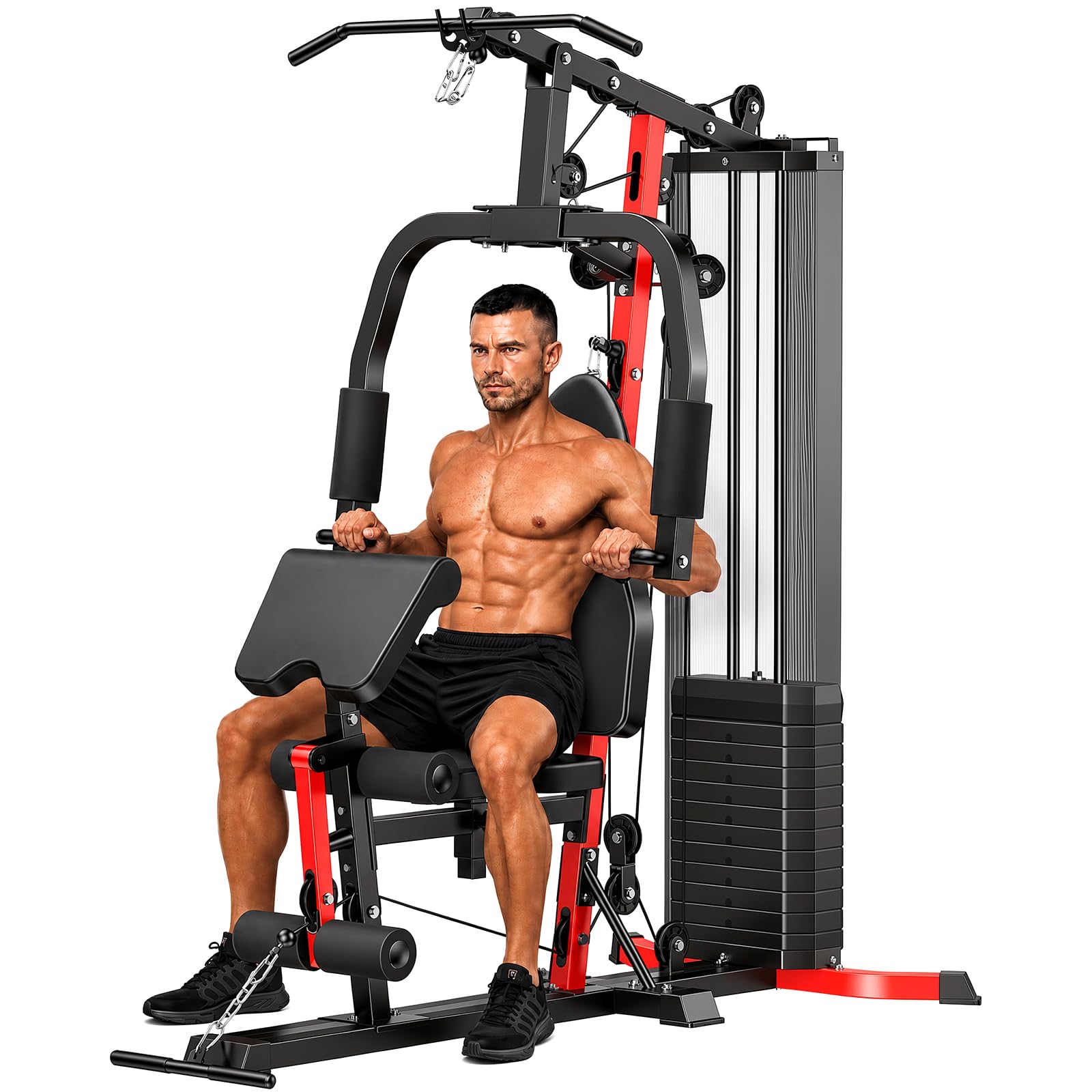
A 160-pound stack and three pulley heights, billed as the beginner’s front door.
ROBORE pitches this unit squarely at home users who want a clean routine without a crowded gym. The 160-pound selectorized stack — 10 pounds heavier than the Marcy’s 150 and the SunHome’s 138 — covers ten named exercises on one station, from chest press and pec fly to seated low row and seated cable ab crunch. High, mid, and low pulley positions give it more cable variety than its lone stack suggests.
Adjustability is a real selling point for mixed households: the seating moves and the preacher curl pad comes off, which helps different-sized users find a working position. A 300-pound max weight recommendation puts it on par with the Marcy despite the compact 66″D x 38″W x 79″H frame. The strongest signal in the review data is the pair of owners who call it a great addition to a shared home gym.
Where it earns scrutiny is assembly. Buyers split sharply — some describe a fairly easy build, others call it “a massive project” with confusing instructions. One seasoned owner gives a useful tip: the top cable just hangs until the bottom cable is routed, so skip ahead to the later steps before adding the weights to avoid tipping the frame. Functionality also draws mixed notes, mainly about the amount of cable slack.
What It Does Well
- 160-pound stack beats the Marcy and SunHome stacks
- Three pulley heights add cable variety
- Adjustable seating and removable preacher pad
- Compact 66″D x 38″W x 79″H frame
Where It Needs A Heads-Up
- Assembly splits buyers from smooth to very frustrating
- Some cable slack in use
- Range of motion limits experienced lifters
- Not a long-term heavy-lifting rig
Best for: A beginner or a lighter-lifting household wanting a 160-pound stack in a small footprint, and willing to hire a hand for a couple of hours if assembly gets hairy.
Skip this if: You already lift heavy — several owners note a strong beginner can max the 160-pound stack within months, and the range of motion runs short of a heavier-duty rig.
6. WFLGFT Home Gym Workout Equipment 148 LB Weight Stack
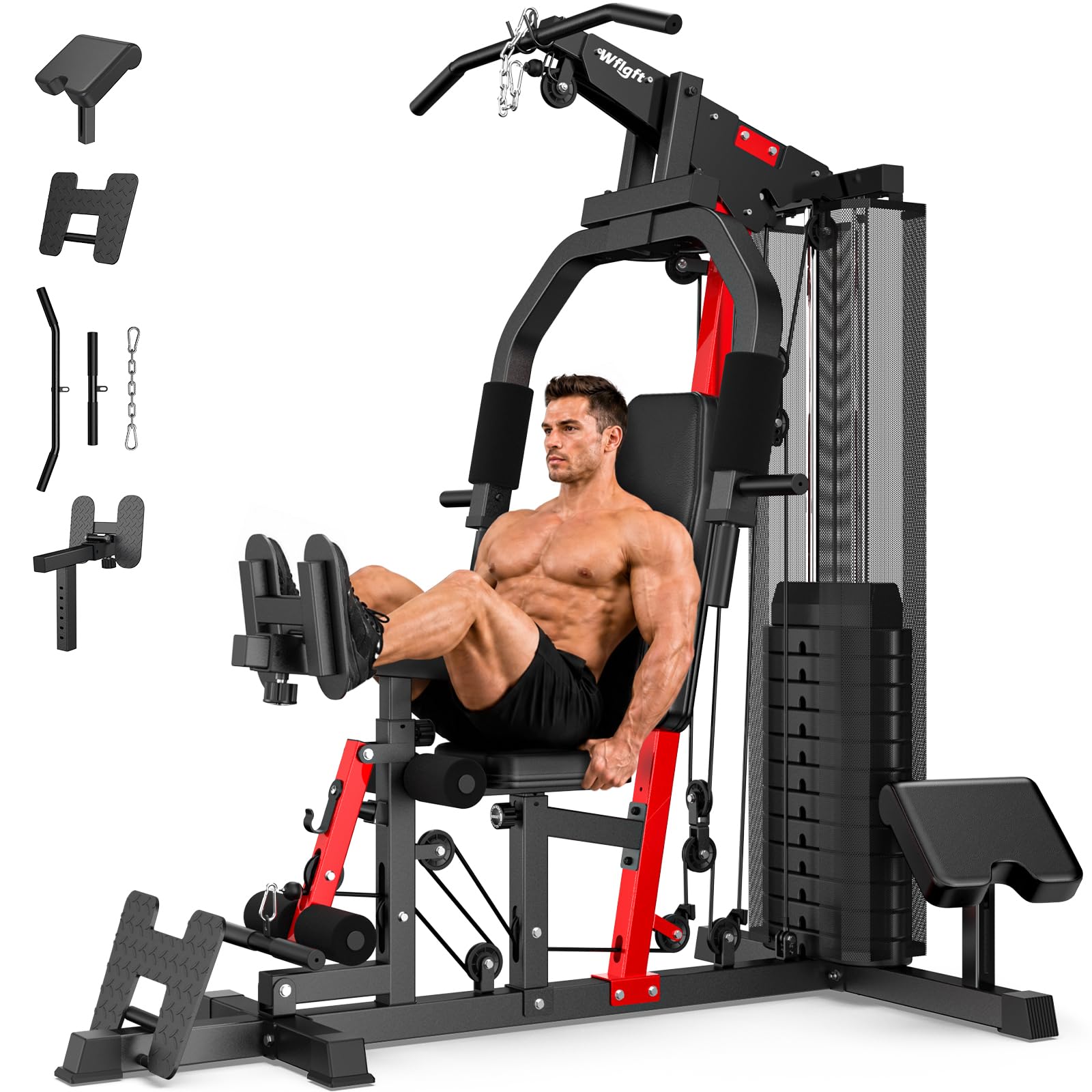
148 waterproof pounds of resistance inside a 34.65-inch-wide frame built for real full-body work.
The WFLGFT makes its case with density: a 148-pound waterproof, rust-proof weight stack and a 450-pound maximum weight recommendation, all squeezed into a 63.39″D x 34.65″W x 80.71″H footprint. The 450-pound rating is the highest of any budget-tier machine here, and the frame is rated for over 35 exercises including chest press, lat pulldown, low row, and core work. That is a lot of machine in a narrow column of floor space.
What owners consistently name first is the everyday home-gym experience: sturdy, stable under heavy resistance, and quiet. The pulley action gets praised as smooth for the money, and the frame does not wobble on heavy sets. Convertible pads and built-in storage make it feel more carefully thought out than its price suggests, and the protective weight covers plus non-slip feet are the sort of safety detail you notice once you are actually working out.
Assembly is the trade-off buyers mention most — and treating it honestly, it is a fit note, not a flaw. The instructions themselves get good marks; it is the sheer number of steps that runs the clock. A one-day owner noted they had not yet tested long-term durability, so the honest read is that this is a well-built machine that time will confirm. Beginners should expect to spend an evening or two learning the settings.
Fit and footprint: At 34.65 inches wide, this is a distinctly space-conscious machine for a basement, apartment, or garage bay. The 148-pound stack is light enough to start on and heavy enough to grow into for a while.
Pick it if: You need a serious-capacity machine — 450-pound rating, 35+ exercises — in a genuinely narrow footprint and don’t mind a slow, careful build.
Consider a different route if: You want an instant setup or you plan to train past 148 pounds of stack tension on the main lifts long term.
7. Mikolo Home Gym ProStation with 150LBS Weight Stack
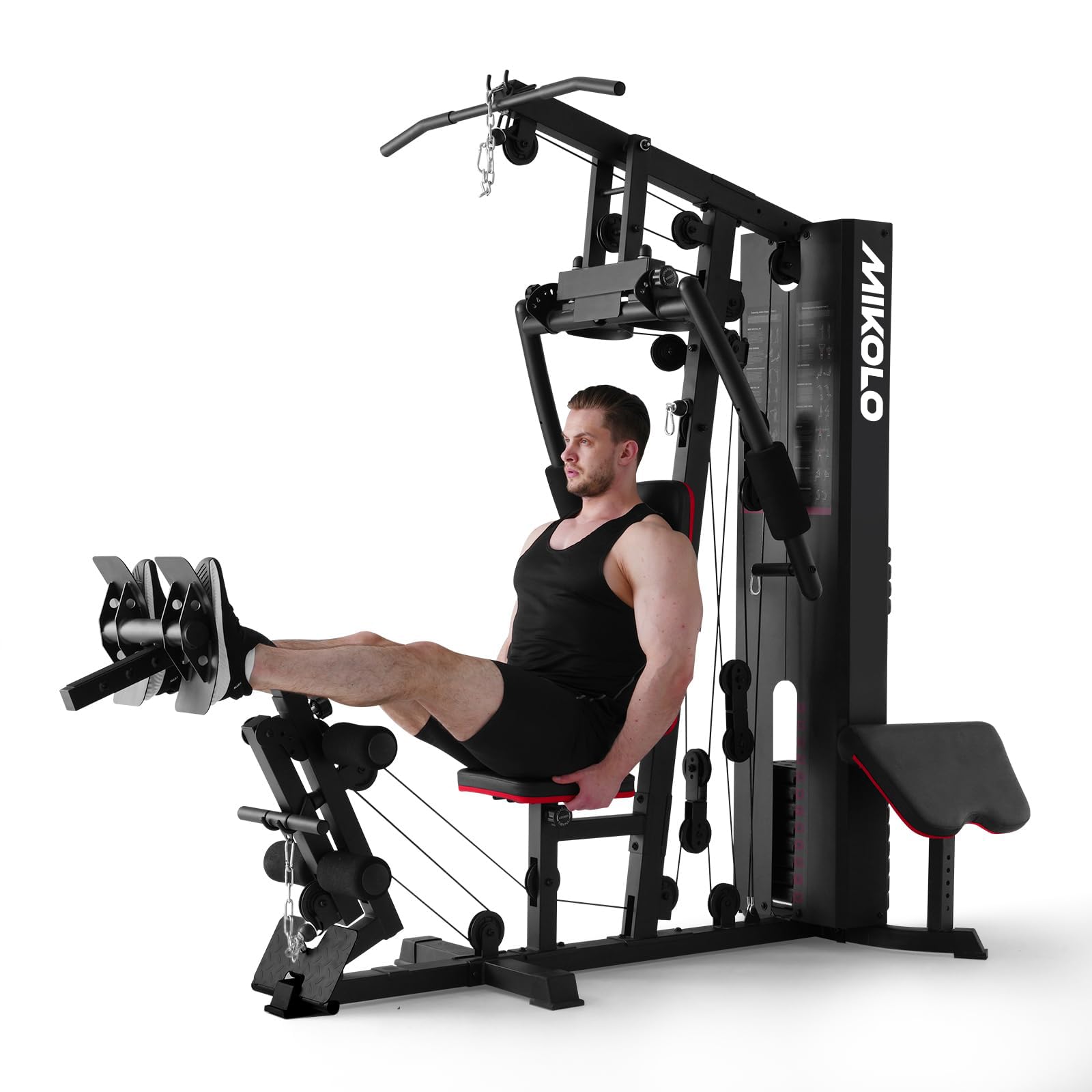
A 10-in-1 station with 90+ exercises and a 14-gauge steel frame that plays the long game.
The Mikolo ProStation’s strength is breadth. It runs a high, mid, and low pulley system on top of chest press, chest fly, and back extension in the same machine, supporting over 90 exercise variations on a 300-pound max weight recommendation. The frame is 14-gauge steel — a thicker grade than many budget machines — with the counterweight block protected by a steel sheet. That is the spec that separates it from the entry-level crowd.
The stack is a little fiddly to pin down: the listing says 152LBS while the printed stack is commonly described as 150 pounds, and it adjusts in 12-pound increments from 10 to 154 pounds. Owners who use it regularly say the cable path multiplies the felt weight — one noted a 145-pound gym chest press landing around a “8” out of 12 on the Mikolo. It comes bundled with D-handles, a lat pulldown bar, a short cable bar, a tricep rope, and a chain attachment, which adds up to a lot of movement variety from the start.
The honest caveat is height. Several owners find the machine too small, and it is repeatedly flagged as tight for anyone above roughly 5’11” to 6’1″. The lat pulldown in particular does not allow full arm extension for taller users without a chain adjustment. Instructions also draw mixed notes — buyers who study the pictures before starting do better than those who follow the written steps live.
What the numbers say: 90+ exercises, 150-pound stack, 300-pound max weight recommendation, 75″D x 36.3″W x 80″H. The 36.3-inch width makes it one of the few broad-feature machines that still slots into a side wall.
Build and support: Customer service consistently earns high marks — replacements for a defective arm bushing and dented panels were shipped without a fight. That support quality is part of what you’re paying for.
Choose this if: You want nearly every major muscle group covered by one mid-priced machine and value sturdy 14-gauge steel over a bigger headline stack.
Skip past it if: You are taller than about six feet, where the limited lat-pulldown extension and compact cage become real annoyances.
8. Fitvids Multifunctional Home Gym Equipment with 160 lbs Weight Stack

A 160-pound stack and industrial-grade steel on paper — but the owner verdicts demand caution.
On the spec sheet, the Fitvids 160 is a strong proposition: industrial-grade 1.5″ thick steel tubing, nylon-coated aircraft cables tested to a 1000-pound capacity, a 375-pound user rating, a 160-pound vinyl weight stack, and a 15-pulley high/low system. It also covers a spread of training styles — lat pulldowns, leg presses, butterfly chest, and rowing simulation on one station. If you only read the top of the listing, it reads like a premium machine at a mid-range price.
The buyer experience tells a fuller story, and it is worth being straight with you: the weight placement and cable issues show up again and again in the review record. Owners mention the weight-selection pin slipping loose, cables arriving short enough to need a chain fix, and cable-stopper balls shredding over time. Fit also draws criticism on the leg press alignment. That cluster of friction points is why this machine, despite its eye-catching spec sheet, sits near the bottom of our ranking rather than the top.
To be fair to it, the machine has genuine fans too — a parent bought it for a teen athlete who uses it almost nightly and reports it sturdy, smooth, and easy to assemble. The build is ambitious, and Fitvids clearly put thought into the steel gauge and pulley count. But new buyers should go in knowing that pin and cable quirks are a documented part of ownership, and some long-term durability questions remain open.
Watch the cable and pin: The loose weight pin and short cables are the reports that repeat most, so a simple chain adjustment and a spare pin are worth having on hand from day one.
Where it fits: A casual home user who wants maximum station and stack count at the lowest end of the mid-tier, and who does not plan to train to failure daily on the cables.
Why some readers will pass: Serious lifters who need rock-solid pin engagement and cables that last will likely prefer one of the higher-tier rigs above — the reliability question is simply real here.
9. GMWD Dual-Station Smith Machine Power Cage
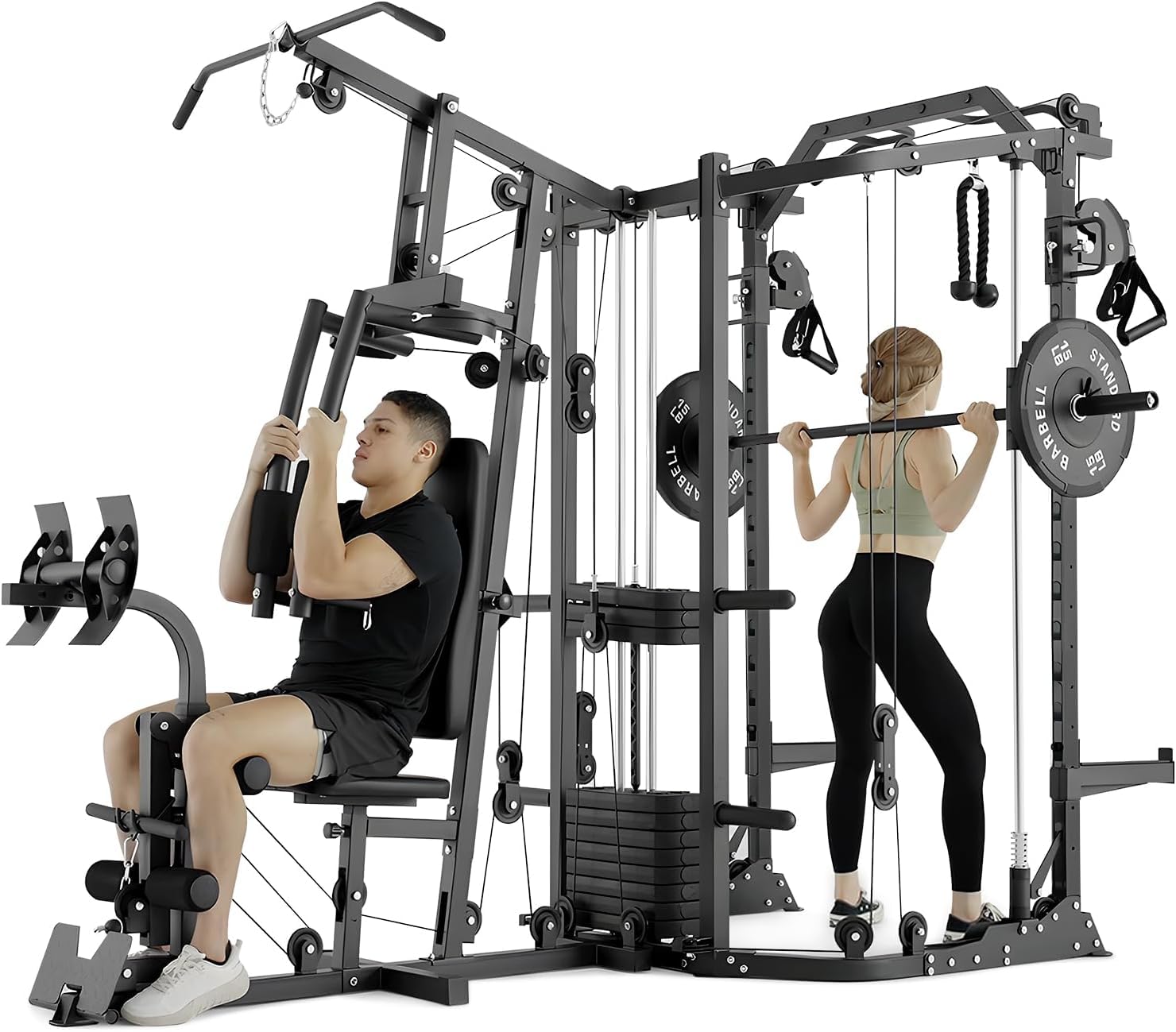
Two racks, two 121-pound stacks, one footprint — a rig built for simultaneous training.
GMWD takes the dual-user idea and goes bigger: it combines a Smith machine, a power rack, and a functional trainer into one rig, with two independent 121-pound stacks so one person can run Smith squats while the other does cable flyes. The exercise menu runs to 100+ movements, and the pulley system offers 16 levels of height adjustment — a genuinely deep range for isolating different muscles.
The build is rated for a 2000-pound max weight recommendation, which puts it on the same tier as the premium machines above it. Adjustable seating and multi-position backrests round out a very complete package for the mid-to-premium money. Right now it is one of the few true dual-station rigs sitting between the budget and premium tiers.
The recurring concern is cable length. Multiple owners — including a six-foot-one lifter with a long arm span — say the cables run short before full extension, and a second reviewer flagged the pulley action as less than smooth and the machine as tight for anyone 5’10” or taller. Stability also draws mixed notes on early lifts. The word that recurs on the assembly side is patience: many owners describe a full-day build, though one pair knocked it out in a full day and called the instructions workable.
Why Couples Like It
- Two independent 121-pound stacks for side-by-side training
- 100+ exercise variations on one footprint
- 16 pulley height levels with adjustable seating and backrest
- 2000-pound max weight recommendation
The Caveats
- Cables run short for taller lifters hitting full extension
- Assembly is a full-day build requiring patience
- Some owners find the pulley action rough
- Stability draws mixed notes on heavier early lifts
Ideal for: A two-person household that wants simultaneous training on genuine independent stacks and values a huge exercise menu.
Reconsider if: You are tall — cables ending before full extension and a tight feel above 5’10” are the two reports to weigh hardest.
10. DONOW Smith Machine with Weight Stacks Home Gym System
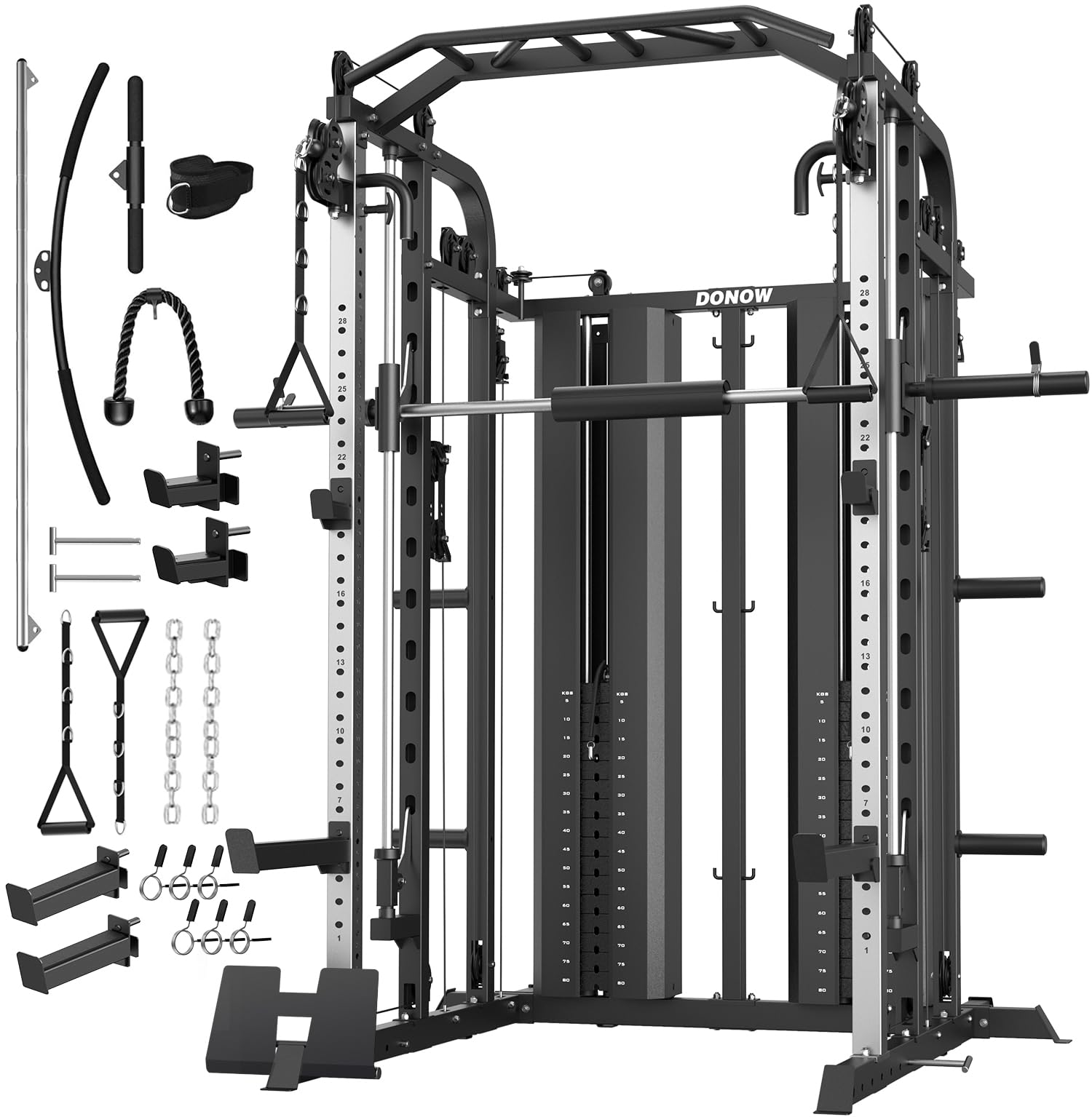
352 pounds of built-in stack, a true Smith machine, and a dual cable crossover in one rig.
The DONOW is the machine you graduate to. It sits in the premium tier with dual weight stacks totaling 352 pounds, a 2″x2″ steel frame rated to 2240 pounds, and a full feature set — Smith machine, power rack with safety arms, dual cable crossover, and multi-grip pull-up station all in one unit. The dual stacks run a 2:1 cable ratio, meaning the resistance you feel at the handle is lighter than the number on the stack.
That 2:1 ratio is the spec to understand before you buy. On a 2:1 system, a heavy stack pull feels lighter — fine for high-rep and cable work, but weaker for brute-force pressing. One owner who chose it for value says they would prefer a 1:1 ratio next time for better-built feel. Others say the dual stacks are ample once you understand the ratio, and the quick stack changes make supersets easy without ever walking around to load plates.
Owners repeatedly describe the frame as solid and stable, with smooth weight-bar slides and a slight list of quirks — one owner found the Smith bar guide misaligned from the factory, and another noted a rear pulley that occasionally tangles. Assembly is a long haul, around ten hours with two people in one account. Use a video, keep patience, plan the build session around a full day.
Where the value shows: Owners consistently say the build quality and included attachments — barbell, cable bar, lat pulldown bar, bicep rope, ankle strap — feel better than the price suggests. That is the strongest recommendation for a premium-tier purchase.
The ratio call: If your training leans toward heavy straight-arm pressing and low-rep work, the 2:1 ratio is the part to think through before buying. If you mostly do high-rep cable movements, the ratio works in your favor.
Best for: A serious home lifter in a garage or basement who wants a commercial-style rig with enough stack and station variety to replace the gym entirely.
Go in understanding: The 2:1 cable ratio means you need more stack weight to feel heavy on presses, and setup is a full-day undertaking.
11. Major Fitness Drone MAX V Smith Machine
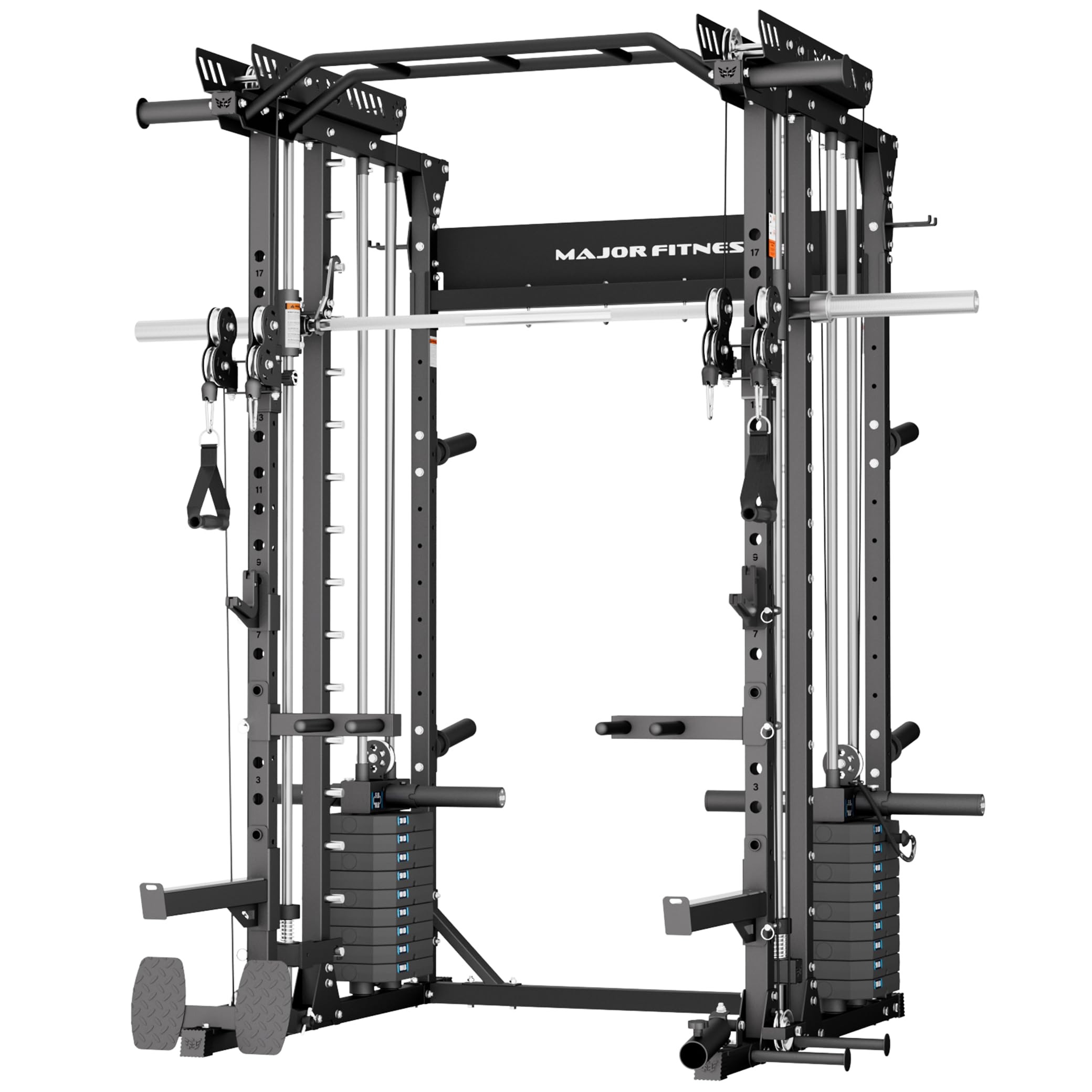
One pulley system, two ratios, and a 2500-pound capacity for truly heavy training.
The Drone MAX V answers the 2:1 ratio problem directly: its aluminum pulley system offers both 1:1 and 2:1 ratios, so you can flip between true-weight resistance for strength-building and lighter high-volume pulls on demand. The frame rattles off a 2500 lbs capacity and is built from 2″x2″ 14-gauge steel, with a Smith bar rated for 400 lbs dynamic and 750 lbs static loads. That is serious engineering at the high end of this list.
The adjustment range is the deepest of the group: 18 J-cup positions for the barbell and 18 pulley positions, from floor level to over 71 inches. That lets a 5’4″ partner and a six-foot lifter find working positions on the same machine. The setup combines a power rack, Smith machine, lat pulldown, low row station, and multi-grip pull-up bar into one compact unit with a genuinely high capacity.
Two honest notes from owners: the straight bar handles can slip under heavy load, and a couple of units arrived with small alignment issues on the Smith bar guide rails that support resolved with a washer adjustment. Assembly is a several-hour affair — one reviewer hired a builder, others took five to eight hours solo. The pulleys themselves get praised as smooth with cement stacks that glide without sticking.
The ratio advantage: Being ableto switch between 1:1 for strength and 2:1 for volume is the feature that makes this machine work for both beginners and lifters chasing real numbers.
Best fit: A household with mixed ability levels — from a beginner to a serious lifter — that wants one machine capable of both true-weight strength work and lighter high-rep training.
The trade-off: Assembly runs five to eight hours, the plastic straight-bar handles slip under heavy load, and no tricep rope or ankle straps are included, so plan on buying a few accessories separately.
12. Body-Solid Multi-Station Single Weight Stack Home Gym EXM2500S

Fourteen stations and a 210-pound stack in one compact, small-space footprint.
The Body-Solid makes the “more stations, less floor” argument better than anything else on this list. It packs 14 unique workout stations — multi-press, lat pulldown/high pulley, ab crunch/mid pulley, leg extension/leg curl, and seated row/low pulley — around a single 210-pound stack with state-of-the-art nylon bushings for smooth, quiet operation. That stack is the largest of any mid-tier machine here, and it tops the SunHome’s 138 and the Marcy’s 150.
The frame is built from 2″ x 4″ 12-gauge high-tensile steel with sealed bearings, and the listed dimensions land at 83″D x 51″W x 83″H. It is a heavy, permanent machine — owners strongly advise placing it at its final spot before assembly, because it will not move easily afterward. The exercise list runs from pec fly and incline press to glute kick and tricep kickback, covering the whole body without ever swapping a cable.
Assembly is the biggest gripe here, and it is worth being direct about. Owners describe up to eight hours over two days, and this machine ships with picture-only instructions rather than written ones; detailed assembly is a known weak spot. A few also note that the very lightest plate does not fully descend due to pulley friction until enough weight is pinned. Both are setup-and-usage details rather than durability concerns — the underlying build earns high marks.
Station-per-inch champion: 14 stations against a 51-inch width and 210 pounds of stack is the tightest full-featured package in the mid tier. If variety and small-space fit are your two priorities, this becomes the one to beat.
Set realistic build expectations: Picture-only instructions and a heavy frame mean this is genuinely a two-person, two-session job. Keeping the pulley nuts loose during assembly, as owners suggest, is the trick that saves frustration.
Top choice for: Someone who wants the widest exercise variety possible in a compact, solid machine and is comfortable with a patient, hands-on assembly.
Weak fit if: You want fast setup or written directions — this one ships with picture-only assembly and often takes a couple of evenings.
13. Mikolo M4 2.0 Smith Machine with 2200lbs Squat Rack
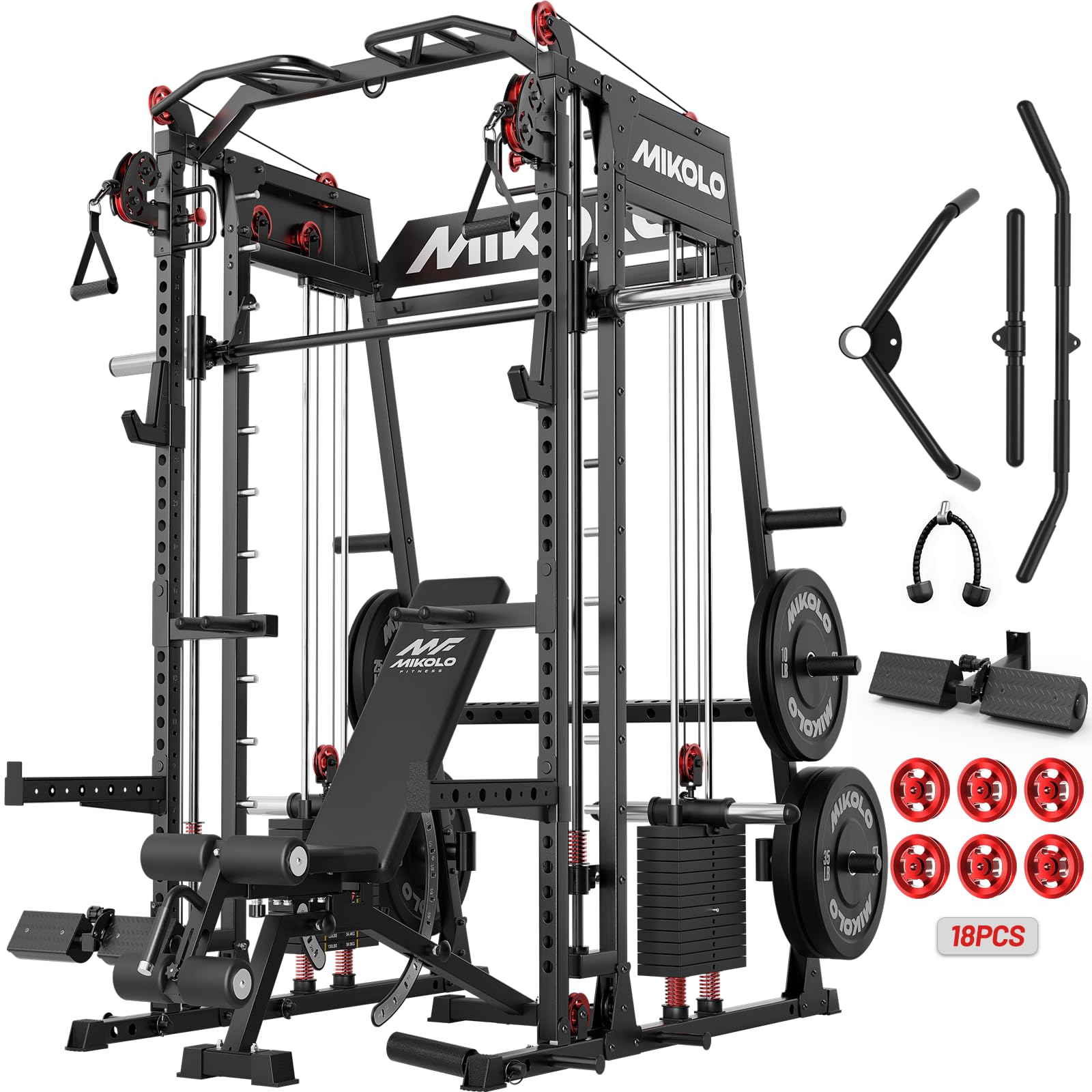
Flat sandwich J-cups, a 2200-pound frame, and a 230-pound stack built for the long haul.
The Mikolo M4 2.0 is the top of the list for a reason: a 2200-pound capacity 2″x2″ steel frame, an aluminum pulley system for ultra-smooth motion, and the M4 2.0 Elite Package including a 230-pound weight stack and bench. Against the SunHome’s 138-pound stack and the Marcy’s 150, that 230-pound figure is on another level entirely — enough to grow with a serious lifter without ever buying a second machine.
The refinement shows in the details. Flat sandwich J-cups with lining hold the barbell steady during re-racking, and the machine adds a set of genuinely thoughtful touches: 34 height positions with 2″ hole spacing, a 3-in-1 lat pulldown/seated row/pull-up attachment, an arm-reach storage system for J-hooks, spotters, and dip bars, four olympic plate posts, and a Smith bar that stores at the top so you can move freely for dips and spotting. The compact 87.2″H x 71″L x 74.4″W footprint keeps it garage-friendly.
Owners describe the build as sturdy with no wobble, the Smith bar smooth with the counterweight system, and the cable pulleys smooth and quiet. Assembly takes a couple of evenings with numbered parts and included tools. The realistic watch-outs: parts ship in four boxes and are scattered enough to slow you down, one owner needed to re-tighten a few screws after two months of vibration, and replacement parts ship overseas slowly, though Mikolo replaces them free under warranty.
what separates it: A 230-pound stack, aluminum pulleys, and the arm-reach storage system make this the most carefully engineered machine in the lineup — the ones that fit the “buy once, keep forever” brief.
Owner reality: Use is heavy but maintenance is real: re-check the bolts after the first couple of months. Support is excellent, but overseas shipping means waiting if you need a part.
Best for: The buyer who wants the best-built machine on the list and is willing to invest in a long-term rig, with a 230-pound stack and true 1:1 or 2:1 versatility.
Consider the alternatives: If budget pushes you to mid-range, the Body-Solid or ROBORE deliver a lot of stack and station count for less — this pick is for when build quality is the top priority.
Understanding the Specs
Weight Stack Size
The weight stack is the built-in column of plates you pin to set your resistance — no plate loading required. Stacks in this category run from 121 pounds per side on the GMWD up to 230 pounds on the Mikolo M4 2.0 Elite, with the older DONOW running 352 pounds across two stacks. Match the stack to your long-term strength, not just your first month. A 121-pound stack feels heavy to a beginner and light to someone who deadlifts regularly.
Cable Ratio
A cable ratio tells you how much pull resistance reaches the handle for each pound on the stack. On a 2:1 system — like the DONOW — a 100-pound stack feels closer to 50 pounds at the handle, which is great for range and speed but adds up for brute-force pressing. Machines like the Major Fitness Drone MAX V let you switch between 1:1 and 2:1 ratios, which is why it suits a wider range of users.
Footprint And Ceiling Height
These machines take real space. The compact SincMill sits at 34 inches wide, while the GMWD peaks at 71.18 inches of width and over 87 inches tall. Before buying, measure your widest and deepest clear wall section and check your ceiling against the published height figure. A machine that does not fit your room is not a bargain, no matter its stack.
Max Weight Recommendation
This figure is the machine’s rated training limit, and it varies widely — from 138 pounds on the SunHome up to 2500 pounds on the Major Fitness Drone MAX V. It tells you the load the frame is engineered to handle safely. Match it to your heaviest expected lift with margin to spare, and remember the number for a machine and its maximum user body weight are often listed separately.
FAQ
Will a weight stack home gym fit under a standard basement ceiling?
How heavy should the weight stack be for a beginner?
What does a 2:1 cable ratio mean on a home gym machine?
How long does assembly take on a Smith machine home gym?
Can two people train on one all-in-one gym machine at the same time?
Do these machines work for tall users over six feet?
Are assembled all-in-one gyms hard to move once built?
Do I need to buy anything else besides the machine?
Is a Smith machine home gym better than a free-weight rack?
How do I choose between a single-stack and a dual-stack machine?
Final Thoughts: The Verdict
For most buyers, the all-in-one gym machine worth starting with is the SunHome Multifunction Home Gym — it delivers genuine dual-user training with two independent 138-pound stacks in a commercial-grade steel frame, which is why it sits at the top of the list despite not having the largest stack. If you want the best build quality and a bigger 230-pound stack for a one-and-done purchase, the Mikolo M4 2.0 is the machine to reach for. And for anyone training in a tight room where width is the hard limit, the SincMill squeezes a 160-pound stack into a 34-inch footprint. Confirm your body type against the machine’s seat height and cable length before you buy — that one measurement saves more returns than any other.
How We Picked
We do not accept paid placement. Every pick is matched to a real buyer and a real use-case; we do not hands-on test units.
Sources & Methodology
Specifications: manufacturer listings and product documentation. Review insights: verified customer reviews, as of September 2026. Pricing: not shown on this page (it changes often); check the current price via the retailer link.
As an Amazon Associate, Gadgets Feed earns from qualifying purchases. This does not affect which products we feature.