
Our readers keep the lights on and my morning glass full of iced black tea. As an Amazon Associate, I earn from qualifying purchases.
Specs are compiled from manufacturer listings and verified buyer reviews and can change over time — please confirm the key details on the product page before buying.
The board that can carve a groomer, pop off a natural roller, and still slide a down-rail without catching an edge is the unicorn every all-mountain park rider chases. You want one that floats in soft snow, holds a line on ice, and doesn’t feel like a wet noodle in the terrain park. The trick is knowing which profile and flex to trust — and which package delivers real performance without breaking on day one.
I’m Min — the founder and writer behind Gadgets Feed. This guide is built by comparing the manufacturers’ published specifications and the patterns across verified customer reviews, so you get each pick’s real strengths and trade-offs instead of marketing spin.
When you choose the right all mountain park snowboard, you get a single board that handles powder, chunder, and park laps with equal confidence.
Our Picks at a Glance


How To Choose The Best All Mountain Park Snowboard
The best all-mountain park boards walk a tight line between two personalities. You need enough camber underfoot to launch off booters and hold a carve, but enough rocker in the nose to float through soft snow without catching an edge on a rail. The right pick depends on your riding style and whether you prioritize park laps or charging the whole hill.
Board Profile: Camber, Rocker, and Everything Between
Traditional camber gives you explosive pop and edge hold but can feel catchy in the park. Full rocker floats in powder and presses easily but lacks bite on hard snow. A hybrid profile (camber-rocker-camber or C2 rocker) gives you the best of both — rocker between the feet for forgiveness and camber in the tip and tail for snap and stability.
Flex Rating: Where the Board Bends
If you want to press into a box or butter off a roller, a softer flex (2-4/10) makes that easy, but the board will chatter at speed. If you need to hold a trench on ice, a stiffer flex (7+/10) locks in, but it punishes mistakes in the park. A mid-flex around 5-6/10 is the balance for an all-mountain park board — responsive enough for speed, forgiving enough for features.
Bindings and Package Deals
A complete package saves money upfront but the bindings are often the weak point. Check that the baseplate and ratchets use metal or high-grade composite — cheap plastic straps are the first thing to snap under repeated park landings. If the reviews consistently mention broken bindings, budget for a separate binding purchase even if the board itself is solid.
Quick Comparison
| Model | Best For | Profile | Flex | Weight | Amazon |
|---|---|---|---|---|---|
| System MTN w/ Summit Bindings★ Best Overall | Budget-minded all-mountain | CRCX (Camber-Rocker-Camber) | Stiff | Amazon | |
| CAPiTA D.O.A.Also Great | Resort do-it-all rider | Hybrid Camber | 5.5/10 | 155cm (5 lb) | Amazon |
| Burton Process | Intermediate park-plus-groomer | PurePop Camber | Mid | 152cm (7.1 lb) | Amazon |
| Lib Tech T.Rice Pro (155cm) | All-mountain twin freestyle | C2 Rocker/Camber | Mid-Stiff | 155cm (6.9 lb) | Amazon |
| Lib Tech T.Rice Pro (159cm) | Advanced all-mountain freestyle | C2 Rocker/Camber | Mid-Stiff | 159cm (7 lb) | Amazon |
| Symbolic Knotty Package | Budget entry-level setup | Hybrid Rocker | Soft | 155cm (20 lb) | Amazon |
In‑Depth Reviews
1. System MTN Snowboard with Summit Bindings
Our pick — over 4★ from 90+ verified ratings; the strongest balance of quality and price.
A budget-friendly complete package that punches above its weight — if the bindings hold.
System’s MTN board uses an all-new CRCX camber profile — a rocker-dominant camber-rocker-camber design that keeps the contact points lifted for catch-free riding while small camber sections in the nose and tail add explosive pop. The ultralight 3D core centers Poplar wood with high-density stringers and an artisan heartwood stringer down the middle. In the 159cm package it is a stiff flex, so it handles black diamonds and park features without folding, as owners confirm.
The Camp Seven Summit bindings bring full-length EVA base padding, gel-contoured straps, adjustable toe ramps, and aluminum ratchets. One rider with size 17 boots confirmed the bindings fit. The board itself earns consistent praise for value and quality — plenty of owners call it excellent on park features, sharp edges, and great wax from the start.
The catch: multiple buyers report the bindings broke on the first day of use. The seller offered to replace the ladder strap, but the rider had to buy new bindings to finish the trip. Treat this as a very good board with binding durability that is questionable. If you buy it, budget for a binding upgrade, or be prepared to work with the seller on replacements.
What works
- CRCX profile floats powder and avoids edge catches
- Stiff flex handles speed and park landings
- Poplar core with stringers gives durable construction
What to watch for
- “Bindings broke the first day” is a pattern across multiple reviews
- Package weight is not listed — fully assembled setup is heavy to carry
Best for: the budget-conscious rider who wants a full setup and is willing to upgrade or warranty the bindings if needed — the board itself is solid.
Think twice if: you want a low-maintenance package that runs from day one without any support calls.
2. CAPiTA D.O.A. Men’s Resort Snowboard
The do-everything resort board that weighs as much as a pair of boots.
The CAPiTA D.O.A. is exactly what a modern all-mountain park board should feel like — light, balanced, and aggressive enough to satisfy an intermediate rider who wants one quiver-killer. It rides a True Twin shape with a Hybrid Camber profile and a flex of 5.5/10, which puts it dead center on the forgiving-versus-responsive scale. At just 5 pounds it is the lightest board on this list (considerably lighter than the 6.9-to-20-pound range of the rest), so you feel less fatigue throwing spins in the park or hiking sidecountry kickers.
The construction blends wood, fiberglass, and metal into a 60.5-inch deck with a 11.88-inch waist width in the 155cm wide version. Owners rave about the graphic quality and the do-it-all confidence — it is the kind of board that lets an intermediate push harder without feeling overmatched.
The honest caveat: at a 4.0/5 rating, it has fewer reviews than the crowd favorites, and one owner found it less comfortable than their other board. That is a fit preference, not a flaw — the 5.5 flex means it is not the stiffest charger for someone who skis 50+ days a year, but for the resort rider hitting park and piste in equal measure, it is a precision tool.
Why it wins
- 5 lb weight makes park laps noticeably less tiring
- Hybrid Camber profile balances float, pop, and edge hold
- True Twin rides switch without any weirdness
The trade-off
- 5.5/10 flex is not a charger for heavy speeds
- Small review pool means long-term durability is still unproven at scale
Reach for this if: you want a single board that carves groomers, rides switch in the park, and floats in soft snow without breaking your back carrying it.
Look elsewhere if: your days are spent pointing it down chutes at mach speed — you want a stiffer, camber-dominant deck.
3. Men’s Burton Process Snowboard (152cm)
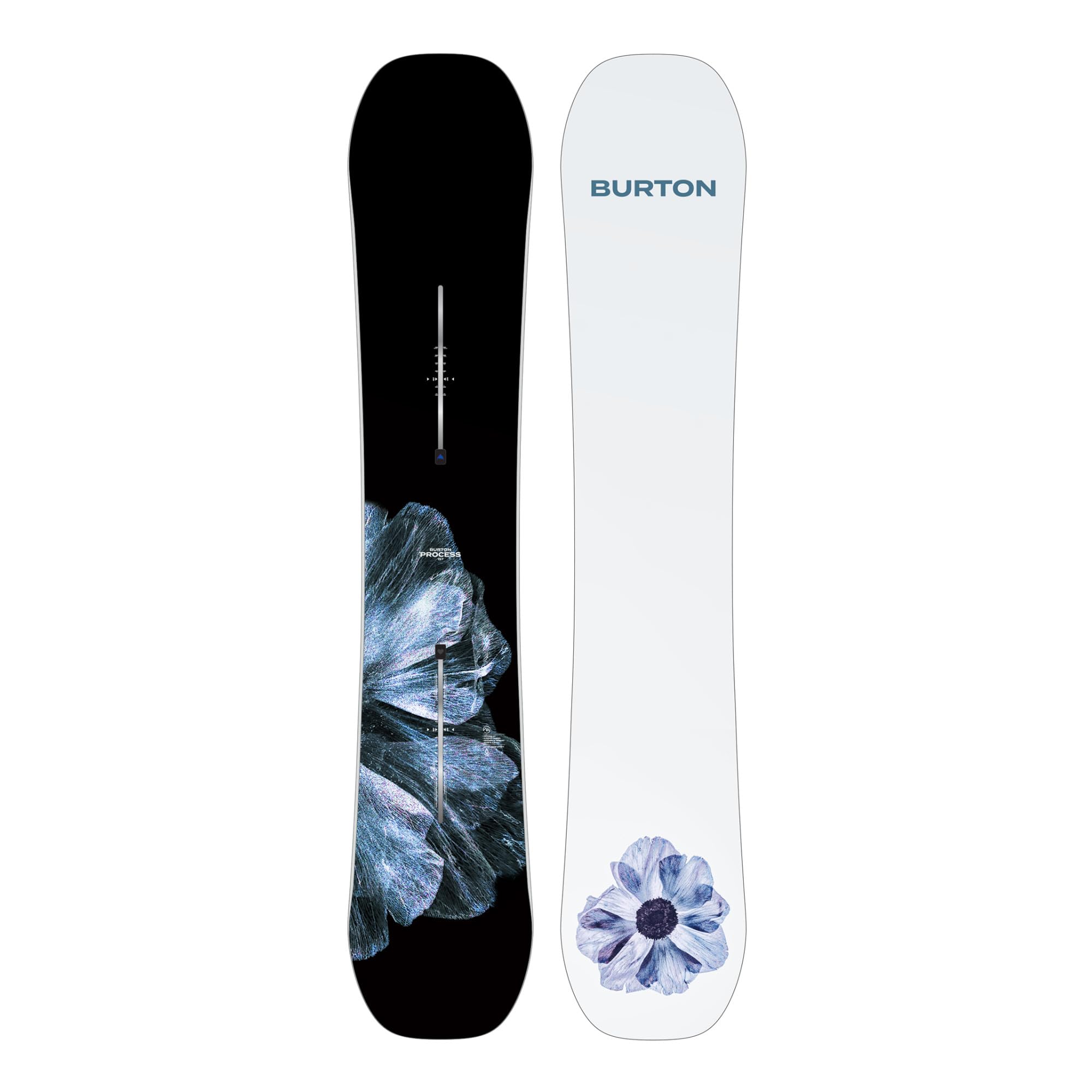
Burton’s answer for the rider who gaps 50 feet and still hits the jib line.
The Burton Process has among the most versatile resumes on the mountain. Owners say it handles park boxes and rails, launches 40-to-50-foot gaps, and holds stable at 50 mph slopes — all from a mid-flex PurePop Camber profile that sits between aggressive and playful. At 152cm and 7.1 pounds it is compact enough for spins but feels planted when you open it up.
Burton packs in their Super Fly II 700G Core (stronger and lighter woods) with Dualzone EGD that aligns wood grain along the toe and heel edges for better response. The Triax Fiberglass gives a versatile flex that adapts to everything from a sidehit to a big kicker. A sintered base soaks up wax for speed, and it carries a 3-year warranty.
The catch: it is an intermediate-level board, so beginners will find the PurePop Camber catches edges if they are still learning to carve. And the mid-flex makes deep presses a workout — you have to work for that butter.
Your mountain Swiss Army knife: one board for rails, 50-foot gaps, and 50-mph carves — the Process does all three without complaint.
Who this fits: the advancing rider who charges booters in the morning and jibs the park in the afternoon — it has the snap for pop and the forgiveness for presses.
Who should skip: absolute beginners who need a super-soft, catch-free rocker for learning turns.
4. Lib Tech T.Rice Pro Mens Snowboard (155cm)
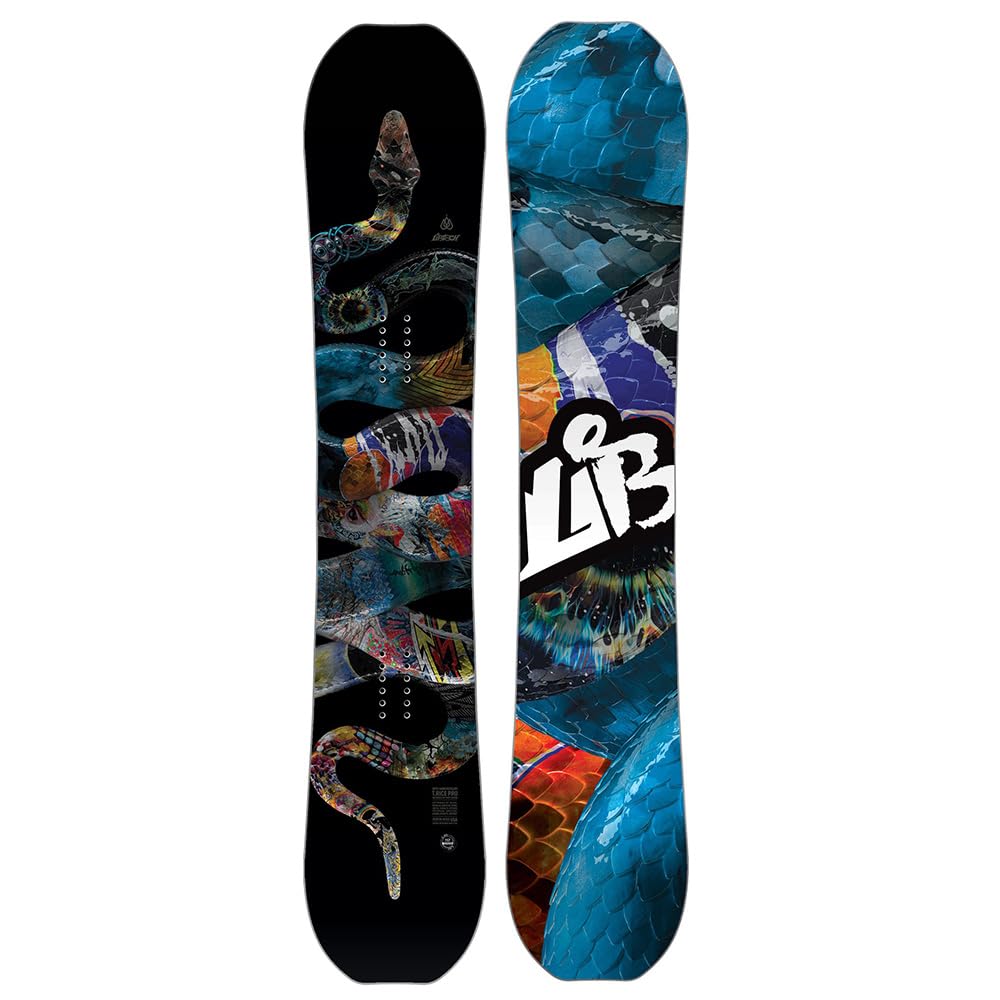
Travis Rice’s personal stick — a freestyle twin that bites ice like a pit bull.
The T.Rice Pro is the board Travis Rice uses to redefine what is possible, and it translates that DNA into a freestyle / all-mountain twin that works everywhere. Its C2 Rocker/Camber profile combines rocker between the feet (for easy turn initiation and powder float) with camber zones underfoot (for pop and precision). The Magne-Traction serrated edges — a Lib Tech signature — carve into hardpack and ice with a locked-in feel that flat-edge boards simply cannot match.
Horsepower construction uses a poplar core with bi-axial and tri-axial fiberglass plus basalt fiber reinforcement, keeping the weight at a reasonable 6.9 pounds while staying snappy underfoot. The sintered eco-sublimated base is competition-ready for glide speed. At 155cm with a 11.5-inch waist width, it skis short enough to spin in the park but stable enough to charge.
The small but perfect review score tells you that the owners who buy this board know exactly what they want — a high-performance deck that rewards technique. An occasional rider or pure beginner would find the C2 profile less forgiving than a soft rocker.
Why it stands out
- Magne-Traction edges hold on ice where others slide
- C2 profile floats powder naturally while keeping camber pop
- Basalt fiber adds damp response without adding weight
The honest trade-off
- Premium price reflects pro-level construction
- C2 rocker can feel washy to riders who prefer full camber
Your pick if: you charge hard on icy mornings and still want a board that spins, presses, and floats in the afternoon slush.
Pass if: you are looking for a cheap rocker to learn on — this board earns its reputation with every carve.
5. Lib Tech T.Rice Pro Mens Snowboard (159cm)
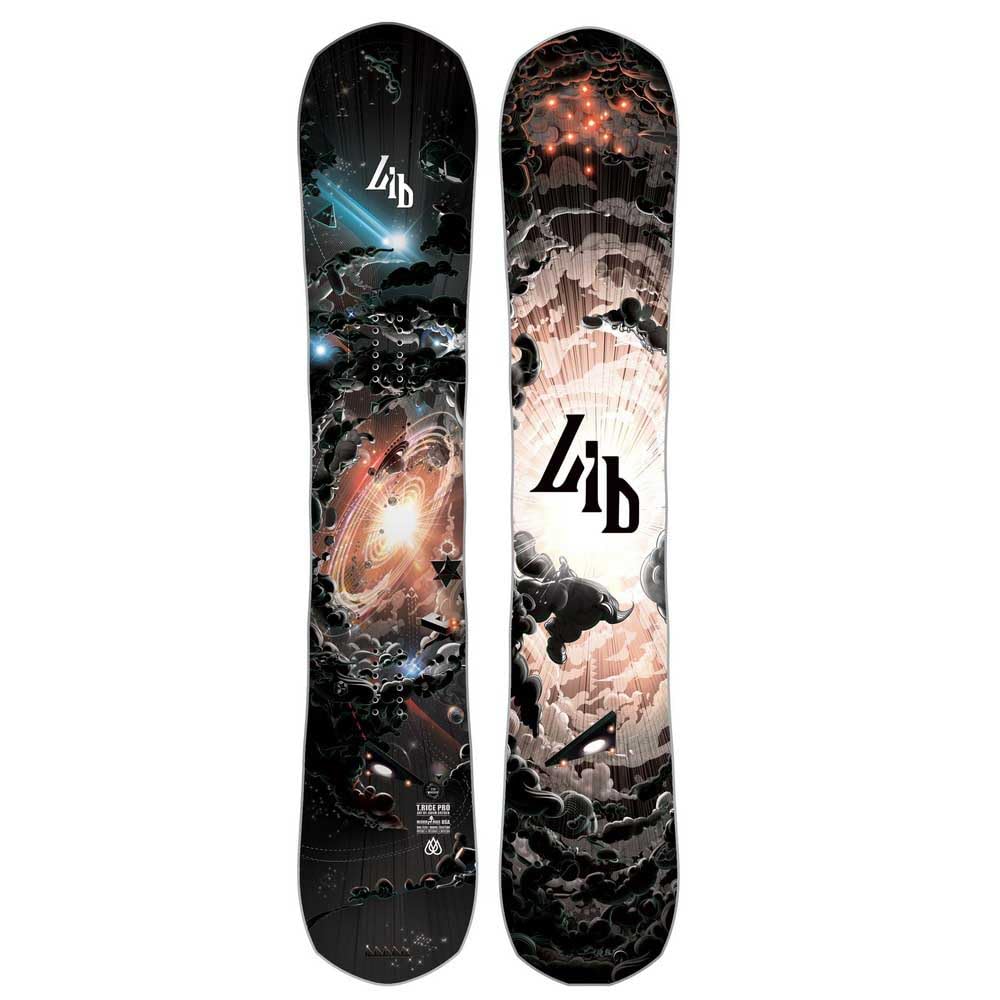
The bigger brother of the T.Rice Pro — built for advanced riders who want extra platform.
At 159cm with a 12-inch waist width and weighing 7 pounds, this is the T.Rice Pro for taller or heavier riders who need more surface area without losing the freestyle twin shape. It is the exact same C2 Rocker/Camber profile, sintered competition base, and Lib Tech construction — just scaled up for riders who spend their days charging park and all-mountain terrain at an advanced level. The 159cm length gives you more effective edge for high-speed carves and more float in powder, while the slightly wider waist helps with boot-out on deep carves.
Art by Mike Parillo wraps the top-sheet, and the board is listed at an advanced skill level, meaning it expects the rider to bring the technique. There are no beginner-friendly crutches here — you get a pro-level tool that demands input to shine. It is a premium pick for the rider who already knows their stance width, edge angle, and landing technique.
The honest downside: at it is the most expensive option here, and without any customer reviews to lean on, you are betting on the reputation of the T.Rice line. If you trust that lineage, this is a top-shelf board for advanced park-and-mountain riding.
Built for the veteran: a longer, wider T.Rice that trades forgiveness for high-speed stability and advanced boot clearance.
This is for you if: you already ride at an advanced level and need a 159cm deck with a freestyle twin shape for booters, rails, and charging the whole mountain.
Not for you if: you are intermediate or below — this board rewards skill and punishes laziness.
6. Symbolic Knotty 2025 Snowboard Package

A complete package that gets you on the mountain cheaply — but it comes with clear limits.
The Symbolic Knotty bundle includes a snowboard, bindings, a leash, and a stomp pad — everything a first-time buyer needs to start riding. It uses a Hybrid Rocker profile that lifts the contact points for catch-free turning, and the 155cm size is a standard all-mountain length. The package weighs 20 pounds (the heaviest overall on this list — four times the 5-pound CAPiTA D.O.A.), which makes it feel clunky carrying to the lift line but is less noticeable once strapped in. The bindings use an ABS (Acrylonitrile Butadiene Styrene) construction and come in a L/XL size that fits men’s boot sizes 9-15.
Owners coming from old boards (one from a 20-year-old K2 Eldorado) call it a great upgrade. The bindings feel comfortable for casual riding, and the board works well for someone who goes a few times a year. A buyer gifting it to their grandson reported the daughter — a snowboarder — was impressed by the quality.
The serious red flag: one rider describes it as a “dangerous board” with almost no edge to break, calling it the worst edge hold they have ever experienced. Another owner noted the board looks brown in person, not black as shown in the listing photo. This is not a board for icy conditions or speed — it is a soft, forgiving rocker for mellow groomers and learning turns.
What it is: a low-cost entry point for casual riders who want a complete setup without shopping for separate components. What it is not: a board for hardpack, steeps, or aggressive carving.
This fits: the first-time rider or casual vacation snowboarder who just wants to cruise green and blue runs while staying affordable.
Do not buy for: intermediate riders who need edge hold on ice, any park riding, or hitting any speed over 25 mph — the edge performance is simply not there.
Understanding the Specs
Camber vs Rocker Profiles
A board’s profile is the shape of its base when laid flat. Camber (an arch in the middle) gives you snap, pop, and edge hold — great for carving and launching. Rocker (a banana curve from tip to tail) lifts the contact points so you float in powder and never catch edges — forgiving for park and beginners. A hybrid profile like C2 Rocker/Camber or camber-rocker-camber gives you both: rocker in the middle for float and forgiveness, camber under the feet for pop and precision.
Flex Rating and What It Feels Like
Flex is measured on a 1-to-10 scale. A 1/10 board is a wet noodle — easy to press but scary at speed. A 10/10 board is a concrete plank — stable at speed but punishing on landings. For an all-mountain park board, a 5/10 to 6/10 flex (mid-stiff) is the balance. You get enough torsional stiffness to hold a carve at high speed but enough give to press on a box or butter off a roller. A stiffer board (7+) works for charging, a softer one (3-4) works for jibbing.
FAQ
What is the difference between an all-mountain board and an all-mountain park board?
What size all mountain park snowboard do I need?
Can I ride an all-mountain park board in powder?
Is a complete snowboard package worth buying?
What is Magne-Traction?
How long does a snowboard last?
What does true twin shape mean for riding switch?
Can I use my old bindings on a new board?
Final Thoughts: The Verdict
For most riders, the all mountain park snowboard winner is the CAPiTA D.O.A. because it offers the lightest weight (5 lb), a True Twin Hybrid Camber profile that works everywhere, and a 5.5/10 flex that suits both park and resort riding without compromise. If you need Magne-Traction edge hold for icy conditions, grab the Lib Tech T.Rice Pro (155cm). And for the rider hitting 50-foot gaps who wants Burton quality with a 3-year warranty, the Burton Process is the one to reach for.
How We Picked
We do not accept paid placement. Every pick is matched to a real buyer and a real use-case; we do not hands-on test units.
Sources & Methodology
Specifications: manufacturer listings and product documentation. Review insights: verified customer reviews, as of July 2026. Pricing: not shown on this page (it changes often); check the current price via the retailer link.
As an Amazon Associate, Gadgets Feed earns from qualifying purchases. This does not affect which products we feature.