
Our readers keep the lights on and my morning glass full of iced black tea. As an Amazon Associate, I earn from qualifying purchases.
Specs are compiled from manufacturer listings and verified buyer reviews and can change over time — please confirm the key details on the product page before buying.
Picking a pocket-sized point-and-shoot, a full-frame mirrorless powerhouse, or a classic DSLR can feel like choosing a language you do not speak. Every camera type promises better photos, but the real trick is matching the tool to the moment — whether that is a quick snapshot at a family party or a planned shoot in changing light. This guide cuts through the confusion and lays out the concrete specs that separate a great buy from a frustrating one.
I’m Min — the founder and writer behind Gadgets Feed. This guide is built by comparing the manufacturers’ published specifications and the patterns across verified customer reviews, so you get each pick’s real strengths and trade-offs instead of marketing spin.
These seven picks cover the spectrum of all types of cameras worth your attention right now.
Our Picks at a Glance

How To Choose The Best Camera Type For You
Before you dive into the specs, the single most useful question is: where and how will you carry this camera most days? A heavy, feature-packed DSLR is great in a studio but a burden on a hike. A tiny point-and-shoot fits in a coat pocket but struggles in low light. Matching the size and weight to your real daily routine will instantly cut the list in half.
Sensor Size and Megapixels — Not the Same Thing
A full-frame sensor (like the 35.6×23.8mm chip inside the Sony A7 III) captures more light and gives you that soft, blurred-background look (shallow depth of field) that smartphone filters fake. A smaller sensor (like the 1/2.3-inch sensor in many zoom cameras) works well on bright outdoor days but gets noisier when the sun drops. More megapixels (33 MP vs 16 MP) mean you can crop deeper into a photo without losing detail, but they do not automatically make every shot sharper — that depends on the lens and the light.
Autofocus Points and Coverage
The number of autofocus points tells you how much of the frame the camera can track a subject across. A 693-point system (like on the Sony A7 III) covers 93% of the image area, so a running child stays locked even at the edge of the frame. A 25-point or 51-point system is still capable for slower subjects but will miss more erratic movement. Phase-detection autofocus is generally faster and more reliable than contrast-detection for moving targets.
Zoom Range — Optical vs Digital
Optical zoom uses the lens glass to magnify the scene without losing quality — think of it like binoculars with a camera attached. Digital zoom crops and enlarges the image inside the camera, which makes it look pixelated. A 52x optical zoom (like the Kodak Astro Zoom) can pull a bird from across a field, while a 5x optical zoom works better for portraits and group shots. Wide-angle is measured at the other end of the range (24mm is wider than 28mm, so you fit more of the room into the frame).
Burst Speed (Continuous Shooting)
Measured in frames per second (fps), burst speed tells you how many shots the camera can fire in one second while tracking a moving subject. 10 fps (the Sony A7 III) catches the exact peak of a soccer player’s kick. 7 fps (the Canon 5D Mark IV) is still plenty for most sports and wildlife, while 6 fps (the Kodak Astro Zoom) handles slower action like a child’s birthday party.
Quick Comparison
| Model | Best For | Megapixels | Optical Zoom | Max Burst (fps) | Amazon |
|---|---|---|---|---|---|
| Canon EOS 5D Mark IV★ Best Overall | Pro-level DSLR versatility | 30.4 MP | Interchangeable lens | 7.0 fps | $1,799.00$2,498.01Amazon |
| Sony Alpha A7 IIIAlso Great | All-around full-frame performance | 24.2 MP | Kit lens zoom | 10 fps | $1,898.00Amazon |
| Sony Alpha 7 IV | High-res full-frame mirrorless | 33 MP | Interchangeable lens | — | $1,998.00Amazon |
| Canon EOS RP | Lightweight travel mirrorless | 26.2 MP | RF 24-105mm | — | from $799.00Amazon |
| Nikon D7500 | Action-ready DSLR with lens | 20.9 MP | AF-S 18-140mm | 8 fps | $1,296.95Amazon |
| Kodak Astro Zoom AZ528 | Long-reach superzoom | 16 MP | 52x | 6 fps | $279.99Amazon |
| Kodak PIXPRO FZ55 | Simple everyday point-and-shoot | 16 MP | 5x | — | $194.95Amazon |
In‑Depth Reviews
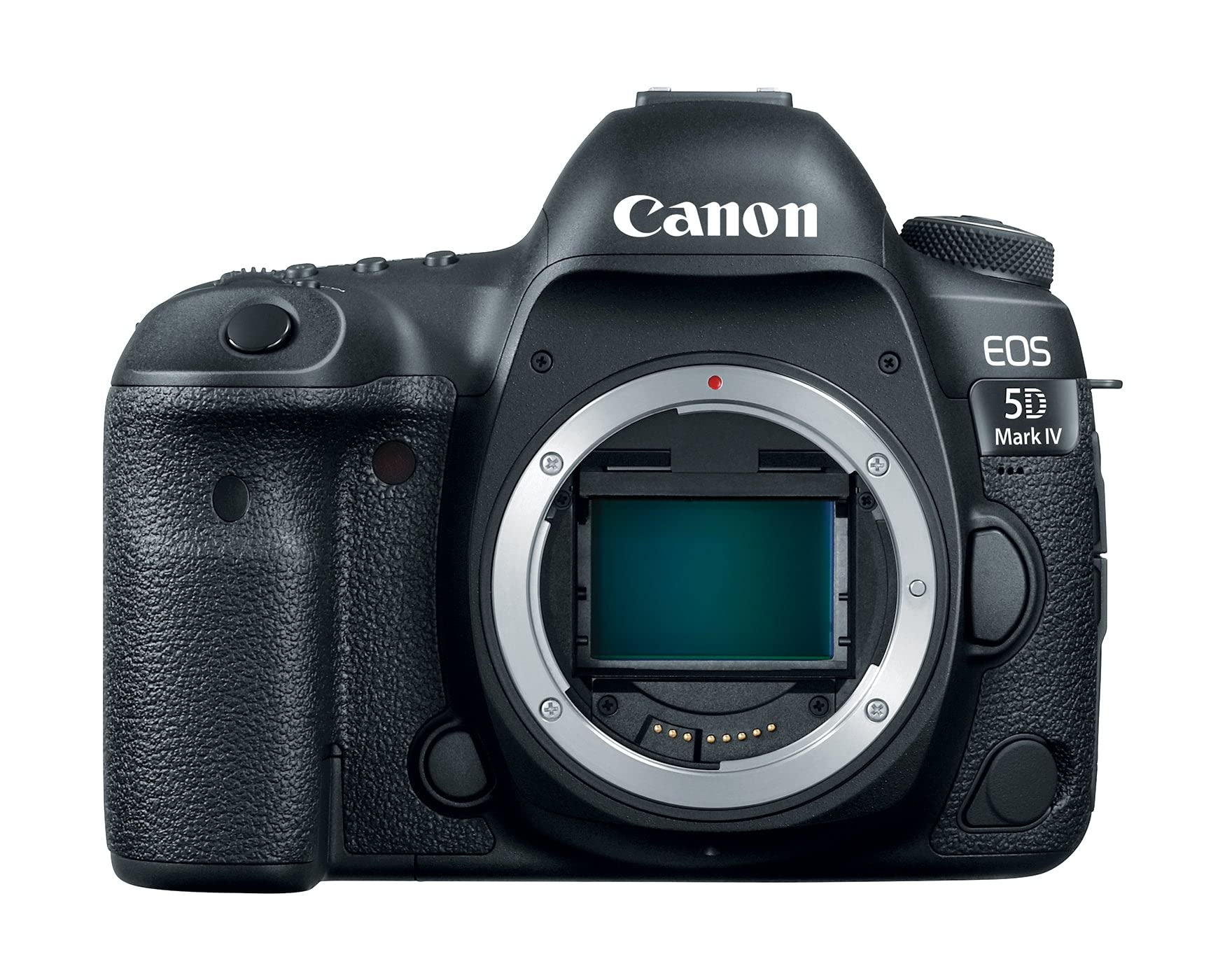
1. Canon EOS 5D Mark IV
Our pick — over 4.5★ from 850+ verified ratings; the strongest balance of quality and price.
The DSLR that wedding pros and portrait shooters still refuse to retire.
You get studio-grade color and detail straight out of camera because the 5D Mark IV pairs a 30.4MP full-frame CMOS sensor (the light-capturing chip) with the DIGIC 6+ image processor (the computer that handles color and noise). The Dual Pixel CMOS AF (Canon’s technology that uses every pixel for fast autofocus) makes live-view shooting and video feel almost as responsive as a mirrorless camera. It shoots 4K Motion JPEG video at 30 or 24 fps (frames per second), and Full HD up to 60 fps.
Owners mention that the built-in Wi-Fi and Canon Camera Connect app make file transfer to a phone quick for social sharing, and the touchscreen interface feels modern on a DSLR body. The ISO range expands to 50-102400, giving you usable shots in dim conditions. However, the 7.0 fps burst shooting is slower than the Sony A7 III’s 10 fps, so fast action requires better timing.
Why working pros reach for it
- 30.4MP full-frame sensor with 14-bit depth delivers studio-grade color and detail.
- Dual Pixel CMOS AF makes the touchscreen focus fast and intuitive during video.
- Built-in Wi-Fi and Canon Camera Connect app simplify sharing in seconds.
Where it shows its age
- 7.0 fps burst speed lags behind the 10 fps of the Sony A7 III.
- DSLR body and optical viewfinder are heavier and bulkier than mirrorless rivals.
- 4K video is Motion JPEG format (large files, less editing-friendly than MP4).
Ideal for: studio portraitists, event photographers, and anyone who loves Canon’s color science and wants a tough, proven body.
Look elsewhere if: lightweight travel or high-speed sports are your main gigs — mirrorless is lighter, and the Sony A7 III fires faster.
2. Sony Alpha A7 III
The mirrorless all-rounder that taught the industry how to do everything well at once.
You get sharp images in challenging light and fast tracking for moving subjects because the Sony A7 III pairs a 24.2MP BSI full-frame sensor (a back-illuminated chip that captures more light by placing wiring behind the light-sensitive layer) with a 693-point phase-detection autofocus system covering 93% of the frame. At 10 fps continuous shooting (frames per second with autofocus tracking), it fires 43% more frames per second than the Canon EOS 5D Mark IV’s 7.0 fps — so you catch the peak of a bird taking off or a player sprinting past. The 15-stop dynamic range (keeping detail in both shadows and highlights in one shot) and 14-bit uncompressed RAW files (the highest-quality image format with the most color data) mean you can recover blown-out skies or dark corners in editing.
Buyers report that the 5-axis in-body image stabilization (IBIS — a system that moves the sensor to counteract handshake) lets them handhold shots at shutter speeds that would make older cameras blurry, even with vintage lenses via an adapter. The 4K30 video is solid, but the real win is the ISO range that climbs to 204,800 — you get usable shots in a candlelit room where most cameras would turn grainy.
The trade-off: the kit lens (28-70mm f/3.5-5.6 OSS) is decent but not spectacular; you will likely want a faster prime lens (like a 35mm f/1.8) to open up the sensor’s low-light potential. Also, the 3-inch tilting LCD is practical but not fully articulated for vlogging selfies.
The decisive edge: This is the camera for you if you want one body that handles portraits, sports, travel, and nighttime street photography without compromise. skip it if you primarily shoot vlogs — the Canon ecosystem offers friendlier video features.
Your move if: you want one camera that handles portraits, sports, travel, and nighttime street photography without compromise.
Think twice if: you primarily shoot vlogs — the tilting screen does not flip forward, and the Canon ecosystem offers friendlier video features.
3. Sony Alpha 7 IV

The high-resolution mirrorless that chews through pixels without slowing the creative flow.
With 33 megapixels on a full-frame Exmor R back-illuminated CMOS sensor, the A7 IV packs 2.1x the resolution of the 16MP point-and-shoot cameras on this list — so you can crop into a distant bird or a tight portrait and still have enough detail for a large print. The next-generation BIONZ XR image processing engine runs 8x more powerful than previous generations, which speeds up menu navigation and reduces blackout between shots. It records 4K 60p video in 10-bit 4:2:2 color (a high-end color format that gives editors flexibility in post) with full pixel readout (the sensor uses every pixel to create the 4K image, not a cropped portion).
Buyers particularly praise the 7K oversampling when shooting 4K 30p — the camera captures a 7K image and downsamples it to 4K, resulting in noticeably sharper, cleaner video. The S-Cinetone color profile (from Sony’s cinema cameras) gives footage a film-like look without heavy grading. The 693-point autofocus system is identical in count to the A7 III, but with improved real-time tracking for eyes (human, animal, and bird). One catch: this body has no built-in flash, and the 33MP files are large, filling memory cards faster and demanding a solid computer for editing.
The resolution equation: 33 MP (2.1x more than 16 MP point-and-shoots) plus 7K oversampled 4K video and S-Cinetone color — a hybrid shooter’s dream if the budget allows.
Go for this if: you shoot both high-res stills and professional video (especially 4K 60p 10-bit) and need room to crop in post.
Pass if: you are mostly snapping photos for social media — the 24.2MP A7 III is lighter on files and your wallet.
4. Canon EOS RP

The lightest way to step into Canon’s full-frame RF system without carrying a backpack.
You get full-frame image quality in a compact body because the EOS RP pairs a 26.2MP full-frame CMOS sensor with an RF 24-105mm f/4-7.1 IS STM lens that covers a versatile walkaround zoom range — from a wide group shot at 24mm to a portrait-friendly 105mm. The lens includes optical image stabilization (the lens physically counteracts handshake) rated at up to 5 stops of shake correction, so you can shoot at much slower shutter speeds and still get sharp handheld results.
It shoots 4K UHD 2160p video and uses Dual Pixel AF (Canon’s phase-detection system) for smooth focus during video recording. The touchscreen is responsive, and it has built-in Wi-Fi and Bluetooth 4.0. Buyers frequently mention that the close-focusing ability (0.66 feet in autofocus, and as close as 0.43 feet in manual macro mode) lets them capture impressive detail shots of flowers or food. But the kit lens’s f/4-7.1 aperture is slow — in dim indoor light at the 105mm end, you will need to raise ISO or use a flash. Also, the 4K video has a crop factor (a smaller portion of the sensor is used), which reduces the wide-angle effect compared to 1080p.
What makes it a travel winner
- Compact full-frame body is genuinely easy to carry all day.
- RF 24-105mm lens covers a useful range with up to 5 stops of stabilization.
- Close-focus macro mode (0.43 feet) captures detailed close-ups.
The trade-offs
- Kit lens aperture f/4-7.1 is slow, limiting low-light performance.
- 4K video has a crop factor (less wide than 1080p mode).
- Battery life is modest compared to larger Sony A7 models.
Best suited for: travelers and vloggers who want full-frame image quality in a compact, affordable package.
Think twice if: you shoot a lot in low light without a flash — a faster lens upgrade will cost extra.
5. Nikon D7500

The crop-sensor DSLR that borrows the D500’s brain and muscle for a lot less cash.
You get D500-level performance at a lower cost because the D7500 packs a 20.9MP DX sensor (a smaller APS-C sensor than full-frame, with a 1.5x crop factor that makes a 200mm lens act like a 300mm lens, great for sports and wildlife) and the EXPEED 5 image processor into a body with 8 fps continuous shooting and a 51-point AF system (with 15 cross-type sensors for better lock-on in low contrast). It shoots 4K Ultra HD and 1080p Full HD video with stereo sound, plus power aperture control (adjust the aperture smoothly during recording) and auto ISO for video.
The large 3.2-inch 922K-dot tilting LCD touchscreen makes composing from awkward angles easy. Buyers appreciate that the 18-140mm kit lens covers a very practical zoom range — wide enough for landscapes and long enough for compressed portraits — making it a true one-lens solution for travel. However, the DX sensor means the 20.9MP resolution is spread across a smaller chip, which can show slightly more noise at very high ISOs than full-frame. Also, the standard zoom range has an equivalent field of view about 1.5x narrower than labeled (so 18mm behaves like a 27mm full-frame lens).
Strengths that stand out
- 8 fps continuous shooting with a 51-point AF system catches fast action reliably.
- 18-140mm kit lens covers landscape to portrait range in one compact lens.
- Large 3.2-inch tilting touchscreen for flexible composition.
Constraints to consider
- DX sensor (APS-C) produces more noise at high ISO than full-frame rivals.
- 1.5x crop factor reduces the wide-angle field of view compared to full-frame.
Great for: action shooters, sports parents, and hobbyists who want D500-level performance at a fraction of the cost.
Not ideal if: you need maximum low-light cleanliness or ultra-wide landscapes — full-frame handles both better.
6. Kodak PIXPRO Astro Zoom AZ528

52x reach that brings mountaintops and sideline plays into your lap without a giant lens.
You get 10.4x more reach than the 5x zoom on the Kodak PIXPRO FZ55 because the AZ528 uses a 52x optical zoom at a 24mm wide angle — it uses genuine optical glass (not digital cropping) to magnify without pixelating. So you can shoot a hawk on a distant branch or a player at the opposite end of the field and still get a sharp, usable image. The built-in optical image stabilization (OIS) actively counters handshake even at maximum zoom; without it, a 52x telephoto shot would be a blurry mess. The 16MP BSI CMOS sensor (back-illuminated, meaning the wiring is behind the light-sensitive layer for better low-light performance) helps in dimmer conditions than older point-and-shoots.
It shoots 6 fps continuous burst, and buyers appreciate that it accepts SD, SDHC, and SDXC cards up to 512 GB for thousands of images and hours of 1080p Full HD video without swapping cards. However, at 16 MP, you have less cropping flexibility than the 33MP Sony A7 IV, and the autofocus (25 contrast-detection points) is simpler than the 693-point phase-detection systems on full-frame cameras. Tracking fast, erratic subjects is less reliable.
Where it dominates
- 52x optical zoom (10.4x more reach than 5x zoom cameras) captures distant subjects sharp.
- 24mm wide angle is 17% wider than the 28mm on the FZ55, fitting more landscape in the frame.
- 6 fps burst helps capture the best frame in fast action sequences.
Where it lags
- 16 MP limits cropping compared to 33 MP full-frame cameras.
- Contrast-detection autofocus (25 points) is slower for unpredictable movement.
Perfect for: wildlife watchers, birders, and sports fans who want an affordable superzoom without carrying interchangeable lenses.
Not for: anyone who needs fast autofocus for speedy, erratic subjects — stick with a full-frame mirrorless.
7. Kodak PIXPRO FZ55
No learning curve, no heavy bag — just a pocket camera that starts snapping the second you need it.
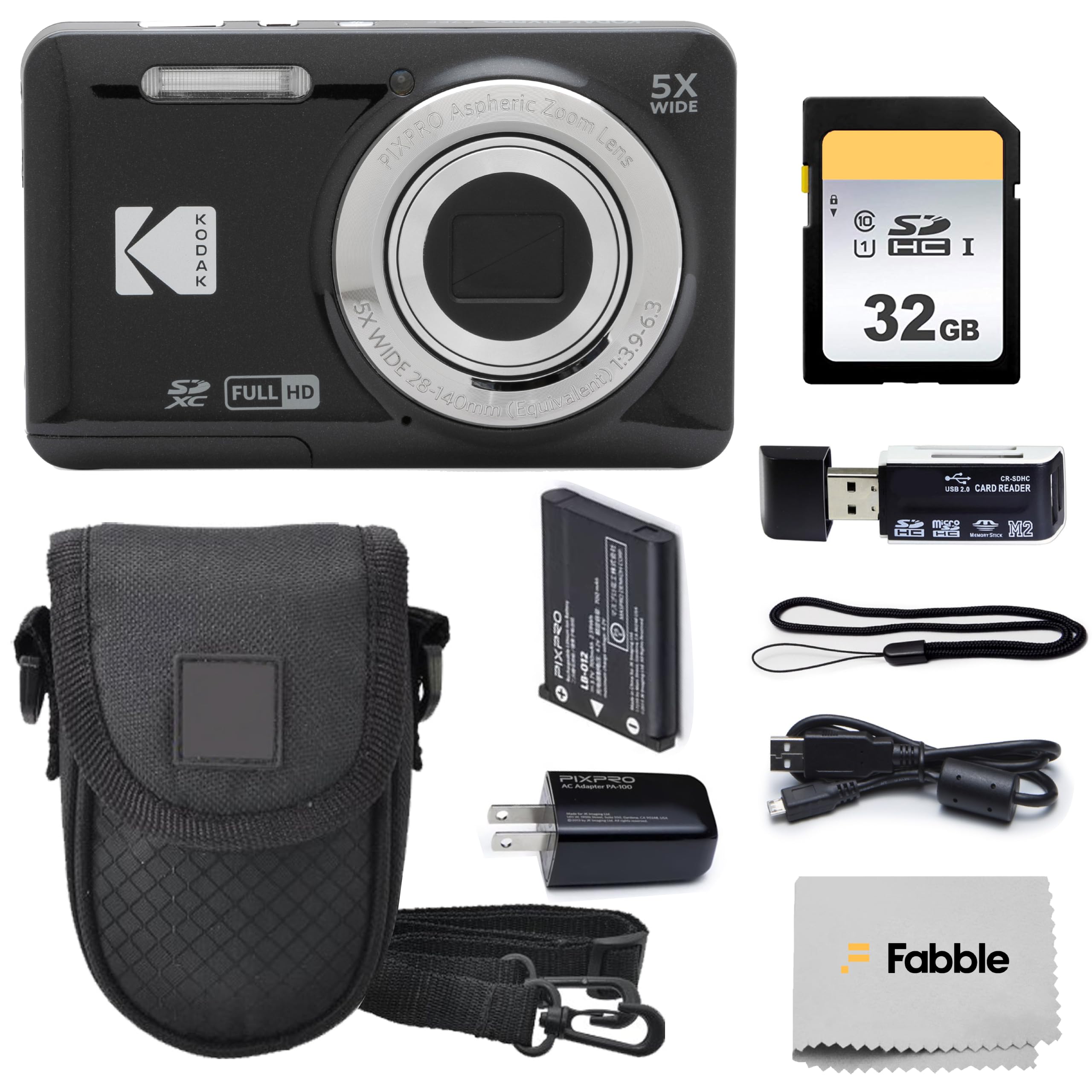
This is the camera for people who do not want to think about photography. They just want a clear photo of the birthday cake or the vacation skyline. The 16MP sensor and 5x optical zoom with a 28mm wide-angle lens cover the everyday range — from a table full of food to a group selfie. The 5x zoom has enough reach (optical only, so it stays sharp) to frame a grandkid on stage without walking down the aisle. A 28mm wide angle is a practical starting point for landscapes (though 17% less wide than the 24mm on the AZ528).
It records 1080p Full HD video, and the 2.7-inch LCD screen makes framing straightforward. The bundle includes a 32GB SD card, a protective case, and a card reader — everything you need in one box. Customers note that the simplicity and accessories make this a reliable pick for a child’s first camera or an older relative who just wants to point and shoot. The limitation: compared to the 693 autofocus points on the Sony A7 III, this uses contrast detection with 179 points — fine for static subjects but not for chasing a running toddler. Also, no battery is included (it runs on lithium-ion cells you need to buy separately).
Why it works for beginners
- 16MP sensor with 5x optical zoom captures crisp everyday photos without complexity.
- 28mm wide angle frames group shots and landscapes comfortably.
- Bundle includes 32GB SD card, case, and reader — everything to start immediately.
Where it falls short
- Contrast-detect AF (179 points) struggles with moving subjects.
- Battery not included — you must purchase separately.
Best for: absolute beginners, kids, or anyone who needs a cheap, simple camera for occasional use.
pass on it if: your subject moves — a moving target plus contrast-detect autofocus means many blurry frames.
Understanding the Specs
Full-Frame vs APS-C vs 1/2.3-inch Sensor
The sensor is the light-capturing chip inside the camera. A full-frame sensor (35.6×23.8mm, as in the Sony A7 III and Canon 5D Mark IV) is the size of a single frame of 35mm film — it collects more light per pixel, giving cleaner low-light performance and shallower depth of field (the blurred background in portraits). An APS-C (DX) sensor (like the Nikon D7500) is smaller (roughly 24x16mm) and has a 1.5x crop factor, which effectively extends telephoto lenses but makes wide-angle lenses less wide. A 1/2.3-inch sensor (in the Kodak zoom cameras) is much smaller — good for bright outdoor days and extreme zoom, but noisier in dim light and less capable of background blur.
Autofocus Points — Phase vs Contrast Detection
Autofocus points are tiny sensors that measure distance to your subject. Phase-detection points (on most mirrorless and DSLR cameras) use a split-image method to calculate distance and direction instantly — it is fast and ideal for moving subjects. Contrast-detection points (used in many point-and-shoot cameras) hunt back and forth to find the sharpest contrast, which is slower and less reliable for action. More points (25 vs 51 vs 693) means better tracking of subjects that are not centered in the composition.
FAQ
Which is better for a beginner — a DSLR or a mirrorless camera?
What does “crop factor” mean and how does it affect my photos?
Can I use old DSLR lenses on a new mirrorless camera?
Why do higher-end cameras have fewer built-in features like a pop-up flash?
Is a higher megapixel count always better?
What is the best camera for taking photos of kids and pets?
How important is optical image stabilization in a camera?
What video specs should I look for in a camera for YouTube?
Do I need a full-frame camera, or is a crop-sensor camera enough?
What is the real difference between optical zoom and digital zoom?
Final Thoughts: The Verdict
For the majority of shoppers, the all types of cameras winner is the Sony Alpha A7 III because it delivers professional-grade full-frame image quality (24.2MP BSI sensor, 15-stop dynamic range) with class-leading autofocus (693 points, 10 fps burst) in a relatively compact mirrorless body. If you want a pro-level DSLR with superb color science and the largest lens ecosystem, grab the {“@context”: “https://schema.org”, “@graph”: [{“@type”: “ItemList”, “name”: “7 Best All Types Of Cameras”, “url”: “https://gadgetsfeed.com/best-all-types-of-cameras/”, “numberOfItems”: 7, “itemListElement”: [{“@type”: “ListItem”, “position”: 1, “name”: “Canon EOS 5D Mark IV”, “url”: “https://gadgetsfeed.com/best-all-types-of-cameras/#product-2”}, {“@type”: “ListItem”, “position”: 2, “name”: “Sony Alpha A7 III”, “url”: “https://gadgetsfeed.com/best-all-types-of-cameras/#product-1”}, {“@type”: “ListItem”, “position”: 3, “name”: “Sony Alpha 7 IV”, “url”: “https://gadgetsfeed.com/best-all-types-of-cameras/#product-3”}, {“@type”: “ListItem”, “position”: 4, “name”: “Canon EOS RP”, “url”: “https://gadgetsfeed.com/best-all-types-of-cameras/#product-4”}, {“@type”: “ListItem”, “position”: 5, “name”: “Nikon D7500”, “url”: “https://gadgetsfeed.com/best-all-types-of-cameras/#product-5”}, {“@type”: “ListItem”, “position”: 6, “name”: “Kodak PIXPRO Astro Zoom AZ528”, “url”: “https://gadgetsfeed.com/best-all-types-of-cameras/#product-6”}, {“@type”: “ListItem”, “position”: 7, “name”: “Kodak PIXPRO FZ55”, “url”: “https://gadgetsfeed.com/best-all-types-of-cameras/#product-7”}]}, {“@type”: “Product”, “position”: 1, “name”: “Canon EOS 5D Mark IV”, “image”: “https://m.media-amazon.com/images/I/71rNrQlkr2L.jpg”, “brand”: {“@type”: “Brand”, “name”: “Canon”}, “url”: “https://www.amazon.com/dp/B01KURGS9E/?tag=gadgetsmin-20”, “offers”: {“@type”: “Offer”, “url”: “https://www.amazon.com/dp/B01KURGS9E/?tag=gadgetsmin-20”}}, {“@type”: “Product”, “position”: 2, “name”: “Sony Alpha A7 III”, “image”: “https://m.media-amazon.com/images/I/517CEyCXIHL.jpg”, “brand”: {“@type”: “Brand”, “name”: “Sony”}, “url”: “https://www.amazon.com/dp/B07B45D8WV/?tag=gadgetsmin-20”, “offers”: {“@type”: “Offer”, “url”: “https://www.amazon.com/dp/B07B45D8WV/?tag=gadgetsmin-20”}}, {“@type”: “Product”, “position”: 3, “name”: “Sony Alpha 7 IV”, “image”: “https://m.media-amazon.com/images/I/71BaBwNek-L.jpg”, “brand”: {“@type”: “Brand”, “name”: “Sony”}, “url”: “https://www.amazon.com/dp/B09JZT6YK5/?tag=gadgetsmin-20”, “offers”: {“@type”: “Offer”, “url”: “https://www.amazon.com/dp/B09JZT6YK5/?tag=gadgetsmin-20”}}, {“@type”: “Product”, “position”: 4, “name”: “Canon EOS RP”, “image”: “https://m.media-amazon.com/images/I/612kscpSH4L.jpg”, “brand”: {“@type”: “Brand”, “name”: “Canon”}, “url”: “https://www.amazon.com/dp/B086TTTZR5/?tag=gadgetsmin-20”, “offers”: {“@type”: “Offer”, “url”: “https://www.amazon.com/dp/B086TTTZR5/?tag=gadgetsmin-20”}}, {“@type”: “Product”, “position”: 5, “name”: “Nikon D7500”, “image”: “https://m.media-amazon.com/images/I/71HzYhwABXL.jpg”, “brand”: {“@type”: “Brand”, “name”: “Nikon”}, “url”: “https://www.amazon.com/dp/B06Y5RTN1T/?tag=gadgetsmin-20”, “offers”: {“@type”: “Offer”, “url”: “https://www.amazon.com/dp/B06Y5RTN1T/?tag=gadgetsmin-20”}}, {“@type”: “Product”, “position”: 6, “name”: “Kodak PIXPRO Astro Zoom AZ528”, “image”: “https://m.media-amazon.com/images/I/7127mWGA51L.jpg”, “brand”: {“@type”: “Brand”, “name”: “Kodak”}, “url”: “https://www.amazon.com/dp/B0B9BLHWB8/?tag=gadgetsmin-20”, “offers”: {“@type”: “Offer”, “url”: “https://www.amazon.com/dp/B0B9BLHWB8/?tag=gadgetsmin-20”}}, {“@type”: “Product”, “position”: 7, “name”: “Kodak PIXPRO FZ55”, “image”: “https://m.media-amazon.com/images/I/81MV8AgQH2L.jpg”, “brand”: {“@type”: “Brand”, “name”: “Kodak”}, “url”: “https://www.amazon.com/dp/B0DCJFYTHH/?tag=gadgetsmin-20”, “offers”: {“@type”: “Offer”, “url”: “https://www.amazon.com/dp/B0DCJFYTHH/?tag=gadgetsmin-20”}}, {“@type”: “FAQPage”, “mainEntity”: [{“@type”: “Question”, “name”: “Which is better for a beginner — a DSLR or a mirrorless camera?”, “acceptedAnswer”: {“@type”: “Answer”, “text”: “For a beginner today, a mirrorless camera (like the Canon EOS RP or Sony A7 III) is generally the better choice because you see the exact exposure and depth of field through the electronic viewfinder before you press the shutter. DSLRs (like the Canon 5D Mark IV or Nikon D7500) use an optical viewfinder that shows the scene through the lens, which can be tougher to predict the final result. Mirrorless bodies are also smaller and lighter. However, DSLRs often have longer battery life and a wider selection of affordable used lenses if you are on a strict budget.”}}, {“@type”: “Question”, “name”: “What does \”crop factor\” mean and how does it affect my photos?”, “acceptedAnswer”: {“@type”: “Answer”, “text”: “Crop factor describes how a smaller sensor (like the APS-C sensor in the Nikon D7500) changes the effective field of view of a lens. The Nikon D7500 has a 1.5x crop factor, so a 200mm lens behaves like a 300mm lens on a full-frame camera — the subject appears more magnified. This is great for wildlife and sports, but a wide-angle lens is less wide: an 18mm lens on the D7500 acts like a 27mm full-frame lens. Full-frame cameras (Sony A7 III, Canon 5D Mark IV) have a 1.0x crop factor — no multiplication, what you see is what you get.”}}, {“@type”: “Question”, “name”: “Can I use old DSLR lenses on a new mirrorless camera?”, “acceptedAnswer”: {“@type”: “Answer”, “text”: “Yes, but you need a lens adapter. Canon makes the EF-EOS R adapter for using DSLR lenses on the EOS RP, and Sony has several third-party adapters for Canon EF and Nikon F lenses on the A7 III and A7 IV. Autofocus speed and accuracy vary — many adapters work well in good light, but performance can drop in dim conditions. You will also lose some compactness because the lens and adapter together are often as long as the original DSLR setup.”}}, {“@type”: “Question”, “name”: “Why do higher-end cameras have fewer built-in features like a pop-up flash?”, “acceptedAnswer”: {“@type”: “Answer”, “text”: “High-end cameras like the Sony A7 IV and Canon 5D Mark IV omit a built-in flash because the on-camera flash is usually too weak and produces harsh lighting. Professionals prefer a larger external flash (mounted on the hotshoe) that they can tilt or bounce off ceilings for softer light. Removing the pop-up flash also saves space and reduces a potential failure point in a rugged body designed for heavy use.”}}, {“@type”: “Question”, “name”: “Is a higher megapixel count always better?”, “acceptedAnswer”: {“@type”: “Answer”, “text”: “Not always. More megapixels (33 MP vs 16 MP) give you more detail and allow deeper cropping before resolution drops — useful for large prints or wildlife photos. But higher MP also means larger file sizes (filling memory cards faster) and more demand on your editing computer. Sensor size matters just as much: a 20.9MP full-frame sensor generally produces cleaner images than a 20.9MP 1/2.3-inch sensor because each pixel on the larger sensor captures more light.”}}, {“@type”: “Question”, “name”: “What is the best camera for taking photos of kids and pets?”, “acceptedAnswer”: {“@type”: “Answer”, “text”: “Fast and reliable autofocus is key. The Sony A7 III (693 phase-detection points, 10 fps burst) and the Nikon D7500 (51 points, 8 fps) are both strong choices because they track erratic movement better. The Kodak PIXPRO FZ55 with contrast-detect autofocus will likely miss many of those moments. A fast burst rate (8-10 fps) lets you fire a sequence and pick the best frame.”}}, {“@type”: “Question”, “name”: “How important is optical image stabilization in a camera?”, “acceptedAnswer”: {“@type”: “Answer”, “text”: “Very important if you shoot handheld (without a tripod), especially at telephoto zoom or in low light. Optical image stabilization (OIS) physically moves a lens element to counteract handshake, allowing you to shoot at slower shutter speeds without blur. The Canon EOS RP’s kit lens has up to 5 stops of stabilization (you can shoot at a shutter speed 5 stops slower and still get a sharp shot). In-body stabilization (IBIS), like the Sony A7 III’s 5-axis system, works with any lens you mount.”}}, {“@type”: “Question”, “name”: “What video specs should I look for in a camera for YouTube?”, “acceptedAnswer”: {“@type”: “Answer”, “text”: “For a standard YouTube channel, 4K resolution at 30 fps is a good baseline. The Sony A7 IV (4K 60p with 10-bit 4:2:2 color) is overkill but future-proof, while the Canon EOS RP (4K 24p with crop) is more limited. Look for a camera with a fully articulated screen if you plan to film yourself talking to the camera. Clean HDMI output (available on the Canon 5D Mark IV and Sony models) lets you connect the camera to an external monitor for a high-quality webcam setup.”}}, {“@type”: “Question”, “name”: “Do I need a full-frame camera, or is a crop-sensor camera enough?”, “acceptedAnswer”: {“@type”: “Answer”, “text”: “A crop-sensor camera (like the Nikon D7500’s APS-C sensor) is enough for most photographers, especially for outdoor landscapes, travel, or portraits in good light. Full-frame (Sony A7 III, Canon 5D Mark IV) gives cleaner high-ISO performance (less noise in dim light), a wider angle of view for every lens, and more control over depth of field. If you mainly post to social media and do not shoot much in low light, a crop-sensor camera plus a good lens will serve you well for years.”}}, {“@type”: “Question”, “name”: “What is the real difference between optical zoom and digital zoom?”, “acceptedAnswer”: {“@type”: “Answer”, “text”: “Optical zoom physically moves the lens glass to magnify the scene — the image stays sharp because the sensor uses its full resolution. Digital zoom enlarges the center of the photo inside the camera, discarding pixels and resulting in a grainier image. The Kodak AZ528 has a 52x optical zoom, meaning 52x magnification without quality loss. Digital zoom on any camera (often marketed as \”10x digital zoom\”) should be avoided for clean results — you can achieve the same effect by cropping later on a computer, often with better control.”}}]}]}
Related Guides
Product prices and availability are accurate as of the date/time indicated and are subject to change. Any price and availability information displayed on Amazon at the time of purchase will apply to the purchase of this product. As an Amazon Associate I earn from qualifying purchases.
CERTAIN CONTENT THAT APPEARS ON THIS SITE COMES FROM AMAZON. THIS CONTENT IS PROVIDED "AS IS" AND IS SUBJECT TO CHANGE OR REMOVAL AT ANY TIME.
Amazon and the Amazon logo are trademarks of Amazon.com, Inc. or its affiliates.