
Our readers keep the lights on and my morning glass full of iced black tea. As an Amazon Associate, I earn from qualifying purchases.
Specs are compiled from manufacturer listings and verified buyer reviews and can change over time — please confirm the key details on the product page before buying.
Brake dust is not just ugly — it is baked-on iron that can etch into your wheels permanently if you use the wrong cleaner. The trick is finding a formula that dissolves that metallic grime without eating through your clear coat or your wallet, and the best ones signal exactly when they are working by turning purple or red on contact.
I’m Min — the founder and writer behind Gadgets Feed. This guide is built by comparing the manufacturers’ published specifications and the patterns across verified customer reviews, so you get each pick’s real strengths and trade-offs instead of marketing spin.
We have broken down the top six contenders by how fast they strip iron, what finishes they are safe for, and whether they actually save you time — everything you need to find the right alloy wheel cleaner for your car and your routine.
Quick Picks
- Nanoskin Non Acid Professional Wheel & Tire — Smart Value
- KOCHCHEMIE Magic Wheel Cleaner — Iron Crusher
- SONAX Beast Wheel Cleaner — Showroom Finish
- Car Gods Acid Free Color Changing Alloy Wheel — Citrus Fresh
- 303 Products Heavy Duty Wheel Cleaner — Budget Champ
- Griot’s Garage Wheel Cleaner — Maintenance Pro
How To Choose The Best Alloy Wheel Cleaner
A good wheel cleaner does one thing well: it turns brake dust into something that rinses off without you scrubbing for twenty minutes. To find that, you need to check a few key details before you click add to cart.
Acid-Free vs. pH-Neutral — Not the Same Thing
Acid-free means the formula skips harsh acids (like hydrofluoric or phosphoric) that can pit clear coats and dull chrome. pH-neutral goes a step further — it sits at a balanced 7 on the scale, making it the safest bet for coated or delicate wheels. If you have aftermarket or ceramic-coated rims, pH-neutral is the safer play; for heavy baked-on grime, a non-acid iron remover often works faster.
Color-Changing Technology — The Honest Signal
A cleaner that sprays on clear and turns deep red or purple as it touches iron is not a gimmick — it shows you the chemical reaction is active. When the color stops changing, the iron is dissolved and you can rinse. This saves you guesswork and prevents you from scrubbing too early or letting it dry on the wheel.
Concentrate vs. Ready-to-Use — The Value Math
A gallon of concentrate that dilutes at 4:1 gives you four gallons total — far more wheel washes per dollar than a small spray bottle. If you clean multiple cars or do regular maintenance, a concentrate pays off fast. A ready-to-use 16-ounce bottle is simpler and fine for a one-car household that cleans every few months.
Quick Comparison
| Model | Best For | Volume | Weight | Type | Amazon |
|---|---|---|---|---|---|
| Nanoskin Non Acid Professional Wheel & Tire Cleaner | Volume & value for frequent use | 1 Gallon | 9 Pounds | Concentrate | Amazon |
| KOCHCHEMIE Magic Wheel Cleaner | Heavy brake dust on German cars | 500 ml | — | Ready-to-Use | Amazon |
| SONAX Beast Wheel Cleaner | Quick color-change action | 33.8 oz | 2.54 Pounds | Ready-to-Use | Amazon |
| Car Gods Acid Free Color Changing Alloy Wheel Perfection Cleaner | Pleasant mango scent | 17 Fl Oz | — | Ready-to-Use | Amazon |
| 303 Products Heavy Duty Wheel Cleaner | Safe for all wheel types | 15.5 Fl Oz | 1.2 Pounds | Ready-to-Use | Amazon |
| Griot’s Garage Wheel Cleaner | pH-neutral weekly maintenance | 1 Gallon | 8.5 Pounds | Ready-to-Use | Amazon |
In‑Depth Reviews
1. Nanoskin Non Acid Professional Wheel & Tire Cleaner

The gallon jug that keeps on giving — one bottle makes four.
If you detail more than one car or just hate running out of cleaner mid-job, this is the one. The Nanoskin is a concentrated formula with a 4:1 dilution ratio — that means a single gallon yields four gallons of ready-to-use spray, which buyers report makes it affordable enough to use daily in a mobile detailing business. It is also 9 pounds in the bottle compared to 1.2 pounds for the 303 Products spray, a 7.5x weight gap that tells you exactly how much cleaning power you are getting per container.
The Xtreme Cling foaming action sticks to vertical tire walls and rims so it stays wet and working instead of dripping onto the driveway. It is acid-free, safe for clear-coated, powder-coated, chrome, and alloy finishes, and owners mention the thick white foam turns brown as it lifts grime. You will need a separate sprayer (a 32-ounce bottle or an IK foam sprayer works) — it does not come in a trigger bottle.
Best for the long haul: If you clean wheels regularly or run a side detailing gig, the Nanoskin concentrate gives you the most volume per dollar and the power to tackle heavy brake dust without acid.
One catch: you need to mix it yourself, and at 9 pounds the jug is not exactly light to haul around.
Charge it: This is the pick for anyone who wants professional-grade dilution and a 4:1 ratio that outlasts ready-to-use sprays by a mile.
Skip it: If you prefer grab-and-go spray bottles and only clean wheels twice a year, a smaller ready-to-use option will feel less clunky.
2. KOCHCHEMIE Magic Wheel Cleaner

Thick, sticky, and turns red the second it meets brake dust.
KOCHCHEMIE is a name you see in pro detailing bays, and this Magic Wheel Cleaner explains why. It has a high-viscosity formula that clings to wheels instead of running off, giving it a longer working time than thinner sprays. When it hits iron particles, it turns a visible red — you watch the chemical reaction happen. Customers note it restores black rims to a deep gloss shine and that a little goes a long way because it is highly concentrated, even at ready-to-use strength.
The downside is the smell. Multiple reviews describe it as a harsh rotten-eggs-meets-industrial-cleaner odor, typical of strong iron removers. You definitely want to use it outdoors with gloves. At 500 ml (16.9 ounces), it is a smaller bottle than some competitors — but since you only need a light mist per wheel, it lasts longer than the package size suggests.
Heavyweight punch: For caked-on brake dust on German cars, this is the cleaner buyers consistently call the best they have ever used — it does the work with almost no scrubbing.
Stinky trade-off: The odor is genuinely strong, so expect to air out the garage afterward.
Reach for this if: You have heavy iron contamination and want a visible, fast chemical reaction that saves elbow grease.
Look elsewhere if: You are sensitive to strong chemical smells or prefer a larger bottle for the same price.
3. SONAX Beast Wheel Cleaner

Sprays clear, turns deep red, and melts winter grime away.
The Beast lives up to its name. Its color-changing formula sprays on clear and turns deep red or purple as it reacts with ferrous metals from brake dust. One reviewer noted their wheels were pretty rough after the winter with a lot of brake dust and the Beast melted all the dirt and grime off. The formula is acid-free and pH-balanced, safe for chrome, aluminum, steel, clear-coated, PVD, painted, and plastic wheel covers — which covers nearly everything on the road.
You still need a light scrub on stubborn spots (buyers mention it is not a total no-touch product on heavy buildup), and the strong chemical odor is a recurring note. At 33.8 ounces (1 liter), it is a bigger bottle than most ready-to-use competitors, so you get several full-car applications before it runs dry. For the DIYer who wants that just-rolled-off-the-showroom-floor look, this is a straightforward pick.
What works
- Dramatic color change shows you exactly where the iron is dissolving
- Safe on nearly every factory and aftermarket wheel finish
- Large 33.8 oz bottle delivers multiple uses
What to know
- Still needs some scrubbing on caked-on brake dust
- Strong chemical smell — use with ventilation
One-line verdict: A satisfying spray-and-watch experience that cuts through post-winter grime for anyone who hates scrubbing.
4. Car Gods Acid Free Color Changing Alloy Wheel Perfection Cleaner

The wheel cleaner that smells like mango instead of rotten eggs.
Car Gods went a different route with fragrance — a pleasant mango scent that is a welcome break from the industrial-chemical blast most iron removers hit you with. The formula is acid-free, pH-neutral, and silicone-free, so it is safe on all alloy wheel types including painted and clear-coated finishes. It also changes color as it dissolves iron splinters and brake dust, so you can see it working.
One buyer mentioned it cleaned 4 wheels like new but noted the bottle only lasted for those four wheels, meaning it takes a generous amount per wheel. Another reviewer found that medium to heavy dirt still required scrubbing, so it is not a complete no-touch solution for neglected rims. If you clean your wheels every few weeks and hate the smell of traditional cleaners, this is a solid choice — just keep a second bottle on hand if you have a truck or SUV with big wheels.
Best for scent-sensitive buyers: If the smell of standard wheel cleaners makes you gag, the mango fragrance alone makes Car Gods worth the switch.
One limitation: The 17-ounce bottle goes fast — you may finish it in one full detail session.
5. 303 Products Heavy Duty Wheel Cleaner

A trusted brand name that cleans without corroding your wheels.
303 Products has been in the car care game for over 40 years, and their Heavy Duty Wheel Cleaner lives up to that reputation. It is a non-corrosive, acid-free formula safe on aluminum, chrome, steel, and alloy wheels. The purple iron-indicating formula shows you where the brake dust is reacting, and the directions are simple — spray on, let sit for 2 minutes, rinse off. One owner reported it worked well on 2021 Audi RS5 wheels with heavy brake dust and that it rinsed cleanly with a mild smell compared to pure iron removers.
It is a smaller 15.5-ounce bottle, so expect maybe two full-car details per bottle (one customer observed the quantity was sufficient for two cars). You also need to use a fair amount per wheel — reviews mention having to put a lot on to get full coverage. At the budget-friendly end of the spectrum, this is a reliable, low-risk entry into color-changing wheel cleaners.
Strengths
- Non-corrosive and safe on all wheel types
- Mild smell compared to heavy iron removers
- Simple 2-minute dwell time
Weaknesses
- Small bottle goes fast on larger vehicles
- Needs a generous spray to cover the whole wheel
Reach for this if: You want a proven brand and a gentle acid-free formula that still delivers a visible color change.
Look elsewhere if: You clean multiple cars or need a deep-cleaning concentrate for heavy buildup.
6. Griot’s Garage Wheel Cleaner
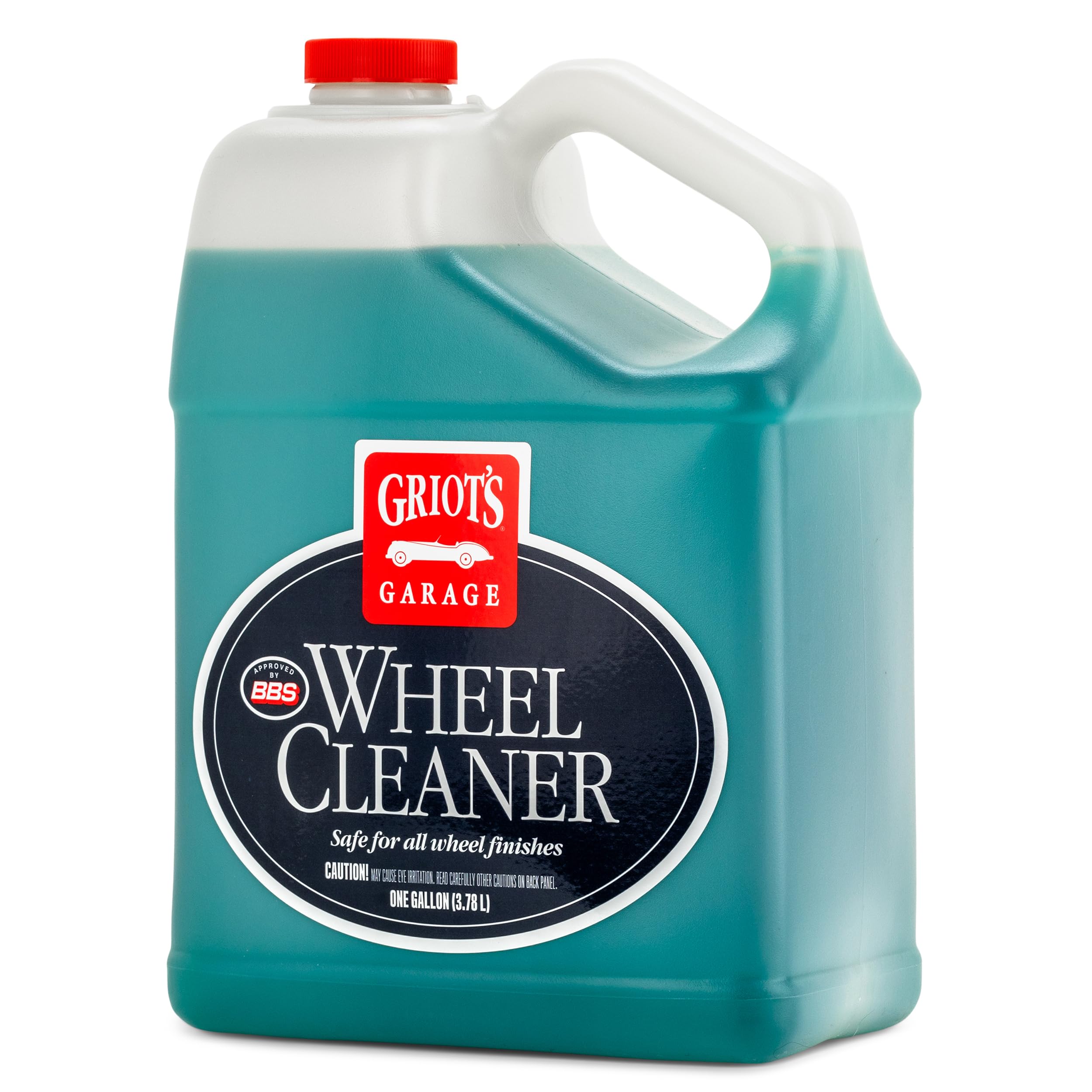
A pH-balanced gallon that is gentle enough for ceramic coatings.
Griot’s Garage takes a different approach — instead of an aggressive iron-removing formula, this is a pH-neutral spray that lifts road grime, tar, and brake dust without stripping waxes or sealants. Reviewers point out that it is on the weaker side compared to color-changing iron removers and requires agitation (you need to scrub with a sponge or brush). One reviewer who uses it on a ceramic-coated Aston Martin trusts only Griot’s products and confirms this cleaner will not pit or damage wheels.
The upside is that it is a full gallon of ready-to-use liquid, so you get plenty of washes for the money. It works best as a weekly maintenance cleaner rather than a once-a-season deep strip. If your wheels are ceramic-coated or you keep them clean regularly, this pH-neutral approach preserves your protection layer while still cutting through everyday brake dust. For neglected wheels with months of caked-on iron, pick one of the color-changing options above.
Best for coated wheels: If you have a ceramic coating or wax on your rims and want a cleaner that will not strip it, Griot’s is the safe daily driver.
Not for neglected rims: Heavy, baked-on brake dust will need something stronger — keep this for your regular wash routine.
Understanding the Specs
Acid-Free vs. pH-Neutral
An acid-free cleaner skips harsh acids that can etch clear coats or dull chrome, but it can still be alkaline (high pH). A pH-neutral cleaner sits at a 7 on the scale, making it the gentlest option for delicate finishes like ceramic coatings, painted alloys, or powder-coated rims. For routine washes on coated wheels, pH-neutral is the safer bet; for heavy iron removal, an acid-free (but not necessarily pH-neutral) formula often works faster.
Color-Changing Formula
A cleaner that sprays on clear and turns red or purple when it contacts iron is giving you real-time feedback. The color change means the chemical is actively dissolving ferrous metal from brake dust. When the color stops deepening, the iron is neutralized and you can rinse. This feature saves guesswork — you know exactly when to scrub and when to stop.
FAQ
Can I use an alloy wheel cleaner on painted or chrome rims?
How long should I let a wheel cleaner sit before rinsing?
Is a concentrate or ready-to-use wheel cleaner better for home use?
Will a wheel cleaner damage my tires or tire dressing?
What does the purple or red color change mean?
Why do some wheel cleaners smell so bad?
Can I use an alloy wheel cleaner on my brake calipers?
How often should I clean my alloy wheels?
Final Thoughts: The Verdict
For the majority of shoppers, the alloy wheel cleaner winner is the Nanoskin Non Acid Professional Wheel & Tire Cleaner because the 4:1 concentrate gives you professional-grade cleaning at the lowest per-wash cost. If you want a dramatic color change that does the work for you, grab the SONAX Beast Wheel Cleaner. And for ceramic-coated or sensitive wheels where you need pH-neutral safety, the standout is the Griot’s Garage Wheel Cleaner.
How We Picked
We do not accept paid placement. Every pick is matched to a real buyer and a real use-case; we do not hands-on test units.
Sources & Methodology
Specifications: manufacturer listings and product documentation. Review insights: verified customer reviews, as of July 2026. Pricing: not shown on this page (it changes often); check the current price via the retailer link.
As an Amazon Associate, Gadgets Feed earns from qualifying purchases. This does not affect which products we feature.