
A harness that feels fine at the crag can feel like a lead weight strapped to your hips during a long glacier crossing or an alpine start at 4 AM. The difference between a technical alpine climbing harness and a standard rock climbing harness isn’t just grams — it’s the ability to put it on while wearing crampons, rack ice screws without fumbling, and trust load distribution with zero bulk under a backpack.
I’m Min — the co-founder and writer behind Gadgets Feed. I’ve spent countless hours digging through technical specifications and user field reports to determine which alpine harnesses actually deliver on their promises for multi-pitch objectives and ski mountaineering.
After analyzing every key variable from weight and packability to buckle design and gear loop configuration, you’ll find the definitive breakdown of the best alpine climbing harness for your specific objectives and budget.
How To Choose The Best Alpine Climbing Harness
An alpine harness is a specialized tool that must balance ultralight packability with the ability to perform under technical conditions — often one-handed while wearing gloves. The wrong choice here means wasted weight in your pack or a harness that’s impossible to adjust mid-route.
Weight and Packability
Every gram matters when your harness is tucked inside a pack for a 10-hour approach. An alpine-specific harness should weigh under 300 grams and pack down smaller than a water bottle. The lightest options use high-modulus polyethylene strands instead of foam padding to distribute load without bulk, while still meeting CE and UIAA safety standards.
Donning Over Boots and Crampons
On a glaciated route, you do not want to remove your skis or crampons just to put your harness on. Look for designs that allow you to step into the waistbelt and leg loops while standing fully geared up. Adjustable leg loops with buckles that operate through thick gloves are a must for alpine conditions.
Gear Loop Configuration
Alpine climbing requires racking ice screws, slings, carabiners, and rescue gear in a specific order. A harness with two to four integrated equipment loops that don’t interfere with a backpack hipbelt is essential. Silicone-lined retainers on leg loops for ice screw storage give you quick access when you need it most.
Quick Comparison
On smaller screens, swipe sideways to see the full table.
| Model | Category | Best For | Key Spec | Amazon |
|---|---|---|---|---|
| Petzl Altitude | Premium | Ski touring & glacier travel | 150 grams | Amazon |
| Petzl Tour | Mid-Range | Ski mountaineering with gear | 320 grams | Amazon |
| KAILAS B4 | Mid-Range | All-around alpine performance | 320 grams capacity | Amazon |
| KAILAS B3 | Mid-Range | Budget alpine & gym training | 320 grams capacity | Amazon |
| Summit Pro Safety (Large) | Mid-Range | Heavy-duty tree stand work | 5.06 pounds | Amazon |
| Summit Pro Safety (Medium) | Mid-Range | Heavy-duty tree stand work | 4.9 pounds | Amazon |
| DIJJIG Half Body Safety Belt | Budget | Roofing & rescue work | 5.86 pounds | Amazon |
| SOB Full Body Invertible | Value | Work at height & rescue | 4.48 pounds | Amazon |
| Full Body Thicken Safety Harness | Budget | Recreational full-body use | 4.48 pounds | Amazon |
In‑Depth Reviews
1. Petzl Altitude Harness

At just 150 grams, the Petzl Altitude defines the ultralight alpine harness category. Its Wireframe technology uses high-modulus polyethylene strands instead of traditional foam padding, distributing load across the waistbelt and leg loops without bulk. This is the harness you put on a glacier before a long ski tour and forget you’re wearing until you need it.
The DoubleBack Light buckle is fully glove-friendly, allowing adjustments even with thick mittens on. The four integrated equipment loops are positioned to minimize interference with a backpack hipbelt — a critical detail for long approaches where you carry a heavy pack. Keeper loops on each leg hold ice screws securely in place.
Users confirm it performs perfectly for ski touring and glacier travel, though it’s not designed for heavy daily use like rappelling or multi-pitch rock climbing. The included protective carry bag keeps it compact and prevents wear when stuffed in a pack. One note: if you’re between sizes, size up for a proper fit over base layers.
Why it’s great
- Extremely lightweight at 150g with excellent load distribution
- Can be put on over skis, crampons, or mountaineering boots
- Glove-friendly DoubleBack Light buckle for easy adjustment
Good to know
- Not built for heavy daily climbing or rappelling use
- Sizing runs small — order up if between sizes
2. Petzl Tour Adjustable Ski Mountaineering Harness

The Petzl Tour strikes a smart balance between durability and weight for ski mountaineering. Built with high-strength polyester webbing and a robust steel DoubleBack buckle, it offers superior abrasion resistance compared to ultralight racing harnesses while still weighing only 320 grams — light enough for long approaches but tough enough for technical mixed routes.
Intuitive color coding on the straps makes it immediately obvious how to untangle and put the harness on correctly, even in low light or while wearing gloves. Two gear loops provide essential racking space for carabiners and rescue gear, while silicone-lined retainers on each leg loop hold ice screws securely in place during movement.
Users consistently mention the compact size when packed and the ease of donning without removing skis or crampons. The hand wash care instruction and 10-year shelf life are standard for quality Petzl gear. One common note: if you’re between sizes, go up for a comfortable fit over winter layers.
Why it’s great
- Steel DoubleBack buckle for durability and easy glove operation
- Color-coded straps prevent tangling in low light
- Silicone-lined leg loop retainers for ice screw storage
Good to know
- Slightly heavier than pure ultralight options at 320g
- Size up if between sizes for a proper fit
3. KAILAS B4 Rocking Climbing Harness
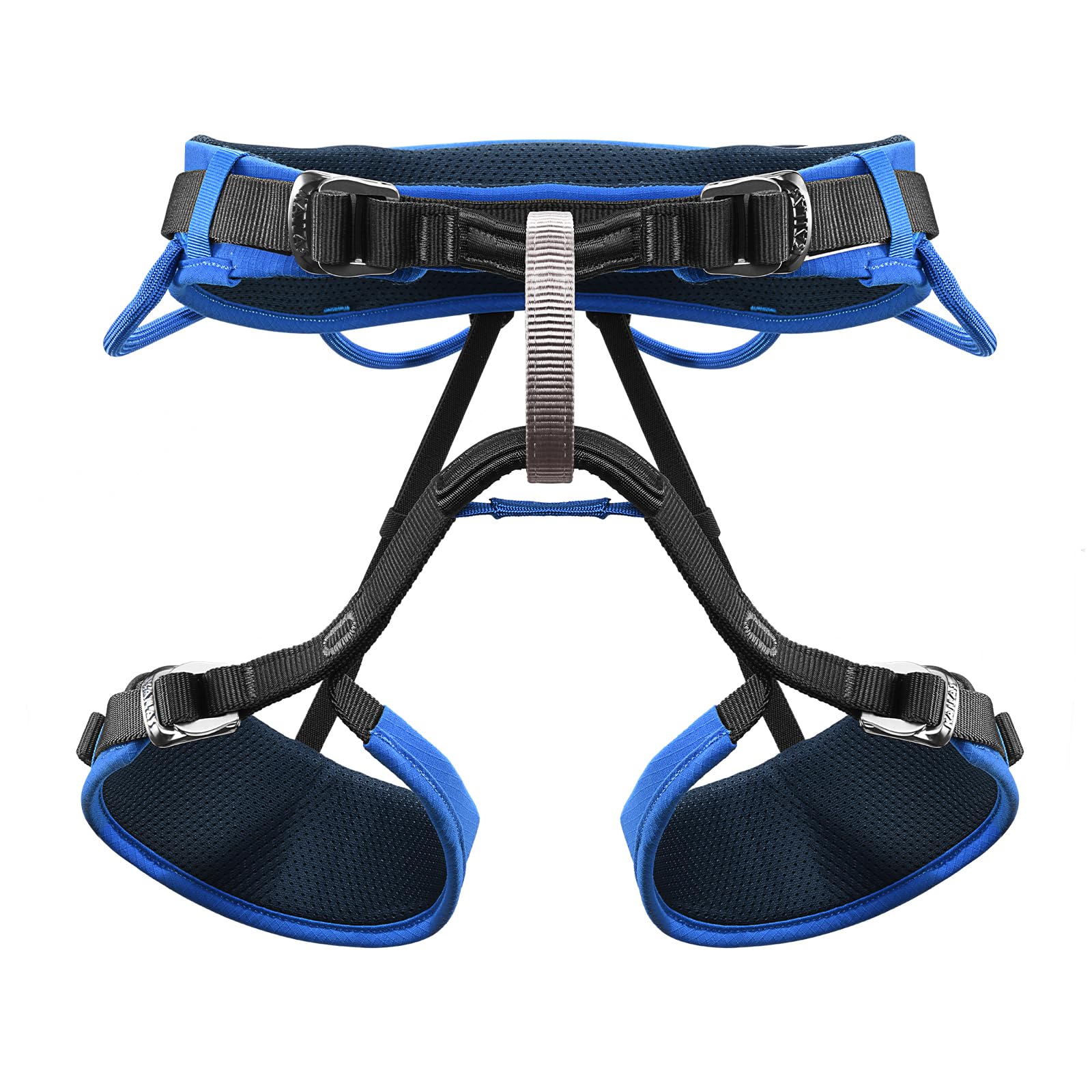
The KAILAS B4 brings premium features like breathable 3D mesh padding and dual-adjustable leg loops at a mid-range price point. The abrasion-resistant nylon construction is rated five times stronger than standard harness fabrics, giving you confidence on long alpine rock routes where gear takes a beating against granite.
Dual-adjustable leg loops and waistbelt accommodate a wide range of body sizes, from XS to XL, without hip slippage during steep climbing. The symmetrical gear loops via dual waist adjustment allow for balanced racking — an advantage on multi-pitch where you need quick access to gear from either side. Users praise the excellent sizing adjustability and comfortable padding that works well for both gym training and trad climbing.
It packs down reasonably well for an all-around harness, though it’s not an ultralight specialist. The front gear loops angle slightly forward, which some users prefer and others find a minor quirk. For climbers who want one harness that transitions from the crag to moderate alpine routes, the B4 delivers exceptional value.
Why it’s great
- Excellent adjustability with dual leg loops and waistbelt
- Breathable 3D mesh padding for long days on the wall
- Symmetrical gear loops for balanced racking
Good to know
- Not ultralight — built for all-around use, not pure alpine speed
- Front gear loops angle forward, a preference-dependent design
4. KAILAS B3 Rock Climbing Harness
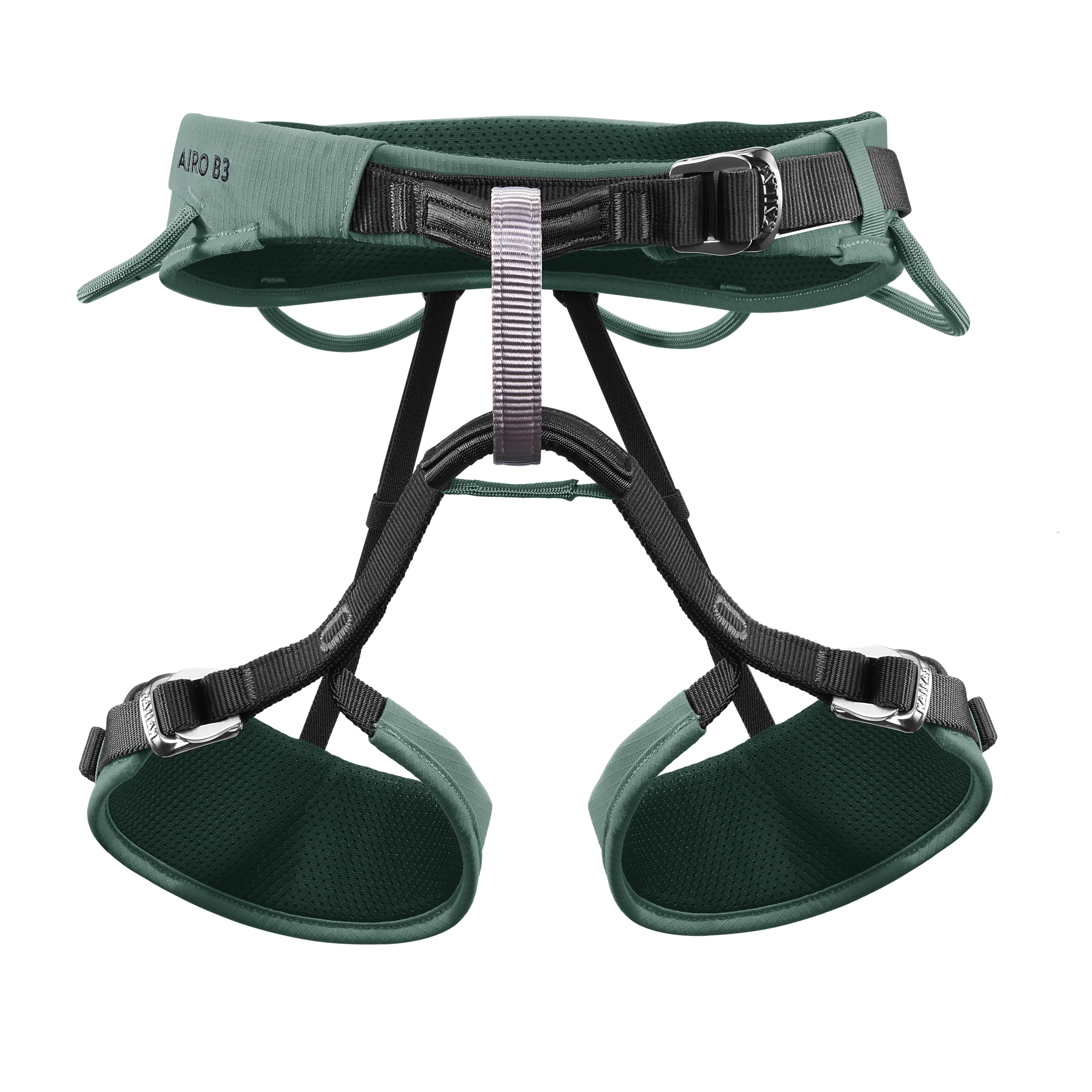
The KAILAS B3 is a budget-friendly entry point into alpine-capable climbing harnesses without sacrificing safety certifications. CE and UIAA certified, it features breathable 3D mesh padding that reduces thigh pressure during long hangs, with moisture-wicking fabric that performs well during active approaches.
Dual adjustable leg loops and waistbelt accommodate men and women across XS-XL sizes, making it a versatile choice for mixed groups or climbers still dialing in their fit. The ultra-lightweight design minimizes fatigue for multi-pitch climbs and gym training, and the abrasion-resistant nylon construction matches the B4’s five-times-stronger rating against standard materials.
Customer feedback highlights its durability and comfortable wide waistband, with aluminum buckles that keep weight down. The sizing runs slightly small, so consider ordering up. It works well for larger users from 6’1″ and 240 pounds, though the lack of on/off leg tensors is a notable omission for climbers who want quick transitions.
Why it’s great
- CE and UIAA certified safety at a budget-friendly price point
- Breathable mesh padding reduces thigh fatigue on long climbs
- Works well for larger users up to 240 pounds
Good to know
- Sizing runs small — order up from your usual size
- No on/off leg tensors for quick transitions
5. Summit Treestands Pro Safety Harness (Large)

The Summit Treestands Pro Safety Harness is built for heavy-duty use in tree stand hunting, not alpine technical climbing. Its 5-plus-pound weight and military-inspired MOLLE attachment system prioritize security and comfort for long stationary hours in a tree stand rather than movement efficiency on a ridge.
Padded shoulder straps and a torso strap provide exceptional comfort for all-day sits, and the included 8-foot safety rope with adjustable Prusik knot gives you a functional self-rescue system. Users confirm the buckles are quiet — no clinking metal sounds that spook game — and the harness is easy to put on and take off without stepping through leg loops.
For its intended use, this harness delivers premium comfort and safety. However, at over 5 pounds, it is not suitable for alpine climbing where every gram counts. The MOLLE webbing offers modular attachment options for accessories, but the overall design is focused on stationary vertical security rather than dynamic movement.
Why it’s great
- Extremely comfortable for all-day stationary use with padded shoulder straps
- Quiet buckles and MOLLE attachment system for hunting applications
- Includes 8-foot safety rope with adjustable Prusik knot
Good to know
- Very heavy at 5+ pounds — not suitable for alpine approaches
- Designed for tree stand hunting, not technical climbing
6. Summit Treestands Pro Safety Harness (Medium)
The medium version of the Summit Pro Safety Harness shares the same heavy-duty construction and features as its larger counterpart, including the MOLLE attachment system and padded shoulder straps. It fits waist sizes from 28 to 35 inches and weighs slightly less at 4.9 pounds.
Users consistently report this harness is more comfortable than competing models from other brands, with quiet clips that don’t make noise during movement. The torso strap keeps the harness from shifting during long sits, and the easy on-off design doesn’t require stepping through leg loops — a practical advantage for hunters who change positions frequently.
Like the large version, this is not an alpine climbing harness. The weight and design are optimized for tree stand safety, not glacier travel or multi-pitch climbing. However, for its intended purpose in hunting and stationary work-at-height scenarios, it offers exceptional comfort and reliability at a reasonable price point.
Why it’s great
- Superior comfort compared to other tree stand harness brands
- Quiet, strong clips with no metal-on-metal noise
- Easy to put on and take off without stepping through
Good to know
- Heavy at 4.9 pounds — not for alpine technical use
- Limited to tree stand and stationary hunting applications
7. DIJJIG Half Body Safety Belt

The DIJJIG Half Body Safety Belt targets a different audience entirely — roofing, tree climbing, and rescue work rather than alpine mountaineering. Its thick padded construction distributes weight well for stationary or ascending work, and users confirm it performs for high-rise building services and roofing projects.
At 5.86 pounds, this is among the heaviest options on this list, with a half-body design that prioritizes safety over mobility. Users note that stepping into the harness can be difficult due to the lack of quick-release buckles on the leg pieces, and the overall fit is better suited for work applications than technical vertical movement.
For entry-level rappelling or rope access work where budget is the primary constraint, this harness gets the job done safely. But for alpine climbing, the weight and lack of alpine-specific features like glove-friendly buckles or ice screw retainers make it a poor fit. It’s a solid budget choice for its intended work-at-home niche.
Why it’s great
- Thick padding distributes weight well for stationary work
- Affordable entry point for roofing and rescue applications
- Durable construction that holds up to daily use
Good to know
- Very heavy at 5.86 pounds — not for alpine use
- Difficult to get into without quick-release buckles
8. SOB Full Body Climbing Harness (Invertible)

The SOB Full Body Invertible Harness is a Class III safety harness designed for work at height, tower climbing, and rescue scenarios where inversion capability is required. Its thickened, widened waist protection and full-body design prevent flipping during a fall — a critical feature for arborist and industrial users.
Users report it performs far above its price point, with easy adjustment, lightweight relative to other full-body designs, and durable stitching that holds up to repeated use. The multiple attachment points allow for versatility with two lanyards and fall restraint systems. At 4.48 pounds, it’s heavy for alpine use but reasonable for its class.
The absence of quick-release buckles is a common complaint — adjusting leg and shoulder straps is tedious for frequent on-off users. It fits smaller frames particularly well, and customers confirm its comfort for hours of use. For work-at-height professionals who need a budget-friendly full-body harness, this is a strong choice, but it does not belong on an alpine ridge.
Why it’s great
- Class III full-body design with inversion capability for rescue work
- Multiple attachment points for lanyards and fall restraint systems
- Performs far above its price point for work-at-height applications
Good to know
- No quick-release buckles — tedious to adjust frequently
- Heavy at 4.48 pounds — not suitable for alpine climbing
9. Full Body Thicken Safety Harness (SOB)

This full-body climbing harness from SOB offers thickened, widened padding designed to distribute weight evenly and prevent the tourniquet feeling common with narrow harnesses during long hangs. ASTM F1772 certified, it’s built for recreational indoor climbing, tree work, and rappelling rather than alpine technical climbing.
Users praise the secure feel and intuitive buckle design that doesn’t creep loose during use. The full-body design prevents flipping in a fall, a key safety advantage for beginners or those uncomfortable with standard sit harnesses. Reinforced tie-in points add durability for repeated rappelling and rope access work.
Like other full-body options on this list, it lacks quick-release buckles, requiring you to step into the harness rather than clip on quickly. At 4.48 pounds, it’s not a weight-conscious choice for alpine approaches. For recreational climbers, arborists, or families introducing new climbers to the sport, this harness offers great value, but serious alpine objectives demand a lighter, more specialized design.
Why it’s great
- Thickened padding prevents tourniquet feeling during long hangs
- ASTM F1772 certified for recreational and work-at-height use
- Full-body design prevents flipping for beginner safety
Good to know
- No quick-release buckles — inconvenient for frequent on-off use
- Heavy at 4.48 pounds — not suitable for alpine climbing
FAQ
Can I use a standard rock climbing harness for alpine mountaineering?
What does it mean for a harness to be donned with skis on?
Final Thoughts: The Verdict
For most users, the best alpine climbing harness winner is the Petzl Altitude because it sets the standard for ultralight weight at 150 grams with effective HMPE Wireframe load distribution and full alpine features like donning over skis and glove-friendly buckles. If you want more durability for mixed routes with steel hardware and ice screw retainers, grab the Petzl Tour. And for a budget-friendly all-around alpine harness that transitions from the gym to moderate ridges, nothing beats the KAILAS B4.