
Your central furnace heats the whole house, but it ignores the garage, the basement workshop, the drafty barn, and every room where you actually spend winter weekends. An alternative heat source solves that mismatch — it delivers high-BTU warmth exactly where you need it, without running ductwork or raising your monthly gas bill.
I’m Min — the co-founder and writer behind Gadgets Feed. After hundreds of hours comparing BTUs, fuel types, safety certifications, and real-user endurance data across propane, kerosene, diesel, and electric units, this guide isolates the practical truths that separate a reliable heater from a noisy, short-lived mistake.
Whether you need spot warmth for a single stall garage or emergency-ready heat for a thousand square feet, this research-backed roundup of the best alternative heat source options will help you match the right fuel, output, and safety features to your space.
How To Choose The Best Alternative Heat Source
Every alternative heat source solves the same problem — putting warmth in a space your furnace ignores — but the approach differs wildly. Before you buy, match the heater type to three variables: your space size, your fuel access, and your tolerance for noise and venting requirements.
BTU Output vs. Real-World Coverage
Manufacturers quote square footage, but the real number is BTUs. A room with poor insulation, high ceilings, or frequent door opening needs a higher BTU rating than the square footage suggests. A general rule: multiply your space length by width by desired temperature rise, then divide by 1.6 to get the BTUs you need. A 20×20 garage at roughly 500 sq ft with a 30°F rise requires about 18,000 BTU minimum. A fully unfinished barn or warehouse space may demand 60,000 BTU or more.
Fuel Type: Storage, Cost, and Runtime
Propane is widely available in 20 lb tanks, burns clean, and suits forced-air units but requires ventilation. Kerosene offers the highest energy density per gallon, with 23,500 BTU units running 10-12 hours per tank fill — ideal for emergency preparedness. Diesel heaters (typically 12V or 24V) sip fuel at 0.18-0.53 L/h, making them exceptional for long-duration RV or cabin use, but the fuel pump noise is audible. Electric units like the DREO are cord-bound but require zero ventilation, no fuel storage, and operate silently — best for finished indoor rooms.
Heating Method: Radiant vs. Forced Air vs. Convection
Radiant heaters (Gasland, Mr. Heater) warm objects and people directly — silent, no dust circulation, but heat dissipates fast when the unit shuts off. Forced-air heaters (Remington, Dyna-Glo) blow hot air across the space, warming the entire volume quickly, but generate fan noise and stir up dust. Convection heaters (Sengoku HeatMate) rely on natural air circulation, produce no noise or moving parts, and distribute heat evenly over longer periods — best for continuous indoor use where silence matters.
Quick Comparison
On smaller screens, swipe sideways to see the full table.
| Model | Category | Best For | Key Spec | Amazon |
|---|---|---|---|---|
| DREO Whole Room Heater 714 | Electric | Indoor living spaces | 1500W, 34dB noise | Amazon |
| Remington LP Forced Air Heater | Propane | Large garages, job sites | 60,000 BTU, 1,500 sq ft | Amazon |
| Dyna-Glo RMC-FA60DGD | Propane | Variable heat, large spaces | 30-60K BTU, 1,350 sq ft | Amazon |
| Gasland MHA18BN | Propane | Quiet, enclosed spaces | 18,000 BTU, silent radiant | Amazon |
| Sengoku HeatMate HMC-23K | Kerosene | Emergency backup, large rooms | 23,500 BTU, 12-hr runtime | Amazon |
| LF Bros 5KW Diesel Heater | Diesel | RVs, cabins, extended use | 17,000 BTU, 0.18 L/h fuel | Amazon |
| Mr. Heater 75K BTU Kerosene | Kerosene | Massive spaces, job sites | 75,000 BTU, 1,750 sq ft | Amazon |
In‑Depth Reviews
1. DREO Whole Room Heater 714
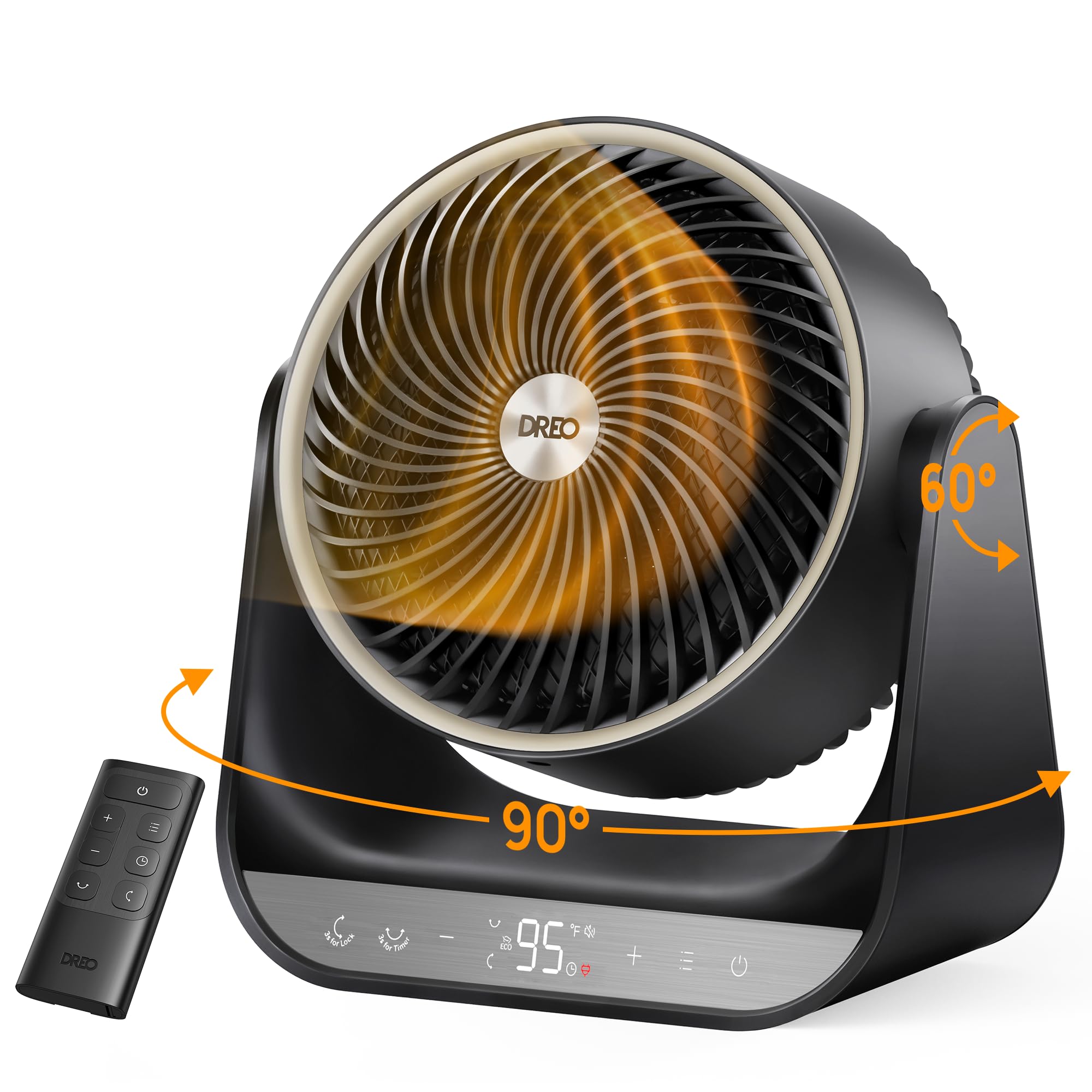
The DREO 714 is the rare electric heater that genuinely moves air across an entire room rather than baking one chair. Its 1500W PTC element delivers heat in 2 seconds, while 60° vertical and 90° horizontal oscillation pushes warm air at 12 ft/s — covering 161-269 sq ft without the hot-and-cold pockets common in stationary units. The brushless DC motor keeps noise at a whisper-quiet 34 dB, quiet enough to run in a bedroom or office without waking anyone.
Safety is comprehensive: overheat shutoff, tip-over protection, and flame-retardant housing backed by ETL listing. The ECO mode lets you set temperature in 1°F increments between 41-95°F, so the unit cycles on and off to maintain your target without wasting power. The 12-hour timer and included remote make it convenient for pre-heating a bedroom before you get out of bed.
Customer reviews consistently praise the sturdy build — the unit resists tipping and feels heavier than its 6.5 lbs suggests. The only minor complaint is that the touch controls require reading glasses for older users, but the remote solves that. For an electric alternative heat source that delivers even, silent, and safe warmth to finished indoor spaces, the DREO 714 is the clear pick.
Why it’s great
- 3D oscillation covers the whole room, not just one corner
- 34 dB noise floor — genuinely silent at low fan setting
- ECO mode with 1°F increments saves electricity
Good to know
- Touch panel is unlit and hard to read without glasses
- Only heats usable space; no fuel independence
2. Dyna-Glo RMC-FA60DGD LP Forced Air Heater
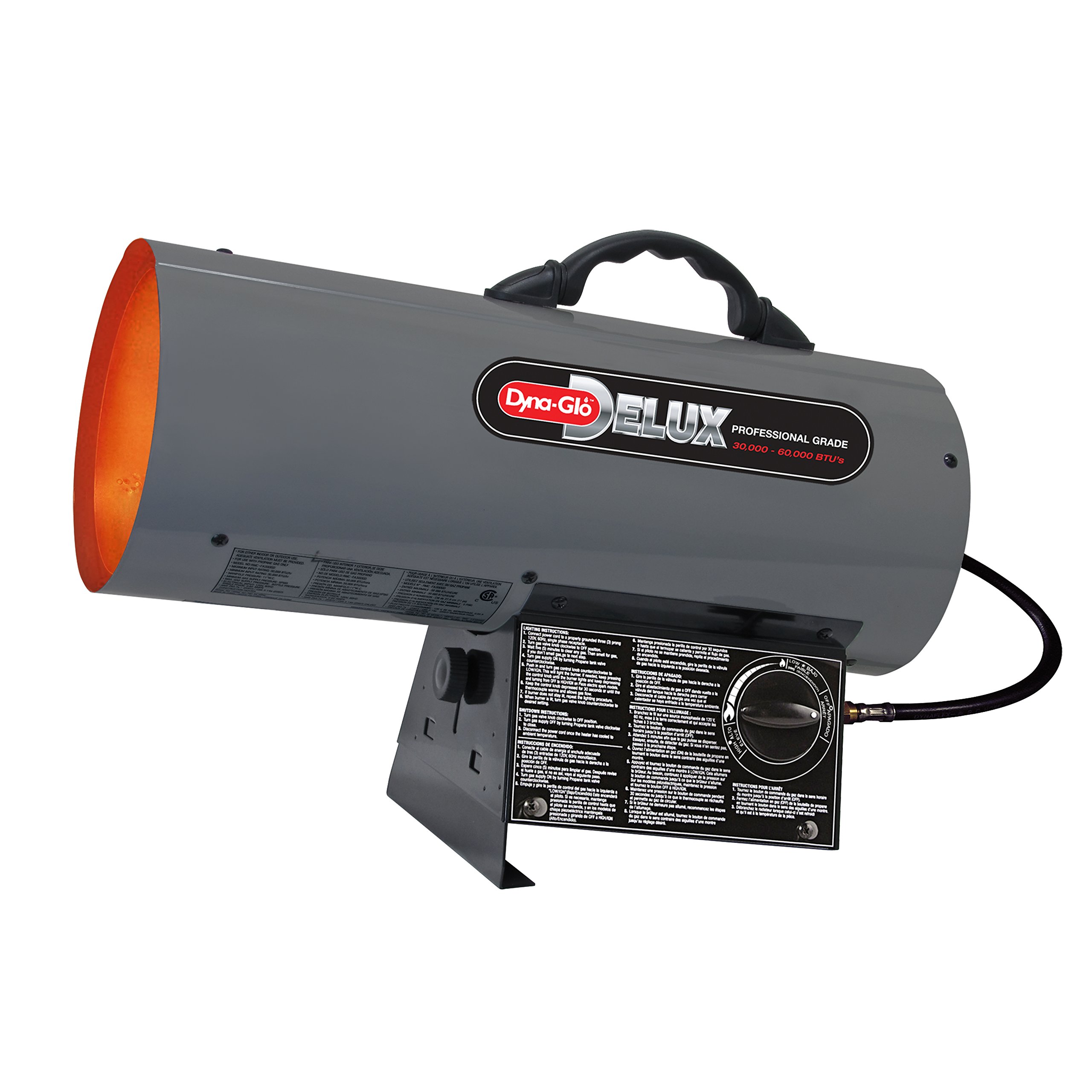
The Dyna-Glo RMC-FA60DGD hits the sweet spot for anyone who needs propane heat across a large but variable space. Its continuously variable BTUs range from 30,000 to 60,000, so you can dial in low for a 20×20 garage or crank it to high for a 1,350 sq ft workshop. The forced-air design moves heat fast — real-world tests show a 28°F garage climbing to 56°F in roughly one hour on the high setting.
Build quality is functional, not fancy. The steel housing is rugged, but the front tube can arrive slightly pinched, and the power cord is frustratingly short at under 3 feet. The continuous electronic ignition prevents delayed ignition (a genuine safety hazard on older designs), and the overheat auto-shut-off adds peace of mind. The included 10-foot hose and regulator get you connected to a 20 lb propane tank immediately.
Noise is the main trade-off — the forced-air fan and propane flame roar together at roughly 25% of a hair dryer in volume. That’s manageable for a work environment but too loud for a quiet living area. Buyers consistently report excellent fuel efficiency, with a 30 lb tank lasting multiple heavy-use sessions. For the price, the Dyna-Glo delivers the highest BTU-per-dollar of any unit in this lineup.
Why it’s great
- Continuously variable BTUs from 30K to 60K for tailored output
- Fast heating — raises a cold garage 30°F in under an hour
- Includes 10-foot hose and regulator for immediate setup
Good to know
- Loud forced-air noise — not for living spaces
- Short power cord limits placement flexibility
3. Remington LP Forced Air Heater 60,000 BTU
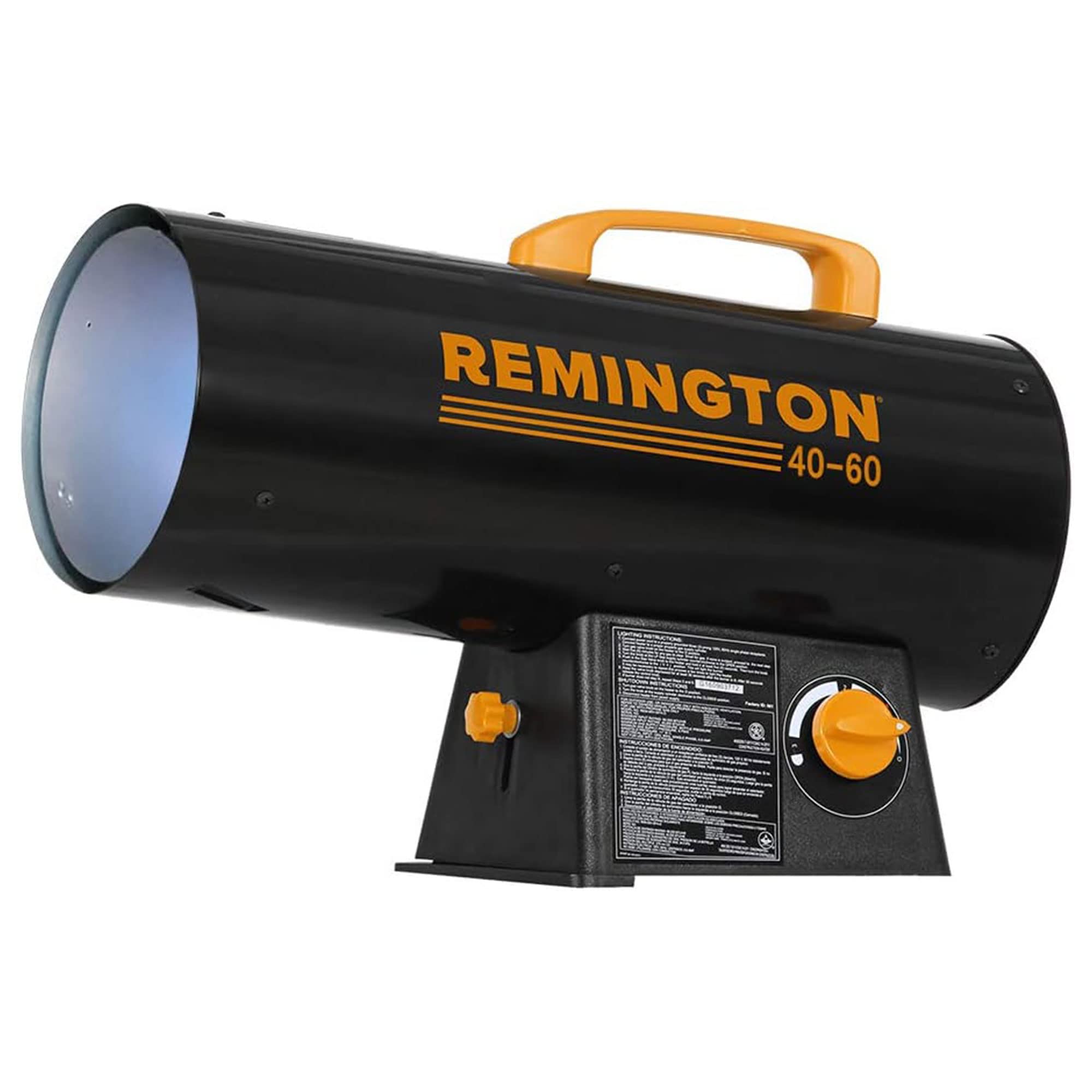
The Remington LP Forced Air Heater is a no-nonsense brute built for construction sites, barns, and oversized garages. Its 60,000 BTUs of forced air cover up to 1,500 sq ft — a range that dwarfs most electric and small propane units. The heavy-duty steel construction weighs just 11 lbs, making it easy to carry from truck to job site, but the engineering is clearly prioritized for output volume, not acoustics.
Variable heat settings let you dial the flame from low to high, but in practice, buyers report that the heater on low still produces substantial noise and heat. The electronic ignition provides quick start-up, and safety is addressed through a thermocouple, high-temperature limit shut-off, and flame-out fuel cut-off. The included 10-foot LP hose and regulator get you running quickly, though the power cord is remarkably short — under 1 foot — which forces you to use an extension cord for most installations.
User reports from insulated two-car garages show the Remington raises temperatures from freezing to comfortable in under 10 minutes. The trade-off is noise: buyers consistently describe it as “very loud,” with the forced-air fan and flame roar dominating any conversation. This is a tool for work, not leisure. If your priority is raw heat output for a large, uninsulated space, the Remington delivers power that few competitors match at this price tier.
Why it’s great
- 60,000 BTU output heats 1,500 sq ft in minutes
- Lightweight 11 lbs for easy job-site transport
- Safety cut-offs for overheat, flame-out, and tip-over
Good to know
- Extremely loud — not suitable for living spaces
- Power cord is under 1 foot, requiring an extension cord
4. Gasland MHA18BN Propane Radiant Heater

The Gasland MHA18BN is the quietest propane heater in this lineup because it uses radiant heat rather than a fan. Instead of blowing air, the glowing ceramic panel warms objects and people directly — no fan noise, no dust circulation, just silent warmth. At 18,000 BTU, it covers up to 450 sq ft, making it best for a single-car garage, workshop, office, or enclosed patio where noise matters.
The cabinet design hides the 20 lb propane tank inside, keeping the overall footprint neat and the tank out of the way. Built-in rolling wheels and an easy-carry handle make repositioning effortless. Three heat modes (High/Medium/Low) let you adjust output, and the safety features include tip-over shutoff and low-oxygen shutoff — critical for indoor use. The unit requires zero electricity, so it works during a power outage without any cords.
Owners report excellent results in spaces up to a 33-ft travel trailer, easily maintaining comfortable temperatures even in cold weather. The only downside is the initial lighting procedure, which some users find finicky until the gas line purges. Once running, the radiant heat is steady and the auto shut-off functions exactly as intended. If silence and portability are your priority, the Gasland MHA18BN delivers on both without sacrificing heating power.
Why it’s great
- Silent radiant heat — no fan noise whatsoever
- Runs on 20 lb propane, no electricity required
- Cabinet hides the tank for a cleaner look
Good to know
- Requires ventilation — not for sealed rooms
- Initial lighting can take a few tries to purge air from line
5. Sengoku HeatMate HMC-23K Kerosene Heater

The Sengoku HeatMate HMC-23K is built for people who take emergency preparedness seriously. This kerosene convection heater delivers 23,500 BTUs and heats up to 1,000 sq ft — enough to keep the main living area of a small house warm during a grid failure. Its 1.9-gallon fuel tank provides up to 12 hours of runtime on a single fill, which means you can sleep through the night without refueling.
The convection heating method is key to its versatility. Unlike forced-air units, the HeatMate has no fan, no moving parts, and produces zero noise while operating. Heat rises naturally and circulates through the room. The push-button electronic start, EZ flame adjuster, and included siphon pump make setup straightforward. Safety features include automatic shut-off, a tip-over switch, and protective safety guard grills — plus, no electricity is required to run the heater.
Real-world users praise its reliability during Texas winter storms and use it for garages, sheds, and poorly insulated rooms. The unit burns kerosene cleanly when using ClearFuel or K-1 grade fuel, producing minimal odor. The wick holds up well through a full season of regular use. The main considerations are fuel cost and availability — kerosene is less common than propane in some regions — and the 27-lb weight makes it less portable than tank-top alternatives. For a long-duration, silent, indoor-rated heater that doesn’t depend on the grid, the HeatMate is unmatched in this price range.
Why it’s great
- 12-hour runtime on one 1.9-gallon tank of kerosene
- Silent convection heat — no fan or motor
- Requires no electricity, perfect for blackouts
Good to know
- Kerosene fuel can be harder to source than propane
- Heavy at 27 lbs, less portable than smaller units
6. LF Bros 5KW Diesel Heater
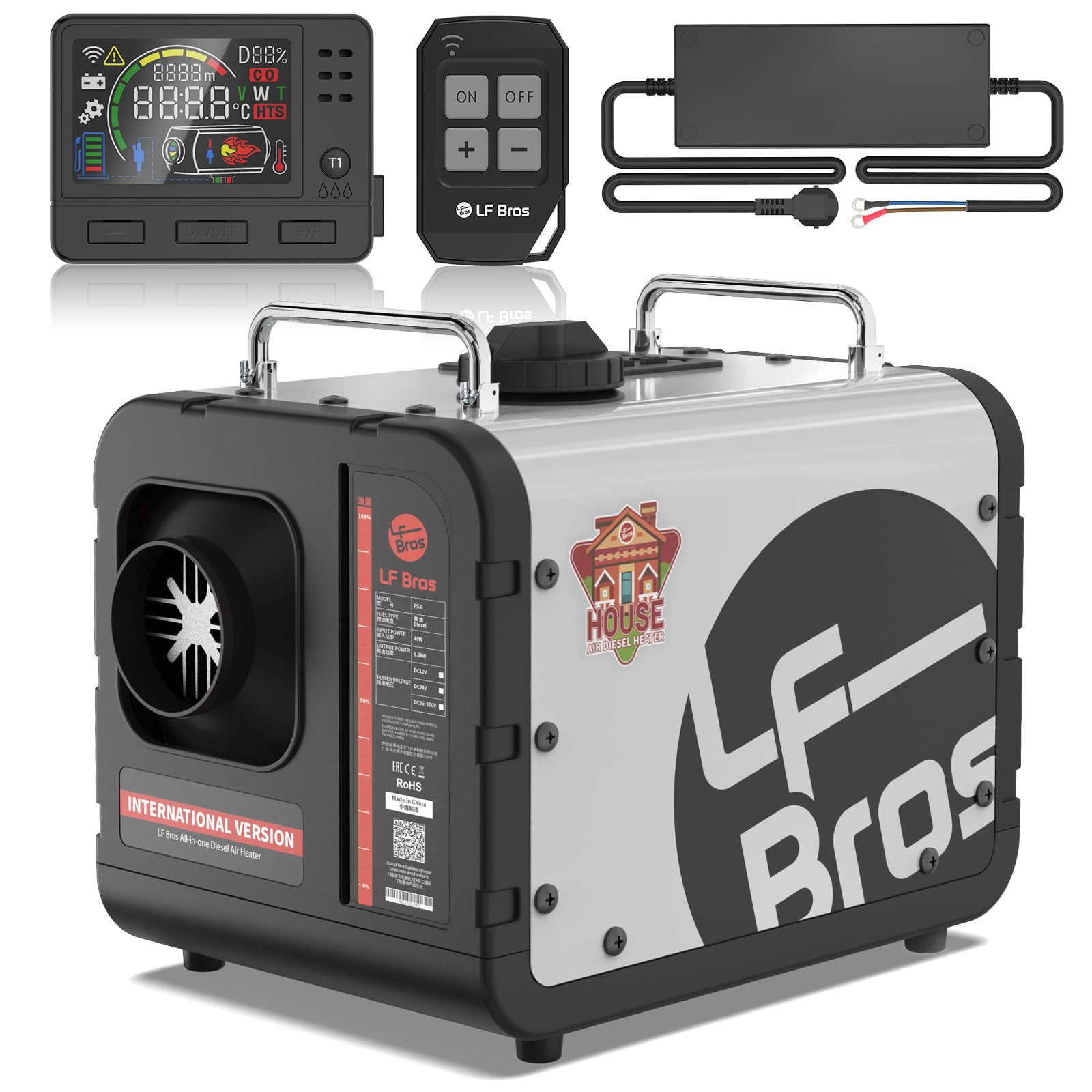
The LF Bros 5KW diesel heater solves a problem no propane or kerosene unit can: ultra-low fuel consumption for extended off-grid runs. At 0.18 L/h on the low setting, a full 5-liter tank can run for over 27 hours. The unit outputs 4,700-17,000 BTU and operates on 12V or 24V DC, but the included 110V transformer means you can plug it directly into a wall outlet for garage or home use.
This is an all-in-one unit — the heater, combustion chamber, fuel pump, and LCD controller are integrated into a single chassis with a built-in fuel tank. Setup involves attaching the exhaust pipe and connecting the DC power or AC adapter. The remote control works up to 100 feet, letting you adjust temperature and power without leaving your seat. The LCD screen displays real-time operating status, and the spill-proof fuel tank uses an internal-thread cap that prevents leaks even in bumpy RV travel.
User feedback from RV owners and off-grid cabin dwellers is overwhelmingly positive: the heater kept floors warm in single-digit outdoor temperatures on low setting, and a full tank lasted weeks of intermittent use. The exhaust exits through the side wall or floor, requiring a 3-inch hole for the vent pipe. Some units ship with a faint fuel pump tick — audible but not disruptive. Customer service is responsive, with multiple reports of instant replacement for DOA units. For anyone living in a camper, trailer, or cabin who needs efficient long-duration heat, the LF Bros diesel heater is the top specialist choice.
Why it’s great
- Extremely fuel-efficient — 27+ hours on low setting
- Runs on 12V/24V/110V for maximum versatility
- Spill-proof tank design prevents leaks during travel
Good to know
- Requires cutting a 3-inch hole for exhaust vent
- Fuel pump produces a faint ticking noise
7. Mr. Heater 75,000 BTU Kerosene Heater

The Mr. Heater 75,000 BTU forced-air kerosene heater is the heaviest hitter in this guide, designed for spaces that laugh at standard portable heaters. It covers up to 1,750 sq ft with a fixed 75,000 BTU output — enough to heat an entire large workshop, a two-story garage, or a construction site. The rugged steel cabinet houses a heavy-duty high-output fan that moves hot air aggressively across the entire volume.
The unit runs for about 11 hours on a full tank of kerosene (K-1 grade recommended for clean burn). It includes a built-in thermostat, a lighted on/off switch, a fuel gauge, and six-function LED diagnostics that help troubleshoot flame, fan, and sensor issues. The forced-air design means it warms a two-car garage from 15°F to 65°F in under 10 minutes — and then cycles off for up to 20 minutes before needing to fire again.
At 37.9 lbs, this is not a casual carry — it stays where you put it. Noise is moderate for a forced-air kerosene unit; users describe it as “not loud” compared to propane forced-air models. Some buyers have successfully run diesel fuel through it in a pinch, though kerosene is the manufacturer-recommended fuel. The main practical hurdle is fuel cost and availability — kerosene prices have risen sharply in many regions. This is the right choice only if you genuinely need 75K BTUs and have the space and ventilation to handle it.
Why it’s great
- 75,000 BTU output covers the largest spaces in this guide
- Built-in thermostat cycles the unit to maintain steady temp
- Six-function LED diagnostics simplify troubleshooting
Good to know
- Very heavy at 37.9 lbs — not portable between uses
- Kerosene fuel has become expensive in many regions
FAQ
Can I use a propane or kerosene heater indoors in my home?
What size heater do I need for a two-car garage?
How long does a 20 lb propane tank last in a forced-air heater?
What’s the difference between forced-air and radiant heat for a garage?
Final Thoughts: The Verdict
For most users, the best alternative heat source winner is the DREO Whole Room Heater 714 because it combines silent electric operation, genuine 3D oscillation, and comprehensive safety features for indoor rooms without any fuel or ventilation headaches. If you need raw propane power for a large garage, grab the Dyna-Glo RMC-FA60DGD. And for off-grid extended runtime in an RV or cabin, nothing beats the LF Bros 5KW Diesel Heater.