
Carrying a pair of bulky binoculars on a hike, to a concert, or on a bird-watching trip often means sacrificing space and convenience for a wider field of view. The weight, the neck strain, and the fiddly dual-focus adjustment can turn a spontaneous moment of wildlife spotting into a chore. If you’ve been looking for a way to get that same magnified clarity without the awkward bulk, the answer lies in a much simpler, more portable optical tool.
I’m Min — the co-founder and writer behind Gadgets Feed. I’ve combed through hundreds of hours of technical reviews and user reports to analyze the optical glass, prism types, and mount stability that define the best single-handed viewing experiences in this category.
After reviewing the top contenders, I’ve narrowed down the field to seven models that represent the most compelling options on the market today. Whether you are watching distant wildlife or just want a clearer view of the stage, this guide to the best alternative to binoculars will help you find the perfect fit for your outdoor adventures.
How To Choose The Best Alternative To Binoculars
Switching from binoculars to a monocular or spotting scope means trading some stereoscopic depth perception for portability, simplicity, and often better glass for the price. To pick the right one, you need to understand the key specifications that dictate performance in the field.
Magnification and Objective Lens Size
The first number in an optical spec (like “12×60”) is the magnification power—how many times closer an object appears. The second is the diameter of the objective lens in millimeters. A larger objective lens gathers more light, which is critical for low-light conditions at dawn or dusk. For handheld use, 8x to 12x magnification is the sweet spot; going higher often requires a tripod to keep the image steady.
Prism and Lens Coatings
The glass quality is defined by the prism type and coatings. BAK4 prisms are made from higher-density barium crown glass than the cheaper BK7, producing a sharper, brighter image with no dark edges. Fully Multi-Coated (FMC) lenses have multiple anti-reflective layers on every glass surface, maximizing light transmission for better contrast and color fidelity. These two features are the strongest predictors of image quality in any monocular.
Portability and Build Features
Look at the overall weight and dimensions to ensure the device fits in a jacket pocket or daypack without adding noticeable bulk. Water resistance (like an IPX4 rating) and a rubber-armored exterior protect against rain and drops. If you plan to use your phone for digiscoping, a bundled smartphone adapter and a tripod are essential for capturing steady, shake-free photos.
Quick Comparison
On smaller screens, swipe sideways to see the full table.
| Model | Category | Best For | Key Spec | Amazon |
|---|---|---|---|---|
| Bushnell Legend 10×42 | Premium | High-end wildlife observation | ED Prime Glass | Amazon |
| Athlon Talos 20-60×80 | Premium | Long-range spotting and target shooting | 20-60x Zoom Range | Amazon |
| Nocs Zoom Tube 8×32 | Mid-Range | Compact everyday carry with premium feel | 384ft FOV @1000yds | Amazon |
| AYRAVIIO 12×60 | Mid-Range | Giftable kit for beginners | 60mm Objective Lens | Amazon |
| Pankoo 12×60 | Mid-Range | All-in-one kit with solid BAK4 glass | 25mm Large Eyepiece | Amazon |
| AMITHER 80×100 | Value | High-zoom digiscoping on a budget | Real 80x Magnification | Amazon |
| PhysioPhyx 80×100 | Value | Budget-friendly kit with wide FOV | 21mm Objective Lens | Amazon |
In‑Depth Reviews
1. Bushnell Legend 10×42 Ultra HD Monocular

Bushnell’s Legend series brings an Extra-Low Dispersion (ED) Prime glass element into a single-handed monocular format, a feature usually reserved for high-end binoculars. The 10×42 configuration delivers generous light transmission through a 4.2mm exit pupil, and the Ultra Wide Band Coating pushes color fidelity to the point where chromatic aberration is virtually invisible even at the edges of the 340-foot field of view.
The build is a rugged, rubber-armored body with O-ring sealed optics that survive immersion. A smooth focus knob allows fast, single-handed adjustment, and the twist-up eyecup offers three stops for comfortable use with or without eyeglasses. At 374 grams, it disappears into a backpack pocket without compromising optical quality, making it a genuine one-for-one replacement for a full-sized binocular.
Users consistently praise the crispness of the view, especially when scanning treelines for birds or watching distant marine life on a cruise. The only recurring criticism involves the stiff plastic lens cap, but the optical performance at this level justifies the premium positioning for anyone whose primary concern is image sharpness.
Why it’s great
- ED Prime glass eliminates fringing for true color fidelity
- Fully waterproof and fog-proof with O-ring seals
- Fast single-handed focus with a smooth central wheel
Good to know
- Lens cap design is stiff and can be irritating in the field
- No bundled tripod or smartphone adapter for digiscoping
2. Athlon Optics Talos 20-60×80 Spotter Scope

When you need to identify a target beyond the reach of a handheld monocular, the Athlon Talos 20-60×80 steps in as a full-sized spotting scope. Its 80mm objective lens and nitrogen-purged, fully multi-coated optics create a bright image up to 60x magnification. The zoom ring and focus knob are separate, allowing precise adjustments without losing your target at a distance.
The body is built from lightweight aluminum, and the included table-top tripod offers enough stability for casual range use or landscape scanning. Field testers have confirmed clean hits on .22-caliber bullet holes at 100 yards and steel targets out to 300 yards, with image clarity holding strong up to 40x before softening at the maximum zoom. The 1.57-degree field of view at 20x is narrow enough to demand a tripod, but that trade-off is inherent in a scope designed for extreme reach.
Some shooters note that eye relief becomes short at higher magnifications, and the tripod legs are light enough to wobble in a breeze. However, for the price point, the combination of waterproofing, fog-proofing, and a versatile zoom range makes this a serious option for anyone who needs to see far, not just wide.
Why it’s great
- Impressive 20-60x zoom range for long-range target ID
- Nitrogen-purged for reliable fog-proof performance
- Lightweight aluminum housing is easy to pack
Good to know
- Image quality degrades noticeably past 40x magnification
- Included tripod is adequate but not rock-solid in wind
3. Nocs Provisions Zoom Tube 8×32 Monocular

Nocs Provisions designed the Zoom Tube with a deliberate focus on daily carry portability. At just 9.5 ounces and 8×32 format, it fits in a jacket pocket with room to spare. The Swiss-designed BAK4 prism and fully multi-coated optics produce a flat, bright image with a generous 384-foot field of view at 1000 yards, and the central focusing system is responsive enough for quick wildlife glassing without fumbling.
The textured rubber grip and IPX4 water resistance mean it holds up in rain, snow, or a splash from a kayak paddle. A multi-stop twist-up eyecup accommodates eyeglass wearers, and the integrated 1/4-inch 20 tripod mount offers flexibility for steady viewing. Users report using it for everything from hiking to fishing to casual birding, consistently praising the clarity as a significant step above generic budget options.
The trade-off for this compact size is the lack of a bundled phone adapter or dedicated case, and the 8x magnification is on the lower end for reaching distant objects. But for the person who prioritizes a slim, durable, and optically solid device that can be on hand at all times, the Zoom Tube is a refined choice backed by a lifetime warranty.
Why it’s great
- Ultra-compact and lightweight for everyday carry
- Water-resistant construction with a lifetime warranty
- Wide field of view for quick target acquisition
Good to know
- No smartphone adapter or carrying case included
- 8x magnification may feel underpowered for long-range scenes
4. AYRAVIIO 12×60 Monocular

The AYRAVIIO 12×60 pairs a large 60mm objective lens with a BAK4 prism and fully multi-coated optics to pull in enough light for crisp viewing during twilight hours. Its exit pupil of 5mm is larger than many competitors, which translates directly to a brighter image when the sun drops low. The body is compact for a 60mm class optic, weighing just 8.9 ounces, and the included phone adapter and tripod make it a complete digiscoping kit out of the box.
Users describe the view as “surprisingly crisp” for the price tier, with smooth manual focusing that lets beginners get sharp results quickly. The smartphone adapter is functional but some users found it finicky to align perfectly on the first try. The included tripod is very basic—adequate for casual porch viewing but not for extended hands-free use—and a few buyers opted to replace it with a sturdier model.
For the price, this kit delivers a strong balance of optical quality and accessory completeness. It’s a smart choice for a beginner hiker or as a gift for someone new to outdoor optics, where the convenience of having everything in one box outweighs the premium feel of standalone components.
Why it’s great
- Large 60mm objective provides excellent low-light performance
- Complete kit with phone adapter, tripod, and carrying bag
- Lightweight build for its class at under 9 ounces
Good to know
- Smartphone adapter requires some patience to set up
- Included tripod is too flimsy for stable long-term use
5. Pankoo 12×60 Monocular

Pankoo’s 12×60 stands out by combining a 25mm large eyepiece with a BAK4 prism and fully multi-coated lens, producing a 6.5-degree wide field of view that feels surprisingly open for a monocular. The large eyepiece reduces the sensation of looking through a tunnel, and the 60mm objective delivers bright detail out to 1200 yards. The barrel is built with a rubberized finish that inspires confidence in wet or dusty conditions.
The kit includes a padded portable case, a sturdy adjustable tripod, and a smartphone adapter that fits a wide range of phones including iPhones and Samsung devices. Users on cruises and hikes reported clear views of whales and birds, and many noted the monocular was easier to use one-handed than a standard pair of binoculars. The phone mount was described as functional but stiff, requiring some effort to lock the phone into position for shake-free photo capture.
At 12x magnification, a tripod is recommended for stable viewing beyond a few seconds, but the device is comfortable enough for quick handheld spot checks. The optical clarity at this price point is a standout, making it a strong mid-range contender for anyone who wants BAK4 glass without stepping into premium territory.
Why it’s great
- Large 25mm eyepiece reduces tunnel vision effect
- Strong image clarity at distance with good color fidelity
- Comprehensive kit includes case, tripod, and phone adapter
Good to know
- Phone mount is fiddly and can be hard for new users to manage
- Tripod is adequate but not stable in windy conditions
6. AMITHER 80×100 Monocular Telescope

The AMITHER 80×100 leverages a long focal length and a large objective to claim a real 80x magnification when paired with a 10x smartphone lens. The fully multi-coated green film lens and BAK4 prism work together to boost light transmission in low-light conditions, making it functional for evening observation as long as there is some ambient light source. The kit includes a phone adapter and a lightweight tripod to stabilize shots at extreme zoom levels.
The dual-focus mechanism allows coarse and fine adjustments, which is essential at high magnification where tiny turns of the focus wheel move the focal plane drastically. The included storage bag and cleaning cloth add convenience for travel. Users found the image quality excellent for wildlife phone photography when properly stabilized, though the same high magnification makes handheld use nearly impossible without significant shake.
This is not an optical product for the purist who wants a pristine naked-eye view—it is built for digiscoping on a budget. The included tripod is basic, and some units arrived with minor durability issues such as a broken tripod leg. For the price, however, the capability to capture long-distance phone photos is unmatched in this group.
Why it’s great
- Extreme 80x magnification enables phone capture of distant subjects
- Dual-focus system allows precise adjustment at high zoom
- Low-cost entry point for smartphone digiscoping experiments
Good to know
- Not usable without a tripod due to the extreme zoom
- Included tripod legs can be fragile in shipping
7. PhysioPhyx 80×100 Monocular Telescope
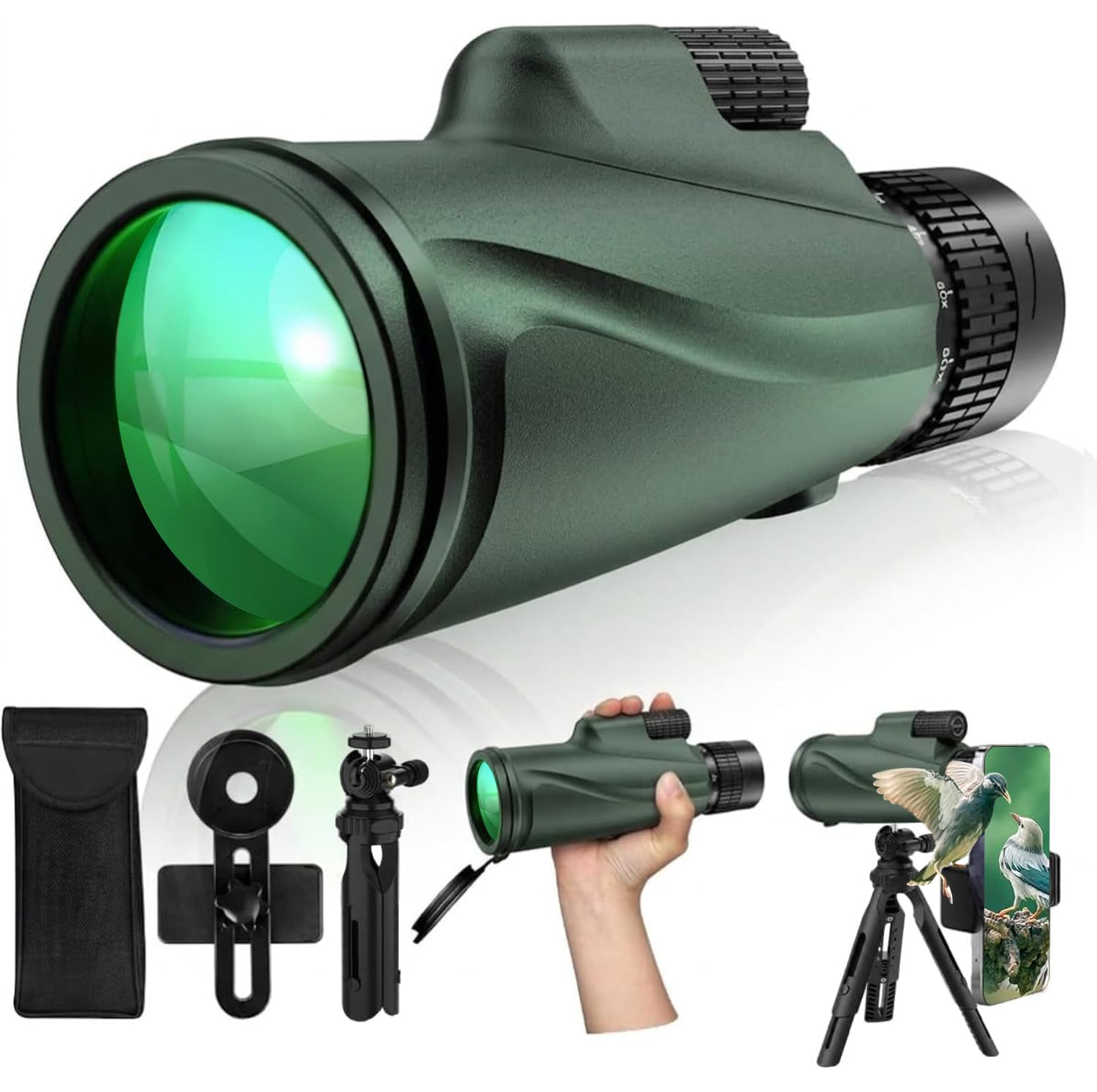
The PhysioPhyx enters the category as a straightforward, budget-conscious monocular with a large lens design aimed at delivering a wide field of vision. The advanced coated optics claim improved light transmission and color reproduction, and the ergonomic one-hand operation is comfortable for extended glassing sessions. The adjustable eyecup is a welcome feature for users who wear glasses, preventing the blackout effect common with cheap optics.
The kit includes a sturdy tripod, a smartphone adapter, and a cleaning cloth. The packaging is well-suited for a casual user who wants to try monocular viewing without a significant investment. However, the 21mm objective lens diameter is unusually small for a product marketed as high-power, which limits the potential light gathering and resolves image quality at longer distances.
Customer feedback is mixed, with some reviews clearly misplaced from a different product listing, while others note the scope functions as expected for general use near the house. It is the most basic option here, best suited for a complete beginner on a minimal budget who wants a simple kit to experiment with zoomed photography and is not particular about edge-to-edge sharpness.
Why it’s great
- Very affordable complete kit with tripod and phone adapter
- Adjustable eyecup works well for eyeglass wearers
- Lightweight frame suitable for one-handed operation
Good to know
- Small 21mm objective lens limits low-light performance
- Mixed customer feedback indicates potential variability in quality
FAQ
Is a monocular as good as binoculars for bird watching?
What does BAK4 prism mean and why does it matter?
Can I use a monocular for stargazing or astronomy?
Final Thoughts: The Verdict
For most users, the best alternative to binoculars winner is the Bushnell Legend 10×42 because its ED Prime glass delivers binocular-grade optical clarity in a much lighter, single-handed form factor. If you want a complete kit with a smartphone adapter and tripod that works immediately out of the box, grab the AYRAVIIO 12×60. And for the long-range shooter or observer who needs to see past half a mile, nothing beats the variable zoom reach of the Athlon Talos 20-60×80.