
A dashboard altimeter for your car does more than just tell you how high you are — it reveals the true grade of the trail, warns you before a tilt becomes dangerous, and turns every mountain road into a known quantity. Whether you are overlanding in the Rockies, leveling a campervan for the night, or navigating backcountry passes in a Jeep, having real-time altitude and angle data on your dash changes how you read the terrain.
I’m Min — the co-founder and writer behind Gadgets Feed. I’ve spent countless hours combing through user reviews, technical specs, and real-world performance data to identify exactly which altimeter for car use holds up on washboard roads, works in direct sunlight, and delivers accurate elevation without draining a battery.
After sorting through dozens of models, I’ve narrowed the field to the seven that actually earn a spot on your dashboard. This guide breaks down each one by its core strengths and real limitations so you can pick the right unit for your rig. Buckle up — this is your definitive resource for picking the best altimeter for car.
How To Choose The Best Altimeter For Car
A car altimeter is not a single technology — it comes in two fundamentally different flavors: GPS-based digital units and analog barometric units. GPS models calculate elevation by triangulating satellite positions, while barometric altimeters measure changes in atmospheric pressure to determine height. Each approach has a clear use case. Understanding which one fits your driving environment is the first and most important decision you will make.
GPS vs. Barometric Sensing
GPS altimeters are self-calibrating and update in real time, making them ideal for long road trips where you cross multiple time zones and terrain types. They also bundle features like speed, heading, and coordinate display. Barometric altimeters require manual calibration before a trip but remain accurate for hours afterward without needing satellite signal — a huge advantage in tunnels, deep canyons, or dense forest where GPS drops out. The best choice depends on whether you prioritize convenience or independence from satellites.
Tilt and Inclinometer Functionality
If you drive off-road, a dedicated inclinometer is non-negotiable. A quality unit measures both pitch (front-to-back angle) and roll (side-to-side tilt) with a usable range of ±40 degrees. Look for adjustable alarm thresholds so you can set a warning before the vehicle approaches a dangerous lean angle. Units with a dedicated inclinometer sensor — separate from GPS-derived tilt estimation — deliver far more responsive readings on rough terrain.
Display Readability and Mounting Stability
A dim or glare-prone display defeats the entire purpose of a dashboard altimeter. The best digital units include an ambient light sensor for automatic brightness adjustment. Analog units rely on large, hand-painted numerals and a clean lens. Regardless of type, the mounting bracket must survive direct summer sun without softening or loosening. Hook-and-loop attachments offer flexibility, but a screw-tightened swivel mount provides the most durable hold on bumpy roads.
Quick Comparison
On smaller screens, swipe sideways to see the full table.
| Model | Category | Best For | Key Spec | Amazon |
|---|---|---|---|---|
| MR CARTOOL M95 | Premium | OBD + GPS accuracy | OBDII / GPS dual-mode | Amazon |
| Sun Company AltiTilt | Premium | Battery-free off-road | Barometric altimeter + inclinometer | Amazon |
| Sun Company AltiLINQ | Premium | Pure passive altimeter | 0–15,000 feet barometric range | Amazon |
| AUTOOL X95 | Mid-Range | Color HUD with alarms | Color LCD, light sensor brightness | Amazon |
| MOTOCOCHE MM202-60 | Mid-Range | Dual driving modes | Multi-axis gyroscope inclinometer | Amazon |
| MR CARTOOL M60 | Mid-Range | Compact 8-function display | 230 g, stainless steel build | Amazon |
| AZIJYV H500G | Budget | Entry-level GPS HUD | 40 g, plug-and-play USB | Amazon |
In‑Depth Reviews
1. MR CARTOOL M95
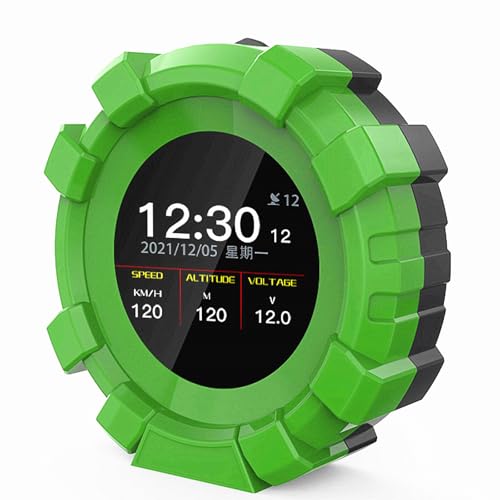
The MR CARTOOL M95 is the most versatile dashboard altimeter on this list because it pulls elevation and vehicle data from two independent sources: the OBDII port for engine speed, fuel consumption, and error codes, and a built-in GPS module for altitude, heading, and inclinometer readings. That dual-path approach means your elevation display stays active even if the GPS signal drops, as long as the OBDII connection remains alive. The 40-degree tilt alarm threshold is adjustable, and the automatic brightness sensor adapts the HUD display to changing cabin light.
Weighing 0.2 kilograms and measuring roughly 4.7 by 4.3 inches, the M95 fits neatly on any dashboard without blocking windshield visibility. The ABS plastic housing feels robust, and the included hardware supports both adhesive and hard-wiring installation. For users who want a single device that replaces a dedicated altimeter, inclinometer, and scan tool, this unit consolidates all three into one tidy package.
Real-world feedback is overwhelmingly positive among Jeep and off-road owners, who praise the easy programming and reliable approach/roll angle tracking. A minority report that the daytime display can feel dim in strong direct sun, and the compass relies on GPS, which makes it useless inside tunnels. If your driving involves a mix of pavement and backcountry trails, the M95’s dual-source architecture delivers the most complete data set available at this level.
Why it’s great
- OBDII and GPS data overlap for continuous altitude readout
- User-adjustable 40-degree tilt alarm with auto brightness
- Covers engine diagnostics plus inclinometer in one unit
Good to know
- Compass functionality is GPS-only, fails in tunnels
- Some users find the daytime display brightness lacking
2. Sun Company AltiTilt

The Sun Company AltiTilt combines a barometric altimeter with a mechanical inclinometer, making it the only unit on this list that requires zero batteries, zero wiring, and zero satellite signal. The altimeter reads up to 15,000 feet using changes in atmospheric pressure, while the inclinometer uses a bright Saturn-yellow tube with a brass ball that provides an instant visual of pitch and roll. The adjustable dial lets you calibrate for high or low-pressure systems before a trip, and once set, the readings remain stable for hours.
At just 3.7 ounces and measuring 1.2 by 2.8 by 3.5 inches, the AltiTilt is the most compact option here. The hook-and-loop dashboard mount attaches to either the top or front of the dash, and the entire unit detaches easily for handheld use on the trail. Engraved and hand-painted numerals ensure legibility without any backlight — useful for drivers who prefer a clean, analog look that never struggles with screen glare.
Owner reviews consistently highlight its accuracy for elevation tracking and the usefulness of the inclinometer for leveling a truck bed or monitoring side slopes. The biggest drawback is the mounting bracket: in extreme heat, the adhesive can soften and the ball-joint may loosen, requiring periodic tightening. For overlanders who want a dead-simple, always-on altimeter that cannot be killed by a dead battery, the AltiTilt is the obvious choice.
Why it’s great
- Zero power needed — works purely on barometric pressure
- Brass-ball inclinometer gives instant roll/pitch feedback
- Compact enough to take on the trail when you leave the rig
Good to know
- Mount can soften in high heat; may need tightening
- Manual calibration required before each journey
3. Sun Company AltiLINQ

The Sun Company AltiLINQ is the purest altimeter in this lineup — it strips away the inclinometer, speedometer, and compass to deliver a single-function barometric altitude display with a weather trend indicator. The adjustable dial accounts for high or low-pressure systems, and the scale reads up to 15,000 feet in increments that are useful for both sea-level driving and high mountain passes. The battery-free design means you simply set the elevation at home, and the mechanical movement tracks changes in real time.
Weighing just 0.25 pounds and measuring roughly 7 by 3.7 inches, the AltiLINQ is slightly larger than the AltiTilt but still dashboard-friendly. Two hook-and-loop attachments come in the box for mounting on the top or front of the dash, and the unit pops off easily for handheld use. For drivers who only care about elevation — not angle or speed — this is the most focused and reliable instrument available.
Reviews from retired pilots and frequent mountain travelers note that the AltiLINQ is surprisingly accurate once calibrated, and the lack of batteries means it is always ready. The primary complaint involves the mounting bracket: the tilt adjustment screw can loosen over weeks of vibration, requiring occasional re-tightening. If you want a dedicated altitude gauge that never needs charging and works in any weather, the AltiLINQ delivers exactly that.
Why it’s great
- Purely analog — no battery, no screen, no signal required
- Set-and-forget calibration holds for hours of driving
- Includes weather trend indicator for pressure changes
Good to know
- No inclinometer or speed data — altitude only
- Mount requires occasional screw tightening
4. AUTOOL X95

The AUTOOL X95 is a full-color HUD that packs altitude, inclinometer, speed, compass, coordinates, and driving distance into a single 4.9-by-4.5-inch display. The light sensor automatically adjusts screen brightness to ambient conditions, which helps with visibility during the transition from a shaded forest road into an open sunny stretch. The built-in high-precision GPS module provides satellite positioning for elevation, and the alarm system triggers warnings at 40 degrees of tilt, overspeed, and after four hours of continuous driving.
Weighing 240 grams, the X95 is slightly heavier than comparable digital units, but the plastic housing feels solid. The screen itself is an upgrade over earlier MR CARTOOL models — colors are punchier and the data layout is easier to parse at a glance. For drivers who want a modern, information-rich display without moving into tablet-sized territory, the X95 strikes a good balance between data density and dash footprint.
Off-road owners of Toyota 4Runners and side-by-sides report that the inclinometer tracks well on graded roads, though the climb angle can appear jittery on rocky terrain. The alarm triggers frequently on bumpy surfaces because even momentary impacts register as tilt events. Users also note that the display can wash out in very bright sunlight. For overlanders who want a feature-rich HUD with three years of warranty coverage, the X95 is a compelling mid-premium pick.
Why it’s great
- Color LCD with automatic brightness adjustment
- Three-year warranty on the main unit covers defects
- Displays altitude, tilt, speed, coordinates, and more
Good to know
- Tilt alarm triggers too easily on rough washboard roads
- Screen readability suffers in direct bright sunlight
5. MOTOCOCHE MM202-60
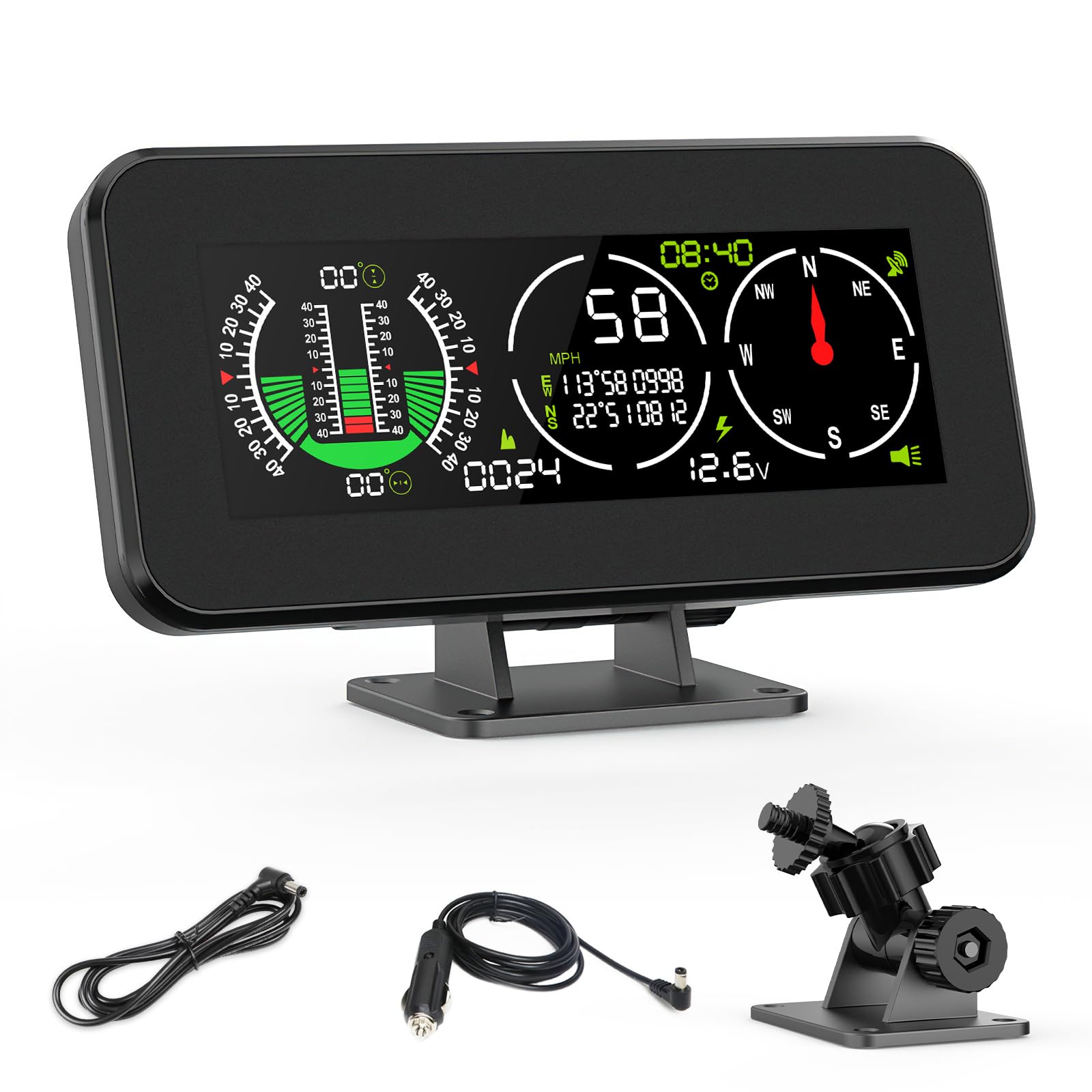
The MOTOCOCHE MM202-60 uses a dedicated multi-axis gyroscope to monitor pitch and roll angles independently of GPS, resulting in faster and more accurate inclinometer updates than units that derive tilt data from satellite positioning alone. It offers two driving modes — city and off-road — that adjust the sensitivity of the display and alarm thresholds. The color LCD screen is readable enough for night driving, and the freely rotating stand lets you dial in the perfect viewing angle.
Weighing 330 grams and measuring 5 by 1.18 by 2.36 inches, the MM202-60 is the heaviest unit here, but that weight comes from a more robust internal sensor array. The package includes two power cables (one for the cigarette lighter and one for hard-wiring) and a manual. For the mid-range price, you get a gyroscope-driven inclinometer that is legitimately responsive, not a GPS approximation.
Owner reviews from Kawasaki Teryx and Jeep enthusiasts are enthusiastic, noting that the display is fun to watch during climbs and easy to program. However, a small number of users report that the unit failed after about a month of use, which suggests some quality variance. If you are willing to accept that risk in exchange for a genuinely good inclinometer sensor at a reasonable cost, the MM202-60 delivers excellent value.
Why it’s great
- Multi-axis gyroscope for true inclinometer response
- Two driving modes tailor tilt sensitivity to the terrain
- Comes with hard-wiring kit for permanent installation
Good to know
- A minority of units fail within weeks of purchase
- Brightness must be set manually — no auto sensor
6. MR CARTOOL M60
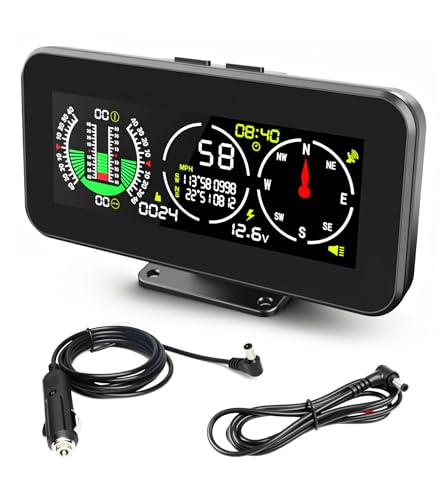
The MR CARTOOL M60 packs eight functions — speedometer, vehicle tilt angle, pitch angle, battery voltage, satellite time, compass, altitude, and coordinates — into a compact stainless-steel housing that measures 5 by 1.18 by 2.36 inches. The freely rotatable stand mount ensures you can position the display optimally regardless of dash angle, and the built-in GPS module provides the satellite data for altitude and compass. For drivers who want a no-nonsense digital unit that does not dominate the dashboard, the M60 is a space-efficient choice.
At 230 grams, the M60 feels substantial without being heavy. The stainless steel construction is a step up in durability from the plastic shells used by most competitors in this segment. The alarm system triggers at 40 degrees of tilt, and the slope calibration can be adjusted through the settings menu. Setup is straightforward for anyone comfortable with basic parameter menus, though the instruction manual could be clearer.
Reviews from motorhome and golf cart owners praise the inclinometer for leveling vehicles and the altitude display for mountain driving. The main drawbacks are the daytime display brightness — which some find too dim to read in direct sun — and the fact that the compass only functions when GPS signal is available, making it useless in covered parking or tunnels. For a compact, metal-bodied unit that covers all the essential data points, the M60 is a solid mid-range option.
Why it’s great
- Stainless steel housing offers better durability than ABS plastic
- Rotatable stand makes dash placement flexible
- Covers 8 driving data points in a small footprint
Good to know
- Daytime display can be hard to read in bright sunlight
- Compass requires GPS signal — no internal magnetometer
7. AZIJYV H500G
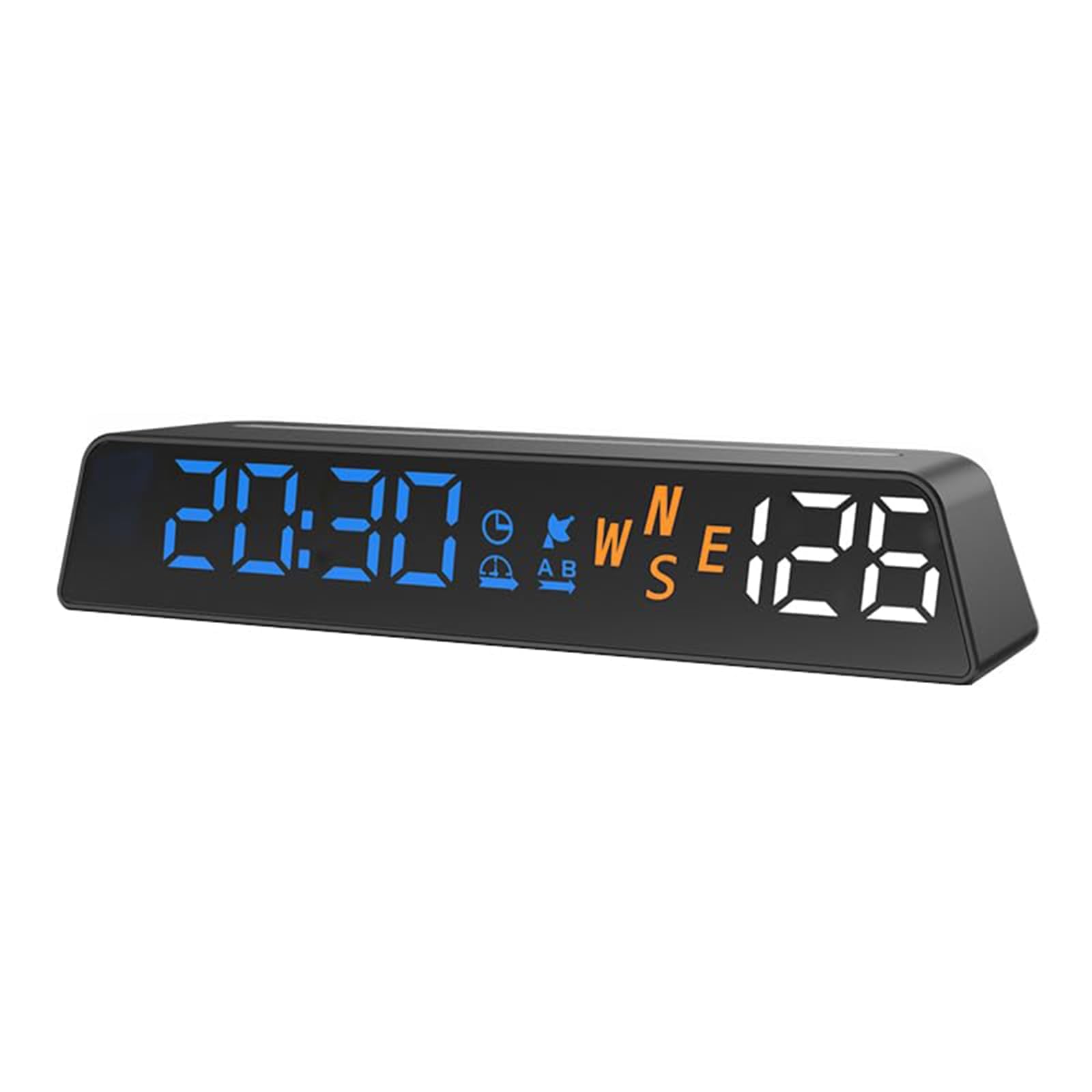
The AZIJYV H500G is an entry-level GPS head-up display that offers altitude, speed, clock, compass, and driving distance in a single ultra-light 40-gram package. It uses a GPS+BeiDou dual-satellite system for positioning and requires only a USB cable for power — no hard-wiring, no OBDII port needed. The LCD screen does not require a reflective film, which eliminates ghosting in direct sunlight, and the built-in light sensor automatically adjusts the display brightness to match the ambient light level.
Setup is truly plug-and-play: connect the included USB cable to a 5V source, place the unit on the dash, and it acquires a satellite fix within 10 to 30 seconds on the first boot. The 5-by-1.5-by-1-inch footprint is small enough to fit almost anywhere, and the lack of a separate external antenna keeps the installation clean. For the budget-level price, you get a functional GPS altimeter that simply works.
User feedback is mixed on accuracy: several owners report that the speedometer reads about 5 MPH high at highway speeds with no user calibration option, and a small number received non-functional units. On the positive side, UTV and bicycle owners appreciate the low cost and clear daytime readability. If you want a minimal-investment way to add altitude and speed data to a vehicle that lacks a factory altimeter, the H500G is worth considering — just calibrate your expectations accordingly.
Why it’s great
- Ultra-light 40-gram design with USB plug-and-play setup
- No reflective film needed — clear LCD even in direct sun
- Auto brightness adjustment from built-in light sensor
Good to know
- Speed can read 5 MPH high with no manual calibration
- Quality control issues reported — some units arrive dead
FAQ
Does a car altimeter need an internet connection to work?
Why does my GPS altimeter show different elevation than road signs?
Can I use a car altimeter on a motorcycle or UTV?
How do I calibrate a barometric car altimeter?
Final Thoughts: The Verdict
For most users, the best altimeter for car is the MR CARTOOL M95 because it combines OBDII engine data with GPS altitude and a responsive inclinometer in a single unit, giving you the most complete picture of your vehicle’s status on and off the road. If you want a battery-free solution that works in any weather and never needs charging, grab the Sun Company AltiTilt. And for a feature-packed color HUD that includes a three-year warranty and automatic brightness, nothing beats the AUTOOL X95.