
Our readers keep the lights on and my morning glass full of iced black tea. As an Amazon Associate, I earn from qualifying purchases.
Specs are compiled from manufacturer listings and verified buyer reviews and can change over time — please confirm the key details on the product page before buying.
Swapping your old cast-iron heads for a set of aluminum ones is the quickest way to wake up a tired small-block Chevy. But with so many choices — bare vs. assembled, 64cc vs. 68cc chambers, angle vs. straight plugs — it is easy to get lost. This guide cuts through the noise by focusing on what actually matters for your specific build: the intake runner volume that matches your cam, the combustion chamber size that sets your compression ratio, and the state of assembly that fits your skill level.
I’m Min — the founder and writer behind Gadgets Feed. This guide is built by comparing the manufacturers’ published specifications and the patterns across verified customer reviews, so you get each pick’s real strengths and trade-offs instead of marketing spin.
If you are piecing together a weekend cruiser or a high-compression stroker motor, these are the best alum sbc heads you can buy right now, ranked by real owner experience and measurable specs.
Our Picks at a Glance


How To Choose The Best Alum SBC Heads
The right pair of heads depends on three decisions: what intake runner volume works with your cam, if you want to assemble them yourself, and how much port work you are willing to do.
Intake Runner Volume — The Power Band Decider
The runner volume, measured in cubic centimeters (cc), tells you where the engine makes its peak torque. A 180cc runner keeps velocity high for strong low-end and mid-range pull — ideal for a street-driven 350. A 205cc runner sacrifices a touch of low-speed throttle response for top-end breathing, which is what you want on a 383 stroker or a rev-happy 327. Match the runner to your cam’s intended operating range, not your ego.
Bare vs Assembled Heads — Your Skill Level Matters
Bare heads mean you install the valves, springs, retainers, and seals yourself. This saves money and lets you pick your own valvetrain parts, but it also means setting installed height and checking for coil bind (when the spring coils stack solid before the valve is fully open). Assembled heads come with springs and valves already installed to a specific lift range — bolt them on and go, provided your cam lift stays within the factory spring spec. If you do not own a spring compressor and a micrometer, assembled is the safer play.
Combustion Chamber Size — Compression Control
The chamber volume — usually 64cc or 68cc on SBC aluminum heads — directly sets your static compression ratio when combined with your piston deck height (how far the piston sits below the block deck) and gasket thickness. A 64cc chamber on a flat-top-piston 350 lands around 10.0:1 to 10.5:1; a 68cc chamber drops that closer to 9.5:1. Stock-replacement builds with cast pistons should stick to the larger chamber to avoid detonation (knocking from uncontrolled fuel burning) on pump gas.
Quick Comparison
| Model | Best For | Intake Runner (cc) | Chamber (cc) | State of Assembly | Amazon |
|---|---|---|---|---|---|
| Auto Dynasty AD-CYLH-SBC-350-X2★ Best Overall | Entry-Level Bare Builds | 200 | 68 | Bare | Amazon |
| Speedmaster PCE281.2010Also Great | Bolt-On Power, Budget Big-Build | 205 | 64 | Assembled | Amazon |
| IMOOA MTD0196 | Custom Valvetrain, Porting Project | 205 | 64 | Bare | Amazon |
| FLOTEK 102505 | Mild Street 350 Upgrade | 180 | 64 | Assembled | Amazon |
| Edelbrock 5089 | Brand-Name confidence | — | 64 | Assembled | Amazon |
In‑Depth Reviews
1. Auto Dynasty AD-CYLH-SBC-350-X2 Bare Cylinder Head Pair
Our pick — over 4★ from 60+ verified ratings; the strongest balance of quality and price.
The low-cost entry point that proves aluminum SBC heads do not have to break the bank.
At just over half the weight of iron heads (each head is 10.33kg, or roughly 22.7 lbs), these bare Auto Dynasty heads shed serious front-end weight while adding a 200cc intake runner and a 68cc combustion chamber. That 68cc chamber is the largest on this list, making it the right pick for a flat-top-piston 350 build where you want to keep compression around 9.5:1 on pump gas. They accept standard 2.020-inch intake and 1.600-inch exhaust valves, and feature a straight spark plug angle and a 3-angle valve seat (a multi-angle cut on the valve seat that improves airflow). Reviewers point out using them on 383 strokers with 1.7-height springs and 0.510 lift cams without issues, calling them an “inexpensive alternative to Trick Flow and such.”
The honest note from owners is that the as-cast ports do not flow like premium heads from the start — a few say “needs porting” and compare them to a stock Vortec (a common GM iron head). The castings are a little rough inside the chambers, though nothing extreme. If you have a die grinder and an afternoon, a quick port cleanup wakes them up significantly. They are not a magic bolt-on for 500 hp, but for a mild street 350 or a budget 383, they deliver real results for the money.
Why These Are Worth It
- Lightweight bare heads (10.33kg each) that save significant nose weight over iron — and accept standard 2.020/1.600 valves with a 3-angle valve seat
- 68cc chambers keep compression friendly for pump-gas street builds with flat-top pistons
- Real-world shoppers say successful builds up to 0.510 lift on 383 strokers with appropriate spring upgrades
Know Before You Buy
- As-cast ports flow similar to a stock Vortec — plan on spending time with a die grinder to open up real power
- Rough chamber castings noted by multiple buyers, though most say “nothing extreme” after cleanup
Best for the budget builder with tools: If you are okay with spending an afternoon porting and want aluminum weight savings for minimal cash, this is your pair.
Skip if you want out-of-box flow: If you expect bolt-on 400-hp performance with zero port work, spend more on a fully finished head like the Speedmaster pair above.
2. Speedmaster PCE281.2010 Assembled Cylinder Heads
Bolt-on power for the builder who wants premium specs at a realistic budget.
This is the pair that gives you 205cc intake runners, 64cc chambers, and fully assembled stainless valves — everything ready to drop onto a standard-deck block (a normal factory-deck-height Chevy small block). You get the big runners’ breathing for strong top-end power (at 205cc versus the FLOTEK’s 180cc intake volume), and at 50.8 pounds the pair, the weight savings over iron is dramatic. Buyers report using them on 383 stroker builds and calling the flow “great performance on a budget price.” The caveat is that you need to match the intake port to your manifold; owners mention a Victor Jr. single-plane is a favorite match.
The assembled state eliminates the need for a spring compressor and setting installed height, though owners do recommend quality head gaskets and a careful torque sequence. Guide plates are included for stud-mounted rockers, so you are good up to serious lift figures. The recurring note in reviews is that these are “performance heads” — they expect you to understand pushrod length and port matching — but if you do, they outperform anything near their tier.
Why This Pair Wins
- Fully assembled with stainless valves, springs, and retainers — install and go on standard-deck blocks
- 205cc intake runners paired with 64cc chambers hit the balance for 350/383 street-strip builds
- Buyers consistently praise the price-to-performance ratio, calling it “all the features of a high-end product without the price”
Know Before You Buy
- Requires proper intake port gasket matching (raised runner ports are larger than stock) — not a direct swap for a factory iron intake
- A few owners note the castings need careful torque sequence and quality gaskets for a reliable seal
Built for the informed builder: This is the pick if you understand that performance heads need matching gaskets, pushrod checks, and a single-plane or dual-plane intake tuned to the runner volume.
Not the drop-in for stock rebuilds: If you are sticking with a stock cast-iron intake and want a no-headache replacement, the smaller-runner FLOTEK assembled heads are a simpler fit.
3. IMOOA MTD0196 Bare Angle Plug Cylinder Head Pair
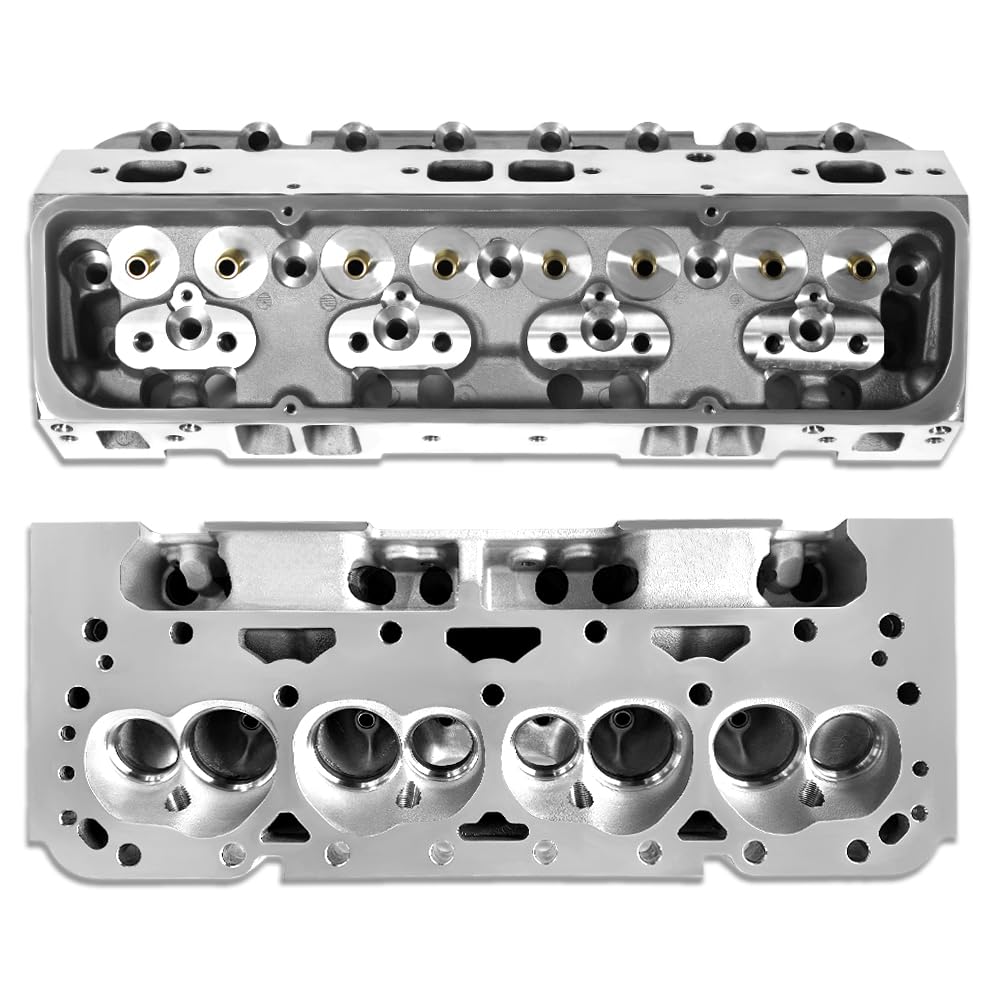
The bare-bones project head for the builder who enjoys the setup as much as the drive.
If you are the kind of person who wants to choose your own springs, valves, and retainers, these bare IMOOA heads are the canvas. They share the same 205cc intake runner and 64cc chamber dimensions as the Speedmaster pair above — at 205cc versus the FLOTEK’s 180cc intake volume — but at 64cc chambers, they bump compression slightly versus the 68cc Auto Dynasty pair. Customers note that the casting flash (thin excess aluminum left behind from the casting process) inside the intake runners comes out easily with a die grinder, and that the rocker studs are drilled through into the runners (easily fixed with thread sealer, no performance impact). The overall machining earns top marks for the price, with owners calling them “top-notch quality” and reporting superb flow after a quick cleanup.
The trade-off with any bare head is the assembly time and the cost of valvetrain parts. By the time you add springs, valves, retainers, seals, and a spring compressor rental, the total can approach a ready-to-run assembled pair. But for a builder running a specific cam with unusual lift and duration, bare heads allow you to spec exactly the spring rate and installed height you need.
Why These Stand Out
- Bare design lets you install your preferred valvetrain — ideal for custom cam profiles where spring specs matter
- 205cc intake runners paired with angle plugs improve flame travel and power potential over straight-plug designs
- Buyers consistently describe the quality as “awesome” given the price, with easy-to-clean casting flash
Know Before You Buy
- Rocker studs are drilled through into the intake runners — plan to seal them with thread compound during assembly
- Bare heads mean you supply all valvetrain components, which can push total cost close to an assembled pair like the Speedmaster
For the hands-on engine builder: Pick these if you own a spring compressor and want to fine-tune the valvetrain to your specific cam specs.
Not the budget shortcut: If you did not plan to spend extra on valves, springs, and retainers, an assembled head like the Speedmaster pair above will cost about the same once fully built.
4. FLOTEK 102505 Assembled Cylinder Head (Single)

The smaller, smarter runner that keeps torque on tap for daily-driven small blocks.
At 180cc intake runners and 64cc chambers, the FLOTEK heads are the most street-oriented pick here — and the only assembled heads you buy individually (remember to order two). The smaller runner volume relative to the 205cc Speedmaster and IMOOA heads means the air velocity stays high at lower engine speeds, which translates to snappier throttle response in a daily-driven 350. The assembled package includes 2.020/1.600-inch valves and 1.460-inch springs, and buyers confirm a 0.470-lift, 279-duration cam works without spring binding on a 357 Chevy. At just 22 pounds per head, these are also the lightest option by a wide margin (the Speedmaster pair clocks 50.8 pounds for two, while a single FLOTEK is 22 pounds).
The honest consensus from owners is mixed on fit. A few report alignment issues with rocker studs, and a handful received damaged boxes with scuffed head surfaces. The durability aspect also gets some negative feedback, with one build reportedly blowing head gaskets under supercharger boost. The machine shop in that case recommended DART heads for forced induction. For naturally aspirated street use, however, most buyers are happy, describing the heads as “good value” with “nice clean castings.”
Why This Pick Works
- 180cc runners keep intake velocity high for strong low-end and mid-range torque — ideal for a 350 daily driver or mild tow rig
- At 22 pounds each, they are dramatically lighter than any iron head and most other aluminum heads — easy on the front springs
- Assembled with 1.460-inch springs that clear a 0.470-lift cam from the start, per real owner experience
Know Before You Buy
- Fitment has mixed reviews — some buyers report rocker-stud alignment needing attention; check everything before final assembly
- Not recommended for supercharged builds; at least one buyer experienced head gasket failure under forced induction
Best for mild street 350s: Pick this pair if you want an assembled, bolt-on upgrade that improves power without requiring a cam swap or port work — the 180cc runner matches stock-oriented builds perfectly.
Think twice if you plan boost: Owners mention these are not supercharger-safe; a high-compression or forced-induction build needs a thicker-deck head (like the Edelbrock’s 0.562-inch deck) or a dedicated aftermarket casting such as DART.
5. Edelbrock 5089 E-Street Cylinder Head Pair
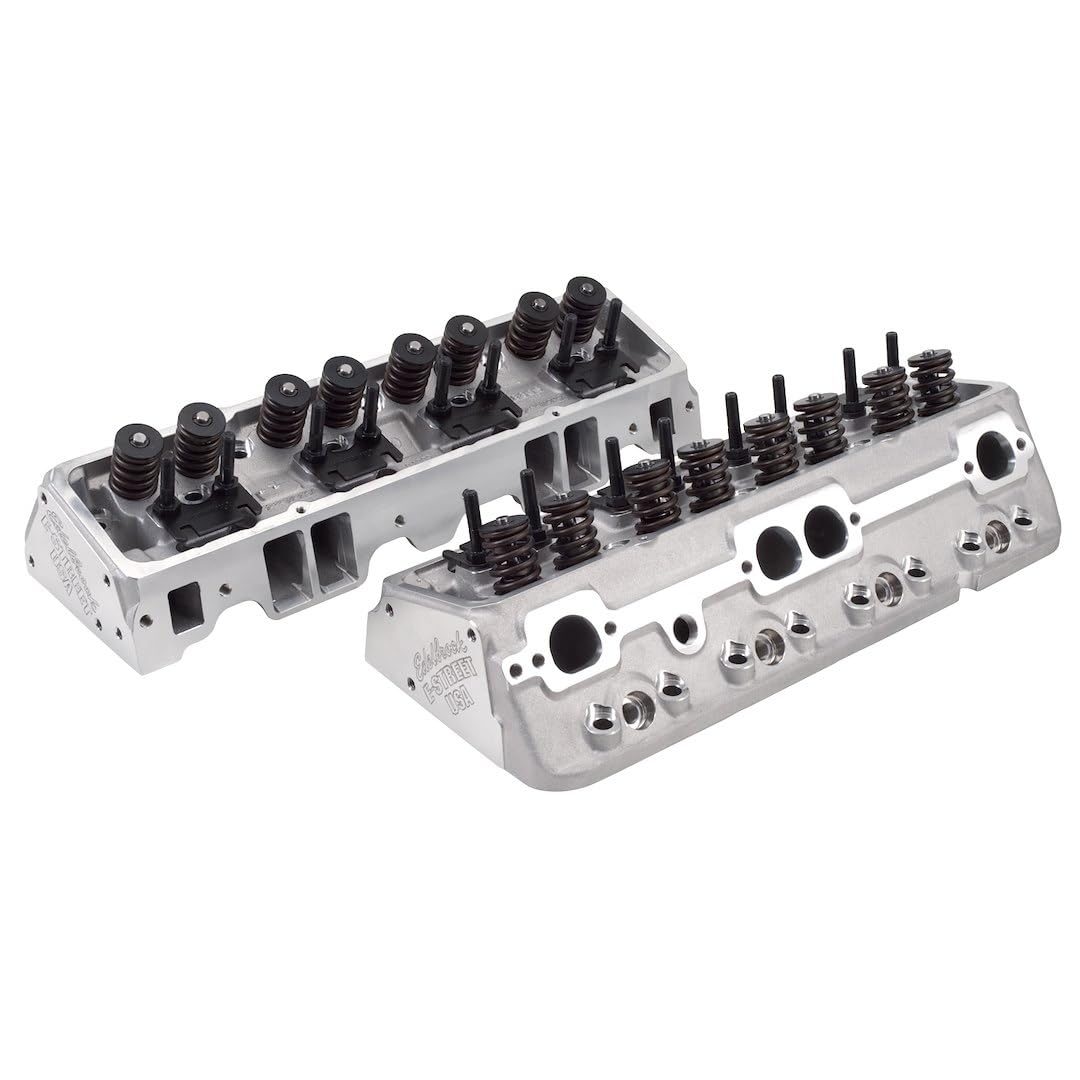
The trusted name that works perfectly from the start — assuming you get a good pair.
Edelbrock is the brand most gearheads know by heart, and the 5089 E-Street heads deliver what the name promises: a complete, assembled pair for hydraulic flat tappet (a type of cam follower) SBC builds. They come with a 64cc combustion chamber, 2.02-inch intake and 1.6-inch exhaust valves, and a satin finish that looks clean under the hood. The 0.562-inch deck thickness gives them a solid structural foundation, and buyers running flat tappet cams confirm they “work great” right from the start with the right springs and pushrods.
The reality check from the review data is that machining consistency has been a recurring issue. Several customers note guide plates that need attention, head bolt bores with metal shavings that required cleaning, and one head with an undersized stud hole that needed a Dremel to widen. One experienced builder reported a valve dropping after a week of professional installation, a failure they noted as “common with Edelbrock heads.” These problems are not universal, but they appear often enough in the feedback to be a real consideration. For the premium price, you expect flawless machining — and a minority of buyers did not get it.
Why The Trust Matters
- Assembled pair with Edelbrock’s extensive R&D behind the port design — bolt-on and go for hydraulic flat tappet cams
- 0.562-inch deck thickness provides a beefy sealing surface that resists distortion under heat and torque
- At 59 pounds for the pair, they are still significantly lighter than iron heads, helping handling and nose weight
Know Before You Buy
- Machining quality is inconsistent — some pairs arrive with metal shavings, misaligned bores, or guide-plate issues that require cleanup before installation
- A small but notable number of owners experienced valve-train failures after short periods, attributing it to questionable quality control
Ideal for the brand-loyal builder: If you want Edelbrock engineering and a known port design for a flat tappet 350, and you are comfortable inspecting and cleaning the heads before install, this is still a solid choice.
Skip if perfect out-of-box quality matters most: Given the machining complaints, the Speedmaster assembled pair above delivers comparable or better consistency at a significantly lower price point.
Understanding the Specs
Intake Runner Volume (cc)
This number — 180cc, 200cc, or 205cc (cubic centimeters) — tells you the size of the passage the air-fuel mixture travels through before hitting the valve. Smaller runners (180cc) keep air speed high for strong low-RPM torque, which is why they suit daily drivers and trucks. Larger runners (200-205cc) move the power band higher, trading some low-end snap for top-end breathing that pays off at the track. Match the runner size to your cam’s intended operating range for the best all-around performance.
Combustion Chamber Volume (cc)
The chamber volume (the hollow area in the head where the air-fuel mix is compressed) determines your static compression ratio when combined with piston deck height, head gasket thickness, and connecting rod length. A 64cc chamber on a standard flat-top-piston 350 typically lands around 10.0:1 compression — doable on premium pump gas. A 68cc chamber drops compression closer to 9.5:1, which is safer for iron heads or engines running 87-octane. A 64cc chamber on the same engine raises compression roughly half a point compared to a 68cc chamber — enough to matter on a hot summer day.
Bare vs Assembled Heads
A bare head ships with no valvetrain components — you buy and install valves, springs, retainers, locks, and seals separately. This gives you control over spring pressure, valve stem height, and material choice, but requires tools and expertise. An assembled head comes with valves, springs, and seals installed to a specific lift range — bolt it on and run, as long as your cam lift stays within the factory spring specs. If you do not own a spring compressor or a micrometer, assembled heads save time and frustration.
Straight Plug vs Angle Plug
Straight-plug heads position the spark plug more vertically in the chamber, which clears most stock exhaust manifolds and tall valve covers easily. Angle-plug heads tilt the plug toward the exhaust valve, which can improve flame travel and combustion efficiency but often requires shorty or block-hugger headers (compact exhaust headers that tuck close to the engine block) for clearance. Angle plugs are common on high-performance aftermarket heads because they free up space around the cylinder for larger valves and better airflow.
FAQ
Will these heads fit my stock Chevy 350?
What is the difference between 64cc and 68cc chambers?
Can I use my stock pushrods with these heads?
How much weight do aluminum heads save over iron?
Do I need special head bolts or studs?
Can I use these heads with a supercharger or turbo?
What is “casting flash” and why does it matter?
How long do aluminum cylinder heads last?
Final Thoughts: The Verdict
For most people, the commanding pick among the alum sbc heads is the Speedmaster PCE281.2010 assembled pair because it delivers 205cc runners, 64cc chambers, and fully assembled valvetrain at a price that undercuts premium brands while maintaining real-world performance. If you want the control of a bare head and a custom valvetrain setup, the IMOOA MTD0196 pair gives you the same 205cc/64cc dimensions as a blank canvas. And for a no-hassle upgrade on a mild daily-driven 350, the FLOTEK 102505 assembled heads keep the torque where you want it without needing a die grinder or a spring compressor.
How We Picked
We do not accept paid placement. Every pick is matched to a real buyer and a real use-case; we do not hands-on test units.
Sources & Methodology
Specifications: manufacturer listings and product documentation. Review insights: verified customer reviews, as of July 2026. Pricing: not shown on this page (it changes often); check the current price via the retailer link.
As an Amazon Associate, Gadgets Feed earns from qualifying purchases. This does not affect which products we feature.