
Our readers keep the lights on and my morning glass full of iced black tea. As an Amazon Associate, I earn from qualifying purchases.
Specs are compiled from manufacturer listings and verified buyer reviews and can change over time — please confirm the key details on the product page before buying.
Choosing the right paint for an aluminum hull isn’t the same as painting a garden fence. Aluminum is reactive, barnacles are relentless, and the bottom of your boat takes a constant beating from water, weeds, and sun. The wrong coating flakes off in a season, while the right one makes your boat glide easier and stay protected for years. This guide breaks down the best options for different boats, budgets, and use cases so you can pick with confidence.
I’m Min — the founder and writer behind Gadgets Feed. This guide is built by comparing the manufacturers’ published specifications and the patterns across verified customer reviews, so you get each pick’s real strengths and trade-offs instead of marketing spin.
Whether you’re painting a jon boat, an outdrive, or a pontoon, this roundup of the best aluminium boat paint options will help you find the right balance of protection, ease of application, and long-term durability.
Our Picks at a Glance


How To Choose The Best Aluminium Boat Paint
Picking the right paint starts with knowing your boat’s material and how you use it. Aluminum expands and contracts with temperature more than fiberglass or wood, and it reacts badly with copper-based antifouling paints unless a barrier coat is applied first. You need to match the paint to the environment — fresh, salt, or brackish water — and to the level of abuse your hull takes from trailering, beaching, or long-term mooring.
Antifouling vs. Topside Paint
Antifouling paints release a biocide (often copper) that prevents barnacles, algae, and mussels from attaching to the hull below the waterline. Many formulations, however, use copper, which causes galvanic corrosion on aluminum. That is why copper-free antifouling paints or a proper epoxy barrier coat are essential for aluminum boats. Topside paints, on the other hand, sit above the waterline and focus on UV resistance, color retention, and a smooth finish — no antifouling properties needed there.
Two-Part Epoxy vs. Single-Part Enamel
Two-part epoxy paints (like the TotalBoat Barrier Coat) cure through a chemical reaction, giving you a rock-hard, waterproof layer that bonds aggressively to aluminum. They resist abrasion and corrosion far better than single-part paints, but they require strict mixing ratios and have a limited pot life once combined. Single-part enamels (like Rust-Oleum Marine) are easier to apply and recoat, but they lack the long-term bond strength of epoxy on bare aluminum.
Coverage and Number of Coats
Different paints cover different areas. A quart of epoxy bottom coating covers about 30 square feet, while a quart of antifouling paint can cover up to 125 square feet. Always buy enough for at least two coats — a thin first coat ensures adhesion, and the second fills any missed spots. On a 14-foot jon boat, one quart is often just enough for two thin coats, while a 22-foot center console might need a full gallon for a single good coat.
Prep Is Everything
Aluminum needs a clean, etched surface for any paint to stick. Most guides recommend degreasing the hull, then applying an etching wash or self-etching primer before the main paint. Skipping prep — even on a boat that looks clean — leads to peeling within weeks. Owners who sand, acetone-wipe, and apply a dedicated barrier coat report dramatically better adhesion and fewer touch-ups.
Quick Comparison
| Model | Best For | Coverage | Type | Volume | Amazon |
|---|---|---|---|---|---|
| Fasco Epoxies Super Slick 2000★ Best Overall | Ultra-slick drag reduction | ~30 sq. ft. per quart | Two-part epoxy | 1 quart | Amazon |
| Interlux Trilux 33 AerosolTop Performer | Outboards and outdrives | Barely two coats per can | Antifouling (spray) | 16 oz | Amazon |
| Topside Paint for InflatablesNiche Pick | Inflatable boats and dinghies | 100 sq. ft. per quart | Elastomeric topside | 1 quart | Amazon |
| Rust-Oleum Marine Flat Bottom | Value-priced antifouling | 110 sq. ft. per quart | Copper-based antifouling | 32 fl oz | Amazon |
| TotalBoat AlumiPaint AF | Aluminum hulls (copper-free) | 125 sq. ft. per quart | Copper-free ablative | 1 quart | Amazon |
| Durabak 18 Textured | Non-slip decks and topsides | 60 sq. ft. per gallon (2 coats) | Polyurethane bedliner | 1 gallon | Amazon |
| TotalBoat Underdog | Budget-friendly single-season | 500 sq. ft. per gallon | Copper-based ablative | 1 gallon | Amazon |
| TotalBoat Barrier Coat | Corrosion protection for aluminum | 225 sq. ft. per gallon | Two-part epoxy primer | 1 gallon | Amazon |
In‑Depth Reviews
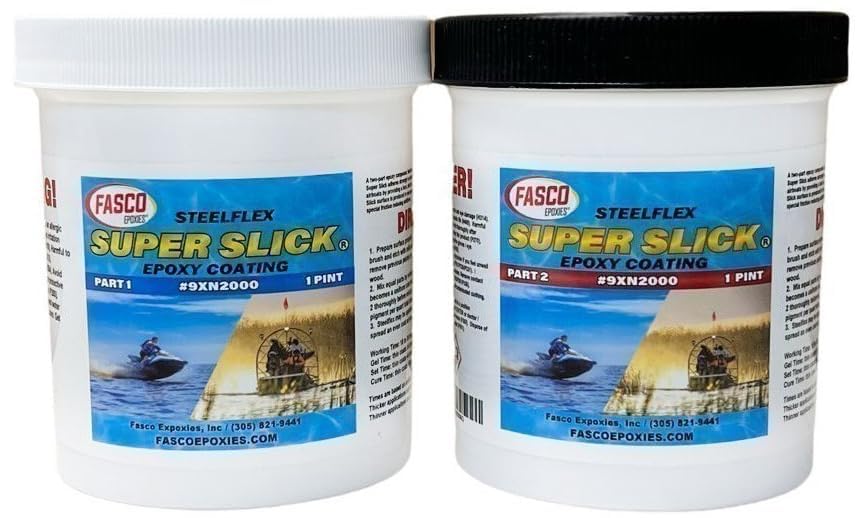
1. Fasco Epoxies Super Slick 2000 Epoxy Bottom Coating (Quart Kit)
Our pick — over 4.5★ from 350+ verified ratings; the strongest balance of quality and price.
The epoxy coating that makes your hull feel greased before it even hits the water.
This is a two-part epoxy system infused with PTFE and friction-reducing additives, designed to create a surface so slick that grass, mud, sand, and water all slide past with minimal drag. Owners of jon boats, airboats, canoes, and PWCs consistently report a dramatic improvement in glide. One reviewer noted their quart kit covered the entire bottom of a 14-foot john boat — though some added a second quart for extra thickness. The 1:1 mix ratio and brush-or-roller application keep the prep straightforward compared to many spray-only coatings.
What wins people over here is the sheer effectiveness — over 30 owners praise how well it works, and another 25 call out the slickness specifically. The coating dries “hard as a rock but super slick,” as owners describe it, and it bonds well enough to seal leaky rivets. The main trade-off is thickness: some buyers found it thickened and set very fast, and a few noted the finish faded slightly after days in direct sun. Still, the coating acts as a sacrificial wear layer, taking the abuse so your aluminum hull stays protected underneath.
Compared to the one-part Rust-Oleum below, this epoxy system offers a tougher, longer-lasting bond but demands more precise mixing. For a trailer-launched boat that sees a mix of sand, mud, and rock, this is the coating that owners trust most.
What Gets the Glow
- Remarkable drag reduction — owners say it glides far easier than bare aluminum
- Seals leaky rivets and stops water intrusion at seams
- Dries to a hard, rock-like finish that stands up to repeated beaching
What to Watch For
- Thickens fast during application; work in small batches
- Appearance can fade slightly after prolonged garage or sun exposure
- One quart delivers a thin coat; plan for two kits if you want substantial thickness
Who It Fits: Anyone running an aluminum hull through grass, mud, or sand who wants less drag and quieter paddling or planing.
The Real Caveat: If you need a single-season antifouling paint for year-round saltwater mooring, the copper-free options below are a better fit — this is purely a slick barrier, not an antifoulant.
2. Interlux YBA068A/16 Trilux 33 Aerosol Antifouling Paint (White, 16 oz)
The spray-on shield that keeps barnacles off your outdrive without corroding your aluminum.
Trilux 33 uses Biolux technology to reduce slime and boost antifouling performance, and it is specifically formulated for aluminum outboards, outdrives, and aluminum hulls in fresh, salt, and brackish water. Because it is copper-free, it won’t cause the galvanic corrosion that standard copper-based bottom paints trigger on aluminum. The 16-ounce aerosol can is convenient for tight spots, though buyers report it provides barely enough coverage for two coats on a single outdrive — so plan for two cans if you are doing an outdrive and a trim tab setup.
The product earns strong marks for quality and performance, with over 10 owners each praising those areas. One owner using it on a Volvo Penta outdrive in the Upper Chesapeake Bay reported very few barnacles after a full year of immersion, calling it clearly better than other options. Others have used it on sailboat propellers and confirm it “completely prohibits zebra-mussel and barnacle adhesion.” The color is white, though several owners mention it looks closer to a primer gray than a true bright white — worth knowing if color matters for a show boat.
At 16 fluid ounces, it holds exactly half the volume of the Rust-Oleum quart (32 fl oz) below, making it the pick for smaller, high-stakes surfaces rather than a full hull.
Why Owners Reach for It
- Safe on aluminum — no copper means no galvanic corrosion risk
- Excellent antifouling results even after a full season submerged
- Easy aerosol application for outdrives, props, and tight corners
Where It Falls Short
- One can barely does two coats on a single outdrive; buy two for full coverage
- Color is more of a primer gray than true white — check before you buy
- Premium price for the volume you get
Best for: Owners of outboards, outdrives, or trim tabs on aluminum boats who want a proven copper-free spray that works in salt and brackish water.
Look elsewhere if: You need to coat a full hull — the 16 oz can goes too fast for large surfaces. The TotalBoat AlumiPaint AF below offers better value for a whole bottom.
3. Topside Paint for Inflatable Boats and Dinghies (Gray, Quart)
The stretchy paint that brings a sun-bleached raft back to life without cracking.
This is a specially formulated paint for inflatable boats, with added elasticity to flex with the fabric and UV resistance to hold up in direct sunlight. It is one of the only paints designed specifically for inflatables — standard marine paint cracks when the boat fabric bends. The quart also includes a sealant to improve airtight integrity, which is a clever addition if you have slow leaks around seams. Coverage is rated at around 100 square feet per quart, with a dry time of 4 hours between coats.
Buyers have used it to restore a sun-bleached 15-foot raft, reporting that it took 2 quarts (though 3 would have been ideal for full thickness). The paint goes on thick and is easy to roll over fabric after a pressure wash and acetone wipe. “It worked very well,” and “looks new” are common refrains. The only limitation is that if you need to cover bare fabric areas, thinning the paint down and double-coating is recommended for a smooth result.
This is a true topside paint, not an antifouling coating — so keep it above the waterline for best results.
The Elastic Edge: Standard boat paint will crack on a PVC inflatable within weeks. This formulation flexes with the fabric and resists UV fading — exactly what a dinghy needs. The sealant additive is a bonus for older boats with microscopic pinhole leaks. One owner’s 15-foot raft went from “neglected” to “younger brother of a new boat” with 2 quarts and a weekend of work.
Buy it for: Any inflatable, dinghy, or RIB that has faded, chalked, or developed small leaks. The UV resistance and flexibility are a genuine match for PVC and hypalon.
skip it if: Your boat is a rigid aluminum hull — you are paying for elastomeric properties you do not need. Go with the Fasco or TotalBoat instead.
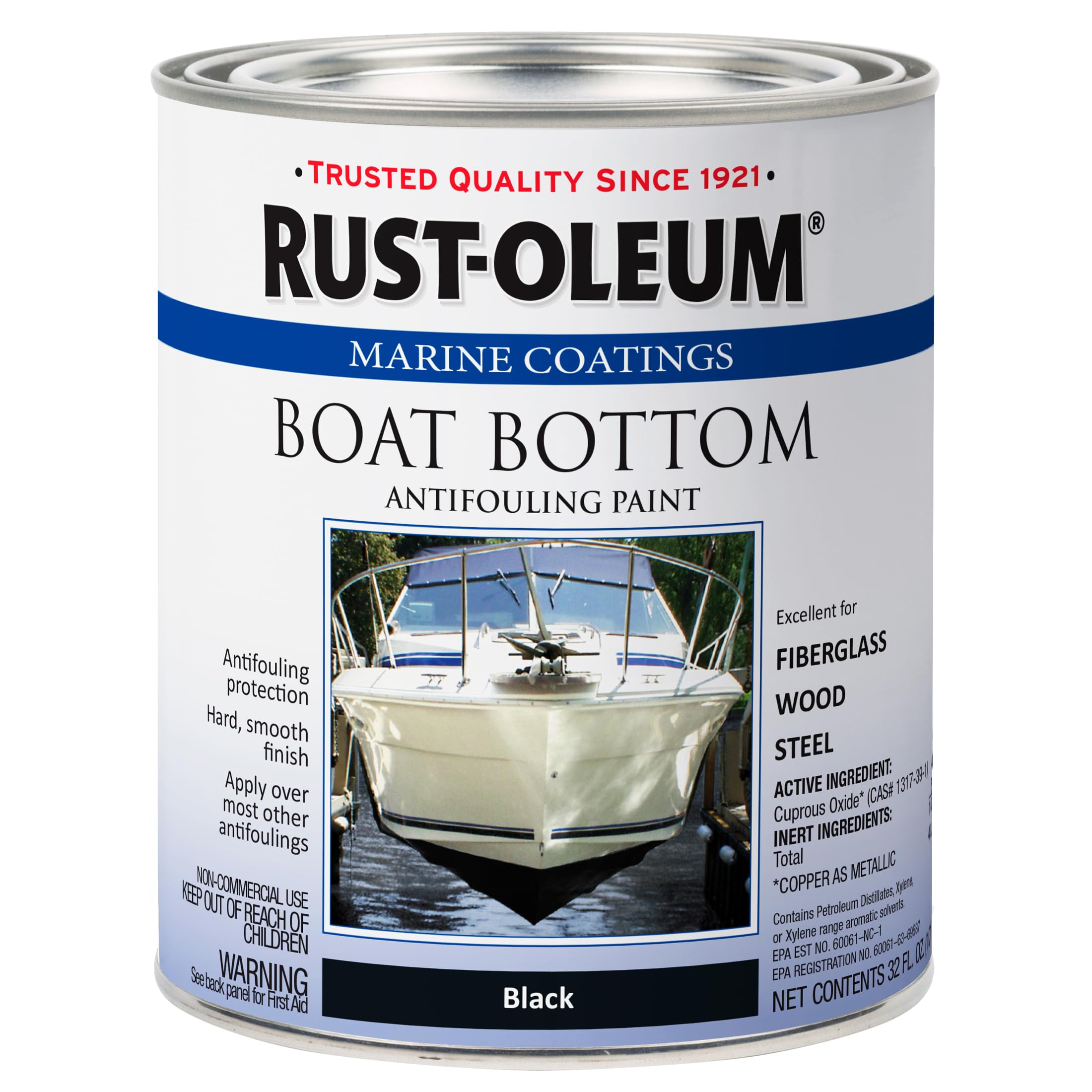
4. Rust-Oleum 396967 Marine Flat Boat Bottom Antifouling Paint (Quart, Black)
The crowd-favorite bottom paint that balances price, ease, and real antifouling bite.
Rust-Oleum’s marine bottom paint is a copper-based formulation meant for fiberglass, wood, and steel surfaces — but owners frequently use it on aluminum after a proper barrier coat. It releases copper steadily to prevent barnacles, algae, and other growth from attaching below the waterline. The quart covers up to 110 square feet, and you can recoat in 4 hours with a full cure and launch time of 16 hours. The black flat finish dries hard and smooth, and owners praise how thick it applies — one buyer covered 2 coats on a 13-foot Boston Whaler with a single quart.
Quality is the most-discussed positive here, with over 60 owners calling it out, followed by ease of application (35 mentions). The paint is noticeably thick and goes on well with a brush or roller. Durability, however, is mixed — some owners find it very durable while others report it dents or scratches more easily than they expected. The value proposition is strong: buyers consistently call it the “best and cheapest bottom paint,” noting that 2 quarts gave one coat on a 22-foot center console and held up to monthly diver cleaning in hot South Florida water with minimal growth after a year.
Because this is copper-based, it should NOT be applied directly to bare aluminum — use a barrier coat first or skip it for direct-to-aluminum needs.
Bang for the Buck: The coverage, quick recoat time, and proven antifouling performance at this price point make it the go-to for budget-conscious boaters. The honest trade-off is the mixed durability reports — it dents more readily than epoxy, so trailer-launched boats that scrape bottom will see wear faster than moored boats.
Who it fits: Trailer boaters on a budget who want hard, effective antifouling protection for fiberglass, wood, or steel hulls, and are willing to use a barrier coat for aluminum.
Not for: Bare aluminum hulls without a barrier coat — the copper will react. For direct-to-aluminum, choose the copper-free TotalBoat AlumiPaint AF.
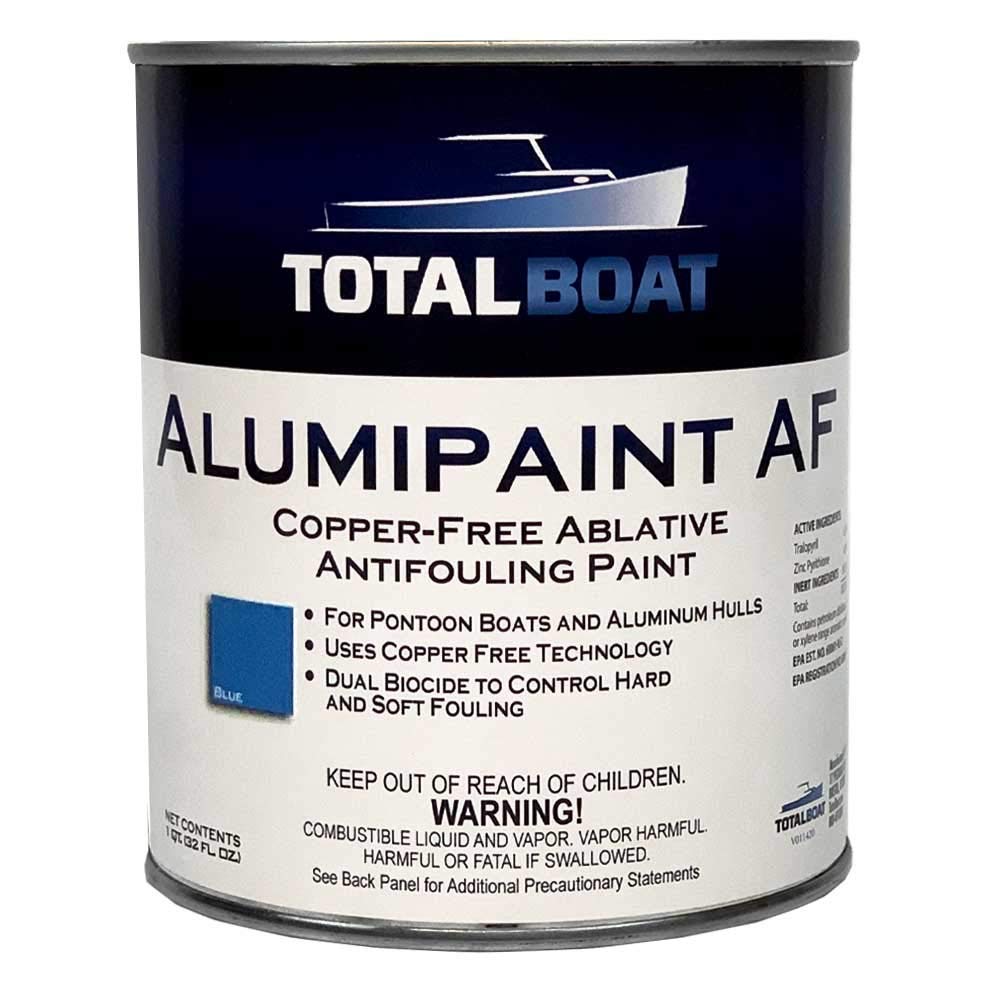
5. TotalBoat AlumiPaint AF Copper Free Aluminum and Pontoon Boat Bottom Paint (Blue, Quart)
The ablative paint that wears away season after season, exposing fresh biocide without corroding your hull.
AlumiPaint AF is a copper-free, ablative bottom paint specifically designed for pontoon and aluminum boats. Instead of releasing copper into the water, it uses a different biocide system and wears away gradually, continuously exposing a fresh active layer. This makes it ideal for boats that stay in the water for weeks at a time. Coverage is rated at 125 square feet per quart — enough for two coats on a 14-foot Starcraft, according to one buyer. Available in blue or black, with a matte finish.
Quality and ease of application are the most-praised aspects here (26 and 18 mentions, respectively). One owner detailed a thorough 4-step application process: sand, fill pock holes with marine JB Weld, re-sand, apply etching spray, then 3 coats of barrier paint, and finally 2 coats of AlumiPaint. That level of prep pays off — the same owner reported excellent single-season protection against mussels. The color “bright blue” does fade in saltwater, which some owners note, and one buyer experienced a “polka dot” effect after unexpected rain hit the uncured paint. The price is higher than most, and value for money is a mixed point among buyers.
Compared to the copper-based Rust-Oleum, this paint eliminates the galvanic corrosion risk entirely, making it the safer choice for direct application over a properly prepared aluminum hull.
What Stands Out
- Copper-free formula protects aluminum from galvanic corrosion
- Ablative action exposes fresh biocide as it wears — extends protection
- Excellent adhesion when paired with proper surface prep (etching + barrier coat)
The Honest Trade-Offs
- Fades in saltwater — the blue loses its pop over a season
- Rain on a fresh coat can ruin the finish; watch the forecast
- Price is higher per quart than the Rust-Oleum, but you pay for copper-free safety on aluminum
Best fit: Pontoon and aluminum hull owners who moor their boats in salt or brackish water and want effective antifouling without the corrosion risk of copper.
Think twice if: You need a budget-friendly option — the Rust-Oleum above costs less but requires a barrier coat. If you want simplicity, the Interlux spray is easier for small surfaces.
6. Durabak 18 Textured Non-Slip Coating (White, Gallon)

The textured bedliner that gives your decks a permanent, slip-proof grip that ordinary paint cannot match.
Durabak 18 is a one-part, moisture-cured polyurethane coating loaded with recycled rubber tire granules. The result is a tough, flexible, and waterproof textured surface that provides serious non-slip traction on decks, gunwales, and even trailer fenders. It bonds to concrete, wood, fiberglass, and metal — and will even bond to itself, making repair a simple recoat. Coverage is 60 square feet per gallon with the recommended 2 coats, and full cure takes 72 hours. The texture is substantial: owners call it “very grippy” and note it feels cooler underfoot than bare metal on hot days.
Quality and appearance lead the positive feedback here (22 and 15 mentions). Buyers have used it on boat decks, Jeep tubs, wood planters, and shop ramps, with excellent adhesion after xylene surface prep. One owner described rubbing a tree branch against the coating and finding that “tree bark wore down, not the Durabak.” Durability, however, is mixed — while some say it holds up extremely well, others report peeling after two years in harsh sun. The gallon size is generous, but the cost is higher than standard topside paint.
This is not a bottom paint — it belongs on decks, non-skid surfaces, and anywhere feet need to stay planted.
The Grip Factor: This is not a subtle non-skid additive mixed into paint. The recycled rubber granules create a texture you feel through your shoes. Owners who applied it to boat decks report a dramatic improvement in confidence when walking on wet surfaces. The trade-off is that it is harder than standard paint to keep spotless — the textured surface collects grime if not rinsed regularly.
Reach for this if: Your boat deck, trailer step, or fishing platform is dangerously slick when wet and you want a permanent textured coating that flexes with the surface.
Look elsewhere if: You need a smooth bottom paint for your hull; this is strictly for topside and deck use. For a smooth non-slip alternative, the Rust-Oleum topside paints are easier to clean.
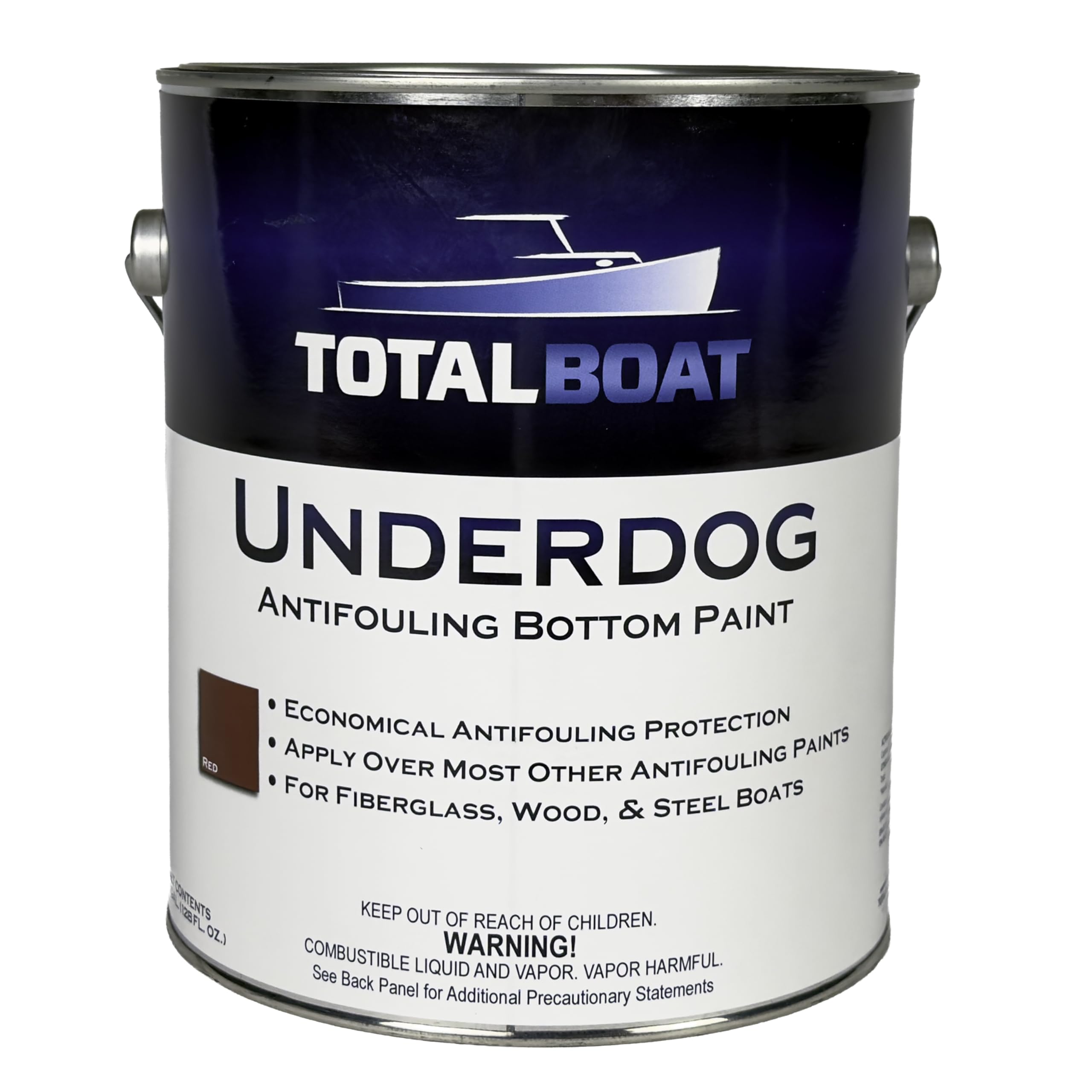
7. TotalBoat Underdog Marine Antifouling Bottom Paint (Red, Gallon)
The gallon that covers your whole bottom for what a quart of some brands costs.
Underdog is a copper-based, ablative antifouling paint designed for fiberglass, wood, steel, and iron boat bottoms — not for bare aluminum, because the copper can cause galvanic corrosion. It is budget-priced and comes in a full gallon, covering up to 500 square feet per gallon. The ablative coating wears away during the season, releasing fresh biocide as water passes under the hull. That means no paint buildup over multiple seasons, making next year’s repaint easier. Flat finish, single-season protection, and it can handle trailering and beaching better than traditional soft ablatives.
Owners praise the value-for-money here more than any other product in this roundup (42 mentions). The gallon includes free accessories like a roller, tray, gloves, suit, dust mask, and mixing sticks — a real bonus for first-timers. One buyer covered a 28-foot boat in one coat with a single gallon and called the finish smooth and true black. Application is straightforward: use a natural bristle brush or a 3/16-inch nap roller. The most common complaint is not about the paint itself but about damaged cans during shipping — 30 owners flagged dented or leaking containers. The product itself gets excellent marks for quality (83 positive mentions).
For aluminum hulls, this paint requires a barrier coat first, making the total cost and labor higher than going with a copper-free option like the AlumiPaint AF.
Why Owners Buy It
- Gallon covers a 28-foot boat in one coat — unbeatable value per square foot
- Kit includes roller, tray, gloves, suit, mask, and mixing sticks — no extras to buy
- Ablative formula means no paint buildup year after year
The Catch
- Cans often arrive dented or leaking due to poor packaging
- Not safe for bare aluminum — requires epoxy barrier coat first
- Single-season protection; active boaters may need to repaint annually
Best for: Owners of larger fiberglass, wood, or steel boats on a tight budget who want a full gallon of effective ablative paint with all the application gear included.
Not for: Bare aluminum hulls — go with the TotalBoat Barrier Coat plus AlumiPaint AF instead. Also not ideal if you hate dealing with dented shipping containers.
8. TotalBoat Aluminum Boat Barrier Coat (Gallon, Gray)

The epoxy foundation that stops aluminum corrosion before it starts — and it bonds to even lightly oxidized metal.
This is a high-build, two-component epoxy primer and barrier coat designed specifically for aluminum hulls and pontoon boats. It provides superior corrosion protection on all underwater metals and can be overcoated with bottom paints or other 1- and 2-part paints. Coverage is approximately 225 square feet per gallon at 7 mils wet, and it dries fast with no sanding needed between coats. Full cure takes just 3 hours. Available in gray in quart or gallon kits, it is intended for use both above and below the waterline.
Quality and coverage lead the positive feedback (23 and 16 mentions). Customers note that it “etches and bonds to even lightly oxidized aluminum” and creates a tough, durable foundation for subsequent paint layers. One buyer applied it to a 16-foot aluminum boat and found it excellent for leak prevention. The most-discussed mixed point is thickness — while some appreciate the high-build nature, others find it “too thick to spray” and recommend brush or roller application. A single owner noted that the keel lost some paint after a month, suggesting it is not complete armor against hard grounding.
This is a barrier coat, not a finish paint. It requires a topcoat (like the TotalBoat AlumiPaint AF or a topside paint) for UV protection and color. Buyers using it with TotalBoat’s own paints report smooth adhesion and long-lasting results.
The Foundation First Philosophy: Owners who skip barrier coats on aluminum are the ones posting “paint peeled off” reviews a year later. This epoxy system etches aggressively into the metal, creating a bond that single-part paints cannot match. Sailboat riggers recommend it specifically for protecting corroded shafts and transoms. The 3-hour recoat window means you can build up multiple layers in a single afternoon.
Reach for it if: You are painting a bare aluminum hull or outdrive and want the most sturdy corrosion protection available before applying a topcoat.
Think twice if: You just need a simple topcoat without the extra mixing steps — this is a two-part epoxy that requires precise ratio measuring (3:1 by volume, 5.6:1 by weight) and a topcoat for UV protection.
Understanding the Specs
Antifouling and Copper-Free Formulations
Standard antifouling paints use copper as the biocide that stops barnacles and algae. Copper reacts chemically with aluminum, causing galvanic corrosion that eats pinholes through your hull. That is why copper-free paints (like the TotalBoat AlumiPaint AF and Interlux Trilux 33) exist — they use alternative biocides that are safe for aluminum. If you already have a copper-based paint you love, you can still use it on aluminum, but only after applying a dedicated epoxy barrier coat first (like the TotalBoat Barrier Coat).
Ablative vs. Hard Coat
Ablative paints — also called “polishing” paints — are designed to wear away gradually as the boat moves through water, continuously exposing fresh biocide. They are ideal for boats that are used regularly because the motion of water does the work of exposing new active ingredients. Hard coat paints, on the other hand, form a durable film that releases biocide through controlled leaching. They are better for boats that sit at a dock for long periods without much movement. The TotalBoat Underdog is an ablative, while the Rust-Oleum Marine is a hard coat.
Epoxy vs. Single-Part Paint
Two-part epoxy paints require mixing a resin and a hardener before application. They cure through a chemical reaction that creates an extremely tough, waterproof, and chemically resistant layer. They bond aggressively to aluminum and are the gold standard for corrosion protection. Single-part paints (like Rust-Oleum Marine) are simpler — just stir and apply — but they form a weaker physical bond and are more prone to chipping and peeling on aluminum over time. The Fasco Super Slick 2000 and TotalBoat Barrier Coat are two-part epoxies.
Coverage and Thickness
Coverage numbers — given in square feet per quart or gallon — tell you how much area a single coat will cover at the recommended film thickness. Thinner coats spread further but provide less protection. Most paints recommend a minimum of two coats. For reference, a 14-foot jon boat has roughly 50-60 square feet of bottom area, so one quart of a paint rated at 125 sq. ft. per quart should cover two coats. A 22-foot center console has around 200-250 square feet of bottom, requiring a gallon for one good coat.
FAQ
Can I use regular copper-based antifouling paint on an aluminum boat?
How much paint do I need for a 14-foot jon boat?
Can I spray Durabak 18 or is it brush only?
How long does bottom paint last on an aluminum boat?
What is the difference between ablative and hard coat bottom paint?
Do I need to sand between coats of epoxy boat paint?
Can I paint over old bottom paint with a new one?
What prep is needed before painting an aluminum boat for the first time?
Is the Interlux Trilux 33 good for saltwater use?
Can I use the Topside Inflatable paint on a rigid aluminum dinghy?
Final Thoughts: The Verdict
If you want one dependable pick, the best aluminium boat paint winner is the Fasco Epoxies Super Slick 2000 because it combines proven epoxy durability, genuine drag reduction, and the ability to seal leaky rivets and deteriorated hulls. If you need a copper-free antifouling paint that is safe for direct application on aluminum, grab the TotalBoat AlumiPaint AF. And for a hard-wearing, non-slip deck coating that transforms a slippery boat into a confident walkway, the Durabak 18 is the one to reach for.
How We Picked
We do not accept paid placement. Every pick is matched to a real buyer and a real use-case; we do not hands-on test units.
Sources & Methodology
Specifications: manufacturer listings and product documentation. Review insights: verified customer reviews, as of July 2026. Pricing: not shown on this page (it changes often); check the current price via the retailer link.
As an Amazon Associate, Gadgets Feed earns from qualifying purchases. This does not affect which products we feature.