
If your chop saw is spitting jagged edges or melting the workpiece, your blade is the problem. Standard wood-cutting blades hook too aggressively for soft aluminum, grabbing the material and leaving rough burrs that double your finishing time. A dedicated best aluminum chop saw blade uses a negative hook angle and triple-chip tooth geometry to shear through non-ferrous metal without snagging, delivering a clean edge straight off the saw table.
I’m Min — the co-founder and writer behind Gadgets Feed. I have spent many hours analyzing the technical specifications, tooth geometries, and real-world use patterns of over forty aluminum-cutting blades to isolate the ones that reliably deliver smooth, accurate cuts without dulling prematurely. This guide is the result of that deep research.
Whether you are trimming extruded T-slot on a miter saw or cutting thick bar stock on a chop saw, selecting the right best aluminum chop saw blade means balancing tooth count, arbor size, and hook angle to match your specific material thickness and saw type.
How To Choose The Best Aluminum Chop Saw Blade
Picking the wrong blade for cutting non-ferrous metal is a fast way to ruin a workpiece and waste material. The three factors that matter most are tooth geometry, tooth count, and hook angle. Understanding these will save you from the frustration of melted edges and excessive burrs.
TCG Teeth vs ATB Teeth
Triple Chip Grind (TCG) teeth are the standard for aluminum and other non-ferrous metals. The alternating flat-top and beveled tooth design resists chipping on the softer material and produces a cleaner cut edge. Alternate Top Bevel (ATB) teeth, common on wood blades, tend to grab and tear at aluminum, creating rough surfaces and putting more strain on the saw motor.
Tooth Count and Feed Speed
For thin-walled extrusions and tubing, a 100-tooth blade yields a near-mirror finish with minimal burring. For thicker bars and solid stock, an 80-tooth blade clears chips faster and allows a quicker feed rate without bogging the motor. The 60-tooth range is a hybrid compromise — faster than high-count blades, cleaner than abrasive wheels.
Negative Hook Angle
A negative hook angle (typically -5 degrees) is critical for aluminum. It reduces the aggressive bite that causes the blade to self-feed, which in turn prevents the blade from pulling the material forward uncontrollably. This makes the cut safer and produces a more controlled, chatter-free kerf.
Quick Comparison
On smaller screens, swipe sideways to see the full table.
| Model | Category | Best For | Key Spec | Amazon |
|---|---|---|---|---|
| Diablo D1080N 10-Inch | Premium 10″ | General non-ferrous cutting | 80 TCG teeth, -5° hook, Perma-SHIELD coating | Amazon |
| Diablo D1296N 12-Inch | Premium 12″ | Large chop saw cutting | 96 TCG teeth, 1″ arbor, Tri-Metal brazing | Amazon |
| Oshlun SBNF-100100 | Pro 10″ | Mirror-finish aluminum cuts | 100 C-1 carbide teeth, negative hook | Amazon |
| Evolution 14BLADEAL | Specialty 14″ | 14″ chop saw aluminum cutting | 80 TCT teeth, 1″ arbor, 1600 RPM max | Amazon |
| MASTEC 10-Inch 100T | Mid-Range 10″ | Budget-friendly high tooth count | 100 carbide teeth, 5/8″ arbor | Amazon |
| TOMAX 10-Inch 80T | Mid-Range 10″ | DIY aluminum and PVC cutting | 80 TCG teeth, electrophoretic coating | Amazon |
| TWIN-TOWN 10-Inch 80T | Budget 10″ | Occasional non-ferrous cutting | 80 TCG teeth, C4 carbide, limited lifetime warranty | Amazon |
In‑Depth Reviews
1. Diablo D1080N 10-Inch 80T Non-Ferrous Blade
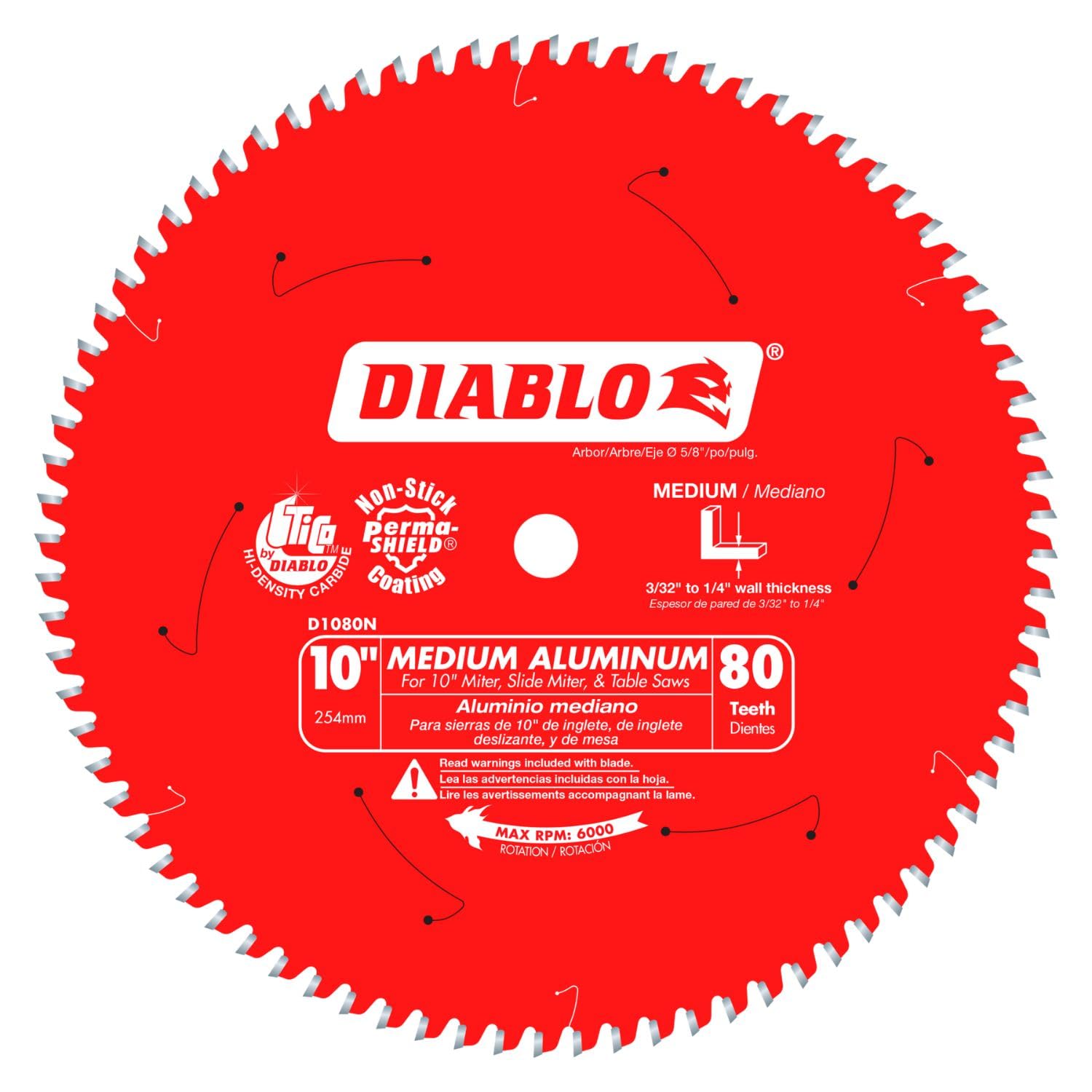
The Diablo D1080N is the reference standard for 10-inch non-ferrous cutting. Its TiCo Super-Density Micro-Grain carbide tips hold their edge noticeably longer than the entry-level offerings, and the Tri-Metal Shock-Resistant brazing means the tips stay attached even when you push through thicker 1/4-inch aluminum bar stock. The Perma-SHIELD coating actively resists the gumming that happens when aluminum chips heat-weld to the blade body — a common failure point on cheaper blades.
Laser-cut stabilizer vents in the plate do more than reduce noise; they dissipate heat so the blade runs cooler during extended cuts. At 0.094 inches, the kerf is narrow enough to minimize material waste but still rigid enough to resist deflection on a miter saw. Users report getting hundreds of cuts on 6061 extrusion before noticing any dulling, and the -5-degree hook angle keeps the cut smooth without self-feeding.
For a shop that cuts aluminum, copper, brass, or plastic several times a week, the D1080N justifies its premium tier position with genuine longevity. The cut finish is consistently burr-free enough that many fabricators skip secondary deburring entirely.
Why it’s great
- Perma-SHIELD coating prevents aluminum adhesion and gumming
- Tri-Metal brazing keeps carbide tips secure under heavy loads
- Laser-cut stabilizer vents reduce vibration and heat buildup
Good to know
- Premium price compared to budget 80-tooth alternatives
- Not ideal for wood-heavy applications — dedicated wood blade yields better results
2. Oshlun SBNF-100100 10-Inch 100T Saw Blade

The Oshlun SBNF-100100 competes directly with the premium Diablo line but does so at a price point that makes it a compelling mid-range value. With 100 teeth of professional-grade C-1 carbide, this blade produces a surface finish on 6061 aluminum that approaches a machined edge — minimal burrs and no need for file work. The negative hook angle gives it the same safe, non-grabbing behavior that aluminum cutting demands.
Copper-plugged expansion slots are a feature you typically find on blades costing twice as much. These slots reduce vibration and allow the blade to expand evenly under heat without warping. The 0.11-inch plate thickness adds stability, especially when cutting thicker sections on a table saw or miter saw where blade deflection is a risk.
Users who cut aluminum extrusions and brass tubing regularly praise its edge retention — hundreds of cuts with no visible wear. The only downside is the weight; at 2.1 pounds it is heavier than the Diablo, which can be felt on a spring-loaded miter saw, but the cut quality is outstanding.
Why it’s great
- 100-tooth count delivers near-mirror finish on soft metals
- Copper-plugged expansion slots control vibration and heat
- C-1 carbide holds edge impressively long for the price
Good to know
- Heavier plate adds noticeable heft on lightweight miter saws
- Not designed for ferrous metal — steel contact dulls it quickly
3. Diablo D1296N 12-Inch 96T Non-Ferrous Blade

For those running a 12-inch chop saw, the Diablo D1296N is the obvious upgrade path. Its 96 TCG teeth and -5-degree hook angle deliver the same smooth, burr-free cutting behavior as the 10-inch version, scaled up for larger material. The 0.091-inch kerf on a 12-inch blade is impressively thin, which means less waste and less strain on the saw motor.
The same Tri-Metal Shock-Resistant brazing and Perma-SHIELD coating carry over from the D1080N, and they are just as effective on this larger platform. Users report cutting heavy 1/2-inch aluminum plate with a water-cooled setup and achieving a mirror finish. The blade is also effective on copper, brass, and plastic, making it a versatile large-format cutter.
One note — this blade is designed for use at lower RPMs (5000 max). Running it on a saw that spins faster can overheat the tips. Verify your saw’s arbor size and speed rating before purchase, as the 1-inch arbor is standard for larger professional chop saws.
Why it’s great
- Scales premium Diablo performance to 12-inch format
- Thin kerf reduces material waste on large stock
- Perma-SHIELD coating prevents aluminum chip welding
Good to know
- Max RPM of 5000 — verify saw speed before mounting
- Packaging sometimes confuses this model with a wood blade — inspect before mounting
4. Evolution 14BLADEAL 14-Inch 80T Aluminum Blade
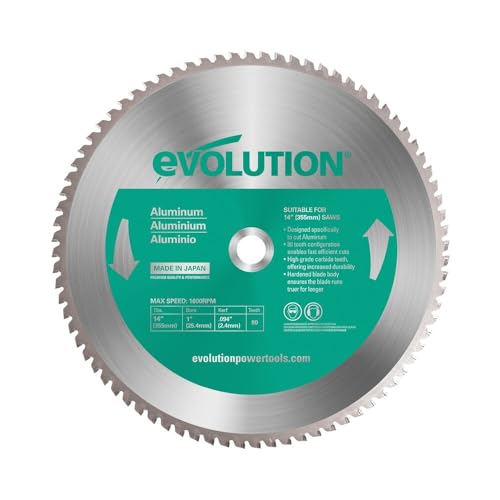
The 14-inch format is a specialist realm — most aluminum chop saw blades top out at 12 inches. The Evolution 14BLADEAL fills this gap for users running large-diameter cold saws like the DeWalt DW872 or the Evolution S380CPS. With 80 carbide-tipped teeth and a maximum RPM of 1600, this blade is engineered for the slow, high-torque cutting that thick aluminum bar stock demands.
The 0.094-inch kerf is generous enough to clear chips efficiently without creating excessive waste. Users who cut 2×2-inch aluminum railing posts report smooth, clean cuts that require no secondary finishing. The TCT (Tungsten Carbide Tipped) construction handles the thermal shock of repeated cutting without losing tip integrity.
The blade is specifically matched to Evolutions’ low-RPM saws, but it also works on the dry-cut saws from DeWalt, Milwaukee, and Steelmax. Note that some units arrive with balance issues that require corrective taping — a mild inconvenience given the otherwise solid performance.
Why it’s great
- 14-inch diameter is rare — essential for large cold saws
- Designed for low-RPM, high-torque aluminum cutting
- Cuts thick aluminum rail and bar without clogging
Good to know
- Limited to saws with 1-inch arbor and max 1600 RPM
- Reported balance inconsistency on some units
5. MASTEC 10-Inch 100T Carbide TCG Blade

At 100 teeth on a 10-inch blade, the MASTEC optimizes for finish quality over raw speed. The high tooth count creates a fine shearing action that leaves minimal burrs on thin-walled aluminum extrusions and T-track. This is the blade to reach for when you are cutting visible workpieces that cannot tolerate heavy filing afterward.
The blade works across miter saws, circular saws, and table saws thanks to the standard 5/8-inch arbor. Users report clean cuts on both aluminum flat stock and plastic shades, with one buyer noting it saved them hundreds of dollars by enabling precise length adjustment of expensive custom shades. The TCG grind ensures the teeth do not chip on the softer material.
For the price, the MASTEC offers the highest tooth count in the mid-range tier. The trade-off is that the carbide grade is not as premium as the Diablo or Oshlun, so aggressive use on thick stock may accelerate wear. It is best suited for light to medium-duty cutting in a home workshop.
Why it’s great
- 100 teeth deliver superior finish on thin extrusions
- Works on common 5/8-inch arbor saws across categories
- Budget-friendly entry to high-tooth-count cutting
Good to know
- Carbide grade is not industrial — moderate lifespan under heavy use
- High tooth count means slower feed rate on thick material
6. TOMAX 10-Inch 80T TCG Aluminum Blade

The TOMAX occupies a reliable middle ground for the DIYer who needs a dedicated non-ferrous blade without paying premium prices. Its 80 TCG teeth with construction-grade carbide deliver smooth cuts on aluminum angle, PVC conduit, and plastic sheets. The electrophoretic coating provides a layer of rust and corrosion resistance that extends the blade’s usable life in humid shop environments.
Users report excellent results cutting 1.5-inch aluminum extrusions on a Ryobi miter saw, with a clean edge that requires no sanding. The blade also handles schedule 80 PVC without melting or gumming, making it useful for mixed-material projects. The limited lifetime warranty offers peace of mind for occasional users who do not want to replace a blade after a single heavy cut.
The main compromises are in edge retention — the carbide grade is not designed for high-volume shop use — and the plate thickness, which can lead to slight vibration on worn saw arbors. For weekend projects and light fabrication, however, the TOMAX is a solid pick.
Why it’s great
- Smooth cuts on aluminum and PVC at a moderate price
- Electrophoretic coating resists rust and corrosion
- Limited lifetime warranty covers manufacturing defects
Good to know
- Carbide wears faster than premium options under heavy use
- Label placement on the wrong side can be confusing
7. TWIN-TOWN 10-Inch 80T TCG Aluminum Cutting Blade
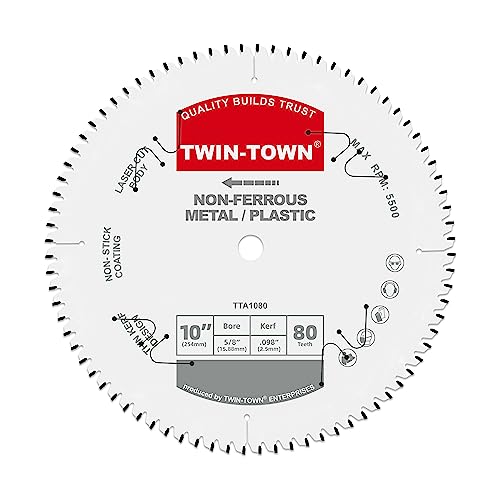
The TWIN-TOWN is the entry-level solution for anyone who needs to cut aluminum or plastic occasionally and wants to avoid the cost of premium blades. Its 80 teeth are made from C4 grade ultra-fine grain carbide, which the manufacturer claims stays sharp twice as long as standard carbide. While that claim is hard to verify outside a lab, real-world users report solid performance on heavy aluminum shower door headers and PVC conduit.
The electrophoretic coating and TCG grind are the same features found on mid-range blades, and they function adequately for the price. Users note that the finish, while clean, is not as smooth as the Diablo or Oshlun — some burrs remain on thicker cuts. The blade produces a lot of fine aluminum particles, so eye protection is mandatory.
The unique ID code for quality assurance is a nice touch, and the limited lifetime warranty adds confidence. This blade is best viewed as a cost-effective entry point — if your aluminum cutting needs grow, the Diablo or Oshlun will be a noticeable upgrade.
Why it’s great
- Budget-friendly price with 80 TCG teeth for non-ferrous work
- Electrophoretic coating improves rust resistance
- Quality tracking via unique ID code and lifetime warranty
Good to know
- Finish is not as smooth as premium blades — may need deburring
- Generates significant aluminum dust and particles during cutting
FAQ
Can I use a wood-cutting blade on aluminum?
What does TCG mean and why does it matter for aluminum?
Is higher tooth count always better for cutting aluminum?
Do aluminum chop saw blades fit any saw?
Final Thoughts: The Verdict
For most users, the best aluminum chop saw blade winner is the Diablo D1080N because it combines reliable burr-free cutting, exceptional carbide edge retention, and anti-gumming coating in a package that fits most 10-inch saws. If you need a 12-inch format, grab the Diablo D1296N. And for 100-tooth mirror-finish cuts at a mid-range price, nothing beats the Oshlun SBNF-100100.