
Our readers keep the lights on and my morning glass full of iced black tea. As an Amazon Associate, I earn from qualifying purchases.
Choosing a sheet of aluminum diamond plate seems simple, until you realize the one-inch difference in thickness turns a flimsy panel into a floor you can actually walk on. The core decision here isn’t brand names or fancy coatings — it’s all about picking the right gauge and alloy for the abuse you plan to dish out. You will find sheets thinner than a credit card right next to slabs thick enough to stop a forklift, and the price gap between them is surprisingly small.
I’m Min — the founder and writer behind Gadgets Feed. This guide is built by comparing the manufacturers’ published specifications and the patterns across verified customer reviews, so you get each pick’s real strengths and trade-offs instead of marketing spin.
So whether you are patching an RV floor, building a garage wall, or adding a custom kick plate to a boat trailer, you need the best aluminum diamond plate for the job — one that resists rust, stops slips, and does not bend the moment you put a tool on it.
Quick Picks
- RMP 3003 H22 Aluminum Diamond Tread Sheet, 12 Inch x 36 Inch x 0.125 Inch — Heavy-Duty Champ
- 24in. x 48in. – Aluminum Diamond Plate Sheet Metal, Genuine Commercial Grade Anodized Tread Plate (Platinum Ice) — Best Anodized Finish
- 24″ x 48″ Aluminum Diamond Plate Flat Sheet.063″ Tread Brite Bright Finish 3003 — Mid-Gauge All-Rounder
- Diamond Plate Aluminum Sheet 0.045″ 3003-H22, 6x120in | With Gloves/Rivets — DIY Kit with Gloves
- Diamond Plate Aluminum Sheet – 3003 H22, 17GA 0.045″ Thick, Heavy-Duty 6″ x 120″ — Budget 10-Foot Strip
How To Choose The Best Aluminum Diamond Plate
The right aluminum diamond plate is a balance of three things: how thick the metal is (its gauge), the alloy (what it is made of), and the finish (anodized or bare). Here is what to look for.
Thickness (Gauge) — The Only Number That Matters First
Thicker metal handles weight, dents, and bending much better. A sheet that is 0.063 inches (1/16 inch) is a good middle ground for garage walls or truck bed liners. A 0.125-inch sheet is serious — that is heavy enough for machine guards, dock plates, or commercial floors where forklifts roll. The thinnest you will find, around 0.045 inches (17-gauge), works for light-duty DIY like under-sink covers or decorative kick plates.
Alloy — 3003 Is the Standard, H22 Is the Hardened Version
Most aluminum diamond plate sold today is 3003 alloy, which is strong enough for everyday use and easy to cut, bend, and weld. If you see “3003 H22”, that “H22” tells you the sheet has been strain-hardened — it is stiffer and resists dents better than plain 3003. For home and auto shop projects, 3003 is just fine. For heavy commercial foot or vehicle traffic, look for H22.
Finish and Shipping — Anodized vs. Bare and How It Arrives
Anodized plates have an extra-hard coating that resists scratches and corrosion much better than raw aluminum — it also has a bright, shiny look. Raw (bare) sheets can oxidize over time and show scuffs more easily. Also, note that larger sheets (like 120 inches long) often ship rolled in a box, which some buyers report can dent edges during transit. Checking the packaging method mentioned in reviews helps.
Quick Comparison
On smaller screens, swipe sideways to see the full table.
| Model | Best For | Thickness | Alloy / Grade | Dimensions | Amazon |
|---|---|---|---|---|---|
| RMP 3003 H22 (0.125″) | Heavy industrial / trailer fenders | 0.13 in | 3003 H22 | 12 x 36 in | $58.95Amazon |
| DLDIRECT 24×48 (0.045″) | Anodized wall panels / stone guards | 0.05 in | 3003 (anodized) | 24 x 48 in | $49.45Amazon |
| Industrial Touch 24×48 (.063″) | Versatile mid-gauge / welding projects | 0.06 in | 3003 | 24 x 48 in | $96.50Amazon |
| Vruelia 6×120 (0.045″) | RV floor repair / long strips | 0.05 in | 3003 H22 | 120 x 6 in | from $29.99Amazon |
| RVSurve 6×120 (0.045″) | Budget DIY / under-sink patches | 0.05 in | 3003 | 120 x 6 in | from $27.99Amazon |
In‑Depth Reviews
1. RMP 3003 H22 Aluminum Diamond Tread Sheet, 12 Inch x 36 Inch x 0.125 Inch

The brute-strength plate that demands an angle grinder, not tin snips.
It supports real weight without sagging because it is 0.13 inches thick — about 2.6 times thicker than the 0.05-inch sheets like the RVSurve or Vruelia. You feel that difference the instant you pick it up. Owners mention it is “excellent, heavy duty” and warn that you “won’t cut with tin snips, used angle grinder.” That tells you this is real industrial material built for abuse, not a decorative layer.
The 3003 H22 alloy means it is strain-hardened (a process that makes it stiffer), so it flexes very little under load — one owner noted they “thought it might have too much flex, but hardly any at all.” It ships in a manageable 12 x 36-inch size, so it arrives flat and ready to work. People have used it successfully on boat trailer fenders, for reinforcing hail-damaged roofs (cut with a table saw and a metal cutting wheel), and for heavy-duty trailer floors.
The case for it: True 0.125-inch (0.13-inch measured) thickness makes it the only pick in this list suitable for supporting real weight — forklift docks, steel-toe traffic, vehicle fenders — without sagging.
The catch: That thickness also makes it heavy and hard to cut — you need power tools, so skip it if you only have hand shears or want a quick, lightweight DIY project.
Best for: Commercial floors, heavy equipment guards, boat trailers, and any surface that takes direct impact or bears weight.
Skip if: You need a large sheet size (over 36 inches) or you want something you can cut with ordinary snips.
2. 24in. x 48in. – Aluminum Diamond Plate Sheet Metal, Genuine Commercial Grade Anodized Tread Plate (Platinum Ice)
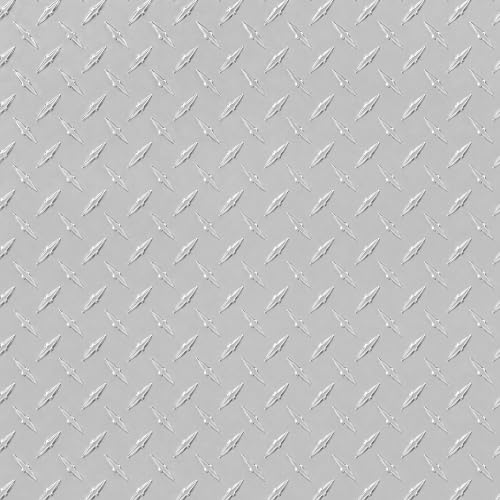
A 24×48 showpiece with a hard anodized shell and “Mad Max” van vibes.
Scratches and scuffs show far less on this DLDIRECT sheet because it has an anodized “Platinum Ice” finish — the maker claims it is 3X harder than standard aluminum and 10X harder than paint. Unlike the other 0.05-inch sheets here, it comes as a large 24 x 48-inch panel, giving you a lot of surface for wall panels, trailer stone guards, or corner guards without having to patch multiple strips together.
Reviewers love the “very shiny” look and say it is “high quality aluminum.” One did note that while the diamond plate “cuts easily with tin snips,” it “bends and mars corners,” so a jigsaw with clamps is better for clean edges. The anodized coating also resists stains, oil, and antifreeze — just wipe it clean. It is a genuine commercial-grade sheet, and at 0.05 inches it is flexible enough to wrap around curves.
The case for it: The large 24×48 size plus the scratch-resistant anodized surface make it the best pick for visible sections like backsplashes, wall guards, or decorative van/trailer panels where you want the plate to look good for years.
The downside: At 0.05 inches it is lighter-duty than the RMP sheet above — it will not support heavy weight or repeated impacts without denting.
Best for: Visible wall panels, camper van interiors, restaurant splash zones, and any spot where appearance and chemical resistance matter more than brute strength.
Skip if: You need to stand on it or drive equipment over it — go thicker.
3. 24″ x 48″ Aluminum Diamond Plate Flat Sheet.063″ Tread Brite Bright Finish 3003

The happy middle ground — thicker than 0.045 but lighter than 0.125.
This 24 x 48-inch sheet from Industrial Touch & Designs gives you noticeably better dent resistance than the 0.05-inch options because it is 0.063 inches (1/16 inch) — nearly 30% thicker. At 8 pounds, one person can still handle and cut it. The 3003 alloy makes it easy to weld and bend, as stated in the specs, so it works well for custom fabrication projects.
Buyers found real versatility here. One used it as a backsplash in a canning kitchen after a fire, loving the fact it “won’t have to worry about it catching fire” and calling cleanup “easy.” Another built an outdoor wheelchair ramp transition with it, noting it “needed some support underneath, but that was expected.” It ships flat and well-packaged, according to reviews.
The case for it: The 0.063-inch thickness provides a real step up in rigidity versus the thinner sheets without jumping all the way to the heavy industrial 0.125-inch plate, making it the most versatile all-purpose gauge.
The trade-off: It is not anodized, so it will show scuffs and scratches more easily than the DLDIRECT anodized sheet — and it costs more than the thinner basic sheets.
Best for: A kitchen backsplash, small equipment guards, wheelchair ramps, and any project where you need solid strength without the weight of 0.125-inch plate.
Skip if: You want maximum scratch resistance (choose anodized) or need the absolute cheapest option for a temporary patch.
4. Diamond Plate Aluminum Sheet 0.045″ 3003-H22, 6x120in | With Gloves/Rivets
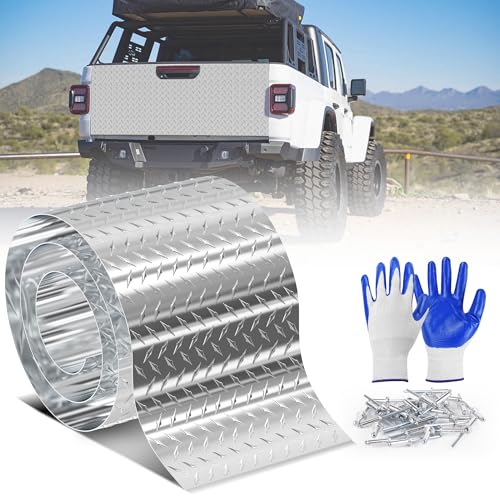
A 10-foot strip that comes with rivets and gloves — ready to install out of the box.
You do not have to hunt for fasteners because this Vruelia sheet includes gloves and rivets in the box. At 120 inches long but only 6 inches wide, it is designed for narrow jobs like RV floor repair strips, truck bed liner sections, or garage kick plates. It is the same 0.05-inch thickness as the RVSurve sheet but uses 3003-H22 alloy, which is hardened and stiffer than plain 3003.
Customers note it is “pliable yet rugged” and that it “hides wrinkles” and “gives a professional appearance” — one reviewer specifically praised how it “effectively improves visibility for pressure washing a trailer.” Because it ships coiled in a box at 120 inches long, expect some minor rolling, but the H22 temper helps it flatten out well. The 120 x 6 x 0.05-inch dimensions mean it is a 3.3x longer strip than the 36-inch RMP plate.
The case for it: The 10-foot length without seams is perfect for continuous RV floor repairs or long trailer edges, and the included hardware gets you started immediately.
One limitation: At only 6 inches wide it is too narrow for large surface panels — you would need multiple strips side-by-side for a full floor or wall.
Best for: Repairing rotted RV floor sections, lining long truck-bed strips, and any narrow, continuous surface that needs slip resistance.
Skip if: You need a full-size 24-inch-wide panel or a piece shorter than 6 feet — the 120-inch length is a lot to store and manage.
5. Diamond Plate Aluminum Sheet – 3003 H22, 17GA 0.045″ Thick, Heavy-Duty 6″ x 120″
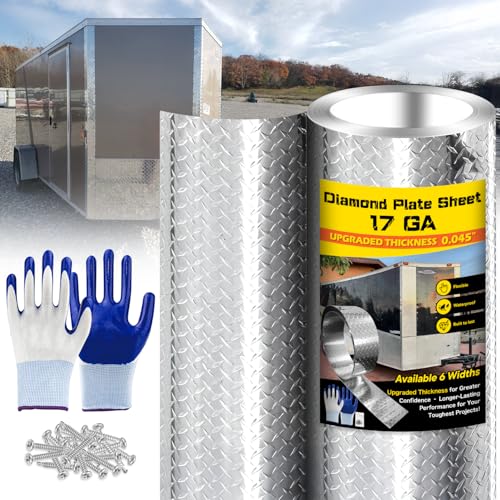
The entry-level strip that one buyer used to seal a hole a varmint could sneak through.
This RVSurve sheet is the most affordable diamond plate in the lineup, and it shows in the right ways — it is simple, functional, and good enough for a wide range of DIY patching jobs. Like the Vruelia sheet above, it measures 0.05 inches thick and 6 x 120 inches, but it uses plain 3003 alloy rather than H22, making it slightly softer and easier to cut with basic tin snips.
Buyers have put it to creative use: one used it “for bottom of doors” and cut it “each piece to length but saved a lot of money.” Another had a hole under the sink big enough for an animal to come through and used this sheet to “easily cut around the pipes, lay the metal and screw it down” — calling it “chew proof.” Some reviews noted that the packaging is too light, and edges can arrive dented, so inspect it when it arrives. It comes in six different sizes, so you can pick a width that fits.
The case for it: At a lower entry price than any other 10-foot strip here, it is the cheapest way to get a solid sheet of aluminum diamond plate in your hands for patching, trimming, or protecting a surface.
The compromise: The plain 3003 alloy is softer than the H22 version, so it will dent more easily under impact, and the thin packaging can lead to edge damage during shipping.
Best for: Budget-friendly under-sink covers, bottom-of-door kick plates, short trailer sections, and any project where saving money matters more than max durability.
Skip if: You need a stiff, dent-resistant sheet for heavy foot traffic — the RMP 0.125-inch plate is a much better choice for that.
Understanding the Specs
Gauge (Thickness)
The number that determines whether your plate bends or stays straight. Most sheets you find are 0.045 inches (17 gauge) — fine for walls and light patching. A jump to 0.063 inches (1/16 inch) gives you noticeably better resistance to dents. At 0.125 inches (1/8 inch), you are in commercial territory where the plate can support forklift traffic. Always check the “Item Thickness” number in the specs; some listings say “17GA” but measure slightly differently.
Alloy and Temper (3003 vs. 3003 H22)
3003 is the standard aluminum alloy for diamond plate — it is strong, easy to weld, and resists rust. When you see “H22” after the alloy number, it means the sheet has been strain-hardened (a process that makes the metal stiffer and more dent-resistant). An H22 sheet will hold its shape better during cutting and installation, but it is also slightly more brittle. For most garage and home projects, plain 3003 is fine. For flooring and impact areas, seek out H22.
FAQ
What is the difference between 0.045-inch and 0.125-inch aluminum diamond plate?
Can I cut aluminum diamond plate with tin snips?
Is anodized aluminum diamond plate better than bare aluminum?
Will aluminum diamond plate rust?
How do I clean aluminum diamond plate?
What size sheet do I need for an RV floor repair?
Can I weld aluminum diamond plate?
Does aluminum diamond plate come with a non-slip guarantee?
How do I prevent the sheet from bending during cutting?
How does shipping affect aluminum diamond plate?
Final Thoughts: The Verdict
For the majority of shoppers, the aluminum diamond plate winner is the RMP 3003 H22 0.125-inch because it is the only sheet here thick enough to handle real weight and impact without bending. If you want an anodized scratch-resistant surface for a wall, backsplash, or camper van, grab the DLDIRECT 24×48. And for a budget-friendly long strip to patch an RV floor or seal an under-sink hole, the standout is the value of the Vruelia 6×120 with gloves and rivets.
How We Picked
We do not accept paid placement, and we did not hands-on test every unit. Instead, we match each pick to a real buyer and use-case by comparing the manufacturers’ published specifications against the patterns in verified customer reviews — so you get each pick’s real strengths and trade-offs instead of marketing copy.
Sources & Methodology
Specifications: manufacturer listings and product documentation. Review insights: verified customer reviews, as of July 2026. Pricing: not shown on this page (it changes often); check the current price via the retailer link.
As an Amazon Associate, Gadgets Feed earns from qualifying purchases. This does not affect which products we feature.
Product prices and availability are accurate as of the date/time indicated and are subject to change. Any price and availability information displayed on Amazon at the time of purchase will apply to the purchase of this product. As an Amazon Associate I earn from qualifying purchases.
CERTAIN CONTENT THAT APPEARS ON THIS SITE COMES FROM AMAZON. THIS CONTENT IS PROVIDED "AS IS" AND IS SUBJECT TO CHANGE OR REMOVAL AT ANY TIME.
Amazon and the Amazon logo are trademarks of Amazon.com, Inc. or its affiliates.