
Aluminum is lightweight and corrosion-resistant, but it’s also soft enough to crack under vibration and thin enough to punch a hole through when a rock hits the hull. Every boat owner, auto mechanic, and DIY fabricator has faced the same moment of frustration: a broken bracket, a leaking radiator, or a cracked cast-aluminum housing that needs fixing without a TIG welder in sight. A true aluminum epoxy fills that gap with a cold-weld bond that can be drilled, tapped, and sanded back to factory shape.
I’m Min — the co-founder and writer behind Gadgets Feed. I’ve spent countless hours cross-referencing cure schedules, working-time windows, thermal limits, and real-world user reports to separate the epoxies that actually bond to aluminum from those that just sit on top of it.
This guide breaks down the seven best candidates on the market today, each evaluated for adhesion strength, heat resistance, and machinability, to help you identify the right best aluminum epoxy for whatever repair you’re up against.
How To Choose The Best Aluminum Epoxy
Not every two-part epoxy bonds to aluminum the way it bonds to steel. Aluminum’s natural oxide layer is slick and low-energy, which means a generic “metal glue” often fails under load. The following criteria are non-negotiable for a repair that lasts.
Working Time vs. Set Time
The clock starts the moment you mix Part A with Part B. A 5-minute set epoxy (like most fast-drying consumer tubes) forces you to rush alignment and clamping. For vertical repairs, gap-filling, or multi-layer builds, a working time of 20–30 minutes at 77°F gives you the control to shape the material before it hardens. Know which number dominates your repair scenario.
Heat and Chemical Resistance
If the repaired part lives near an engine, exhaust, or radiator, the epoxy must withstand sustained temperatures well above ambient. A rating of 250°F–392°F after full cure separates a durable automotive repair from one that softens on a warm afternoon. Oil and water resistance also matter — an epoxy that swells or loses bond in contact with coolant or fuel is useless for engine components.
Machinability After Cure
A true cold-weld epoxy should behave like solid metal after full cure: drillable without chipping, sandable flush to the parent surface, and tapable for threads if you’re rebuilding a stripped hole. Some products harden to a brittle plastic that fractures under a drill bit. The spec sheet should explicitly say “drillable and tapable” or “machinable” after 24 hours.
Quick Comparison
On smaller screens, swipe sideways to see the full table.
| Model | Category | Best For | Key Spec | Amazon |
|---|---|---|---|---|
| Mastercool Alum Bond 90935 | Premium | Cast aluminum repairs, radiators, engine blocks | 8,600 PSI compressive strength | Amazon |
| WEST SYSTEM G/flex 650 Kit | Premium | Aluminum boat seams and rivets | 75 min working time at 72°F | Amazon |
| AOJEL S300 (2-Pack) | Mid-Range | Structural load-bearing metal repairs | 392°F heat resistance after cure | Amazon |
| AOJEL S300 Single | Mid-Range | Controlled 30-min working time repairs | 30 min working time at 77°F | Amazon |
| PLJOFRSHI Metal Repair Glue 3-Pack | Budget | General auto and household cracks | 4,680 PSI cured strength | Amazon |
| WXYCRUEYE Metal Repair Glue 3-Pack | Budget | Metal-to-metal bond for non-critical parts | 5 min initial set, 24 hr full cure | Amazon |
| Cerca de Metal Glue | Budget | Small household aluminum mends | 10 min initial set, dual-tube dispenser | Amazon |
In‑Depth Reviews
1. Mastercool 90935 Alum Bond Aluminum Repair Compound
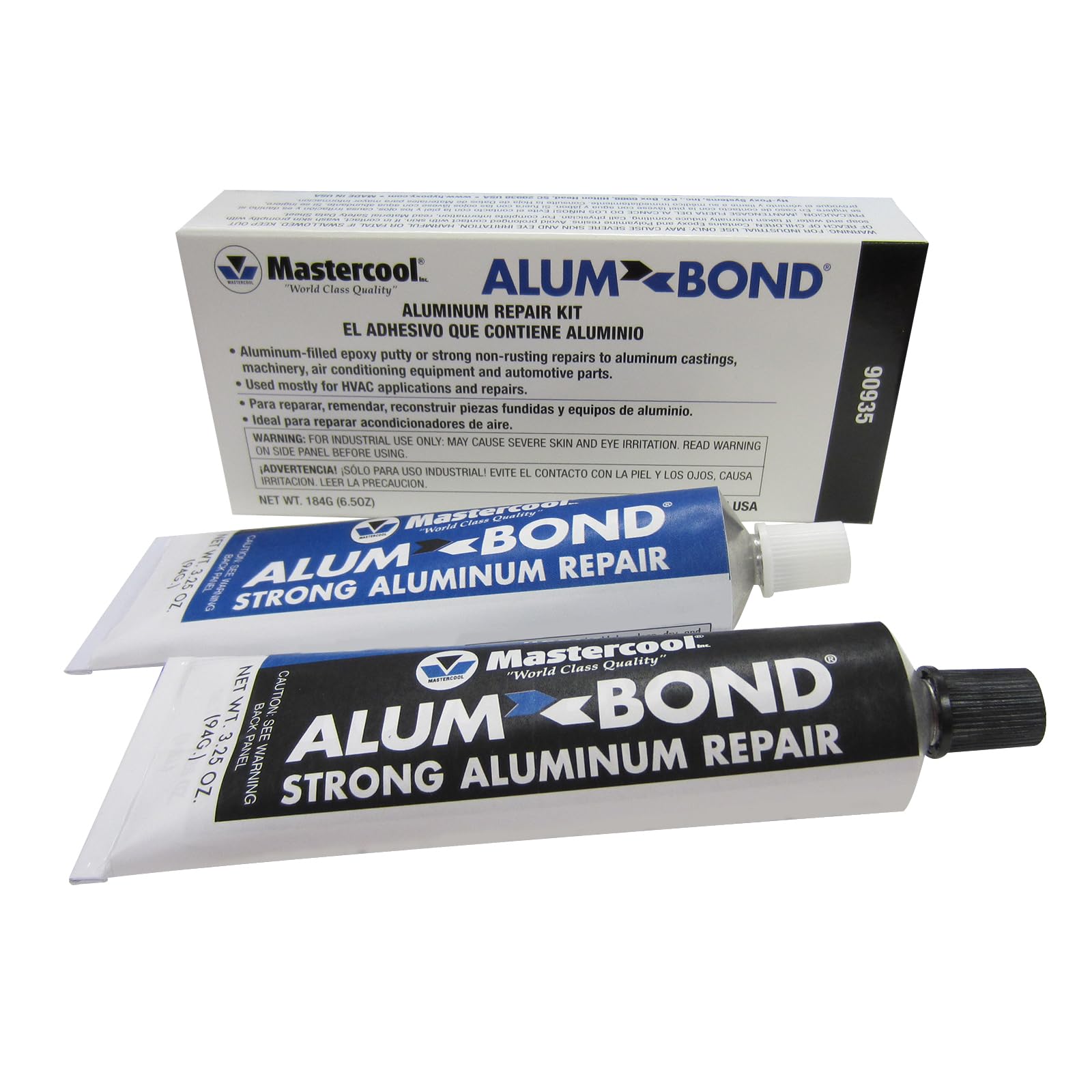
Mastercool Alum Bond is not a general-purpose metal glue — it is an aluminum-filled polymer designed specifically for casting repairs, and its 8,600 PSI compressive strength reflects that focus. The paste is thick and non-sagging, which means it stays put on vertical radiator housings and overhead engine block surfaces without dripping. Users have successfully sealed condenser coils and filled blow holes in aluminum boat hulls, reporting that the cured material machines like actual aluminum when tapped or drilled.
The working time is practical rather than rushed, giving you enough window to pack the compound into cavities and shape it before the cure clock runs out. Temperature resistance tops out at 250°F, making it suited for coolant-related repairs but not direct exhaust manifold contact. For its price point, the Alum Bond delivers a density of aluminum particles that visibly sets it apart from cheaper epoxies — the bond color and texture closely match the parent metal after sanding.
Each container holds enough material for multiple small repairs, and the industrial-grade formula eliminates the guesswork of consumer dual-syringe dispensers. If your repair involves cast aluminum, radiator end-tanks, or engine block porosity, this is the formula that professional HVAC and automotive technicians have relied on since its release in 2013.
Why it’s great
- High aluminum content creates a machinable repair body that drills and taps cleanly
- Non-sag paste formula stays in place on vertical and overhead surfaces
- Proven track record for radiator and condenser coil repairs since 2013
Good to know
- Temperature ceiling of 250°F limits use near hot engine zones above that threshold
- Single large canister may be more than needed for small spot repairs
2. WEST SYSTEM G/flex 650 Aluminum Boat Repair Kit
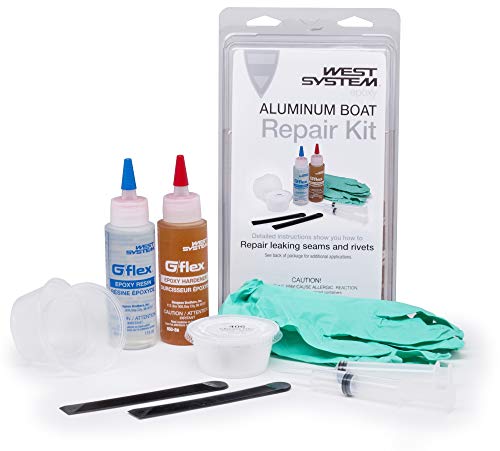
WEST SYSTEM’s G/flex 650 is formulated differently from the brittle epoxies that fail on riveted aluminum boats. The core innovation is a toughened polymer backbone that flexes under stress rather than cracking — critical for hull seams and rivet lines that experience constant cyclical loading from waves and trailering. The kit includes 8 ounces of resin and hardener, adhesive filler, syringes, mixing pots, and gloves, making it a self-contained repair station for marine aluminum.
The 75-minute working time at 72°F is the longest in this comparison, giving you over an hour to mix, apply, clamp, and clean up. That extended window is essential for large-area repairs like patching a leaking river seam where multiple applications are needed before the epoxy tacks up. Some users reported that the epoxy is runnier than paste-style fillers, which makes it ideal for wicking into tight rivet joints but less suited for vertical gap-filling without fiberglass mesh reinforcement.
While the price is higher than most consumer syringes, the G/flex system is a legitimate marine-grade solution that live-aboard sailors keep onboard as a standard repair consumable. If you are repairing a riveted aluminum canoe, jon boat, or sailboat dinghy, this kit outperforms general-purpose epoxies that cannot handle the combination of water immersion and structural movement.
Why it’s great
- Toughened formula flexes under stress instead of cracking on boat seams
- Full kit with syringes, pots, and gloves for immediate use
- 75-minute working time allows careful application on large repairs
Good to know
- Lower viscosity runs on vertical surfaces without mesh or thickener
- Premium cost per ounce reflects specialized marine-grade formulation
3. AOJEL S300 Metal Epoxy (2-Pack)
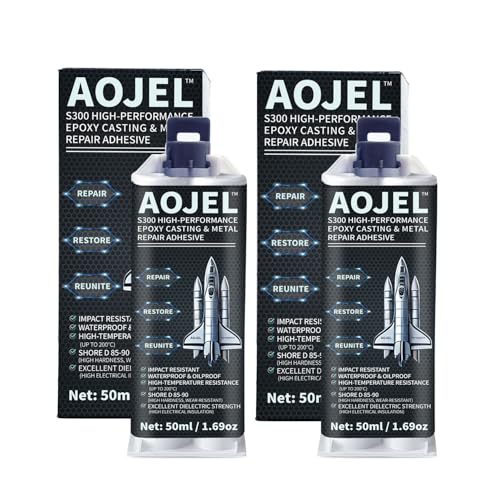
The AOJEL S300 formula was engineered for rigid structural repair on metal parts that must bear load — brackets, frames, housings, and pipes. The two-pack provides 3.38 ounces total, and each syringe delivers a true 1:1 ratio with consistent flow when the plungers are aligned properly. After full cure, the epoxy withstands sustained heat up to 392°F, which places it firmly in the range of automotive engine bay components and exhaust-adjacent repairs.
Users have successfully patched cracked aluminum crankcases on ATVs, reattached separated seat straps on aluminum patio chairs, and repaired metal fence posts. The working time is generous enough for alignment and clamping without the panic of a 5-minute set. One common complaint involves the twin plunger mechanism — the pistons can bind at the beginning of the stroke, making it hard to dispense equal amounts for very small repairs. For larger jobs, the plungers work smoothly after the first few millimeters of travel.
At this price for two full syringes, the per-ounce cost is lower than most single-tube competitors, and the 392°F ceiling makes it one of the most temperature-resilient options in the mid-range tier. If you need a reliable, heat-tolerant epoxy for multiple garage projects, the 2-pack is the smarter buy than a single premium tube.
Why it’s great
- 392°F heat resistance handles engine-bay and exhaust-adjacent repairs
- Two syringes offer better per-ounce value than single-tube alternatives
- Proven on aluminum crankcases and patio furniture frames
Good to know
- Dual plungers require careful initial alignment to dispense evenly
- Designed for rigid materials only — not suitable for flexible joints
4. AOJEL S300 Metal Epoxy (Single)
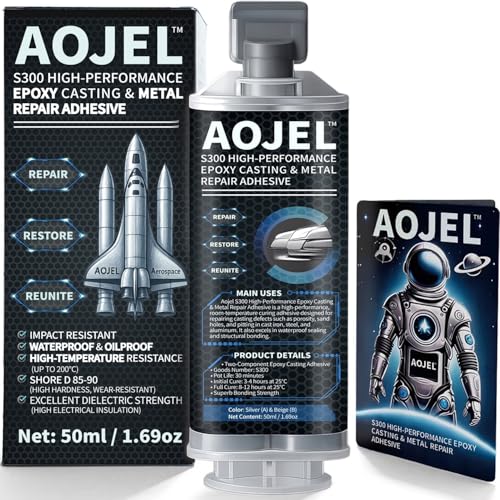
A single-syringe version of the same S300 formula found in the 2-pack, this product is optimized for the buyer who needs exactly one controlled repair rather than a bulk box. The 30-minute working time at 77°F is the headline spec — it is long enough to apply multiple layers, position clamps, and clean up excess before the material sets. AOJEL explicitly recommends building a thick repair body beyond the visible crack line rather than applying a thin surface coat, which aligns with proper cold-weld technique.
Customer reports confirm strong bonds on aluminum brackets, cast aluminum housings, and steel frames. One user fixed a cracked ATV crankcase, noting that the slower cure was actually beneficial because it allowed three sequential applications to seal a persistent leak. The cured epoxy is drillable, sandable, and paintable, and the 1.69-ounce syringe is well-sized for a single bracket or housing repair without wasteful leftover material.
The primary trade-off is the same dual-plunger binding issue seen in the 2-pack, and some users found it difficult to push an equal ratio from a cold tube. Pre-warming the syringe slightly or dispensing a small test bead before the actual application helps. For a single precise repair where you value working time over speed, this is the better choice than a fast-set alternative.
Why it’s great
- 30-minute working time is ideal for layered, gap-filling repairs
- Heat resistance to 392°F after full cure
- Builds a drillable repair body that machines like metal
Good to know
- Plunger binds at start of stroke — test a small bead before applying
- Not intended for flexible plastics, PE, PP, or rubber-like materials
5. PLJOFRSHI Metal Repair Glue 3-Pack
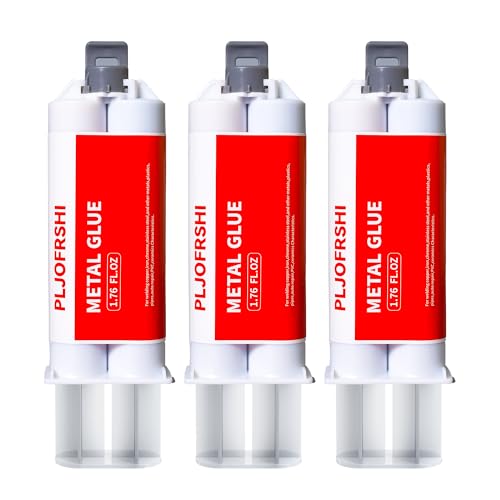
PLJOFRSHI packs three 1.76-ounce syringes into one affordable bundle, making it the highest-volume budget option for users who know they will be applying multiple repairs over time. The claimed cured strength of 4,680 PSI is competitive with mid-tier competitors, and the epoxy stays stable across a temperature range from -65°F to 287°F. Each syringe includes a pusher and scraper, and the 1:1 ratio dispenses from a dual-barrel design similar to more expensive brands.
User feedback highlights successful repairs on car floor panels, boat hulls, and general household metal cracks. The 5-minute initial set is fast — you have to work deliberately and have your surfaces clamped before mixing. The epoxy cures to a medium gray that blends acceptably with unfinished aluminum after sanding. A few users noted that the plunger mechanism can be stiff on the first press, but consistent pressure produces an even mix.
At under 3 ounces per dollar, this pack is hard to beat for value. The three separate syringes also mean you can open one for a small repair and keep the others sealed for future use without worrying about a single large tube hardening on the shelf. It is not the highest heat tolerance in this list, but the 287°F ceiling covers radiators, water pipes, and most auto underhood components that are not directly on the exhaust manifold.
Why it’s great
- Three full syringes provide the best volume-to-value ratio in this guide
- 4,680 PSI cured strength covers most automotive and household repairs
- Temperature range from -65°F to 287°F handles seasonal thermal cycling
Good to know
- 5-minute initial set means fast work — align clamps before mixing
- Not recommended for flexible or high-torsion metal joints
6. WXYCRUEYE Metal Repair Glue 3-Pack
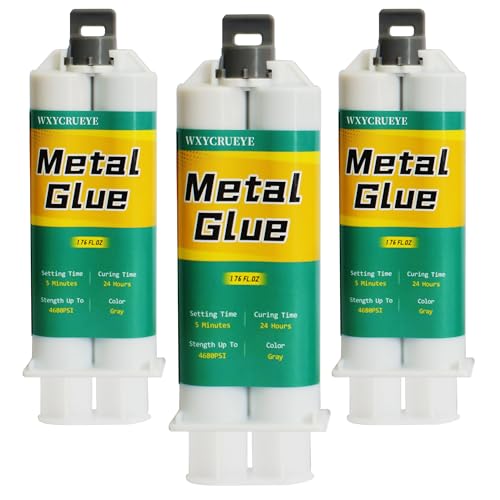
WXYCRUEYE’s entry matches the three-syringe, low-price formula of the PLJOFRSHI pack but with a slightly different viscosity that users describe as easy to spread across flat metal surfaces. The 5-minute initial set and 24-hour full cure are standard for this budget tier, and the epoxy works on aluminum, copper, steel, and hard plastics. Several buyers have used it to repair refrigerator door handles, monitor mounts, and general metal-to-metal bonds around the home with lasting results.
The clear-cured color is a differentiator — most aluminum epoxies cure gray or silver, but this one dries translucent, which can be an advantage for cosmetic repairs where you want the metal grain to show through. One critical negative review reported the epoxy had hardened inside the tube before use, suggesting that stock age or storage temperature can affect product consistency. That risk is inherent with any epoxy bought on a long-tail supply chain, but the three-tube format at least lets you test one before committing to a critical repair.
For non-structural mends like filling small holes in auto body panels, bonding metal fixtures, or repairing garden tools, this pack gets the job done at a negligible per-use cost. If you need a high-temperature or load-bearing spec, step up to the AOJEL or Mastercool options.
Why it’s great
- Clear-cured epoxy preserves metal surface appearance better than gray fillers
- Three-tube pack keeps shelf life long for intermittent use
- Works on aluminum, copper, plastic, and steel for versatile household repairs
Good to know
- Some units arrive with hardened contents — test before starting a critical job
- No published heat resistance or compressive strength spec
7. Cerca de Metal Glue

Cerca de positions its metal glue as an affordable dual-syringe system for small, non-critical repairs around the house and garage. The 1.6-ounce tube delivers enough epoxy for one or two small jobs, and the 1:1 plunger dispenser makes mixing straightforward for first-time epoxy users. The formula includes added metal powder, which gives the cured bond a higher hardness than standard epoxy resin and allows it to be sanded, painted, and drilled after 24 hours of cure.
Customer reviews confirm reliable bonds on metal bookshelf joints, loose brackets, and other household fixtures where the load is moderate. The 10-minute initial set is a slight improvement over the 5-minute options, giving you a few extra seconds to position parts. However, the 287°F temperature ceiling matches the budget tier and will not survive exhaust or engine block environments. The tube also lacks the tactile feedback of a premium syringe — some users found it difficult to gauge when both plungers were advancing equally.
This product is best viewed as a test-drive for someone new to aluminum epoxy who wants to try a low-stakes repair before investing in a premium system. The small size means less waste if the repair goes wrong, but also less material for larger projects. If you outgrow its capabilities, the AOJEL or Mastercool products are natural upgrades.
Why it’s great
- Low entry price and small tube size ideal for first-time epoxy users
- Metal powder additive increases cured hardness over standard resin
- 10-minute set gives slightly more positioning time than 5-min epoxies
Good to know
- Small 1.6-ounce volume limits use to minor, single repairs
- Plunger equalization is less reliable than premium dual-syringe systems
FAQ
Can aluminum epoxy withstand engine heat in a car engine bay?
Do I need to sand the aluminum surface before applying the epoxy?
Is aluminum epoxy safe for repairing a leaking radiator or coolant system?
Final Thoughts: The Verdict
For most users, the best aluminum epoxy winner is the Mastercool 90935 Alum Bond because its high aluminum fill, 8,600 PSI compressive strength, and machinable cure make it the most capable formula for cast aluminum and radiator repairs. If you want precise working time and heat resistance up to 392°F, grab the AOJEL S300. And for marine aluminum boat seam repairs where flexibility matters, nothing beats the WEST SYSTEM G/flex 650 Kit.