
Our readers keep the lights on and my morning glass full of iced black tea. As an Amazon Associate, I earn from qualifying purchases.
Specs are compiled from manufacturer listings and verified buyer reviews and can change over time — please confirm the key details on the product page before buying.
You are building a 3D printer, a CNC machine, or a custom workbench. The first decision you face is which aluminum extrusion profile can handle the load without flexing. Pick the wrong one and you get wobble, stripped slots, and a project that never feels solid. This guide shows you exactly which profile matches your build’s demands by explaining the series numbers and slot sizes in plain language.
I’m Min — the founder and writer behind Gadgets Feed. This guide is built by comparing the manufacturers’ published specifications and the patterns across verified customer reviews, so you get each pick’s real strengths and trade-offs instead of marketing spin.
Whether you are reinforcing a printer gantry or framing a sim racing cockpit, the right structural spine matters. These are the best aluminum extrusion profiles for DIY builders who need straight, strong, and precisely cut rails on the first try.
Our Picks at a Glance

How To Choose The Best Aluminum Extrusion Profiles
Picking the right extrusion is about matching three things: the physical size of the profile (the series number), the alloy and temper (how strong it is), and the slot style (what hardware it accepts). Here is what to look for.
Match the Series to Your Load
The series number — 2020, 4080, 10-Series — tells you the profile’s cross-section in millimeters or inches. A 2020 profile is 20mm x 20mm, ideal for light printer gantries and small jigs. A 4080 profile is 40mm x 80mm, built for structural frames that carry heavy gear or support an awning. The 10-Series (1 inch x 1 inch) is the 80/20 standard, widely compatible with industrial brackets and joining plates. Choose the series that matches the weight you are supporting; bigger extrusions handle more load without bowing.
Check the Alloy and Temper
Most profiles use 6063 aluminum (good corrosion resistance and a smooth anodized finish) or the stronger 6063-T5 and 6063-T6 tempers. The “T5” and “T6” refer to heat treatments that increase yield strength (the stress a material can take before it permanently deforms). For a fixed frame or a shelf that stays put, 6063-T5 is plenty. For a moving gantry or a load-bearing upright, 6063-T6 (like the 80/20 pick below) gives you extra stiffness.
Know Your Slot: T-Slot vs V-Slot
A standard T-slot profile has square channels that accept T-nuts and bolts — universal for most framing projects. A V-slot profile has a 45-degree angled groove in the channel, designed specifically for V-wheel rollers in 3D printers and CNC routers. If you are building a linear motion system with wheels, you need V-slot. If you are bolting brackets and panels, stick with standard T-slot.
Quick Comparison
| Model | Best For | Series / Size | Length | Weight | Amazon |
|---|---|---|---|---|---|
| 4pcs 2020 T-Slot★ Best Overall | 3D printer frames & light jigs | 2020 (20mm x 20mm) | 400mm | 1.7 lbs (set of 4) | Amazon |
| 80/20 1010 10-Series | Industrial frames & heavy builds | 10-Series (1″ x 1″) | 89″ | 3.77 lbs | Amazon |
| 2020 V-Slot (VICHSAMWY) | Gantry & roller wheel systems | 2020V (20mm x 20mm) | 400mm | 0.79 kg (set of 4) | Amazon |
| 4080 T-Slot (IXGNIJ) | Heavy structural frames & sim rigs | 4080 (40mm x 80mm) | 500mm | 4.69 lbs (set of 2) | Amazon |
In-Depth Reviews
1. 4pcs 400mm T Slot 2020 Aluminum Extrusion (IXGNIJ)
Our pick — over 4.5★ from 950+ verified ratings; the strongest balance of quality and price.
The budget-friendly four-pack — each 20mm x 20mm x 400mm rail made from 6063-T5 aluminum with an anodized surface that resists corrosion — earns a 4.7-star crowd following.
This is the entry-level workhorse for small DIY builds. Each piece measures 20mm x 20mm x 400mm and is made from 6063-T5 aluminum (the “T5” is a heat treatment that gives good strength for static loads) with an anodized surface (an electrochemical coating that prevents oxidation). The 4-piece pack weighs only 1.7 pounds total, making it light enough to ship cheaply and easy to cut with a small Ryobi bandsaw, as one owner confirmed.
Quality is the top praise — well over thirty buyers single it out. The extrusions arrive “sturdy, precisely formed, cleanly cut, individually wrapped,” with only minor burrs that a file removes quickly. The standard T-slot accepts M3, M4, and M5 T-nuts (nuts that slide into the slot, sized for 3mm to 5mm bolts) and pulleys, so you have hardware flexibility for custom jigs, printer frames, and small enclosures. One reviewer used them for a 3D printed telescope project and another for a reloading stand.
The main caveat: these are non-standard 20mm x 20mm (sometimes called “10-series” in European sizing), not the true 1-inch x 1-inch 80/20 standard. You need the correct 20mm T-nut kit, as a few owners noted. For light motion control and hobby builds, that is rarely an issue.
Best for budget-minded builders prototyping a 3D printer frame, a small CNC, or a custom jig where 400mm rails are enough and cost matters most. Skip these if your frame needs to span more than 15 inches — the 80/20 1010 pick above gives you 89 inches of uninterrupted rail.
What makes it a value champ
- Four rails in one box for a low per-piece cost — ideal for prototyping and small frames.
- Anodized 6063-T5 surface stays smooth and resists corrosion without extra coating.
- Owners praise the cutting performance — a small bandsaw handles it cleanly.
The trade-off
- 400mm max length limits you to compact builds; not suitable for long spans.
- Requires 20mm-specific T-nuts, not the standard 1-inch 80/20 hardware.
2. 80/20 1010 10-Series 1″ x 1″ T-Slotted Aluminum Extrusion

This is the industrial-grade spine that holds a 52-pound awning through off-road trips without flexing — the 80/20 1010 10-Series uses the strongest alloy in this lineup.
This profile sets the standard for modular framing. It uses 6063-T6 aluminum (the “T6” is the strongest heat-treat grade in this lineup, meaning about 10-15% higher yield strength than T5) with four open T-slots that accept all standard 1-inch based joining plates and brackets. At 3.77 pounds for the single 89-inch bar, it is noticeably more solid than the lighter 2020 options, which weigh about 1.7 pounds for a set of four shorter 400mm rails.
What wins people over is the straightness and precision. Buyers report the pieces arriving “perfectly straight” with outside dimensions exactly matching the 1-inch spec. The ends are deburred and cuts are clean, so you spend less time filing. One owner said this extrusion was perfect for pull-out drying racks in a large laundry cabinet after seeing similar builds on social media.
The value-for-money aspect draws mixed opinions — the raw material cost is higher than budget 2020 packs, but you pay for industrial-grade alloy and a full 7.4 feet of uninterrupted rail. This is sharper at resisting flex across long spans than the 4pcs 2020 T-Slot pack because of the T6 temper and larger cross-section.
Reach for this if you need a long-span frame, a track-saw guide, or a heavy workbench that needs zero sag and full 80/20 ecosystem compatibility. Look elsewhere if you only need short 400mm rails for a small printer or light jig — the 2020 packs below will save you weight.
Why builders trust it
- 6063-T6 alloy is the strongest temper available, giving you real stiffness on long spans.
- Four open T-slots mean universal compatibility with 80/20 brackets, plates, and T-nuts.
- Deburred ends and tight cut tolerances get you building immediately without clean-up.
The honest trade-off
- Single 89-inch piece is heavy to handle solo at nearly 4 lbs.
- Higher per-foot cost than European 2020 packs, though the alloy and precision justify it.
3. 2020 V Aluminum Extrusion 4PCS 400mm (VICHSAMWY)
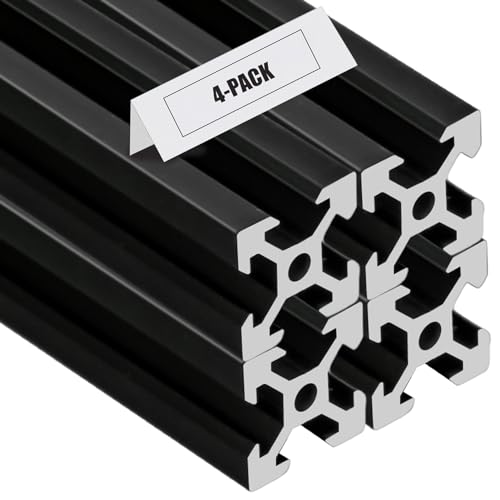
This profile lets roller wheels glide smoothly on your 3D printer gantry or CNC router because of its V-slot groove — a feature standard square T-slot profiles cannot offer.
This profile is purpose-built for linear motion. The 2020V extrusion has a 6.2mm-wide slot with a 45-degree V-shaped groove, designed specifically for V-wheel rollers that run along the channel rather than sliding. It is crafted from 6063 aluminum (an alloy known for good corrosion resistance and a smooth finish) with an anodized coating, and it measures a precise 20mm x 20mm x 400mm per piece with a wall thickness of 1.5mm. The total set of four weighs about 0.79 kilograms.
Beyond printer gantries, builders have used these for surprisingly creative projects. One owner confirmed they built a foot steering system for a kayak, and another used them for custom speaker stands for vintage JBL L100 speakers. The anodized finish adds corrosion resistance, so outdoor use is viable. The V-slot profile also works with all 20-series fasteners, giving you standard T-nut compatibility alongside the roller groove.
The one thing to plan for: the pack does not include corner brackets or slot nuts. You need to source those separately. Given the price point and the smooth V-slot surface, this is a strong pick for anyone upgrading a printer’s linear rail system or building a lightweight gantry from scratch.
Reach for this if you are building a 3D printer gantry, a CNC router, or any linear-motion rig that needs V-wheel rollers and a corrosion-resistant anodized surface. Not for you if your project uses standard bolt-and-bracket joining only — save money with the standard T-slot 2020 pack above.
V-slot advantage: The angled groove pairs with roller wheels for friction-free motion — standard square T-slot profiles cannot do this. Buyers specifically praise them as “quality rails for gantry projects” that work with roller plates right from the start.
Plan ahead: You need separate corner brackets and slot nuts to join these into a frame. The extrusion itself is precise and clean, but the hardware (nuts, brackets, screws) is sold separately.
4. 4080 T Slot Aluminum Extrusion 500mm x 2 (IXGNIJ)

This 40mm x 80mm beam turns a sim racing rig into a rock-solid cockpit — with a 40mm x 80mm cross-section versus the 20mm x 20mm of a 2020 rail, so it handles heavy static and dynamic loads without bowing.
This is the heavy lifter of the group. Each profile measures 40mm x 80mm x 500mm — nearly four times the cross-sectional area of a 2020 rail — and the set of two weighs 4.69 pounds. It uses 6063-T5 aluminum with a full anodized finish, and the T-slot design is compatible with all Series 40 fasteners and accessories. This is not a profile for a small jig; it is meant for structural frames that carry real loads.
Buyers have put it to serious use. One owner bolted two of these to an overlanding rig as awning supports, and the extrusion held a 52-pound awning through multiple off-road trips without a single hole needing to be drilled. Others use it for sim racing cockpits (one buyer called it “perfect for my cockpit 6sigma”), and another described it as “amazing for DIY projects or SIM racing rigs.” The sturdiness earns consistent praise — the profile simply does not flex under normal loads.
The stability rating carries mixed feedback, which likely reflects that 4080 extrusions are very rigid but can amplify vibration in certain frame designs unless properly braced. For static frames like workbenches, awning supports, and sim rigs, that is rarely a concern.
Reach for this if you are building a sim racing cockpit, a heavy workbench leg, or an awning frame that needs uncompromising rigidity and accepts a 500mm beam length. skip it if your project is a small 3D printer or a light CNC — the 2020 profiles are far easier to work with and a fraction of the weight.
What makes it a powerhouse
- Massive 40mm x 80mm cross-section handles heavy static and dynamic loads without bowing.
- Compatible with all Series 40 T-slot hardware — brackets, nuts, and plates are widely available.
- Buyers confirm it supported a 52-pound awning through rough off-road terrain with zero issues.
The honest trade-off
- 500mm length is short relative to the mass — you pay for weight, not span.
- Heavier and bulkier than 2020 profiles; overkill for small printer frames or light jigs.
Understanding the Specs
Series Number (2020, 4080, 10-Series)
The series number tells you the profile’s cross-section in millimeters or inches. A 2020 profile is 20mm x 20mm, suited for light printer frames and jigs. A 4080 is 40mm x 80mm — while a 2020 is 20mm x 20mm — designed for structural loads. The 10-Series (1 inch x 1 inch) is the 80/20 industry standard, measured in inches. Choose the series that matches your frame’s span and weight demands; a longer unsupported span needs a larger profile to avoid sagging.
6063 Alloy with T5 vs T6 Temper
Almost all extrusion in this class uses 6063 aluminum alloy, valued for its smooth anodized finish and corrosion resistance. The “T5” and “T6” suffixes are heat treatments that increase strength. 6063-T5 is standard for most framing and is plenty strong for static loads. 6063-T6 is around 10-15% stronger in yield strength (the stress a material can take before it permanently deforms), which matters for moving gantries or long spans where you cannot tolerate any flex. The 80/20 1010 pick uses T6; the budget 2020 packs use T5.
FAQ
What is the difference between 2020 and 4080 aluminum extrusion?
Can I mix European 2020 extrusion with 80/20 10-Series hardware?
How do I cut aluminum extrusion cleanly at home?
What is the difference between T-slot and V-slot extrusion?
Will 2020 extrusion hold a 3D printer frame without wobbling?
What T-nut size do I need for 2020 extrusion?
Is anodized aluminum better than raw aluminum for extrusion?
How much weight can a single 4080 extrusion support?
Can I use aluminum extrusion outdoors for a pergola or awning?
What is the standard length tolerance on these extrusions?
Final Thoughts: The Verdict
If you want one dependable pick, the best aluminum extrusion profiles winner is the 80/20 1010 10-Series because it combines the strongest 6063-T6 alloy with universal 80/20 compatibility and a generous 89-inch length that works for nearly any DIY frame. If you are building a 3D printer or CNC gantry, grab the 4pcs 2020 T-Slot pack for unbeatable value. And for heavy structural jobs like sim cockpits or awning supports, the 4080 T-Slot is the one to reach for.
How We Picked
We do not accept paid placement. Every pick is matched to a real buyer and a real use-case; we do not hands-on test units.
Sources & Methodology
Specifications: manufacturer listings and product documentation. Review insights: verified customer reviews, as of July 2026. Pricing: not shown on this page (it changes often); check the current price via the retailer link.
As an Amazon Associate, Gadgets Feed earns from qualifying purchases. This does not affect which products we feature.