
Our readers keep the lights on and my morning glass full of iced black tea. As an Amazon Associate, I earn from qualifying purchases.
Specs are compiled from manufacturer listings and verified buyer reviews and can change over time — please confirm the key details on the product page before buying.
If you are shopping for a greenhouse, the frame is the part that decides whether your plants survive their first real storm. An aluminum frame will not rot the way wood does and will not rust through the way cheap steel does — that is why it is the material worth paying for. Below you will find eight real aluminum-frame greenhouses, sorted by what each one actually does well, so you can pick the right size, panel thickness, and door style for your yard instead of guessing from a photo.
I’m Min — the founder and writer behind Gadgets Feed. This guide is built by comparing the manufacturers’ published specifications and the patterns across verified customer reviews, so you get each pick’s real strengths and trade-offs instead of marketing spin.
A frame can look identical in two listings and still behave completely differently after a season of wind. The details below show you which of these aluminum greenhouses holds up — and which one fits your garden — so you can read a listing the way an experienced grower does. That is the whole point of hunting for the aluminum greenhouse frame that fits your yard.
Our Picks at a Glance
How To Choose The Best Aluminum Greenhouse Frame
Two greenhouses can list the same floor size and still be built for completely different weather. The trick is knowing which numbers actually change what the structure does once it is standing in your yard — not just how it looks in a product photo. Before any of the reviews below, decide which version you actually need: a compact seasonal starter that keeps plants alive through a cold snap, or a walk-in build that stands up to snow load and high wind on its own.
Frame Material And Why Aluminum Beats Wood And Steel Here
Aluminum is the frame material to want in a greenhouse because it does not rot, does not rust through like untreated steel, and weighs far less than the same span in timber. That lighter weight is a real advantage for assembly — but it also means anchoring matters even more. Every model below uses an aluminum frame, and several listings note that the frame gaps should be sealed with silicone or glass glue once built (that sealant is not included with some kits). Plan on sealing your panels regardless of which one you buy.
Panel Thickness And Weight Change How Warm It Gets
Polycarbonate panels listed in millimeters — twin-wall or double-wall — are what trap heat and diffuse light inside the structure. The 6mm panels on the larger Sylviera build sit heavier and thicker than the 4mm panels on the smaller units, which is exactly why bigger greenhouses run warmer and hold that warmth longer overnight. Thicker panels typically mean better insulation for year-round growing; thinner panels keep the greenhouse lighter and easier to move.
Snow Load, Wind Rating, And Why The Base Saves You
Snow load capacity (measured in psf, or pounds per square foot of roof) and wind rating (in mph) are the two numbers that tell you whether the frame is built for a real winter or just a mild one. A few of the picks below list a 56 mph wind rating and a snow load figure directly; when a listing does not name one, that is your cue to look at the frame construction notes instead. In almost every review, the build that survived storms was secured to a wooden or concrete base — a few owners who skipped the base watched the whole structure blow around.
Quick Comparison
| Model | Best For | Frame | Panel Thickness | Vents | Amazon |
|---|---|---|---|---|---|
| 12×12 FT T-Shape (Sylviera)★ Best Overall | Big backyard plots | Aluminum | 6mm | 2 | Amazon |
| 8X10FT Greenhouse with Thermometers (WUKHG)Smart Monitoring Pick | Remote temp monitoring | Aluminum | 4mm | 1 | Amazon |
| Jocisland 6×12 FT Walk-inBest Value | Hobby gardeners on a budget | Aluminum | 4mm | 2 | Amazon |
| YITAHOME 6x16FT | Long narrow plots | Aluminum | 4mm | 2 | Amazon |
| AMERLIFE 6×12 FT Walk-in | Small-space growers | Aluminum | Twin-wall PC | 2 | Amazon |
| Palram Canopia Hybrid 6′ x 10′ | Beginner-friendly kits | Aluminum + galvanized base | Twin-wall PC | 1 | Amazon |
| HOWE 8x8x7.5 FT | Cold-climate growing | Aluminum | 6mm | 2 | Amazon |
| AMERLIFE 12 x 10 x 8-Ft Hybrid | Big build, fast assembly | Aluminum | Hybrid PC | 2 | Amazon |
In‑Depth Reviews
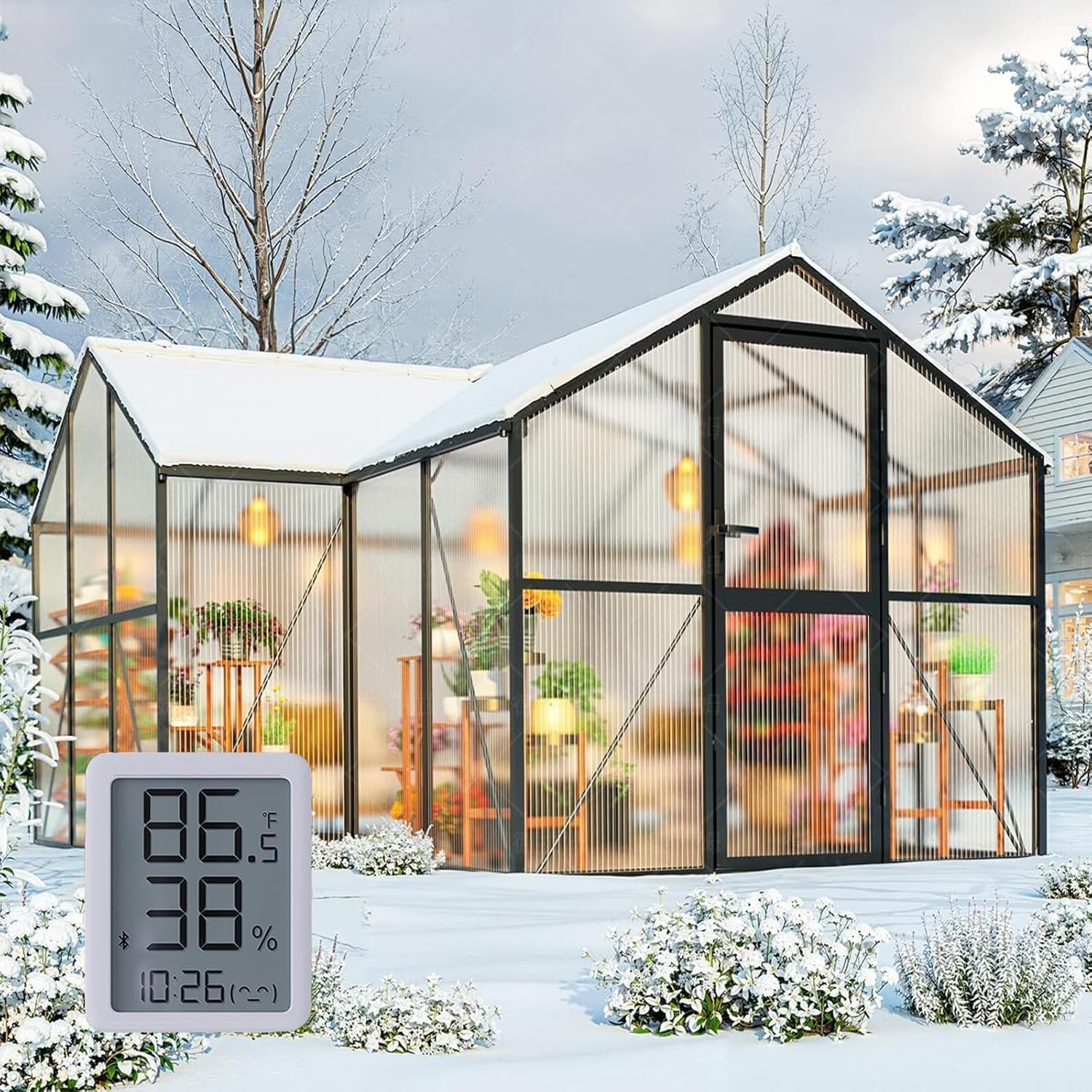
1. 12×12 FT T-Shape Greenhouses, Polycarbonate Green House with UV Protection
Our pick — over 4★ from 150+ verified ratings; the strongest balance of quality and price.
The square-foot king — the biggest twin-wall panels on this list, wrapped in a reinforced aluminum alloy frame.
Square footage is where this one separates itself. At 143″L x 143″W x 84″H, it gives you roughly twice the footprint of the WUKHG 8×10 (119.2″L x 97.2″W x 80.6″H), and that extra room is the difference between tending a few shelves and actually walking around your plants. The 6mm double-wall polycarbonate panels at 1100g each are also noticeably heavier than the 720g 4mm panels on that same WUKHG unit — heavier glazing usually means a warmer interior and a longer overnight hold on cold nights. Two adjustable roof vents and a lockable door round out the airflow side.
What buyers keep coming back to is the raw quality of the build — it shows up as the single most-praised trait across the reviews — followed by how stiff and stable the frame feels once it is up. Owners running it in harsh climates (one describes it holding its own against desert heat and temperature swings in Las Vegas) report it doing exactly what an insulated box should: keeping the interior warmer through cool nighttime temperatures than a bare plot ever would. Assembly, though, is the honest caveat. Amazon’s own review summary flags it as mixed, and that matches what buyers report: one noted it takes “1+ day solo,” and it genuinely helps to have a second set of hands. There is also a hint of a trade-off on refinement — one buyer felt it would be sturdier still with plexiglass panels — so treat the polycarbonate and the frame together as a system that wants a solid base and, ideally, silicone in the panel gaps (not included) to seal it in for year-round service.
Set expectations on the build calendar, not the structure. If you have a weekend and a helper, you end up with the largest, best-glazed greenhouse in this group and a genuine multi-season growing space — which is why it earns the top spot at 4.4 stars across 150 ratings.
Where It Earns Its Keep
- 143″L x 143″W x 84″H footprint is the roomiest here — double the floor area of the WUKHG 8×10.
- 6mm double-wall, 1100g polycarbonate panels outsize the 720g 4mm glazing on the WUKHG, for a warmer, slower-cooling interior.
- Reinforced aluminum alloy frame with strengthened corners; two adjustable roof vents plus a lockable door handle airflow and access.
- Holds its own in a real climate — a Las Vegas grower reports it shielding plants from sun, wind, and temperature swings.
Where It Fights Back
- Assembly is a project — owners mention “1+ day solo,” and the instructions land as confusing without the video walkthrough.
- Want it to shrug off wind? Anchor it. A buyer notes it can blow away unsecured, and reinforced it with steel wires and ground anchors.
- Panel gaps want silicone sealer (not included) to lock in the year-round insulation the frame is built for.
Reach for this if: you have real ground to fill and want the biggest, thickest-glazed aluminum-frame greenhouse on this list for year-round growing.
Look elsewhere if: you are a one-person, one-afternoon builder — the size that makes it great also makes it a multi-day, two-person job.
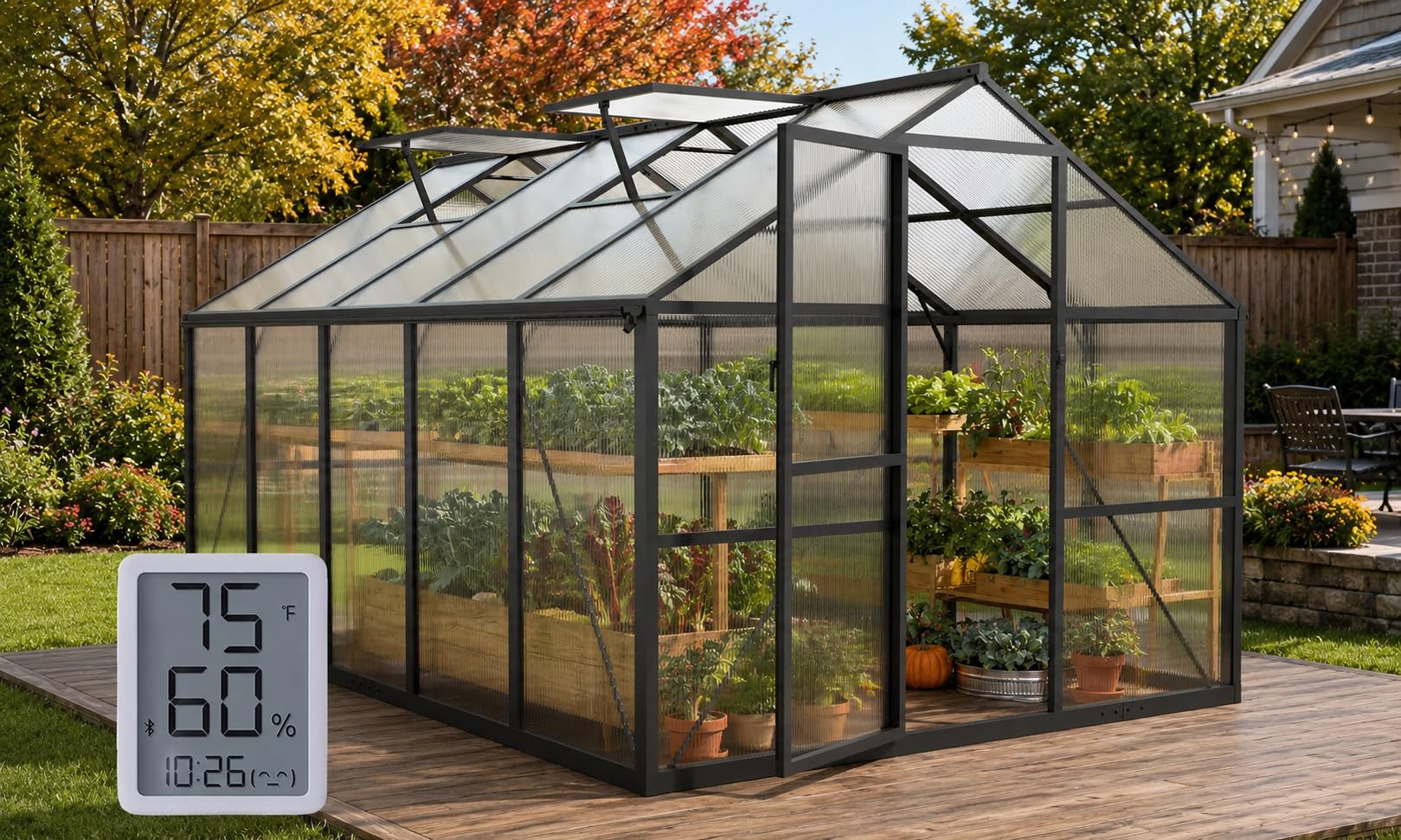
2. 8X10FT Greenhouse with Thermometers, Large Aluminum Greenhouse for Outdoors
The one that texts you the temperature — an aluminum-frame greenhouse with an app-connected climate monitor baked into the kit.
Most greenhouses make you walk out and read a dial. This WUKHG build ships with a thermometer hygrometer that pairs to an app so you can watch temperature and humidity remotely, refreshing every two seconds, with ±0.54℉ / ±0.3℃ temperature accuracy and ±3%RH humidity accuracy (the battery for it is not included). It also logs 14-day data graphs and offers half-year data export, which is genuinely useful when you are trying to figure out why one corner of the greenhouse runs hotter than another. The frame itself is high-quality aluminum alloy — which is what buyers praise most, quality being the trait that comes up again and again across the reviews — paired with 720g, 4mm twin-wall polycarbonate panels. There is a built-in gutter system for rainwater collection, plus a lockable door and adjustable ventilation windows.
Compare it to the pick above and the trade-offs flip: this one is the smaller 4mm-panel build (119.2″L x 97.2″W x 80.6″H), so on a severe-cold night it will not hold heat the way the 6mm Sylviera will. What you get instead is that monitoring layer and a simpler footprint. The roof panels are shatterproof and UV-blocking, and customers note the structure doing its real job — holding plants steady through wind, rain, and temperature drops. The recurring gripe worth knowing is the roof window: it tends to slam shut in a light breeze and, in a strong one, can be a weak point unless you secure it. One buyer found the advertised 6×4 footprint actually comes in smaller than listed, describing it as “smaller; still adequate” — so measure your intended space before you commit.
Buyers also treat it as solid value for the money, which is the second trait they call out most. It is a practical, monitored, walk-in box for someone who wants climate data more than maximum cubic footage.
The app angle is the draw: real-time temperature and humidity on your phone, with 14-day graphs and half-year export, changes how you manage a greenhouse — you check a screen instead of guessing.
The caveat that matters: 4mm panels are the lighter-duty glazing on this list, and the roof vent wants reinforcing before a windy season.
Choose this if: remote monitoring is worth more to you than panel thickness, and you want a straightforward walk-in with good airflow and a rain-catching gutter.
Pass it up if: you need maximum warmth retention in deep cold — the thinner 4mm glazing is a genuine ceiling compared to the 6mm builds here.
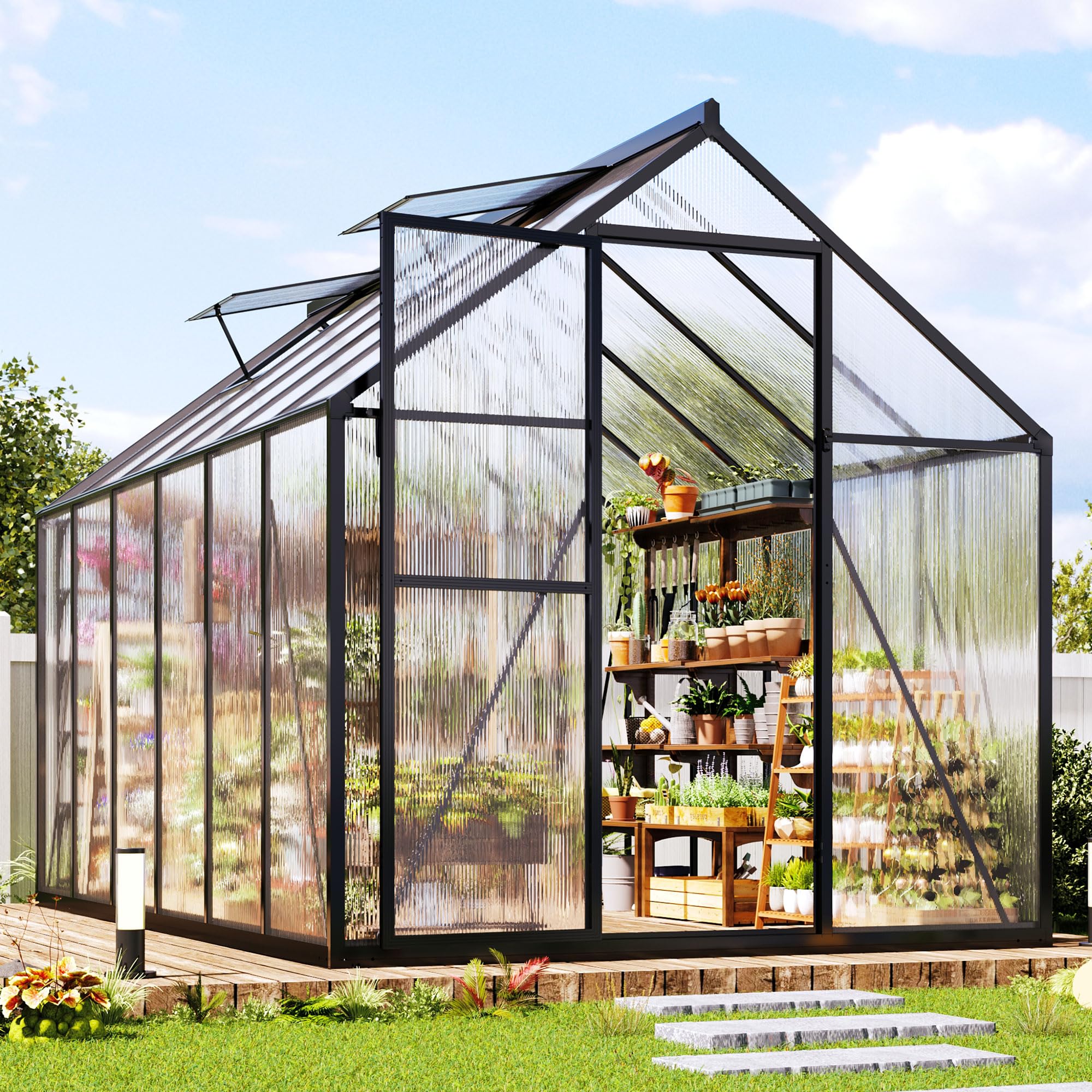
3. Jocisland 6×12 FT Walk-in Polycarbonate Greenhouse with 2 Top Windows
Long, narrow, and quick to raise — a 6×12 walk-in with side pull braces and the budget-friendliest frame here.
The shape is the selling point: a 6×12 footprint fits a sliver of yard, a side path, or a strip along a fence that a square unit would never slot into. Jocisland builds it around side pull braces for wind resistance and includes ground stakes and bolts so you can anchor it into soil or concrete. It ships with two roof vents, each with support-rod holders, and a swing door, plus 4mm polycarbonate panels that the listing says block 99.99% of UV rays. The claims about setup point to quick-connect joints letting two people build it in a few hours.
Where the honest picture lives is in the build and the wind. The reviews split hard: some growers describe a sturdy, easily assembled kit, and one reviewer noted it shrugged off 70mph wind gusts undamaged once anchored to 4x4s — an anchor-and-brace approach that clearly does the heavy lifting. But others found setup takes two people and far longer than advertised, with at least one reporting that flimsier panels popped out in single-digit wind speeds until they added adhesive. That is a meaningful spread, and it points to the same lesson as everywhere else in this category: this frame rewards a proper foundation. Appearance is the trait buyers praise most — the big glassy look is what sells it — and functionally it delivers a warm, humid interior when sealed up; one buyer mentioned it held the 80s inside while the 40s sat outside, with a small heater overnight.
One practical quirk worth flagging: remove the protective film from both sides of every polycarbonate panel before you seal anything, because the listing notes it and forgetting it is an easy, annoying mistake to unwind.
The budget math is honest: at 6×12 you get real walk-in length and two vented windows for very little — the roomiest footprint per dollar on this list.
The trade-off is build quality consistency: assembly time and wind performance vary widely, so a level base and extra bracing are non-negotiable here.
Best for: a confident builder who wants maximum walk-in length on a tight budget and is happy to add a proper anchored base.
Think twice if: you expect a bolt-together-in-an-afternoon kit — some reviewers point out it takes two people and far longer than the listing suggests.
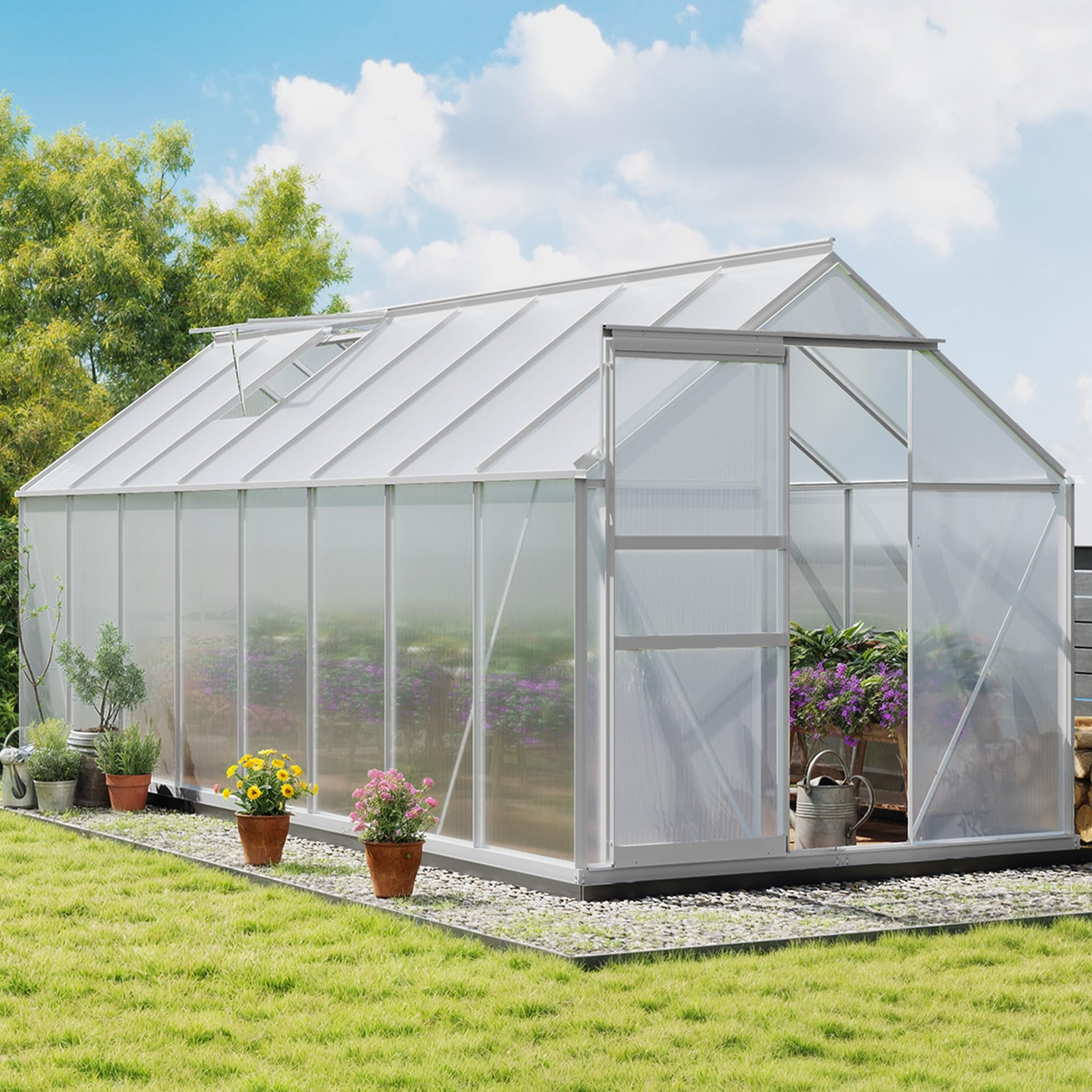
4. YITAHOME 6x16FT Polycarbonate Greenhouse Large Heavy Duty Green Houses Outdoor Aluminum Greenhouses with Sliding Doors Vent Window Walk-in Greenhouse for Garden Backyard
Sixteen feet of straight run — the longest frame on this list, with a sliding door that saves the swing space.
If your garden is a long strip, this is the shape you want. At 192″L x 72″W x 77″H, the YITAHOME gives you the longest continuous growing bed here, and the sliding door is a smart touch on a narrow greenhouse — it glides instead of swinging, so you are not clearing an arc of yard every time you walk in. The frame is aluminum alloy with reinforced side rods and diagonal rod fixation for extra stiffness, and the 4mm double-wall panels are UV-protected. Two adjustable skylights handle airflow. It is also the heaviest kit in this roundup at 108.6 pounds, which tells you there is real material in the box.
The quality of the build is what buyers appreciate most, with the roomy interior close behind — owners consistently describe a sturdy, well-functioning structure, and one customer mentions their plants surviving multiple storms. But this is also the pick where the assembly instructions become a genuine sticking point. Direction clarity is the loudest complaint in the reviews, with buyers recounting carpenters taking ten hours and the parts needing careful sorting before you start. The frame earns its keep once it is standing; getting it there demands patience and prep. The other recurring note is wind: several buyers find it sturdier when proactively braced, and one found the plastic ground loops brittle and upgraded them — an easy fix that matches the listing’s own advice to set the base in a pre-dug trench and seal the panel-to-frame gaps with glass glue for water protection.
What separates it from the smaller picks above is the length, and that length is the whole reason to buy it. Think of it as a long, walk-in growing aisle rather than a compact box.
Pick this if: you have a long, narrow bed and want the longest aluminum-frame walk-in here, with a space-saving sliding door.
Reconsider if: you want an easy, tool-light afternoon build — the directions here are the roughest in this group, and the kit is heavy enough to need real prep.
5. AMERLIFE 6×12 FT Walk-in Polycarbonate Greenhouse with 2 Top Windows
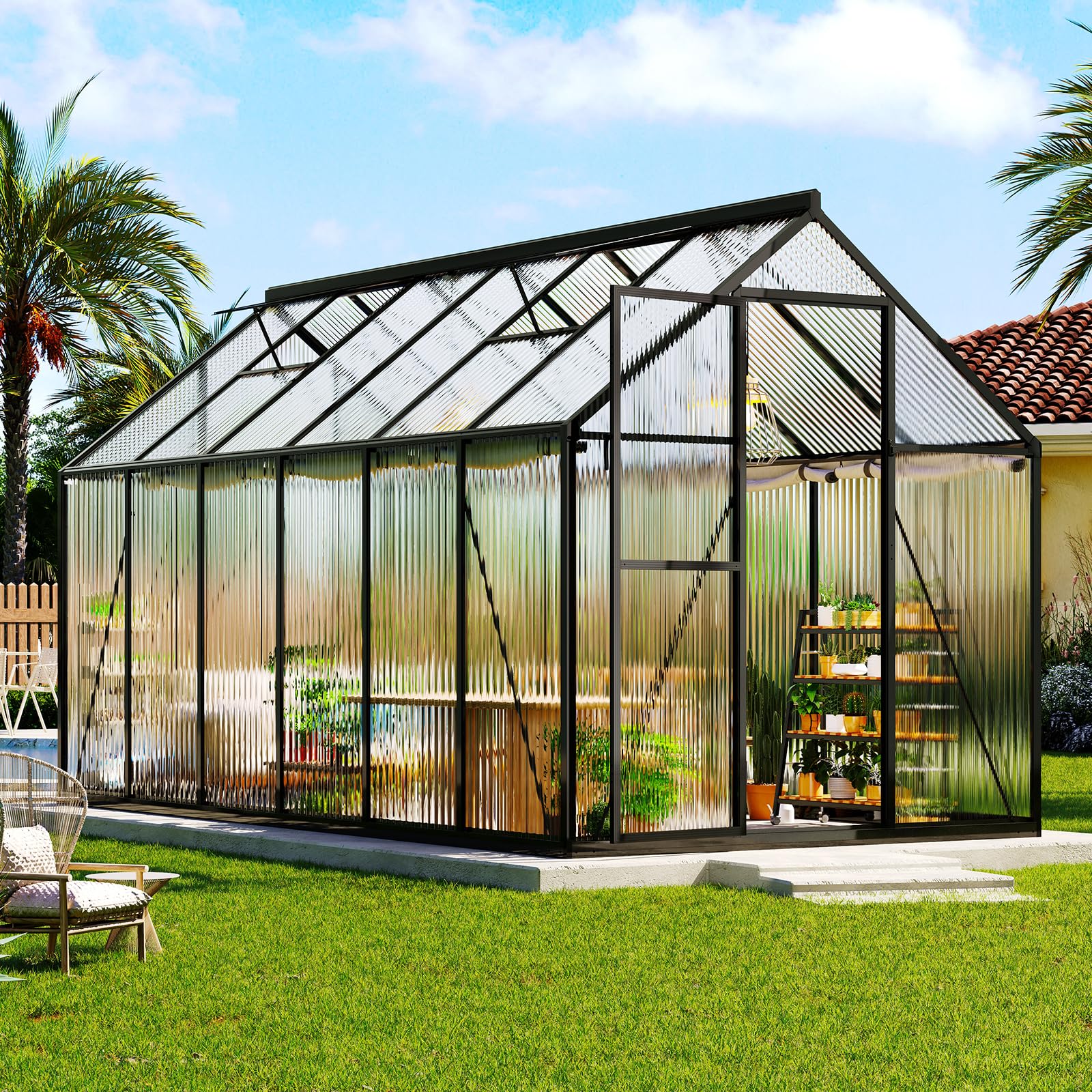
The measured one — a 6×12 walk-in that actually tells you its wind rating and snow load up front.
Most listings bury this, but AMERLIFE puts two hard numbers on the box: a 56 mph wind rating and a 20 psf snow load capacity. That tells a cold-climate buyer something concrete before the first flake falls — the frame is engineered to a stated structural standard, not just described as “sturdy.” The actual footprint is 5.9×11.9×6.4 FT, with a recommended foundation size of 6.5×13 FT, and it uses an aluminum frame with Quick-Fit joints and quarter-turn locks especially on those locks — the design is designed to cut the screws and bolt-fiddling that eat a build day. Twin-wall translucent polycarbonate panels carry 99.99% UV protection, exactly on par with the Jocisland 6×12’s 4mm panels on the UV front, but paired here with a frame carrying a stated snow load. Two vents and a lockable swing door offer airflow and access.
The distinctive selling point is the Quick-Fit joint system, which snaps together with quarter-turn locks instead of relying on a bag of bolts. Buyers describe getting exactly what the listing promised — panels better than foil when left up over winter, straightforward directions, and an undamaged shipment — but the setup time splits the room. Some find it simple; others describe a full weekend including power tools, and one notes the door opening runs a bit short. Heat retention is a clear positive: shoppers say it staying warm even through cloud cover, with the ventilation doors doing their job. One practical note for warm-region growers: a buyer in Florida actually removed the doors entirely to cope with the heat, which is worth knowing if you are in a hot climate.
Two handy design details set this one apart: the Quick-Fit quarter-turn locks (fewer loose screws to chase) and the two top windows for upper-air venting, alongside a lockable swing door with a magnetic latch suggested for convenience.
Standout spec: that 56 mph wind rating and 20 psf snow load are stated up front — real numbers you can plan a northern winter around.
Known snag: the door opening is on the short side of seven feet, so taller gardeners will want to duck, and setup time is a weekend for most.
Best for: a cooler-climate grower who wants a stated wind rating and snow load in a compact 6×12 walk-in.
Look elsewhere if: you are tall and want the 6ft-plus entry of the HOWE, or you want a fast afternoon build — this one is a weekend project.
6. Palram – Canopia Hybrid 6′ x 10′ Polycarbonate Aluminum Greenhouse, Silver

The kit with the most history behind it — a two-panel-type hybrid build on a powder-coated aluminum frame and steel base.
This is the greenhouse that shows up when you search the category, and it earns the attention. Palram uses a smart two-panel approach: twin-wall polycarbonate on the roof to soften strong sunlight, and crisp polycarbonate on the walls for over 90% light transmission — so plants get bright, diffused light without the harsh glare of clear roof panels. The frame is powder-coated aluminum that resists oxidation, and it sits on an included galvanized steel base for stability. Design touches include a single hinged door you can fit on the left or right, a magnetic door catch, a built-in gutter, and an adjustable vent window. It measures 120″L x 73″W x 82″H.
What wins people over is the quality of the finished build — it is the most-praised trait in the reviews — and the look; owners describe it as a genuinely attractive structure that stands up to weather, with repeat customers reporting it surviving hurricanes, tornadoes, hail, and snow/ice storms across multiple seasons without cracks or metal deterioration. That longevity is the real draw. The honest caution is assembly clarity: the graphical, illustration-heavy directions frustrate a lot of buyers, and the recurring gripe is a vent window that ships without a magnet or clasp and can blow off unless you secure it. The corner cross braces are on the thin side too — one long-term owner replaced theirs with galvanized angle iron for noticeably more rigidity.
The verdict from owners who sort the instructions and secure the vent window is overwhelmingly positive, and the sheer volume of buyers who chose this kit makes it the safest pick if you want a proven, supported design. It comes with parts and service available for year-round support.
Why owners rate it: a proven two-panel-type design (twin-wall roof, clear walls at 90%+ light transmission) on an oxidation-resistant powder-coated aluminum frame with a galvanized steel base.
Where it needs your hand: illustration-only directions and a vent window that ships without a clasp — both are easy enough to fix, but both land squarely on the builder.
Choose this if: you want a proven design with strong support and a galvanized steel base — the safest bet for a first real greenhouse.
skip it if: you expect clear written directions and a fully secured vent window from the start — plan to add both yourself.
7. HOWE 8x8x7.5 FT Polycarbonate Greenhouse with Lockable Swing Door
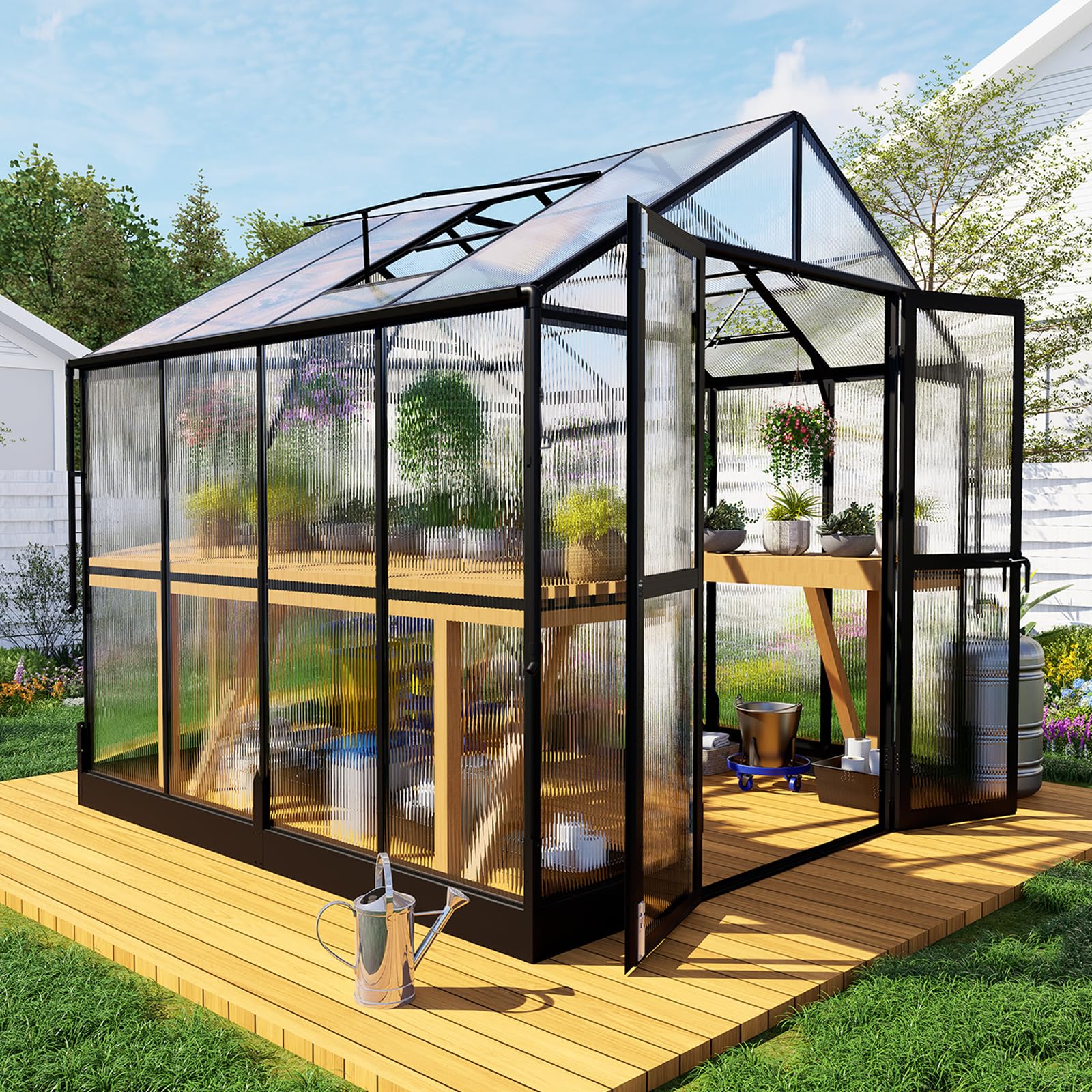
Built to be buried — four corner posts and two middle posts anchor this tall 8×8 deep into soil or concrete.
Here is the roomiest square greenhouse of the group, and the sturdiest on paper. At 96″L x 96″W x 90″H, the HOWE gives you a walk-in box that is genuinely tall enough to stand up inside (the listing highlights 6ft doors for easy entry), with a stated 15.4 psf snow load capacity and a 56 mph wind rating. The anchor strategy is what separates it: four corner posts plus two middle posts are meant to be buried deep in soil or concrete, which is a far more serious approach than the ground stakes on the smaller kits. It carries 6mm twin-wall translucent polycarbonate panels with 99.99% UV protection, two vents, a lockable swing door, and a built-in gutter system on both sides for rainwater collection.
The 6mm panels put this one in the elite insulation tier alongside the top pick — thicker glazing, warmer interior, better overnight hold. What buyers praise most is the overall quality of the structure, with value for money right behind it; the finished product looks good and feels solid once built. The trade-off, every time, is assembly. A few buyers report parts arriving bent and hardware coming up short on nuts and bolts. Line up a helper and a full weekend, and read the directions twice before you start.
The detail that makes this one unique is the foundation strategy: those six posts plus the two-sided gutters let you set it deep and collect runoff — the closest you get to a permanently planted greenhouse here.
What Sold People On It
- 6mm twin-wall panels bring the insulation tier of the Sylviera top pick into a taller, squarer frame.
- Stated 56 mph wind rating and 15.4 psf snow load — real numbers for a cold-weather grow.
- Six buried posts (four corners, two middle) anchor deeper than the smaller kits, and double-sided gutters collect rain.
- 5×12-style 90″H interior stands a walk-in with 6ft doors — no crouching.
Where It Asks For Effort
- Detail-thin instructions — most buyers describe a build that runs past a full day.
- Occasional bent parts and short hardware reported; check the box count before starting.
- Burying posts in concrete or soil is the intended install, so it is not a quick freestanding setup.
Best for: cold-climate growers who want max insulation and a six-post concrete-anchored install, and are prepared to spend a weekend building it.
Think twice if: you want a leave-it-in-the-box setup — the buried-post design is part of the point here, not an optional extra.
8. AMERLIFE 12 x 10 x 8-Ft Hybrid Polycarbonate Greenhouse

The premium one — 435 cubic feet of usable space, a quick-connect frame, and a hybrid panel mix.
When you want the biggest footprint and the fastest build together, this is the kit that tries to deliver both. AMERLIFE lists 435 cu. ft. of usable space, a reinforced aluminum frame with thickened supports, and a quick-connect assembly system the maker says can be built in roughly six hours by three do-it-yourselfers. It is engineered to handle winds up to 56 mph and snow loads up to 18 psf. The hybrid panel setup mixes clear and translucent polycarbonate for impact resistance, UV protection, and strong light transmission. Two adjustable roof vents handle airflow, and an integrated gutter system channels rainwater. The kit weighs 245 pounds, so bring a truck or a friend with a truck.
The quality of the build is what buyers rave about, with the appearance right behind — owners describe it as beautiful and exceeding expectations, a real statement structure for the yard. Durability gets mixed notes: most describe it as very strong, though the reliability of the roof panels shows up as a recurring gripe. This is also the pick where the honest state of the market shows through — several buyers want to buy again but the unit has gone out of stock, so check availability before you fall for it. As for the assembly itself, the consensus is that it takes real dedication: owners mention it taking two people multiple days, and needing genuine construction expertise rather than a first-timer’s patience. Set up looks great and stays sturdy once built below that.
Two quiet features worth knowing: the listing notes exclusive spear-shaped bird spikes to deter perching, and the quick-connect system is credited with the faster build and extra stability.
The headline number: 435 cu. ft. of usable space at 12 x 10 x 8 ft — the biggest volume here, with a stated 56 mph wind rating and 18 psf snow load.
The real cost: a multi-day, multi-person build that rewards a construction-savvy mind, plus availability that comes and goes.
Best for: a confident builder with help, a level base, and the room for the biggest volume in this roundup.
Look elsewhere if: you want the longest-standing, best-supported kit — the Palram has the proven track record, and this one needs your construction skills.
Understanding the Specs
Frame Material And Construction
Aluminum is the material to prioritize because it will not rot or rust the way wood and untreated steel will, and it is light enough that one or two people can raise the frame without heavy machinery. When you read a listing, look for the words “aluminum alloy” or “powder-coated aluminum,” and check whether the kit includes a base — a galvanized steel base or a buried-post design means the frame is engineered to be anchored, which is what separates a greenhouse that stays put from one that tips in a storm.
Panel Thickness And Weight
Polycarbonate panel thickness is measured in millimeters, and it is the number that decides how well the greenhouse holds heat overnight. A twin-wall or double-wall panel — one with two layers of plastic and a trapped air gap between them — insulates far better than a single sheet. Thicker panels, like the 6mm builds here, warm faster and hold that warmth into the night; thinner 4mm panels stay lighter and cheaper but lose heat sooner. Heavier panels also tend to feel more rigid and less prone to rattling in wind.
Snow Load And Wind Rating
Two numbers tell you how much weather the frame is built to shrug off. Snow load capacity, measured in psf (pounds per square foot of roof), is how much packed snow the structure can carry before it deforms. Wind rating, in mph, is the gust speed the frame is engineered to handle. When a listing states these clearly, you can plan for a real winter; when it does not, look at the frame construction notes and the base design instead, and err toward over-anchoring.
Doors, Vents, And Gutter Systems
Airflow decides whether a sealed greenhouse bakes your plants or protects them. Vents — especially adjustable roof vents — let hot air rise and escape, and a lockable door gives you both access and security. A gutter system, either one-sided or built into both sides, channels rainwater off the roof so it does not pool at the base; some designs let you collect that runoff for the garden. Match vent count and door style to your climate: hot regions want more airflow, colder regions want to seal up tighter.
FAQ
Do I need to anchor an aluminum greenhouse to the ground?
What is the difference between 4mm and 6mm polycarbonate panels?
How long does it take to assemble a walk-in aluminum greenhouse?
Can these greenhouses handle strong wind and snow?
Do I need to seal the polycarbonate panels with silicone?
Will UV-blocking panels still let enough light through for plants?
Can I use an aluminum greenhouse year-round?
What foundation works best under a walk-in greenhouse?
How much interior space do I need for a small garden?
Is an aluminum frame better than a steel frame for a greenhouse?
Do I need power tools to build one of these greenhouse kits?
Final Thoughts: The Verdict
For most yards, the aluminum greenhouse frame winner is the Sylviera 12×12 because it delivers the thickest 6mm panels and the largest footprint in this roundup — you get more growing space and better overnight warmth than anywhere else on this list. If your priority is watching temperature and humidity from your phone, the WUKHG 8×10 with its app thermometer is the one to reach for. And for a cold-climate grower who wants a stated 56 mph wind rating and buried six-post anchoring, the HOWE 8×8 is the pick. Whichever you choose, the frame is the part that lasts — anchor it properly and seal the panels.
How We Picked
We do not accept paid placement. Every pick is matched to a real buyer and a real use-case; we do not hands-on test units.
Sources & Methodology
Specifications: manufacturer listings and product documentation. Review insights: verified customer reviews, as of September 2026. Pricing: not shown on this page (it changes often); check the current price via the retailer link.
As an Amazon Associate, Gadgets Feed earns from qualifying purchases. This does not affect which products we feature.