
Sanding wood well comes down to one question: does the paper cut fast or just burnish the surface? Aluminum oxide sandpaper is the most common choice for a good reason — it self-sharpens (the grit fractures as you use it, exposing new sharp edges) and stays aggressive longer than natural abrasives like garnet. This guide covers six real options to match the right paper to your project, from belt sanders to detail work. The WORKPRO set gives the most versatile kit for anyone with a random orbital sander, covering 10 grits in one box, but the best choice depends on your tool and task.
I’m Min — the co-founder and writer behind Gadgets Feed. This guide is built by comparing the manufacturers’ published specifications and the patterns across verified customer reviews, so you get each pick’s real strengths and trade-offs instead of marketing spin.
Whether you need a bulk box of sheets, precision strips for a lathe, or sticky discs for a random orbital sander (a tool that moves the disc in a random pattern to avoid scratches), the right aluminum oxide sandpaper for wood saves time and money — here is exactly how to find yours.
How To Choose The Best Aluminum Oxide Sandpaper For Wood
Picking sandpaper sounds simple until you stand in front of a wall of grit numbers (how coarse or fine the abrasive particles are) and backing types. The decisions you make here directly affect how fast material comes off and how smooth the final surface feels. Focus on three things: the grit range that matches your task, the backing (the material behind the grit) that fits your tool, and the paper’s durability once the dust starts flying.
Grit Number Decoder: Coarse, Medium, Fine
The number on the back tells you particle size. A lower number (like 60 or 80 grit) means larger, sharper grains that remove material aggressively — think stripping old paint or leveling rough lumber. A high number (220 to 600 grit) means fine particles that polish the surface smooth. For a typical wood project, you start around 80 grit to shape the wood, move to 120 to remove scratches, and finish at 220 or higher for a ready-to-stain surface. A pack that jumps from 60 directly to 220 skips the crucial middle range, so look for sets that include 100 or 120 grit.
Backing Type: Paper, Cloth, or PSA
The material behind the grit determines flexibility and lifespan. Paper-backed sheets (like the Fandeli 9×11-inch sheets) fold easily for hand sanding and work well on flat surfaces, but they tear if you push too hard into corners. Cloth-backed strips (like the DCT rolls) resist tearing and bend around curved shapes like spindles or bowls — they last longer when you are sanding on a lathe (a machine that spins wood while you shape it). PSA (pressure-sensitive adhesive — a sticky back) discs have a sticky back that peels and sticks to a sander’s pad — no clips or velcro needed, but the adhesive can leave residue if you leave them on too long.
Open Coat vs. Closed Coat
You rarely see these words on the box, but they matter. Open coat means the abrasive particles cover only about 50% to 70% of the paper surface — the gaps between grains let sawdust escape, which keeps the paper from clogging on soft or resinous woods like pine or cedar. Closed coat means the grit covers the entire surface for a faster, more aggressive cut, but it clogs faster on gummy woods. For general woodworking with aluminum oxide, open coat is the safer bet because it handles dust-prone jobs without constant cleaning.
Quick Comparison
On smaller screens, swipe sideways to see the full table.
| Model | Category | Best For | Key Spec | Amazon |
|---|---|---|---|---|
| WORKPRO Sanding Discs Set | Discs | Random orbital sanding, all grits in one box | 150 discs, 10 grades (60–600) | Amazon |
| Fandeli Multi-Purpose Sheets | Sheets | Hand sanding, orbital sander sheets | 25 sheets, 9×11″, 3 grits | Amazon |
| POWERTEC Sanding Belts | Belts | Belt sanders, heavy material removal | 10-pack, 4×24″, 80 grit | Amazon |
| DCT Abrasive Paper Variety Pack | Strips | Lathe work, detail sanding, tight spaces | 5 rolls, 1″x20″, 150–600 grit | Amazon |
| 1/4 Sheet Sandpaper P60 | Sheets | Palm sanders, aggressive stripping | 50 sheets, 4.5×5.5″, P60 grit | Amazon |
| Gold PSA Sanding Discs | PSA Discs | Sticky-back discs, paint prep, metal | 100 discs, 6″, 220 grit | Amazon |
In‑Depth Reviews
1. WORKPRO 150-piece Sanding Discs Set
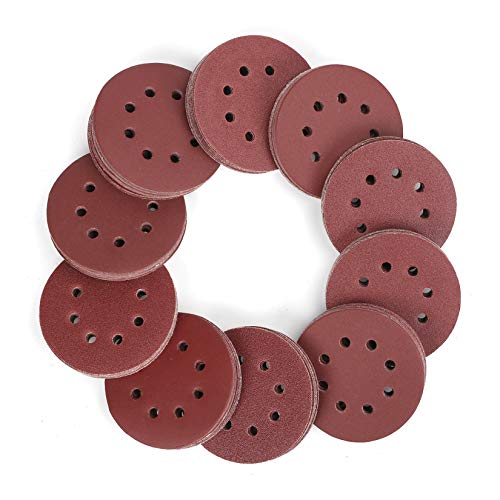
150 discs across 10 grit grades (60 through 600) make the WORKPRO set the top pick for anyone who uses a random orbital sander and wants one box that covers every job from stripping to polishing. The aluminum oxide grain (synthetic abrasive particles) starts sharp and stays aggressive because the grit fractures naturally as you sand, exposing fresh cutting edges. Buyers report the dust extraction through 8 holes per disc keeps the paper from loading up (clogging with dust), though some owners mention the discs “wear out quickly on heavy jobs, requires frequent disc changes” compared to premium brands.
At 1.11 kilograms (about 2.4 pounds), this set is noticeably heavier than the DCT pack (which weighs just 0.5 kilograms) — that extra heft comes from 150 discs versus 5 rolls, so you get a 3x larger quantity. The hook-and-loop backing (a fabric loop surface that grips the sander’s hook pad) grabs your sander’s pad securely and makes swaps fast without adhesive residue. For the price, you get 15 discs per grit, which means you can burn through a few coarse 60-grit discs on rough lumber without feeling wasteful.
This is the set for anyone who sands often enough to want every grit within arm’s reach but does not need industrial-grade longevity on every disc. If you sand only once a season, a smaller pack like the Fandeli sheets might suit you better, but for consistent projects, the WORKPRO set delivers the most versatility per dollar in this lineup. Shop this one over the single-grit bundles if you value having every step from 60 to 600 ready to go.
Why it’s great
- 10 grit grades cover everything from 60 (stripping) to 600 (polishing) in one package.
- 8 dust-extraction holes keep discs cutting longer without clogging.
- Strong hook-and-loop backing makes disc changes instant.
Good to know
- Discs wear faster than premium brands on extended heavy sanding.
- At 1.11 kg, this is a substantial box — not a travel pack.
2. Fandeli Multi-Purpose Sanding Paper

The Fandeli sheets are the most straightforward choice if you just need good paper for hand sanding or cutting down to fit an orbital sander — 25 sheets in three practical grits (80, 120, 220) at a per-sheet cost that beats most hardware stores. While the WORKPRO set dominates for disc-sander users, this pack goes the other direction: full 9×11-inch sheets that you can cut into quarters for hand blocks or tear into strips for tight spots. Buyers consistently call it “good quality sandpaper for general woodworking and other home projects.”
The paper backing is sturdy enough for power sanders but flexible enough to wrap around a sanding block or curved surface. With 5 sheets of 80 grit, 10 of 120, and 10 of 220, the mix leans toward medium-to-fine work — ideal for smoothing prepared wood rather than blasting through heavy paint layers. At just 0.1 inches thick per sheet, they store flat in a drawer without taking up much room.
This is the pack to grab when you want a reliable, no-surprises sandpaper for everyday woodworking and you do not need specialty backings or disc shapes. If you need a wider grit range or a cloth backing for lathe work, look at the DCT rolls instead — but for flat-surface sanding at a fair price, Fandeli delivers exactly what it promises.
Where it shines
- Large 9×11 sheets can be cut to fit any sander or hand block.
- Open-coat aluminum oxide resists clogging on pine and other resinous woods.
- FSC-certified paper source for environmentally conscious buyers.
Worth noting
- Only three grits — no coarse 60 or fine 400+ included.
- Paper backing can tear if used aggressively on edges.
3. POWERTEC 4 x 24 Inch Sanding Belts

When you need to flatten a glued-up butcher block or strip old paint off a deck fast, the POWERTEC 4 x 24 Inch Sanding Belts in 80 grit deliver aggressive material removal without the belt shredding mid-job. The X-weight cloth backing resists tearing even when you bear down on edges, and the resin-on-resin bond keeps the belt from separating under heat — one reviewer who used these on a Bauer 10-amp belt sander noted “40 grit gums up on sap-filled pine, but cleans with brass brush” and praised the “thick tracking material, no separation.”
Each belt measures 4×24 inches and fits popular machines like the Makita 9403/9404, Ridgid EB4424, and WEN 6524. At 1.5 pounds for the 10-pack, each belt weighs about 0.15 pounds, which reflects the substantial cloth backing that stands up to friction without delaminating. A few customers note that the tape joint can fail under prolonged heat, with one buyer reporting the “tape joint pulls apart with heat” and planning to reheat and press it — a risk with any glued belt on heavy use.
Choose these if you have a belt sander and want a cost-effective supply of reliable 80-grit belts for regular work — but plan for possible joint failure on long, hot sanding sessions, and remember that the X-weight cloth backing is the same durable fabric used in industrial-grade belts.
What stands out
- X-weight cloth backing resists tearing under heavy pressure.
- Resin-on-resin bond handles heat better than glue-only belts.
- Cost per belt beats most local hardware and big-box stores.
The trade-offs
- Glue joint can fail on extended heavy use with high heat.
- Only 80 grit — no grit variety in this pack.
4. DCT Abrasive Paper Variety Pack with Dispenser
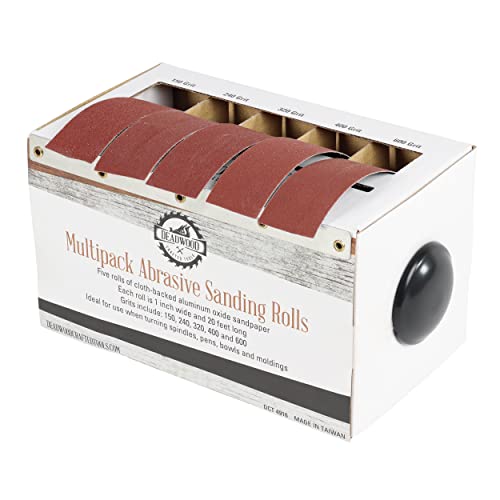
The single number that matters most in this category is grit range, and this pack scores a 150-to-600 spread across five 20-foot rolls — a continuous strip length that standard sheets cannot match. If you ever sand on a lathe, in tight corners, or around curved profiles, the DCT rolls solve a problem that standard sheets cannot — they come as 1-inch wide strips on 20-foot rolls (five rolls total) in 150, 240, 320, 400, and 600 grit, all packed in a dispenser box with a built-in cutting blade. That is a 2x larger unit count than the Fandeli pack (5 rolls vs 25 sheets at 50 count), but each roll gives you continuous strip length instead of pre-cut pieces. One user sums it up simply: “I use it the most for lathe work in tight places.”
The cloth backing is the critical detail here — unlike paper-backed sheets that tear when you pull them around a spindle (a rotating cylinder on a lathe), these strips flex and hold up to repeated wrapping and pulling. At just 0.5 kilograms (about 1.1 pounds), the entire box is lighter than the WORKPRO disc set (which weighs 1.11 kilograms) by about half, making it easy to move from bench to lathe. The dispenser keeps grit labels visible and protects the rolls from dust when you close the lid.
One shortcoming noted by reviewers: the dispenser lacks a retaining knob for both ends of the roller, so the rolls can slide out of alignment. The grit range also starts at 150 (medium-fine) and goes up to 600 — there is no coarse grit for aggressive stripping, so you need a separate coarse paper for initial shaping. If your work involves fine finishing on already-shaped wood, glass sculptures, or metal jewelry, this is the most convenient setup in the list, offering strong price-to-value for specialized fine-finishing tasks. skip it if you need to strip paint or do any heavy stock removal.
The upsides
- Cloth-backed strips flex without tearing around curves and spindles.
- Dispenser box with cutting blade keeps strips tidy and ready.
- Five grits in one box cover fine sanding through final polish.
Keep in mind
- No coarse grit below 150 — not for heavy stock removal.
- Dispenser roller can shift without retaining knobs on both ends.
5. 1/4 Sandpaper Sheet – P60 Grit 50-Pack

What you actually get at this lower price is a 50-pack of aggressive P60 grit aluminum oxide sheets (4.5×5.5 inches each) — double the sheet count of the Fandeli pack (50 vs 25) at a comparable budget-friendly price point. The red-colored grain is bonded to a paper backing designed to fit 1/4-sheet palm sanders from Ryobi, DeWalt, SKIL, and Black & Decker. One reviewer who restored old furniture confirmed the “60 grit removed leftover paint and leveled rough spots.”
The catch you accept at this tier is paper flexibility and tear resistance. Several reviewers point out the sheets “tore easier than expected, requiring frequent changes due to paper quality,” and one reviewer gave it a 1-star rating saying the paper “rips easily” and produces “scratchy results.” These are real warnings — if you need a paper that bends around contours without cracking, the DCT cloth-backed strips are a better choice, but for flat, aggressive stripping on a palm sander, the volume here is hard to beat.
At 5 x 2 x 0.01 inches per sheet, each one is thin and slightly smaller than a standard quarter-sheet, so check that your sander’s pad accepts this exact 4.5×5.5 size. The holes do not line up for every sander’s dust collection, though some shoppers say they align fine. This is the pack to grab if you have a palm sander and a big stripping project ahead — just expect to change sheets more often than with premium paper, and this is the exact budget buyer it is perfect for: someone who needs maximum coarse-grit sheet count for a single flat-stripping job and is willing to accept shorter sheet life and limited flexibility.
Why we’d pick it
- 50 sheets of P60 grit give you aggressive stripping power in bulk.
- Fits standard 1/4-sheet palm sanders from major brands.
- Aluminum oxide grain cuts aggressively through paint and stain.
A few caveats
- Paper backing tears more easily than cloth-backed options.
- Dust holes may not align with every sander’s vacuum ports.
6. Gold PSA Sandpaper 6 Inch 100 PCS 220 Grit
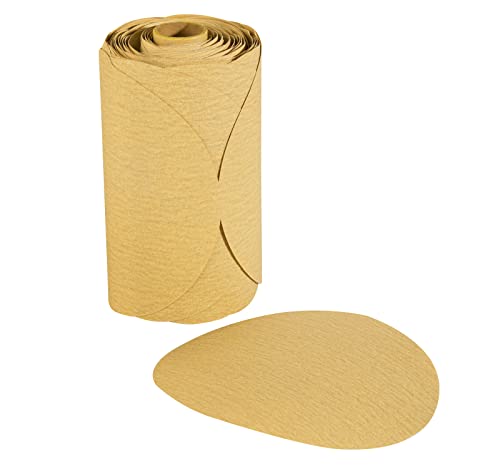
This bulk pack is perfect for the woodworker or auto painter who goes through 220-grit discs quickly and wants a consistent, flat finish between orbital sanding passes on furniture or car paint. The 100 adhesive-backed 6-inch discs stick firmly and release cleanly when peeled off, and because they use PSA (pressure-sensitive adhesive) rather than hook-and-loop, there is no loop fabric to wear out and they lay completely flat on the pad without the slight thickness of a hook-and-loop interface. One buyer who used them alongside the 3M product reported they “stick as well or better” and called them a money-saver.
The premium gold aluminum oxide grain is described by the maker as evenly distributed and sharp, with an anti-clogging coating that the brand says prevents the paper from loading up with dust. At 6 x 6 x 0.04 inches per disc, they are slightly larger than the standard 5-inch orbital discs, so verify your sander accepts 6-inch pads before buying. The single-grit limitation (220 only) means you need a separate source for coarse and finer papers, but if you burn through fine-grit discs regularly, buying in this volume is cost-effective.
The one gentle caution is that PSA discs work best on flat, rigid pads — they do not conform to contoured surfaces as well as hook-and-loop or cloth-backed sandpaper, and at roughly 4x the weight of the DCT cloth pack when considering the total disc count, the box is substantial. This is the right pick if you already have a 6-inch sander and want a bulk supply of high-quality 220-grit discs that stick without slipping — it is a specialised buy for fine-finishing tasks, not an all-purpose starter pack.
Strong points
- PSA adhesive sticks aggressively and removes without residue.
- Anti-clogging coating extends disc life on dusty jobs.
- 100 discs of consistent 220 grit provide a large fine-finishing supply.
Before you buy
- Only 220 grit — no variety for coarse or extra-fine work.
- Requires a 6-inch sander pad, not compatible with standard 5-inch orbital sanders.
Understanding the Specs
Grit Number
The number stamped on the back tells you the size of the abrasive particles. A lower number (like 60 or 80) means bigger, coarser particles that cut aggressively — think stripping paint or leveling rough lumber. A higher number (like 220 or 400) means finer particles that polish the surface smooth. For woodworking, you typically start coarse (60–80) and work up through medium (120–150) to fine (220–320) before finishing. A pack that jumps directly from 80 to 220 skips the critical 120-step that removes coarse scratches.
Backing Material
This is what the grit sticks to, and it determines how the paper behaves. Paper backing (found on the Fandeli and BAOSTC sheets) is affordable and works for hand sanding and orbital sanders, but it tears easily on edges and curves. Cloth backing (used in the DCT rolls) is flexible and resists tearing — ideal for lathe work, spindles, and any curved surface. PSA (pressure-sensitive adhesive) backing (used in the Gold discs) has a sticky underside that presses onto a sander’s pad — no clips required, but it needs a flat, clean surface to grip well.
Open Coat vs. Closed Coat
Open coat means the abrasive particles cover only about 50% to 70% of the paper surface. The gaps between grains let sawdust escape, which keeps the paper from clogging on soft or gummy woods like pine or cedar. Closed coat means the grit covers the entire surface for a faster cut, but it clogs faster. Most aluminum oxide sandpaper for wood is open-coat because it handles dust better — especially important when sanding resinous woods or painted surfaces.
Disc Diameter and Hole Pattern
For random orbital sanders, the disc diameter must match the sander’s pad — 5-inch discs (like the WORKPRO set) are the standard, while 6-inch discs (like the Gold PSA) require a larger pad. The hole pattern matters for dust extraction: 8-hole discs align with most sander’s dust ports, but some sanders use 5 or 6 holes. If your sander’s dust collection does not line up, the disc will load up with dust faster and cut slower.
FAQ
Can I use aluminum oxide sandpaper on a random orbital sander?
What is the difference between aluminum oxide and garnet sandpaper for wood?
How do I know which grit to start with on raw wood?
Why does my sandpaper clog up so fast on pine?
Can I use the same sandpaper for metal that I use for wood?
Final Thoughts: The Verdict
When it comes down to it, the aluminum oxide sandpaper for wood winner is the WORKPRO 150-piece Sanding Discs Set because it covers 10 grits from coarse stripping to fine polishing in one affordable box, saving you multiple store trips. If you need cloth-backed strips for lathe work or detail sanding, grab the DCT Abrasive Paper Variety Pack. And for pure value on sheet paper that you cut to size for hand or orbital sanding, the standout is the Fandeli Multi-Purpose Pack.