
Our readers keep the lights on and my morning glass full of iced black tea. As an Amazon Associate, I earn from qualifying purchases.
Specs are compiled from manufacturer listings and verified buyer reviews and can change over time — please confirm the key details on the product page before buying.
Aluminum is the surface that makes paint slide off. Its oxide skin forms in seconds, and ordinary primer just sits on top of it until the first hard season peels it away. What fixes that is an etch primer, a coating that chemically bites into bare metal so your topcoat has something to hold. Below are nine primers actually formulated for aluminum and bare metal, sorted by what each one does best.
I’m Min — the founder and writer behind Gadgets Feed. This guide is built by comparing the manufacturers’ published specifications and the patterns across verified customer reviews, so you get each pick’s real strengths and trade-offs instead of marketing spin.
Some are brush-on quarts for boats and railings, others are aerosols built for spot repairs on a truck frame. Expect different dry times, cure windows, and coverage per can, because those numbers decide whether a primer suits a weekend project or a full restoration.
This breakdown of the best aluminum paint primer covers adhesion, dry and cure times, and real coverage so your topcoat finally stays put.
Our Picks at a Glance


How To Choose The Best Aluminum Paint Primer
Aluminum does not behave like steel. It grows a thin oxide layer the moment you sand it, and that layer is what makes paint fail. An etch primer (sometimes called a self-etch primer) uses an acid to bite into bare metal and leave a rough, grippy surface for your topcoat to lock onto. Pick the wrong primer and you will be sanding the whole panel back down within a season.
Match the primer to the metal you actually have
Not every primer in this list handles the same surfaces. Some are built specifically for aluminum and galvanized metal, where paint normally struggles to stick. Others also handle stainless steel, chrome, fiberglass, and rigid plastics. Read the label’s surface list before you buy, because a primer made for steel alone may not grip aluminum at all.
Dry time versus cure time — the two clocks that matter
Dry-to-touch is when the film stops feeling wet, and it can happen in under an hour on some sprays. Full cure is when the primer has hardened enough to hold a topcoat properly, and that can run a full day. Confusing the two is the most common reason a first paint job lifts. If your project is a weekend job, a spray with a short dry time helps you keep moving.
Format: brush-on quart or aerosol can
A quart of brush-on primer suits large, flat surfaces like a boat hull or a porch railing, and you control the thickness with each pass. An aerosol can is better for spot repairs, rims, stair edges, and anything with curves or grille slats. Many restorers keep both — a brush-on for the big panels and a spray for the tricky corners.
Quick Comparison
| Model | Best For | Form | Dry Time | Full Cure | Amazon |
|---|---|---|---|---|---|
| Rust-Oleum 8781502 Stops Rust Flat Aluminum Primer, Quart★ Best Overall | Boats and railings | Brush-on quart | 2 hours | 2 hours | Amazon |
| Hycote Etch Primer Spray PaintPremium Pick | Automotive panels | Aerosol | 3 hours | 24 hours | Amazon |
| JENOLITE Universal Etch Primer, GreyFastest to Topcoat | Fast topcoat turnaround | Aerosol | 0.5 hours | 24 hours | Amazon |
| Dupli-Color Multi-Purpose Self-Etching Primer, Green | Spot repairs | Aerosol | 1 hour | 1 hour | Amazon |
| Custom Shop Self Etching Primer Spray, Gray | Truck steps and trailers | Aerosol | — | — | Amazon |
| Raptor Acid Etch Primer 1K Aerosol | Bed-liner prep | Aerosol | 1 hour | — | Amazon |
| SprayMax 2K Epoxy Primer Black | Sandable build-up | Aerosol | 12 hours | 12 hours | Amazon |
| Eastwood Self Etching Primer Spray Paint, Gray | Chrome and stainless | Aerosol | — | — | Amazon |
| POR-15 Self Etch Primer Spray, Gray | Rust-belt frames | Aerosol | — | 30 minutes | Amazon |
In‑Depth Reviews
1. Rust-Oleum 8781502 Stops Rust Flat Aluminum Primer, Quart
Our pick — over 4.5★ from 350+ verified ratings; the strongest balance of quality and price.
The quart of brush-on primer that turns a bare aluminum hull into a paintable surface.
If you are working on a boat, a railing, or any large aluminum panel, this is the one that earns its place first. It is a water-based acrylic formula made specifically for aluminum and galvanized metal, so you brush or roll it on instead of shaking a can. The build is where it wins: coverage runs 90 sq ft and one quart has been known to cover a 14′ boat. Dry to touch takes 2 hours, and full cure lands at 2 hours as well, so you are not waiting overnight before the color coat goes on.
What wins people over is the grip. One owner repainting a rusty fridge applied two coats an hour apart and found the primer resisted a fingernail scratch the next day. Others used it on an aluminum porch frame, sanding to shiny bare metal first and wiping with denatured alcohol. The flat gray finish takes a wide range of topcoats, and porch frames have come through a month of rain looking like new. It is also a zinc-free alternative to chromate-style aluminum primers, which is a real draw for anyone concerned about what they are brushing on.
The catch here is surface prep, not the product. Skip the sanding or leave oxidation behind and the film buckles and peels, so this is not a shortcut primer. A boat owner who applied one coat of primer and two coats of latex house paint reported it still sticking in salt water two years later. skip it if you want to spot-prime a door edge in ten minutes with a spray can; that is what the aerosols below are for.
Where it delivers
- 90 sq ft of coverage from one quart, enough for a 14′ boat
- 2-hour dry and cure window keeps a weekend repaint moving
- Water-based acrylic and zinc-chromate free
- Flat gray base takes a wide range of topcoats
Where it asks more of you
- Requires sanding to bare metal and a solvent wipe before priming
- Leftover oxidation under the film causes buckling and peeling
- Brush-on only — no spray convenience for tight corners
Buy it for: a boat hull, porch frame, or anything large and flat where you want one quart to cover serious ground.
Pass on it for: quick touch-ups in tight corners, where you would rather grab an aerosol and be done in minutes.
2. Hycote Etch Primer Spray Paint, Self Etching Automotive Primer for Bare Metal Surfaces, 13.5 Oz
An automotive-grade etch spray built for aluminum, zinc, and galvanized steel in one pass.
Hycote’s spray uses a specialty resin to grab onto non-ferrous metals — the family that includes aluminum, zinc-coated panels, and galvanized steel. That is a narrower target than a general-purpose primer, and it is the reason the adhesion here is the headline. The matte finish is waterproof, rated for both indoor and outdoor use, and it resists weathering, chipping, and peeling, which matters if the panel lives outside. It works on rigid plastics and fully cured paint too, though not on copper or brass, so check your surface first.
Where this one gives ground to the JENOLITE above is speed: dry to touch takes 3 hours here versus 0.5 hours there, so if you want to recoat the same afternoon, the JENOLITE wins that round. Full cure is 24 hours, matching the JENOLITE, so the topcoat waits the same either way. The spray pattern itself is the reason automotive painters like it — a broad, consistent fan that lays down even coats without runs or drips when the can is properly shaken.
The honest catch is the nozzle. Some cans spit instead of spraying smoothly even after a long shake, and when that happens you are in for a lot of sanding to level the surface out. It is not a can-wide problem, but it is the one thing worth testing on a scrap panel before you commit to a visible area.
The adhesion story: non-ferrous metals like aluminum and galvanized steel are exactly where standard primers fail, and this resin-based formula is aimed straight at them.
The realistic caveat: nozzle performance varies can to can, so spray a test patch first — a spitting can means extra sanding before your color coat.
Reach for this if: you are priming aluminum or galvanized automotive panels and want a wide, even spray pattern.
Look elsewhere if: your surface is copper or brass, which this primer is not made for.
3. JENOLITE Universal Etch Primer, Grey, 13.5 fl oz
Half an hour to a touch-dry film — the fastest recoat window in this lineup.
When you want to prime and topcoat the same day, this is the can to grab. Dry to touch takes 0.5 hours, which is six times quicker than the Hycote’s 3 hours, so you can lay the color coat while the motivation is still there. Full cure still runs a full 24 hours, so the panel is not done curing until the next day, but you get the topcoat on far sooner. Coverage is listed at 2 square meters per can, and it handles aluminum, galvanized steel, and stainless steel, plus rigid plastics and fully cured paint.
Adhesion is what buyers bring up most, and it holds up in the details. One painter used it as a base for galvanized conduit, adhering well to the galvanized finish before topcoating with a matching color. Scaled-up users report smooth application on a plastic rain barrel with no sputtering, a quick recoat window, and minimal smell when used outdoors. The gray satin finish is neutral enough to blend under most topcoats.
The one thing to plan for is drying between coats if you over-apply. It is an outdoor-rated aerosol, not a high-build primer, so two thin passes beat one heavy one. pass on it if you need to prime an entire vehicle body in a single sitting; the coverage per can will not stretch that far.
Why painters like it
- 0.5-hour dry time lets you topcoat the same day
- Handles aluminum, galvanized, and stainless steel
- Works on rigid plastics and fully cured paint too
- Neutral gray satin finish blends under most topcoats
Worth knowing
- 24-hour full cure means the panel is not done until the next day
- Coverage of 2 square meters per can suits small-to-mid projects
- Thin coats are essential — heavy passes slow everything down
Best match: same-day jobs where you want primer down and paint on before dinner.
Think twice if: you are priming a whole car body — you will burn through cans fast.
4. Dupli-Color Multi-Purpose Self-Etching Primer, Green, 12 oz
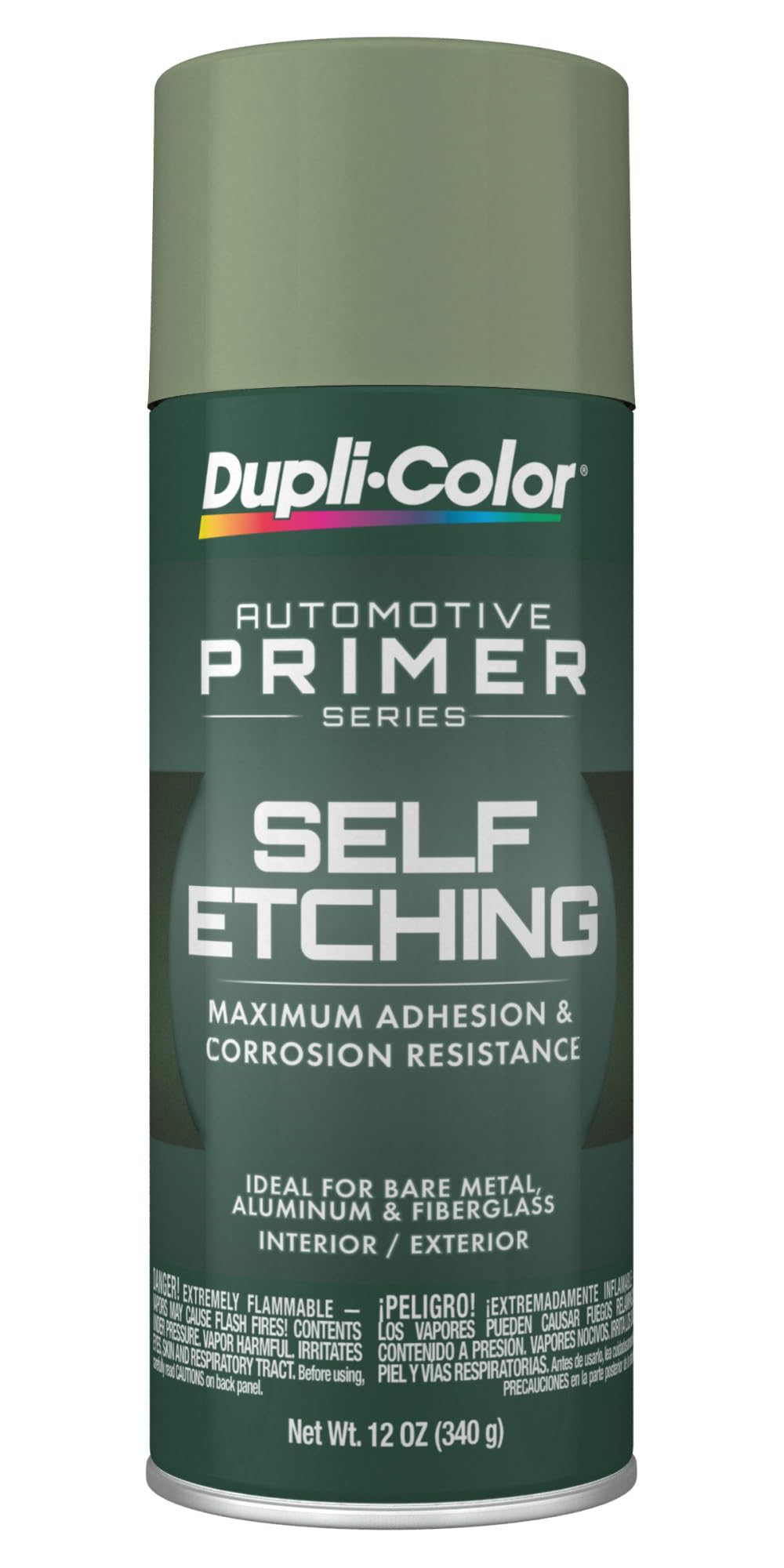
The one-hour cure that makes spot repairs genuinely same-day work.
Small and specific is the whole point here. Full cure lands at 1 hour, which puts this in a different league from the JENOLITE’s 24-hour cure — that is a 24x gap on the final-set clock, and it is what lets you prime a scuffed panel in the morning and have color on it before the garage gets cold. Dry to touch takes 1 hour as well. Coverage runs 15 to 20 square feet per can, which is plenty for a patch, a rim, or a couple of edges, and the primer is rated for bare metal, aluminum, and fiberglass.
Performance is the thing owners return to. It works well for topcoat adhesion and gives good coverage over a mildly rusted surface after nothing more than carding — the light scuff that knocks rust off without grinding it down. The nozzle runs a flat, broad spray that lets you change your angle for even thickness, and a single can stretches further than most people expect. Painters report it sprays evenly, dries quickly, and takes a color coat with no issues.
Two things to know. It needs an organic vapor respirator and good ventilation, because it is a serious solvent-based spray. And a minority of cans stop spraying partway through while still holding material, so buy a spare if the job matters — it is a can-quality hiccup, not a formula problem.
The case for it: the fastest full cure in this lineup at 1 hour, which is what makes true same-day spot repairs possible.
The fine print: use it outdoors with an organic vapor respirator, and keep a spare can nearby in case one clogs early.
Best for: touching up a rim, a fender patch, or a bit of chassis where a quick cure matters more than volume.
Skip if: you need to cover a large panel — the per-can coverage will not stretch to a whole hood.
5. Custom Shop Self Etching Primer Spray, 12.9oz Gray
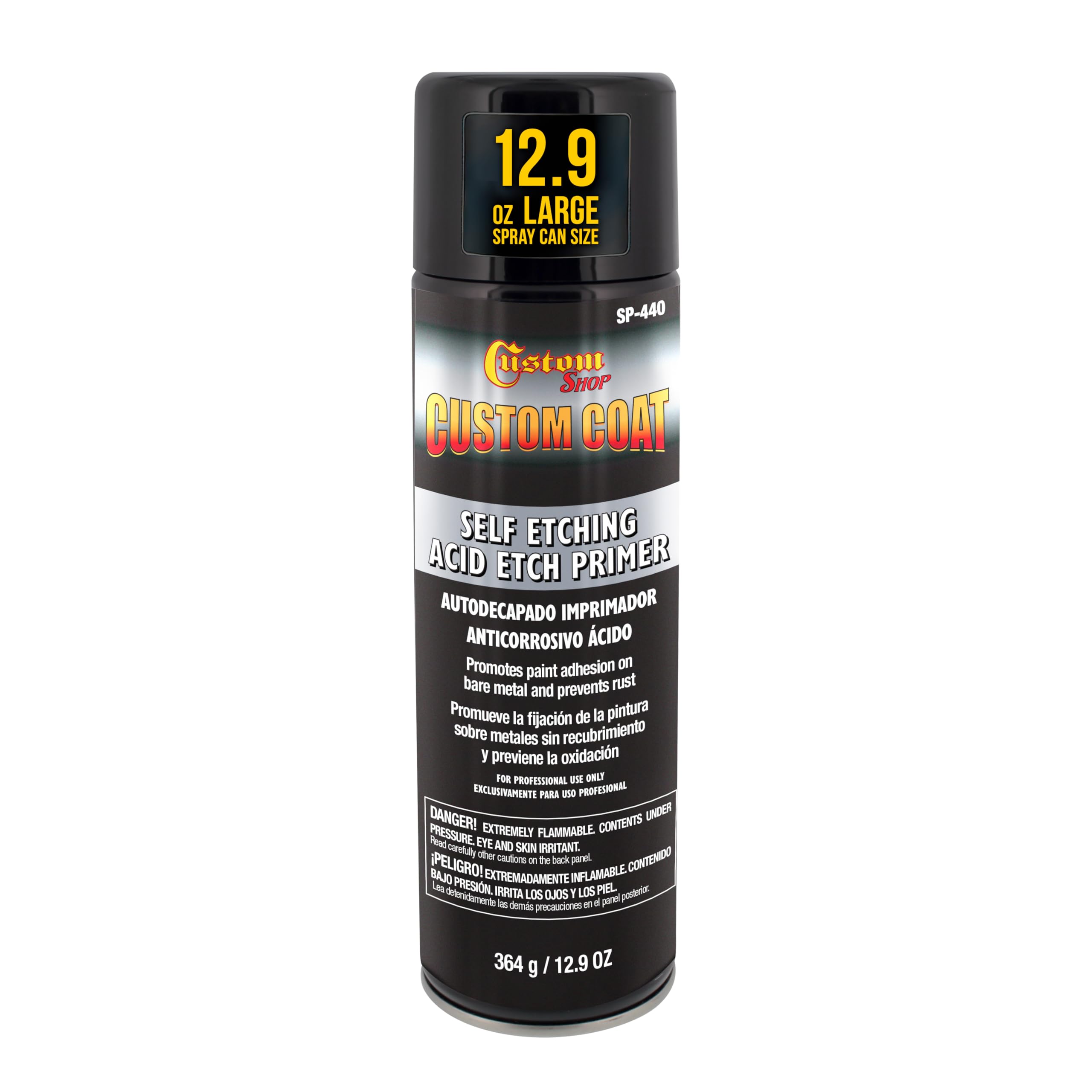
A phosphoric-acid etch spray that bonds to aluminum and steel without a sanding step.
Custom Shop is the primer for people who want one can to handle several metals. It uses a phosphoric acid etch (phosphoric acid is the ingredient that roughs up bare metal so paint can grip) and it works across steel, stainless, and aluminum. The no-sand claim is the standout — this primer is designed to be topcoated directly, with no scuffing step in between. If you have ever tried to sand inside a tight wheel arch, you will understand why that matters.
Owners use it broadly. One owner sprayed it on truck steps and had enough left over to mostly cover a utility trailer. Another reports using it on both steel and aluminum, prepping with sandpaper and acetone, then getting good adhesion and single-coat coverage before a base coat of whatever spray paint was on hand. The flat gray matte finish takes automotive paints well, and the wide fan pattern keeps the coat even from edge to edge.
The catch is technique. Spray too thick on your first pass and you can see the result — one owner’s first step came out heavy but still usable, and the fix is a practice panel before you commit to something visible. It is also rated for outdoor use, and it plays nicely as a base for truck bed liner products like Raptor, so it is worth considering if you are prepping for liner.
The value angle
- Phosphoric acid etch bonds to steel, stainless, and aluminum
- No-sand topcoat saves a whole finishing step
- One can covered a truck step job with enough left for a trailer
- Works as a base under bed-liner products like Raptor
What to watch
- Heavy first coats are easy to spray — practice on scrap first
- Outdoor-rated, so plan ventilation when spraying indoors
- Still needs a proper prep wipe (acetone or similar) before spraying
Pick this if: you are priming a mix of metals and want the sanding step out of your workflow.
Second-guess it if: you tend to spray heavy first coats — this one rewards a light hand on the trigger.
6. Raptor Acid Etch Primer 1K Aerosol, 13.2 OZ

U-POL’s acid etch spray, the prep coat that truck-bed-liner crews reach for first.
Raptor sits at the higher end of this lineup, and the reason is what it bonds to: galvanized steel and aluminum, both tricky surfaces, plus bare metal panels and rub-throughs. It uses a phosphoric acid ester formula (a variant of the same acid family that etches metal for grip) to etch and prime in a single step, and it needs no sanding before you topcoat with most paint systems. Dry to touch runs 1 hour, and the finish is a flat matte gray.
Owners use it as the base layer under Raptor’s own bed-liner, and the reports reflect that relationship — the liner stays adhered, which is itself the strongest sign the primer is doing its job. It lays down in two light coats, dries fast enough to reinstall parts the next day, and the gray matches well against a factory finish. A painter who did not strip the factory paint off some running boards reports no bubbling — the primer went over the existing finish without lifting it.
There is a caveat worth stating: this primer is designed as an underlayer, so do not expect it to hide dents or sand out like a build primer. It is there to make paint stick, not to fill. If you want something that builds and sands flat, look at the SprayMax 2K below instead.
Why it earns its keep: phosphoric acid ester etches galvanized steel and aluminum in one pass, no sanding needed before the topcoat.
Where it stops short: it is an adhesion primer, not a build primer — it will not fill scratches or level out a dented panel.
Matches well with: truck bed liners, running boards, and aluminum panels where the coating above needs a serious grip.
Not the right tool if: you need to fill and sand imperfections — reach for a high-build primer instead.
7. SprayMax 2K Epoxy Primer Black, 341 ml

A two-part epoxy spray that seals, builds, and sands flat — the pro-level prep coat.
This is the different animal in the lineup. It is 2K epoxy (two-part, meaning an internal hardener kicks off a chemical cure instead of just drying), and that is what gives it the sanding and sealing properties the etch sprays do not have. Dust-dry hits in 15 minutes, and the film is ready to sand within hours. Dry time and full cure are both listed at 12 hours, so this is a slower clock than the aerosol etch primers, and it is the trade-off for the build. It works on steel, aluminum, and galvanized metal, with a gloss black finish and a variable nozzle for precise control.
Adhesion to bare and cleaned metal is the strength. Painters report it sprays consistently, lays down a clean black finish, and takes a sand with 600 grit without rubbing through — One can covered both halves of a motorcycle fairing with a little left over. It works over truck bed coatings too, and Two-coat jobs on a Jeep hood and two fenders took 2 cans. The adjustable tip and the sandability are the two things that separate it from the etch sprays in this list.
The fair warning: quality opinions split sharply here. The spray head can come loose, and one owner reports a design flaw with the orange cap producing weak or three-directional spray that sputters after a few seconds. It is a tool that rewards a steady hand and a well-shaken can, and it is not the right pick if you want pure simplicity.
What 2K buys you
- 2K epoxy formula builds and seals, not just etches
- Dust-dry in 15 minutes, sandable within hours, 600-grit friendly
- Variable nozzle for controlled spray across curves and flats
- Works on steel, aluminum, and galvanized metal
The honest caveats
- 12-hour dry and cure is the slowest clock in this lineup
- Nozzle and cap issues have caused sputtering for some users
- Higher outlay per can than the etch sprays
Choose it for: a restoration where you need to seal, build, and sand flat before the color coat.
Leave it for another day if: you want a fire-and-forget etch spray — this one asks for careful technique.
8. Eastwood Self Etching Primer Spray Paint, Gray, 16 oz

The one in this lineup that grips chrome and stainless, not just aluminum and steel.
Chrome is the surface most primers cannot touch, and that is where Eastwood earns its place. This spray is built to adhere to steel, stainless, aluminum, and chrome, and it is a lacquer-based single-stage formula that needs no catalyst — you shake it and spray, no mixing. It also withstands up to 170 degrees F, which covers sun-baked panels and most engine-bay surfaces. Coverage is about 10 sq ft per can, so this is a spot-and-trim primer rather than a whole-body solution.
Application is what gets called out. It goes on thick and forgiving, builds up well in two coats, and levels out to a smooth finish. The technique detail that matters: warm the can in hot water for about 8 minutes before spraying, because a cold can causes bubbling. If you are spraying a full can, clean the nozzle with WD-40 midway through. One owner repainting a 1966 Corvette chrome grille prepped with light sanding and got strong adhesion under the color coat.
There is one thing to steer around: the tip can spatter a little, so keep a light touch and short passes. That said, users who warm the can and clean the nozzle report a much cleaner result, and An aluminum flashing test panel held up through both summer and winter without showing wear.
The odd-one-out advantage: chrome and stainless are surfaces most etch primers will not touch, and this lacquer-based formula handles both.
Practical note: warm the can in hot water for about 8 minutes before spraying — a cold can is what causes bubbling.
Buy it when: your project includes chrome, stainless, or trim pieces that other primers slide off.
Don’t reach for it if: you need to cover a large flat panel — about 10 sq ft per can goes quickly.
9. POR-15 Self Etch Primer Spray, Gray, 15 Fluid Ounces

The rust-belt favorite — a fast-curing etch spray that locks down frames and farm equipment.
POR-15 has a reputation among restoration people, and this primer is built to live up to it. Full cure lands at 30 minutes, the quickest in this entire lineup, so you can topcoat the same session. It is a high-adhesion etch spray formulated for steel, aluminum, stainless steel, brass, and primed or painted surfaces, with a gray satin finish and a coverage range of 15 to 22.5 sq ft per coat. It is also waterproof, which matters if the part lives outside.
Application is smooth and even, and buyers report it sprays as evenly as an expensive spray gun — a difference they notice compared with cheaper etch primers that come out in chunks and force a full sanding job. On rust prevention, the track record is strong: Users have sprayed it on very rusty farm machinery and reported the rust never comes back, and one owner used the full POR-15 system on a 2006 Tundra frame in salt-heavy winters.
The trade-off is honest: this is the most expensive primer in this comparison, and a couple of users note a can that stopped spraying with material still inside. It is a premium product with a premium price, and if you are already committed to POR-15’s rust-prevention coating underneath, this primer pairs directly with it.
What makes POR-15 stand apart
- 30-minute full cure — the fastest in this lineup
- Adheres to steel, aluminum, stainless steel, and brass
- Waterproof gray satin finish rated for outdoor use
- Pairs directly with POR-15 rust-prevention coating
What it costs you
- Highest outlay of any primer here
- Occasional cans stop spraying with product still inside
- Best results when used as part of the full POR-15 system
The pick for: frames, farm equipment, and anything fighting rust where a 30-minute cure and serious grip matter.
Think twice when: you are priming a small spot — the per-ounce value is better on the mid-range sprays above.
Understanding the Specs
Dry time versus full cure
Dry-to-touch is when the film stops feeling tacky, and it can run anywhere from half an hour on the JENOLITE to a full 12 hours on the SprayMax 2K. Full cure is when the primer has hardened enough that a topcoat will bond without lifting. Those are two separate numbers, and the longer one is the one that matters. If you apply color before full cure, the solvent in the topcoat can soften the primer underneath and you are back to bare metal.
Coverage per can
Coverage tells you how much surface a single can handles, and the numbers vary widely — the Rust-Oleum quart covers 90 sq ft, while the Eastwood spray covers about 10 sq ft. For a boat hull or a railing you want the quart; for a rim or a grille you want the spray. Always over-buy by one can if the job is on a visible panel, because respraying a mismatched patch is harder than spraying an extra coat.
Why acid etch matters on aluminum
Aluminum grows an oxide layer in minutes after sanding, and paint cannot grip that layer. A phosphoric-acid etch primer — like the Custom Shop and Raptor sprays — bites through and roughens the surface so the topcoat has something to hold. That is why a primer made for steel alone, without an etch step, often fails on aluminum even if it looks fine at first. Check that the label names aluminum before you buy.
Format: quart, aerosol, or both
Brush-on quarts give you control — one Rust-Oleum quart covers 90 sq ft, and you can build thickness with each pass. Aerosols give you speed and reach into curves and tight gaps. Many restorers keep both on the shelf: a quart for the big flat panels and an aerosol for the trim, hinges, and corners. That is why this lineup includes both formats.
FAQ
Does aluminum actually need an etch primer or will regular primer work?
How long do I have to wait before applying a topcoat over an etch primer?
Can I spray etch primer over painted surfaces?
Do I need to sand the aluminum before priming?
How much area does one can of aluminum primer cover?
Is a 2K epoxy primer better than an etch primer for aluminum?
Can I use an aluminium etch primer on galvanised steel as well?
What protection do I need when spraying etch primer indoors?
Can I apply a second coat of etch primer after the first one dries?
Which aluminum primer works over rusted metal surfaces?
Final Thoughts: The Verdict
For most people priming aluminum, the Rust-Oleum 8781502 Stops Rust Flat Aluminum Primer is the sensible place to start. It is a water-based acrylic built specifically for aluminum and galvanized metal, and 90 sq ft of coverage from one quart is more reach than any aerosol here. If you want speed over volume, the JENOLITE Universal Etch Primer dries to touch in 0.5 hours — the fastest recoat window in the lineup. For a rust-belt frame or farm equipment where you want the primer to fight back, the Raptor Acid Etch Primer and POR-15 Self Etch Primer both hold up under serious corrosion. And if your project includes chrome or stainless trim, the Eastwood Self Etching Primer Spray is the only one here that names chrome on the label. Prep matters more than the brand — sand to bare metal, wipe it clean, and give the primer its full cure before the topcoat. Do that and any primer on this list will hold.
How We Picked
We do not accept paid placement. Every pick is matched to a real buyer and a real use-case; we do not hands-on test units.
Sources & Methodology
Specifications: manufacturer listings and product documentation. Review insights: verified customer reviews, as of September 2026. Pricing: not shown on this page (it changes often); check the current price via the retailer link.
As an Amazon Associate, Gadgets Feed earns from qualifying purchases. This does not affect which products we feature.