
Nothing kills a perfect day on the water faster than pulling up to the dock with pontoons that look more “sea salt” than “sea shine.” The constant sun, water, and UV exposure doesn’t just dull your aluminum — it leaves a chalky, oxidized layer that seems impossible to cut through. Whether you’re prepping for a summer launch or fighting years of neglect, the right compound makes the difference between a back-breaking afternoon and a showroom-worthy finish.
I’m Rikta — the co-founder and writer behind Gadgets Feed. My research into marine-grade metal restoration has involved months of cross-referencing chemical formulations, customer longevity reports, and grit-level performance data on six different compounding and cleaning approaches. (And Homer 🐱 supervised from the deck of my desk chair, unimpressed until the final shine test.)
A good polish doesn’t just mask the damage — it removes the oxidation layer and leaves a protective barrier. Whether you want a spray-and-hose solution or a hand-applied compound for a deep mirror finish, the right aluminum polish for pontoons saves you time, frustration, and preserves the resale value of your boat.
How To Choose The Best Aluminum Polish For Pontoons
Not all aluminum polishes are built for the marine environment. A polish made for car rims or motorcycle pipes often lacks the particle size or chemical strength to cut through heavy chalking on pontoon logs. Before you buy, consider three crucial factors.
Spray Cleaner vs. Cutting Compound
Spray-on cleaners, often acid-based, are excellent for first-stage restoration — they chemically break down oxidation and waterline stains so you can simply rinse them off. However, they leave a matte or slightly chalky finish that lacks depth. Cutting compounds and abrasive polishes use fine grit particles (measured by grit number) to physically abrade the surface, producing a true mirror shine. For heavily neglected pontoons, a combination of both works best: a spray cleaner first, then a machine or hand polish.
Grit Rating and Particle Aggressiveness
The grit number tells you how coarse the abrasive is. Lower numbers (around 36 to 150) are aggressive cutting compounds for removing heavy pitting and deep oxidation. Medium grits (around 800) balance cut and finish. Higher numbers (1000+) are finishing polishes that refine the shine without scratching. For pontoons that have been sitting for years, start with a medium-cut compound and finish with a fine polish — skipping the aggressive stage means hours of extra buffing.
Application Method and Effort
Some formulas are optimized for a high-speed orbital buffer, while others are designed for hand application with a microfibre cloth. Machine-grade compounds contain heavier abrasives that work best with wool pads and don’t break down under heat. If you plan to polish by hand, choose a product with a smooth paste consistency and a higher grit rating — you’ll get shine without needing a machine to remove scratches from the compound itself.
Quick Comparison
On smaller screens, swipe sideways to see the full table.
| Model | Category | Best For | Key Spec | Amazon |
|---|---|---|---|---|
| 3M 09020 Aluminum Restorer | Premium Polish | Heavy oxidation removal | 1000 Grit / 18 oz | Amazon |
| 3M 09019 Metal Restorer | Premium Polish | Multi-metal restoration | 36 Grit / 18 oz | Amazon |
| Shurhold Buff Magic | Mid-Range Compound | Gelcoat & aluminum shine | 800 Grit / 22 oz | Amazon |
| Renegade Pro Red | Mid-Range Polish | Mirror finish on metal | Light Cut / 24 oz | Amazon |
| Toon-Brite B1000 | Spray Cleaner | Quick spray-on cleaning | 64 Fl Oz / Sprayer | Amazon |
| Quality Chemical Combo | Spray Cleaner | Large-area brightening | 128 oz / 2 Sprayers | Amazon |
| Autosol 1824B | Entry-Level Paste | Small aluminum parts | 150 Grit / 75 ml | Amazon |
In‑Depth Reviews
1. 3M Marine Aluminum Restorer & Polish 09020

This is the polish that seasoned pontoon owners reach for when heavy chalking has turned their logs into a white, powdery mess. With a 1000-grit fine abrasive and a paste consistency designed for both hand and machine application, the 09020 cuts through years of UV damage without leaving micro-scratches that require a secondary finishing step. The concentrated formula means a single 18-ounce tube covers an entire tritoon setup with the right technique.
Users report that patience is the key — multiple passes with a wool pad on a variable-speed buffer gradually reveal a mirror finish that holds its shine for the full boating season. The product is designed to remove heavy oxidation and chalking specifically on aluminum, making it more targeted than multi-metal polishes that sacrifice cut depth. One reviewer noted their tritoon kept its luster all summer after a single deep session.
Where it falls short is heavily pitted aluminum that has been corroded by sea air. The 1000-grit particles can improve the look of pitted areas with extra buffing, but they won’t level deep surface irregularities. For boats with active pitting, you need a coarser compound first and this polish as a finisher.
Why it’s great
- Formulated specifically for marine aluminum, not all-purpose metal
- Concentrated paste — small amount delivers big coverage
- Fine 1000-grit finish outshines acid-based brighteners
- Works safely with a machine buffer for large pontoon surfaces
Good to know
- Heavy pitting requires a coarser pre-polish step
- Generates black residue — keep plenty of soft cloths on hand
- Produces a mild odor during use
2. 3M Marine Metal Restorer & Polish 09019
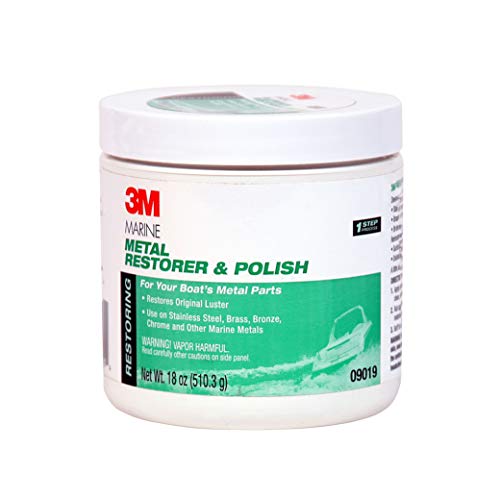
The 09019 is the more aggressive cousin in the 3M marine line, carrying a 36-grit rating that puts it in heavy-cut territory. This makes it the better choice if your pontoons have stubborn rust spots, staining from toilet bowl cleaners (oddly common on boat metal), or surface-level corrosion that a fine polish alone can’t touch. The paste consistency won’t drip or splatter during machine application, which is a real bonus when working on vertical pontoon surfaces.
While it is not advertised as aluminum-specific, its compatibility list covers stainless steel, brass, bronze, copper, chrome, and aluminum — giving you one product for the entire boat’s metal trim plus the pontoons. Users restoring metal mirror frames and stainless sinks have praised its ability to reverse rust and dullness without scratching.
The trade-off is that the aggressive grit works best as a pre-polish step. You will still want a finer compound like the 09020 to bring out the deep gloss after the 09019 does the heavy lifting. If you are polishing relatively new pontoons, skip this one and go straight to a medium or fine polish.
Why it’s great
- Aggressive 36-grit compound cuts through rust and heavy stains
- Works on multiple metals — stainless, brass, bronze, aluminum
- Paste consistency stays put on vertical surfaces
- No strong odor reported during use
Good to know
- Requires a secondary fine polish for a true mirror finish
- Labour-intensive — expect to work in small sections
- Higher price point for the 18-oz container compared to general polishes
3. Shurhold Buff Magic Compound
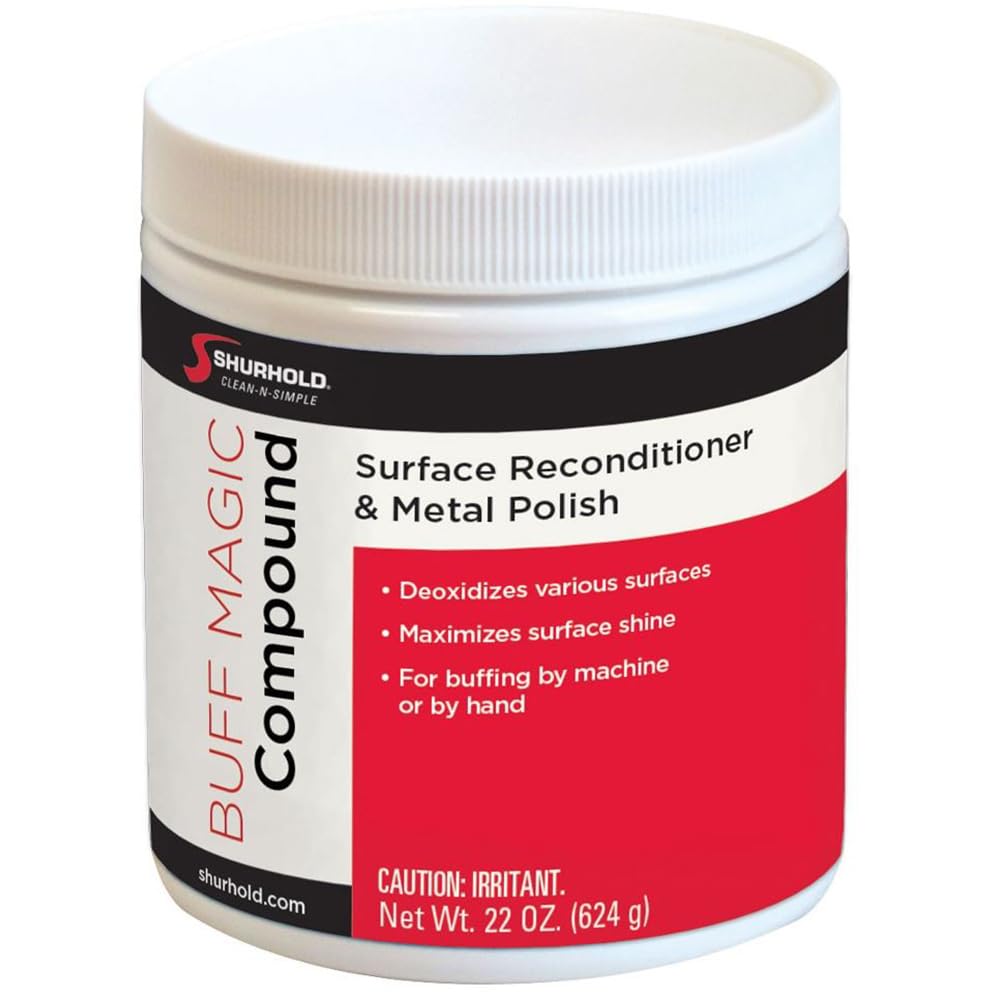
Buff Magic is the crossover champion of this list — it works equally well on heavily oxidized fiberglass gelcoat and pontoon aluminum, making it a one-jar solution for boat owners who maintain both surfaces. The proprietary aluminium oxide abrasive carries an 800-grit rating, placing it squarely in the medium-cut range that balances cutting power with finishing shine. One can was enough to restore the full topside of a 27-foot boat that a professional had quoted thousands of dollars to wet-sand.
The key to unlocking its potential is a professional-grade orbital buffer with a wool pad. Users attempting hand application or random-orbit polishers report dramatically slower progress. Applied correctly, this compound removes oxidation in a single pass, transforming dull surfaces into a deep, glossy finish that can be waxed for the season. The 22-ounce jar offers more volume than most tube-based polishes, and leftover product after a full boat job is common.
Buff Magic is not a standalone protectant — it is strictly a cutting and polishing compound. You must apply a wax or sealant afterward to lock in the shine. Additionally, the formula is designed for heavy oxidation; lightly weathered pontoons may find the cut more aggressive than necessary.
Why it’s great
- 800-grit medium cut works on both gelcoat and metal
- Generous 22-ounce jar — enough for a full boat plus extras
- One-step application removes oxidation without wet sanding
- Works brilliantly with a high-speed buffer and wool pad
Good to know
- Requires wax or sealant after polishing — no built-in protection
- Hand application yields poor results; a buffer is almost mandatory
- Overly aggressive for pontoons with only light haze
4. Renegade Pro Red Liquid Metal Polish

The Pro Red formula from Renegade is a liquid metal polish that targets users who want a deep, reflective mirror finish without the heavy cut of a restoration compound. It uses a light-grit abrasive designed to remove tarnish, light scratches, and oxidation while leaving a protective coating on the aluminum. The liquid consistency spreads easily by hand or with a polishing machine, and the 24-ounce bottle provides enough product for multiple applications on a pontoon set.
Users driving trucks through dirt pits daily have reported that Pro Red brings back the mirror finish on aluminum rims, and horse trailer owners praise its ability to revive heavily weathered panels. The protective coat left behind by the polish is a meaningful differentiator — it extends the interval between polishing sessions, especially for pontoons that sit in direct sun all season. The bottle features a flip-top cap, though some units have shipped with a missing gasket that causes leakage.
Because the grit is light, this polish struggles with heavy chalking or deep oxidation. If your pontoons are grey and powdery, you need an aggressive cleaner or compound before you can expect Pro Red to deliver its full shine. Use this as a maintenance polish after initial restoration.
Why it’s great
- Leaves a protective coating that extends shine between applications
- Generous 24-ounce bottle — good value for the volume
- Easy to apply by hand or machine with minimal effort
- Excellent for maintaining a finish after heavy restoration
Good to know
- Light-cut formula is ineffective on heavy oxidation or chalking
- Flip-top cap may lack a sealing gasket on some units
- Liquid consistency can splatter during high-speed machine buffing
5. Toon-Brite B1000 Aluminum Cleaner

Toon-Brite is the acid-based spray cleaner that takes the elbow grease out of the first stage of pontoon restoration. You spray it on, let it dwell for a few minutes, and hose it off — no scrubbing, no buffing. The biodegradable formula uses a lemon scent and is designed to dissolve marine deposits, scum, stains, and oxidation without damaging the aluminum substrate. A half-gallon of full-strength cleaner dilutes to make up to 2 gallons, making it an economical choice for large pontoons or multiple seasons.
One owner restoring a 1996 pontoon used Toon-Brite with a gas-powered pressure washer and reported that the heavy chalkiness disappeared in a single session. Multiple coats are recommended to avoid wasting product — working from the bottom up with a pump sprayer gives the cleaner enough contact time to break down layers of grime. The product is effective enough that you may not need a sanding or wire wheel step, which saves significant time and risk of scratching.
The sprayer included with the bottle is the weak point. Multiple users report the pump mechanism failing partway through the bottle, requiring a transfer to a separate sprayer or a pump-up garden sprayer for the remainder. This is a known production issue that does not affect the cleaner itself, but it is a frustration to prepare for.
Why it’s great
- Eliminates scrubbing — spray on, wait, and hose off
- Biodegradable formula with a pleasant lemon scent
- One gallon of full strength dilutes into two gallons of cleaner
- Ideal first step before machine polishing for deep restoration
Good to know
- Included sprayer pump frequently fails before the bottle is empty
- Requires multiple coats for heavily oxidized pontoons
- Leaves a matte finish — does not produce a polished shine
6. Quality Chemical Aluminum Cleaner & Brightener Combo

This combo from Quality Chemical is a heavy-duty acid-based cleaner and brightener that comes in a 128-ounce gallon plus two empty sprayers and two refill quarts. For owners of multiple boats, or anyone with a large tritoon, this volume is a massive time-saver. The concentrated formula can be diluted up to 8:1 for lighter cleaning or used full strength for stubborn oxidation. Users in the Pacific Northwest have reported effortless mold and algae removal from aluminum trailers with just a 10-minute dwell time and an electric pressure washer.
The brightener action leaves the aluminum looking clean and fresh, but the finish tends to be slightly chalky — this is the nature of acid-based cleaning versus abrasive polishing. One pontoon owner noted that full-strength application is necessary for maximum brightness, but the fumes are strong enough to take your breath away, so proper ventilation and gloves are non-negotiable. The included plastic sprayers are not rated for the acid, and the chemicals will eat the pump seals within a single use.
If your goal is a shiny, polished surface rather than simply a clean one, this product works best as a pre-treatment. Use it to strip the grime and oxidation, then follow with an abrasive polish like the 3M 09020 or Renegade Pro Red for true luster. The value here is unbeatable for initial restoration volume.
Why it’s great
- Massive 128-ounce gallon plus refill quarts — best value per ounce
- Concentrated formula stretches even further when diluted
- Fast-acting on mold, algae, and heavy stains
- Works with a pressure washer for rapid large-area treatment
Good to know
- Strong acid fumes require a respirator and gloves
- Leaves a matte, slightly chalky finish — not a polish
- Included spray pumps degrade quickly from acid exposure
7. Autosol 1824B Aluminium Polish

Autosol is the classic aluminum polish that has been a staple in restoration shops for decades, and the 1824B formulation is built around a 150-grit medium abrasive. This is a tube polish designed for smaller surfaces — think engine parts, trailer trim, cleats, railing, and the hardware on your pontoon rather than the full logs. The paste consistency means a tiny amount goes a very long way: professional aluminum polishers with over a decade of experience report that it blends machine and hand polishing efficiently, and is extremely economical for targeted work.
Users have praised it for restoring the finish on vintage coffee makers, camping cookware, and motorcycle wheels, but the 150-grit cut is aggressive enough to leave visible swirl marks on softer aluminum finishes. The product requires thorough buffing to achieve a high shine, and multiple reviews note a mild chemical odor that is expected from a medium-cut compound. It also demands more physical effort than modern liquid polishes, which may be a disadvantage for large pontoon sections.
The small 75-milliliter tube limits its use to detail work or touch-ups. If your pontoon logs are already clean and you need to bring the shine back to the trim and railing, Autosol is a perfect finishing tool. For a full set of pontoons, you would need several tubes — making it more expensive per-square-foot than the jar or bottle alternatives on this list.
Why it’s great
- Trusted shop-standard polish with decades of proven results
- Very concentrated — a small amount covers a surprisingly large area
- 150-grit medium cut works on moderate oxidation and tarnish
- Works well by hand or with a machine buffer
Good to know
- Small 75-ml tube is impractical for full-pontoon polishing
- Requires significant buffing to avoid swirl marks
- Mild chemical odor during application
FAQ
Can I use a car wheel polish on pontoon aluminum?
Do I need to sand the pontoons before polishing?
How long does a polished pontoon finish last?
Final Thoughts: The Verdict
For most users, the aluminum polish for pontoons winner is the 3M Marine Aluminum Restorer & Polish 09020 because its 1000-grit marine-specific formula delivers a true mirror finish on heavy oxidation without requiring a secondary polishing step. If you want a spray-and-hose cleaner that eliminates scrubbing for initial restoration, grab the Toon-Brite B1000. And for a single-jar compound that tackles both gelcoat and aluminum with the right buffer, nothing beats the Shurhold Buff Magic.